91
Immune Network
Mite Antigens from an Asthma Patient by Using a Phage Display Library
Wang-lim Jung1*, Hee-kyung Lee1, Tae-soon Yong2 and Sang-hoon Cha1,3
1Division of Food Sci. & Biotechnology, College of Agriculture & Life Sci., Kangwon National University, Chunchon, 2Department of Parasitology, Yonsei University College of Medicine, Seoul, 3IG Therapy Co., Kangwon National University, Nong 3rd Rm. 112, Chuncheon, Korea
ABSTRACT
Background: In order to characterize human antibodies with specificity for mite aller- gens at the molecular level, a scFv phage display library was constructed using peripheral blood mononuclear lymphocytes from an asthma patient allergic to mite as Ig gene sources. Methods: Immunoglobulin VH and V gene fragments were obtained by poly- merase chain reaction, and randomly combined in pCANTAB-5E vector. The resulting human scFv phage display library had 3×10⁴ independent clones, and biopanning was performed with house dust mite extracts. Results: Four scFv clones specific for house dust mite extract were isolated. Immunoblot assay showed that our clones reacted to 25 kDa and 50~60 kDa proteins with unknown identity in mite extracts. Sequence analysis indicated that two clones (b7 and c15) are identical, and all clones belong to human VH3 subgroup. On the other hand, light chain usage was different in that two clones (a2 and b7/c15) belonging to Vκ4 subgroup, but a4 used Vκ1 light chain gene.
Conclusion: Our approach should facilitate provision of useful information on the antibody responses against allergens at the molecular level in humans. (Immune Network 2002;2(2):91-95)
Key Words: Phage display library, scFv, asthma, type-1 hypersensitivity, house dust mite, allergen
Abbreviations: Single chain variable fragment (scFv), polymerase chain reaction (PCR), monoclonal antibody (mAb), immunoglobulin (Ig), horse radish peroxi- dase (HRPO)
Correspondence to: Sang-hoon Cha, Division of Food Sci. &
Biotechnology, College of Agriculture & Life Sciences, Kangwon National University, Chuncheon 200-701, Korea. (Tel) 82-361- 250-6485, (Fax) 82-361-254-3835, (E-mail) chash@kangwon. ac.kr
*Present address: Macrogen Co., Seian Building #116, 8F-9F, Sinmunno 1-ga, Jongno-gu, Seoul 110-061, Korea.
This study was supported by Korea Research Foundation grant (KRF-1999-041-F00100).
Introduction
Mites belonging to the Pyroglyphidae family (Der- matophagoides pteronyssinus, Dermatophagoides farinae, and Euroglyphus maynei) have adapted to live in human houses and feed from human scales, thereby called house dust mites. These mites are clinically important since skin test with mite extract demonstrated that Dermatophagoides species is a major risk factor for asth- ma, a typical type I hypersensitivity (1); thereby, phy- sicochemical properties of these mites have been ex-
tensively studied. Each of these mite species contains several allergens belonging to either enzymatic or nonenzymatic mite allergens, and biochemical simi- larities among species are present which account for the immunological cross-reactivity observed in anti- body responses of patients (2). At present, mite aller- gens have been divided into thirteen groups on the basis of biochemical and immunological properties (3), but other mite allergens that need to be designated, such as Mag 1 and Mag 29 have been identified (4,5).
Among these mite allergens, group 1 and group 2 allergens are recognized by most mite allergic patients (6,7), suggesting that these groups of allergens are the most important components of mite extract that in- duce sensitization of allergic patients. The group 1 al- lergens are 25 kDa cysteine proteases synthesized by cells in the gastrointestinal tract, and found in whole mite and fecal extract of the mite (6). The group 2 allergens are 14 kDa nonglycosylated proteins with
unknown function (8).
Extensive studies have been progressed in order to identify specific amino acid sequences in mite aller- gens that react with either B- or T cells. These studies are important because data from epitope mapping can be applied to the development of effective and specific immunomodulatory reagents to treat asthma patients. To identify B cell epitopes, murine mono- clonal antibodies, polyclonal antibodies raised from experimental animals as well as sera from patients have been used, and multiple epitopes on mite aller- gens have been defined (9). However, human sera gained from allergic patients and animal antibodies obtained by immunization are not appropriate to identify specific epitopes because of their poly- clonality (10). Strategies for developing novel systems for generation of human monoclonal specific anti- bodies had to be worked out.
At present, generation of human monoclonal anti- bodies by a conventional hybridoma fusion technique has been proved to be impractical (11). As an alterna- tive, phage display library has been used successfully in isolation of human monoclonal antibodies against a variety of antigens (12,13). In this study, we con- struct a scFv phage display library from an asthma patient by the use of pCANTAB-5E phagemid vec- tor, and isolate human scFv antibodies that have specificity for mite allergens.
Materials and Methods
Construction of a scFv phage display library. cDNA coding for variable regions of heavy chain (VH) and light chain (VL kappa) Ig genes were obtained by RT-PCR using PCR primers specific for human Ig genes (14).
Heavy chain primers in this kit were not isotype- specific. Peripheral blood lymphocytes of an asthma patient whose serum showed high titer of IgE re- sponse to mite allergens were kindly provided from Dr. Bor-luen Chiang (College of Medicine, Taiwan National University, Taipei, Taiwan), and total RNA isolated from these cells was used as a template. The resulting VH and VL kappa genes were randomly link- ed together by overlapping PCR using linker frag- ment, and a human scFv phage display library was constructed by using pCANTAB-5E phagemid vector according to manufacturer's protocols provided in Recombinant Phage Antibody System kit (Amersham Pharmacia Biotech, Sweden).
Biopanning procedure. Biopanning was performed as des- cribed (15) in order to isolate human recombinant antibodies specific for mite allergens from the phage display library. Mite extract was prepared by disrup- ting the mites (Dermatophagoides pteronyssinus) (maintained at the Dept. of Parasitology, School of Medicine, Yonsei University, Seoul 120-752, South
Korea) in phosphate buffered saline (PBS) with glass bead biter. The resulting mite extract [500μg/ml in coating buffer (0.1 M NaHCO3, pH 9.6)] was used to coat microtiter plates. TG1 cells (Amersham Phar- macia Biotech) were infected with eluted phage from the fifth round of panning, and grown in 2X YT agar plate containing 100μg/ml of ampicillin. Twenty-one colonies were randomly picked and monoclonal recombinant phage clones were obtained by M13K07 helper phage (Stratagene, San Diego, CA). Thence, polyclonal and monoclonal phage ELISA were performed to identify recombinant phage clones that bind to house dust mite antigen (16).
Immunoblot and ELISA. Immunoblot assay and ELISA were performed to confirm the binding specificity of scFv phage clones. For immunoblot, house dust mite proteins were separated by 12% SDS-PAGE, and transferred to nitrocellulose membrane (Amersham Pharmacia Biotech). The membrane strips were incu- bated with recombinant phage clones that showed positive signal in phage ELISA, followed by incu- bation with anti-M13 antibody-conjugated with HRPO (Sigma Co. St. Louise, MO). Enhanced Che- moilluminescence (ECL) (Amersham Pharmacia Bio- tech) was used to detect signals. Anti-Der p 1 mAb (5C65) (kindly provided from Dr. Bor-luen Chiang, College of Medicine, Taiwan National University, Tai- pei, Taiwan) was used as a positive control. For ELISA, soluble scFv molecules were prepared ac- cording to manufacturer's protocols in Recombinant Phage Antibody System kit. The resulting E. coli (HB 2151) culture supernatant was added into ELISA plates coated with mite extract, pyruvate dehydroge- nase complex (Sigma Co.) or BSA. After washing the ELISA plates with PBS-tween, mouse anti-E tag anti- body (Amersham Pharmacia Biotech) that binds to E-tag fusion at the end of scFv fragments was added to the plates for 1 hr. Goat anti-mouse IgG (Fc spe- cific) conjugated with alkaline phosphatase (AP) (Sig- ma Co.) and pNPP (Sigma Co.) were used to detect binding signals in ELISA.
DNA sequencing analysis. scFv gene from positive clones was isolated and subcloned into pBlueScript SK-vector (Stratagene). PCR was performed with cy5 TM AutoCycleTM Sequencing Kit (Amersham Phar- macia Biotech) according to manufacturer's protocol.
Sequencing gel was prepared using Long Ranger TM Gel solution (FMC Corp., Rockland, MI), and auto- matic DNA sequencing was performed using ALF- express sequencer (Amersham Pharmacia Biotech).
Results
VH and VκIg cDNAs were obtained by RT-PCR amplification from peripheral blood lymphocytes of an asthma patient who has high titer of IgE against
A
0 0.1 0.2 0.3 0.4
1st 2nd 3rd 4th 5th N
Amplifed phage after panning
O.D. 405nm
Mite extracts BSA
B
0 0.1 0.2 0.3 0.4
1 2 3 4 5 6 7 8 9 101112131415161718192021N1 N2
ScFv phage clones
O. D. 405nm
Mite extracts BSA
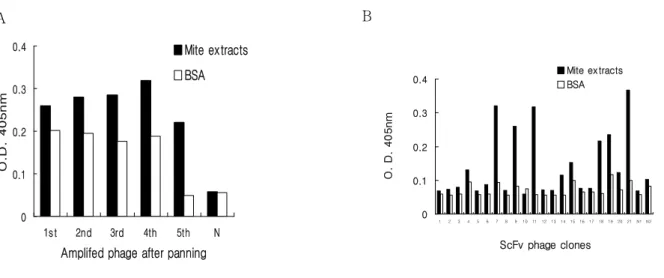
Figure 1. Polyclonal and monoclonal phage ELISA. A. Increase of recombinant phages specific for mite antigens after each round of panning. ELISA plate was coated with mite extracts or BSA, and amplified phage after each round of panning were added into each well. M13K07 helper phage was used as a negative control (N). B. Identification of recombinant phage clones specific for mite antigens. Recombinant phage clones obtained after 5th round of panning were added into each well. M13K07 helper phage (N1) and human scFv recombinant phage from pHEN1 (N2) were used as negative controls. Anti-M13 antibody conjugated with HRPO and ABTS were used as a secondary antibody and substrate, respectively. Absorbance at 405 nm was measured by ELISA reader.
mite allergens. The isolated VH and VκIg genes were linked together via short linker peptide by assembly PCR, and the resulting scFv genes were cloned into pCANTAB-5E vector. The library had 3×10⁴ inde- pendent clones. Analysis of 10 randomly isolated clones indicated that about 80% of clones contained scFv insert, and restriction fragment length polymor- phism (RFLP) analysis of scFv inserts using Mvu II restriction showed that they are not closely related (data not shown).
This scFv phage display library was panned five times using mite extracts immobilized on ELISA plates. The percentage yield after the fifth panning was increased almost 100 folds compared to the first panning indicating that the affinity selection was undertaken. ELISA using amplified phage harvested after each round of panning also showed that recom- binant phage with specificity for house dust mite al- lergen were preferentially enriched after the fifth panning (Fig. 1A). In order to identify specific recombinant human scFv clones, ELISA was per- formed to analyze binding specificity of twenty-one independent phage clones those were binders from the 5th round of panning (Fig. 1B). Among 21 clones, at least six phage clones showed distinct binding specificity for house dust mite allergens, and four phage clones that have higher than 0.25 of absor- bance at 405 nm (#7, #9, #11 and #21 which were named a2, a4, b7 and c15, respectively) were selected.
Immunoblot analysis showed that binding pattern of these scFv recombinant phage clones to a 25 kDa
protein in mite extracts was almost identical to anti-
Der p 1 mAb (5C65) (Fig. 2A) suggesting that these clones recognized a heat stable epitope on Der p 1 (25 kDa). However, these phage clones, especially b7 and c15 also reacted to other molecules of 50~60 kDa size in mite extracts. Fig. 2B further demon- strated that four different soluble scFv molecules (a 2~c15) specifically bound to mite antigens in ELISA.
Sequence analysis indicated that all 4 clones belong to the human VH3 subgroup and two of the clones (b7 and c15) used identical heavy chains (Fig. 3A).
However, the origin of germ line gene was different.
VH of a4 was originated from DP-49/1.9III germ line VH gene. VH of a2 (GenBank accession number: AF 428048) and b7/c15 (GenBank accession number:
AF428047) were also almost identical, and originated from the same germ line COS-6/DA-8 VH gene (EMBL Z17392). Regarding light chain usage three clones (a2 and b7/c15) belong to Vκ4 subgroup whereas the forth clone a4 used Vκ1 gene (GenBank accession number: AF428046) (Fig. 3B). This clone compared to others showed also the least cross- reactivity to mite extract in immunoblot analysis.
Discussion
A phage display library expressing human scFv molecule has been constructed, and scFv molecules specific to house dust mite antigens were isolated.
Since the PCR primers used to obtain VH genes are not isotype-specific, the scFv library constructed in this study is not surely reflecting IgE responses, and
rather represents whole antibody repertoire in human.
A a b B
1 2 3 4 5
50 kDa
25 kDa 25 kDa
0 0.1 0.2 0.3 0.4 0.5 0.6 0.7
a2 a4 b7 c15
Soluble scFv antibodies
O. D. 405nm
Mite ex tracts BSA
PDC-E2
Figure 2. Determination of antigen binding specificity of positive clones. A. Immunoblot. Mite extract contents were separated by 12% SDS page, and transferred to nitrocellulose membrane. The nitrocellulose strips were incubated with anti-Der p 1 mAb (5C65) followed by incubation with goat anti-mouse IgG-HRPO conjugated (a) or recombinant phage clones (b) followed by incubation with anti-M13 antibody-conjugated with HPRO. The signal was visualized by ECL and developed on X-ray film. Lane 1: a2, 2: a4, 3: b7, 4: c15 and 5: irrelevant recombinant phage (negative control). Arrows indicate major reactive protein bands (25 kDa and 50 kDa) recognized by the recombinant phage antibodies. B. ELISA. Antigen binding specificity of soluble scFv antibodies determined by ELISA.
Soluble scFv molecules from positive recombinant phage clones were obtained as described in the Materials & Methods. ELISA plate was coated with mite extract, pyruvate dehydrogenase complex (PDC) or BSA, and HB2151 culture supernatant containing soluble scFv molecules was added into each well. Mouse anti-E tag mAb and goat anti-mouse IgG conjugated with AP were used to detect binding signals as described in the Materials & Methods.
A FR1 CDR1 FR2 CDR2 FR3 CDR3 FR4
a2 QVQLQESGGGLVQPGGSLRLSCAASGFSFS GYWMN WVRQAPGKGLLRVS RINGDGKTTTYGDSVEG RFTVSRDNAKNTLY LQMNSLRAGDTAVYYCAR VGTSSSLPYFALLGARAP W GQGTLVTVSS b7/c15 ---- S--- --- --- --- A--- --- E--- -- Y--- DY --- a4 E--- -Q---- V---- R--- TLR DYGFH ---- T--- EW -A A -SS -GSGQY -A--- K- --- I-- E-SA --- MN -TPE -- GF ---- N AREGRW -AVDF --L—P---
B FR1 CDR1 FR2 CDR2 FR3 CDR3 FR4
a2 DIQMTKSPDSLAVSLGERATIN C KSNETLLYTSKNRNYLG WYQQKPGHPPKLLMY WASTRES GAPDRFSGSGSGTDFTLTISSLQAEDVAVYYC HQYYSSPYT FGQGTKLEIKR b7/c15 --- --- --- --- --- --- --- a4 E---- Q-- S-- PA -V-D-V-- T- RASQIISSSLN --- KA ---- I- V ---- SLQ - AV -S--- P---- -F-A-F- Q -T-IT -Q- ---
A
B
Figure 3. Deduced VH and VL amino acid sequence of positive scFv molecules. DNA sequencing analyses of VH and VL of positive scFv genes were performed as described in the Materials & Methods [GenBank accession number: a4 (AF428046), b7/c15 (AF428047) and a2 (AF428048)], and amino acid sequences of VH (A) and VL (B) were deduced from the DNA sequences of each scFv clones.
Whole mite extract was used since there are several groups of allergens in house dust mite; thereby, in- creases the chance of isolating diverse scFv clones from the library. However, we ended up isolating a few human antibody clones that were almost identical antigen-binding specificity. This may be due to either small size of our library resulting in the reduction of Ig diversity or too small number of positive clones characterized. So far, isolation of human recombinant Fab specific for allergens such as timothy grass pollen allergen Phl p5 (17) or rye grass pollen allergen Lol pII (18) have been reported. However, no study on molecular level of human V gene usage against house dust mite antigens have been reported. Human mon- oclonal scFv antibodies obtained in this study reacted to Der p 1, but at least one of them (b7/c15) also showed strong reactivity to other molecules with higher molecular weight (50~60 kDa) in mite extract in immunoblot. It is not certain whether binding of this scFv molecule to two proteins of different mole- cular weight is due to either low affinity of the scFv or sharing of similar epitopes by two proteins. DNA sequencing analysis showed that b7 and c15 are the same scFv molecule suggesting preferential selection of this scFv during affinity selection of the phage display library. In fact, cross-reactivity of human sera to allergens has been generally well known. Anti-Der
f 1 murine monoclonal antibodies specifically binds to Der f 1, and only a few of them are cross-reactive to Der f 1 and Der p 1, whereas IgE and IgG anti- bodies in allergic patients bound predominantly to cross-reacting epitopes (19). Our DNA sequencing data revealed that the same VH segment with dif- ferent DJ shuffling occurred in a2 and b7 (c15), and different DJ joining to the identical V segment may render the subtle binding difference to the antibody resulting in extent of cross-reactivity to mite allergens.
Among our clones, a4 showed the least cross-reacti- vity to mite allergens possibly due to the fact that it has more heterogeneous VH3 amino acid sequences compared to other two clones, and has a different Vκ1 light chain gene. It had been reported that VH5 heavy chain gene in IgE repertoire were over-repre- sented in patients with either atopic dermatitis (20) or hypersensitivity against house dust mite (21) sug- gesting preferential usage of this VH subgroup in the IgE antibody responses against allergens. It is pos- sible that our antibodies may not reflect in vivo anti- body responses in asthma patients since our scFv phage display library did not represent IgE repertoire, but still provided valuable information on V gene usage of anti-Der p 1 antibody responses in humans.
References
1. Platts-Mills TAE, Thomas WR, Aalberse RC, Vervloet D, Chapman MD: Dust mite allergens and asthma: report of a second international workshop. J Allergy Clin Immunol 89;1046-1060, 1992
2. Colloff MJ, Howe CW, McSharry C, Smith HV: Charac- terization of IgE antibody binding profiles of sera from patients with atopic dermatitis to allergens of the domes- tic mites Dermatophagoides pteronyssinus and Euroglyphus may- nei, using enhanced chemiluminescent immunoblotting. Int Arch Allergy Immunol 97;44-49, 1992
3. Thomas WR, Smith W: House-dust-mite allergens. Allergy 53;821-832, 1998
4. Aki T, Ono K, Paik SY, Wada T, Jyo T, Shigeta S, Mu- rooka Y, Oka S: Cloning and characterization of cDNA coding for a new allergen from the house dust mite, Der- matophagoides farinae. Int Arch Allergy Immunol 103;349- 356, 1994a
5. Aki T, Fujikawa A, Wada T, Jyo T, Shigeta S, Murooka Y, Oka S, Ono K: Cloning and characterization of cDNA coding for a new allergen from the house dust mite, Der- matophagoides farinae: homology with human heat shock cognate proteins in the heat shock protein 70 family. J Biochem 115;434-440, 1994b
6. Chua KY, Stewart GA, Thomas WR, Simpson RJ, Dil- worth RJ, Plozza TM, Turner KJ: Sequence analysis of cDNA coding for a major house dust mite allergen, Der p 1. Homology with cysteine proteases. J Exp Med 167;
175-182, 1988
7. Heymann PW, Chapman MD, Aalberse RC, Fox JW, Plat- ts-Mills TA: Antigenic and structural analysis of group II allergens (Der f II and Der p II) from house dust mites (Dermatophagoides spp). J Allergy Clin Immunol 83;1055- 1067, 1989
8. Chua KY, Doyle CR, Simpson RJ, Turner KJ, Stewart GA, Thomas WR: Isolation of cDNA coding for the ma- jor mite allergen Der p II by IgE plaque immunoassay.
Int Arch Allergy Appl Immunol 91;118-123, 1991 9. Greene WK, Thomas WR: IgE binding structures of the
major house dust mite allergen Der p I. Mol Immunol 29;257-262, 1992
10. Rapoport B, Portolano S, McLachlan SM: Combinatorial libraries: new insights into human organ-specific autoanti- bodies. Immunol Today 16;43-49, 1995
11. Winter G, Milstein C: Man-made antibodies. Nature 349;
293-296, 1991
12. Barbas III CF, Kang AS, Lerner RA, Benkovic SJ: Assem- bly of combinatorial antibody libraries on phage surface:
The gene III site. Proc Natl Acad Sci USA 88;7978-7982, 1991
13. McCafferty J, Griffiths AD, Winter G, Chiswell DJ: Phage antibodies: filamentous phage displaying antibody variable domains. Nature 348;552-554, 1990
14. McCafferty J, Johnson KS: Construction and screening of antibody display libraries. In: Kay BK, Winter J, McCaf- ferty J eds.: Phage display of peptides and proteins, p79- 111, Academic Press, 1996.
15. Palmey SF, Smith GP: Affinity-selectable filamentous fd phage vectors: affinity purification of target genes. Gene 73;305-318, 1988
16. Rondot S, Koch J, Breitling F, Dbel S: A helper phage to improve single-chain antibody presentation in phage display. Nat Biotech 19;75-78, 2001
17. Steinberger P, Kraft D, Valenta R: Construction of a com-
binatorial IgE library from a allergic patient: Isolation and characterization of human IgE Fabs with specificity for the major timothy grass pollen allergen, Phl p 5. J Biol Chem 271;10967-10972, 1996
18. De Lalla C, Tamborini E, Longhi R, Tresoldi E, Manoni M, Siccardi AG, Arosio P, Sidoli A: Human recombinant antibody fragments specific for a rye-grass pollen allergen:
characterization and potential applications. Mol Immunol 33;1049-1058, 1996
19. Heymann PW, Chapman MD, Platts-Mills TA: Antigen Der f I from the dust mite Dermatophagoides farinae : struc- tural comparison with Der p I from Dermatophagoides ptero- nyssinus and epitope specificity of murine IgG and human IgE antibodies. J Immunol 137;2841-2847, 1986 20. van der Stoep N, van der Linden J, Logtenberg T: Mole-
cular evolution of the human immunoglobulin E re- sponse: high incidence of shared mutations and clonal re- latedness among epsilon VH5 transcripts from three un- related patients with atopic dermatitis. J Exp Med 177;
99-107, 1993
21. Snow RE, Djukanovic R, Stevenson FK: Analysis of im- munoglobulin E VH transcripts in a bronchial biopsy of an asthmatic patient confirms bias towards VH5, and in- dicates local clonal expansion, somatic mutation and iso- type switch events. Immunology 98;646-651, 1999