Traumatic cervical cord injuries can cause multiple organ dysfunction and complications:1) such injuries often cause neurologic disorders, paralysis, and dysfunction of respi- ratory muscles, which result in secondary complications.
They remain as one of the most common causes of in-
creased morbidity and mortality.2-4) Also, respiratory com- plications are one of the most common causes of death in multiple trauma patients.2,3)
Many patients with traumatic cervical cord injuries need sustained implementation of mechanical ventila- tion.1,5) Among 21%–77% of these patients, tracheostomy, rather than endotracheal intubation, is needed to make breathing more comfortable and more efficient by reduc- ing dead-space ventilation.5) In addition, the known ad- vantages of tracheostomy include stable airway, possible oral nutrition, efficient management of tracheal secre- tions, and reduced respiratory complications.6-11) However, tracheostomy may lead to complications such as airway
The Need for Early Tracheostomy in Patients with Traumatic Cervical Cord Injury
Jae-Young Beom, MD, Hyoung-Yeon Seo, MD
Department of Orthopedic Surgery, Chonnam National University Hospital, Gwangju, Korea
Background: In patients who need sustained endotracheal intubation and mechanical ventilation due to respiratory failure after traumatic cervical spinal cord injury, tracheostomy can be performed to reduce the duration of mechanical ventilation and respira- tory complications. The purpose of this study was to determine criteria and timing of tracheostomy in patients with severe trau- matic cervical spinal cord injury accompanied by motor weakness.
Methods: We reviewed 22 patients who underwent tracheostomy (study group) and 27 patients who did not (control group) from January 2005 to March 2016. We assessed the American Spinal Injury Association (ASIA) impairment scale score and investigated accompanying thoracic injury, paradoxical respiration, postoperative endotracheal intubation and other clinical parameters. The study group was also subdivided into the early tracheostomy group and late tracheostomy group depending on whether the trache- ostomy was performed within or later than 7 days after surgery.
Results: Twenty-two patients in the study group had a mean ASIA impairment scale score of 14.1 points, which was lower than the control group’s 23.4 points. Paradoxical respiration was observed in 77% of the patients in the study group compared to 18%
in the control group. Postoperative intubation was maintained in 68% in the study group; 32% underwent endotracheal intubation due to respiratory failure within 4 days after surgery and had a tracheostomy. In the control group, postoperative intubation was maintained in 22%, and all of them were weaned off intubation within 4 days after surgery. The duration of intensive care unit hospitalization was 11.4 days for the early tracheostomy group, which was shorter than the late tracheostomy group’s 19.7 days.
Conclusions: In patients with severe traumatic cervical spinal cord injury, tracheostomy may be needed when the motor grade of the ASIA scale is low, above the C4 segment is injured, or paradoxical respiration occurs after injuries. In addition, if endotracheal extubation is not feasible within 4 days after surgery, an early tracheostomy should be considered.
Keywords: Traumatic cervical cord injury, Early tracheostomy, Paradoxical respiration
Copyright © 2018 by The Korean Orthopaedic Association
This is an Open Access article distributed under the terms of the Creative Commons Attribution Non-Commercial License (http://creativecommons.org/licenses/by-nc/4.0) which permits unrestricted non-commercial use, distribution, and reproduction in any medium, provided the original work is properly cited.
Clinics in Orthopedic Surgery • pISSN 2005-291X eISSN 2005-4408 Received January 7, 2018; Accepted February 26, 2018
Correspondence to: Hyoung-Yeon Seo, MD
Department of Orthopedic Surgery, Chonnam National University Hospital, Chonnam National University Medical School, 42 Jebong-ro, Dong-gu, Gwangju 61469, Korea
Tel: +82-62-227-1640, Fax: +82-62-225-7794 E-mail: [email protected]
stenosis, hemorrhage, infection at the operation site, and dysphagia because it is an invasive procedure.
Early tracheostomy has a positive effect on the prognosis of the patient by reducing the duration of me- chanical ventilation and length of stay in the intensive care unit (ICU) and improves patient tolerance to mechanical ventilation.6,8,10,12,13) The need for a tracheostomy is usually determined based on the level of neurological injury, age, and other accompanying injuries in patients with trau- matic cervical spinal cord injuries; however, the criteria for early tracheostomy remain controversial.8,10,11) The purpose of this study is to determine the proper criteria and timing for early tracheostomy in patients with severe traumatic cervical spinal cord injury accompanied by motor weak- ness.
METHODS
Patients and Study Design
This study was performed retrospectively on 49 patients with motor weakness whose muscle strength score of American Spinal Injury Association (ASIA) impairment scale was under 50 after surgery for cervical spinal injury.
We conducted this study in compliance with the principles of the Declaration of Helsinki. The protocol of this study was reviewed and approved by the Institutional Review Board of Chonnam National University Hospital (IRB No.
CNUH-2017-316). Written informed consents were ob- tained from all subjects. The patients underwent surgical treatment for traumatic cervical spinal injury at Chonnam National University Hospital from January 2005 to March 2016. Of those, 22 patients had tracheostomy: 10 within 7 days after surgery and the rest later than 7 days after surgery.
Clinical Evaluations
The patient’s age, sex, degree of injury, level of injury, presence of accompanied thoracic injuries, presence of paradoxical respiration, period before tracheostomy, con- tinuation of intubation after surgery for cervical spinal cord injury, length of ICU stay, and amount of tracheal secretion were investigated. The severity of injury was measured based on the muscle strength score of the ASIA impairment scale, and the level of injury was determined as the highest level of the segment injured, which was de- tected by simple radiography and computed tomography.
Paradoxical respiration was considered present when the doctor in charge or a specialist doctor observed contrac- tion of abdominal muscles during respiration from injury to surgery. The amount of respiratory secretion was as- sessed based on the number of times the nurse in charge of ICU performed aspiration per hour: 0 point was given for less than once per hour; 1 point, for once; 2 points, for twice; and 3 points, for three times per hour.
Statistical Analysis
Descriptive statistics (arithmetic mean, standard devia- tion, and range) were calculated using SPSS ver. 14.0 (SPSS Inc., Chicago, IL, USA). The independent t-test was used to determine the significance of intergroup differences. A p-value < 0.05 was considered significant and the statisti- cal analysis was performed by an independent statistician.
RESULTS
Comparisons between Tracheostomy and Non-tracheostomy Groups
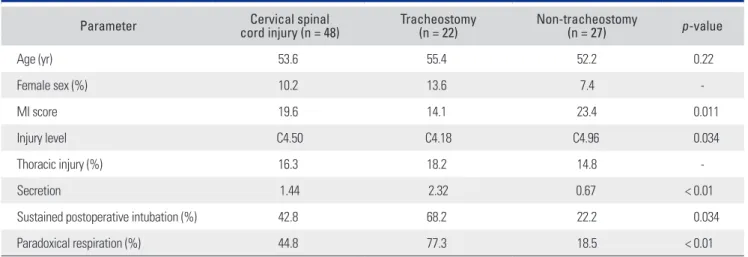
The characteristics of the two groups are summarized in
Table 1. Characteristics of Patients with and without Tracheostomy
Parameter Cervical spinal
cord injury (n = 48) Tracheostomy
(n = 22) Non-tracheostomy
(n = 27) p-value
Age (yr) 53.6 55.4 52.2 0.22
Female sex (%) 10.2 13.6 7.4 -
MI score 19.6 14.1 23.4 0.011
Injury level C4.50 C4.18 C4.96 0.034
Thoracic injury (%) 16.3 18.2 14.8 -
Secretion 1.44 2.32 0.67 < 0.01
Sustained postoperative intubation (%) 42.8 68.2 22.2 0.034
Paradoxical respiration (%) 44.8 77.3 18.5 < 0.01
MI: motor impairment.
Table 1. Of the total 49 patients who underwent surgery for traumatic cervical spinal cord injury with motor weak- ness, 22 patients (19 males and 3 females) with a mean age of 55.4 years (range, 26 to 70 years) underwent trache- ostomy. In them, the mean ASIA impairment scale score for muscle strength was 14.1 points at the time of injury, which was statistically significantly lower than the aver- age of 23.4 points of 27 patients in the non-tracheostomy group (25 males and 2 females) with a mean age of 52.3 years (range, 17 to 81 years) (p = 0.034).
The tracheostomy group had damage to the higher segments (Fig. 1). The average level of injury in the trache- ostomy group was at C4.18 (range, C1 to C6), whereas the average level in the control group was at C4.96 (range, C3 to C7), showing a statistically significant difference between groups (p = 0.011). There was no statistically significant dif- ference between the two groups in the incidence of associ- ated thoracic injury: 18% (four patients) in the tracheotomy
group vs. 14% (four patients) in the non-tracheotomy group. A statistically significant difference was observed in the presence of paradoxical respiration between the two groups (p < 0.001): 77% (17 patients) in the tracheotomy group vs. 18% (five patients) in the non-tracheotomy group.
The score for the assessment of the amount of tracheal se- cretion was 2.32 points in the tracheostomy group and 0.67 point in the non-tracheotomy group, showing a statistically significant difference between groups (p < 0.001).
In the tracheostomy group, tracheostomy was per- formed at a mean of 7.5 days (range, 1 to 29 days) after surgery. Of the 22 patients in the tracheostomy group, in- tubation was maintained after surgery in 68% (14 patients) and 32% (eight patients) showed respiratory failure ac- companied by increased tracheal secretion and respiratory muscle fatigue, so intubation was performed within 4 days after surgery. All of them underwent tracheostomy for sus- tained mechanical ventilation. In the non-tracheostomy group, intubation was maintained in 22% (five patients) of 27 patients after surgery and removed within 4 days after surgery in all patients (Fig. 2).
Comparison between Groups That Underwent Tracheostomy within 7 Days and after 7 Days
The characteristics of the two groups are summarized in Table 2. Ten patients (eight males and two females; average age, 51.2 years [range, 33 to 73 years]) who underwent tra- cheostomy within 7 days after surgery (early tracheostomy group) had a mean ASIA impairment scale score of 7.7 points at the time of injury, which was statistically signifi- cantly lower than the mean 19.5 points of 12 patients in the late tracheostomy group who underwent tracheostomy later than 7 days after surgery (11 males and one female;
average age, 58.9 years [range, 26 to 70 years]) (p = 0.039).
C1 12
10
8
6
4
2
0
C2 C3 C4 C5 C6 C7
Injury segment 1
5 8
10
6
2 7
4 4
Tracheostomy Non-tracheostomy
Fig. 1. Injury level in tracheostomy and non-tracheostomy patients.
No.ofpatients
A B
Immediate 16
14 12 10 8 6 4 2 0
POD1 POD2 POD3 POD4
15
1 1
3
2
No.ofpatients
OP date 25
20
15
10
5
0
POD1 POD2 POD3 POD4
21
1 1 1
3
Fig. 2. (A) Duration until postoperative intubation in tracheostomy patients: intubation was required in all patients until postoperative day (POD) 4. (B) Duration until extubation in non-tracheostomy patients: extubation was performed within POD 4. OP: operative.
The duration of postoperative sustained mechanical ven- tilation was shorter in the early tracheostomy group (6 days), but the difference was not statistically significant (p
= 0.41). The duration of postoperative ICU hospitaliza- tion was 11.4 days in the early tracheostomy group, which was shorter than that of the late tracheostomy group (19.7 days), showing statistically significant difference (p = 0.033).
DISCUSSION
Among patients who had surgery for traumatic cervical cord injury accompanied by motor weakness, the lower motor weakness score of the ASIA impairment scale, higher injury level, and paradoxical respiration were as- sociated with the greater need for tracheostomy. Further- more, respiratory failure and increased tracheal secretion persisting for more than 4 days after surgery necessitated continuous mechanical ventilation and in this case, early tracheostomy could reduce the duration of ICU stay.
The patients who have acute spinal cord injury have an increased risk of respiratory failure, followed by respi- ratory disease, such as pneumonia, and mortality due to complications. In many cases, prolonged mechanical ven- tilation is needed after endotracheal intubation to prevent respiratory complications and to treat respiratory failure after spinal cord injury. Furthermore, tracheostomy may also be needed to prevent complications due to prolonged endotracheal intubation in many cases.14)
Patients with traumatic cervical spinal cord injury are susceptible to respiratory complications due to neu- rological injury of respiratory muscles of the diaphragm, thoracic spine, and abdomen, which results in reduction of
vital capacity and reserve volumes.15) It is known that acute cervical spinal cord injury can affect descending reticulo- spinal respiratory pathways that control the diaphragm, intercostal muscles, accessory respiratory muscles, and ab- dominal muscles causing muscular dysfunction. Ultimate- ly, it leads to reduced vital capacity and static oral pressure, weakened cough, and disorder of removal of foreign body, and it can increase rates of atelectasis and respiratory in- fection. It is known that endotracheal intubation and me- chanical ventilation can not only reduce respiratory failure and complications following surgery for acute cervical spinal cord injury but also prevent spinal cord injury due to secondary hypoxia.16)
Although there is no clear evidence that tracheos- tomy reduces ventilator-associated pneumonia, it is re- ported that it can reduce the duration of mechanical ven- tilation and ICU hospital stay.10,15,17) In this study, we also confirmed that tracheostomy could reduce the duration of ICU hospital stay. Additional benefits of the procedure include easier patient management for nurses, disposal of secretion, patient comfort, feasibility of deglutition move- ment, and early vocalization. However, misplaced needles and cannulae, fracture of cricoid cartilage, injury of the posterior wall of the trachea, hemorrhage, pneumothorax, emphysema, wound infection, and mediastinitis are inher- ent risks of the invasive procedure, which can lead to death in severe cases.18-20) It has been reported that the mortality rate of tracheostomy ranges from 1.1% to 8.9% in adults;
major causes of death include post-procedure hemorrhage and airway obstruction and infection due to wrong trachea incision tube insertion.21) Therefore, tracheostomy should be determined on the basis of assessment of benefits and risks of the procedure.
Table 2. Characteristics of Patients with Early and Late Tracheostomy
Parameter Total (n = 22) Early tracheostomy (n = 10) Late tracheostomy (n = 12) p-value
Age (yr) 55.4 51.2 58.9 0.077
MI score 14.1 7.7 19.5 0.039
Injury level C4.18 C4 C4.33 0.274
Duration after operation (day) 7.5 3.8 10.7 0.001
Secretion 2.32 2.40 2.25 0.343
MV duration (day) 6.5 6.0 6.9 0.413
ICU stay duration (day) 15.9 11.4 19.7 0.033
Paradoxical respiration (%) 77.2 90 66.7 -
MI: motor impairment, MV: mechanical ventilation, ICU: intensive care unit.
In the past, tracheotomy was performed as late as possible to prevent traumatic organ injury in patients requiring continuous mechanical ventilation. Recently, however, persistent tracheal intubation has been known to cause various complications, and advantages of tracheos- tomy are being highlighted. Therefore, early tracheostomy is being recognized as a good treatment option, and some studies have reported that early tracheostomy reduces ICU mortality and hospital mortality.22-27) However, there is still controversy regarding the proper timing of tracheostomy in patients with traumatic spinal cord injuries. So, we set out this study to determine the criteria and timing for early tracheostomy in patients with severe traumatic cervi- cal spinal cord injury with motor weakness.
In previous studies, an injury to the segment above the fourth cervical vertebra and low strength scores of the ASIA impairment scale were associated with the need for tracheostomy.8,10,11) Based on our findings in this study, we suggest that tracheostomy should also be performed in case of paradoxical respiration or persisting increased secretion. In addition, if tracheal extubation is not feasible within 4 days after surgery, early tracheostomy should be considered because continuous mechanical ventilation will be needed.
Despite the concern over the risk of infection at the previous surgical site after tracheostomy in patients with anterior cervical spine fusion or fixation, there is very little
research on this. In the current study, there was no statisti- cally significant increase in cervical spine infections after anterior cervical spine fusion, and none of the patients with tracheostomy had surgical site infection. According to Northrup et al.,14) the correlation between tracheostomy and infection after anterior cervical spine surgery seems to be low.
There are some limitations in this study. First, only a small number of patients were studied because only patients with symptomatic traumatic cervical spinal cord injury in a single institution were included. Second, para- doxical respiration and the amount of secretion may be different depending on observers because they are subjec- tive criteria, rather than objectively, quantifiable criteria.
In patients with traumatic cervical spinal cord inju- ries, tracheostomy is highly likely to be needed when the motor grade of the ASIA impairment scale score is low, the injury level is higher than C4, or paradoxical respira- tion and increased secretion are observed. Furthermore, if intubation was required for more than 4 days after opera- tion, early tracheostomy should be considered.
CONFLICT OF INTEREST
No potential conflict of interest relevant to this article was reported.
REFERENCES
1. Mansel JK, Norman JR. Respiratory complications and management of spinal cord injuries. Chest. 1990;97(6):1446- 52.
2. National Spinal Cord Injury Statistical Center, University of Alabama at Birmingham. 10 Annual report for the spinal cord injury model system. Birmingham, AL: National Spinal Cord Injury Statistical Center; 2011.
3. Nakajima A, Honda S, Yoshimura S, Ono Y, Kawamura J, Moriai N. The disease pattern and causes of death of spinal cord injured patients in Japan. Paraplegia. 1989;27(3):163- 71.
4. Neumann CR, Brasil AV, Albers F. Risk factors for mortal- ity in traumatic cervical spinal cord injury: Brazilian data. J Trauma. 2009;67(1):67-70.
5. Ball PA. Critical care of spinal cord injury. Spine (Phila Pa 1976). 2001;26(24 Suppl):S27-30.
6. Berney S, Stockton K, Berlowitz D, Denehy L. Can early ex- tubation and intensive physiotherapy decrease length of stay
of acute quadriplegic patients in intensive care? A retrospec- tive case control study. Physiother Res Int. 2002;7(1):14-22.
7. Brook AD, Sherman G, Malen J, Kollef MH. Early versus late tracheostomy in patients who require prolonged me- chanical ventilation. Am J Crit Care. 2000;9(5):352-9.
8. Branco BC, Plurad D, Green DJ, et al. Incidence and clini- cal predictors for tracheostomy after cervical spinal cord injury: a National Trauma Databank review. J Trauma.
2011;70(1):111-5.
9. Fishburn MJ, Marino RJ, Ditunno JF Jr. Atelectasis and pneumonia in acute spinal cord injury. Arch Phys Med Re- habil. 1990;71(3):197-200.
10. Goettler CE, Fugo JR, Bard MR, et al. Predicting the need for early tracheostomy: a multifactorial analysis of 992 intu- bated trauma patients. J Trauma. 2006;60(5):991-6.
11. Harrop JS, Sharan AD, Scheid EH Jr, Vaccaro AR, Przybyl- ski GJ. Tracheostomy placement in patients with complete cervical spinal cord injuries: American Spinal Injury Asso-
ciation Grade A. J Neurosurg. 2004;100(1 Suppl Spine):20-3.
12. Kluger Y, Paul DB, Lucke J, et al. Early tracheostomy in trauma patients. Eur J Emerg Med. 1996;3(2):95-101.
13. Palmieri TL, Jackson W, Greenhalgh DG. Benefits of early tracheostomy in severely burned children. Crit Care Med.
2002;30(4):922-4.
14. Northrup BE, Vaccaro AR, Rosen JE, Balderston RA, Cotler JM. Occurrence of infection in anterior cervical fusion for spinal cord injury after tracheostomy. Spine (Phila Pa 1976).
1995;20(22):2449-53.
15. Milanchi S, Magner D, Wilson MT, Mirocha J, Margulies DR. Percutaneous tracheostomy in neurosurgical patients with intracranial pressure monitoring is safe. J Trauma.
2008;65(1):73-9.
16. Berlly M, Shem K. Respiratory management during the first five days after spinal cord injury. J Spinal Cord Med.
2007;30(4):309-18.
17. Arabi YM, Alhashemi JA, Tamim HM, et al. The impact of time to tracheostomy on mechanical ventilation duration, length of stay, and mortality in intensive care unit patients. J Crit Care. 2009;24(3):435-40.
18. Epstein SK. Late complications of tracheostomy. Respir Care. 2005;50(4):542-9.
19. Stauffer JL, Olson DE, Petty TL. Complications and conse- quences of endotracheal intubation and tracheotomy: a pro- spective study of 150 critically ill adult patients. Am J Med.
1981;70(1):65-76.
20. De Leyn P, Bedert L, Delcroix M, et al. Tracheotomy:
clinical review and guidelines. Eur J Cardiothorac Surg.
2007;32(3):412-21.
21. Stemmer EA, Oliver C, Carey JP, Connolly JE. Fatal compli- cations of tracheotomy. Am J Surg. 1976;131(3):288-90.
22. Whited RE. A prospective study of laryngotracheal sequelae in long-term intubation. Laryngoscope. 1984;94(3):367-77.
23. Goldenberg D, Ari EG, Golz A, Danino J, Netzer A, Joachims HZ. Tracheotomy complications: a retrospec- tive study of 1130 cases. Otolaryngol Head Neck Surg.
2000;123(4):495-500.
24. Esteller More E, Ibanez-Nolla J, Garcia-Hernandez F, et al.
Post-mortem study of laryngotracheal lesions produced by prolonged intubation and/or tracheotomy. Acta Otorrino- laringol Esp. 1997;48(7):545-50.
25. Esteller-More E, Ibanez J, Matino E, Adema JM, Nolla M, Quer IM. Prognostic factors in laryngotracheal injury fol- lowing intubation and/or tracheotomy in ICU patients. Eur Arch Otorhinolaryngol. 2005;262(11):880-3.
26. Cosortium for Spinal Cord Medicine. Respiratory man- agement following spinal cord injury: a clinical practice guideline for health-care professionals. J Spinal Cord Med.
2005;28(3):259-93.
27. Cox CE, Carson SS, Holmes GM, Howard A, Carey TS.
Increase in tracheostomy for prolonged mechanical ven- tilation in North Carolina, 1993-2002. Crit Care Med.
2004;32(11):2219-26.