• 검색 결과가 없습니다.

The Unusual Suspect: Anemia-induced Systolic Anterior Motion of the Mitral Valve and Intraventricular Dynamic Obstruction in a Hyperdynamic Heart as Unexpected Causes of Exertional Dyspnea after Cardiac Surgery

N/A
N/A
Protected

Academic year: 2021

Share "The Unusual Suspect: Anemia-induced Systolic Anterior Motion of the Mitral Valve and Intraventricular Dynamic Obstruction in a Hyperdynamic Heart as Unexpected Causes of Exertional Dyspnea after Cardiac Surgery"

Copied!
4
0
0

로드 중.... (전체 텍스트 보기)

전체 글

(1)

Korean J Thorac Cardiovasc Surg 2013;46:457-460 □ Case Report □ http://dx.doi.org/10.5090/kjtcs.2013.46.6.457 ISSN: 2233-601X (Print) ISSN: 2093-6516 (Online)

− 457 −

1

Presbyterian Medical Center,

2

Lee Gil Ya Cancer and Diabetes Institute,

3

Division of Cardiology, Department of Internal Medicine, Gachon University of Medicine and Science

Received: June 11, 2013, Revised: July 16, 2013, Accepted: July 22, 2013

Corresponding author: Jeonggeun Moon, Division of Cardiology, Department of Internal Medicine, Gachon University of Medicine and Science, 21 Namdong-daero 774beon-gil, Namdong-gu, Incheon 405-760, Korea

(Tel) 82-32-460-8305 (Fax) 82-32-469-1906 (E-mail) [email protected]

C

The Korean Society for Thoracic and Cardiovascular Surgery. 2013. All right reserved.

CC

This is an open access article distributed under the terms of the Creative Commons Attribution Non-Commercial License (http://creative- commons.org/licenses/by-nc/3.0) which permits unrestricted non-commercial use, distribution, and reproduction in any medium, provided the original work is properly cited.

The Unusual Suspect: Anemia-induced Systolic Anterior Motion of the Mitral Valve and Intraventricular Dynamic Obstruction in a Hyperdynamic Heart as Unexpected Causes of Exertional Dyspnea

after Cardiac Surgery

Jeong-Beom Mun, M.D.

1

, Ah-Reum Oh, M.S.

2

, Hwa-Sun Park, M.D.

3

, Chul-Hyun Park, M.D., Ph.D.

3

, Kook-Yang Park, M.D., Ph.D.

3

, Jeonggeun Moon, M.D.

3

Dynamic left ventricular (LV) outflow tract obstruction is a characteristic feature of hypertrophic cardiomyopathy; how- ever, it can also occur in association with hyperdynamic LV contraction and/or changes in the cardiac loading con- dition, even in a structurally normal or near-normal heart. Here, we report a case of anemia-induced systolic ante- rior motion of the mitral valve and the resultant intraventricular obstruction in a patient who underwent coronary ar- tery bypass grafting and suffered from anemia associated with recurrent gastrointestinal bleeding.

Key words: 1. Anemia

2. Echocardiography 3. Mitral valve

CASE REPORT

Dynamic left ventricular (LV) outflow tract (LVOT) ob- struction associated with the systolic anterior motion (SAM) of the mitral valve (MV) is a characteristic feature of hyper- trophic cardiomyopathy. However, when certain conditions are met, this intriguing phenomenon can occur even in a structurally normal or near-normal heart. Here, we report a case of a transient intraventricular obstruction resulting from SAM of the MV in a patient who suffered from anemia due to gastrointestinal bleeding after coronary artery bypass graft- ing (CABG) surgery.

A 73-year-old Asian male presented with dyspnea (New York Heart Association class III/IV) on exertion and effort

intolerance; the condition had developed over the course of

several days. The patient had a medical history of radical

subtotal gastrectomy (Billroth II) due to stomach cancer in

2003 and coronary artery bypass grafting (CABG) for treat-

ment of stable angina with triple-vessel coronary artery dis-

ease in 2011. The result of CABG was successful, and there-

after, aspirin, angiotensin II receptor blocker, and statin were

prescribed. The patient was monitored in the outpatient clinic

after the operation without symptoms of angina pectoris or

heart failure for two years. Recently, however, he had suf-

fered from multiple episodes of gastrointestinal bleeding from

small bowel angiodysplasia and peptic ulcer, which were

treated with endoscopic Argon plasma coagulation and long-

term gastric acid-suppressing therapy. During the episodes of

(2)

Jeong-Beom Mun, et al

− 458 −

Fig. 1. Apical 3-chamber view showing the left ventricular (LV) outflow tract (LVOT) and MV during systole. (A) Apparently normal LV ge- ometry and normal mitral valve (MV) before coronary artery bypass grafting. The LV ejection fraction was 60% with normal LV wall motion. At that time, the serum hemoglobin (Hb) level was 11.4 g/dL. (B) At the time of heart failure associated with anemia (Hb, 8.3 g/dL). The LV size was small, and LV contraction was markedly hyperdynamic (LV ejection fraction, 78%). Systolic anterior motion of the MV (arrow) was prominent, and LVOT was notably narrow. LA, left atrium; Ao, aorta.

acute hemorrhage, blood transfusion was performed at the at- tending physicians’ discretion without any complications.

At the time of the current presentation, vital signs were not remarkable (blood pressure, 110/70 mmHg; heart rate, 72 beats/min). A physical examination revealed that he was pale in appearance and his extremities were rather cold, with slightly decreased skin turgor and a dry tongue. Of note, on auscultation, a systolic murmur (grade IV/VI) was audible at the left lower sternal border. Chest radiography was not re- markable, except mild cardiomegaly. Findings of a 12-lead electrocardiography examination showed a sinus rhythm and nonspecific changes in the ST-segment and T-wave. Laboratory findings indicated normocytic and normochromic anemia (haemoglobin, 8.3 g/dL; [normal range, 13 to 17 g/dL]; mean cell volume, 86.6 fL; [normal range, 79 to 96 fL]; and mean cell hemoglobin, 28.4 pg; [normal range, 27 to 31 pg]). The blood urea nitrogen was 11.4 mg/dL, and the creatinine level was 0.6 mg/dL. The serum protein level was 6.2 g/dL, and the albumin level was 3.2 g/dL. The pro-brain natriuretic pep- tide level was 228.8 pg/mL.

We performed transthoracic echocardiography for a further evaluation of the systolic murmur and cardiac pathology po- tentially associated with symptoms of heart failure. Results showed the newly developed systolic anterior motion (SAM)

of the mitral valve (MV) (Fig. 1). The left ventricular (LV) cavity size was small (LV end-diastolic dimension, 41 mm) with remarkable hyperdynamic LV contraction (LV ejection fraction, 78%), suggesting intracardiac volume depletion. The patient’s heart was essentially free from myocardial or valvu- lar abnormality, except concentric LV remodeling (relative wall thickness, 0.44; LV mass index, 73 g/m

2

). A color Doppler evaluation showed aliasing at the portion between the MV and the interventricular septum during the systolic phase, suggesting flow acceleration across the LV outflow tract (LVOT). A continuous Doppler study of the LVOT demonstrated a late-peaking profile of the flow suggestive of dynamic intraventricular obstruction. The maximal pressure gradients were 54 mmHg at rest and 65 mmHg during the strain phase of the Valsalva maneuver estimated by the sys- tolic blood flow velocity. This was suggestive of significant dynamic LVOT obstruction, which was aggravated during preload reduction (Fig. 2). Meanwhile, the early diastolic mi- tral inflow velocity (E) was 0.4 m/sec, and the early diastolic mitral annulus velocity (E') at the septal corner was 0.05 m/sec (E over E' ratio, 8). The inferior vena cava diameter was 1.1 cm and showed good collapsibility (respiratory varia- bility was greater than 50%).

The patient was relatively stable and showed no signs of

(3)

Anemia-induced SAM of the MV after CABG

− 459 −

Fig. 2. The change in the Dopper contour at the left ventricular outflow tract (LVOT). (A) The seemingly normal contour of the LVOT pulsed-wave Doppler image with normal velocity (1.2 m/sec) before coronary artery bypass grafting. (B) Echo performed when the patient suffered from anemia (hemoglobin, 8.3 g/dL). Dagger-shaped continuous-wave Doppler contour across the LVOT during the strain phase of the Valsalva maneuver. The peak velocity of the flow was more than 4 m/sec, and the pressure gradient was estimated to be 65 mmHg, suggesting significant subaortic obstruction. The patient’s aortic valve was normal, and there was no evidence of a fixed obstruction at the aortic level, such as aortic stenosis or subaortic web.

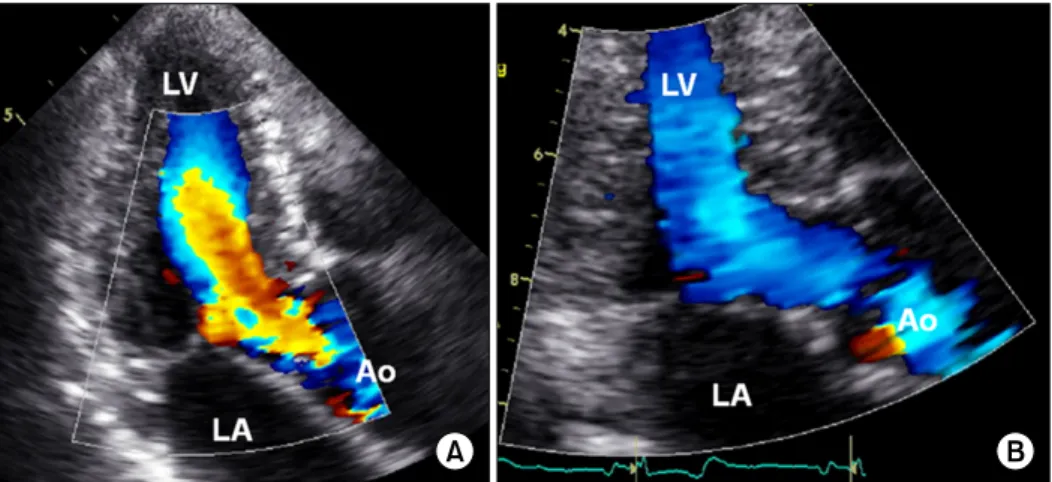
Fig. 3. (A) Color Doppler image taken at the time of anemia (hemoglobin, 8.3 g/dL). Note the aliasing of color Doppler from the mid-level of left ventricular (LV) to LV outflow tract LVOT, suggesting flow acceleration and dynamic obstruction. (B) A color Doppler image at the LVOT after treatment. The systolic anterior motion of the mitral valve was abolished. Concurrently, this image shows a low-velocity laminar LVOT blood flow. The patient’s symptoms were improved dramatically. LA, left atrium; Ao, aorta.

active gastrointestinal bleeding or hemodynamic deterioration at the time of presentation; therefore, he was treated with a chronic oral iron supplement rather than further blood transfusion. In addition, based on the result of the echocardio- graphic evaluation, the angiotensin II receptor blocker was discontinued; instead, beta-blocker (bisoprolol 5 mg daily) and oral hydration were encouraged in order to minimize LV hypercontractility. One week after treatment, the patient was free from previous symptoms of heart failure, and the systolic murmur was no longer detected. In the follow-up echocardio-

graphic evaluation, the SAM of the MV was fully abolished, and a laminar LVOT blood flow was observed (Fig. 3).

Hence, we decided to continue the altered medication for the time being and instructed the patient to avoid dehydration and physical overexertion.

DISCUSSION

Intraventricular obstruction resulting from the SAM of the

MV is typically observed in hypertrophic cardiomyopathy due

(4)

Jeong-Beom Mun, et al

− 460 − to the asymmetrical bulging of the interventricular septum, which causes narrowing of the LVOT. However, the interest- ing ‘malfunction’ of the seemingly normal MV is observed in certain clinical settings, even in an apparently normal or min- imally abnormal heart, particularly in critically ill patients. In fact, dynamic intraventricular obstruction due to the SAM of the MV, sometimes accompanying significant mitral regur- gitation, has been reported in the case of an acute coronary syndrome [1], after valve surgery [2], and in the case of an apical ballooning syndrome [3] when the LV geometry is altered. In addition, dynamic obstruction of the LVOT can occur upon vigorous contraction of the LV in patients with- out organic heart disease, such as sepsis [4], and under the influence of catecholamine [5]. In the current case, anemia was the precipitating factor for hyperdynamic LV contraction during physical effort, which induced the SAM of the MV with intracardiac obstruction. We reckon that because the SAM of the MV tends to become aggravated during exercise, a transient alteration of the MV movement, along with ane- mia, served as the cause of effort intolerance in our patient.

SAM of the MV can occur in various situations; however, clinicians tend not to pay attention to this intriguing phenom- enon, and thus, it tends to be undiagnosed and ignored. Our patient complained of shortness of breath mainly during ex- ercise, and the most plausible clinical suspicions included dia- stolic dysfunction, postoperative constriction [6], and/or graft failure after CABG. Of note, with timely echocardiography, we were able to correctly diagnose subaortic obstruction due to the SAM of the MV induced by anemia; this made the tailored management possible. We attempted to correct the anemia, restored the intracardiac volume with hydration, and prescribed a beta-blocker, all of which alleviated the patient’s symptoms. In conclusion, intracardiac dynamic obstruction due to the SAM of the MV can occur in association with acute changes in the afterload [4], preload [7], LV, and/or MV apparatus geometry [1,3], and ventricular contractility [4]; therefore, it should be suspected as a potential cause for heart failure even in patients without hypertrophic cardio-

myopathy. From this perspective, an insightful echocardio- graphic evaluation is invaluable.

CONFLICT OF INTEREST

No potential conflict of interest relevant to this article was reported.

ACKNOWLEDGMENTS

This work was supported by the Gachon University Gil Medical Center (grant number: 2013-10) and by Boryung Pharmaceutical Company, Republic of Korea.

REFERENCES

1. Haley JH, Sinak LJ, Tajik AJ, Ommen SR, Oh JK. Dynamic left ventricular outflow tract obstruction in acute coronary syndromes: an important cause of new systolic murmur and cardiogenic shock. Mayo Clin Proc 1999;74:901-6.

2. Kudo M, Yozu R, Kokaji K, Kimura N. A simple method of prevention for systolic anterior motion in mitral valve repair by loop technique method. Ann Thorac Surg 2009;87:324-5.

3. To AC, Khan AA, Kay P, Kerr AJ. Resting systolic anterior motion of mitral valve apparatus: association with apical ballooning syndrome. Circ Heart Fail 2008;1:84-5.

4. Kruppa J, You EJ, Suh SY, Park YS, Moon J. Cardiogenic shock induced by basal septal hypertrophy and left ventricular outflow tract dynamic obstruction in a critically ill patient with sepsis. Int J Cardiol 2012;156:338-40.

5. Henein MY, O’Sullivan C, Sutton GC, Gibson DG, Coats AJ. Stress-induced left ventricular outflow tract obstruction:

a potential cause of dyspnea in the elderly. J Am Coll Cardiol 1997;30:1301-7.

6. Kim JH, Hwang YH, Youn YN, Yoo KJ. Effect of post- operative constrictive physiology on early outcomes after off-pump coronary artery bypass grafting. Korean J Thorac Cardiovasc Surg 2013;46:22-6.

7. Kim D, Mun JB, Kim EY, Moon J. Paradoxical heart fail-

ure precipitated by profound dehydration: intraventricular

dynamic obstruction and significant mitral regurgitation in a

volume-depleted heart. Yonsei Med J 2013;54:1058-61.

수치

Fig. 1. Apical 3-chamber view showing the left ventricular (LV) outflow tract (LVOT) and MV during systole
Fig. 3. (A) Color Doppler image taken at the time of anemia (hemoglobin, 8.3 g/dL). Note the aliasing of color Doppler from the mid-level  of left ventricular (LV) to LV outflow tract LVOT, suggesting flow acceleration and dynamic obstruction

참조

관련 문서

Therefore, in this paper, the solar array of HST is modeled as a simple model with beams and membranes, and the phenomenon of thermal induced vibration is verified and

Using this leap motion, a surgeon can perform the virtual shoulder arthroscopic surgery skillfully and reduce mistakes in surgery.. The simulation using leap motion shows

Absolute and Relative Velocity in Plane Motion Instantaneous Center of Rotation in Plane Motion Absolute and Relative Acceleration in Plane Motion... Analysis of Plane

Since every classical or virtual knot is equivalent to the unknot via a sequence of the extended Reidmeister moves together with the forbidden moves, illustrated in Section 2,

웹 표준을 지원하는 플랫폼에서 큰 수정없이 실행 가능함 패키징을 통해 다양한 기기를 위한 앱을 작성할 수 있음 네이티브 앱과

_____ culture appears to be attractive (도시의) to the

The index is calculated with the latest 5-year auction data of 400 selected Classic, Modern, and Contemporary Chinese painting artists from major auction houses..

1 John Owen, Justification by Faith Alone, in The Works of John Owen, ed. John Bolt, trans. Scott Clark, "Do This and Live: Christ's Active Obedience as the