• 검색 결과가 없습니다.

Comparison of the Muscle Activities in the Lower Extremities during Weight-bearing Exercises J K S P T

N/A
N/A
Protected

Academic year: 2021

Share "Comparison of the Muscle Activities in the Lower Extremities during Weight-bearing Exercises J K S P T"

Copied!
7
0
0

로드 중.... (전체 텍스트 보기)

전체 글

(1)

Comparison of the Muscle Activities in the Lower Extremities during Weight-bearing Exercises

Eun Ja Kim, PT

1

, Byong Yong Hwang, PT, PhD

2

, Mi Sun Kim, PT, PhD

3

, Ik Hwan Kim, PT

3

1

Department of Physical Therapy, Graduate School, Yong In University,

2

Department of Physical Therapy, College of Health & Welfare, Yong In University,

3

RAONJENA Center

Purpose: Weight-bearing exercise is a type of physical exercise that is widely performed for rehabilitation after acquiring nervous-system diseases or sports-related injuries. It is one of the most commonly prescribed rehabilitation programs for strengthing of the lower extremities. Weight-bearing exercise is important for the conduct of such activity of daily living (ADLs) as walking, and up and down the stairs. The purpose of this study was to investigate the muscle activities during one-leg standing and one-leg squatting, the two most representative weight-bearing exercises.

Methods: A total of 43 elderly (60~70 years old) males who could perform weight-bearing exercises were included in the study. During the one-leg standing and one-leg squatting, the electromyographic (EMG) signals were quantified as maximum voluntary isometric contraction (%MVIC) using surface EMG, and then the muscle activities of the lower extremities during the two exercises were compared. For statistical analysis, an independent sample t-test and one-way ANOVA were performed.

Results: The results of the study are as follows: (1) in the one-leg standing , the activity of the gluteus medius was the greatest among the vastus medialis, vastus lateralis, bicep femoris, (2) in the one-leg squatting, the activity of the vastus medialis was the greatest; and (3) the activity was greater in the one-leg squatting than in the single-leg standing exercise.

Conclusion: The one-leg standing and squatting exercises are suitable for strengthening the muscles for the prevention of and recovery from lower-extremity injury, and for functional ADL in elderly people. In addition, dynamic exercise was shown to be more effective than static exercise for strengthening the muscles.

Keywords: Aged, Electromyogram, Maximum voluntary isometric contraction

I. Introduction

Weight-bearing exercise is a type of physical exercise that is widely performed for rehabilitation after acquiring nervous- system diseases or sport-related injuries. It is one of the rehabilitation programs prescribed for reinforcement of the muscles of the lower extremities.

1

There are two types of lower-extremity-muscle strengthening exercise: non- weight-bearing exercise, an open-chain exercise, and weight-bearing exercise, a closed-chain exercise. Non-

weight-bearing exercise, which can be performed in the supine or seated position, can strengthen individual muscles and allows independent movements during the exercise due to the free movement of the feet. For muscular contraction, concentric contraction is predominant. Weight-bearing exercise, on the other hand, is performed with the feet on the ground and is effective for strengthening the extensor as the body weight acts as a resistance to the lower extremities.

In addition, the articular movements are mutually dependent and thus the movement occur at the distal and proximal parts of the articular axis. For muscular contraction, eccentric contraction is predominant. Weight-bearing exercise is a functional exercise that is very important for the conduct of daily tasks, such as walking and up and down the stairs,

2,3

and increases the stability of the dynamic movement of the lower extremities.

4

Weight-bearing exercises include Received May 16, 2012 Revised June 8, 2012

Accepted June 11, 2012

Corresponding author Byong Yong Hwang, [email protected]

Copyright © 2012 by The Korean Society of Physical Therapy

This is an Open Access article distributed under the terms of the Creative Commons Attribution Non-Commercial License (http://creativecommons.org/licenses/by-nc/3.0/) which permits unrestricted non-commercial use, distribution, and reproduction in any medium, provided the original work is properly cited.

The J ournal of K orean S ociety of P hysical T herapy Original Article

(2)

Original Article

lateral step-up, forward step-up, one-leg squatting, and one-leg standing, and are effective for strengthening the quadriceps and abductor of the hip joint. One-leg squatting is for strengthening the quadriceps femoris and is the typical weight-bearing exercise. It requires more articular movements than does non-weight-bearing exercise. In addition, it promotes the functional patterns of muscular recruitment and stimulates the proprioceptive sense and is thus functional. Besides, it is effective for strengthening the muscle and for recovering its function during the performance of weight-bearing tasks such as walking, jogging, and recovery of knee joint injury.

5

One-leg standing exercise is a functional task of movement motion, such as activity of daily living (ADLs), sports activities, and walking. While maintaining weight bearing, the gluteus medius is involved in the stability in the frontal plane and transverse plane of hip and thus plays an important role in the control of the posture during walking and functional activities.

Thus, the weak gluteus medius interrupts walking and influences the posture control.

6

In addition, one-leg standing exercise promotes the activation of the lower-extremity muscle by recruiting all the muscles that traverse multiple joints during the weight bearing.

7

A weak gluteus medius is related with lower-extremity injuries like patellofemoral pain syndrome, iliotibial band friction syndrome, and anterior cruciate ligament sprain. In addition, in patellofemoral pain syndrome, such activities as continuous sitting, squatting, and up and down the stairs exacerbate the symptoms by pressuring the patella.

When performed for the prevention of and recovery from lower-extremity injury, the one-leg squatting and one-leg standing increased the muscle activity of the gluteus medius more than the non-weight-bearing exercise.

8

The one-leg squatting exercise performed for the prevention of such knee injuries, and for recovery.

Activity of the vastus lateralis increased during the tibial medial rotation with one-leg squatting

9

and activity of the vastus medialis increased during the tibial lateral ratation and foot neutral position with one-leg squatting. Thus, one-leg squatting is effective for improving the patellar stability in patients with patellofemoral pain syndrome.

10

As such, most

of the relevant studies compared the muscle activities during weight-bearing exercises performed for the prevention of and recovery from lower-extremity injury among subjects in their 20s and 30s. Few studies, however, compared the muscle activities during weight-bearing exercises among the elderly subjects, and investigated the effects of the weight- bearing exercises. Muscle-strengthening exercises targeted for elderly people require the use of exercise devices and involve complex methods, and thus are difficult to perform without assistance from an expert. In addition, most of the other past related studies were subjective in terms of the clinical basis as they used only functional assessments. It is thus important to establish exercise methods that elderly people can easily perform in their daily activity, and the clinical basis of the exercise.

11

As such this study presents exercise methods and an objective basis for the daily activities and functional tasks of elderly people. The purpose of this study was to investigate the muscle activity of the lower extremities during the two most representative weight-bearing exercises (one- leg squatting and one-leg standing) for elderly people and to provide clinical basis for the exercises by comparing the muscle activities between the two exercise methods.

II. Materials and Methods

1. Subjects

The inclusion criteria were male elderly without cerebro- vascular damage, severe musculoskeletal pain, and cardio- vascular disease.

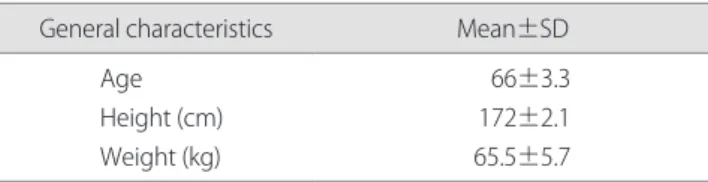
The purpose and methods of the study were explained to the subjects, after which their informed consents were obtained. Below are the general characteristics of the subjects (Table 1).

Table 1. General characteristics of the subjects (n=43)

General characteristics Mean±SD

Age Height (cm) Weight (kg)

66±3.3

172±2.1

65.5±5.7

SD: standard deviation.

(3)

2. Methods

1) Surface electromyogram (EMG) and analytical system To define muscular contraction, the radio surface electrode of the eight-channel wireless EMG system developed by Tringno (Delsys Inc, Boston, Massachusetts, USA) was used. A total of eight Trigno-8 electrodes were used (one for each of the four muscles on both the left and right sides), and the motions of each muscle were collected using an electromyogram wireless EMG, and were then saved.

2) Placement of the electromyograom electrodes and markers To investigate the signal amplitude of the EMG of the lower extremities, the gluteus medius, bicep femoris, vastus lateralis, and vastus medialis were selected. The following electrod- placement positions were marked (using an oil-based pen):

(1) a 2 cm proximal site between the iliac crest and the greater trochanter in the gluteus medius; (2) a site 3~5 cm lateral and superior to the knee joint in the vastus lateralis; (3) a site 2 cm superior and proximal to the corner of the knee joint in the vastus medialis; and (4) a site 15 cm distal to the lateral side of the ischial tuberosity in the bicep femoris.

12

The electrodes were attached to these sites because it is there that the maximum muscular contraction of manual muscle testing was distinctive. To reduce the skin resistance to the surface EMG, the keratin layer of the skin was removed by scrubbing the skin surface with the use of sandpaper, and the fat on the skin surface was removed using rubbing alcohol. Then the surface electrodes were attached.

3) Weight-bearing exercises

13

For the one-leg standing , the subject was made to stand with both upper extremities abducted to the shoulder level, with both feet apart to shoulder width, and with one leg lifted, and he was made to maintain this posture for 5 seconds. This motion was repeated three times.

For the one-leg squatting, the subject was made to main- tain a squatted posture for 5 seconds, with both upper extre- mities abducted to the shoulder level, with both feet apart to shoulder width, and with one leg lifted. This motion was repeated three times.

In these exercises, the subject was instructed to use the

predominant leg to touch the ground, and the feet were in the neutral position. Each weight-bearing exercise was per- formed after one session of preparatory exercise, and the sequence of the test was random.

4) Measurement of the EMG signal amplitude of the maximum isometric contraction

To quantify the action potential of the gluteus medius, bicep femoris, vastus lateralis, and vastus medialis, the activity of each muscle was measured during the maximum isometric contraction in the manual muscle test posture. The muscle activity measured for 5 seconds was converted into root mean square (RMS). Then the mean EMG signal amplitude of 3 seconds was used as maximum voluntary isometric contraction (%MVIC), excluding the first 1 second and the last 1 second of the 5 seconds.

3. Analysis methods

1) Data process and quantification

The muscle activities during the one-leg standing and the one-leg squatting performed three times each were measured. The muscle activities that had been measured for 5 seconds were converted into RMS. Then the mean EMG signal amplitude of 3 seconds was used as %MVIC, excluding the first 1 second and the last 1 second of the 5 seconds.

2) Statistical methods

For the activity of each muscle during weight-bearing exercise, an independent sample t-test was performed, and for the muscle activity during weight-bearing exercise, one- way ANOVA was performed. The statistical significance level was set at p=0.05. For the statistical processing of the data, SPSS ver. 13.0 for Windows (SPSS Inc., Chicago, IL, USA) was used.

III. Results

1. EMG signal amplitude of each muscle during weight- bearing exercise

1) Comparison of the EMG signal amplitudes of the muscles during the one-leg standing

The EMG signal amplitudes of the muscles during the one-

(4)

leg standing were normalized to %MVIC, and then the muscle activities were compared. The muscle activity considerably increased in the gluteus medius during the one-leg standing and were significantly different between the muscles (p<0.01) (Table 2).

2) Comparison of the EMG signal amplitudes of the muscles during the one-leg squatting

The EMG signal amplitudes of the muscles during the one-leg squatting were normalized to %MVIC, and then the muscle activities were compared. The muscle activities considerably increased in the vastus medialis during the one-leg squatting and were significantly different between the muscles (p<0.01) (Table 3).

2. Comparison of the EMG signal amplitudes between the muscles and between weight-bearing exercises The EMG signal amplitudes were normalized to %MVIC and were compared between the muscles and weight-bearing

exercises. The activity of muscles increased more during the one-leg squatting than during the one-leg standing.

The activity of the vastus medialis was higher than that of the three other muscles. The EMG signal amplitudes of the vastus medialis and vastus lateralis muscles were significantly different between the weight-bearing exercises (p<0.01) (Table 4).

IV. Discussion

Functional ADL include up and down the stairs, rounding a curve, sitting down from a standing position, and squatting.

As one gets older, his capability for functional ADL decreases due to the weakened lower-extremity muscle, and injury may occur due to the decreased responsiveness to the unexpected change in weight bearing. For the weakened lower-extremity muscle in the elderly, weight-bearing exercise is an effective rehabilitation program.

15

When faced with obstacles, olderly adopt a slower gait, and dynamic balance ability in olderly

Table 2. Comparison of the EMG signal amplitudes of the muscles during the one-leg standing (Unit: %MVIC) Gluteus medius muscle Bicep femoris muscle Vastus medialis muscle Vastus lateralis muscle F-value

Mean±SD 46.57±20.87 26.19±17.68 35.01±18.03 40.75±19.78 8.185*

SD: standard deviation, EMG: electromyogram, %MVIC: maximum voluntary isometric contraction.

*p<0.01.

Table 3. Comparison of the EMG signal amplitudes of the muscles during the one-leg squatting (Unit: %MVIC) Gluteus medius muscle Bicep femoris muscle Vastus medialis muscle Vastus lateralis muscle F-value

Mean±SD 47.19±20.02 28.70±18.02 54.15±19.22 52.07±27.13 10.895*

SD: standard deviation, EMG: electromyogram, %MVIC: maximum voluntary isometric contraction.

*p<0.01.

Table 4. Comparison of the EMG signal amplitudes between the muscles and between weight-bearing exercises (Unit: %MVIC)

Muscle One-leg standing One-leg squatting t-value

Gluteus medius muscle Bicep femoris muscle Vastus medialis muscle Vastus lateralis muscle

46.57±20.87 26.19±17.68 35.01±18.03 40.75±19.78

47.19±20.02 28.70±18.02 54.15±19.22 52.07±27.13

-0.128 -0.628 -4.258*

-2.004*

Values are number or mean±standard deviation.

EMG: electromyogram, %MVIC: maximum voluntary isometric contraction.

*p<0.01.

(5)

decrease with age.

15

Weight-bearing exercise is a hip abductor and knee ex- tensor strengthening exercise. The hip abductor keeps the trunk upright by stabilizing the pelvis during weight bearing. It also maintains the balance in the walking and static standing posture, and the postural controls in various postures during dynamic movements, allowing the performance of functional tasks.

16

During the one-leg weight-bearing functional activities in sports activities such as soccer and basketball, and in daily activities involving a neutral hip joint position, the activity of the gluteus medius increases. Knee strengthening is for the prevention of and recovery from overuse, contusion, and sports-related injuries, and knee extensor strengthening exercise plays an important role in the maintenance of the alignment in the frontal plane.

17

The abnormal alignment of the frontal plane of the knee causes pain, and knee strengthening exercise can be performed on a selective basis for the prevention of abnormal alignment.

9

Knee extensor strengthening exercise in the form of a non-weight-bearing exercise increases the activity of the vastus lateralis. Squatting as a weight-bearing exercise, however increases the activity of the vastus medialis and is thus desirable for the treatment of knee pain.

18

Unilateral weight-bearing exercise is also a task involving a daily activity, such as up and down the stairs. In up and down the stairs, the muscle activity is different between the vastus medialis and vastus lateralis, and the increased activity of the vastus lateralis, It causes knee pain due to the movement of the patellar lateral side. Thus, strengthening of the overall lower-extremity muscle should be considered to prevent knee pain and injuries in such daily activities as up and down the stairs.

19

The gluteus activity considerably increased more in the one-leg standing than in the one-leg squatting and lateral stepping-up, and one-leg standing was performed to reduce the pain, the functional impairment, and improve the kinematic performance. One-leg squatting and lateral step-up were effective for muscule strengthening, postural stability, and motor regulation in the initial rehabilitation.

13

Step-up exercise is effective for the prevention of falls in the

elderly by improving their balancing capability, and can be easily performed in groups or individually at home.

20

Lateral step-up increased the activity of the gluteus medius more than did forward step-up, and as a hip abductor streng- thening exercise, lateral step-up was shown to be more appro priate than forward step-up.

21

The activities of the gluteus maximus, gluteus medius, and vastus medialis considerably increased more in the one-leg squatting than in the forward step-up and, lateral step-up and one-leg squatting was effective for strengthening the hip and knee muscles.

7

In the comparison of the activities of the gluteus medius muscle during the double-leg standing, one-leg standing, and one-leg squatting, the muscle activity increased more during the one-leg standing than during the double-leg standing, and the one-leg squatting than during the one-leg standing.

This indicated that dynamic exercise increased the muscle activity more than static exercise.

22

In the this study, the activity of the gluteus medius considerably increased during the one-leg standing, indicating that the exercise was effective for strengthening the gluteus medius. The activity of the quadriceps femoris considerably increased during the one-leg squatting, and the activity increased more in the vastus medialis than in the vastus lateralis. It was found that one-leg squatting was effective for strengthening the quadriceps femoris. In addition, the muscle activity increased only in the one-leg squatting exercise and not in the one-leg standing, and increased more in the quadriceps femoris muscle than in the other lower-extremity muscles, indicating that one-leg squatting exercise is more effective as a dynamic exercise for strengthening the lower- extremity muscle compared to the other weight-bearing exercises.

After the performance of the exercise program consisting

of muscular strengthening, balance capability, flexibility,

and endurance exercises by the elderly subjects, and after

the increase in the muscle activity of their lower extremities,

the subjects’ capability for functional ADL also increased.

10

In the this study, the one-leg standing and one-leg squatting

increased the activity of the gluteus medius and quadriceps

femoris, and each weight-bearing exercise was shown

(6)

to be effective for the prevention of and recovery from lower-extremity injury in elderly people, and for muscle strengthening. In addition, the comparison of weight-bearing exercises showed that dynamic exercise is more effective than static exercise for muscle strengthening. It is considered that comparison based on the ages and sexes of the subjects and comparison of the muscle activities during various weight-bearing exercises are required.

This study was performed on a total of 43 elderly males aged 60~70 years. The muscle activities during one-leg standing and one-leg squatting (unilateral weight-bearing exercises), and the muscle activities between various weight-bearing exercises were compared. The activity of the gluteus medius increased during the one-leg standing, and the muscle activities were shown to be significantly different between the muscles (p<0.01). The activity of the quadriceps femoris increased in the one-leg squatting, and the muscle activity increased more in the vastus medialis than in the vastus lateralis. The muscle activities were significantly different between the muscles (p<0.01). In the comparison of the muscle activity between the muscles during weight- bearing exercise, the muscle activity increased during the one-leg squatting exercise, and considerably increased in the vastus medialis of the lower extremities.

Taken together, one-leg standing among the various weight-bearing exercises was shown to be effective for strengthening the gluteus medius, and one-leg squatting for strengthening the quadriceps femoris. It is considered that comparison based on the ages and sexes of the subjects and comparison of the muscle activities during various weight- bearing exercises are required.

Author Contributions

Research design: Kim EJ Acquisition of data: Kim EJ

Analysis and interpretation of data: Kim MS Drafting of the manuscript: Kim EJ

Administrative, technical, and material support: Hwang BY Research supervision: Hwang BY

References

1. Fitzgerald GK. Open versus closed kinetic chain exercise: issues in rehabilitation after anterior cruciate ligament reconstructive surgery. Phys Ther. 1997;77(12):1747-54.

2. Sherrington C, Lord SR, Herbert RD. A randomised trial of weight- bearing versus non-weight-bearing exercise for improving physical ability in inpatients after hip fracture. Aust J Physiother.

2003;49(1):15-22.

3. Olivetti L, Schurr K, Sherrington C et al. A novel weight-bearing strengthening program during rehabilitation of older people is feasible and improves standing up more than a non-weight-bearing strengthening program: a randomised trial. Aust J Physiother.

2007;53(3):147-53.

4. Parkkari J, Kujala UM, Kannus P. Is it possible to prevent sports injuries? Review of controlled clinical trials and recommendations for future work. Sports Med. 2001;31(14):985-95.

5. Madhavan S, Shields RK. Weight-bearing exercise accuracy influences muscle activation strategies of the knee. J Neurol Phys Ther. 2007;31(1):12-9.

6. Schmitz RJ, Riemann BL, Thompson T. Gluteus medius activity during isometric closed-chain hip rotation. J Sport Rehab. 2002;

11(3):179-88.

7. Ayotte NW, Stetts DM, Keenan G et al. Electromyographical analysis of selected lower extremity muscles during 5 unilateral weight- bearing exercises. J Orthop Sports Phys Ther. 2007;37(2):48-55.

8. Distefano LJ, Blackburn JT, Marshall SW et al. Gluteal muscle activation during common therapeutic exercises. J Orthop Sports Phys Ther. 2009;39(7):532-40.

9. Serrao FV, Cabral CM, Berzin F et al. Effect of tibia rotation on the electromyographical activity of the vastus medialis oblique and vastus lateralis longus muscles during isometric leg press. Physical Therapy in sport. 2005;6:15-23

10. Kim HH, Song CH. The effect of knee and foot position on EMG activity and ratio of vastus medialis oblique and vastus lateralis during squat exercise. J Muscle Joint Health. 2010;17(2):142-50.

11. Kim HR. Causality analysis of muscle activation physical strength and daily living abilities change among the elderly due to a health promotion exercise program. Korean Soc Phys Ther.

2010;22(4):73-81.

12. Cram JR, Kasman GS, Holtz J. Introduction to Surface Eltro- myography. Maryland, Aspen Pub. (1998).

13. O’Sullivan K, Smith SM, Sainsbury D. Electromyographic analysis of the three subdivisions of gluteus medius during weight- bearing exercises. Sports Med Arthrosc Rehabil Ther Technol.

2010;2(17):1758-2555.

14. Madhavan S, Burkart S, Baggett G et al. Influence of age on neuromuscular control during a dynamic weight-bearing task. J Aging Phys Act. 2009;17(3):327-43.

15. Park S, Park JW. The relationship between dynamic balance

measures and center of pressure dispacement time in older adults

during an obstacle crossing. J Korean Soc Phys Ther. 2011;23(3):1-5

16. Earl JE. Gluteus medius activity during three variations of isometric

(7)

single-leg stance. J Sport Rehab. 2005;14(1):1-11.

17. Bolgla LA, Uhl TL. Electromyographic analysis of hip rehabilitation exercises in a group of healthy subjects. J Orthop Sports Phys Ther.

2005;35(8):487-94.

18. Irish SE, Millward AJ, Wride J et al. The effect of closed-kinetic chain exercises and open-kinetic chain exercise on the muscle activity of vastus medialis oblique and vastus lateralis. J Strength Cond Res. 2010;24(5):1256-62.

19. Oh JS, Kwon OY, Yi CH et al. Effects of hip internal rotation on knee extensor and hip abductor electromyographic activity during

stair up and down. Phys Ther Korea. 2008;15(2):54-63.

20. Day L, Fildes B, Gordon I et al. Randomised factorial trial of falls pre vention among older people living in their own homes. BMJ.

2002;325(7356):128.

21. Mercer VS, Gross MT, Sharma S et al. Comparison of gluteus medius muscle electromyographic activity during forward and lateral step- up exercises in older adults. Phys Ther. 2009;89(11):1205-14.

22. Krause DA, Jacobs RS, Pilger KE et al. Electromyographic analysis

of the gluteus medius in five weight-bearing exercises. J Strength

Cond Res. 2009;23(9):2689-94.

수치

Table 1. General characteristics of the subjects (n=43)
Table 4.  Comparison of the EMG signal amplitudes between the muscles and between weight-bearing exercises   (Unit: %MVIC)

참조

관련 문서

Weight, body fat percentage and body mass index (BMI), except only in the exercise group in comparison to the two groups after the experiment than before

Changes in functional physical fitness, after the experiment compared to before the experiment in the group of exercise, showed a significant difference in

In the change of physical strength, The exercise group showed statistically significant differences in muscle strength(right), muscle strength(left),

glen plaids 글렌 플레이드와 캐시미어 카디건, 캐리지 코트, 그리고 케이프 -&gt; 격자무늬의 캐시미어로 된 승마용 바지, 마부용 코트, 말 그림이 수

다양한 번역 작품과 번역에 관한 책을 읽는 것은 단순히 다른 시대와 언어, 문화의 교류를 넘어 지구촌이 서로 이해하고 하나가

In view of the essential relevance of mission in history (and not only in the history of religion), on the one hand, and in theology (and not only in missiology),

The index is calculated with the latest 5-year auction data of 400 selected Classic, Modern, and Contemporary Chinese painting artists from major auction houses..

core exercise program showed not only increasing peak torque of the right leg, left leg in Hip Extension of exercise group but also increasing peak torque of the right leg, left