Pain Disability of Orofacial Pain Patients
Se-Heon Choi, D.D.S,M.S.D., Ki-Suk Kim, D.D.S.,M.S.D.,Ph.D., Mee-Eun Kim, D.D.S.,M.S.D.,Ph.D.
Department of Oral Medicine, School of Dentistry, Dankook University
As Pain is a comprehensive, biopsychosocial phenomenon, improved understanding and successful management of pain need assessment of health-related quality of life and psychological states. The purpose of this study was to evaluate pain severity and pain-related interference to daily lives for patients with non-dental, orofacial pain(OFP) and a possible relation of OFP with psychological morbidity. Relation with such factors as gender, age, pain duration and diagnosis was also assessed.
Inclusion criteria was all new patients with non-dental OFP attending the oral medicine∙orofacial pain clinic of Dankook University Dental Hospital over 3 months' period, who completed the questionnaires of the Brief Pain Inventory (BPI) and Hospital Anxiety and Depression Scale (HADS). Prior to the first consultation, the patients were asked to fill out the questionnaire in the waiting room and were diagnosed through consultation and clinical examination. Total subjects were 163 with M:F ratio of 1:1.5 and mean age of 34.6±17.7 years. Mean duration of pain was 13.3±26.2 months and all patients were divided into; Trigeminal Neuralgia group (TN, N=8), Neuropathic Pain group (NeP, N=9), Persistent Idiopathic Facial Pain group (PIFP, N=8), and Temporomandibular Disorders group (TMD, N=138), subdivided into muscle problem (TMD-m, N=73), joint problem (TMD-j, N=24) and muscle-joint combined problem (TMD-c, N=41).
OFP patients showed moderate pain severity and moderate pain-related interference. There was no gender difference in overall pain severity and interference and levels of anxiety and depression. Elderly patients aged ≥ 60 years showed higher pain severity (p<0.05). Patients with chronic pain ≥ 3 months reported more increased level of anxiety and depression than those with acute pain (p<0.05). Compared to TMD patients, patients with TN, NeP and PIFP suffered from higher level of pain and pain-related interference and reported higher level of anxiety and depression (p<0.05).
Pain interference was closely correlated with their pain severity and with psychometric properties such as anxiety and depression. Pain severity was weakly correlated with levels of anxiety and depression.
The results suggest a need for psychosocial assessment and support for successful management of OFP in addition to control of pain itself.
Key words: Orofacial pain, Pain disability, BPI, HADS, Quality of life
Corresponding author: Mee-Eun Kim
Department of Oral Medicine, Dankook University, School of Dentistry
Sinbu-dong San 7-1 Cheonan 330-716 Tel: 041-550-1915
Fax: 041-556-9665
Email: [email protected]
Received: 2009-05-07 Accepted: 2009-06-13
I. INTRODUCTION
Pain is an unpleasant experience that perhaps
motivates an individual far greater than any other
life experience. Pain seriously impairs the lives of
millions of people around the world.
1)In particular,
chronic or persistent pain is a major problem for
patients and poses a massive socio-economic
burden for health services and the worldwide
community.
2)In Western Europe, chronic pain prevalence is 1 in 5 and 70 million adults suffer persistent pain and one-third of householders are affected by pain.
One-third of them reported pain affecting employment and one-fourth reported losing a job due to pain while one-fourth were depressed because of pain.
3)Chronic pain is common, it affects the working population, it often lasts for many years and it impacts on most aspects of function.
Unrelieved chronic pain causes interference with daily activities, loss of sleep and increased sickness absence from education or paid employment.
2)It is important to address the physical and psychosocial aspects of any chronic pain. In the mid-1980s, work by Waddell and Main
4)revealed that the disability associated with chronic non-specific low pack pain is only partly explicable in terms of physical factors found on examination.
They discovered that psychological factors almost as significant as contributors to the level of disability.
Orofacial pain (OFP), defined as pain related to the face or mouth, is a common symptom in the population and in a significant proportion of cases it can become chronic and disabling.
5-7)OFP can be the presenting, and sometimes the only, complaint of many disorders that originate from cranial structures. In the clinical setting, the identification of the underlying cause, and therefore the decision about the investigations needed, occasionally represents a challenge, even for experienced physicians.
8)Although the majority of OFP which dentists encounter is of dental origin, recent studies in the UK have shown that chronic OFP of non-dental origin has a prevalence of 7%, and many of them will have chronic pain in other parts of the body.
9)Chung et al
10)reported the 6-month prevalence of joint pain (15.5%), face pain (9.3%), toothache (26.8%), oral sore (26.2%) and burning mouth (14.2%) through a telephone survey over 1,032 Korean elders aged ≥ 55 years, which was a relative higher proportion with OFP symptoms than
in the Western population. According to the study, 49.9% of subjects with face pain had high level of disability. A study
11)on the social impact of OFP in an industrial Malaysian population showed high prevalence of OFP with 43.6% of the total subjects and that pain affected the quality of life through loss of sleep and of productivity through sick leave.
Both of the two studies included dental pain.
As Pain is a comprehensive, biopsychosocial phenomenon, improved understanding and successful management of pain need assessment of health-related quality of life and psychological states. However, there is still lacking such studies over a variety of non-dental OFP conditions.
The purpose of this study was to evaluate pain severity and pain-related interference to daily lives for patients with non-dental, OFP and a possible relation of OFP with psychological morbidity.
Relation with factors such as gender, age, pain duration and diagnosis was also assessed.
Ⅱ. MATERIALS AND METHODS 1. Participants
Inclusion criterion was all new patients attending the oral medicine
∙orofacial pain clinic of Dankook University Dental Hospital, Cheonan, Rep. of Korea over 3 months' period in 2008, who completed questionnaires. Prior to the first consultation, all new patients in the waiting room were asked to fill in the Brief Pain Inventory (BPI) and Hospital Anxiety and Depression Scale (HADS). All of them were examined clinically and diagnosed. Written informed consent was obtained for collecting data.
We exclude those who did not fully complete the questionnaires; with significant mental disorders;
who were considered to have dental or
psychological pain. Those who disagreed with
participation in the study were also excluded. In
accordance to inclusion and exclusion criteria, total
number of the subjects were 163 with a ratio of
male to female of 1:1.5 and mean age of 34.6
±17.7
years (Min= 9 years, Max=80 years)
2. Methods
Information collected retrospectively from clinical records of the eligible patients included scores of pain severity and interference from BPI and anxiety and depression subscales from HADS, duration of pain and diagnosis.
BPI with an 11-item numerical rating scale is a short, self-administered questionnaire designed to assess the severity and impact of pain experienced.
12)The BPI Pain severity score is the mean of the four BPI pain ratings: worst, least, average and current pain. The BPI Pain interference includes 7 items to determine impact of pain on patient's general activity, mood, walking, work, relation with others, sleep, and enjoyment of life, which were summed up and averaged. Korean version of the BPI was used and the question asking interference with walking ability was replaced by interference with chewing ability because OFP is hardly considered to be related with walking ability.
Psychological morbidity were assessed by HADS, a 14-tiem self-report screening scale that was originally developed to indicate the possible presence of anxiety and depression states in the setting of a medical nonpsychiatric outpatient clinic.
13)HADS consists of a 7-item anxiety subscale (HAD-A) and a 7-item depression subscale (HAD-D). Each item scores on a 4-point Likert scale, giving maximum subscale scores of 21 for depression and anxiety, respectively. Korean version of HADS was used in this study.
Duration of OFP was categorized into acute and chronic; < 3 months as acute, and ≥ 3 months as chronic. Mean pain duration for all subjects was 13.3
±26.2 months, ranging from 0.02 month to 120 months.
According to diagnostic criteria for OFP proposed by both the International Association for the Study of Pain (IASP) and the International Headache Society (HIS) and the Research Criteria for TMD (RDC/TMD), we divided diagnosis groups into;
Trigeminal Neuralgia group (TN, N=8), Neuropathic
Pain group (NeP, N=9), Persistent Idiopathic Facial Pain (PIFP, N=8), and Temporomandibular Disorders group (TMD, N=138). As 84.7% of total was TMD patients and TMD is considered a heterogeneous disorder, based on the structures affected, TMD were subdivided into TMD with muscle problem (TMD-m, N=73), TMD with joint problem (TMD-j, N=24) and TMD with muscle-joint combined problem (TMD-c, N=41).
NeP comprised postoperative trigeminal neuropathic pain (N=4), atypical odontalgia (N=1) and burning mouth syndrome (BMS, N=4). Those suffering from continuous OFP without any relevant abnormality were allocated to PIFP group (ICHD-II classification)
14)3. Statistical Analysis
Pearson's Correlation Coefficients were calculated to investigate any possible relation of pain severity to interference, and to psychometric properties such as anxiety and depression.
t-tests, one-way ANOVA and multiple
comparison t-tests were used to determine whether such factors as gender, age, pain duration and diagnosis affected pain severity and interferences and psychometric properties. Level of significance was defined as p<0.05.
Ⅲ. RESULTS
Table 1 shows pain severity and interference and psychometric properties of all OFP patients in this study. The OFP patients had moderate pain severity of 5.5
±2.7 for worst pain and 4.1
±2.4 for average pain and suffered from mild to moderate level of interference of their daily lives.
Interferences on mood, chewing ability were greater than any other activities. HADS scores were 9.4
±4.8 for anxiety and 8.5
±4.2 for depression.
There was no significant gender difference in
pain severity and interference and levels of anxiety
and depression (Table 2) but women reported the
higher intensity of the worst pain than men did
Pain severity Mean SD
Max. Pain 5.5 2.7
Ave. Pain 4.1 2.4
Pain interference
General activity 3.7 2.9
Mood 5.0 3.1
Chewing ability 5.3 3.2
Normal work 3.5 3.0
Sleep 4.2 3.4
Enjoyment of life 4.2 3.2 HADS
Anxiety subscale 9.4 4.8 Depression subscale 8.5 4.2 HADS: Hospital Anxiety and Depression Scale.
Table 1. Pain severity and interference and psychometric properties of OFP patients.
(6.2
±2.6 for women, 5.1
±2.7 for men, p<0.05, t-test).
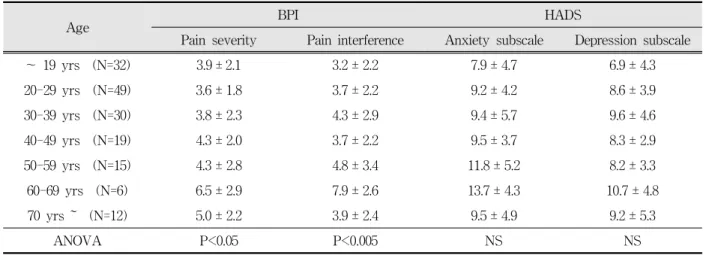
Significant difference of pain severity and interference was found between age groups (p<0.05, Table 3). Elderly patients aged ≥60 years showed higher pain severity and interference compared to any other age groups. Age difference was not found in the levels of anxiety and depression although the patients in sixties showed the highest anxiety and depression scores (Table 3).
gender BPI HADS
Pain severity Pain interference Anxiety subscale Depression subscale
Men (N=65) 4.3 ± 2.2 4.2 ± 2.6 8.9 ± 4.5 8.0 ± 4.1
Women (N=98) 3.9 ± 2.2 3.9 ± 2.6 9.8 ± 4.9 8.8 ± 4.2
t-test NS NS NS NS
NS: not significant, BPI: Brief Pain Inventory; HADS: Hospital Anxiety and Depression Scale.
Table 2.Comparison of pain severity and interference and psychometric properties between gender groups.
When pain < 3 months was defined as acute pain, pain severity and interference was not affected by pain duration but psychometric properties were differed between acute and chronic pain groups.
Anxiety and depression subscales of HADS were significantly higher in the chronic group (p<0.05, Table 4).
Various OFP groups showed significant difference in pain severity and interference (Table 5, p<0.005). TN group indicated the highest pain severity and interference, followed by NeP, PIFP, and TMD-c. The lowest pain severity and interference was observed in TMD-j. Psychometric properties also significantly differed in OFP groups (p<0.05, Table 5). Anxiety was the highest in PIFP, followed by TN, NeP, and TMD-m in order and depression subscales was the highest in TN, followed by PIFP, TMD-m, TMD-c and NeP. The lowest scores of anxiety and depression was TMD-j group. PIFP group had the second highest interference due to pain, with high psychological morbidity.
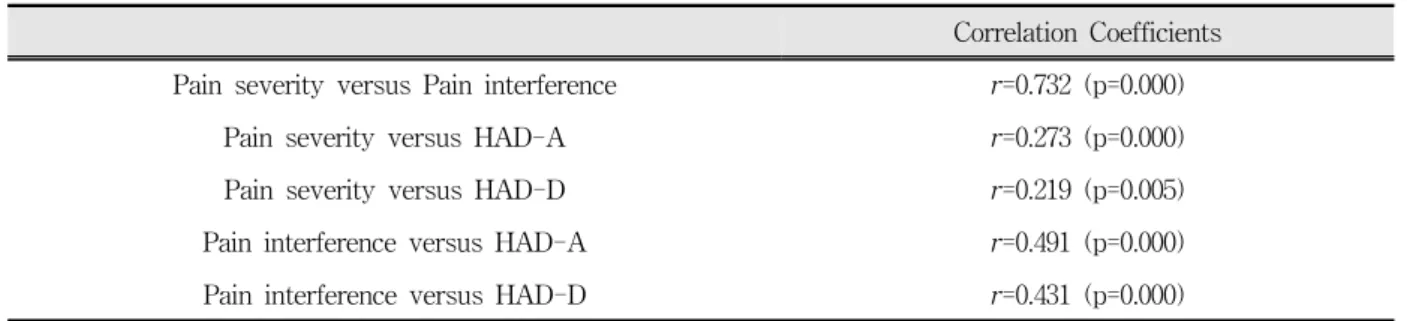
Pain severity and interference was strongly correlated but pain severity and psychometric properties such as anxiety and depression weakly correlated (Table 6, p<0.05). Pain interference and psychometric properties was moderately correlated (p<0.05).
Ⅳ. DISCUSSION
The experience of pain has consequences for
sensory, cognitive, affective, immune, motor,
Age BPI HADS
Pain severity Pain interference Anxiety subscale Depression subscale
~ 19 yrs (N=32) 3.9 ± 2.1 3.2 ± 2.2 7.9 ± 4.7 6.9 ± 4.3
20-29 yrs (N=49) 3.6 ± 1.8 3.7 ± 2.2 9.2 ± 4.2 8.6 ± 3.9
30-39 yrs (N=30) 3.8 ± 2.3 4.3 ± 2.9 9.4 ± 5.7 9.6 ± 4.6
40-49 yrs (N=19) 4.3 ± 2.0 3.7 ± 2.2 9.5 ± 3.7 8.3 ± 2.9
50-59 yrs (N=15) 4.3 ± 2.8 4.8 ± 3.4 11.8 ± 5.2 8.2 ± 3.3
60-69 yrs (N=6) 6.5 ± 2.9 7.9 ± 2.6 13.7 ± 4.3 10.7 ± 4.8
70 yrs ~ (N=12) 5.0 ± 2.2 3.9 ± 2.4 9.5 ± 4.9 9.2 ± 5.3
ANOVA P<0.05 P<0.005 NS NS
NS: not significant, BPI: Brief Pain Inventory; HADS: Hospital Anxiety and Depression Scale.
Table 3. Comparison of pain severity and interference and psychometric properties between age groups.
Pain duration BPI HADS
Pain severity Pain interference Anxiety subscale Depression subscale
Acute (N=98) 4.1 ± 2.1 3.8 ± 2.6 8.8 ± 4.6 7.9 ± 4.0
Chronic (N=65) 3.9 ± 2.2 4.3 ± 2.6 10.4 ± 4.9 9.3 ± 4.2
t-test NS NS P<0.05 P<0.05
NS: not significant, BPI: Brief Pain Inventory; HADS: Hospital Anxiety and Depression Scale.
Table 4. Comparison of pain severity and interference and psychometric properties between acute and chronic groups.
Diagnosis BPI HADS
Pain severity Pain interference Anxiety subscale Depression subscale
TN (N=8) 6.3 ± 2.5 6.5 ± 2.9 11.3 ± 4.7 11.5 ± 3.4
NeP (N=9) 5.4 ± 2.3 5.1 ± 2.9 10.9 ± 4.7 8.1 ± 5.6
PIFP (N=8) 4.4 ± 3.1 5.7 ± 3.0 12.3 ± 5.3 10.6 ± 4.0
TMD-m (N=73) 3.9 ± 1.8 3.9 ± 2.4 10.0 ± 4.7 8.8 ± 3.9
TMD-j (N=24) 2.7 ± 2.2 2.6 ± 2.5 6.9 ± 4.2 6.5 ± 3.6
TMD-c (N=41) 4.2 ± 2.1 3.9 ± 2.3 8.7 ± 4.6 8.2 ± 4.4
ANOVA P<0.005 P<0.005 P<0.05 0<0.05
BPI: Brief Pain Inventory; HADS: Hospital Anxiety and Depression Scale.
TN: trigeminal neuralgia; NeP: neuropathic trigeminal pain;
PIFP: persistent idiopathic facial pain; TMD-m: TMD with muscle problem;
TMD-j; TMD with joint problem; TMD-c: TMD with muscle-joint combined problem.
Table 5. Comparison of pain severity and interference and psychometric properties between various OFP disorder groups.
Correlation Coefficients Pain severity versus Pain interference r=0.732 (p=0.000)
Pain severity versus HAD-A r=0.273 (p=0.000)
Pain severity versus HAD-D r=0.219 (p=0.005)
Pain interference versus HAD-A r=0.491 (p=0.000)
Pain interference versus HAD-D r=0.431 (p=0.000)
Pearson’s Correlation. HAD-A: Anxiety subscale of HADS, HAD-D: Depression subscale of HADS.
Table 6. Correlation of pain severity, interference and psychometric properties
autonomic and reproductive functions and some of the effects are either the direct result of pain or a consequence of the activation of the body's stress-response system. However it remains uncertain whether and exactly how pathogenetic mechanisms play a role in pain, which causes profound confusion in understanding and managing the pain.
15)It is generally accepted that gender differences exist with respect to experience and perception of pain. Women report more pain, in more bodily areas, with greater frequency and for longer duration when compared to men, which may be explained by differences between men and women's emotional and coping responses to pain.
16)This study showed different results that there was no gender difference not only in pain severity and interferences but also in psychological properties for OFP patients. However, it is noteworthy that women reported significantly higher severity of the worst pain than men did (t-test, p<0.05).
Contrary to gender, age affected pain severity and interferences (p<0.05, Table 2). Elderly patients such as their sixties and seventies showed higher pain severity and interference compared to any other age groups. Particularly, OFP patients in sixties had the highest anxiety and depression subscale scores in addition to the highest pain severity and interference. Relatively high proportion of Korean elderly people ≥ 55 year old reported OFP symptoms and joint pain, burning mouth, and toothache of them strongly affected their social or
daily activities.
10)HADS scores were not significantly different in overall age groups.
Spinhoven et al
17)indicated weak correlation between HADS scores and age in different groups of Dutch subjects.
Chronic OFP patients in this study reported
significantly higher HADS scores than those with
acute pain < 3 months (p<0.05, Table 4) although
pain severity and interferences were not affected by
pain duration. It is suggested that a range of
psychological factors play a major part in the
development of disability. Negative thoughts,
attitudes and emotions (emotional distress) are
important factors in the transition from acute to
chronic pain states. Chronic pain may lead to
depression, anxiety, anger and other psychological
influence on pain and disability; these effects may
be greater than biomedical factors. However there
has been no clear conclusion about cause and effect
regarding chronic pain and psychological factors.
2)The conversion from acute to chronic pain may
result from the body's inability to restore normal
physiological function.
18)Psychological factors are
considered to be a major issue in the onset,
exacerbation or perpetuation of the pain.
19)Important psychological factors promoting the
process of conversion from acute to chronic pain
and disability include beliefs about, and attitudes
towards, pain, coping strategies, catastrophization
and emotional distress. There is often prolonged
disability and sometimes problem drug use in those
with chronic pain.
2)Studies
7)showed that chronic
pain patients also report higher levels of pain and disability compared to those with acute pain and are more likely to seek treatment and take medication. Wilson et al
20)suggested that patients with nonmalignant chronic pain appear to have depressive symptoms in about 20% of the cases and disturbed sleep in 50-70% of the cases.
Overall patients with OFP in this study showed moderate pain severity and pain-related interference and various OFP disorder groups were significantly different in pain severity and interference (Table 5, p<0.005). As expected, TN group had the highest pain severity and interference and depression scores. As reported earlier, pain severity was strongly correlated with pain interference but weakly correlated with level of anxiety and depression (Table 6). Interestingly, PIFP group had the highest anxiety scores, in spite of lower pain severity than those of TN and NeP groups. This finding may reflect that they had not been explained properly about their pain and cause.
Earlier referral and diagnosis can reduce a possibility to develop their pain-related interference and psychological morbidity related with pain problem.
Heterogeneous TMD group showed relatively lower pain severity and interference and psychometric properties than other OFP groups such as TN, NeP and PIFP groups and TMD having both muscle and joint problems reported the highest pain severity and interference among TMD subgroups while TMD with joint problem had the lowest scores. This finding was partly supported by a study by Jung et al about quality of life over 61 TMD patients, which presented with patients with masticatory muscle pain were negatively affected on quality of life and interfered compared to those with intracapsular complaint of TMJ.
21)45.8% of Korean elderly subjects with self- reporting joint pain reported high levels of disability
10)which is higher than the 20% in the US population or 13% in the Swedish population.
22)Forssell et al
23)reported only 6% of 93 TMD patients presenting with high level of disability in a
study using the Graded Chronic Pain Scales and most of Grade I (low pain intensity and low level of disability) were revealed as 'adaptive copers' characterized by low levels of emotional distress and life interference by pain and high levels of perceived pain control and general activity. In a study over TMD patients, Kafas and Leeson
24)suggested that when pain affects eating and chewing, enjoyment of life is decreased in an almost directly proportional manner. This can be explained by the importance of jaw disability not only from the perspective of natural metabolic needs but also the significance of enjoyment of life in both acute and chronic groups. The explanation may also be applied to other OFP conditions with higher pain-related interferences.
This study evaluated pain disability and psychological morbidity over various OFP pain disorders including TN, NeP and PIFP. Previous researches regarding pain disability have been performed over TMD patients. However, weakness of this study is proportion of various OFP disorders. As more than 80% of the participants in this study were TMD patients, relatively small numbers of other OFP conditions needs a future research with large population sample in each pain groups. A further study is also needed to evaluate whether reduced pain with proper treatment improves physical and psychological disability or vise versa.
V. CONCLUSIONS
Non-dental OFP patients showed moderate pain severity and moderate pain-related interference.
There was no gender difference in overall pain severity and interference and levels of anxiety and depression. Elderly patients aged ≥ 60 years showed higher pain severity.
Chronic pain ≥ 3 months appears to be related
with increased level of anxiety and depression than
those with acute pain. Compared to TMD patients,
patients with TN, NeP and PIFP suffered from
higher level of pain and pain-related interference
and reported higher level of anxiety and depression.
Pain interference was closely correlated with their pain severity and with psychometric properties such as anxiety and depression while levels of anxiety and depression were weakly correlated with pain severity.
The results suggest a need of psychosocial assessment and support for successful management of OFP in addition to control of pain itself.
REFERENCES
1. Okeson JP. Bell's orofacial pains: The clinical management of orofacial pain. 6th ed., Chicago, 2005, Quintessence, pp. 3.
2. Simpson KH. Chronic non-cancer pain In: Chronic pain. Dickman A & Simpson KH eds. Oxford, 2008, Oxford University Press.
3. Breivik H, Collett B, Ventafridda V et al. Survey of chronic pain in Europe: prevalence, impact on daily life, and treatment. Eur J Pain 2006;10:287-333.
4. Main CJ, Waddell G. Behavioural responses to examination. A reappraisal of the interpretation of non-organic signs. Spine 1998:23:2367-2371.
5. Aggarwal VR, McBeth J, Zakrzewska JM, Lunt M, Macfarlane GJ. Are reports of mechanical dysfunction in chronic oro-facial pain related to somatisation? A population based study. Eur J Pain 2008;12:501-507.
6. Murray H, Locker D, Mock D, Tenenbaum HC. Pain and the quality of life in patients referred to a craniofacial pain unit. J Orofac Pain 1996;10:316-323.
7. Macfarlane TV, Blinkhorn AS, Davies RM, Kincey J, Worthington HV. Oro-facial pain in the community:
prevalence and associated impact. Community Dent Oral Epidemiol 2002;30:52-60.
8. Siccoli MM, Bassetti CI, Sndor PS. Facial Pain:
clinical differential diagnosis. Lancet Neurol 2006;5:
257-267.
9. Zakrzewska JM. Diangosis and management of non-dental orofacial pain. Dent Update 2007;34:134- 139.
10. Chung JW, Kim JH, Kim HD et al. Chronic orofacial pain among Korean elders: prevalence, and impact using the graded chronic pain scale. Pain 2004;112:
164-170.
11. Jaafar N, Razak IA, Zain RB. The social impact of oral and facial pain in an industrial population. Ann Acad med Singapore 1989;18:553-555.
12. Radbruch L, Loick G, Kiencke P et al. Validation of the German version of the Brief Pain Inventory. J Pain Symptom Managel 1999;18:180-187.
13. Zigmond AS and Snaith RP. The Hospital Anxiety and Depression Scale. Acta Psychiatr Scand 1983;67:361-370.
14. Headache Classification Subcommittee of the International headache Society. The International Classification of Headache Disorders, 2nd ed.
Cephalagia 2004;24(suppl 1).
15. Stohler CS. Chronic orofacial pain: Is the puzzle unraveling? Journal of Dental Education 2001;65:
1383-1392.
16. Keogh E, McCracken LM, Eccleston C. Do men and women differ in their response to interdisciplinary chronic pain management? Pain 2005;114:37-46.
17. Spinhoven P, Ormel J, Sloekers PP et al. A validation study of the Hospital Anxiety and Depression Scale (HADS) in different groups of Dutch subjects.
Psycho Med 1997;27:363-370.
18. Loeser JD, Melzack R. Pain: an overview. Lancet 1999;353:1607-1609.
19. Auerbach SM, Laskin DM, Frantsve LM, Orr T.
Depression, pain, exposure to stressful life events, and long-term outcomes in temporomandibular disorders patients. J Oral Maxillofac Surg 2001;59:
628-633.
20. Wikson KG, Eriksson MY, D'Eon JL, Mikail SF, Emery PC. Major depression and insomnia in chronic pain. Clin J Pain 2002;18:77-83.
21. Jung JS, Hur YK, Choi JK. Evaluation of quality of life in patients with temporomandibular disorders.
Korean J Oral Med 2006;31:127-139.
22. List T. Dworkin SF. Comparing TMD diagnoses and clinical findings at Swedish and US TMD centers using research diagnostic criteria for temporoman- dibular disorders. J Orofac Pain 1996;10:240-252.
23. Forssell H, Santalahti P, Puukka P, Talo S. Searching for an assessment instrument to determine temporomandibular disorders pain profiles for the purposes of primary health care. Int J of Rehabil Res 2005;28:203-209.
24. Kafas P, Leeson R. Assessment of pain in temporomandibular disorders: the bio-psychosocial complexity. Int J Oral Maxillofac Surg 2006;35:
145-149.
국문초록
구강안면통증 환자의 통증활동제한
단국대학교 치과대학 구강내과학교실
최세헌․김기석․김미은
통증은 포괄적이고 생리적, 심리적, 사회적 복합현상이기 때문에 통증을 보다 잘 이해하고 더 나은 치료를 위해서는 환자의 삶의 질과 심리적 상태에 대한 평가가 필요하다. 본 연구는 비치성 구강안면통증 환자들이 느끼는 통증의 정도와 통증으로 인한 일상생활의 제한(pain interference)을 평가하고 심리적 요인과의 관련성을 평가하고자 하였다. 또한 성별 및 연령, 통증 의 지속기간과 진단에 따른 차이를 함께 평가하고자 하였다.
연구대상은 3개월간 단국대학교 부속 치과병원 구강내과구강안면통증클리닉에 내원한 초진환자들 중에서 간이동통목록 (Brief Pain Inventory, BPI)과 병원불안우울척도(Hospital Anxiety and Depression Scale, HADS)의 두 가지 설문지에 답하 고, 비치성 구강안면통증으로 진단받은 환자들을 대상으로 하였다. 환자들은 의사와의 첫 면담 전 대기실에서 설문지를 작성 하도록 하였고, 작성 후에는 진료실에서 임상검사와 면담을 통해 진단을 내렸다. 총 163명의 환자들이 연구에 포함되었는데, 남녀비 1:1.5, 평균 연령 34.6세, 평균 통증지속기간 13.3개월이었다. 진단에 따라 삼차신경통군(Trigeminal Neuralgia group;
TN), 신경병성동통군(Neuropathic Pain group; NeP), 만성안면통증군(Persistent Idiopathic Facial Pain; PIFP), 턱관절장애 군(TMD)으로 나누고 TMD는 저작근장애군(TMD-m), 관절장애군(TMD-j) 및 근육-관절 복합군(TMD-c)으로 세분하였다.
비치성 구강안면통증 환자들은 중등도의 통증과 중등도의 일상생활 제한을 보였다. 3개월 이상의 만성통증을 가진 환자들은 급성군에 비해 높은 수준의 불안과 우울척도를 보였다(p<0.05). TMD 환자들보다 삼차신경통, 만성안면통증 및 신경병성통 증 환자들의 통증이 심하고 pain interference가 컸으며 불안과 우울척도도 높았다 (p<0.05). Pain interference는 통증의 강도 과 강한 상관관계를 보였고 우울 및 불안척도와 중등도의 상관관계를 보였다 (p=0.000). 우울 및 불안척도는 통증의 강도와 약한 상관관계를 보였다 (p<0.05).
결론적으로 구강안면통증의 성공적인 치료를 위해서는 통증 자체의 조절뿐 아니라 통증으로 인한 심리적, 사회적 영향에 대한 평가와 심리사회적 측면에서의 지원(psychosocial support)가 필요함을 알 수 있다.
주제어: 구강안면통증, 통증활동제한, 간이동통목록, 병원불안우울척도, 삶의 질