106
Available online at http://www.kccp.or.kr pISSN: 1226-6051
Clopidogrel에 Proton Pump Inhibitors 병용 시 급성 관동맥 증후군 환자의 심장관련 부작용에 미치는 영향
김수현
1·이유정
2*
1여의도성모병원 약제팀, 2강원대학교 약학대학
(2013년 12월 12일 접수·2014년 6월 6일 수정·2014년 6월 13일 승인)
Influence of the Concomitant Use of Clopidogrel and Proton Pump Inhibitors on Adverse Cardiovascular Events in
Korean Patients with Acute Coronary Syndrome
Su Hyun Kim
1and Yu Jeung Lee
2*
1Department of Pharmacy, Yeouido St. Mary’s Hospital, Seoul, Korea
2College of Pharmacy, Kangwon National University, Korea (Received December 12, 2013·Revised June 6, 2014·Accepted June 13, 2014)
Purpose: Recent investigations suggest that the antiplatelet effect of clopidogrel may be decreased when this medication is taken together with certain proton pump inhibitors (PPIs). However, there has been no study conducted in Korea regarding the clinical effect of clopidogrel-PPI interaction. This study targeted patients who received stents to investigate the effect of the concomitant use of clopidogrel and PPIs on the occur- rence of adverse cardiovascular events in Korean patients. Methods: The patients who received a stent insertion at the Yeouido St. Mary’s Hospital between January 2010 and April 2011 were included. The patients were divided into two groups, clopidogrel and clopidogrel + PPI, and followed for 12 months after the date of stent insertion using prescription history and medical records. The recurrence rates of the car- diovascular events among the two patient groups were statistically analyzed. Results: There was no differ- ence between the two groups in the basic characteristics of the 157 patients in the clopidogrel group and the 62 patients in the clopidogrel + PPI group. Simple logistic regression showed a significantly higher rate of re-hospitalization in the clopidogrel + PPI group (OR=1.893, 95% CI 1.040-3.445, p=0.037). However, the results of the multivariate logistic regression of the variables found to have statistical significance by crosstabulation showed no significant difference in the rate of adverse cardiovascular events or re-hospitaliza- tion between the two groups. Conclusions: There was no significant difference between the clopidogrel and clopidogrel+PPI group among new patients with cardiovascular stents with respect to the occurrence of revascularization procedures, stent thrombosis, or chest pain, or with respect to the re-hospitalization rate for all cardiovascular events.
□ Key words - clopidogrel, proton pump inhibitors, interaction, adverse cardiovascular events, acute coronary syndrome
Acute coronary syndrome is an ischemic heart disease that is accompanied by severe chest pain due to the stenosis or occlusion of the coronary arteries, leading to decreased myocardial perfusion. This condition includes unstable angina and myocardial infarctions (MIs) with or without ST eleva-
tion on echocardiogram (STEMI or NSTEMI, respectively), and severe cases can lead to death. In the United States, approximately 780,000 people suffer from acute coronary syndrome, with 470,000 recurrences. Furthermore, patients with coronary artery diseases now represent over half of the cardiovascular disease patients under the age of 75.
1)As a treatment for acute coronary syndrome, medical revascularization can be implemented via antiplatelet agents, anticoagulants, anti-ischemic drugs, percutaneous coronary intervention (PCI), or coronary artery bypass graft
Correspondence to : Yu Jeung Lee
Department of Clinical Pharmacy, College of Pharmacy, Kangwon National University, Chuncheon-si, Gangwon-do 200-701, Korea Tel: +82-33-250-6913, Fax: +82-33-255-7865 E-mail: [email protected]
(CABG). Of the interventional procedures used in coro- nary arteries, stenting has a high success rate and a low rate of restenosis and is thus performed frequently.
2-4)American College of Cardiology/American Heart Asso- ciation (ACC/AHA) guidelines recommend a concomitant treatment of the antiplatelet agents aspirin and clopidogrel for a minimum of 12 months after PCI.
5, 6)A concomitant treatment with these two drugs reduces the risk of major adverse cardiac events (MACEs) among patients with PCI.
7)Proton pump inhibitors (PPIs) have been frequently pre- scribed to reduce the risk of GI bleeding in patients receiv- ing aspirin and clopidogrel. However, studies conducted in the past several years suggest that PPIs can reduce the antiplatelet effect of clopidogrel.
8)The US Food and Drug Administration (FDA) published an early commu- nication on the safety review of the potential interaction between clopidogrel and PPIs.
Clopidogrel is a pro-drug that is metabolised by the cyto- chrome P450 (CYP) 2C19 enzyme, and it exerts its anti- platelet effect by irreversibly interfering with the binding of adenosine-5-diphosphate (ADP) to the P2Y12-receptor on platelets.
9,10)PPI medications, including esomeprazole, lan- soprazole, omeprazole, and rabeprazole, are also metabolised by CYP 2C19, and it has been suggested that these drugs may interfere with the metabolism of clopidogrel.
11,12)Many patients undergo PCI annually, and this number is on the rise;
thus, understanding the potential interactions between clopi- dogrel and PPI is important for patients who need long-term clopidogrel treatment.
According to a prior study by Ho et al., which included the observation of patients admitted and treated between 2003 and 2006 at one of the 127 Veterans Health Adminis- tration (VHA) medical centers due to acute coronary syndrome
13), the 5244 patients treated with clopidogrel and a PPI (omeprazole or rabeprazole) had 1.86 times the rate of recurrent acute coronary syndrome (adjusted odds ratio, AOR=1.86; 95% confidence interval, CI=1.57-2.20) and 1.49 times the revascularization procedures (AOR=1.49;
95% CI=1.30-2.71) compared with the 2961 patients who received only clopidogrel. Furthermore, death or re-hospi- talization due to side effects was 1.25 times higher in the group receiving both PPI and clopidogrel (AOR=1.86;
95% CI=1.57-2.20).
According to a randomized double-blinded study by Gilard et al.
14)that investigated 124 patients, the platelet reactivity index (PRI) was 83.2% (SD 5.6) in the clopi- dogrel-only group and 83.9% (SD 4.6) in the clopi- dogrel+omeprazole group on day 1 of treatment; on day 7, the numbers were 39.8% (SD 15.4) and 51.4% (SD 16.4), respec- tively, with an elevated PRI in the clopidogrel + omeprazole group (p < 0.0001).
Clopidogrel and PPIs are commonly used in Korea.
However, there has been no study conducted in Korea regarding the clinical effect of clopidogrel-PPI interaction.
Therefore, the present study targeted Korean patients who were admitted with acute coronary syndrome and treated with stent insertion. The patients were divided into two groups, one receiving only clopidogrel and the other receiving a PPI in addition to clopidogrel, to compare and evaluate the occurrence rates of MACEs between the two groups through retrospective analysis of prescriptions and medical records.
METHODS
Study subjects
This study targeted patients who were admitted with acute coronary syndrome and treated with a stent insertion at the Department of Cardiology of Yeouido St. Mary’s Hospital.
The hospital is located in Seoul, South Korea, and is a ter- tiary health care facility with a 770-bed capacity.
1) Eligibility criteria
(1) Patients who were admitted with acute coronary syn- drome and treated by PCI (stent insertion) at the Depart- ment of Cardiology of Yeouido St. Mary’s Hospital during the study period (January 2010 to April 2011)
(2) Patients who had received a stent procedure at Yeo- uido St. Mary’s Hospital and had been prescribed clopi- dogrel or clopidogrel + PPI at discharge or at the outpatient clinic and who were able to be followed up for 12 months for observation
2) Exclusion criteria
(1) Patients taking an H
2-antagonist or with a gas-
trointestinal ulcer
(2) Patients with thrombocytopenia or bleeding disorders (3) Patients with renal failure or liver failure
(4) Patients who were lost to follow-up in the electronic medical record during the 12 months following the stent- ing procedure
(5) Patients who were discontinued from clopidogrel ther- apy during the 12 months following the stenting procedure
Data Collection and Method
The list of the patients who were admitted to the cardiol- ogy department with acute coronary syndrome and treated with a stent insertion during the 16-month period from Janu- ary 2010 to April 2011 was analyzed. Approval was obtained from the Institutional Review Board of the Yeo- uido St. Mary’s Hospital after submitting a clinical research plan, ethical considerations, and case report forms. Dis- charge prescriptions and prescriptions at outpatient visits after the discharge of eligible patients were reviewed, and the patients were assigned to either a group receiving clopi- dogrel or a group receiving clopidogrel and a PPI at least once concomitantly (clopidogrel + PPI). The electronic medical records of all of the eligible patients were reviewed to collect the following information.
First, basic patient information was analyzed to reflect the variables between the two groups. Patient gender, age, and weight and the effectiveness of stent were examined.
In addition, the risk factors for coronary artery disease, including chronic diseases, such as hypertension, diabetes, and stroke; current smoking status; and a previous history of percutaneous coronary intervention, were examined.
Second, any other medications used with clopidogrel were categorized as a β-blocker, angiotensin-converting enzyme (ACE) inhibitor, angiotensin receptor blocker (ARB), cal- cium channel blocker (CCB), nitrate, warfarin, or non-ste- roidal anti-inflammatory drug (NSAID) and then investigated.
Third, when clopidogrel and a PPI were prescribed together, the PPI medications were categorized as esomepra- zole, lansoprazole, or rabeprazole (all with a hospital pre- scription code), and all cases of concomitant usage of more than one day were investigated.
Fourth, based on the information from medical records, including coronary angiography records and PCI records,
the number of stented vessels and the location of the treated vessel, which was classified as left main coronary (LM), left anterior descending (LAD), left circumflex (LCX), or right coronary artery (RCA), were investigated.
Fifth, re-hospitalization records within 12 months of the PCI procedure date were reviewed; in the cases of MACE occurrence, the effectiveness of the stent was investigated by categorizing the adverse outcomes as follows: revascu- larization procedure performed, occurrence of stent throm- bosis, and chest pain or dyspnea. For those patients whose records did not persist for the 12-month follow-up period, it was difficult to determine whether the loss of record was due to the transfer of care to another institution or mortal- ity. As such, the number of expired patients could not be confirmed.
Statistical Analysis
Of the variables between the PPI group and the non-PPI group, two nominal variables, age and weight, were analyzed for the mean and standard deviation (SD) of each group, and an independent t-test was performed on the two groups.
Other ordinal variables underwent crosstabulation to determine the p-value. In the cases in which there were only two categories of response, such as for the variables of the presence of diabetes and the presence of hyperten- sion, only the frequency and percentage of responses affirming the presence of the conditions were recorded.
For those variables with three or more response categories, such as diagnosis and intervention location, the frequency and percentage of all of the categories were recorded. A chi-square test or Fisher’s exact test was performed for the crosstabulation analysis. Furthermore, each of the factors for re-hospitalization due to a cardiac event (i.e., revascu- larization, thrombosis, or chest pain) were crosstabulated to obtain the odds ratio (OR) and the p-value.
Multiple logistic regression analysis was performed on
the variables found to have statistical significance on
crosstabulation (p < 0.1), and Fisher’s exact test was per-
formed to determine whether each of the PPI medications
(esomeprazole, lansoprazole, and rabeprazole) had a dif-
ferent effect on the occurrence rate of major cardiovascular
events. SPSS 12.0 version (SPSS Inc, Chicago, IL, USA)
was used, and statistical significance was defined as a p value less than 0.05.
RESULTS
Characteristics of the Subjects
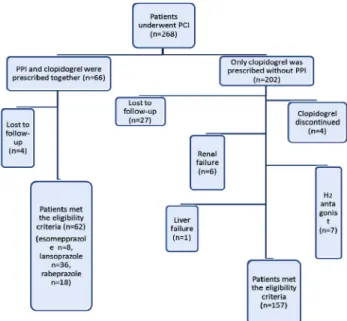
A total of 268 patients were admitted to the Cardiology Department of Yeouido St. Mary’s Hospital and underwent PCI. Sixty-six of these patients were prescribed clopidogrel and a PPI together, whereas 202 were only prescribed clopi- dogrel. Out of the 66 patients in the clopidogrel + PPI group, 62 met the eligibility criteria, with eight receiving esomeprazole, 36 receiving lansoprazole, and 18 receiving rabeprazole. Omeprazole, which has a relatively established interaction with clopidogrel, was never prescribed during the follow-up period. Of the 202 patients who were pre- scribed only clopidogrel without a PPI, 157 met the eligibil- ity criteria (Fig. 1).
The clopidogrel-only group and the clopidogrel + PPI group showed a significant difference in the percentage of patients with hypertension (55.4% vs. 71.0%; p=0.046), with more patients with hypertension in the group with con- comitant PPI therapy. With this exception, the other basic characteristics were not significantly different between the two groups (Table 1).
Analysis of Factors Affecting the Occurrence of Each Cardiovascular Event
The results of an analysis of the factors affecting revas- cularization found that diabetes (p=0.060), diagnosis (p=0.088), concomitant PPI therapy (p=0.066), and beta- blocker therapy (p=0.004) were significantly correlated with the occurrence of revascularization at a significance Fig. 1. Study design.
Table 1. Basic information on the clopidogrel-only group and the clopidogrel + PPI group.
Clopidogrel without PPI
(n=157)
Clopidogrel with PPI
(n=62)
p-value**
Age, mean (SD), y 63.0 (10.5) 66.2 (11.3) 0.055 Sex
Male Female
103 (65.6) 54 (34.4)
35 (56.5) 27 (43.5)
0.217 Weight, mean (SD), kg 66.9 (11.8) 64.0 (11.4) 0.098
Smoking 38 (24.2) 12 (19.4) 0.480
Diabetes 69 (43.9) 22 (35.5) 0.288
Hypertension 87 (55.4) 44 (71.0) 0.046*
Stroke history 5 (3.2) 1 (1.6) 1.000
PCI history 14 (8.9) 11 (17.7) 0.096
Diagnosis Angina MI
125 (79.6) 32 (20.4)
43 (69.4) 19 (30.4)
0.113 Medications
β-blocker ACE inhibitor ARB CCB Nitrate Aspirin Warfarin NSAIDs
81 (51.6) 12 (7.6) 110 (70.1) 54 (34.4) 21 (13.4) 154 (98.1) 1 (0.6) 14 (8.9)
40 (640.5) 4 (6.5) 40 (64.5) 24 (38.7) 6 (9.7) 60 (96.8) 1 (1.6) 10 (16.1)
0.098 1.000 0.519 0.639 0.504 0.623 0.487 0.150 Procedure location
LAD LCX RCA LM ≥ 2 sites
64 (40.8) 22 (14.0) 20 (12.7) 2 (1.3) 49 (31.2)
28 (45.2) 8 (12.9) 14 (22.6) 0 (0.0) 12 (19.4)
0.195
Values are expressed as number (percentage) unless otherwise indicated
*p < 0.05.
**The p-values of continuous variables (i.e., age and weight) are derived from independent t-tests.
The p values of categorical variables are derived from a chi-square test or Fisher's exact test.
ACE inhibitor (Angiotensin-converting enzyme inhibitor); ARB (Angiotensin receptor blocker); CCB (Calcium channel blocker); MI (Myocardial infarction); NSAIDs (Non-steroidal anti-inflammatory drugs); PPI (Proton pump inhibitor); LAD (Left anterior descending);
LCX (Left circumflex); LM (Left main coronary); RCA (Right coronary artery)
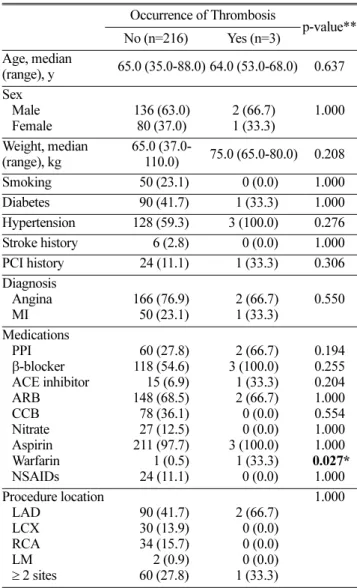
level of 0.1 (Table 2). Only warfarin therapy (p=0.027) was found to be significantly correlated with the occur- rence of thrombosis (Table 3). The occurrence of chest pain or dyspnea was significantly influenced by age (p=0.058), past history of PCI (p=0.012), and CCB ther- apy (p=0.014) (Table 4). Thus, occurrences of thrombosis
and chest pain were not affected by concomitant PPI ther- apy at a significance level of 0.1.
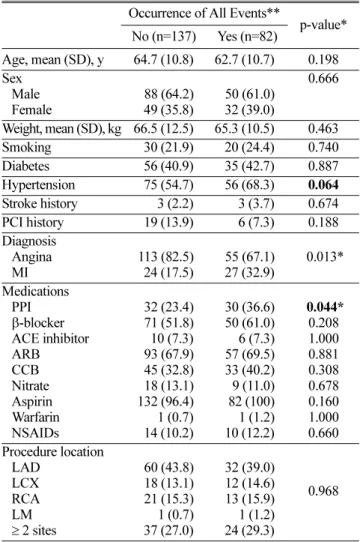
Re-hospitalization occurrence, defined as all combined cases of revascularization, thrombosis, and chest pain, was found to be significantly associated with hypertension (p=0.064), diagnosis (p=0.013), and concomitant PPI ther- Table 2. Result of crosstabulation of variables affecting
revascularization.
Occurrence of Revascularization
p-value**
No (n=192) Yes (n=27)
Age, mean (SD), y 63.7 (11.0) 65.5 (9.5) 0.427 Sex
Male Female
121 (63.0) 71 (37.0)
17 (63.0) 10 (37.0)
1.000 Weight, mean (SD),
kg 66.4 (11.9) 63.7 (10.5) 0.257
Smoking 45 (23.4) 5 (18.5) 0.635
Diabetes 75 (39.1) 16 (59.3) 0.060
Hypertension 113 (58.9) 18 (66.7) 0.532
Stroke history 5 (2.6) 1 (3.7) 0.550
PCI history 20 (10.4) 5 (18.5) 0.206 Diagnosis
Angina MI
151 (78.6) 41 (21.4)
17 (63.0) 10 (37.0)
0.088
Medications PPI β-blocker ACE inhibitor ARB CCB Nitrate Aspirin Warfarin NSAIDs
50 (26.0) 99 (51.6) 15 (7.8) 132 (68.8) 72 (37.5) 23 (12.0) 187 (97.4) 1 (0.5) 21 (10.9)
12 (44.4) 22 (81.5) 1 (3.7) 18 (66.7) 6 (22.2) 4 (14.8) 27 (100.0) 1 (3.7) 3 (11.1)
0.066 0.004*
0.700 1.000 0.138 0.753 1.000 0.232 1.000 Procedure location
LAD LCX RCA LM ≥ 2 sites
84 (43.8) 25 (13.0) 29 (15.1) 2 (1.0) 52 (27.1)
8 (29.6) 5 (18.5) 5 (18.5) 0 (0.0) 9 (33.3)
0.597
Values are expressed as number (percentage) unless otherwise indicated
*p<0.05.
**The p values of continuous variables (i.e., age and weight) are derived from independent t-tests.
The p-values of categorical variables are derived from a chi-square test or Fisher's exact test.
ACE inhibitor (Angiotensin-converting enzyme inhibitor); ARB (Angiotensin receptor blocker); CCB (Calcium channel blocker); MI (Myocardial infarction); NSAIDs (Non-steroidal anti-inflammatory drugs); PPI (Proton pump inhibitor); LAD (Left anterior descending);
LCX (Left circumflex); LM (Left main coronary); RCA (Right coronary artery)
Table 3. The results of the crosstabulation of variables affecting thrombosis.
Occurrence of Thrombosis
p-value**
No (n=216) Yes (n=3) Age, median
(range), y 65.0 (35.0-88.0) 64.0 (53.0-68.0) 0.637 Sex
Male Female
136 (63.0) 80 (37.0)
2 (66.7) 1 (33.3)
1.000 Weight, median
(range), kg
65.0 (37.0-
110.0) 75.0 (65.0-80.0) 0.208
Smoking 50 (23.1) 0 (0.0) 1.000
Diabetes 90 (41.7) 1 (33.3) 1.000
Hypertension 128 (59.3) 3 (100.0) 0.276
Stroke history 6 (2.8) 0 (0.0) 1.000
PCI history 24 (11.1) 1 (33.3) 0.306
Diagnosis Angina MI
166 (76.9) 50 (23.1)
2 (66.7) 1 (33.3)
0.550 Medications
PPI β-blocker ACE inhibitor ARB CCB Nitrate Aspirin Warfarin NSAIDs
60 (27.8) 118 (54.6) 15 (6.9) 148 (68.5) 78 (36.1) 27 (12.5) 211 (97.7) 1 (0.5) 24 (11.1)
2 (66.7) 3 (100.0) 1 (33.3) 2 (66.7) 0 (0.0) 0 (0.0) 3 (100.0) 1 (33.3) 0 (0.0)
0.194 0.255 0.204 1.000 0.554 1.000 1.000 0.027*
1.000 Procedure location
LAD LCX RCA LM ≥ 2 sites
90 (41.7) 30 (13.9) 34 (15.7) 2 (0.9) 60 (27.8)
2 (66.7) 0 (0.0) 0 (0.0) 0 (0.0) 1 (33.3)
1.000
Values are expressed as number (percentage) unless otherwise indicated
*p<0.05.
**The p values of continuous variables (i.e., age and weight) are derived from independent t-tests.
The p values of categorical variables are derived from a chi-square test or Fisher's exact test.
ACE inhibitor (Angiotensin-converting enzyme inhibitor); ARB (Angiotensin receptor blocker); CCB (Calcium channel blocker); MI (Myocardial infarction); NSAIDs (Non-steroidal anti-inflammatory drugs); PPI (Proton pump inhibitor); LAD (Left anterior descending);
LCX (Left circumflex); LM (Left main coronary); RCA (Right coronary artery)
apy (p=0.044) (Table 5).
Univariate Logistic Regression Analysis between the Clopidogrel-only Group and the Clopidogrel + PPI group
Univariate logistic regression analysis was performed on
each of the revascularization, thrombosis, chest pain or dyspnea, and re-hospitalization groups, with PPI use as the only variable in comparing the clopidogrel-only group and the clopidogrel + PPI group.
The result of the analysis found that the re-hospitaliza- tion rate was 1.893 times higher in the clopidogrel + PPI Table 4. The results of the crosstabulation of variables
affecting chest pain or dyspnea.
Occurrence of Chest
Pain or Dyspnea p-value**
No (n=165) Yes (n=54)
Age, mean (SD), y 64.7 (10.6) 66.1 (12.2) 0.058 Sex
Male Female
106 (64.2) 59 (35.8)
32 (59.3) 22 (40.7)
0.520
Weight, mean (SD), kg 66.1 (12.2) 65.9 (10.4) 0.884
Smoking 35 (21.2) 15 (27.8) 0.352
Diabetes 72 (43.6) 19 (35.2) 0.340
Hypertension 94 (57.0) 37 (68.5) 0.152
Stroke history 4 (2.4) 2 (3.7) 0.638
PCI history 24 (14.5) 1 (1.9) 0.012*
Diagnosis Angina MI
131 (79.4) 34 (20.6)
37 (68.5) 17 (31.5)
0.137
Medications PPI β-blocker ACE inhibitor ARB CCB Nitrate Aspirin Warfarin NSAIDs
45 (27.3) 94 (57.0) 12 (7.3) 112 (67.9) 51 (30.9) 22 (13.3) 160 (97.0) 2 (1.2) 17 (10.3)
17 (31.5) 27 (50.0) 4 (7.4) 38 (70.4) 27 (50.0) 5 (9.3) 54 (100.0) 0 (0.0) 7 (13.0)
0.603 0.431 1.000 0.741 0.014*
0.486 0.337 1.000 0.618 Procedure location
LAD LCX RCA LM
≥2 sites
69 (41.8) 23 (13.9) 26 (15.8) 1 (0.6) 46 (27.9)
23 (42.6) 7 (13.0) 8 (14.8) 1 (1.9) 15 (27.8)
0.908
Values are expressed as number (percentage) unless otherwise indicated
*p<0.05.
**The p values of continuous variables (i.e., age and weight) are derived from independent t-tests.
The p values of categorical variables are derived from a chi-square test or Fisher's exact test.
ACE inhibitor (Angiotensin-converting enzyme inhibitor); ARB (Angiotensin receptor blocker); CCB (Calcium channel blocker); MI (Myocardial infarction); NSAIDs (Non-steroidal anti-inflammatory drugs); PPI (Proton pump inhibitor); LAD (Left anterior descending);
LCX (Left circumflex); LM (Left main coronary); RCA (Right coronary artery)
Table 5. The results of the crosstabulation of variables affecting overall re-hospitalization.
Occurrence of All Events**
p-value*
No (n=137) Yes (n=82)
Age, mean (SD), y 64.7 (10.8) 62.7 (10.7) 0.198 Sex
Male Female
88 (64.2) 49 (35.8)
50 (61.0) 32 (39.0)
0.666
Weight, mean (SD), kg 66.5 (12.5) 65.3 (10.5) 0.463
Smoking 30 (21.9) 20 (24.4) 0.740
Diabetes 56 (40.9) 35 (42.7) 0.887
Hypertension 75 (54.7) 56 (68.3) 0.064
Stroke history 3 (2.2) 3 (3.7) 0.674
PCI history 19 (13.9) 6 (7.3) 0.188
Diagnosis Angina
MI 113 (82.5)
24 (17.5)
55 (67.1) 27 (32.9)
0.013*
Medications PPI β-blocker ACE inhibitor ARB CCB Nitrate Aspirin Warfarin NSAIDs
32 (23.4) 71 (51.8) 10 (7.3) 93 (67.9) 45 (32.8) 18 (13.1) 132 (96.4) 1 (0.7) 14 (10.2)
30 (36.6) 50 (61.0) 6 (7.3) 57 (69.5) 33 (40.2) 9 (11.0) 82 (100) 1 (1.2) 10 (12.2)
0.044*
0.208 1.000 0.881 0.308 0.678 0.160 1.000 0.660 Procedure location
LAD LCX RCA LM ≥ 2 sites
60 (43.8) 18 (13.1) 21 (15.3) 1 (0.7) 37 (27.0)
32 (39.0) 12 (14.6) 13 (15.9) 1 (1.2) 24 (29.3)
0.968
Values are expressed as number (percentage) unless otherwise indicated
*p<0.05
**One of revascularization, thrombosis or chest pain episodes occurred.
*** The p values of continuous variables (i.e., age and weight) are derived from independent t-tests.
The p-values of categorical variables are derived from a chi-square test or Fisher's exact test.
ACE inhibitor (Angiotensin-converting enzyme inhibitor); ARB (Angiotensin receptor blocker); CCB (Calcium channel blocker); MI (Myocardial infarction); NSAIDs (Non-steroidal anti-inflammatory drugs); PPI (Proton pump inhibitor); LAD (Left anterior descending);
LCX (Left circumflex); LM (Left main coronary); RCA (Right coronary artery)