DOI: https://doi.org/10.7473/EC.2020.55.4.281
Building Calibration Curve for Py-GC/MS Analysis of SBR/BR Blend Rubber Compounds
Eunji Chae and Sung-Seen Choi
†Department of Chemistry, Sejong University, 209 Neungdong-ro, Gwangjin-gu, Seoul 05006, Republic of Korea (Received October 8, 2020, Revised October 19, 2020, Accepted October 23, 2020)
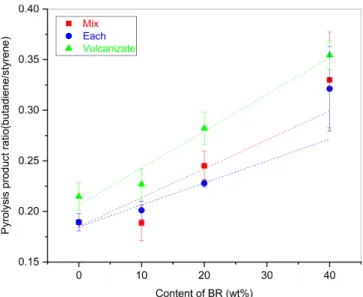
Abstract: A calibration curve is needed to determine the SBR and BR blend ratio of SBR/BR blend rubber compounds using pyrolysis-gas chromatography/mass chromatography (Py-GC/MS) or Py-GC. In general, a calibration curve is obtained using reference SBR/BR vulcanizates with various blend ratios. In this study, the calibration curves were obtained using reference samples made of rubber solutions and were compared to those plotted using the reference SBR/BR vul- canizates. Calibration curves using variations of 1,3-butadiene/styrene, 4-vinylcyclohexene (VCH)/styrene, 2-phenylpropene (PhP)/butadiene, PhP/VCH, 4-phenylcyclohexene (PhCH)/butadiene, and PhCH/VCH ratios with the BR content were examined for the suitability. We found that the calibration curves obtained using the mixed rubber solution references (1,3- butadiene/styrene and PhP/butadiene) could replace those constructed using the reference SBR/BR vulcanizates. The cal- ibration curves of 1,3-butadiene/styrene and PhP/butadiene obtained using the raw references can be used for the deter- mination of the SBR/BR blend ratios by applying some correction factors.
Keywords: SBR/BR blend, Calibration curve, Passenger car tire tread, Blend ratio, Mixed rubber solution, Py-GC/MS
Introduction
자동차 타이어는 천연고무(natural rubber, NR), 스타이렌- 부타디엔 고무(styrene-butadiene rubber, SBR), 그리고 부타디 엔 고무(polybutadiene rubber, BR)를 사용하여 제조한다.
1승 용차용 타이어 트레드 고무는 주로 SBR과 BR을 혼합하여 제 조한다.
2BR은 타이어 트레드의 내마모성을 향상시킨다. 2가 지 이상의 고무가 혼합된 블렌드 고무 배합물의 경우 혼합된 고무 비율에 따라 화학적 특성과 물리적 특성이 다르게 나타 난다.
1따라서, 블렌드 고무의 함량비를 분석하는 것이 중요 하다.
블렌드 고무의 함량비 분석에는 푸리에 변환-적외선 분광 법(Fourier transform infrared spectroscopy, FT-IR), 핵자기공 명분석법(nuclear magnetic resonance spectroscopy, NMR), 열 중량분석법(thermogravimetric analysis, TGA), 시차주사열량 분석법(differential scanning calorimetry, DSC), 열분해-기체 크로마토그래피/질량분석법(pyrolysis-gas chromatography/
mass spectrometry, Py-GC/MS) 등이 사용된다.
1,3,4NMR을 이 용하여 SBR의 미세구조를 분석하기 위해서 원재료 고무를 CDCl
3에 용해시킨 후
1H-NMR로 분석한다.
3IR 분석을 위해 서 고무 용액을 KBr window에 코팅 후 투과 방식으로 분석 한다. NMR과 IR은 분석 전 가교된 고무 시료에서 가교 결합
을 끊고 고분자 성분을 추출하는 시료 전처리 과정이 필요하 다. 고무 조성비를 정량하기 위해서 열분해기가 장착된 FT-IR 을 사용할 수 있다.
4699 cm
1와 967 cm
1로 각각 SBR과 BR 의 함량을 계산한다. 699 cm
1은 styrene에 의해 나타나고 967 cm
1은 trans-1,4-unit butadiene에서 나타난다. 하지만 해당 피 크는 배음과 조합에 의한 피크가 나타나는 파수 영역으로 미 지의 블렌드 고무에서는 식별이 곤란하다. TGA 분석은 SBR 과 BR의 유사한 열분해 거동으로 인해 정량 분석이 곤란하 다.
4DSC를 이용하여 고무 조성비를 결정할 때는 유리 전이 온도(glass transition temperature, T
g)를 사용한다.
4NR/SBR이 나 NR/BR 블렌드 고무와는 달리 SBR/BR 블렌드 고무는 T
g차이가 크지 않아 함량비를 분석하기 곤란하다.
Yang 등은 Py -GC/MS로 혼합 고무의 함량을 분석하기 위 해서 카본블랙이 포함되지 않은 고무 블렌드를 이용하여 SBR/BR 고무에서 SBR의 함량에 따른 열분해 생성물의 피크 면적비를 도식하여 검량선을 작성하였다.
1분석에 사용한 고 무는 가교 구조를 끊기 위해 과산화수소와 사이클로헥산으로 고무를 용해시켰다. SBR과 BR을 식별할 열분해생성물로 4- vinylcyclohexene (VCH)와 sty rene을 이용하였다. 이때 열분 해 생성물의 피크면적비는 styrene/(styrene + VCH) 피크면적 비로 계산하였다.
블렌드 고무 제품의 고무 성분비를 분석하기 위해서는 고 무 조성을 변화시킨 검량선 작성이 필요하다. 검량선 작성에
†