Biomedical Science Letters 2017, 23(4): 339~347 https://doi.org/10.15616/BSL.2017.23.4.339 eISSN : 2288-7415
Protective Effect of Kaempferol on Cultured Neuroglial Cells Damaged by Induction of Ischemia-like Condition
Young-Woo Son
1, Yu-Ran Choi
2and Young-Mi Seo
3,†1
Sanbon Hospital, School of Medicine, Wonkwang University, Gunpo 15865, Korea
2
Department of Physical Therapy, Graduate School of Daejeon University, Daejeon 35235, Korea
3
Department of Nursing, College of Medicine, Seonam University, Namwon 55724, Korea
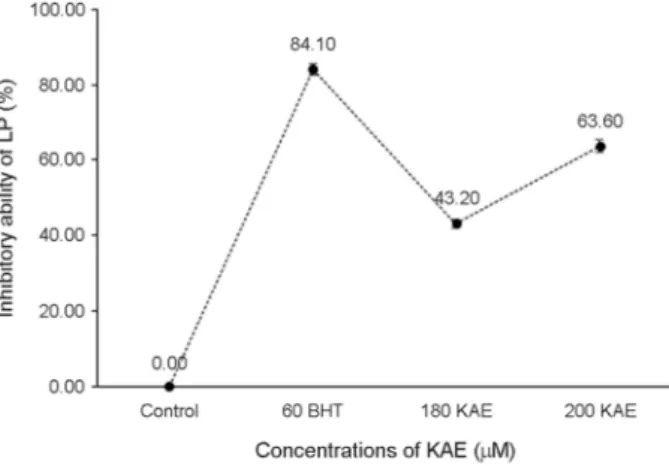
This study was performed to evaluate the cytotoxicity induced by ischemia-like condition (ILC) in cultured neuroglial cells (C6 glioma cells). The protective effect of kaempferol (KAE), flavonoid against the cytotoxicity induced by ILC induction was assessed. In addition, antioxidative effects of KAE were done by colorimetric assays. Cell viability and the antioxidative effects such as DPPH-radical scavenging activity, superoxide dismutase (SOD)-like activity and inhibitory activity of lipid peroxidation (LP) were analyzed. ILC induction decreased cell viability in a dose-dependent manner, and the XTT
90value (low cytotoxicity value) and XTT
50value (high cytotoxicity value) were determined during ILC induction for 15 and 40 minutes, respectively. The butylated hydroxytoluene (BHT) antioxidant significantly increased cell viability damaged by the ILC-induced cytotoxicity. In the protective effect of KAE on ILC-induced cytotoxicity, KAE protected the ILC-induced cytotoxicity by the significant increase of cell viability, and also it showed DPPH-radical scavenging ability, SOD-like ability and inhibitory ability of LP. From these results, it is suggested that ILC induction showed cytotoxicity in these cultures and the oxidative stress is involved in the ILC-induced cytotoxicity. While, KAE prevented ILC-induced cytotoxicity by antioxidative effects. In conclusion, natural products like KAE may be a putative therapeutic agent for the treatment of disease associated with oxidative stress such as ischemia.
Key Words: Ischemia, Flavonoid, Cytotoxicity, Antioxidative effect
서 론
허혈(ischemia)은 혈관의 폐색이나 협착에 의한 일시적 인 혈액공급의 부족을 의미하는데, 뇌허혈은 뇌혈관의 출 혈과 함께 뇌졸중(stroke)의 중요한 요인의 하나로 작용한 다(Lee and Kim, 2006). 뇌조직에서 혈관이상에 의한 허혈 은 뇌세포를 산소결핍상태로 만들며 이 상태가 오랫동안 지속되면 결국 뇌세포는 사멸된다(Lee et al., 2005). 뇌 구 성 세포 중 신경교세포는 신경세포에 영양공급, 재생 및
정화기능을 가지고 있으며, 허혈과 같은 변병 시 회복을 위한 항상성 역할을 수행한다. 따라서 신경교세포가 손상 되면 뇌세포의 사멸이 더욱 촉진된다(Endoh et al., 1994).
허혈 유발과 관련이 깊은 뇌혈관 질환의 가장 대표적인 병 인의 하나인 죽상경화증(atherosclerosis)은 내피손상을 비롯 하여 지질침착의 증가, 결합조직성분의 합성 증가와 같은 병리적 증상을 나타낸다고 알려져 있다(Jialal and Devaraj, 1996). 또한 죽상경화증이 노출된 동맥내막은 혈소판의 유 착과 응집현상이 반복되면서 혈전이 더욱 빠르게 진행되 고 (Hamsten et al., 1994), 진행과정 중에 thromboxane A
2와
*Received: November 22, 2017 / Revised: December 19, 2017 / Accepted: December 19, 2017
†Corresponding author: Young-Mi Seo. Department of Nursing, College of Medicine, Seonam University, Namwon 55724, Korea.
Tel: +82-63-620-0102, Fax: +82-63-620-0154, e-mail: [email protected]
○CThe Korean Society for Biomedical Laboratory Sciences. All rights reserved.
○CCThis is an Open Access article distributed under the terms of the Creative Commons Attribution Non-Commercial License (http://creativecommons.org/licenses/by-nc/3.0/) which permits unrestricted non-commercial use, distribution, and reproduction in any medium, provided the original work is properly cited.