Case Report
J Gastric Cancer 2016;16(1):51-53 http://dx.doi.org/10.5230/jgc.2016.16.1.51
Copyrights © 2016 by The Korean Gastric Cancer Association www.jgc-online.org
This is an open-access article distributed under the terms of the Creative Commons Attribution Non-Commercial License (http://creativecommons.org/
licenses/by-nc/4.0) which permits unrestricted noncommercial use, distribution, and reproduction in any medium, provided the original work is properly cited.
Introduction
Natural orifice transluminal endoscopic surgery (NOTES) was introduced as a new approach and surgical procedures can be performed primarily through natural orifices, such as the mouth, anus, or vagina. Natural orifice specimen extraction (NOSE), as a part of NOTES, allows for specimen extraction through natural orifices without additional abdominal incisions. Both NOTES and NOSE aim to shorten recovery times, decrease the risk of abdominal wall hernia and surgical site infection, and reduce vis- ible scarring.1 They are typically preferred in cholecystectomy, appendectomy, and colorectal resections, but rarely in gastric sur- gery. These techniques may have a particular role with morbidly obese patients in decreasing the occurrence of wound-related
complications and providing a more rapid recovery. Herein, we aimed to demonstrate the feasibility of transvaginal extraction of a gastrectomy specimen in a morbidly obese patient with gastric cancer.
Case Report
A 58-year-old female was admitted for abdominal pain and dyspepsia lasting one year. Despite her recent weight loss, she was still morbidly obese (body mass index 44.2 kg/m2). She also had diabetes and hypertension. Upper gastrointestinal endoscopy revealed an adenocarcinoma at the gastric antrum. Computed tomography indicated a 45 mm mass in the antrum with no metastatic distant focus. Her laboratory tests were unremarkable except for mild anemia (hemoglobin: 12.0 g/dl). After patient consent was obtained, we planned a fully laparoscopic gastrec- tomy with transvaginal specimen extraction. She was placed in the lithotomy position and five trocars were applied to the abdo- men as described before.2 A xiphoidal 5 mm port for a Nathan- son liver retractor, three 12 mm trocars (at the intersection of the
pISSN : 2093-582X, eISSN : 2093-5641
Correspondence to: Cuneyt Kayaalp
Deparment of Surgery, Inonu University, Malatya 44315, Turkey Tel: +90-422-341-0660, Fax: +90-422-341-0229
E-mail: [email protected] Received January 4, 2016 Revised January 27, 2016 Accepted February 1, 2016
Laparoscopic Gastrectomy and Transvaginal Specimen Extraction in a Morbidly Obese Patient with Gastric Cancer
Fatih Sumer, Cuneyt Kayaalp, and Servet Karagul Liver Transplantation Institute, Inonu University, Malatya, Turkey
Laparoscopic gastrectomy for cancer has some significant postoperative benefits over open surgery with similar oncologic outcomes. This procedure is more popular in the Far East countries where obesity is not a serious public health problem. In the Western countries, lapa- roscopic gastrectomy for cancer is not a common procedure, yet obesity is more common. Herein, we aimed to demonstrate the feasibil- ity of laparoscopic gastrectomy for advanced gastric cancer in a morbidly obese patient. Additionally, we used natural orifice specimen extraction as an option to decrease wound-related complications, which are more prevalent in morbidly obese patients. In this case, we performed a fully laparoscopic subtotal gastrectomy with lymph node dissection and Roux-en-Y gastrojejunostomy with the specimen ex- tracted through the vagina. To the best of our knowledge, this was the first report of a natural orifice surgery in a morbidly obese patient with gastric cancer.
Key Words: Stomach neoplasms; Natural orifice endoscopic surgery; Laparoscopy; Obesity
Sumer F, et al.
52
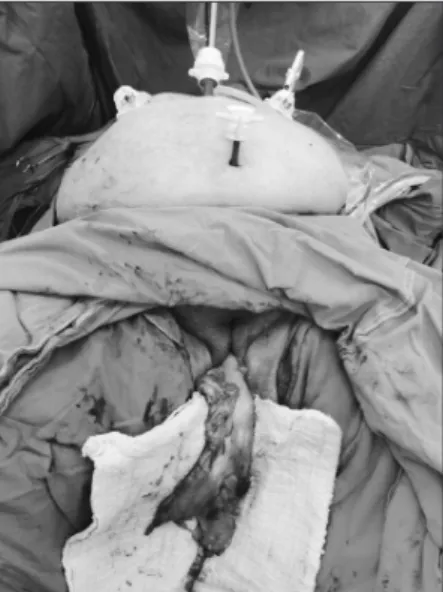
transverse umbilical line and right/left midclavicular lines and at the midline 5 cm inferior to the umbilicus), and a working 5 mm trocar (right subcostal) were placed. A total omentectomy, subtotal gastrectomy, D2 lymph node dissection, and Roux-en-Y gastrojejunostomy were completed exclusively by laparoscopy. An additional suprapubic 5 mm trocar was placed for retraction of the upper uterus and better visualization of the vagina. The posterior fornix of the vagina was opened using laparoscopic vision and the specimen was extracted transvaginally through the posterior fornix (Fig. 1, 2; Written informed consent was obtained from the patient for publication of this Case Report and any accompanying images.). The posterior fornix was closed with a running absorb- able suture. Operating time and blood loss were 430 minutes and 50 ml, respectively. The postoperative course was uneventful with the exception of the use of two units of red cell packs due to intra-abdominal self-limited oozing. She was discharged on day five. Histopathological examination demonstrated a pT3N2M0 (American Joint Committee on Cancer 7th edition), 3.5 cm di- ameter adenocarcinoma. Twenty-two lymph nodes were retrieved with three metastatic locations along the greater curvature. She received adjuvant chemo-radiotherapy (six cycles of 5-flouroura- cil and folinic acid plus 45 Gy radiotherapy). She had no recur- rence well after the 7.5-month follow-up.
Discussion
Laparoscopic gastrectomy for cancer provides some significant postoperative benefits over open surgery with similar oncologic
outcomes. Laparoscopic gastrectomy can result in less blood loss, similar or lower rates of postoperative complications, faster re- covery of bowel function, less postoperative pain, shorter hospi- talization, better convalescence period, and better lung function.2 Globally, laparoscopic gastrectomy for cancer is more popular in Far East countries such as Japan and South Korea.2 Yet, in these countries, obesity is not common and is not a serious health con- cern like in many western countries. Recently, a study on western patients undergoing laparoscopic gastrectomy demonstrated a higher risk of wound-related complications and thromboembo- lism when compared to open gastrectomy.3 This was attributed to the higher body mass index of the western patients. Those authors discussed the necessity of risk reduction strategies for wound infection and thromboembolism in laparoscopic gastrec- tomy, particularly for obese patients.3 It was previously demon- strated that laparoscopic gastrectomy combined with NOSE for advanced gastric cancer may provide a smooth postoperative course without any wound-related complications.4 Additionally, we systematically reviewed 90 cases of laparoscopic right colon resections with transvaginal extractions and found no wound- related complications.5 Our preliminary observations pointed out that natural orifice surgery may decrease the risk of abdominal wound-related complications. Moreover, the risk of thromboem- bolism may also be reduced if the recovery period of the patients can be further shortened with smaller wounds and fewer wound complications.4,5 Lastly, decreasing the postoperative wound- related complications can offer earlier initiation of the postopera- tive chemo-radiotherapy, or, at least, it may avoid any delay for adjuvant therapies due to wound-related complications.4,5
Fig. 1. Transvaginal extraction of the stomach.
Fig. 2. View of specimen including subtotal gastrectomy, omentectomy, and D2 lymph node dissection.
Transvaginal Extraction in Morbidly Obese
53
Previous studies reported satisfactory oncological results in patients with early and advanced gastric cancers by laparoscopic gastrectomy,6-8 but the number of the studies related with natu- ral orifice surgery were very limited.9,10 There are four potential natural orifices for the extraction of surgical specimens of the abdomen.11 The transurethral removal was described only for urological specimens. The transcolonic route is only suitable for colorectal resections. As far as we know, there was no report that described the transrectal extraction of a specimen, except the colon or rectum. Transoral specimen extraction was described only for small sized gastric cancers in the early stages.12 We ex- perienced eight cases of transoral extraction of gastric specimens, but all of them were of a benign nature. These included six sleeve gastrectomies and two gastrectomies for pyloric obstruction due to duodenal ulcers. Transvaginal extraction has been reported in pa- tients with gastric submucosal tumors and early gastric cancers.9,10 We previously reported the first case of laparoscopic gastrectomy and transvaginal extraction for an advanced gastric cancer in a non-obese patient.4 This previous experience encouraged us to adopt a technique for a morbidly obese patient who had a higher risk of wound complications and thromboembolism.
In conclusion, we wanted to highlight the potential advantages of natural orifice surgery regarding issues concerning laparoscopic gastric surgery, particularly in morbidly obese patients. We can advert to the limitations of the transvaginal specimen extraction as being male gender, patient refusal, unsuitable vaginal access, and large specimen size.
Conflicts of Interest
No potential conflict of interest relevant to this article was re- ported.
References
1. Sodergren MH, Markar S, Pucher PH, Badran IA, Jiao LR, Darzi A. Safety of transvaginal hybrid NOTES cholecystec- tomy: a systematic review and meta-analysis. Surg Endosc 2015;29:2077-2090.
2. Pavlidis TE, Pavlidis ET, Sakantamis AK. The role of lapa-
roscopic surgery in gastric cancer. J Minim Access Surg 2012;8:35-38.
3. Glenn JA, Turaga KK, Gamblin TC, Hohmann SF, Johnston FM. Minimally invasive gastrectomy for cancer: current utilization in US academic medical centers. Surg Endosc 2015;29:3768-3775.
4. Sumer F, Kayaalp C, Ertugrul I, Yagci MA, Karagul S. Total laparoscopic subtotal gastrectomy with transvaginal specimen extraction is feasible in advanced gastric cancer. Int J Surg Case Rep 2015;16:56-58.
5. Kayaalp C, Yagci MA. Laparoscopic right colon resection with transvaginal extraction: a systematic review of 90 cases. Surg Laparosc Endosc Percutan Tech 2015;25:384-391.
6. Huang YL, Lin HG, Yang JW, Jiang FQ, Zhang T, Yang HM, et al. Laparoscopy-assisted versus open gastrectomy with D2 lymph node dissection for advanced gastric cancer: a meta- analysis. Int J Clin Exp Med 2014;7:1490-1499.
7. Qiu J, Pankaj P, Jiang H, Zeng Y, Wu H. Laparoscopy versus open distal gastrectomy for advanced gastric cancer: a system- atic review and meta-analysis. Surg Laparosc Endosc Percutan Tech 2013;23:1-7.
8. Martínez-Ramos D, Miralles-Tena JM, Cuesta MA, Escrig-Sos J, Van der Peet D, Hoashi JS, et al. Laparoscopy versus open surgery for advanced and resectable gastric cancer: a meta- analysis. Rev Esp Enferm Dig 2011;103:133-141.
9. Asakuma M, Cahill RA, Lee SW, Nomura E, Tanigawa N.
NOTES: the question for minimal resection and sentinel node in early gastric cancer. World J Gastrointest Surg 2010;2:203- 206.
10. Nakajima K, Nishida T, Takahashi T, Souma Y, Hara J, Yamada T, et al. Partial gastrectomy using natural orifice translumenal endoscopic surgery (NOTES) for gastric submucosal tumors:
early experience in humans. Surg Endosc 2009;23:2650-2655.
11. Auyang ED, Santos BF, Enter DH, Hungness ES, Soper NJ.
Natural orifice translumenal endoscopic surgery (NOTES(®)):
a technical review. Surg Endosc 2011;25:3135-3148.
12. Gunkova P, Gunka I, Zonca P, Dostalik J, Ihnat P. Laparoscopic sleeve gastrectomy for morbid obesity with natural orifice specimen extraction (NOSE). Bratisl Lek Listy 2015;116:422- 425.