Received November 18, 2019, Revised December 11, 2019, Accepted December 13, 2019 Corresponding author: Jae Soo Kim
Department of Acupuncture & Moxibustion Medicine, Daegu Oriental Hospital of Daegu Haany University, 136 Sincheondong-ro, Suseong-gu, Daegu 42158, Korea
Tel: +82-53-770-2108, Fax: +82-53-770-2055, E-mail: [email protected]
CCThis is an open access article distributed under the terms of the Creative Commons Attribution Non-Commercial License (http://creativecommons.org/licenses/ by-nc/4.0) which permits unrestricted non-commercial use, distribution, and reproduction in any medium, provided the original work is properly cited.
Effects of Acupotomy Treatment on Relapsed Lateral Malleolar Bursitis: A Case Report
Jae Hoon Kim, Jung Hee Lee, Yun-Kyu Lee, Hyun-Jong Lee, Jae Soo Kim
Department of Acupuncture & Moxibustion medicine, College of Korean medicine, Daegu Haany University
재발성 족외과 점액낭염에 대한 도침요법: 증례 보고
김재훈 ㆍ이정희 ㆍ이윤규 ㆍ이현종 ㆍ김재수
대구한의대학교 부속 한방병원 침구의학과
Objectives : This study details on a case of acupotomy for relapsed lateral malleolar bursitis. Methods : A 71-year-old woman with lateral malleolar bursitis was treated with acupotomy twice in an outpatient setting. A sterilized, disposable, blade width 0.5 mm
× needle length 50 mm sized acupotomy was administered on GB40 and BL62 on each visit. Pain intensity assessment using Numeric Rating Scale (NRS) and the response evaluation criteria was conducted right after each treatment. Results : Pain on NRS declined from 5 to less than 1 after twice of acupotomy treatment. This result was regarded as 'Complete Response' using the response evaluation criteria. There were no side effects during whole treatment procedure at all. Conclusions : It is turned out that acupotomy can have a positive clinical effect on lateral malleolar bursitis in this case without any adverse effect. Further controlled studies on acupotomy for lateral malleolar bursitis are required for clinical application.
Key words : acupotomy, case report, relapsed lateral malleolar bursitis
Introduction
A bursa is a type of cyst with a lining of synovial mem- brane, which can mitigate pressure or friction over certain area. Bursa can trigger inflammation and suppuration under chronic, repetitive pressure1-3).
The lateral malleolar bursa of the ankle is subcutaneous.
Sitting on one’s own feet, putting on tight shoes, repetitive irritation, excessive pressure, and wound on the feet could result in an inflammatory lesion of lateral malleolar bursa3). The typical conservative treatments for lateral malleolar
bursitis are aspiration, anti-inflammatory medication, methyl- prednisolone acetate injection, OK-432 injection, and so on3,4). However, lateral malleolar bursitis is known to relapse quite frequently, despite these conservative treatments done2). While open excision surgical treatment techniques are also available, post-operative complications including skin ne- crosis, wound dehiscence, and superficial peroneal nerve palsy could develop5). Researchers are continuously devising new treatment techniques, such as ankle arthroscopic bur- sectomy, in order to prevent these complications from hap- pening5).
Studies on minimizing the relapse rate after conservative treatment for lateral malleolar bursitis have recently been reported. For example, one kind of corticosteroid medi- cation, triamcinolone acetonide injection, is emerging as one of the clinically competitive options6).
Acupotomy is a new upcoming acupuncture treatment method that requires understanding of both traditional East Asian medicine meridian theory and modern surgical prin- ciples simultaneously. Acupotomy induces a soft tissue lesion to recover its own normal kinetic state through peeling and removing abnormally adhered tissues, while balancing yin yang qi blood flow at the same time7). Many researchers are trying to prove the advantage of higher-efficacy, quicker- recovery, and the safety of acupotomy treatment compared to ordinary other treatments in musculoskeletal diseases recently8-10).
However, we don’t have to confine its clinical, therapeutic capability only to ordinary musculoskeletal diseases. Aspir- ation, one of the conservative treatments for bursitis must have micro-puncture on target area before to be done. We could also use acupotomy treatment on lateral malleolar bursitis based on its utility against peeling, removing ab- normal tissues.
No study has investigated or reported about lateral mal- leolar bursitis with reference to traditional East Asian medi- cine principle, and neither have studies about relapsed lateral malleolar bursitis been reported.
In this study, we describe the effect of acupotomy on a patient with lateral malleolar bursitis who did received treat- ment several times already, but relapse could not be pre- vented.
Case
A 71-year-old woman who has swelling at the lateral malleolus of the right ankle as a main complaint, was diagnosed with lateral malleolar bursitis of the right ankle at a local hospital in 2017, but refused surgical recommen- dation at that moment. Then, she visited the Daegu Hanny
university traditional Korean medical hospital. Her symptoms including pain and discomfort of the right ankle had relieved after several conservative treatments, allowing her to maintain her daily life activities comfortably. However, it relapsed after repetitive, hard household labor in June 2019.
She was brought to the outpatient department of Daegu Hanny university traditional Korean medical hospital without having received any treatment.
1. Acupotomy with safety
Before acupotomy treatment, the practitioner explained the treatment procedure, cautions to be aware of, and probable side-effects after the treatment thoroughly to the patient. The acupotomy treatment began after the informed consent form for case report study was filled by the patient.
A sterilized, disposable acupotomy (DongBang Acupunc- ture Inc., Republic of Korea; 0.5 × 50 mm, whole length 105 mm, length of acupuncture body 75 mm, length of acu- puncture head 25 mm, length of cylindrical apex 5 mm, and radius 0.5 mm) was used. The patient was in supine position while the acupotomy treatment was done. Acupotomy was performed by Korean medical doctors having department of acupuncture & moxibustion medicine specialist license (licensed by the Ministry of Health and Welfare, Republic of Korea). The identical practitioner, having more than 20 years of clinical experience, administered the procedures through- out the treatment period. The practitioner first marked the point with a surgical marking pen to make sure at which point the acupotomy treatment would be performed. Ster- ilization process was precisely administered in order to prevent any minimal adverse effects from happening, for safety in other studies with acupotomy treatment9). The practitioner wore a sterile mask and surgical gloves before treatment. Skin sterilization was done with a disposable al- cohol stick swab (Firson Inc., Republic of Korea; Altistick, Ethanol 80%) and a disposable potadine surgical stick swab (Firson Inc., Republic of Korea; Postick. Povidone Iodine 10%). Subsequently, a surgical sterilization wrap was draped around the lesion. Acupotomy treatment was performed at the marked point. The practitioner only carried out the
Fig. 1. Application of acupotomy on the lateral malleolus.
Fig. 2. Aspiration of the lateral malleolar bursa after application of acupotomy.
treatment procedure and did not take part in the evaluation.
Acupotomy was administered on GB40, BL62 by peeling around the swollen point on lateral malleolar bursa. There are no dangerous anatomical structures nearby these points.
Aspiration using a 5 cc syringe with a 23-gauge needle (Sungshim Medical., Republic of Korea; Sungshim Insulin Sylinge 0.5 ml/cc) followed (Fig. 1). Aspiration was done twice; first through the rear of lateral malleolus to the front, and second through the lower of lateral malleolus to the upper rear end. The practitioner compressed, squeezed lateral malleolar bursa into various directions to aspirate an adequate volume of mucous (Fig. 2).
A circular sterilized bandage was applied on the admini- stration point to prevent secondary infection. After treatment completion, the practitioner checked for any abnormality at the treatment point.
The status of patient was evaluated just before treatment at each outpatient visit by identical assessor. The symptoms and size of lateral malleolar bursitis were evaluated and measured at each outpatient visit. The clinical results were assessed by response evaluation criteria that were modified from the guidelines of the response to treatment for a solid tumor4,11). These response evaluation criteria include the state of fluctuation, shrinkage of the bursa, and swelling of the soft tissue, scored as ‘Complete Response’, ‘Partial Re- sponse’, and ‘No Response’ (Table 1).
Numeric Rating Scale (NRS) score is also used to assess the severity of pain or symptom. On a scale of 0∼10, where 0 indicates “no pain at all” and 10 indicates “the most severe pain imaginable”, the patient was asked to say a number index that describes the symptom best in a relaxed position12).
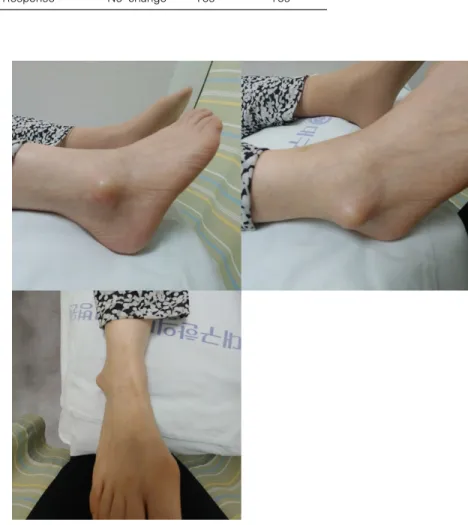
Fig. 3. Picture of the lateral mal- leolus of the right foot on Visit 1.
Table 1. Response Evaluation Criteria for Malleolar Bursitis of the Ankle4)
Response to
treatment Fluctuation Shrinkage Soft tissue swelling
‘Complete Response’ Complete No None or minimal
‘Partial Response’ Partial Yes Yes
‘No Response’ No change Yes Yes
2. Progress
A distinct swelling on lateral malleolar bursa of right ankle was observed at the first visit on 2019.07.04 (Fig. 3). NRS score was assessed as 5. Pain on the lateral malleolus of right ankle was exacerbated the previous night. Pain was most severe during walking with shoes on. Aspiration was per- formed just after acupotomy treatment. Approximately 3 cc of ivory-white mucous was drawn out.
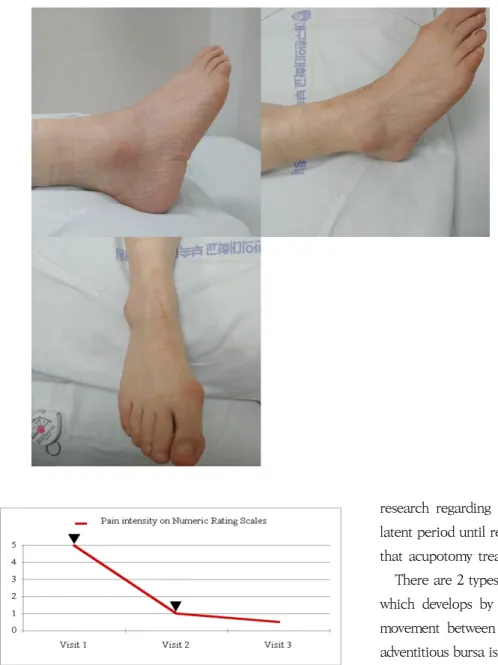
On visit 2, the swelling on the lateral malleolus of the right ankle became quite small after being treated only once with acupotomy; the right ankle seems no different from the left ankle at first sight (Fig. 4). NRS score was assessed as 1 on
this visit. There was no exacerbation of pain after the pre- vious treatment. Acupotomy treatment with aspiration was performed. The treatment method was identical to the pre- vious one. Ivory-white mucous was drawn out as in last visit, but the volume of mucous was less than 0.5 cc.
The patient did not visit after second treatment. We con- ducted a telephonic follow-up about the symptom on 29 July 2019. The patient did not come because the symptom be- came too weak, thinking that there was no need to get other treatments. Pain on her lateral malleolus of right ankle did increase while walking and putting on shoes slightly. How- ever, it was so relieved that it did not become bothersome during her daily life. NRS score was assessed as 0-1, which means lesser than 1. The total NRS progress is described as a graph (Fig. 5).
Fig. 5. Changes of pain intensities on Numeric Rating Scales.
Acupotomy was administered on Visit 1, Visit 2.
Fig. 4. Picture of the lateral mal- leolus of the right foot on Visit 2.
Discussion
In this study, it is turned out that patient’s symptoms were improved after a single acupotomy treatment. NRS scores declined from 5 at first to 1, declined more at after visits.
Assessing the NRS changes, patient’s symptoms maintained an improved state. Based on the response evaluation criteria from Table 1, a state of ‘Complete Response’ appears to be well maintained. There has not been adequate pathological
research regarding the factors that affect relapses or the latent period until relapse; it is not difficult to acknowledge that acupotomy treatment is effective, as demonstrated.
There are 2 types of bursa. One is the anatomical bursa, which develops by moderate friction caused by ordinary movement between tendons and adjacent structures. The adventitious bursa is the other one. It is primarily developed by localized, repetitive, abnormal pressure or friction on a specific part1-3). It also has a thicker fibrous wall compared with an ordinary bursa, increasing the possibility of inflam- matory changes. Therefore, bursitis is more likely to affect an adventitious bursa than any other type of bursa13).
In the case of moderate lateral malleolar bursitis, sub- jective symptoms are often mild. Therefore, ordinary con- servative treatments, such as aspiration, applying a com- pression bandage, corticosteroid injections, or orthopedic posture correction are initially recommended5,14). The re- lapse rate of lateral malleolar bursitis is quite high, though the time after conservative treatment until relapse may differ
among patients. The relapse rate reported after orthopedic posture correction was about 43.7%, and after aspiration, or applying a compression bandage was about 35.0%, according to previous studies3,5).
Patients who repeatedly wear hard shoes, like skaters, or have the habit of sitting on their feet under the buttocks create chronic excessive pressure on the bursa3). Cases of bursitis associated with chronic excessive pressure could progress from bursitis to suppurative inflammation, affecting nearby joints as well6). Therefore, some researchers have suggested that symptoms such as redness, hyperesthesia, enlarged lymph nodes, and heat sensation should be moni- tored in patients who have lateral malleolar bursitis11).
Surgical treatment is recommended when conservative treatment is not effective. Initially, post-operative compli- cations after open excisional surgery were reported to in- clude skin necrosis, wound dehiscence, and superficial per- oneal nerve palsy5,6). New surgical techniques have reported for minimized post-operative complications. Arthroscopic ankle bursectomy, introduced to minimize post-operative complications, might be challenging when deciding the excision range for infected tissues having fistulas associated with post-operative wound infections5). This procedure is also more technically difficult to perform compared to other surgical techniques14). The lateral calcaneal artery adipo- fascial flap, another surgical treatment technique, was also reported to be used for treating malleolar bursitis15). This technique, however, requires quite a large incision. Surgeons also must be well versed in the patient’s local anatomical ankle structure, such as blood vessel patency and blood flow variance prior to using this surgical technique. Due to these limitations, these surgical techniques could not be universally performed, though no better alternative techniques exist14,15).
A previous study reported that triamcinolone acetonide injections are simple, have a lower relapse rate, have fewer complications, and are a highly effective conservative treat- ment6). Another study recommended surgical treatment over conservative treatment and discussed the results of methyl- prednisolone acetate injections after aspiration of the bursa, demonstrating that this treatment did not prevent relapse of
bursitis3). Other study suggested that localized corticosteroid injections should be limited to a maximum of twice, through- out the whole treatment period16). The conclusions of studies focusing on corticosteroid injections as a conservative treat- ment method could not reach a consensus regarding the methodology. Each study used different kinds of cortico- steroids and different volumes for injection, creating vari- ability in the results analyses. Corticosteroid injections could be indeed effective to treat bursitis. However, those contro- versies and limitations should be solved to get universal utility.
Acupotomy evolved from ‘Chinese small knife acupunc- ture therapy’ in 1976, combining traditional Chinese medi- cine meridian theory and modern surgical principles17). From a pathological point of view, inflammatory fluid effusion within the fascia or bursa could increase internal pressure on soft tissues, leading to abnormal localized excessive stress.
This stress may create subtle circulatory disturbances nearby, causing pain in the soft tissues. At this point, ‘the peeling off method’ of acupotomy can be utilized for lesion treat- ment. In a bursa with abnormal effusion, cutting the capsule and peeling it off could be useful to decrease the abnormally increased internal pressure and remove the inflammatory fluid. This treatment may also be administered on the fascia, joint capsules and cortical bone, peeling around the stiffened ligaments nearby. This method could lower internal pressure on the soft tissues, improve the nearby circulation, and promote healing of the inflammatory lesions18).
Acupotomy of lateral malleolar bursitis might be compara- tively rapider and easier to perform than any other proce- dures previously discussed8). Many clinical studies have vari- ously shown the remarkable effect of acupotomy treatment in reducing inflammation, elevating pain threshold, relieving pain, regulating the inflammatory factors (such as inter- leukin-1β, inteleukin-6 and tumor necrosis factor-α), low- ering nitric oxide and so on10). Some studies suggest that acu- potomy treatment has higher, longer lasting cure effect than any other treatments including nerve block or other surgical methods10). Though acupotomy treatment may have higher risk of adverse effect than using conventional acupuncture
technique, few mild adverse effects were reported such as erythema or ecchymosis9-10). There were no serious or severe adverse effect reported after acupotomy treatment9).
There might be lesser need to think about post-operative recovery period or risk of cutaneous complications after acupotomy treatment, making itself as a much-safer pro- cedure than any other treatment methods. We could also suggest that acupotomy has the advantage of a quicker re- covery and a more effective analgesic effect compared to other treatment methods. It showed long-lasting effects and fewer complications after treatment. Therefore, acupotomy might promote healing at the lesion that could lead to a near
‘fully recovered’ state18).
However, in this study, no radiological imaging was used to determine the severity of the patient’s symptoms or the level of lesion improvement after treatment. Additionally, the number of patients was too limited to obtain meaningful results. The evaluation criteria were not sensitive enough to monitor changes during the treatment period. We could not evaluate the effects of acupotomy treatment independently during this study, as it did not include conventional treatment cases as controls to compare the results. Therefore, there were limitations when assessing the objective, accurate, and meaningful effects of acupotomy treatment.
In this study, we explored the possibility to utilize acu- potomy treatments for lateral malleolar bursitis, a rare mus- culoskeletal disorder. The results suggest that the effective- ness of acupotomy treatment may be comparable to those of other conventional treatments.
Further studies including case-series or observational studies which could exclude those limitations mentioned above and include meaningful evidence should be pursued to evaluate the safety and efficacy of acupotomy treatment in a broader target area. This method could emerge as a new solution for other difficult-to-treat diseases.
Acknowledgement
The authors received no specific funding for this work.
Funding
None.
Data availability
The authors can provide upon reasonable request.
Conflicts of interest
The authors have declared that no conflicts of interest exists.
References
1. Hernandez PA., Hernandez WA., Hernandez A. Clinical aspects of bursae and tendon sheaths of the foot. J Am Podiatr Med Assoc. 1991 ; 81(7) : 366-372. doi: 10.7547/87507315-81-7-366 2. Ruangchaijatuporn T., Gaetke-Udager K., Jacobson J. A., Yablon C. M., Morag Y. Ultrasound evaluation of bursae: anatomy and pathological appearances. Skeletal Radiol. 2017 ; 46(4) : 445-462.
doi: 10.1007/s00256-017-2577-x
3. Avci S, Şayli U. Lateral premalleolar bursitis as a result of sitting on the foot. Foot Ankle Int. 2001 ; 22 : 64-66. doi: 10.1007/
s00256-017-2577-x
4. Park KH, Lee J, Choi WJ, Lee JW. OK-432 sclerotherapy for mal- leolar bursitis of the ankle. Foot Ankle Int. 2013 ; 34(10) : 1389- 1394. doi: 10.1177/1071100713488091
5. Choi JH, Lee KT, Lee YK, Kim DH, Kim JR, Chung WC, et al.
Endoscopic versus open bursectomy of lateral malleolar bursitis.
Knee Surg Sports Traumatol Arthrosc. 2012 ; 20(6) : 1205-1208.
doi: 10.1007/s00167-011-1581-2
6. Woo SH, Kim JS, Son SM, Shin WC. Triamcinolone acetonide in- jections for lateral malleolar bursitis of the ankle. J Korean Foot Ankle Soc. 2019 ; 23(1) : 12-17. [In Korean] doi: 10.14193/jkfas.
2019.23.1.12
7. Yuk DI, Kim KM, Jeon JH, Kim YI, Kim JH. A review of trends for
acupotomy. The Acupunct. 2014 ; 31(3) : 35-43. [In Korean] doi:
10.13045/acupunct.2014041
8. Jun SA, Park MS, Oh SJ, Lee JH, Gong HM, Choi SH, et al. Efficacy and safety of miniscalpel acupuncture in knee degenerative os- teoarthritis patients: a study protocol for a randomized con- trolled pilot trial. Korean J Acupunct. 2016 ; 33(2) : 67-74. doi:
10.14406/acu.2016.010
9. Yoon SH, Kwon CY, Leem J. Adverse events of miniscalpel-nee- dle treatment in Korea: A systematic review. European Journal of Integrative Medicine. 2019 ; 27 : 7-17. doi: 10.1016/j.eujim.2019.
02.002
10. Kwon CY, Yoon SH, Lee B. Clinical effectiveness and safety of acupotomy: An overview of systematic reviews. Complementary Therapies in Clinical Practice. 2019 ; 36 : 142-152. doi: 10.1016/
j.ctcp.2019.07.002
11. Therasse P, Arbuck SG, Eisenhauer EA, Wanders J, Kaplan RS, Rubinstein L, et al. New guidelines to evaluate the response to treatment in solid tumors. J Natl Cancer Inst. 2000 ; 92(3) : 205-216. doi: 10.1093/jnci/92.3.205
12. Lee HJ, Lee SS, Lee YH. The study of pain and functional dis- ability scales for low back pain. J Korean Acupunct Moxib Soc.
2002 ; 19(2) : 137-148. [In Korean] (no doi)
13. Treg DB, Thomas EV, Lyle JM. Malleolar bursitis in figure skaters:
indications for operative and nonoperative treatment. Am J Sports Med. 2000 ; 28(1) : 109-111. doi: 10.1177/03635465000280010301 14. Jang HS, Choi HJ. Surgery for synovial fistula after excision of the
lateral malleolar bursitis of the ankle: a case report. J Korean Foot Ankle Soc. 2015 ; 19(3) : 118-121. [In Korean] doi: 10.
14193/jkfas.2015.19.3.11
15. Hashimoto I, Yoshinaga R, Toda M, Nakanishi H. Intractable malleolar bursitis treated with lateral calcaneal artery adipofas- cial flap. Br J Plast Surg. 2003 ; 56(7) : 701-703. doi: 10.1016/
S0007-1226(03)00363-1
16. Nichols AW. Complications associated with the use of cortico- steroids in the treatment of athletic injuries. Clin J Sport Med.
2005 ; 15(5) : 370-375. doi: 10.1097/01.jsm.0000179233.17885.18 17. Korean Acupuncture & Moxibustion Medicine Society. The
Acupuncture and Moxibusition Medicine. 4th edition. Seoul (Korea): Jipmoon. 2012 ; 193
18. Kang CS, Yang HM. Acupotomy and Clinic. Seoul (Korea): DAU.
2011 ; 98-112