1. Introduction
Among the diseases common in women, anemia is the most commonly encountered. In general, anemia is defined as a condition in which the red blood cell count, hematocrit ratio and hemoglobin content of the circulating blood falls below normal. Because the normal range
for many hematologic parameters are not defined, adult women with blood hemoglobin content of 12 gm/㎗ or lower are classified as being anemic in accordance with WHO criteria.
Treatment and prevention of anemia in women are important because the occurrence of this disease is relatively higher in women than in men due not only to their monthly menstruation but also to pregnancy and parturition. Medical therapy is the most common way of controlling and managing
雌性 흰쥐에서 phenylhydrazine으로 유발된 용혈성 빈혈에 오미자 약침의 항빈혈효과
신혜숙1․김이화2․김창주3
1경희대학교 의과대학 간호학과, 2세명대학교 한의과대학 경혈학교실, 3경희대학교 의과대학 생리학교실
Anti-anemic Effect of Aqueous Extracts of Fructus schisandrae on Phenylhydrazine-induced Hemolytic Anemia in Female
Sprague-Dawley Rats
Hye-Sook Shin1, Ee-Hwa Kim2, Chang-Ju Kim3
1Dept. of Nursing Science, College of Medicine, Kyung Hee University; 2Dept. of Meridian & Acupoint, College of Oriental Medicine, Semyung University; 3Dept. of Physiology, College of Medicine, Kyung Hee University
Abstract
목적 : 雌性 흰쥐에서 phenylhydrazine으로 유발된 용혈성 빈혈에 오미자 약침의 항빈혈효과를 알아보기 위해서 적혈구수, hematocrit ratio, hemoglobin, 혈청 철함유량 및 serum total iron binding capacity (TIBC)를 관찰하였다.
방법 : 실험동물은 정상군, 대조군, 250 mg/kg 오미자 투여군 및 500 mg/kg 오미자 투여군으로 총 4개의 군으로 분류하였다. 정상군의 흰쥐는 아무런 처치도 하지 않았고, 대조군은 phenylhydrazine으로 용혈성 빈혈을 유발하였다. 오미자 투여군은 용혈성 빈혈을 유발한 후 7일간 매일 250 mg/kg 및 500 mg/kg의 용량으로 중완혈에 자침하였다.
결과 : 적혈구수, hematocrit ratio 및 hemoglobin은 대조군에서 정상군에 비해 감소한 반면 오미자 투여군 은 증가하였다. 혈청 철함유량과 TIBC는 대조군에서 증가하였으나, 오미자 투여군에서는 감소하였 다. 이러한 결과로 중완혈에 오미자 자침은 phenylhydrazine으로 유발된 용혈성 빈혈에서 항빈혈효 과가 있는 것으로 사려된다.
Keywords : Fructus schisandrae; Hemolytic anemia; Phenylhydrazine
■교신저자 : 김창주, 경희대학교 의과대학 생리학교실, Tel. 02-961-0282, Fax. 02-964-2195, E-mail : [email protected] The Journal of Korean Meridian & Acupoint
anemia. Taking iron supplement pills is recommended for women, especially those who are pregnant. However, these iron supplements are known to cause irritation of the stomach and the intestines, constipation, and digestive troubles. For this reason, it has become necessary to develop new drugs for prevention and treatment of anemia with minimal side effects.
Fructus schisandrae, also classified as Schisandrae chinensis Baill, is a well-known Oriental herb. It is widely encountered in everyday life, not only as materia medica but also in tea, food, and beverages. Fructus schisandrae is a major astringent, with a sour taste, and consists of organic acids including citric acid, tartaric acid, protocatechuic acid, and ascorbic acid. It has been reported that Fructus schisandrae is effective against virus- and chemical-induced hepatitis1-4). A synthetic schisandrin analogue, dimethyl dicarboxylate biphenyl (DDB), is now widely used as a hepato-protective drug, with high effectiveness in normalizing liver functions and very few side effects5-7); the protective effects of Fructus schisandrae against damage due to physical injury in rats and cyclohexamide-induced amnesia have also been reported8,9).
However, the effect of Fructus schisandrae on hemolytic anemia has not been reported yet. In the present study, the anti-anemic effect of Fructus schisandrae on phenylhydrazine-induced hemolytic anemia in female Sprague-Dawley rats was investigated.
2. Materials and methods
2.1. Experimental animals
Adult female Sprague-Dawley rats weighing 150 ± 10g (5 weeks old) were obtained
from a commercial breeder (Daehan Biolink Co., Chungbuk, Korea). The experimental procedures were performed in accordance with the animal care guidelines of NIH and the Korean Academy of Medical Sciences. Animals were housed under controlled temperature (20 2 ℃) and lighting (07:00 - 19:00 hr) conditions with sufficient food and water supplied. The experimental animals were randomly classified into 4 groups: the normal group, the phenylhydrazine-induced-hemolytic anemia group, the anemia-with-250 mg/kg-Fructus schisandrae-treatment group, and the anemia-with-500 mg/kg-Fructus schisandrae- treatment group. Animals of the normal group (n = 6) received no particular treatment, while those of the phenylhydrazine-induced-hemo- lytic anemia group (n = 6) were given injection of 25 mg/kg of phenyldydrazine HCI into a tail vein. The animals of the anemia-with-250 mg/kg Fructus schisandrae-treatment group (n
= 6) and the anemia-with-500 mg/kg-Fructus schisandrae-treatment group (n = 6) received 250 mg/kg and 500 mg/kg of Fructus schisandrae per day, respectively, for 7 consecutive days after injection of phenylhydrazine. Fructus schisandrae was force-fed to the rats using a sonde. Blood was collected by heart puncture at the 3rd and 7th days after the start of the experiment. The red blood cell count, hematocrit ratio, and hemoglobin content were measured from the collected blood, and the iron content and total iron binding capacity (TIBC) were measured from the serum.
2.2. Reagents
The Fructus schisandrae used in the experiment was obtained from the Kyung Hee Medical Center Pharmacy (Seoul, Korea). 200
g of Fructus schisandrae was added to distilled water and heat-extracted, pressure-filtered, and concentrated with a rotary evaporator and lysophilized. The resulting powder, weighing 35 g, (a collection rate of 17.5%) was diluted to the concentration needed with a saline solution.
The phenyldydrazine HCI used in the present experiment was obtained from Wako Pure Chemical Industries Ltd. (Osaka, Japan).
ISOTON III and LYSE III for measuring the complete blood cell count (CBC) (for assessing the RBC count, hematocrit ratio, and hemoglobin content) were obtained from Hematronix Inc. (Texas, USA). The serum iron kit and iron binding capacity kit were obtained from Asan Pharmaceutical Co. Ltd. (Seoul, Korea). For blood cell counting, Coulter Counter Model S880 (Florida, USA) was used.
The serum iron content was measured using the Hitachi 736-20 multianalyzer (Tokyo, Japan). TIBC measurements were made using the Hitachi 7170 multianalyzer (Tokyo, Japan).
2.3. Parameters
The red blood cell count and hematocrit ratio were measured using a blood cell counter.
The blood hemoglobin content was measured according to the cyanomethemoglobin method.
In brief, blood hemoglobin was reacted with potassium ferrocyanide and converted into methemoglobin, and was reacted again with potassium cyanide and converted into cyanomethemoglobin. Finally, the cyanome- themoglobin content was calculated by measuring the optical density. In order to calculate the iron content, 100 ㎕ of serum was placed in a test tube, 200 ml of the buffer solution was added, and the contents of the tube were mixed thoroughly and heated for
five minutes at 37 ℃. 0.5 ml of the color reagent was then added and the optical density was measured using the Hitachi 736-20 multia- nalyzer at a wavelength of 590 nm. In order to measure TIBC, 200 ㎕ of serum was placed in a test tube, to which was added 400 ㎕ of iron solution and an absorbent. The contents were mixed thoroughly, embedded in paraffin, placed at room temperature for five minutes, and then centrifuged at 3,000 rpm. 100 ㎕ of the supernatant was placed in a new test tube, 2.0 ml of the buffering solution was added, and the contents were mixed thoroughly and heated for five minutes at 37 ℃. 0.5 ml of the color reagent was added, and the test tube contents were mixed thoroughly, and heated for five minutes at 37 ℃. Optical density was measured at a wavelength of 590 nm using the Hitachi 7170 multianalyzer.
2.4. Data analysis
The results from each group were expressed as the average and standard error mean (S.E.M.). The difference between each group was assessed using Student's t-test, and P < 0.05 was considered to indicate statistical significance.
3. Results
3.1. Effect of Fructus schisandrae on red blood cell count, hematocrit ratio, and hemoglobin content
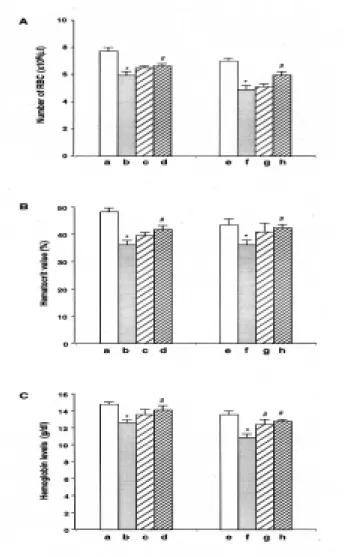
The effect of Fructus schisandrae treatment on the red blood cell count of each group is shown in Fig. 1A. The RBC count in the normal group was 7.74 ± 0.28 x 10⁶/㎕
and 7.00 ± 0.23 x 10⁶/㎕ of blood on the 3rd and 7th days after the start of the experiment,
while that in the phenylhydrazine-induced anemia group was 5.95 ± 0.28 x 10⁶/㎕ and 4.88 ± 0.31 x 10⁶/㎕ on the 3rd and 7th days, respectively. This figure was brought up to 6.49
± 0.13 x 10⁶/㎕ and 5.10 ± 0.22 x 10⁶/㎕ by 250 mg/kg Fructus schisandrae treatment and to 6.65 ± 0.16 x 10⁶/㎕ and 5.97 ± 0.26 x 10⁶/㎕ by 500 mg/kg Fructus schisandrae treatment on the 3rd and 7th days, respectively.
Thus, it appears that the application of Fructus schisandrae has increased the RBC count in anemic rats.
The effect of Fructus schisandrae on the hematocrit ratio in each group is shown in Fig.
1B. The hematocrit ratio in the normal group was 48.30 ± 1.41 % on the 3rd day and 43.50 ± 2.07 % on the 7th day. The hematocrit ratio was decreased by phenylhydrazine injection to 36.20 ± 1.53 % on the 3rd day and 36.30 ± 1.54 % on the 7th day. The hematocrit was increased by treatment with 250 mg/kg Fructus schisandrae to 39.80 ± 1.04
% and 41.00 ± 3.18 % on days 3 and 7, respectively. The hematocrit in the 500 mg/kg-Fructus schisandrae-treated group was also increased, to 41.80 ± 1.43 % after 3 days treatment, and to 42.50 ± 1.12 % after 7 days treatment. Overall, increased hematocrit was observed in Fructus schisandrae-treated groups.
The effect of Fructus schisandrae on the hemoglobin content in anemic rats is shown in Fig. 1C. The hemoglobin content in the normal group was 14.80 ± 0.23 g/㎗ and 13.60
± 0.38 g/㎗, while that in the phenylhy- drazine-treated group was 12.60 ± 0.35 g/㎗
and 10.9±0.36 g/㎗ on the 3rd and 7th days, respectively. This value was increased to 13.60
± 0.54 g/㎗ and 12.40 ± 0.58 g/㎗ by 250 g/kg Fructus schisandrae treatment, and to 14.10
± 0.51 g/㎗ and 12.80 ± 0.19 g/㎗ by 500 mg/kg
Fructus schisandrae treatment for 3 and 7 days, respectively. Thus, in the present study, Fructus schisandrae- treated groups showed increased hemoglobin content.
3.2. Effect of Fructus schisandrae on serum iron content and TIBC (total iron binding capacity)
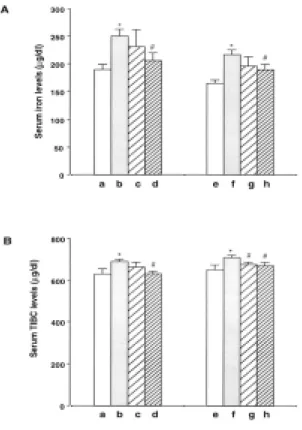
The effect of Fructus schisandrae on the serum iron content in anemic rats is shown in Fig. 2A. The serum iron content in the normal group was 190.30 ± 8.90 ㎍/㎗ on the 3rd day and 166.30 ± 4.90 ㎍/㎗ on the 7th day. This value was increased to 250.80 ± 11.80 ㎍/㎗
and 217.30 ± 8.50 ㎍/㎗ by phenylhydrazine injection on the 3rd and 7th day, respectively.
The serum iron content in the 250 mg/kg-Fructus schisandrae-treated group was 232.30 ± 29.90 ㎍/㎗ and 197.00 ± 16.00 ㎍/㎗
after 3 days and 7 days treatment. Serum iron content in the 500 mg/kg-Fructus schisandrae treated-group was 206.50 ± 14.10 ㎍/㎗ and 190.50 ± 8.50 ㎍/㎗ after 3 days and 7 days treatment. The groups treated with Fructus schisandrae showed a tendency of decreasing serum iron content.
The effect of Fructus schisandrae on the TIBC in anemic rats is shown in Fig. 2B. The TIBC in the normal group was 631.30 ± 22.90
㎍/㎗ and 652.00 ± 22.70 ㎍/㎗ on the 3rd and 7th days, respectively. The TIBC in the phenylhydrazine-treated group was decreased to 690.70 ± 10.80 ㎍/㎗ and 711.50 ± 8.90
㎍/㎗ on the 3rd and 7th days, respectively.
The TIBC was 665.30 ± 21.10 ㎍/㎗ and 676.00
± 10.60 ㎍/㎗ after 3 days and 7 days treatment with 250 mg/kg Fructus schisandrae. After 500 mg/kg Fructus schisandrae treatment for 3 and 7 days, the TIBC value was decreased to 632.20
± 11.80 ㎍/㎗ and 672.70 ± 14.50 ㎍/㎗, respectively. In the present study, a decrease
in TIBC was observed in the groups given Fructus schisandrae.
4. Discussion
Fructus schisandrae is a well-known Oriental herb which has been widely used for the treatment of virus- and chemical-induced hepatitis1,2). Pharmacological studies revealed that Fructus schisandrae increases liver protein and glycogen synthesis, and it was known that Fructus schisandrae antagonizes the induction of liver injuries by CCl4 and thioacetamide3,4,10). Administration of pheny- lhydrazine, which destroys red blood cells, is a well known method experimentally inducing hemolytic anemia11,12). In the present study, blood was sampled on the 3rd and 7th days after injection of 25 mg/kg of phenylhydrazine into a vein in the tail. The red blood cell count, hematocrit, and hemoglobin level were decreased while the serum iron and TIBC contents were increased by phenylhydrazine injection. This result demonstrates the appropriateness of the anemia model.
Red blood cells, which contain hemo- globin, serve as oxygen carriers, and the destruction of red blood cells causes a decrease in the hemoglobin content, which results in disorders, such as anemia, by not being able to transport sufficient oxygen. Therefore, anemia is closely related to hemoglobin levels and occurs when the physiological balance breaks due to a decrease in hemoglobin levels, resulting in a lack of delivered oxygen13,14). The hematocrit is the ratio of the volume of red blood cells to total blood. In anemic states, the volume of blood decreases in relation to the seriousness of the condition, whereas it is almost stable in the normal state, and thus the volume of red blood cells serves as an index
of anemia. The effect of Fructus schisandrae administration on the decreases in red blood cell count, hematocrit ratio, and hemoglobin content induced by phenylhydrazine was demonstrated in this study. Administration of Fructus schisandrae resulted in increases in the RBC number, hematocrit value, and hemoglobin content in a concentration- and duration-dependent manner.
The serum content of iron is determined by the rates of production and destruction of red blood cells, and it is known to reflect the states of hematologic functions. Hemolytic anemia and hemoglobinopathies in particular have long been known to be associated with excessive deposition of iron in the liver and other organs15). In the present study, serum iron was increased in the phenylhydrazine- induced-anemia group, while this figure was decreased in the Fructus schisandrae-treated groups. All iron in the serum exists in combination with transferrin, a γ-globulin.
However, only one-third of the transferrin present in the serum combines with iron, and the other two-thirds remain in an unsaturated state. Because one molecule of transferrin combines with two iron ions, the quantity of iron in the combined state can be estimated by measuring the transferrin concentration in the serum. The total amount of iron that can be combined with transferrin in the serum is called the total iron binding capacity (TIBC).
TIBC is clinically significant because it is increased in iron deficiency anemia, plethora vera, and early stages of acute hepatitis. It is decreased in urinary loss, hepato-cirrhosis caused by metabolic difficulties, cancer, collagen diseases, kidney disorders, etc16,17). In the present study, increased TIBC was observed follwoing phenylhydrazine injection, and Fructus schisandrae treatment decreased
TIBC significantly.
From these results, it was demonstrated that Fructus schisandrae exerts an anti-anemic effect on phenylhydrazine-induced hemolytic anemia in rats. Considering this fact, it can be suggested that the intake of Fructus schisandrae prevents anemia with minimal side effects in women, who are more likely to succumb to anemia due to monthly menstruation, pregnancy, and parturition.
References
1. Pao TT, Liu KT, Hsu HF, Sung CY. Studies on Fructus schisandrae. I. Its effect on increased SGPT levels in animals caused by hepatotoxic chemical agents. Zhonghua Yi Xue Za Zhi. 1974 : 5 ; 275-8.
2. Liu GT. Phramacological actions and clinical use of Fructus schisandrae.
Chinese Medical Journal. 1989 : 102 ; 740-9.
3. Ko KM, Ip SP, Poon MKT., Wu SS, Che CT, Ng KH, Kong YC. Effect of a lignan-enriched Fructus schisandrae extract on hepatic glutathione status in rats: Protection against carbon tetrachloride toxicity. Planta Medica.
1995a : 61 ; 134-7.
4. Ko KM, Mak DHF, Li PC, Poon MKT, Ip SP. Enhancement of hepatic glutathione regeneration capacity by a lignan-enriched extract of Fructus Schisandrae in rats.
Japanese Jopurnal of Pharmacology.
1995b : 69 ; 439-42.
5. Xie JX, Zhou J, Zhang CZ, Yang JH, Jin HQ, Chen JX. Synthesis of schizandrin C analogs. II. Synthesis of dimethyl-4, 4-dimethoxy-5, 6, 5, 6-dimethy- lenedioxybiphenyl-2, 2-dicarboxylate and its isomers. Yao Xue Xue Bao. 1982 : 17
; 23-7.
6. Yu HQ, Yang XY, Zhang YX, Shi JZ.
Biphenyl-dimethyl dicarboxylate in treating and preventing hepatitis due to drug poisoning. Chinese Medical Journal.
1987 : 100 ; 122-3.
7. Han SK, Kim GY, Park YH. Solubilization of biphenyl dimethyl dicarboxylate by cosolvency. Drug Development and Industrial Pharmacy. 1999 : 25 ; 1193-7.
8. Ko KM, Mak DHF, Li PC, Poon MKT, Ip SP. Protective effect of a lignan-enriched extract of Fructus Schisandrae on physical exercise induced muscle damage in rats.
Phytotherapy Research. 1996 : 10 ; 450-2.
9. Hsieh MT, Tsai ML, Peng WH, Wu CR.
Effects of Fructus schizandrae on cyclohexamide-induced amnesia in rats.
Phytotherapy Research. 1999 : 13 ; 256-7.
10. Liu GT, Wei HL. Protection by Fructus schisandrae against acetaminophen hepatotoxicity in mice. Yao Xue Xue Bao.
1987 : 22 ; 650-4.
11. Criswell KA, Sulkanen AP, Hochbaum AF, Bleavins MR. Effects of phenylhydrazine or phlebotomy on peripheral blood, bone marrow and erythropoietin in Wistar rats.
Journal of Applied Toxicology. 2000 : 20
; 25-34.
12. Vannucchi AM, Paoletti F, Linari S, Cellai C, Caporale R, Ferrini PR, Sanchez M, Migliaccio G, Migliaccio AR. Identification and characterization of a bipotent (erythroid and megakaryocytic) cell precursor from the spleen of phenylhydrazine-treated mice. Blood.
2000 : 95 ; 2559-68.
13. Hu R, Yeh MT, Hyland KE, Mather TN.
Experimental Babesia microti infection in golden hamsters: immunoglobulin G response and recovery from severe
hemolytic anemia. Journal of Parasitology.
1996 : 82 ; 728-32.
14. De Franceschi L, Fattovich G, Turrini F, Ayi K, Brugnara C, Manzato F, Noventa F, Stanzial AM, Solero P, Corrocher R.
Hemolytic anemia induced by ribavirin therapy in patients with chronic hepatitis C virus infection: role of membrane oxidative damage. Hepatology. 2000 : 31
; 997-1004.
15. Nelson C, Erikson K, Pinero DJ, Beard JL. In vivo dopamine metabolism is altered
in iron-deficient anemic rats. Journal of Nutrition. 1997 : 127 ; 2282-8.
16. Intragumtornchai T, Huebers HA, Eng M, Finch CA. In vivo transferrin-iron receptor relationships in erythron of rats. American Journal of Physiology. 1988 : 255 ; R326-R331.
17. Ciccoli L, Signorini C, Scarano C, Rossi V, Bambagioni S, Ferrali M, Comporti M.
Iron release in erythrocytes from patients with beat-thalassemia. Free Radical Research. 1999 ; 30 : 407-13.
Fig. 1. Effect of oral administration of aqueous extracts of Fructus schisandrae on the red blood cell (RBC) count, hematocrit value, and hemoglobin content.
Blood sampling via heart puncture was performed on the 3rd and 7th days after phenylhydrazine injection. a: normal group on day 3, b: phen- ylhydrazine-induced-anemia group on day 3, c:
anemia-with-250 mg/kg-Fructus schisandrae-treat- ment group on day 3, d: anemia-with-500 mg/kg -Fructus schisandrae-treatment group on day 3, e:
normal group on day 7, f: phenylhydrazine-induced -anemia group on day 7, g: anemia-with-250 mg/kg-Fructus schisandrae-treatment group on day 7, h: anemia-with-500 mg/kg-Fructus schisandrae- treatment group on day 7. Values are mean ± standard error mean (S.E.M.), with six rats in each group. *; P < 0.05 compared with the normal group,
#; P < 0.05 compared with the phenylhydrazine
Fig. 2. Effect of oral administration of aqueous extracts of Fructus schisandrae on the serum iron content and total iron binding capacity (TIBC). Blood sampling via heart puncture was performed on the 3rd and 7th days after phenylhydrazine injection. a: normal group on day 3, b:
phenylhydrazine-induced-anemia group on day 3, c: anemia-with-250 mg/kg-Fructus schisand- rae-treatment group on day 3, d: anemia-with- 500 mg/kg-Fructus schisandrae-treatment group on day 3, e: normal group on day 7, f:
phenylhydrazine-induced-anemia group on day 7, g: anemia-with-250 mg/kg-Fructus schisan- drae-treatment group on day 7, h: anemia-with -500 mg/kg-Fructus schisandrae-treatment group on day 7. Values are mean ± standard error mean (S.E.M.), with six rats in each group.
*; P < 0.05 compared with the normal group,
#; P < 0.05 compared with the phenylhydrazine -induced anemia group.