Vascular lesions of the musculoskeletal system are common causes of soft tissue masses. Because of the ab- sence of unifying concepts and accurate definitions, sig- nificant confusion remains as to appropriate classifica- tion. The term “hemangioma”has been used as a gener- ic word to describe a variety of vascular lesions, and in the past has been used to describe a combination of the hemangioma of infancy and venous malformation with confusing radiologic findings (1, 2).
In the biological classification system proposed by Mulliken et al. (2), based on cellular turnover, histology, natural history, and physical findings, congenital vascu- lar lesions are usually separated into the hemangioma of infancy and vascular malformation (capillary, lymphat- ic, venous, arterial, or combined). This classification has been useful clinically because unlike venous malforma-
tion, the hemangioma of infancy can undergo involu- tion, and has recently been adopted for interventional radiology (1, 2, 4). There are, however, also various the other masses of vascular origin, including angioleiomy- oma, angiolipoma, hemangiopericytoma, angiosarcoma and soft tissue hematoma. Others may mimic a nonvas- cular soft tissue mass or congenital vascular lesions and should be differentiated (5).
MR imaging can be used to distinguish slow-flow le- sions (venous and lymphatic malformations) from high- flow lesions (hemangioma of infancy, arteriovenous malformation and fistula) on the basis of their spin-echo MR signal characteristics. Slow- and high-flow vascular lesions are distinguished primarily on the basis of their T2-weighted MR imaging findings: high signal intensity is seen in slow-flow lesions, and flow voids in high-flow lesions (3). MR imaging can also represent features of the nonvascular components or static tissues of vascular lesions in which fibrofatty components, smooth muscle, thrombosed vessels, phleboliths and muscle atrophy are present (3, 6).
Because surgical cure is rare in arteriovenous malfor- mation or fistula, and in a hemangioma of infancy spon- taneous involution is possible, pathologic specimen of
MR Imaging of Soft-Tissue Vascular Lesions:
Pathologic Correlation
1Hak Soo Lee, M.D.1,3, Kyung Bin Joo, M.D., Sung Chan Jin, M.D., Yong Soo Kim, M.D., Dong Woo Park, M.D., Choong Ki Park, M.D., Heung Suk Seo, M.D.,
Won Mi Lee, M.D.2, Chan Kum Park, M.D.2
In the evaluation of vascular lesions, MR can be used to distinguish slow- from high- flow lesions on the basis of the observed spin-echo MR signal characteristics. MR imaging can also represent features of the static tissues of the vascular lesions that are composed of fibrofatty components, as well as thromboses, phleboliths and muscle at- rophy. This paper illustrates the MR findings of various vascular lesions, correlating them with the pathologic specimen and emphasizing on the static tissues.
Index words : Soft tissues, neoplasm Soft tissues, MR
Angioma, skeletal system Angioma, muscular
1Department of Diagnostic Radiology, College of Medicine, Hanyang University
2Department of Pathology, College of Medicine, Hanyang University
3Department of Diagnostic Radiology, Eulji University School of Medicine Received September 4, 2000; Accepted May 25, 2001
Address reprint requests to : Kyung -Bin Joo, M.D., Department of Radiology, Hanyang University Hospital,
17, Haengdang-dong, Seungdong-gu, Seoul 133-792, Korea.
Tel. 82-2-2290-9164 Fax. 82-2-2293-2111 E-mail: [email protected]
these two entities are not usually available. We shall, however, review and illustrate the MR findings of the various other vascular lesions relatively commonly en- countered in clinical practice, correlating them with pathologic specimens and emphasizing static tissues.
Venous Malformation
Venous malformation, involving the presence of post- capillary dilated venous spaces characterized by stag- nant flow, a lack of normal venous valves and the ab- sence of arteriovenous shunting, is commonly referred to in the literature as “hemangioma”(3). Spin-echo se- quences of venous malformation indicate that slow flow and a serpentine pattern with internal striations or sep-
tations are characteristic, and there is also associated fo- cal muscle atrophy. T1-weighted images demonstrate iso- or slightly high signal intensity relative to skeletal muscle and poorly delineated or indistinct margins. The high signal intensity seen on T2-weighted images has been attributed to the increased free water present in the stagnant flow in these abnormal vascular spaces (3).
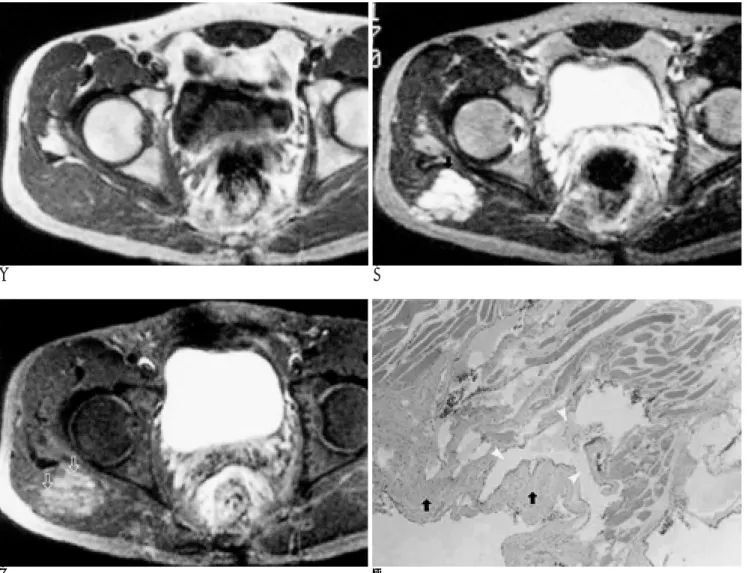
The serpentine or lacelike pattern shows greater signal intensity than that of the skeletal muscle seen on both T1- and T2-weighted images, but less than that of the subcutaneous fat seen on T1-weighted images and greater than that of the fat on T2-weighted images. In spite of the homogenous pattern seen on T1- and T2- weighted images, small localized lesions shows a ser- pentine pattern on Gd-enhanced T1-weighted images
A B
C D
Fig. 1. Typical form of venous malformation
Axial T1-weighted image (A) shows an iso-intense mass of right buttock with internal linear striation of high signal intensity. Axial T2-weighted image (B) shows lobulated mass (arrow) of high signal intensity with internal septum-like structure of low signal inten- sity. Axial Gd-enhanced T1-weighted image (C) shows typical serpentine enhancement (open arrows) of venous malformation.
Pathologic examination (D) (H-E stain, ×40) shows small and large vessels (arrowheads), and fibrofatty elements (arrows) corre- sponding to serpentine enhancement on MR imaging.
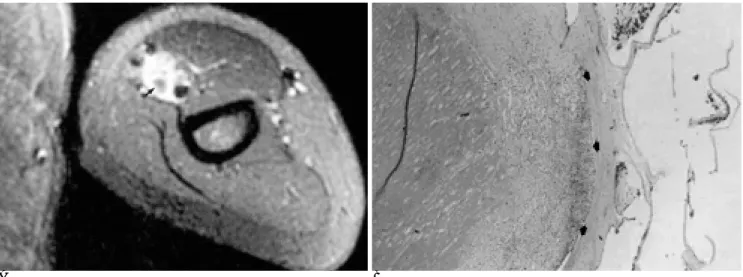
which has been correlated with fibrofatty septa (3, 6, 7) (Fig. 1). Small round or ovoid areas of low signal intensi- ty seen within a lesion on T2-weighted images represent thrombosed vessels, phleboliths, and linear, fibrous stri- ations cut in cross section (3) (Figs. 2, 3).
Lymphatic Malformation
Lymphatic malformation is seen as a unilocular or multilocular mass containing serous or chylous fluid.
The cyst wall and septum consist of fibrous and lym- phatic tissues, vessels and smooth muscle (8). Some are cystic and others consist predominantly of septa rather than cystic spaces. All lymphatic malformations show low signal intensity on T1-weighted and high signal in- tensity on T2-weighted images, findings which are typi- cal of a fluid-filled cyst (Fig. 4). A hemorrhage or fluid- fluid level may be seen in lymphatic malformation (1,9) (Fig. 5), and due to the large amount of adipose and con- nective tissue, the internal septum may show linear
A B
Fig. 2. Venous malformation with thrombosis.
Axial T2-weighted image (A) shows an ill-defined mass, which has high signal intensity with small focus of low signal intensity (ar- row), along the neurovascular bundles at the anteromedial aspect of left arm. There is no enhancement in the small focus of the mass on Gd-enhanced T1-weighted image (not shown). Venous malformation consists of large, thin-walled veins lined by flattened endothelium and has an area of large thrombus (arrows) on pathologic examination (B) (H-E stain, ×40).
A B
Fig. 3. Venous malformation with internal calcification.
Axial Gd-enhanced T1-weighted image (A) shows a lobulated well-enhancing mass with internal nodular and linear striation (ar- row) in the posterolateral aspect of left lower leg. The internal nodular or linear striation has low signal intensity relative to muscle on T1-and T2-weighted image (not shown) and no enhancement on Gd-enhanced T1-weighted image (A). The nodular striation corresponds to calcification (arrows) of venous malformation on pathologic examination (B) (H-E stain, ×40).
high signal intensity on T1-weighted images (9) (Fig.
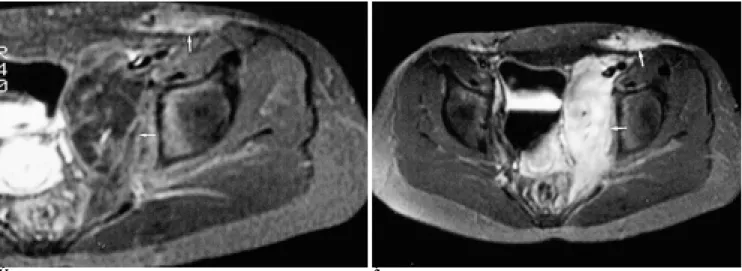
4D). Gd-enhanced T1-weighted images of the wall and septum of lymphatic malformation may demonstrate patchy linear enhancement (1). In one of our case, the pattern of delayed enhancement seen at 30 minutes and involving the enhancement of cystic space mimicked that of venous malformation, but the enhancement pat- tern seen during the early phase (5 minutes) and the findings of pathologic examination were compatible with lymphatic malformation (Fig. 6).
A B C
D
Fig. 4. Typical form of lymphatic malformation.
MR imaging at 4 years after resection of vascular malformation shows residual malformation, which is mainly located in the subcutaneous fat layer at the pos- teromedial aspect of the left arm. The malformation has multiloculated cystic space with internal septation. The cystic portion has low signal intensity com- pared with muscle on T1-weighted image (A) and doesn’t enhance with Gd-DT- PA (C). The septa (arrows) have high signal intensity on T1-weighted image (A), low signal intensity on T2-weighted image (B). Abundant fat lobules (arrows) are present in the stroma between the large lymphatic vessels on pathologic exam (D) (H-E stain, ×40), corresponding to high signal intensity on T1-weighted image.
Fig. 5. Lymphatic malformation with fluid-fluid level
Axial T2-weighted image (A) shows multilobulated cystic mass with fluid-fluid level (arrows) in the anteromedial aspect of left thigh.
A B
Fig. 6. Lymphatic malformation with delayed enhancement of the cystic portion.
Immediate axial Gd-enhanced T1-weighted image (A) shows septum-like enhancement of the lesion (arrows) in pelvis and the sub- cutaneous fat layer of left inguinal area. But, delayed axial Gd-enhanced T1-weighted image (B) at 30 minutes show homogeneous enhancement of the cystic portion of lymphatic malformation (arrows) mimicking enhancement pattern of venous malformation.
A B
Fig. 7 Lymphaticovenous malformation
The axial T1-weighted (A) and T2-weighted images (B) show slow flow vascular lesion in the subcutaneous fat layer and in- tramuscular area of the right forearm. Axial Gd-enhanced T1- weighted image (C) shows minimal linear enhancement (arrow- head) of the cystic mass and nodular or tubular enhancement (open arrows) in subcutaneous and intramuscular lesions. The nodular and tubular structures were thought to be venous com- ponent of lymphaticovenous malformation. At surgery, the draining vein of the mass was markedly dilated and then ligat- ed. Pathologic examination (not shown) shows only lymphatic component containing lymph fluid.
C
Mixed Malformation
MR images of mixed malformation demonstrate the combined characteristics of its separate components.
Vascular flow, for example, may have slow- or high- or mixed-flow characteristics, and the features of the static components may also depend on the components of mixed malformation (1). In our study, one mixed mal- formation involved both lymphatic and venous chan- nels. MR images revealed the lesion’s slow-flow charac- teristics, and both MRI and pathologic examination showed that in terms of signal intensity, components of the septum and cystic space, it shared the characteristics of lymphatic and venous malformation (Fig. 7).
Pathologic examination showed that our other case of mixed malformation involved both venous and arteri- ovenous elements. Because the area involving arteriove- nous malformation was much smaller than that involv- ing venous malformation, MR imaging of the lesion
demonstrated, however, only slow flow characteristics and an absence of flow-related signal void.
Angiomatosis
Angiomatosis involves diffuse infiltration of tissue by hemangiomatous and/or lymphangiomatous lesions, and is difficult to distinguish histologically. A heman- giomatous lesion is usually a mixture of arteriovenous, capillary and cavernous vascular tissue, and imaging may also reveal fat overgrowth (5). Angiomatosis may involve osseous and visceral structures, and except for infiltrative growth and the extensive involvement of multiple tissues, its imaging features (Fig. 8) are similar to those of solitary vascular lesion.
Angioleiomyoma
Angioleiomyoma is a rare benign smooth muscle tu- mor that originates in the tunica media of the veins. It
A B
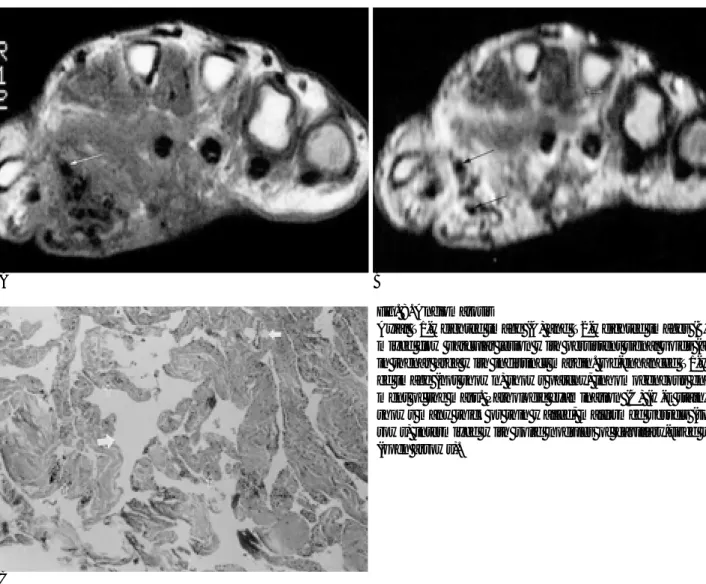
Fig. 8. Angiomatosis
Axial T1-weighted image (A) and T2-weighted images (B) show mixed flow vascular lesion with persistent signal voids (arrows) in thenar area with indistinct margin. Gd-enhanced T1-weight- ed image (not shown) shows patchy, inhomogeneous enhance- ment of the mass. Pathologic examination (C) (H-E stain, ×40) shows many thick or thin walled, malformed vessels (solid ar- rows) intermixed with solid nodules of capillary-sized vessels (open arrows).
C
can be found in the dermis, subcutaneous fat or fascia, and is normally less than 2 cm in diameter. Pathologi- cally, angioleiomyoma shows a concentric proliferation of smooth muscle in the perivascular area (Fig. 9), and T2-weighted images reveal a mixture of high and isosig- nal intensity to skeletal muscle and a rim of low signal intensity. On T2-weighted images, the high signal inten- sity area corresponds to smooth muscle and numerous
vessels, and the isosignal intensity area correlates with fibrous or connective tissue, or intravascular thrombus.
The well-defined rim of low signal intensity is a fibrous capsule. Along with ganglion, fibroma, schwannoma, and lipoma, angioleiomyoma should be included in the differential diagnosis of nodular lesions of the extremity (10).
C D
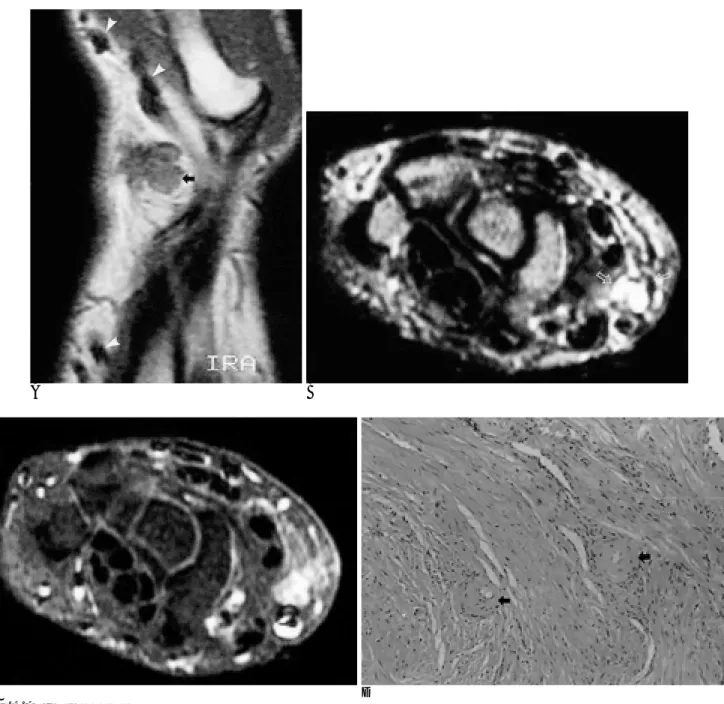
Fig. 9. Angioleiomyoma
The sagittal (A) T1-weighted image shows a lobulated soft tissue mass (arrow) in the subcutaneous fat layer of the radial aspect of the left wrist. There are dilated vascular structures (arrowheads) in the proximal and distal portions of the mass. The mass has iso- signal intensity relative to muscle on T1-weighted image (A) and inhomogeneous high signal intensity with hypointense rim (open arrows) on T2-weighted image (B). There is diffuse contrast enhancement of the mass on axial Gd-enhanced T1-weighted image (C). Pathologic examination (D) (H-E stain, ×100) shows the concentric smooth muscle cells surrounding small-sized vessels (ar- rows). The hypointense rim on T2-weighted image responds to well-defined fibrous capsule (not shown).
A B
Organizing Hematoma
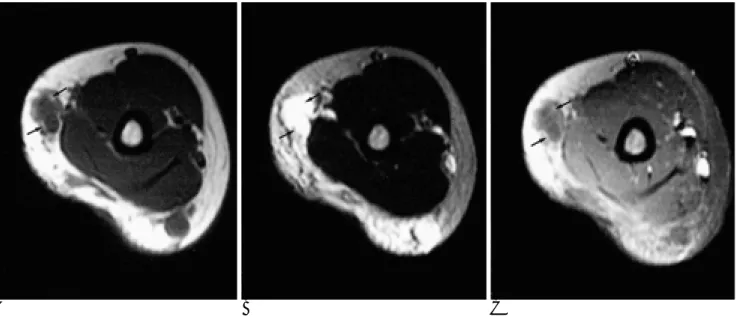
The MR imaging findings of extracranial hematoma vary and depend on the age of the lesion. Spin-echo MR Imaging usually indicates that acute hematoma is homo- geneous and isointense to muscle on T1-weighted im- ages, but shows decreasing intensity on T2-weighted im- ages. Subacute hematoma (1 week to 3 months old) shows a homogeneous increased signal on T1- and T2- weighted images (Fig. 10), and a rind of decreased signal intensity due to hemosiderin-laden macrophages may
be seen. A hematoma may be of mixed signal intensity during the early subacute stage, with intermediate in- tensity in the center and high intensity at the periphery.
As during the subacute stage, a chronic hematoma may demonstrate increased signal intensity on all spin-echo sequences. The rind of hemosiderin-laden tissue may be quite extensive, and at all pulse sequences, the lesion eventually shows a signal intensity less than that of skeletal muscle (5). We encountered a case of organizing hematoma with adjacent bony erosion (Fig.11), but pathologic review indicated that the mass consisted of a large thrombus and a venous hemangiomatous compo-
A B
Fig. 10. Organizing hematoma.
Coronal T1-weighted image (A) and T2- weighted images (B) of the left forearm show a lobulated, nonspecific soft tis- sue mass of high signal intensity with hypointense rim (arrows).
A B
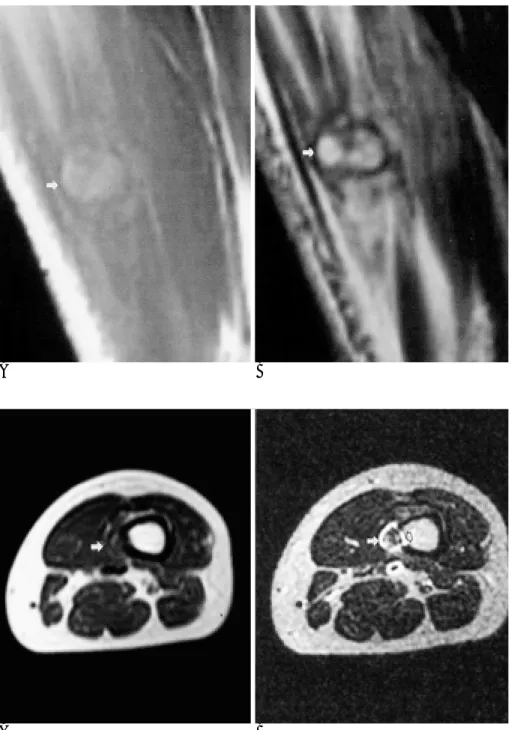
Fig. 11. Organizing hematoma with ve- nous malformation.
Axial T1-weighted (A) and T2-weighted images (B) show soft tissue mass (solid arrows) in the vastus intermedius of the right thigh with adjacent cortical erosion (open arrow). The signal inten- sity of the mass is iso-intense relative to muscle on T1-weighted image, and in- homogeneous hypointense in the cen- tral portion and hyperintense in the pe- ripheral portion on T2-weighted image.
Gd-DTPA was not administered in this case. On pathologic exam, there were larger area of the organizing thrombus and smaller area of the abnormal vas- cular channels that were compatible to venous malformation (not shown).
nent. The final diagnosis was thus the venous malforma- tion associated with hematoma. An organizing hematoma may be differentiated from vascular malfor- mation by the presence of central high signal intensity on T1-weighted images, a hypointense rim, and adjacent muscular edema.
References
1. Meyer JS, Hoffer FA, Barnes PD, Mulliken JB. Biologic classifica- tion of soft-tissue vascular anomalies: MR correlation. AJR Am J Roentgenol 1991;157:559-564
2. Mulliken JB, Glowacki JG. Hemangiomas and vascular malforma- tions in infants and children: A classification based on endothelial characteristics. Plast Reconstr Surg 1982;69:412-22
3. Rak KM, Yakes WF, Ray RL, et al. MR imaging of symptomatic pe- ripheral vascular malformations. AJR Am J Roentgenol 1992;159:
107-112
4. Yakes WF, Luethke JM, Parker SH, et al. Ethanol embolization of vascular malformations. Radiographics 1990;10:787-796
5. Kransdorf MJ. Murphey MD. Vascular and Lymphatic tumors. In Kransdorf MJ. Murphey MD. Imaging of soft tissue tumors.
Philadelphia : Saunders, 1997:103-141
6. Buetow PC, Kransdorf MJ, Moser RP, Jelinek JS, Berrey BH.
Radiologic appearance of intramuscular hemangioma with empha- sis on MR imaging. AJR Am J Roentgenol 1990;154:563-567 7. Memis A, Arkun R, Ustun EE, Kandiloglu G. Magnetic resonance
imaging of intramuscular haemangiomas with emphasis on con- trast enhancement patterns. Clin Radiol 1996;51:198-204
8. Munechika H, Honda M, Kushihashi T, Koizumi K, Gokan T.
Computed tomography of retroperitoneal cystic lymphangiomas. J Comput Assist Tomogr 1987;11:116-119
9. Cutillo DP, Swayne LC, Cucco J, Dougan H. CT and MR imaging in cystic abdominal lymphangiomatosis. J Comput Assist Tomogr 1989;
13:534-536
10. Hwang JW, Ahn JM, Kang HS, Suh JS, Kim SM, Seo JW. Vascular leiomyoma of an extremity: MR imaging-pathology correlation.
AJR Am J Roentgenol 1998;171:981-985
대한방사선의학회지 2001;45:69-77
연부조직 혈관성 병변의 자기공명영상소견: 병리소견과 비교1
1한양대학교 의과대학 진단방사선과학교실
2한양대학교 의과대학 병리학교실
3을지대학병원 진단방사선과학교실
이학수1,3・주경빈・진성찬・김용수・박동우・박충기・서흥석・이원미2・박찬금2
혈관성 병변의 평가시, 자기공명영상은 스핀에코기법의 자기공명영상 신호 특성에 기초하여 저 속도성 병변과 고 속 도성 병변을 구별하는데 이용될 수 있고, 또한 혈관성 병변을 구성하고 있는 섬유지방성분, 혈전, 정맥석, 근 위축 등의 정지조직의 영상을 표현하는데 적합하다. 본 화보에서는 다양한 혈관성 병변의 자기공명영상 소견을 나열하고, 정지조 직을 중심으로 자기공명영상과 조직학적 소견을 비교하고자 한다.