163
and Safety
Available online at http://www.foodhygiene.or.kr
https://doi.org/10.13103/JFHS.2017.32.2.163
비브리오 패혈증균에 대한 매실 추출물의 항균활성
하태만1·전두영1·임현철1·윤연희1·신미영1·윤기복1·김중범2*
1전라남도보건환경연구원 미생물과, 2순천대학교 식품공학과
Antimicrobial Activity of Maesil (Prunus mume) Extract against Vibrio vulnificus
Tea-Man Ha1, Doo-Young Jeon1, Hyun-Chul Im1, Yeon-Hee Yoon1, Mi-Yeong Shin1, Ki-Bok Yoon1, and Jung-Beom Kim2*
1Division of Microbiology, Jeollanam-do Institute of Health and Environment, Muan, Korea
2Department of Food Science and Technology, SunChon National University, Suncheon, Korea (Received February 22, 2017/Revised March 6, 2017/Accepted March 21, 2017)
ABSTRACT - The purpose of this study was to estimate the antimicrobial activity of Maesil (Japanese apricot, Prunus mume) extract against Vibrio vulnificus. The strains tested in the study were 28 V. vulnificus isolates originated from fish, seawater, mud flat and seawater in fish restaurant. The vvhA gene was detected using real-time PCR and biochemical identification expressed above good identification in 28 isolates of V. vulnificus. All of V. vulnificus used in this study was susceptible to tetracycline and chloramphenicol antibiotics. These two antibiotics were considered to be useful for the treatment of patients. Maesil extracts 2.5% and 5% showed antimicrobial activity against V. chol- erae NCCP 13589 and V. parahemolyticus NCCP 11143. V. vulnificus isolate and V. vulnificus NCCP 11135 showed growth inhibition at 1.25%, 2.5% and 5% of Maesil extract, respectively. Compared with V. cholerae and V. para- hemolyticus, the antibacterial activity of Maesil extract against V. vulnificus was high. The minimum bactericidal con- centration of Maesil extract for V. vulnificus was 1.6%. These results revealed that Maesil extract was found to be very useful for inhibiting the growth of V. vulnificus and can be expected to prevent food poisoning caused by V. vulnificus.
Key words : Vibrio vulnificus, Maesil (Japanese apricot), Prunus mume, Antimicrobial activity
2015년 수산물 생산액이 7조원 이상을 기록하는 등 축 산물 보다 수산물을 통한 단백질 섭취가 증가하고 있으며 수산물의 영양학적 가치로 수산식품은 건강식품으로 인식 되고 있다1,2). 수산물은 미생물에 의한 변패가 용이하여 식 중독 원인식품으로 작용할 수 있으며, 주요 병원성세균으 로 비브리오균이 보고1)되고 있다. 특히 우리나라의 경우 해산물 섭취가 많고 어패류를 생식하는 식습관 상 비브리 오균에 의한 감염 위험이 높게 보고3)되고 있다. 병원성 비 브리오균에는 Vibrio parahemolyticus, Vibrio cholerae, Vibrio vulnificus 등이 대표적이며, 수산물 섭취와 관련된 사망사고의 95% 이상이 V. vulnificus와 연관된 것으로 보 고4)되고 있다. V. vulnificus는 비브리오 패혈증의 원인균으 로 알려져 있으며, 간 기능 저하 등 면역력이 약화된 사 람에게 심각한 패혈증을 일으킨다5). V. vulnificus 감염은
오염된 수산물을 섭취하거나 해수에 상처가 노출되었을 때 발생하며 발열, 오한, 복통, 설사 등의 증상과 피부 병 변이 나타난다5). 질병관리본부 보고6)에 의하면 2011부터 2015년까지 5년간 전국에서 발생한 비브리오 패혈증 환자 269명 중 147명(54.6%)이 사망하는 등 비브리오 패혈증은 높은 치사율을 나타내고 있다. 이러한 원인은 비브리오 패 혈증의 진행 속도가 매우 빠르고, ampicilin, moxalactam, cefoperazone, cefomandole 등의 항생제에 내성을 나타내 며 신속한 치료가 이루어지지 않기 때문인 것으로 보고7) 되고 있다. 따라서 수산물 섭취로 인한 V. vulnificus 식중 독을 예방하기 위하여 항생제 내성 V. vulnificus에 대한 항 균활성 연구가 필요하다 하겠다.
매실(Prunus mume)은 장미과에 속하는 식물로 중국 동 남부지방이 원산지로 한국, 중국, 일본에 분포하고 꽃을 볼 때는 매화나무, 열매를 수확 할 때는 매실나무라 지칭8)되 고 있다. 역사적 기록을 살펴보면 삼국유사와 삼국사기에 꽃에 대한 기록만 있어 삼국시대에는 정원수로 사용된 것 으로 추정되며, 고려시대부터 약용으로 사용되기 시작하 여 조선중기 이후 식품으로 이용9)되고 있다. 매실에는 citric
*Correspondence to: Jung-Beom Kim, Department of Food Science and Technology, SunChon National University, 255 Jungang-ro, Suncheon, Jeonnam 57933, Korea
Tel: 82-61-750-3259, Fax: 82-61-750-3208 E-mail: [email protected]
acid, malic acid 등 유기산이 다른 과일에 비해 풍부하며 rutin, syringaresinol, β-sitosterol 등 다양한 생리활성 물질 을 함유하고 있으며, Ca, K 등 무기질 함량이 많아 매실 주, 매실차, 매실엑기스, 매실음료 등 다양한 형태의 식품 으로 가공되고 있다5,8,10,11). 한방에서 매실은 만성설사, 혈 변, 구충 등의 약제로 이용되고 있으며, 특히 말린 매실을 오매라 하여 약제로 사용하고 있다12). 최근 연구에서는 당 뇨병과 간 기능 개선, 항암 및 항산화 작용 등 다양한 생 리활성 효과가 있는 것으로 보고13,14)되고 있으며, 특히 식 중독세균에 대한 매실 농축액과 매실 추출액의 항균효과 연구가 보고8,11,12)되고 있다. 그러나 현재까지의 연구는 식 중독세균 중 Salmonella spp., Staphylococcus aureus, Listeria monocytogenes, Bacillus cereus, V. parahemolyticus, Escherichia coli 등에 한정되어 있고, 수산물 섭취를 통해 매년 지속적으로 감염자가 발생하고 있는 V. vulnificus에 대한 연구는 전무한 실정이다.
따라서 본 연구에서는 수산물 섭취와 연관되어 가장 높 은 사망률을 나타내는 V. vulnificus에 대한 매실 추출액의 항균활성을 측정함으로서 다소비 식품인 수산물의 미생물 학적 안전성 확보에 기여하고자 하였다.
Materials and Methods
매실 추출물
실험에 사용한 매실 추출물은 매실즙을 착즙한 후 가열 농축한 광양시 청매실농원의 고형분 함량 70% 이상인 매 실농축액을 사용하였다. 매실 농축액을 동량의 멸균증류 수로 용해하여 4,000 rpm에서 5분간 원심분리 한 후 상층 액을 0.45 μm pore membrane filter (Toyo Roshi Kaisha Ltd., Tokyo, Japan)로 여과하여 매실 추출물 실험원액 (100%)으로 하였다.
사용균주
실험에서 사용한 균주는 2014년부터 2015년 까지 수산 물, 수족관수, 해수, 갯벌에서 분리되어 전라남도보건환경 연구원에 보관된 V. vulnificus 28주를 대상으로 하였다. 양 성, 음성 대조를 위한 표준균주는 V. vulnificus NCCP 11135, V. parahemolyticus NCCP 11143, V. cholerae NCCP 13589를 사용하였다.
V. vulnificus 확인동정
실험에 사용한 균주가 V. vulnificus임을 재확인하기 위 하여 확인동정실험을 실시하였다. 보관균주를 thiosulfate citrate bile-salt sucrose agar (TCBS; Oxoid, Hampshire, England)에 도말하여 37oC에서 20시간 배양한 후 녹색집 락을 선택하여 tryptone soy agar (TSA; Oxoid)에 계대 배 양하였다. V. vulnificus 특이 유전자인 vvhA 유전자15)를 분
석하기 위하여 배양된 균주 한 백금이를 멸균 증류수 200μL에 현탁한 후 100oC에서 15분간 가열하였다. 가열 된 배양액을 14,000 rpm에서 10분간 원심분리하여 상층 액을 주형 DNA로 사용하였다. V. vulnificus의 vvhA 유전 자 검출을 위한 real-time PCR은 Vibrio triplex real-time PCR kit (KogeneBiotech Co., Ltd., Seoul, Korea)와 real- time PCR (7500 Fast real-time PCR, Applied Biosystems, Singapore)을 사용 제조사의 실험조건에 따라 실시하였다.
real-time PCR 결과 vvhA 유전자가 확인된 균주는 Vitek 2 system (Biomerieux, Durham, NC, USA)를 이용 생화학 적 동정을 실시하여 최종 V. vulnificus를 확인하였다.
항생제 내성 검사
본 실험에 사용된 V. vulnificus의 항생제 내성 현황을 파 악하기 위해 Vitek 2 system을 이용하여 항생제 내성을 실 험하였다. 실험에 사용된 항생제 카드는 AST-N169 card (biomerieux)로 구성 항생제 종류는 ampicillin (AMP), amoxicillin/clavulanic acid (AMC), ampicilln/sulbactam (SAM), cefazolin (CFZ), cefotetan (CTT), cefoxitin (FOX), ceftriaxone (CRO), imipenem (IPM), amikacin (AMK), gen- tamicin (GEN), nalidixic acid (NAL), ciprofloxacin (CIP), tetracycline (TET), chloramphenicol (CHL), trimethoprim/
sulfamethoxazole (SXT) 등 총 15종을 사용하였다. 각각 항생제에 대한 내성(Resistant; R), 중등도 내성(Intermediate;
I), 감수성(Susceptible; S) 판정은 Clinical and Laboratory Standards Institute (CLSI)의 항생제 내성기준16)에 따라 판 정하였다.
항균활성 측정
매실 추출물의 항균활성을 탐색하기 위해 V. vulnificus 분리균주 1주와 V. vulnificus NCCP 11135, V. para- hemolyticus NCCP 11143, V. cholerae NCCP 13589 표준 균주 각각 1주에 대하여 paper disc diffusion법17)을 이용 하여 실험하였다. 각각의 균주를 Mueller-Hinton broth (MHB; Oxoid)에 접종하여 37oC에서 18시간 배양한 후 멸 균생리식염수를 이용 0.8 McFarland의 탁도를 나타내는 균액을 조제하였다. 조제된 균액을 Mueller-Hinton agar (MHA; Oxoid)에 균일하게 도말하였다. 멸균된 10 mm paper disc (Toyo Roshi Kaisha Ltd.)에 각각 농도의(5%, 2.5%, 1.25%, 0.625%) 추출물 50 μL를 흡수시켜 MHA 위 에 놓고 37oC에서 18시간 배양하여 생육저해대의 지름 (mm)을 측정하였다.
최소살균농도 측정
매실 추출물의 최소살균농도(MBC, minimum bactericidal concentration)는 액체배지희석법17)에 따라 실험하였다. V.
vulnificus 실험균주 28주와 V. vulnificus 표준균주 1주, 총
29주를 MHB (Oxoid)에 접종하여 항균활성 실험과 동일 하게 0.8~0.9 McFarland의 탁도를 가진 균액을 조제하였 다. 조제된 균액을 다시 멸균생리식염수로 100배 희석하 여 접종 균액으로 하였다. 매실 추출액과 MHB (Oxoid)를 혼합한 후 MHB를 이용 계단 희석하여 매실 추출액-MHB 배지를 제조하였다. 제조된 매실 추출액-MHB 배지를 시 험관에 1 mL씩 분주한 후 접종 균액 1 mL 넣어 최종 매 실 추출액의 농도가 0.1%부터 6.4%까지 되도록 하였다.
균액이 접종된 시험관을 37oC에서 20시간 배양한 후 각각 시험관의 배양액 0.1 mL를 TSA에 spreading 하여 37oC에 서 20시간 배양하였다. 배양결과 매실 추출액을 첨가하지 않은 시험관의 집락수를 기준으로 0.1% 이하 집락수를 나
타낸 시험관의 매실 추출액 농도를 최소살균농도(MBC)로 하였다.
Results and Discussion
V. vulnificus 확인동정 및 항생제 내성
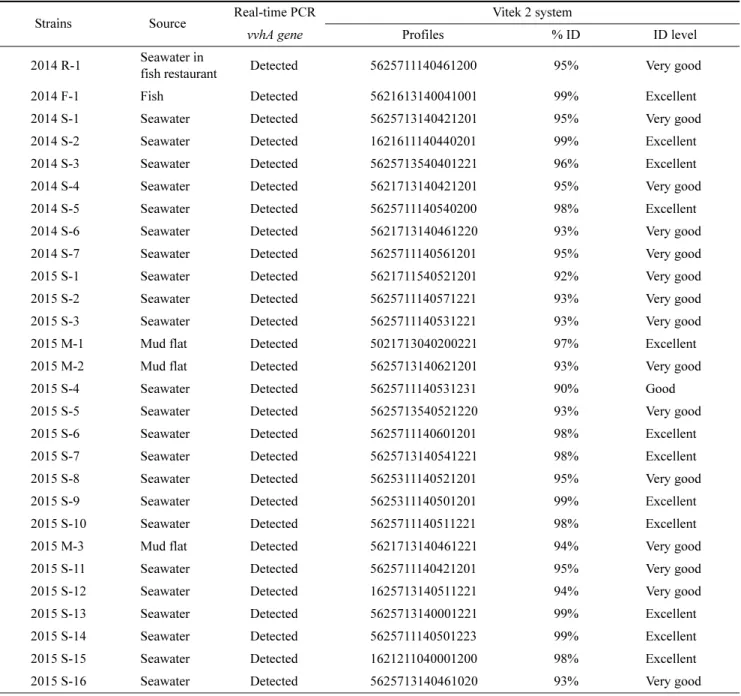
실험에 사용된 V. vulnificus 균주의 확인동정을 위하여 real-time PCR을 이용한 유전자 검출과 vitek 2 system을 이용한 생화학 동정을 실시하였다(Table 1). vvhA 유전자 는 V. vulnificus의 병원성을 확인할 수 있는 용혈 유전자 로서 real-time PCR을 이용한 V. vulnificus 동정 실험의 목 적 유전자로 사용되고 있다15). Vitek 2 system 실험결과
Table 1. Real-time PCR and biochemical profiles for identification of Vibrio vulnificus strains
Strains Source Real-time PCR Vitek 2 system
vvhA gene Profiles % ID ID level
2014 R-1 Seawater in
fish restaurant Detected 5625711140461200 95% Very good
2014 F-1 Fish Detected 5621613140041001 99% Excellent
2014 S-1 Seawater Detected 5625713140421201 95% Very good
2014 S-2 Seawater Detected 1621611140440201 99% Excellent
2014 S-3 Seawater Detected 5625713540401221 96% Excellent
2014 S-4 Seawater Detected 5621713140421201 95% Very good
2014 S-5 Seawater Detected 5625711140540200 98% Excellent
2014 S-6 Seawater Detected 5621713140461220 93% Very good
2014 S-7 Seawater Detected 5625711140561201 95% Very good
2015 S-1 Seawater Detected 5621711540521201 92% Very good
2015 S-2 Seawater Detected 5625711140571221 93% Very good
2015 S-3 Seawater Detected 5625711140531221 93% Very good
2015 M-1 Mud flat Detected 5021713040200221 97% Excellent
2015 M-2 Mud flat Detected 5625713140621201 93% Very good
2015 S-4 Seawater Detected 5625711140531231 90% Good
2015 S-5 Seawater Detected 5625713540521220 93% Very good
2015 S-6 Seawater Detected 5625711140601201 98% Excellent
2015 S-7 Seawater Detected 5625713140541221 98% Excellent
2015 S-8 Seawater Detected 5625311140521201 95% Very good
2015 S-9 Seawater Detected 5625311140501201 99% Excellent
2015 S-10 Seawater Detected 5625711140511221 98% Excellent
2015 M-3 Mud flat Detected 5621713140461221 94% Very good
2015 S-11 Seawater Detected 5625711140421201 95% Very good
2015 S-12 Seawater Detected 1625713140511221 94% Very good
2015 S-13 Seawater Detected 5625713140001221 99% Excellent
2015 S-14 Seawater Detected 5625711140501223 99% Excellent
2015 S-15 Seawater Detected 1621211040001200 98% Excellent
2015 S-16 Seawater Detected 5625713140461020 93% Very good
good identification, very good identification, excellent로 동 정될 경우 분리 균주가 정확하게 동정되었음을 의미한다.
real-time PCR 실험결과 28주 모두에서 V. vulnificus의 특 이 유전자인 vvhA 유전자가 검출되었으며, 생화학 동정에 서도 28주 모두 good identification 이상의 결과를 나타내 어 본 실험에 사용된 분리균주는 모두 V. vulnificus임이 확
인되었다.
V. vulnificus에 대한 항생제 내성 실험결과는 Table 2에 나타내었다. 실험결과 가장 높은 내성을 나타낸 항생제는 cefoxitin으로 24균주 (85.7%)에서 내성을 나타내었으며, ampicilln는 4균주 (14.3%)에서 내성을 나타내었다. 중등도 내성(intermediate)은 cefotetan에서 5균주 (17.9%), ampicillin Table 2. Antibiotic resistance profiles of 28 Vibrio vulnificus strains
Strains Source Antibiotics1,2)
AMP AMC SAM CFZ CTT FOX CRO IPM NAL AMK GEN CIP TET CHL SXT
2014 F-1 Fish S S S S S R S S S S S S S S S
2015 M-1 Mud flat I S S S S S S S S S S S S S S
2015 M-2 Mud flat R S S S S S S S S S S S S S S
2015 M-3 Mud flat S S S S S R S S S S S S S S S
2014 S-1 Seawater S S S S S R S S S S S S S S S
2014 S-2 Seawater S S S S I R S S S S S S S S S
2014 S-3 Seawater S S S S S R S S S S S S S S S
2014 S-4 Seawater S S S S S R S S S S S S S S S
2014 S-5 Seawater S S S S S R S S S S S S S S S
2014 S-6 Seawater S S S S I R S S S S S S S S S
2014 S-7 Seawater S S S S S R S S S S S S S S S
2015 S-1 Seawater S S S S S R S S S S S S S S S
2015 S-2 Seawater I S S S S R S S S S S S S S S
2015 S-3 Seawater S S S S I R S S S S S S S S S
2015 S-4 Seawater S S S S S R S S S S S S S S S
2015 S-5 Seawater S S S S S R S S S S S S S S S
2015 S-6 Seawater S S S S S R S S S S S S S S S
2015 S-7 Seawater S S S S S R S S S S S S S S S
2015 S-8 Seawater S S S S S R S S S S S S S S S
2015 S-9 Seawater S S S S S R S S S S S S S S S
2015 S-10 Seawater S S S S I R S S S S S S S S S
2015 S-11 Seawater S S S S I R S S S S S S S S S
2015 S-12 Seawater R S S S S S S S S S S S S S S
2015 S-13 Seawater R S S S S I S S S S S S S S S
2015 S-14 Seawater S S S S S R S S S S S S S S S
2015 S-15 Seawater S S S S S R S S S S S S S S S
2015 S-16 Seawater S S S S S R S S S S S S S S S
2014 R-1 Seawater in
fish restaurant R S S S S R S S S S S S S S S
Resistance rate (%) 14.3 0 0 0 0 85.7 0 0 0 0 0 0 0 0 0
Intermediate rate (%) 7.1 0 0 0 17.9 3.6 0 0 0 0 0 0 0 0 0
Susceptible rate (%) 78.6 100 100 100 82.1 10.7 100 100 100 100 100 100 100 100 100
1)ampicillin (AMP), amoxicillin/Clavulanic acid (AMC), ampicilln/sulbactam (SAM), cefazolin (CFZ), cefotetan (CTT), cefoxitin (FOX), ceftriaxone (CRO), imipenem (IPM), nalidixic acid (NAL), amikacin (AMK), gentamicin (GEN), ciprofloxacin (CIP), tetracy- cline (TET), chloramphenicol (CHL), trimethoprim/sulfamethoxazole (SXT).
2)R: resistant, I: intermediate, S: susceptible
에서 2균주 (7.1%), cefoxitin에서 1균주 (3.6%)로 나타났 다. 실험에 사용된 V. vulnificus 28균주 모두는 tetracycline 과 chloramphenicol 등 11종의 항생제에 감수성을 나타내 었다. 이러한 결과는 2001년 국내에서 분리된 V. vulnificus 에 대한 항생제 내성 실험결과 chloramphenicol, tetracycline, nalidixic acid, ciprofloxacin, trimethoprim/sulfamethoxazole 항생제에 대해 87.6%에서 92.4%까지 감수성을 나타내었 다는 보고18)와 유사한 결과를 나타내었다. 비브리오 패혈 증 치료에는 tetracycline과 chloramphenicol 항생제가 권장 된다는 보고5,7)와 비교 시 28균주 모두 tetracycline과 chloramphenicol 항생제에 감수성을 나타내어 환자 발생 시 이 두 종류의 항생제가 치료에 용이할 것으로 판단되 었다. 그러나 2004년부터 2006년까지 인천지역 해양에서 분리한 V. vulnificus에 대한 항생제 실험결과 cefoxitin 내 성 6.7%, ampicilln 내성 3.3%를 나타내었다는 보고5)와 비 교 할 때 cefoxitin 내성은 79%, ampicilln 내성 11% 증가 한 경향을 나타내었다. 이러한 결과는 V. vulnificus의 항생 제 내성이 증가할 위험성을 내포하고 있어 지속적 연구가 필요한 것으로 판단되었다.
V. vulnificus에 대한 매실 추출물의 항균활성
Vibrio spp.에 대한 매실 추출물의 항균활성 실험결과는 Table 3과 Fig. 1에 나타내었다. V. cholerae NCCP 13589 와 V. parahemolyticus NCCP 11143 표준균주 모두 매실 추출물 0.625%와 1.25%에서 생육 저지환을 나타내지 않 고, 2.5%와 5%에서 생육 저지환을 나타내었다. 또한 V.
vulnificus 분리균주와 V. vulnificus NCCP 11135 표준균주 모두 매실 추출물 1.25%, 2.5%, 5%에서 생육 저지환을 나타내었고, 0.625%에서는 생육 저지환을 나타내지 않았 다. V. cholerae와 V. parahemolyticus에 비해 V. vulnificus 에 대한 매실 추출물의 항균활성이 높게 나타났다.
V. vulnificus에 대한 매실 추출물의 항균활성 연구가 전 무하여 직접적인 비교는 어려우나 매실 착즙액의 식중독 균에 대한 항균작용 실험결과 Staph. aureus, B. cereus, E.
coli, L. monocytogenes, S. Typhimurium에 항균활성을 나 타내었고19), 매실 에탄올 추출물의 V. parahemolyticus 생 육 억제 작용이 보고20)되었다. 또한 매실 당침출액을 이용
한 식중독균 생육저지 실험결과 L. monocytogenes, E. coli, Staph. aureus, S. Typhimurium, B. cereus, V. parahemolyticus 순으로 매실 당침출액의 항균활성이 크게 나타난 것으로 보고8)되었다. V. parahemolyticus에 대한 매실 당침출액의 항균활성이 다른 식중독균에 비해 크다는 보고와 매실 추 출액에 대한 항균활성은 V. parahemolyticus 보다 V.
vulnificus에서 더 크다는 본 연구의 실험결과를 종합해 볼 때 수산물 중 V. vulnificus 생육억제에 매실 추출물이 매우 유용할 것으로 판단된다.
V. vulnificus에 대한 매실 추출물의 최소살균농도 매실 추출액의 최소살균농도(MBC) 실험결과 V. vulnificus NCCP 11135 표준균주와 V. vulnificus 분리균주 28주 모 두 매실 추출액 0.8% 농도의 시험관에서 혼탁이 관찰되 고, 1.6% 농도의 시험관에서 혼탁이 관찰되지 않았다. 또 한 0.8%, 1.6%, 3.2%의 시험액을 취하여 배양한 결과 0.8%
에서는 V. vulnificus 집락이 형성되었고 1.6%와 3.2% 두 농도의 배양액에서는 V. vulnificus 집락이 형성되지 않아 Table 3. Antimicrobial activity of Maesil (Prunus mume) extract against Vibrio spp.
Strains Diameter of clear zone (mm)1)
0.625% 1.25% 2.5% 5%
Vibrio cholerae NCCP 13589 -2) - 11 14
Vibrio parahaemolyticus NCCP 11143 - - 14 18
Vibrio vulnificus NCCP 11135 - 13 18 23
Vibrio vulnificus isolated in this study - 13 18 22
1) Concentration of Maesil (Prunus mume) extract loaded on paper disk was 50µL/ 10 mm paper disc.
2) No inhibition
Fig. 1. Inhibition zone of Maesil (Prunus mume) extract against Vibrio vulnificus isolated in this study. A (5%), B (2.5%), C (1.25%), and D (0.625%) of Maesil extract.
매실 추출액의 최소살균농도는 1.6%로 나타냈다. 최소살 균농도를 포함한 0.8%, 1.6%, 3.2% 매실 추출액-MHB의 pH는 각각 4.68, 3.91, 3.39로 측정되었다.
V. vulnificus에 대한 매실 추출물의 최소살균농도 연구 가 전무하여 직접적인 비교는 어려우나 매실 당침출액 2%
농도에서 Staph. aureus와 B. cereus의 생육이 완전히 억제 되었고, 1% 농도에서 V. parahemolyticus의 생육이 완전히 억제되었다는 보고8)와 비교 시 매실 추출액 1.6%에서 V.
vulnificus 생육이 완전히 억제된 것은 다소 높은 농도로 나타났다. 이러한 결과는 각각 실험에 사용된 매실 추출 물과 당침출액의 항균물질과 유기산 함량의 차이에 기인 하는 것으로 판단된다. 본 실험에 사용된 농축액과 동일 한 방법으로 제조한 매실 농축액의 유기산 함량은 citric acid 1.5 g/100 g, malic acid는 12.1 g/100 g 으로 보고되고21) 있다. 매실의 미생물 생육 억제작용은 isoeugenol, nomilin, β-sitosterol 등 항균물질과 함께 citric acid, malic acid 등 의 유기산 작용에 의한 것으로 보고8,11)되고 있다. 특히 유 기산은 세포 내 pH와 세포막의 기질 투과성을 저하시켜 항균작용을 나타는 것으로 보고22,23,24)되고 있다. 또한 매 실 추출물의 친수성 분획이 미생물 대사관련 효소 중 glucose-6-phosphate dehydrogenase, succinate dehydrogenase, malate dehydrogenase, hexokinase 등 에너지대사 관여 효 소 작용을 억제하는 것으로 보고25)되고 있다. 이러한 보고 를 종합해 볼 때 매실 추출물에 포함되어 있는 isoeugenol 등의 항균물질과 citric acid 등의 유기산이 미생물의 에너 지대사 효소를 억제하고 세포막의 기질 투과성을 억제하 여 항균활성을 나타내는 것으로 판단된다. 수산물과 관련 된 비브리오균 중 발열, 설사, 복통과 함께 패혈증을 일으 키는 V. vulnificus균은 국내에서 매년 환자를 발생시키고5,6) 있으며 특히 최근 5년간 147명의 사망자를 발생시켰다6). 본 연구결과 V. vulnificus균에 대한 매실 추출물의 항균활 성을 확인하였으며 수산물에 의한 식중독을 예방하기 위 한 매실 추출물 활용연구가 필요한 것으로 판단된다.
Acknowledgement
본 연구는 전라남도보건환경연구원 지원에 의해 수행되 었으며 이에 감사드립니다.
국문요약
V. vulnificus에 대한 매실 추출액의 항균활성을 측정함 으로서 다소비 식품인 수산물의 미생물학적 안전성 확보 에 기여하고자 하였다. 실험에서 사용한 균주는 수산물, 수족관수, 해수, 갯벌에서 분리된 V. vulnificus 28주를 대 상으로 하였다. V. vulnificus 28주 모두에서 vvhA 유전자 가 검출되고 good identification 이상의 생화학 동정 결과
를 나타내어 V. vulnificus임이 확인되었다. 실험에 사용된 V. vulnificus는 tetracycline과 chloramphenicol 항생제에 감 수성을 나타내어 환자 발생 시 이 두 종류의 항생제가 치 료에 용이할 것으로 판단되었다. V. cholerae NCCP 13589 와 V. parahemolyticus NCCP 11143 표준균주 모두 매실 추출물 2.5%와 5%에서 생육 저지환을 나타내었다. 또한 V. vulnificus 분리균주와 V. vulnificus NCCP 11135 표준균 주 모두 매실 추출물 1.25%, 2.5%, 5%에서 생육 저지환 을 나타내어 V. cholerae와 V. parahemolyticus에 비해 V.
vulnificus에 대한 매실 추출물의 항균활성이 높게 나타났 다. V. vulnificus에 대한 매실 추출액 최소살균농도가 1.6%
로 나타나 수산물 중 V. vulnificus 생육억제에 매실 추출 물이 매우 유용할 것으로 판단되었다. 수산물과 관련된 비 브리오균 중 패혈증을 일으키는 V. vulnificus균은 국내에 서 매년 지속적으로 환자와 사망자를 발생시키고 있다. 수 산물 생식 시 발생할 수 있는 식중독을 예방하기 위한 매 실 추출물 활용연구가 필요한 것으로 판단된다.
References
1. Yoon, J.H., Bae, Y.M., Oh, S.W., Lee, S.Y.: Current microbi- ological safety of sliced raw fish. Safe Food, 11(3), 3-9 (2016).
2. Mok, J.S., Shim, K.B., Cho, M.R., Lee, T.S., Kim, J.H.: Con- tents of heavy metals in fishes from the Korean coasts. J.
Korean Soc. Food Sci. Nutr., 38(4), 517-524 (2009).
3. Kim, J.H., Park, J.H., Lee, T.S., Lee, H.J., Kim, S.J.: Distri- bution of pathogenic Vibrios and environmental factors affecting their occurrence in the seawater of live fish tank. J.
Food Hyg. Saf., 16(3), 241-246 (2001).
4. Hoi, L., Dalsgaard, A., Larsen, J.L., Warner, J.M., Oliver, JD.: Comparison of ribotyping and randomly amplified poly- morphic DNA polymerase chain reaction (RAPD-PCR) for characterization of Vibrio vulnificus. Appl. Environ. Micro- biol., 63, 1674-1678 (1997).
5. Hwang, K.W, Oh, B.Y., Gong, Y.W., Lee, J.H., Go, J.M., Kim, Y.H.: Distribution and antibiotic resistance of Vibrio vulnificus isolated in Incheon coastal area, Korea J. Sanita- tion, 22(4), 55-63 (2007).
6. Korea Center for Diseases and Control. Disease web statis- tics system. Available at: https://is.cdc.go.kr/dstat/jsp/stat/
stat0001.jsp (Accessed date February 15th 2017).
7. Kim, D.M., Hong S.J.: Vibrio vulnificus sepsis. The Korean J. Medicine. 82(6), 671-670 (2012).
8. Ko, S.M., Yang, J.B.: Antimicrobial activity of extracts of Prunus mume by sugar. Korean J. Food Precerv., 16(5), 759- 764 (2009).
9. Jun, J.H., Yoon, I.K., Yun, S.K., Nam, E.Y., Kwon, J.H., Chung, K.H.: The story of small stone fruits. RDA Inter- robang., 127, 1-20 (2014).
10. Mitsuo, M., Hirotoshi, U., Ken-ichi, I., Tomoki, Y., Yoshi- haru, O., Harunari, T., Masae, T.: Inhibition of Helicobacter pylori motility by (+)-syringaresinol from unripe Japanese
apricot, Bio. Pharm. Bull., 29(1), 17-173 (2006).
11. Park, W.P., Lee, S.C., Kim, S.Y., Choi, S.G., Heo, H.J., Cho, S.H.: Separation and identification of antimicrobial sub- stances from Prunus mume extract. Korean J. Food Preserv., 15(6), 878-883 (2008).
12. Bae, J.H., Kim, S.M., Lee, W.J., Lee, S.J.: Development of the functional beverage containing the Prunus mume extract.
Korean J. Food Sci. Technol., 32(3), 713-719 (2000).
13. Sheo, H.J., Ko, E.Y., Lee, M.Y.: Effects of Prunus mume extract on experimentally alloxan induced diabetes in rab- bits, Korean Soc. Food Nutr., 16(3), 41-47 (1987).
14. Sheo, H.J., Lee, M.Y., Chung, D.L.: Effect of Prunus mume extract on gastric secretion in rats and carbon tetrachloride induced liver damage of rabbits, J. Korean Soc. Food Nutr., 19(1) 21-26 (1990).
15. WU, Z.H., LOU, Y.L., LU, Y.Y., YAN, J.: Development of quantitative real-time polymerase chain reaction for the detection of Vibrio vulnificus based on hemolysin (vvhA) cod- ing system. Biomed. Environ. Sci., 21(4), 296-301 (2008).
16. Clinical and Laboratory Standards Institute: Performance Standards for Antimicrobial Susceptibility Testing; 20th infor- mational supplement. M100-S20-U. Wayne, PA, USA (2010).
17. Ko, M.S., Yang, J.B.: Effect of heating temperature on anti- microbial activities of garlic juice. Korean J. Food Preserv., 15, 568-575 (2008).
18. Hwang, K.J., Young, I.J., Young, H.L., Kwang, J.L., Song, M.B., Ki, S.K.: Biochemical characteristics and antimicro-
bial susceptibility patterns of vibrio vulnificus isolated from the environment of Korea in 2001. J. Bacterilogy Virology, 33(4), 285-291 (2003).
19. Lee, H.A., Nam, E.S., Park, S.I.: Antimicrobial activity of Maesil (Prunus mume) juice against selected pathogenic microorganisms. Korean J. Food Nutr., 16(1), 29-34 (2003).
20. Lee, Y.G., Choi, Y.W., Joo, W.H.: Extraction process optimi- zation of Poncirus trifoliata and Prunus mume for antibacte- rial activity against Vibrio parahaemolyticus. J. Life Sci., 16(4), 640-646 (2006).
21. Lee, A.N.: Physiochemical Evaluation for Prunus mume Products in Kwangyang area. Master Dissertation. Chonnam national university, Gwangju, Korea. (2016).
22. Beuchat, L.R., Golden, D.A.: Antimicrobials occurring natu- rally in foods. Food Technol., 43, 134-142 (1989).
23. Freese, E., Sheu, C.W., Galliers, E.: Function of lipophilic acids as antimicrobials food additives. Nature, 241, 321-325 (1973).
24. Kim, B.R., Yoo, J.H., Jung, K.S., Heu, S.G, Lee, S.Y.: Inhib- itory effect of organic acids and natural occurring antimicro- bials against Staphylococcus aureus isolates from various origins. J. Food Hyg. Saf., 27(4), 449-455 (2012).
25. Ha, M.H., Park, W.P., Lee, S.C., Heo, H.J.: Inhibition effect of Prunus mume extracts on physicological funtion of food spoilage microorganisms. Korean J. Food Preserv., 14(3), 323-327 (2007).