• 검색 결과가 없습니다.

Research on Use Motivations of Mobile Payment Adopters: A Case Study on Chinese Oversea Students in South Korea

N/A
N/A
Protected

Academic year: 2021

Share "Research on Use Motivations of Mobile Payment Adopters: A Case Study on Chinese Oversea Students in South Korea"

Copied!
8
0
0

로드 중.... (전체 텍스트 보기)

전체 글

(1)

Research on Use Motivations of Mobile Payment Adopters: A Case Study on Chinese Oversea Students in South Korea

1)

Zi-Yang Liu*, Hao Li**, Yi Chen***

Abstract

In this paper we purposes to analyze the motivation of mobile payment adopters. In this study, with unified theory of acceptance and use of technology (UTAUT) model as the basis of research, we set up a structural equation model based on gender, age, experience and voluntary, collected data in the form of a questionnaire survey and analyzed drivers that affected mobile payers. In this study, The necessity of this paper is that the group of Korean students belongs to a special group with nearly 70,000 people. The penetration rate of mobile payment in China is 77%, ranking first in the world, but after the young people came to Korea. There are many obstacles and inconveniences when using mobile payment. We have proposed special subjects for special populations. the survey data were analyzed using SPSS22.0 and AMOS22.0 statistical software and the proposed model was modified. The results show that consumers’ mobile payment is mainly motivated by social influence and performance expectancy. These results are of theoretical value and offer a new direction and implications to mobile payment developers. Besides, they also provide useful information and guidance for enterprises to aim at the market of Chinese oversea students in South Korea.

▸Keyword: mobile payment; unified theory of acceptance and use of technology; mobile payment adopters; data analysis and model modification

I. Introduction

Mobile payment, also known as cell phone payment, is a kind of service that allows users to pay the goods or services they consume using their mobile terminals (usually mobile phones).It mainly includes near-field payment (NFC), Taobao payment, Samsung payment, KakaoPay and remote bank card payment online, etc.

Being convenient and fast, it is applicable to many online and offline scenarios and has great business prospects.

With the popularization of smart phones and development of NFC, there is still a lot of room for the improvement of user scale and transaction volume of mobile payment. In

this paper, we intend to use theories and models related to consumers’ adoption of information technology, collect data using a questionnaire survey and explore the motivations underlying their adoption of mobile payment empirically, from the perspective of mobile users’

perception. The theoretical significance of this paper is that based on existing studies, it sets up a unified research model from the drivers of mobile payment and modifies this model, under the guidance of actual data.

The practical significance of this paper lies in the fact that it accurately explains the psychological cognition and

∙First Author: Zi-Yang Liu, Corresponding Author: Hao Li,Yi Chen

*Zi-Yang Liu ([email protected]), Department of Global Business Graduate School, Kyonggi University, Korea

**Hao Li ([email protected]), Department of Global Business Graduate School, Kyonggi University, Korea

**Yi Chen ([email protected]), Department of Global Business Graduate School, Kyonggi University, Korea

∙Received: 2018. 05. 25, Revised: 2018. 08. 20, Accepted: 2018. 08. 24.

(2)

behaviors of current mobile payment adopters, so that all stakeholders of mobile payment (equipment and service providers and consuming places, etc.) can develop corresponding marketing strategies.

Ⅱ. Literature Review and Hypotheses

Classical models in information technology adoption research include technology acceptance model (TAM) and unified theory of acceptance and use of technology (UTAUT)[1].With respect to research on mobile payment and mobile banking, studying UTAUT or TAM models is one of the mainstream research paradigms today. Venkatesh et al. came up with UTAUT (the Unified Theory of Acceptance and Use of Technology) model in 2003, which integrated 8 classical models and summarized four decisive factors that influenced people’s use of a certain technical product or service: performance expectancy (PE), effort expectancy (EE), social influence (SI) and facilitating conditions (FC), as well as four moderator variables: age, gender, experience and voluntary[2]. Changsu Kim , Mirsobit Mirusmonov and In Lee analyzed and found the impact of m-payment system characteristics and user-centric factors on m-payment usage across different types of mobile payment users[3]. Choi Young Jae and Kim Hyo Chung suggested that external influence had a statistically significant effect on perceived ease of use, perceived usefulness and trust, but didn’t affect the intention to use[4]. Liang Hu, Ling Chi, Hong-tu Li, Wei Yuan, Yu Yu Sun and Jian-feng Chu revealed that all stakeholders of mobile payment applied mobile payment as a trustworthy service[5]. Nguyen Phuong Y, Sung Taek Lee, Wi Man Kang, Jeong Suk Kim and Gwang Yong Gim reported that perceived usefulness, trust and compatibility were important predictors of mobile payment intention[6]. Mu Hong-lei and Lee Young-chan argued that users’ intentions depended on their trust in third-party mobile payment services and perceived usefulness[7].

Run Ze Wu and Jong Ho Lee believed that the technical characteristics of third party payment and characteristics of user tasks had a positive effect on the match degree between task and technology. Social influence, facilitating conditions, price value and enjoyment had a significant positive impact on users’ intention to adopt mobile payment[8]. Jae Min Lee held that the customer satisfaction, relative advantage and perceived usefulness of mobile payment system based on

UTAUT model may have perceived risk of psychological constraint and other factors for simple settlement intention[9].

The research by Jung, Ban showed that more and more users used software-based payment services when paying with mobile devices. However, the long process from the beginning to the end of payment, as well as the concern over the security of payment through mobile devices, contributed to the anxiety of users[10]. Seung-Min Jung indicated that consumer innovation had a positive impact on the intention to use mobile payment. Compatibility and image had a positive impact on the mobile payment intention across online payment types. For mobile application card types, there was no factor affecting the willingness for mobile payment[11]. Cao Yuanyuan and Li Qi proved the negative effect of cost on the adoption of mobile payment, as well as the positive effect of performance expectancy, effort expectancy, social influence and facilitating conditions on the adoption of mobile payment. Using empirical data[12], Chen Huaping and Tang Jun supported the positive effect of performance expectancy and social influence on mobile payment adopters, but failed to support the positive effect of effort expectancy and facilitating conditions, or the negative effect of cost. Also, they showed that risk perception was positively related to the intention to use mobile payment[13].

Literature that examines the behavior of mobile payment adopters from other perspectives is relatively scattered.

Generally speaking, there have been many empirical studies on mobile payment adopters, but there are great discrepancies between findings based on similar models or similar research variables. Dahlberg et al. reviewed the research method, research perspective and research conclusion in 73 high-quality English papers on mobile payment and tallied all structure variables that influenced users’ mobile payment in the literature. The most predominant research variables were ease of use, usefulness, cost, trust, compatibility, social influence, risk, security and facilitating conditions[14] . Since ease of use and usefulness from TAM model, as well as compatibility, social influence and facilitating conditions from other models were integrated into UTAUT model by Venkatesh et al., trust and security were other sides of risks, by analyzing existing literature, we hypothesized that the structure variables of UTAUT model were drivers of users’

adoption of mobile payment.

1. The Proposed Model

Venkatesh et al. came up with UTAUT (the Unified

(3)

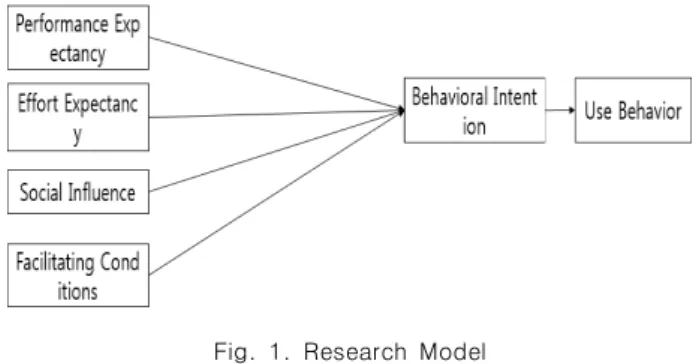
Theory of Acceptance and Use of Technology) model in 2003, which integrated 8 classical models and summarized four decisive factors that influenced people’s use of a certain technical product or service: performance expectancy (PE), effort expectancy (EE), social influence (SI) and facilitating conditions (FC), as well as four moderator variables: age, gender, experience and voluntary(see Fig.1). Among them, “performance expectancy” referred to the extent to which users thought that using an information technology can improve their job performance. Performance expectancy was the most powerful motive that influenced behavioral intention. “Effort expectancy” referred to the extent to which users thought this information technology can reduce their labor intensity.

“Social influence” referred to the extent to which users thought the people who they cared about (e.g., friends and colleagues) would approve of or support their use of this information technology. Facilitating conditions referred to the availability of resources required to use a certain service. In addition, as moderator variables, gender, age, experience and voluntary, played a moderating role in the above four decisive factors. Within just a few years, UTAUT model has been widely applied to research on the behaviors of adopters of all kinds of information technologies and information systems (Eg. e-commerce, online securities, blog course management software and mobile payment).

Fig. 1. Research Model

Since our study focused on the motivations for Chinese oversea students in South Korea to adopt mobile payment, the four moderator variables in UTAUT model were not considered here. Based on UTAUT model, we intended to conduct a confirmatory analysis among Chinese oversea students in South Korea and proposed the following five hypotheses:

Hl: The user’s performance expectancy had a positive effect on the intention to use mobile payment.

H2: The user’s effort expectancy had a positive effect on the intention to use mobile payment.

H3: The user’s social influence had a positive effect on the intention to use mobile payment.

H4: Facilitating conditions had a positive effect on the use behavior of mobile payment.

H5: The intention to use mobile payment had a positive effect on the use behavior of mobile payment.

Ⅲ.Questionnaire Design and Data Collection

1. Questionnaire Design

In this study, we collected empirical data to verify the proposed model using a questionnaire survey. The test items of structure variables in the questionnaire were adapted from existing literature, to guarantee a good content validity. The test items of performance expectancy, effort expectancy, social influence, facilitating conditions, intention to use and use behavior were drawn from literature. We discussed motivations of mobile payment adopters in the form of focus group, made a tiny selection and adjustment on the test items and preliminarily determined the test items of each structural variable. In the stage of data analysis, we further cut some of these items according to the results of data analysis and obtained a more concise and practical model and scale. The test items of structural variable adopted 7-point Likert scale, i.e., the degree of agreement, from “strongly disagree” to

“strongly agree” was expressed using the digits 1-7. Our questionnaire also captured the respondents’ demographic data (gender and age), as well as their familiarity with mobile payment. In March-April 2018, a questionnaire survey was conducted for international students in various universities in Korea.

Test Item Quantity Percentage

(%)

Gender Male 82 40.3

Female 121 59.6

Age

Under 20years 110 54.1

20-30years 82 40.3

Above 30years 11 5.4

Familiarity with Mobile Payment

Not familiar 8 3.9

Just so so 10 4.9

Familiar 185 91

Table 1. The Basic statistics of samples (N=203)

(4)

IV. Data Analysis and Model Modification

1. Reliability Analysis

Reliability refers to the degree of consistency or stability of measured results. According to Nunnally’s psychometric theory, Cronbach’s α should be greater than 0.6, preferably greater than 0.7. The reliability of each variable and “item-deleted reliability” were analyzed using SPSS22.0. The results are shown in Tab. 3. The scale reliability of each variable has met basic reliability requirement, but the reliability value was not satisfactory.

The “item-deleted reliability” referred to the reliability that can be achieved after a test item was deleted. If the

“item-deleted reliability” was greater than the original scale reliability and still there were no fewer than 2 test items in this structure variable after deletion, then this test item can be deleted. Therefore, SI5, SI6 and FC3 were deleted.

Cronbach’s α Standardized Cronbach’s α

Number of Items

PE 0.875 0.875 4

EE 0.869 0.870 3

SI 0.918 0.918 4

FC 0.811 0.811 2

BI 0.859 0.862 3

B 0.780 0.781 2

Table 2. Reliability Analysis Results

2. Validity Analysis

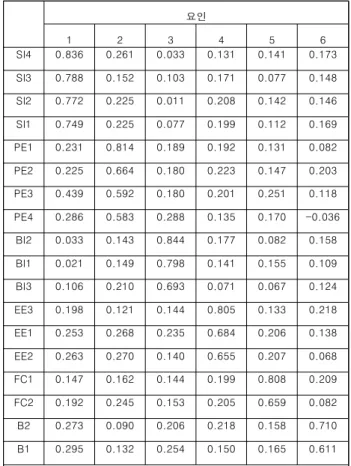
Validity means that an instrument can measure the characteristics of the object it measures. The higher validity, the better the measured results can reveal the true characteristics of the object. The questionnaire in this paper was designed on the basis of an existing scale and had a good content validity. Next, we further judged the construct validity of the survey data using exploratory factor analysis (EFA) of SPSS. First of all, KMO and Bartlett tests were performed in SPSS22.0. The results showed that the KMO value was 0.808. The results of Bartlett’s test of sphericity were significant at P=0.000, indicating that a principal component analysis (PCA) was applicable. We continued to extract factors using PCA and rotate factors using Quartimax in SPSS, the results are presented in Tab. 3. After deleting test items whose factor loading was less than 0.5 (SI5, SI6 and FC3) in Tab. 3, the remaining test items showed a good construct

validity. On the other hand, the factor analysis also showed the 6 extracted principal components accounted for 70% of the cumulative variance variation. The model was fairly convincing. Among them, each factor accounted for a maximum of 30% variation. According to Harman’s single factor test, there was no common method bias in this study.


요인

1 2 3 4 5 6

SI4 0.836 0.261 0.033 0.131 0.141 0.173 SI3 0.788 0.152 0.103 0.171 0.077 0.148 SI2 0.772 0.225 0.011 0.208 0.142 0.146 SI1 0.749 0.225 0.077 0.199 0.112 0.169 PE1 0.231 0.814 0.189 0.192 0.131 0.082 PE2 0.225 0.664 0.180 0.223 0.147 0.203 PE3 0.439 0.592 0.180 0.201 0.251 0.118 PE4 0.286 0.583 0.288 0.135 0.170 -0.036 BI2 0.033 0.143 0.844 0.177 0.082 0.158 BI1 0.021 0.149 0.798 0.141 0.155 0.109 BI3 0.106 0.210 0.693 0.071 0.067 0.124 EE3 0.198 0.121 0.144 0.805 0.133 0.218 EE1 0.253 0.268 0.235 0.684 0.206 0.138 EE2 0.263 0.270 0.140 0.655 0.207 0.068 FC1 0.147 0.162 0.144 0.199 0.808 0.209 FC2 0.192 0.245 0.153 0.205 0.659 0.082

B2 0.273 0.090 0.206 0.218 0.158 0.710

B1 0.295 0.132 0.254 0.150 0.165 0.611

Extraction Method: Principal Component Analysis.

Rotation Method: Quartimax with Kaiser Normalization.

Rotation converged in 6 iterations.

Table 3. Rotated Component Matrix

3. Parameter Estimation

Structural equation modeling (SEM) combined factor

analysis and path analysis effectively. It was a

comprehensive statistical analysis technique in the fields

of economics, sociology and psychology. AMOS, as a kind

of common SEM software, can not only estimate

parameters, but also report the fitting index and

modification index of the model. The standardized factor

loading of each test item, the standardized regression

coefficient (path coefficient) of each path and their

significance were calculated using maximum likelihood

method of AMOS22.0 and key fitting indexes were

reported. According to the evaluation criteria of factor

(5)

loading and fitting index, the factor loading should fall between 0.5 and 0.95, the ratio of the minimum discrepancy to its degree of freedom (CMIN/DF) should fall between 1 and 3 (preferably less than 2), RMSEA should be less than 0.08 (preferably less than 0.05) and both CFI and GFI should be greater than 0.9. The results showed that several factor loadings didn’t meet requirements. CFI and GFI didn’t meet the criterion of good fit, i.e., 0.9. These indexes showed that the existing model needed to be modified.

4. Model Modification

The modification indices (MI) output by AMOS served as a guide for model modification. Although the internal quality of the initial model was good, the external quality was poor. The overall model cannot fit with the actual data. The modification of this model included the following steps:

The index variable “performance expectancy” and the error variables of index variables “effort expectancy”, social influence” and “facilitating conditions” were set to be covariant. The chi-square value decreased from 252.77 to 212.65, from 252.77 to 234.3 and from 252.77 to 204.55 respectively.

The index variable “effort expectancy” and the error variables of index variables “performance expectancy”, social influence” and “facilitating conditions” were set to be covariant. The chi-square value decreased from 252.77 to 242.65, from 252.77 to 241.3 and from 252.77 to 213.55 respectively.

The index variable “social influence” and the error variables of index variables “effort expectancy”,

“performance expectancy” and “facilitating conditions”

were set to be covariant. The chi-square value decreased from 252.77 to 232.35, from 252.77 to 233.3 and from 252.77 to 221.45 respectively.

The index variable “facilitating conditions” and the error variables of index variables “effort expectancy”,

“performance expectancy” and “social influence” were set to be covariant. The chi-square value decreased from 252.77 to 234.55, from 252.77 to 225.43 and from 252.77 to 203.45 respectively.

(5) The index variable “facilitating conditions” and the index variable “intention to use” were set to be causal.

The chi-square value decreased from 252.77 to 125.845.

Fig. 2. The Modified Model in AMOS and Operation

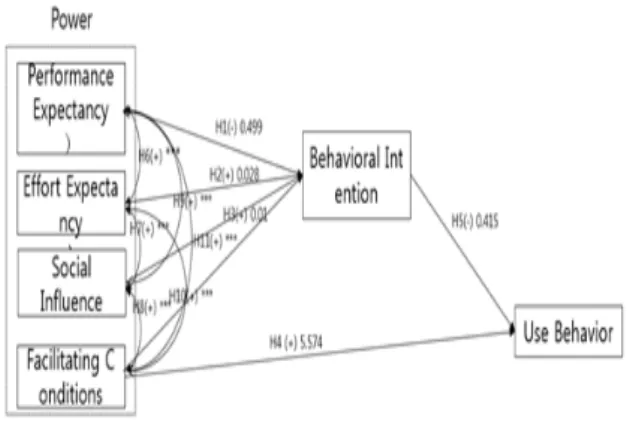
Fig. 3. The Final Model Supporting the Hypotheses Note :(+) positive effect, (-) negative effect; ***

p<0.001

      Estimate S.E. C.R. P result

BI <- PE -0.299 0.443 -0.676 0.499 Reject BI <- EE -1.582 0.719 -2.2 0.028 Accept BI <- SI -1.028 0.398 -2.586 0.01 Accept BI <- FC 4.56 1.59 2.868 0.004 Accept B <- FC 0.935 0.168 5.574 *** Accept B <- BI 0.086 0.105 0.816 0.415 Reject PE <-> EE 0.877 0.142 6.155 *** Accept EE <-> SI 1.15 0.187 6.154 *** Accept SI <-> FC 1.202 0.203 5.91 *** Accept PE <-> SI 1.227 0.188 6.518 *** Accept EE <-> FC 0.978 0.162 6.038 *** Accept PE <-> FC 0.806 0.144 5.582 *** Accept Table 4. Path result analysis

We can get these conclusions through path analysis. PE does not have the effect of “+” that we expect from BI.

EE vs. BI, SI vs. BI, FC vs. BI, and FC vs. B have the “+”

effect we expect, but the impact of BI on B is not

obtained. Expected results. In the test of the correlation

between PE-EE, PE-SI, PE-FC, EE-SI, EE-FC and

SI-FC, we also obtained the expected results.

(6)

Ⅴ. Conclusion

1. Analysis of Results

Based on the operation results after the model was modified, The greater effort expectancy of mobile payment, the higher enthusiasm the user has for adopting mobile payment (H2). People around using mobile payment can drive a person to use mobile payment (H3).

Facilitating conditions can facilitate the use of mobile payment (H4), while the intention to use determines use behavior (H5). Performance expectancy and social influence are interrelated . Effort expectancy and facilitating conditions are interrelated . Performance expectancy and effort expectancy are interrelated (H6).

Effort expectancy and social influence are interrelated . Social influence and facilitating conditions are interrelated. Although mobile payment is very easy-to-use in such payment scenarios as taking a bus/train by swiping a cell phone, mobile booking and mobile shopping, etc., the formalities to change a cell phone, change a card (mobile wallet), apply for opening, deposit costs or repay credit card loans, etc. are nevertheless more troublesome to a non-frequent user.

Besides, at present, South Korea is not fully supportive of China’s payment software (e.g. Alipay and WeChat). Due to the language barrier of oversea students, local payment software in South Korea is not as convenient as traditional payment methods to overseas students. The result is the performance expectancy and use behavior of mobile payment haven’t been realized yet (H1 and H5 are not supported).

Through an empirical study, From the perspective of age and experience, as well as voluntary, all the survey results are concentrated. The ages are concentrated between 20-24 years old, and the experience and voluntary aspects have reached 100%. this paper shows that the greatest motivation that influences consumers to adopt mobile payment is social influence, followed by performance expectancy and facilitating conditions. If social influence, performance expectancy or facilitating conditions of mobile payment were increased, consumers’

enthusiasm to adopt mobile payment would be enhanced significantly, too. This paper also suggests while South Korea has developed a mobile payment network, the mobile payment technology is not mature, convenient and popular enough. Some of Chinese oversea students in South Korea are not very familiar with or unwilling to use

mobile payment in South Korea. Although convenience and fastness seem to be the greatest advantages of mobile payment, in fact, the use value and utility are yet to be demonstrated in combination with actual application scenarios.

This paper respects facts and lets the data speak. It modifies the previous mobile payment adoption model and measurement indexes on a large scale and draws a new conclusion, thus realizing innovation in theory. Also It can guide the development of THE industry in practice.

2. Management Implications and Limitations For mobile payment equipment and service providers, especially mobile communication service providers dominating mobile payment and commercial banks offering mobile banking services, the conclusion in this paper can help them carry out marketing activities effectively and promote the development of mobile payment industry.

(1)As a Chinese student studying in Korea, it is a large group with a large number of people. So far, there are nearly 70,000 students in total, and there are nearly 200,000 people who have graduated but still live in Korea. As a younger generation, this group of people not only accepted China's innovative entrepreneurial ideas, but also went out of China to receive education in South Korea. They are different from young people in China, young people from South Korea, special groups in their careers, and a special consumer group. Therefore, the subgroup was selected for targeted research.

(2)Social influence is the most powerful motivation that influences consumers’ intention to adopt mobile payment.

A variety of payment methods that consumers can choose

from are somewhat replaceable. When consumers are not

clear about the outstanding advantages of mobile

payment, their intention to use mobile payment is more

attributed to social influence, namely, the word of

mouthamong people around, interactive behavior and

psychological self-regulation. If mobile payment operators

have already had a certain number of users and been

recognized by the user group, they can attract other

users to choose and use it more easily. Mobile payment is

characterized by network externality. So we should focus

on attracting innovative adopters in the initial stage so as

to drive more people to adopt mobile payment. Mobile

payment operators should actively explore which kind of

users had greater influence on other potential users and

which group was more easily influenced by social factors,

(7)

give play to the influence of word of mouth, develop appropriate marketing strategies and effectively improve users’ intention to use.

(3) Performance expectancy is a second motivation that influences the intention to use mobile payment. By publicizing concrete applications of mobile payment in various fields, we allow users to feel and experience the use value of mobile payment. This will help promote mobile phone users to adopt mobile payment. Both word-of-mouth marketing and online animation storiettes are conducive to publicizing the use value of mobile payment. We suggest all kinds of retailers should provide mobile payment channels for consumers with as soon as possible. On the one hand, online retailers, including railway customer service centers, should develop mobile payment channels as soon as possible to allow a fast-growing number of mobile Internet users to purchase online using their fragmented time whenever and wherever possible. On the other hand, consumers should be allowed to realize cross-regional applications in traditional consumption scenarios (e.g. bus/train taking and supermarket shopping) and feel the immediate benefits of mobile payment.

(4) Facilitating conditions is a third motivation that influences the intention to use mobile payment. One of the biggest incentives for users to adopt mobile payment is that it is more convenient than cash and bank cards.

We suggest all kinds of mobile operators optimize mobile payment software actively and improve convenience and speed on the basis of security, to make consumers experience more convenience and fastness compared with to traditional payment.

There are also limitations in this study. First of all, the questionnaire design. The scale mainly comes from overseas literature. Although it has been understood and rephrased, still the meaning may not be expressed precisely, thus affecting the scale reliability and validity to a certain degree. Secondly, the survey and sampling. In the first sampling, the sample source is single. In the second online survey, the response rate is too low. The time span is large and there is a certain bias. Thirdly, the motivations finally determined. In the future, we may explore the prior variables and mechanism of these motivations.

REFERENCES

[1] Davis F.D. Perceived Usefulness, Perceived Ease of Use, and User Acceptance of Information Technology. MIS Quarterly, Vol. 13, No. 3, pp. 319-340,1989, [2] Venkatesh V. Morris M.G., Davis G.B., et al. User

Acceptance of Information Technology: Toward a Unified View. MIS Quarterly, vol. 27, No. 3, pp. 425-478, 2003.

[3] Changsu Kim, Mirsobit Mirusmonov, In Lee. Proceedings of the Korea Management Information Systems Society.

No. 2, pp. 72-79, 2009.

[4] Choi Young Jae, Kim Hyo Chung. Journal of Financial Consumers. Vol. 6, No. 1, pp. 109-133, 2016.

[5] Liang Hu, Ling Chi, Hong-Tu Li, Wei Yuan, Yu Yu Sun, Jian-feng Chu.KSII Transactions on Internet and Information Systems (TIIS), Vol. 6, No. 1, pp. 131-146, 2012.

[6] Nguyen Phuong Y, Sung Taek Lee, Wi Man Kang, Jeong Suk Kim and Gwang Yong Gim. Journal of the IT Services, Vol. 14, No. 4, pp. 171-184, 2015.

[7] Mu Hong-lei, Lee Young-chan. Journal of information systems, Vol. 26, No. 4, pp. 247-284, 2017.

[8] Run Ze Wu, Jong Ho Lee. Journal of Distribution Science, Vol. 15, No. 11, pp. 5-19, 2017.

[9] Jae Min Lee. Korean Review of Corporation Management.

Vol. 8, No. 3, pp. 37-53, 2017.

[10] Jeong, Eun-Eun, "A Study on Digital Design," Vol. 14, No. 2, pp. 641-650, 2014.

[11] Seung-Min Jung. Journal of the Korean Academic Society of Industrial Science, Vol. 18, No. 9, pp.101-112, 2017, [12] Cao Yuanyuan and Li Qi, An Empirical Study on Mobile

Payment User Acceptance and Behavior [J]. Statistics and Information Forum, Vol. 24, No. 2, pp.72-77, 2009.

[13] Chen Huaping and Tang Jun, Research on Mobile Payment User and Use Behavior [J]. Management Sciences in China, Vol. 19, No. 6, pp.48-55,2006.

[14] Dahlberg T, Mallat N, Ondrus J, etal. Past, Present and

Future of Mobile Payments Research: A Literature

Review. Electronic Commerce Research and Applications,

Vol. 7, No. 2, pp.165-181, 2008.

(8)

Authors

Ziyang Liu. Received the B.A. degree in Management from Army superintend institute of shijiazhuang China PLA ,China, in 2006, M.A. degree and Ph.D. degree in Management from Kyonggi University, Korea, in 2010 and 2013, reapectively.

Dr. Liu joined the faculty of the Global Business Kyongggi University, Korea in 2015. He is currently an Assistant Professor in the Global Business Kgonggi University. He is intrested in Quality Management. Management Information Systems, International economics, E-business etc.

Hao Li graduated from Liao Cheng University. Now studying for a master degree at Kyonggi University During the school period, the main research interests are in the direction of cultural industry management

Yi Chen graduated from Liao Cheng

University. Now studying for a master

degree at Kyonggi University During the

school period, the main research interest

is in new media operations, advertising

planning and marketing.

수치

Fig.  1.  Research  Model
Table  2.  Reliability  Analysis  Results
Fig.  3.  The  Final  Model  Supporting  the  Hypotheses Note  :(+)  positive  effect,  (-)  negative  effect;  ***

참조

관련 문서

In terms of the relationship between personal service contact and passengers' emotions, this study classified service contact quality factors into four groups based on

The IASCF reserves all rights outside of the Republic of Korea and in any use other than use of the above materials in the Korean language by any

This research focuses on investigating the main factors on using behavior and using intention of mobile payment service, and provides basic materials related

This paper proposes a perspective of political economy to explore important issues on regulation studies, focusing on the case of tobacco control in South

This paper proposes a perspective of political economy to explore important issues on regulation studies, focusing on the case of tobacco control in South Korea.

adio Frequency Identification Tech- nology (RFID) is the state-of-the-art information and communication tech- nology(ICT) that uses radio waves for

1 John Owen, Justification by Faith Alone, in The Works of John Owen, ed. John Bolt, trans. Scott Clark, &#34;Do This and Live: Christ's Active Obedience as the

We’re going to use the special init function (in both our Model and our ViewModel) We’re going to use generics in our implementation of our Model. We’re going to use a function