• 검색 결과가 없습니다.

A Study on Relationship Between Mother's Smartphone Overdependence, Parental Role Intelligence.

N/A
N/A
Protected

Academic year: 2021

Share "A Study on Relationship Between Mother's Smartphone Overdependence, Parental Role Intelligence."

Copied!
6
0
0

로드 중.... (전체 텍스트 보기)

전체 글

(1)

A Study on Relationship Between Mother's Smartphone Overdependence, Parental Role Intelligence.

1)

Dea-Hun Choi*

Abstract

The purpose of this study is to provide basic data that mother 's smart phone overdependence prevention education are needed by confirming the relationship between mother' s smartphone overdependence and parent role intelligence. The research subjects were 220 mothers of 0-2 years old who are attending 15 day care centers in Cheong-ju, Chung-buk. The research tool used smartphone overdependence scale, and parent role intelligence scale. For the analysis of the study, frequency analysis, Pearson 's Ratio correlation and regression analysis were performed. The results showed that mother 's smartphone overdependence was negatively correlated with parental role intelligence and negatively correlated with developmental stimulation, parenting, support, and management. The multiple regression analysis showed that there was a significant negative effect on the smartphone overdependency, parent role intelligence, and sub factors. This suggests that smartphone overdependence prevention education for mother should be needed for nurturing of desirable infants.

▸Keyword: Smartphone Overdependence, Parental Role Intelligence, Developmental Stimulus, Care-giving Role, Management Role

I. Introduction

스마트폰 이용이 대중화되면서 과도한 스마트폰 이용에 대한 우려가 대두되고 있다. 최근 발표된 ‘2017 스마트폰 과의존 실태조 사’에 따르면 과의존 위험군 현황은 18.6%로 스마트폰 이용자 5명중 1명은 스마트폰의 역기능을 경험하고 있다고 한다[1]. 이는 조사가 시작된 2011년 8.4% 보다 2배 이상 증가한 숫자로 앞으로도 지속적인 증가가 예상 된다. 발표에 따르면 전년(17.8%) 대비 상승 폭은 0.8%로 둔화되었으나 전 연령 중 유아동 과의존 위험군은 19.1%로 최근 3년간 6.7%가 증가하였으며 조사대상 중 가장 큰 폭으로 증가하였으며 부모가 위험군일 경우 유아동 자녀도 위험 군에 속하는 비율이 높다는 점 등은 부모를 통한 유아동의 스마트폰 과의존 방지 대책이 필요하다 해석할 수 있다. 스마트폰 과의존이란 과거 ‘스마트폰 중독’이란 질병개념의 부정적 관점을 스스로 조절하 여 바르게 사용할 수 있는 역량을 강화시킨다는 전환개념으로 스마

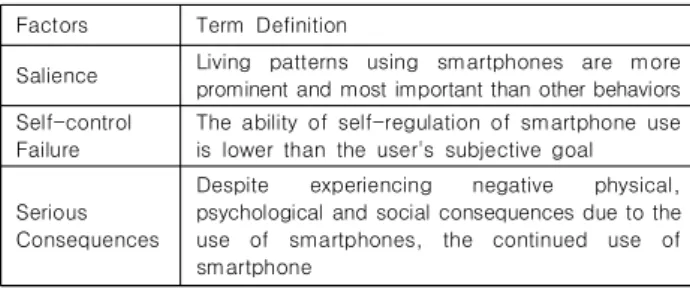
트폰에 대한 과도한 이용으로 현저성(salience)이 증가하고, 스마 트폰 이용의 조절실패(self–control failure)로 문제적 결과 (serious consequences)를 경험하는 상태의 3가지 요인을 포괄하 는 것으로 각각의 용어정의는 다음 <Table 1>과 같다[2].

Factors Term Definition

Salience Living patterns using smartphones are more prominent and most important than other behaviors Self-control

Failure

The ability of self-regulation of smartphone use is lower than the user's subjective goal

Serious Consequences

Despite experiencing negative physical, psychological and social consequences due to the use of smartphones, the continued use of smartphone

Table 1. Three factors of Smartphone Overdependence

∙First Author: Dea-Hun Choi, Corresponding Author: Dea-Hun Choi

*Dea-Hun Choi ([email protected]), Assistant Professor, Dept. of Early Childhood Education, Seowon University.

∙Received: 2019. 01. 08, Revised: 2019. 01. 25, Accepted: 2019. 01. 25.

∙This paper is extension of paper(“A Study on Relationship Between Mother's Smartphone Overdependence, Parental

Role Intelligence.”)presented at the 59th Winter Conference of The Korea Society of Computer and Information in

2019.

(2)

유아동의 스마트폰 과다이용은 널리 알려진 바와 같이 정서 와 사회성발달 및 뇌 발달에 부정적인 영향을 주며 과잉행동과 충동성, 부주의 같은 심각한 문제를 야기 할 수 있고 부모와의 상호작용에도 부정적 영향을 준다는 점에서 적극적인 대안마련 이 요구된다[3],[4]. 영유아의 스마트폰 과의존 해소방안은 첫 스마트폰 제공자가 대부분 주 양육자라는 점에서 부모를 대상 으로 한 스마트폰 과의존 예방교육에서 시작되어야 한다[5].

부모의 미디어에 대한 태도 및 사용방식은 영유아의 미디어노 출 및 사용방식에 영향을 줄 수 있으며[6],[7], 어머니의 스마 트폰 중독 경향성은 학령전기 영유아의 스마트폰 과몰입에 영 향을 준다[8],[9]는 선행연구들 역시 부모를 위한 과의존 예방 교육의 필요성을 뒷받침하고 있다. 그럼에도 불구하고 아직까 지 부모를 위한 스마트폰 예방교육을 위한 정책방안 마련은 여 전히 미비한 실정이다. 스마트폰 과의존과 예방을 위한 정부 정 책과 관련하여서는 ‘국가정보화기본법’ 제30조에 따라 관계부 처 합동으로 3년마다 종합계획을 수립하고 이에 따른 추진계획 을 추진하도록 하고 있으며 현재, 제 3차 스마트폰 인터넷 바른 사용 지원 종합계획(2016~2018)에 따라 어린이집과 유치원을 통한 교사 ․ 유아를 대상으로 한 예방교육 및 바른 사용교육 등 은 강화되고 있으나 부모를 대상으로 하여서는 캠페인 정도로 그치고 있어 실효성이 미흡하다. 이는 보호자를 통한 영유아의 스마트폰 과이용에 대한 개입방안이나 부모역할의 여러 변인이 영유아의 스마트폰 과의존에 영향력이 있다는 기초연구가 부족 하여 필요성을 조명 받지 못한 까닭이라 하겠다.

유아교육기관을 활용한 부모교육은 부모의 양육태도와 부모 역할 실천의 주요 정보원이 될 수 있다. 실제로 부모들은 자녀 양육과 관련하여 유아교육기관을 주 상담기관으로 생각하고 있 으며, 주제별 부모교육과 가정통신문 및 배부자료 등을 통해 정 보와 조언을 얻고 자녀양육의 신념을 공고히 해나간다 [10],[11]. 특히 스마트폰 과의존과 관련하여 조메리명희와 현은자(2014)가 유아교육기관 재원 어머니를 대상으로 스마트 폰 중독 예방교육을 실시한 결과 중독수준이 낮아졌으며 부모 의 스트레스와 자녀와의 역기능 적 상호작용에도 긍정적인 영 향을 미쳤다는 실증연구가 수행된바 있다[12]. 또한 대학생의 스마트폰 사용행동을 연구한 이종만(2013)의 연구에서도 사용 습관에 대한 직접적인 접근이 유효한 방법[13]임을 제시한바 있으며, 부모의 스마트폰 중독은 정신건강에 영향을 미쳐 부모 -자녀관계에 부정적인 영향으로 작용한다[14]는 점에서 유아 교육기관의 부모교육의 주제로서 스마트폰 과의존은 적절한 주 제가 될 수 있다.

한편, 부모의 스마트폰 과의존의 경향성은 부모의 역할변인 과 많은 관련을 보인다. 서해성과 김연하(2014)에 따르면 영아 기 자녀를 둔 어머니의 양육스트레스, 특히 자녀와의 역기능적 상호작용이 높을수록 스마트폰 중독적 특성을 보이며 또한 양 육지식과 스마트폰 중독은 부적 관련성이 있다고 보고한바 있 다[15]. 다른 선행연구들에서도 어머니의 스마트폰 과의존은 자녀와의 부정적 상호작용, 양육스트레스, 양육효능감, 양육행

동, 자아탄력성 등의 영향요인임을 밝히고 있다[4],[5],[9], [16]. 이는 현대사회의 부모들의 일상이나 자녀양육이 스마트 폰과 밀접한 관련이 있으며 영유아의 스마트폰 과의존이 점점 늘어가고 있다는 점에서 부모의 스마트폰 과의존은 이제 부모 역할 변인의 주요한 요인이라 할 수 있다. 또한 부모의 양육관 련 행동과 부모역할 특성은 고정화되지 않으며 자녀를 양육하 는 과정의 다양한 상황에 따라 변화된다[17],[18]는 것 역시 부모를 통한 영유아의 스마트폰 과의존 예방적 접근의 필요성 을 뒷받침 해준다. 다시말해 유아의 스마트폰 과의존을 예방을 위한 주요방안으로 유아교육기관의 부모교육방법을 활용한 접 근방법이 유효할 것이라 판단할 수 있으며 이를 위한 구체적 적용방안이 제안되어야 할 것이다. 앞서 언급한바와 같이 부모 의 스마트폰 과의존 예방교육을 통한 부모역할 강화방안은 아 직 연구가 미약하다. 이는 관련연구의 필요성에 대한 인식부족 보다는 부모의 역할관련 변인과 스마트폰 과의존과의 인과관계 연구의 부족에 기인한다.

이에 본 연구는 부모의 역할과 관련한 다양한 요인 중 자녀 양육 상황의 다양한 맥락에서 기능하는 지적능력과 적응능력인 부모역할지능과 스마트폰 과의존의 관계에 초점을 두고자 한 다. 부모역할 지능은 알려진 바와 같이 자녀양육 상황에서 맥락 에 맞는 합리적인 역할 선택능력과 자녀양육의 갈등상황에서 적절히 대처하는 지적능력으로 긍정적인 부모역할을 기능하게 하는 능력이라 설명할 수 있다[17],[18],[19],[20]. 일반적으 로 가정에서 영유아의 스마트폰 사용은 부모의 선택기준에 따 라 달라질 수 있으며, 영유아의 스마트폰 이용에 대한 태도나 습관 형성이 부모의 양육역할 및 갈등상황 대처행동[15],[16]

에 따라 달라질 수 있다는 점에서 부모의 역할지능은 스마트폰 과의존과 깊은 관련을 보일 것이라 추론할 수 있다. 특히 어머 니의 부모역할지능은 부모교육과 사회적 지원에 따라 충분히 더 기능할 수 있는 부모능력이라는 점[17]에서도 스마트폰 과 의존과의 영향력은 연구될 필요성이 있다. 즉 스마트폰 과의존 예방교육을 통해 부모역할지능은 충분히 향상될 수 있으며 이 는 부모가 영유아의 스마트폰 과이용에 대한 합리적 판단과 적 절한 문제해결과 그리고 맥락에 적합한 양육행동을 수행하는데 도움이 될 수 있을 것이라 예측할 수 있다.

이 같은 이유에서 본 연구는 어머니의 부모역할지능과 스마 트폰 과의존이 어떠한 관계가 있는가를 파악하여 부모를 위한 스마트폰 과의존 예방교육의 방향 설정을 위한 기초데이터를 제공하고자 한다.

이와 같은 연구목적을 달성하기 위하여 다음과 같이 연구문 제를 설정하였다.

첫째, 어머니의 스마트폰 과의존과 부모역할지능에는 어떠한 관계가 있는가?

둘째, 어머니의 부모역할지능이 스마트폰 과의존에 미치는

영향은 어떠한가?

(3)

Ⅱ. Methods

1. Research Model & Hypothesis 1.1 Research Model

본 연구는 어머니의 스마트폰 과의존과 부모역할의 주요 변 인과의 영향관계를 파악하기 위해 선행연구 고찰을 통해 부모 역할지능을 주요요인으로 선정하였고 어머니의 스마트폰 과의 존과 부모역할지능의 영향관계를 알아보고자 다음 <Fig. 1>과 같은 연구모형을 설정하였다.

Fig. 1. Research Model

1.2 Research Hypothesis

연구모형을 기반으로 어머니의 부모역할 지능과 스마트폰과 의존의 영향을 규명하기 위해 다음 <Table 2>와 같이 가설을 설정하였다.

Hypothesis

1 Mother's parent role intelligence will affect smartphone overdependence.

2 Mother's Developmental Stimulus will affect smartphone overdependence.

3 Mother's Care-giving Role will affect smartphone overdependence.

4 Mother's Management Role will affect smartphone overdependence.

Table 2. Research Hypothesis

2. Participants

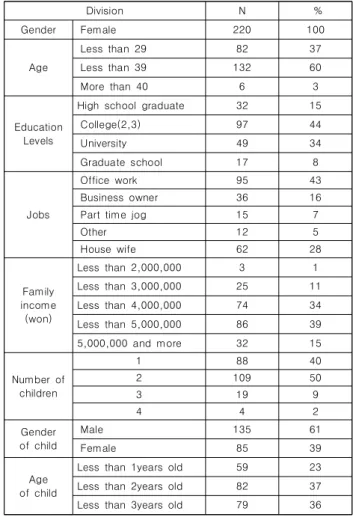
본 연구는 충청북도 청주시 소재 어린이집 15개소에 다니고 있는 만 0~2세 어머니 220명을 대상으로 이루어졌다. 연구시 작 전 예비조사를 실시하여 설문지를 일부 수정하였고 2018년 10월 15일부터 11월 2일까지 재원 어린이집을 통해 총 300부 의 질문지를 배부하였고 이중 256부가 수거되었으며 이중 불 성실한 응답 자료를 제외한 220부가 분석에 사용되었다. 조사 대상자의 일반적 특성은 다음 <Table 3>과 같다.

Division N %

Gender Female 220 100

Age

Less than 29 82 37

Less than 39 132 60

More than 40 6 3

Education Levels

High school graduate 32 15

College(2,3) 97 44

University 49 34

Graduate school 17 8

Jobs

Office work 95 43

Business owner 36 16

Part time jog 15 7

Other 12 5

House wife 62 28

Family income

(won)

Less than 2,000,000 3 1

Less than 3,000,000 25 11

Less than 4,000,000 74 34

Less than 5,000,000 86 39

5,000,000 and more 32 15

Number of children

1 88 40

2 109 50

3 19 9

4 4 2

Gender of child

Male 135 61

Female 85 39

Age of child

Less than 1years old 59 23

Less than 2years old 82 37

Less than 3years old 79 36

Table 3. Participants’ Profiles( N =220)

3. Research Tools

3.1 Smartphone Overdependence Scale

어머니의 스마트폰 과의존을 조사하기 위하여 한국정보화진 흥원이 2017년 전국 실태조사에서 사용한 성인용 스마트폰 과 의존 척도[1]를 사용하였으며 요인별 문항은 아래 <Table 4>

와 같다. 각 문항은 ‘전혀 그렇지 않다(1점)’부터 ‘매우 그렇다 (4점)’까지이며 Likert 4점 척도로 신뢰도 수준(Cronbach’s α) 은 .73 이었다.

3.2 Parent Role Intelligence Scale.

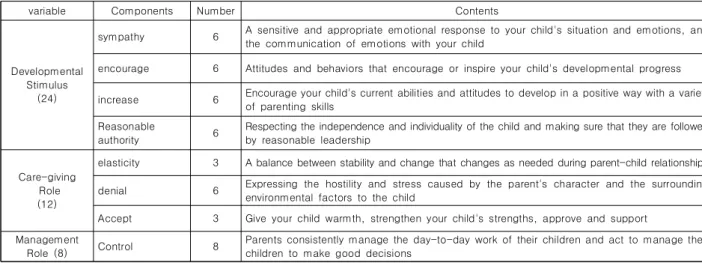
어머니의 역할지능을 조사하기 위하여 현미숙(2004)이 개발 하고[17], 조순옥(2016)이 어머니를 대상으로 수정보완 하여 사용한 부모역할지능 척도를 사용하였다[18]. 본 도구는 총 44 개의 문항으로 구성되어 있으며 발달적 자극, 양육 및 지지, 관 리 등의 3가지 요인과 8개 하위요인(공감, 격려, 증진, 합리적 권위, 융통성, 거부, 수용, 통제)에 대하여 Likert 5점 척도로

‘전혀 그렇지 않다’ 1점에서 ‘항상 그렇다’ 5점 까지로 측정되며

신뢰도 수준(Cronbach’s α)은 .83 이었다. 부모역할지능 척도

는 총 점수 및 하위영역 점수가 높을수록 부모의 역할지능 수

준이 높은 것을 의미한다. 도구의 하위요인 및 문항 수와 내용

은 아래 <Table 5>와 같다.

(4)

variable Components Number Contents

Developmental Stimulus

(24)

sympathy 6 A sensitive and appropriate emotional response to your child's situation and emotions, and the communication of emotions with your child

encourage 6 Attitudes and behaviors that encourage or inspire your child's developmental progress

increase 6 Encourage your child's current abilities and attitudes to develop in a positive way with a variety of parenting skills

Reasonable

authority 6 Respecting the independence and individuality of the child and making sure that they are followed by reasonable leadership

Care-giving Role (12)

elasticity 3 A balance between stability and change that changes as needed during parent-child relationships

denial 6 Expressing the hostility and stress caused by the parent's character and the surrounding environmental factors to the child

Accept 3 Give your child warmth, strengthen your child's strengths, approve and support Management

Role (8) Control 8 Parents consistently manage the day-to-day work of their children and act to manage their children to make good decisions

Table 5. Parent Role Intelligence Scale.

variable Measures

Self-control Failure

1) Every time I try to reduce my smartphone usage time, I fail.

2) It is difficult to control the use time of smartphone 3) It is difficult to keep proper smartphone usage time.

Salience

4) It's hard to focus on other things if you have a smartphone next to you.

5) Smartphone thinking does not leave your head.

6) I feel strong urge to use smartphone.

Serious Consequences

7) have had problems with my health because of smartphone use.

8) I have had a hard time with my family because of smartphone use.

9) Due to the use of smartphones, I have experienced severe conflicts in friends, colleagues, and social relationships 10) Due to the smartphone, it is difficult to carry out work (academic or occupation).

Table 4. Smartphone Overdependence Scale

4. Data Analysis

본 연구의 조사를 위하여 연구대상자로 부터 수집된 자료를 통계프로그램 SPSS 22.0으로 분석하였다. 0~2세 어머니의 일 반적 배경을 살펴보고자 빈도분석과 백분율을 실시하였고, 측 정도구의 신뢰도 검증을 위해서는 Cronbach의 내적 합치도 계 수를 산출하였다. 먼저 어머니의 스마트폰 과의존과 부모역할 지능의 변인 간 상관관계를 살펴보기 위해 Pearson의 적률 상 관관계를 실시하였다. 다음으로 어머니의 부모역할지능과 그 하위요인 들이 스마트폰 과의존에 어떠한 영향력을 알아보기 위해 다중회귀분석을 실시하였다.

Ⅲ. Research Results

1. Relationship between mother's smartphone overdependence and role intelligence

어머니의 스마트폰 과의존과 부모역할지능 및 각 하위요인 간의 상관관계 분석결과는 다음 <Table 6>에 제시한 내용과 같으며 상관관계 범위는 -.23 ~ -.36으로 나타났다.

어머니의 스마트폰 과의존은 부모역할지능(r=-.23, p<.01)과

부적관계가 있었으며 각 하위요인인 발달적 자극(r=-.30, p<.05), 양육 및 지지(r=-.33, p<.05), 관리역할(r=-.36, p<.05) 등으로 부적관계가 있는 것으로 나타났다. 즉 어머니의 부모역할 지능이 높을수록 스마트폰 과의존에 덜 영향을 받는다고 할 수 있다.

구 분   1 2 3 4 5

1 1

2 -.23 ** 1

3 -.30 * .34 * 1

4 -.33 * .34 * .33 * 1

5 -.36 * .24 ** .28 ** .34 * 1

M 2.42 2.57 2.53 2.45 2.21

SD .60 .64 .55 .51 .54

1= Overdependence, 2=Parental role Intelligence, 3= Developmental stimulus, 4= care-giving role, 5= management role

* p<.05, ** p<.01,

Table 6. Correlation analysis ( N = 220)

2. The effect of parental role intelligence on smartphone overdependence

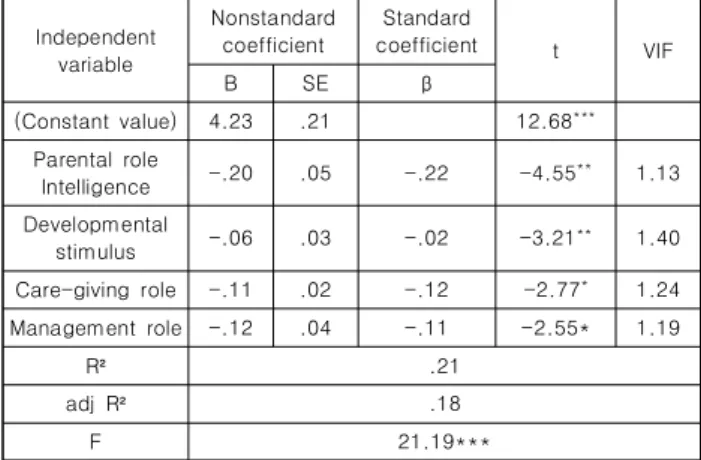
어머니의 부모역할지능이 스마트폰 과의존에 미치는 영향을

확인하기 위하여 부모역할지능 전체와 각 하위요인을 독립변수

로, 스마트폰 과의존을 종속변수로 하여 다중회기분석 한 결과

(5)

는 <Table 7>과 같다.

Independent variable

Nonstandard coefficient

Standard

coefficient t VIF

B SE β

(Constant value) 4.23 .21   12.68 ***

Parental role

Intelligence -.20 .05 -.22 -4.55 ** 1.13

Developmental

stimulus -.06 .03 -.02 -3.21 ** 1.40

Care-giving role -.11 .02 -.12 -2.77 * 1.24

Management role -.12 .04 -.11 -2.55* 1.19

R² .21

adj R² .18

F 21.19***

* p<.05, ** p<.01, *** p<.001

Table 7. Regression analysis ( N = 220)

분산팽창계수(VIF) 값은 각 변인별로 1.13 ~ 1.40의 범위로 10이하로 나타나 다중공선성 위험이 없는 것으로 확인되었고 각 변인들은 독립적인 개념으로 설명되었다.

부모역할지능과 각 하위변인인 발달적 자극, 양육 및 지지, 관리역할을 독립변인으로 투입한 결과 어머니의 스마트폰 과의 존에 약 18%를 설명하였다. 부모역할지능(β=-.22, p<.01), 발 달적 자극(β=-.02, p<.01), 양육 및 지지(β=-.12, p<.05), 관 리역할(β=-.11, p<.05) 모두가 어머니의 스마트폰 과의존에 유 의한 영향을 미치는 요인으로 밝혀졌다. 즉, 어머니들의 부모역 할지능이 낮다고 지각 할수록 스마트폰 과의존에 영향을 받게 된다는 것을 알 수 있다.

IV. Conclusions

본 연구는 최근 급격한 증가세를 보이고 있는 영유아의 스마 트폰 과의존 예방을 위해 정책적 방안모색의 기초 데이터 마련 을 위한 목적에서 실시되었다. 다른 연령대[21]와는 달리 영유 아의 스마트폰 사용기회는 부모를 통해 제공된다[5]. 따라서 부모의 영유아에 대한 스마트폰 사용에 대한 인식전환 및 정보 제공은 자녀의 스마트폰 과이용을 제한하는 효과적인 방법이며 영유아의 스마트폰 과의존 예방의 주요 대안이 될 수 있다. 특 히 성인들의 행동특성은 고착화되어 쉽게 수정되기 어려우나 부모의 역할행동과 자녀양육 행동은 바람직한 정보원과 부모역 할지능을 통해 충분히 수정될 수 있다는 견해[17]에서 부모역 할지능과 부모의 스마트폰 과의존과의 관계분석은 유아의 스마 트폰 과의존 예방정책의 주요 단초가 될 수 있다고 판단하였다.

즉, 부모역할지능은 유아교육기관의 부모교육을 통해 충분히 수정될 수 있기 때문에 스마트폰 과의존과 부모역할지능의 관 계와 상호간의 영향에 대한 조사결과는 부모교육을 통한 영유

아 스마트폰 과의존예방에 효과적인 대안이 될 수 있다.

이 같은 관점에서 선행연구 고찰을 통하여 변수 들을 구성하 고 2개의 연구문제와 4가지 가설을 검증하였다.

연구문제에 따른 연구결과를 요약하면 다음과 같다.

첫째, 어머니의 스마트폰 과이용과 부모역할지능 및 각 하위 요인의 관계를 알아본 결과 어머니의 부모역할지능이 높을수록 스마트폰 과의존에 덜 영향을 받는 것으로 나타났다.

둘째, 어머니의 역할지능과 하위요인인 발달적 자극, 양육 및 지지, 관리역할이 스마트폰 과의존에 미치는 영향에 대해 살펴본 결과 부모역할지능 및 각 하위변인 모두 스마트폰 과의존에 통계 적으로 유의한 영향을 주는 것으로 나타났다. 즉 부모역할지능은 어머니의 스마트폰 과의존 예방에 주요변인인 것이라 할 수 있다.

따라서 바람직한 영유아의 양육을 위하여 어머니를 위한 스마트 폰 과의존 예방교육 고안은 연구될 필요성이 있다.

이상의 연구결과를 바탕으로 가설을 검증하면 다음과 같다.

첫째, 어머니의 부모역할지능은 스마트폰 과의존에 영향력있 는 변인이다.

둘째, 어머니의 발달적 자극은 스마트폰 과의존에 영향력있 는 변인이다.

셋째, 어머니의 양육 및 지지는 스마트폰 과의존에 영향력있 는 변인이다.

넷째, 어머니의 관리역할은 스마트폰 과의존에 영향력있는 변인이다.

이 연구는 청주시의 어린이집 학부모를 대상으로 편의표집하 고 설문조사를 통해 이루어졌다는 점에 연구결과의 일반화에 한 계가 있다. 다만 성인의 스마트폰 과의존의 해소를 부모역할지능 을 통해 조절할 수 있다는 가설을 검증했다는 점에서 의의를 가진 다. 향후 연구에서는 부모교육을 통해 스마트폰 과의존의 정도가 변화되는 실증적 연구가 필요하다고 보며 다양한 부모역할 변인 과 스마트폰 과의존과의 관계규명도 연구될 필요성이 있다.

REFERENCES

[1] Ministry of Science and ICT & National Information Society Agency. “2017’ The survey on smart phone overdependence” Ministry of Science and ICT & National Information Society Agency. 2017

[2] National Information Society Agency. “The concept of internet overdependence as alternative term of internet addiction”, National Information Society Agency. 2017 [3] You, Ji-Hyung & Moon, Hae-Lyun, “The Relationships

between the Children’s smartphone Over- immersion and

their Hyperactivity, Impulsivity and Inattention", Journal

of Early Childhood Education & Educare Welfare. Vol.

(6)

21, No. 1, pp.36-63, 2017.

[4] Kim, Yeon-Soo & Jeong, Yoon-Kyung, “Short-term Longitudinal Study about Relationship between Mother's Smart-Phone Addiction Tendency and Mother-Child Interaction”, The Korean Journal of the Human Development. Vol. 25, No. 1, pp.25-42, 2018.

[5] Park, So-young, “Study of young children's use of smart media and variables affecting overuse.”, Ph.D. thesis, Catholic University. 2015.

[6] Bank A, Barr R, Calvert S, Parrott W, McDonough S, Rosenblum K. “Maternal Depression and Family Media Use: A Questionnaire and Diary Analysis”, Journal of Child and Family Studies. Vol. 21, No. 2, pp.208-216.

2012.

[7] Hamilton, Kyra, Spinks, Teagan, White, Katherine M., Kavanagh, David J.,& Walsh, Anne M. “A psychosocial analysis of parent’s decisions for limiting their young child’s screen time: An examination of attitudes, social norms and roles, and control perceptions”, British Journal of Health Psychology, Vol. 21, No. 2, pp.285-301. 2016.

[8] Kim, In-Suk & Kim, Doh-Yun, “The Effects of Mother’s Smartphone Addiction Tendency on Smart phone Overindulgence and Externalizing Problem Be haviors among Preschool Children", Asian Journal of Education.

Vol. 18, No. 2, pp.221-244, 2017.

[9] Gown, Mi-young & Chyung, Yun-joo, “The Effects of Mothers’ Smartphone Dependency, Parenting Self-Efficacy, and Parenting Behaviors on Their Preschool Children’s Smartphone Dependency”, Korean Journal of Play Therapy. Vol. 21, No. 1, pp.153-169, 2018.

[10] Han, Jong-hwa, “A Study of Parent Education Program focused on Early Childhood Mathematics Education”, Early Childhood Education Research & Review. Vol. 21, No. 2, pp.465-484, 2017.

[11] Kim, Kyung-chul & Kim, Eun-hye “Exploration of a direction of early childhood parent education through big data analysis”, Journal of Early Childhood Education.

Vol. 37, No. 4, pp.741-758. 2017.

[12] Cho, Mary Myung-hee & Hyun, Eun Ja, “The effects of smartphone addiction prevention activities on mothers with young children”, Journal of Early Childhood Education. Vol. 34, No. 5, pp. 347-368. 2014.

[13] Lee, Jong-Man, “A Study on the Factors Affecting Smart Phone Use Behavior of University Students in Class”, Journal of the Korea Society of Computer and Information, Vol. 18, No. 4, pp. 191-199. 2015.

[14] Kim, Na-Ye, “A Study on Impact of Smartphone Addiction on the Mental Health”, Journal of the Korea Society of Computer and Information , Vol. 22, No. 5, pp. 89-95.

2017.

[15] Seo, Hye-Seong & Kim, Yeon-Ha, “The Determinants of Smartphone Addiction among Mothers of Infants, Focusing on Their Socio-Demographic Characteristics, Parental Stress, and Parental Knowledge”, Korean J.

of Child Studies. Vol. 35, No. 5, pp. 1-14. 2014.

[16] Lee, Ju-Yeon, & Jang, Sung-Ye, “The Intermediary Effect of Ego-Resilience in the Relationship between a Mother's Parenting Behaviors and Smartphone Addiction”, Korean Journal of Child Education and Care.

Vol. 14, No. 3, pp. 61-79. 2014.

[17] Kim, Min-Jung, “The Relationships between Parenting Beliefs, Expectations and Parenting Intelligence between Fathers and Mothers”, Korean Journal of Family Welfare. Vol. 18, No. 3, pp. 311-332. 2013.

[18] Park Wha-Youn, Kim, Seon-Hae & Lee, Sung-Hee,

“Relationships among Parental Intelligence, Mother’s Personal Factors, Parents’ Educational Beliefs, and Parents’ Belief of Family-school Collaboration”. Korea Journal of Child Care and Education, Vol. 48, pp. 85-101.

2007.

[19] Hyon, Mi Sook, “Study on Parental Intelligence Scale Development and Validity in Parent Education/Couns -elling at Childhood.” Ph.D. thesis, Sookmyung Women's University. 2004.

[20] Cho, Soo-Ok, “The relationship among mother’s parental intelligence, social competence and ego-resiliency of children”, Early Childhood Education & Care, Vol. 11, No. 1, pp. 95-118. 2016.

[21] Jeong, Byeong-Il & Back, Sang-Uk, “Effects of the smartphone addiction on adjustment to college life - Moderating effect of impulsivity -”. Journal of the Korea Society of Computer and Information , Vol. 20, No. 12, pp. 129-136. 2015.

Authors

Dea-Hun Choi recevied the Ph.D. degree in Early Childhood Education from Chung-Ang university, Korea. Dr. Choi is currently an assistant professor of early childhood education at Seowon University.

He is interested in Early Childhood Teacher

Training Course, Administration and management for early

childhood programs and Multimedia Education for Early

Childhood Teachers.

수치

Table  1.  Three  factors  of  Smartphone  Overdependence
Fig.  1.  Research  Model
Table  4.  Smartphone  Overdependence  Scale
Table  7.  Regression  analysis  ( N =  220)

참조

관련 문서

The purpose of this study is to verify whether The mediating effects of planned happenstance skills on the relationship between perceived social support

Therefore, the purpose of this study is to study on the special education teachers’ state of first aid education completion, knowledge level and abilities

The purpose of this study is to analyze the interest and self-confidence of middle school students in learning English grammar and to examine the

The purpose of this study is to analyze the relationship between dance performances, which is a part of social contribution activities of local governments,

Purpose: The aim of this study is to identify the relationship between knowledge and awareness of radiation department students and their intent in

The purpose of this study is to examine the relationship among marketing mix factors, motivation for watching, relationship quality, and consumption

For the relationship between these variables, this study analyzed the influence of parental rearing attitude on juvenile subjective well-being and examined

Objective: The purpose of this study is to investigate the relationship between employee satisfaction and patient safety and quality improvement after compulsory certification