한국의 저서동물 하천하상지수(BMSI) 개선을 위한 수질요인 분석
김동희
a
․공동수b,†
경기대학교 생명과학과
Analysis of Water Quality Factors for Benthic Macroinvertebrates Streambed Index (BMSI) Improvement in Korea
Dong hee Kim
a
․Dongsoo Kongb,†
Department of Life Science, Kyonggi University
(Received 22 August 2019, Revised 12 November 2019, Accepted 13 November 2019)
Abstract
In 2016, Benthic Macroinvertebrates Streambed Index (BMSI) was proposed as an index to evaluate streams as benthic macroinvertebrate depending on the substrate type of streambed. However, orignal BMSI were selected without consideration of water quality. Analyzes without water quality do not constitute biological indices based solely on the substrate type of streambed. Therefore, in this study, the indicator value was improvement in consideration of water quality, and the distribution characteristics of benthic macroinvertebrates according to the substrate type of streambed were analyzed under relatively equal water quality conditions. We surveyed 20,155 sampling units in Korea from 2008 to 2018, and we re-estimated each lithophility of 191 taxa. As a result of estimating the streambed of each newly lithophilic value classification group considering the water quality, it was different from the original lithophilic value. Representative integer lithophilic values were newly calculated from 126 taxa among the 191 index taxa used in the analysis. The correlation between new constructed BMSI and community structure was compared and analyzed. It showed extreamely significance (p<0.001) in the dominance index, diversity index, abundance index, and evenness index of the community structure. Diversity index, abundance index, and evenness index showed positive correlation, and dominance index showed negative correlation. The correlation coefficient (r) was the highest in the richness index of about 0.664.
Key words : Benthic macroinvertebrates, BMSI, Streambed, Water quality
a 석사과정(Master Student), [email protected], https://orcid.org/0000-0002-3609-7153
b Corresponding author, 교수(Professor), [email protected], https://orcid.org/0000-0001-8438-3229
This is an Open-Access article distributed under the terms of the Creative Commons Attribution Non-Commercial License (http://creativecommons.org/
licenses/by-nc/3.0) which permits unrestricted non-commercial use, distribution, and reproduction in any medium, provided the original work is properly cited.
1. Introduction
수십년간 다양한 저서성 대형무척추동물을 이용한 생물학적 지수를 기반으로 하천생태계의 수질을 평가해왔다(Hawkes, 1979; Hellawell, 1986; Thomas, 1972). 국내에서도 저서성 대형무척추동물을 이용하여 수질 평가를 시행해왔으며 (Yoon et al., 1992a; Yoon et al., 1992b; Yoon et al., 1992c) 이에 대한 평가 지수로는 Won et al. (2006)의 한국오수생물 지수(Korean Saprobic Index, KSI)와 Kong et al. (2018a)의 저서동물지수(Benthic Macroinvertebrates Index, BMI), Kong et al. (2018b)의 저서성 대형무척추동물 생태점수(Ecological Score of Benthic Macroinvertebrates, ESB)가 있다. 하지만 국내에서 물리적인 요인을 기반으로 한 생물학적 지표는 수 질 평가 지표에 비해 연구가 부족한 현황이다. 여러 연구들 은 세립질 하상에 비해 조립질 하상에서 비교적 다양한 저 서성 대형무척추동물분류군이 출현하는 것으로 보고하였다 (Culp et al., 1983; Death, 2000; Gore et al., 2001; Duan et al., 2008; Minshall, 1984). 또한 하상 기질의 조성은 저서성 대형무척추동물의 종수 및 개체수에 영향을 미치는 주된 요 인으로 알려져 있으며(Beisel et al., 1998; Erman and Erman, 1984), 유속과 더불어 저서성 대형무척추동물 군집 구조를 예측하는 가장 좋은 인자로 평가받고 있다(Corkum, 1989; Yoon et al, 1992b). 하천의 물리적 서식지의 교란은 하천 생태계에 영향을 미치는 중요한 요소이다(Malmqvist and Rundle, 2002; Nilsson et al., 2005). 그 중에서도 하상 기질의 교란이 빈번하면 저서성 대형무척추동물의 풍부도가 줄어들 수 있다(Townsend et al., 1997a, 1997b).
국내에서도 Kong and Kim (2016)에 의해 하상 기질의 조성 에 따른 저서성 대형무척추동물 군집을 대변 할 수 있는 저서 동물 하천하상지수(Benthic Macroinvertebrates Streambed Index, BMSI)가 개발됨으로써 이를 수생태계 변화의 원인 분 석에 활용하기 위한 목적으로 수행되었다. BMSI의 구성은 개 체수 출현도와 지표가중치의 곱으로 가중평균한 하상지수 값 을 0∼100점으로 계량화한 형태로 구성되어있고, 점수의 구간 별로 등급을 나누고 있다(Kong and Kim, 2016).
그러나 이 연구에서는 하상 기질의 유형에 따른 저서성 대형무척추동물의 출현 특성을 분석 시, 수질을 고려하지 않았다는 한계점이 있다. 수질 또한 물리적 요인과 함께 생 물 군집에 영향을 미치는 주요한 요인이기 때문에 수질에
독립적이지 않은 자료를 바탕으로 분석된 결과가 온전히 하 상 기질에 의한 영향만을 대변한다고 할 수 없다. 이에 따라 본 연구는 비교적 양호한 수질 조건에서 하상 기질의 유형 에 따른 저서성 대형무척추동물의 분포 특성을 분석하여 BMSI를 보다 정확한 생물학적 하상지수로 개선하는데 목적 이 있다.
2. Materials and Methods
2.1. 자료수집
저서성 대형무척추동물 하천하상지수의 개선에 사용된 자 료는 환경부⋅국립환경과학원의 “수생태계 건강성 조사 및 평가(´08∼´13년)”와 “하천 수생태계 현황 조사 및 건강성 평가(´14∼´18년)”의 저서성 대형무척추동물과 하상 및 수질 조사결과를 이용하였다. 3,035개 지점의 연 2회(봄, 가을) 조 사결과 중 수질과 저서성 대형무척추동물자료를 사용 할 수 있는 표본단위(sampling unit)는 20,155개였다.
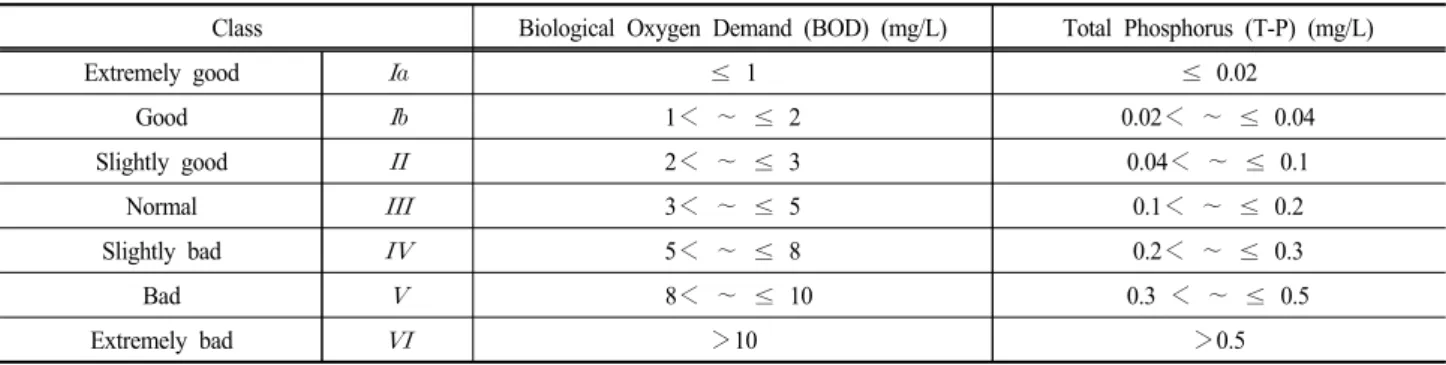
수질 요인에 독립적인 자료를 얻기 위해서 전체 조사지점 중 비교적 동등한 수질 조건을 충족시키는 지점들을 선정하 고자 “물환경정보시스템(www.nier.go.kr)”의 하천의 생활환 경기준에서 ‘좋음’에 해당하는 수질을 기준 조건으로 하였다 (Table 1). 고려한 수질 항목으로는 BOD₅ (5-day biochemical oxygen demand)와 T-P (total phosphorus)가 있으며, BOD₅ 의 농도가 2.0 mg/L 이하이면서 T-P 의 농도가 0.04 mg/L 이하인 지점을 선정하였다. 조건에 부합하는 지점은 2,007개 였으며 총 표본단위는 6,571개였다.
2.2. 분석방법
2.2.1. 저서동물 하상지수 선정
하상의 평균입경(
: =
,
=입경(mm)), 하상기 질의 유형화, 하상계열치(lithophililic series value)의 설정 및 저서성 대형무척추동물의 복합상대출현도(combined relative abundance)의 산출과정은 Kong and Kim (2016)의 분석방법 을 따랐다. Kong and Kim (2016)의 방법에 따라 수질을 고 려하여 새롭게 선정된 6,571개의 지점을 대상으로 하상계급 치(Lithophilic valency)와 하상지수(Lithophilic value), 지표 가중치(Indicator weight value)를 새로이 산정하였다.하상기질의 조성과 저서성 대형무척추동물 군집구조 간의 관계를 분석하기 위해서 새로이 구성된 저서동물 하천하상
Class Biological Oxygen Demand (BOD) (mg/L) Total Phosphorus (T-P) (mg/L)
Extremely good
≤ 1 ≤ 0.02
Good
1< ∼ ≤ 2 0.02< ∼ ≤ 0.04
Slightly good 2< ∼ ≤ 3 0.04< ∼ ≤ 0.1
Normal 3< ∼ ≤ 5 0.1< ∼ ≤ 0.2
Slightly bad 5< ∼ ≤ 8 0.2< ∼ ≤ 0.3
Bad 8< ∼ ≤ 10 0.3 < ∼ ≤ 0.5
Extremely bad >10 >0.5
Table 1. Class of life environment of stream of Biological Oxygen Demand (BOD) and Total Phosphorus (T-P)
지수와 군집지수를 비교하였다. 분석에 이용된 군집지수는 McNaughton (1967)의 우점도지수(Dominant index; DI), Shannon-Weaver (1949)의 다양도지수(Diversity index; H´), Margalef (1958)의 풍부도지수(Richness index; R), Pielou (1975)의 균등도지수(Evenness index; J´)였다.
3. Results and Discussion
3.1. 하상계급치 및 하상지수
새롭게 산정된 각 지표 분류군의 하상계급치는 총 191개 지표 분류군 모두 기존의 것과 차이를 보였다. 이에 따라 분 석에 이용된 총 191개 지표 분류군 중 126개 분류군에서 각 분류군의 대표하상지수(Representative integer of lithophilic value: )가 새롭게 산정되었다(Appendix 1).
예시로 전체 표본단위에서 출현도가 높은 흰점줄날도래 (Hydropsyche valvata)의 하상계급치를 비교하였다(Fig. 1a, 1b). 하상계열 0(
=-6)이 0.37에서 0.34로 감소하였으며, 하상계열 1(
=-5)이 0.29에서 0.36으로 증가, 하상계열 2 (
=-4)가 0.25에서 0.20으로 감소, 하상계열 3(
=-3)이 0.08로 동일, 하상계열 4(
=-1)가 0.01에서 0.02로 증가하 였다. 이에 대표하상지수 값은 0에서 1로 변경되었다. 이는 줄날도래과(Hydropsychidae)가 비교적 빠른 유속에 서식하며, 하상계급치 1의 계열 값인 pebble (
=16 ~ 64)의 하상을 선호하기 때문이다(Kim and Kong, 2018). 기존 결과 와 가장 두드러진 차이를 보인 분류군은 네모집날도래류 (Lepidostoma)였다(Fig. 1c, 1d). 하상계열 0(
=-6)이 기존 0.45에서 0.27로 감소하였으며, 하상계열 1(
=-5)이 0.25에 서 0.16으로 감소, 하상계열 2(
=-4)가 0.16에서 0.19로 증 가, 하상계열 3(
=-3)이 0.12에서 0.33으로 증가, 하상계열 4(
=-1)가 0.02에서 0.05로 증가하였다. 이에 대표하상지수 값은 0에서 3으로 크게 변경되었다. 이는 네모집날도래류의 유충이 1령에서 3령 초기까지 sand (
=0.063∼2)로 집 을 만들고, 그 이후에는 나뭇잎을 이용하여 집을 만들어 생 활하며(Hansell, 1976), 유속이 느린 소에서 서식하기 때문에 (Finlay et al., 2002), 비교적 세립질인 하상을 선호한다. 흰 점줄날도래와 네모집날도래류는 기존에 비해 새로이 구성된 대표하상지수 값이 분류군 특성을 고려하여 더 정확한 값을 나타낸 것으로 판단된다.3.2. 저서동물 하천하상지수(BMSI)와 저서동물지수 (BMI)의 비교
수질을 고려하여 재선정한 전체 지점의 저서동물지수 (BMI)와 기존 BMSI, 새로이 구성된 BMSI를 비교한 결과 두 가지 BMSI 모두 BMI와 높은 상관성을 보였으며 고도의
Li th op hili c val en cy
(a) Original (b) New
0.37
0.29 0.25
0.08 0.01 0.0
0.2 0.4 0.6 0.8 1.0
0 1 2 3 4
Representative lithophilic value (݈) = 0
0.34 0.36 0.20
0.08 0.02 0.0
0.2 0.4 0.6 0.8 1.0
0 1 2 3 4
Representative lithophilic value (݈) = 1
Hydropsyche valvata
(c) Original (d) New
0.45
0.25
0.16 0.12 0.02 0.0
0.2 0.4 0.6 0.8 1.0
0 1 2 3 4
Representative lithophilic value (݈) = 0
0.27
0.16 0.19 0.33
0.05 0.0
0.2 0.4 0.6 0.8 1.0
0 1 2 3 4
Representative lithophilic value (݈) = 3
Lepidostoma Lithophilic value
Fig. 1. Original lithophilic valency and new lithophilic valency of Hydropsyche valvata and Lepidostoma according to
combined relative abundance lithophilic value.Be nt hi c M ac ro in ve rte br at es S tr te am be d In de x (BM SI )
Original BMSI = 1.24 BMI - 21.69 r = 0.93, p < 0.001 New BMSI = 1.13BMI - 18.04
r = 0.90, p < 0.001
0 20 40 60 80 100
0 20 40 60 80 100
Original BMSI New BMSI Original BMSI New BMSI
Benthic Macroinvertebrates Index (BMI)
Fig. 2. Correlation of original benthic macroinvertebrates streambed index (BMSI) and
new benthic macroinvertebrates strembed index (BMSI) according to benthic macroinvertebrates index (BMI).Be nt hi c M ac ro inv er te br at es S tr te am be d Ind ex ( BM SI )
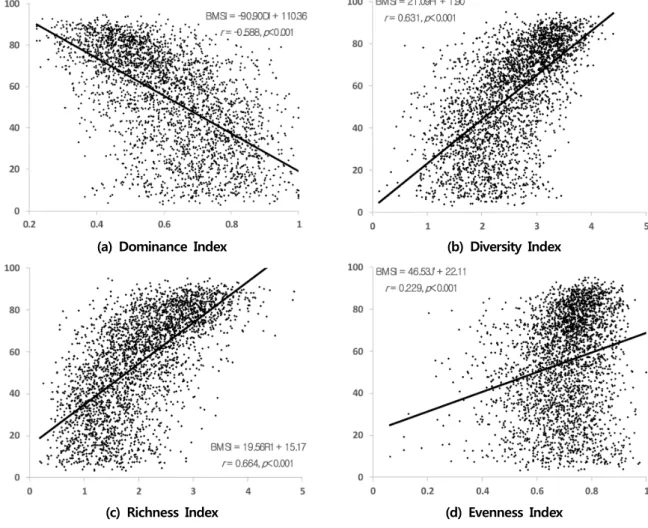
(a) Dominance Index (b) Diversity Index
(c) Richness Index (d) Evenness Index
Community analysis
Fig. 3. Relationship between Benthic macroinvertebrates streambed index (BMSI) and Community analysis (Dominance index;
DI, Diversity index; H´, Richness index; R, Evenness index; J´).
유의성(<0.001)을 보였다(Fig. 2). BMSI와 BMI 상관계수 ()는 기존의 것이 약 0.93, 새로이 구성된 것이 약 0.90의 값을 보였다(Fig. 2). 기존의 비해 새로이 구성된 BMSI의 상 관도가 더 낮았다. 기존의 BMSI 값과 새로이 구성된 BMSI 값은 BMI 값이 약 33.18을 기준으로 양극단으로 갈수록 차 이가 상대적으로 큰 경향을 보였다.
3.3. 저서동물 하천하상지수(BMSI)와 군집지수의 관계 새로이 구성된 BMSI는 군집지수(우점도지수, 다양도지수, 풍부도지수, 균등도지수)와 고도로 유의한( <0.001) 상관성 을 보였다(Fig. 3). BMSI는 우점도지수와 음의 상관성을 보 였으며(=-0.588), 다양도지수 및 풍부도지수, 균등도지수와 양의 상관성을 보였다(각각 =0.631, =0.664, =0.229). 세 립질 하상은 조립질 하상에 비해 교란에 더 민감하여 생물 다양성이 감소하며(Duan et al., 2009), 이에 따라 다양도지 수 및 풍부도지수 값이 낮아진다(Duan et al., 2008). 또한 세립질 하상일수록 BMSI 점수도 낮아지므로 다양도지수와 풍부도지수가 BMSI와 양의 상관성을 보인 것으로 판단된 다. 세립질 하상과 같이 단순한 하상구조일수록 생물 군집 의 다양성이 낮아지고, 소수 종이 우점하여 우점도지수 값 이 높아지기 때문에 BMSI와 우점도지수는 음의 상관성을 보이게 된다.
3.4. 저서동물 하천하상지수(BMSI)의 평가 등급 개정 Kong and Kim (2016)의 분석 방법에 따라 새로이 구성된 저서동물 하천하상지수(BMSI)의 최종 평가 등급을 재설정 하였다. 평가 등급은 복합상대출현도를 기준으로 산정된 BMSI 값의 회귀식을 기초로 하여 설정되었고, 가독성을 위 해 5 단위를 기준으로 반올림 하였다(Table 2).
Kong and Kim (2016)의 BMSI 최종 평가 등급은 아래와 같이 설정되어 있다(Table 3). A부터 E까지 등급별 구간은 각각 기존의 것이 15, 20, 35, 15, 15이며 새로이 구성된 것
이 20, 20, 25, 10, 25 이다. 등급별 구간의 차이는 새로이 구성된 것 이 기존의 것 보다 더 고르게 평가되어 있다.
4. Conclusion
본 연구에서는 수질 요인과는 독립적으로 하상 기질의 유 형에 따른 저서성 대형무척추동물의 분포 특성을 분석하고 자, 비교적 양호한 수질 상태를 가진 6,571개 표본단위를 기 반으로 기존의 저서동물 하천하상지수(BMSI)를 개선하였 다. 그 결과 총 191개 분류군 중 126개 분류군의 대표하상 지수가 새로이 산정되었다. 비교적 수질 요인에 독립적이면 서 더 큰 표본단위를 기반으로 지표 분류군들의 대표하상지 수가 개선됨에 따라 향후 하상 교란에 따른 생물학적 반응 을 보다 더 정확하게 해석할 수 있을 것으로 기대되고, 또한 수질 요인 외에도 유속이나 다른 물리적 환경요소도 고려하 여 보완한다면 독립적인 하상으로만 저서성 대형무척추동물 의 분포 특성을 나타낼 것으로 기대된다.
Acknowledgement
본 연구는 환경부⋅국립환경과학원의 「수생태계 건강성 조사 및 평가(´08~´13년)」와 「하천 수생태계 현황 조사 및 건강성 평가(´14~´18년)」 사업의 자료로 수행되었습니다.
References
Beisel, J. N., Usseglio-Polatera, P., Thomas, S., and Moreteau, J. C. (1998). Stream community structure in relation to spatial variation: The influence of mesohabitat characteristics,
Hydrobiologia, 389, 73-88.
Corkum, L. D. (1989). Patterns of benthic invertebrate assemblages in rivers of northwestern North America,
Freshwater Biology, 21, 191-205.
Lithophility class Benthic macroinvertebrates streambed index (BMSI) Lithophility
A 80≤ ∼ 100 Lithophilous
B 60≤ ∼ <80 Psephophilous
C 35≤ ∼ <60 Moderate
D 25≤ ∼ <35 Psammophilous
E 0 ∼ <25 Pelophilous
Table 3. Classification of Benthic macroinvertebrates streambed index (BMSI) for evaluation of streambed substrate status
from Kong and Kim (2016)Lithophility class Benthic macroinvertebrates streambed index (BMSI) Lithophility
A 85≤ ∼ 100 Lithophilous
B 65≤ ∼ <85 Psephophilous
C 30≤ ∼ <65 Moderate
D 15≤ ∼ <30 Psammophilous
E 0 ∼ <15 Pelophilous
Table 2. Class of Benthic macroinvertebrates streambed index (BMSI) for evaluation of streambed substrate status
Culp, J. M., Walde, S. J., and Davies, R. W. (1983). Relative importance of substrate particle size and detritus to stream benthic macroinvertebrate distribution, Canadian Journal of
Fisheries and Aquatic Sciences, 40, 1568-1574.
Death, R. G. (2000). Invertebrate-substratum relationships, In
New Zealand Stream Invertebrates and Ecology and Implications for Management, Collier, K. J., Winterbourn,
M. J. (eds.), New Zealand Limnological Society, Hamilton, 157-178.Duan, X., Wang, Z., and Tian, S. (2008). Effect of streambed substrate on macroinvertebrate biodiversity, Frontiers of En-
vironmental Science & Engineering in China, 2(1), 122-128.
Duan, X., Wang, Z., Xu, M., and Zhang, K.. (2009). Effect of streambed sediment on benthic ecology, International
Jounal of Sediment Research, 24, 325-338.
Erman, D. C. and Erman, N. A. (1984). The response of stream macroinvertebrates to substrate size and heterogeneity,
Hydrobiologia, 108(1), 75-82.
Finlay, J. C., Khandwala, S., and Power, M. E. (2002). Spatial scales of carbon flow in a river food web, Ecology, 83, 1845-1859.
Gore, J. A., Layzer, J. B., and Mead, J. (2001). Macroinvertebrate instream flow studies after 20 years: a role in stream management and restoration, Regulated Rivers: Research and
Management, 17, 527-542.
Hansell, M. H. (1976). A progress report on some approaches to the study of larval house building with particular reference to Lepidostoma hirtum, Proceedings of the First International
Symposium on Trichoptera, 181-184.
Hawkes, H. A. (1979). Invertebrates as indicators of river water quality, Biological Indicators of Water Quality, James, A., Evison, L. (eds.), Chichester, 2-45.
Hellawell, J. M. (1986). Biological indicators of freshwater pollution and environmental management, Pollution
Monitoring Series, Elsevier Applied Science, London, 546.
Kim, Y. J. and Kong, D. (2018). Estimation on physical habitat suitability of benthic macroinvertebrates in the Hwayang stream, Jounal of Korean Society on Water Environment, 34(1), 10-25.
Kong, D. and Kim, J. Y. (2016). Development of benthic macroinvertebrates streambed index (BMSI) for bioassessment of stream physical habitat, Journal of Korean
Society on Water Environment, 32(1), 1-14. [Korean
Literature]Kong, D., Son, S. H., Hwang S. J., Won, D. H., Kim, M. C., Park, J. H., Jeon, T. S., Lee, J. E., Kim, J. H., Kim, J. S., Park J., Kwak, I. S., Jun, Y. C., Park, Y. S., Ham, S. A., Lee, J. K., Lee, S. W., Park, C. H., Moon, J. S., Kim, J.
Y., Park, H. K., Park, S. J., Kwon Y., Kim P., and Kim, A. R. (2018a). Development of benthic macroinvertebrates index (BMI) for biological assessment on stream environment,
Journal of Korean Society on Water Environment, 34(2),
183-201. [Korean Literature]Kong, D., Park, Y., and Jeon, Y. R. (2018b). Revision of exological score of benthic macroinvertebrates community in Korea,
Jounal of Korean Society on Water Environment, 34(3),
251-269. [Korean Literature]Malmqvist, B. and Rundle, S. (2002). Threats to the running water ecosystems of the world, Environmental Conservation, 29, 134-153.
Margalef, R. (1958). Information Theory in Ecology, General
Systems, 3, 36-71.
McNaughton, S. J. (1967). Relationship among functional properties of California grassland, Nature, 216, 168-169.
Minshall, G. W. (1984). Aquatic insect-substratum relationships, In The Ecology of Aquatic Insects, Resh, V. H., Rosenberg, D. M. (eds.), Praeger Publishers, New York, 358-400.
Nilsson, C., Reidy, C. A., Dynesius, M., and Revenga, C. (2005).
Fragmentation and flow regulation of the world’s large river systems, Science, 308, 405-408.
Pielou, E. C. (1975). Ecological Diversity, Wiely, 165.
Shannon, C. E. and Weaver, W. (1949). The mathematical theory
of communication, University of Illinois Press, Urbana.
Thomas, W. A. (1972). Indicators of environmental quality: An overview, Thomas, W. A. editor, Indicators of Environmental
Quality, Plenum Publishers, New York, 1-5.
Townsend, C. R., Scarsbrook, M. R., and Dole´dec, S. (1997a).
Quantifying disturbance in streams: alternative measures of disturbance in relation to macroinvertebrate species traits and species richness, Journal of the North American
Benthological Society, 16, 531-544.
Townsend, C. R., Dole´dec, S., and Scarsbrook, M. R. (1997b).
Species traits in relation to temporal and spatial heterogeneity in streams: a test of habitat templet theory, Freshwater
Biology, 37, 367-387.
Won, D. H., Jun, Y. C., Kwon, S. J., Hwang, S. J., Ahn. K.
G., and Lee, J. K. (2006). Development of Korean saprobic index using benthic macroinvertebrates and its application to biological stream environment assessment, Journal of
Korean Society on Water Environment, 22(5), 768-783.
[Korean Literature]
Yoon, I. B., Kong, D. S. and Ryu, J. K. (1992a). Studies on the biological evaluation of water quality by benthic macro-invertebrates (1) saprobic valency and indicative value,
Korean Society of Environmental Biology, 10(1), 24-49.
[Korean Literature]
Yoon, I. B., Kong, D. S., and Ryu, J. K. (1992b). Studies on the biological evaluation of water quality by benthic macroinver-tebrates (2) - effects of environmental factors to community -, Korean Society of Environmental Biology, 10(1), 40-55. [Korean Literature]
Yoon, I. B., Kong, D. S., and Ryu, J. K. (1992c). Studies on the biological evaluation of water quality by benthic macroinver-tebrates (3) macroscopic simple water quality eEvaluation, Korean Society of Environmental Biology, 10(2), 77-84. [Korean Literature]
NO. Indicator taxa lithophilic valency
0 * 1 * 2 * 3 * 4 * Phylum Platyhelminthes (편형동물문)
ClassTurbellaria(와충강)
1 Dugesia 플라나리아류 0.3 0.3 0.2 0.2 0.0 0 2
Phylum Nematomorpha(유선형동물문) Class Gordioida(연가시강)
2 Gordius aquaticus 연가시 0.2 0.2 0.3 0.1 0.2 2 2
Phylum Mollusca(연체동물문) Class Gastropoda(복족강)
3 Cipangopaludina 우렁이류 0.1 0.1 0.0 0.1 0.7 4 3
4 Pomacea canaliculata 왕우렁이 0.0 0.1 0.1 0.5 0.3 3 3
5 Gabbia misella 염주쇠우렁이 0.0 0.3 0.2 0.4 0.1 3 2
6 Parafossarulus manchouricus 쇠우렁이 0.0 0.0 0.3 0.4 0.3 3 2
7 Stenothyra glabrata 둥근입기수우렁이 0.0 0.0 0.0 0.2 0.8 4 4
8 Koreanomelania 알다슬기류 0.4 0.3 0.1 0.2 0.0 0 2
9 Semisulcospira coreana 참다슬기 0.2 0.3 0.3 0.2 0.0 1 2
10 Semisulcospira forticosta 주름다슬기 0.1 0.3 0.2 0.3 0.1 1 2
11 Semisulcospira gottschei 곳체다슬기 0.3 0.1 0.2 0.3 0.1 0 1
12 Semisulcospira libertina 다슬기 0.3 0.3 0.2 0.2 0.1 0 2
13 Semisulcospira tegulata 좀주름다슬기 0.4 0.1 0.1 0.2 0.2 0 2
14 Other Semisulcospira 그외 다슬기류 0.1 0.0 0.2 0.5 0.2 3 3
15 Austropeplea ollula 애기물달팽이 0.0 0.0 0.1 0.1 0.8 4 4
16 Radix auricularia 물달팽이 0.1 0.1 0.2 0.2 0.4 4 2
17 Physa acuta 왼돌이물달팽이 0.0 0.2 0.1 0.3 0.3 3 2
18 Gyraulus convexiusculus 또아리물달팽이 0.1 0.1 0.2 0.3 0.3 4 1
19 Hippeutis cantori 수정또아리물달팽이 0.0 0.0 0.0 0.0 0.9 4 5
Class Bivalvia(이매패강)
20 Limnoperna forunei 민물담치 0.8 0.0 0.1 0.0 0.1 0 4
21 Unionidae 말조개류 0.1 0.3 0.2 0.2 0.3 1 1
22 Corbicula 재첩류 0.1 0.2 0.2 0.3 0.2 3 1
23 Pisidium 산골조개류 0.2 0.2 0.4 0.1 0.1 2 2
Class Oligochaeta(빈모강)
24 Nereidae 갯지렁이과 0.0 0.0 0.0 0.1 0.9 4 5
25 Eisenia 줄지렁이류 0.1 0.1 0.2 0.4 0.2 3 2
26 Chaetogaster limnaei 물지렁이 0.0 0.1 0.1 0.2 0.5 4 2
27 Branchiura sowerbyi 아가미지렁이 0.1 0.1 0.1 0.2 0.5 4 3
28 Limnodrilus gotoi 실지렁이 0.2 0.2 0.1 0.2 0.3 4 1
Class Hirudinea(거머리강)
29 Alboglossiphonia 조개넙적거머리류 0.3 0.2 0.2 0.2 0.2 0 1
30 Batracobdella paludosa 연두넙적거머리 0.0 0.4 0.0 0.3 0.2 1 2
31 Glossiphonia 갈색넙적거머리류 0.1 0.3 0.2 0.3 0.2 1 1
32 Helobdella stagnalis 민물넙적거머리 0.0 0.0 0.0 0.3 0.6 4 3
33 Hemiclepsis japonica 곤봉넙적거머리 0.5 0.3 0.1 0.1 0.0 0 2
34 Hemiclepsis marginata 녹색넙적거머리 0.1 0.1 0.1 0.3 0.5 4 2
35 Toryx tagoi 개구리넙적거머리 0.1 0.2 0.0 0.5 0.2 3 2
* : Lithophilic series value
Appendix 1. Lithophilic valency(
), lithophilic value () and indicator weight value () of each indicator taxon.NO. Indicator taxa lithophilic valency
0 1 2 3 4
36 Whitmania sp. 녹색말거머리류 0.1 0.0 0.0 0.7 0.2 3 4
37 Hirudo nipponia 참거머리 0.1 0.0 0.2 0.6 0.0 3 3
38 Erpobdella lineata 돌거머리 0.1 0.1 0.2 0.5 0.1 3 2
39 Barbronia weberi (국명미정) 0.0 0.0 0.0 0.2 0.8 4 4
Phylum Arthropoda(절지동물문) Class Crustacea(갑각강)
40 Asellus 물벌레류 0.1 0.3 0.3 0.2 0.1 1 2
41 Gammarus 옆새우류 0.2 0.4 0.1 0.3 0.0 1 2
42 Atyidae 새뱅이과 0.0 0.1 0.1 0.2 0.6 4 3
43 Macrobrachium 징거미새우류 0.0 0.0 0.0 0.1 0.9 4 5
Class Entognatha(내구강) Order Collembola(톡토기목)
44 Collembola sp. 톡토기목 0.2 0.2 0.3 0.2 0.1 2 2
Class Insecta(곤충강)
Order Ephemeroptera(하루살이목)
45 Siphlonurus chankae 옛하루살이 0.0 0.0 0.1 0.1 0.8 4 4
46 Ameletus 피라미하루살이류 0.5 0.0 0.1 0.1 0.2 0 3
47 Acentrella gnom 깨알하루살이 0.2 0.2 0.2 0.3 0.0 3 2
48 Acentrella sibirica 콩알하루살이 0.4 0.3 0.2 0.1 0.0 0 2
49 Alanites muticus 길쭉하루살이 0.2 0.7 0.0 0.0 0.0 1 4
50 Baetiella tuberculata 애호랑하루살이 0.4 0.3 0.2 0.1 0.0 0 2
51 Baetis fuscatus 개똥하루살이 0.2 0.2 0.2 0.2 0.1 0 1
52 Baetis silvaticus 감초하루살이 0.4 0.4 0.2 0.1 0.0 0 3
53 Other Baetis 그외 꼬마하루살이류 0.3 0.4 0.2 0.1 0.0 1 2
54 Cloeon dipterum 연못하루살이 0.0 0.2 0.1 0.2 0.6 4 3
55 Labiobaetis atrebatinus 입술하루살이 0.1 0.1 0.1 0.2 0.6 4 3
56 Nigrobaetis 깜장하루살이류 0.4 0.2 0.2 0.2 0.0 0 2
57 Procloeon maritimum 작은갈고리하루살이 0.2 0.0 0.1 0.2 0.4 4 2
58 Procloeon pennulatum 갈고리하루살이 0.2 0.3 0.2 0.2 0.2 1 1
59 Isonychia 빗자루하루살이류 0.1 0.1 0.6 0.1 0.0 2 3
60 Cinygmula 봄처녀하루살이류 0.3 0.5 0.1 0.1 0.0 1 3
61 Ecdyonurus bajkovae 몽땅하루살이 0.3 0.2 0.1 0.3 0.0 0 2
62 Ecdyonurus dracon 참납작하루살이 0.3 0.3 0.1 0.2 0.0 0 2
63 Ecdyonurus joernensis 꼬리치레하루살이 0.2 0.2 0.3 0.3 0.1 3 2
64 Ecdyonurus kibunensis 두점하루살이 0.4 0.2 0.1 0.2 0.0 0 2
65 Ecdyonurus levis 네점하루살이 0.4 0.2 0.2 0.2 0.0 0 2
66 Epeorus nipponicus 흰부채하루살이 0.2 0.4 0.3 0.1 0.0 1 2
67 Epeorus latifolium 점박이부채하루살이 0.1 0.0 0.7 0.3 0.0 2 4
68 Epeorus pellucidus 부채하루살이 0.3 0.2 0.2 0.2 0.0 0 2
69 Heptagenia 햇살하루살이류 0.5 0.3 0.1 0.1 0.0 0 3
70 Epeorus sp. 중부채하루살이류 0.9 0.0 0.0 0.0 0.0 0 5
71 Rhithrogena na 산납작하루살이 na 0.5 0.4 0.1 0.0 0.0 0 3
72 Choroterpes altioculus 세갈래하루살이 0.4 0.3 0.2 0.1 0.0 0 2
73 Paraleptophlebia japonica 두갈래하루살이 0.3 0.5 0.2 0.0 0.0 1 3
74 Potamanthus 작은강하루살이류 0.2 0.2 0.3 0.3 0.1 2 2
Appendix 1. Continued.
NO. Indicator taxa lithophilic valency
0 1 2 3 4
75 Rhoenanthus coreanus 강하루살이 0.2 0.2 0.3 0.3 0.0 2 2
76 Ephoron shigae 흰하루살이 0.3 0.1 0.2 0.3 0.0 0 2
77 Ephemera orientalis 동양하루살이 0.2 0.1 0.2 0.3 0.1 3 1
78 Ephemera separigata 가는무늬하루살이 0.1 0.3 0.2 0.2 0.1 1 1
79 Ephemera sachalinensis 사할린하루살이 0.6 0.3 0.1 0.0 0.0 0 3
80 Ephemera strigata 무늬하루살이 0.4 0.3 0.2 0.1 0.0 0 2
81 Ephemera sp. 무늬하루살이류 0.2 0.7 0.1 0.0 0.0 1 4
82 Cincticostella 민하루살이류 0.3 0.3 0.3 0.1 0.0 2 2
83 Drunella 뿔하루살이류 0.5 0.4 0.1 0.0 0.0 0 3
84 Ephemerella 알락하루살이류 0.3 0.1 0.2 0.3 0.0 0 2
85 Serratella 범꼬리하루살이류 0.4 0.3 0.2 0.1 0.0 0 2
86 Teloganopsis 등줄하루살이류 0.3 0.3 0.2 0.2 0.0 0 2
87 Potamanthellus chinensis 방패하루살이 0.2 0.2 0.5 0.1 0.0 2 3
88 Caenis 등딱지하루살이류 0.2 0.2 0.2 0.3 0.1 3 2
Order Odonata(잠자리목)
89 Paracercion 등검은실잠자리류 0.0 0.0 0.1 0.1 0.8 4 4
90 Ischnura asiatica 아시아실잠자리 0.0 0.0 0.0 0.1 0.8 4 5
91 Copera annulata 자실잠자리 0.6 0.0 0.0 0.1 0.2 0 3
92 Platycnemis phillopoda 방울실잠자리 0.0 0.2 0.0 0.1 0.6 4 3
93 Calopteryx 물잠자리류 0.1 0.1 0.2 0.1 0.4 4 2
94 Gomphidae 측범잠자리류 0.0 0.0 0.1 0.6 0.3 3 3
95 Davidius lunatus 쇠측범잠자리 0.3 0.4 0.2 0.1 0.1 1 2
96 Shaogomphus postacularis 어리측범잠자리 0.0 0.1 0.0 0.4 0.5 4 3
97 Nihonogomphus 고려측범잠자리류 0.0 0.0 0.1 0.8 0.0 3 4
98 Lamelligomphus ringens 노란측범잠자리 0.1 0.2 0.3 0.4 0.0 3 2
99 Ophiogomphus obscura 측범잠자리 0.0 0.2 0.5 0.3 0.0 2 3
100 Sieboldius albardae 어리장수잠자리 0.2 0.4 0.2 0.2 0.0 1 2
101 Macromia 잔산잠자리류 0.2 0.1 0.2 0.2 0.4 4 2
102 Orthetrum 밀잠자리류 0.0 0.1 0.1 0.2 0.6 4 3
103 Sympetrum 좀잠자리류 0.1 0.3 0.1 0.3 0.3 4 2
Order Plecoptera(강도래목)
104 Taenionema 메추리강도래류 0.9 0.0 0.0 0.1 0.0 0 5
105 Amphinemura 총채민강도래류 0.5 0.3 0.1 0.0 0.0 0 3
106 Nemoura 민강도래류 0.3 0.3 0.2 0.1 0.0 0 2
107 Protonemura KUa 삼새민강도래 KUa 0.3 0.7 0.0 0.0 0.0 1 4
108 Paracapnia KUa 흰배민강도래 KUa 0.0 0.0 1.0 0.0 0.0 2 5
109 Paracapnia recta 애강도래 0.1 0.7 0.2 0.0 0.0 1 4
110 Rhopalopsole mahunkai 꼬마강도래 0.2 0.4 0.4 0.0 0.0 1 3
111 Yoraperla KUa 넓은가슴강도래 KUa 1.0 0.0 0.0 0.0 0.0 0 5
112 Pteronarcys sachalina 큰그물강도래 0.1 0.0 0.9 0.0 0.0 2 5
113 Archynopteryx KUa 큰등그물강도래 KUa 0.3 0.4 0.4 0.0 0.0 2 3
114 Isoperla 줄강도래류 0.6 0.2 0.1 0.0 0.0 0 3
115 Megarcys ochracea 그물강도래 0.0 0.0 0.6 0.3 0.0 2 4
116 Kamimuria coreana 한국강도래 0.2 0.1 0.0 0.0 0.7 4 3
117 Kiotina decorata 무늬강도래 0.6 0.2 0.1 0.0 0.0 0 3
Appendix 1. Continued.
NO. Indicator taxa lithophilic valency
0 1 2 3 4
118 Neoperla coreensis 두눈강도래 0.5 0.4 0.0 0.0 0.0 0 3
119 Oyamia nigribasis 진강도래 0.3 0.2 0.3 0.2 0.0 2 2
120 Paragnetina flavotincta 강도래붙이 0.7 0.2 0.1 0.0 0.0 0 4
121 Alloperla 민무늬강도래류 0.6 0.0 0.3 0.1 0.0 0 3
122 Sweltsa 녹색강도래류 0.1 0.8 0.0 0.0 0.0 1 5
Order Hemiptera (노린재목)
123 Micronecta 꼬마물벌레류 0.0 0.0 0.0 0.0 0.9 4 5
124 Muljarus japonicus 물자라 0.0 0.1 0.2 0.2 0.5 4 3
Order Megaloptera (뱀잠자리목)
125 Parachauliodes asahinai 뱀잠자리붙이 0.4 0.2 0.2 0.2 0.0 0 2
126 Protohermes xanthodes 노란뱀잠자리 0.4 0.2 0.3 0.2 0.0 0 2
Order Coleoptera (딱정벌레목)
127 Berosus 물땡땡이류 0.0 0.2 0.1 0.3 0.5 4 3
128 Helochares 좀물땡땡이류 0.1 0.0 0.1 0.2 0.7 4 3
129 Laccobius 점물땡땡이류 0.1 0.0 0.2 0.1 0.6 4 3
130 Optioservus 무늬여울벌레류 0.4 0.0 0.4 0.2 0.0 2 3
131 Stenelmis 긴다리여울벌레류 0.4 0.3 0.2 0.1 0.0 0 2
132 Other Elmidae 그외 여울벌레류 0.3 0.2 0.2 0.2 0.0 0 2
133 Eubrianax KUa 둥근물삿갓벌레 KUa 0.4 0.2 0.2 0.2 0.0 0 2
134 Mataeopsephus KUa 물삿갓벌레 KUa 0.4 0.2 0.2 0.2 0.0 0 2
135 Psephenoides KUa 물삿갓벌레과 KUa 0.4 0.3 0.2 0.0 0.0 0 3
Order Diptera (파리목)
136 Antocha KUa 명주각다귀 KUa 0.3 0.3 0.3 0.1 0.0 1 2
137 Dicranomyia KUa 무늬애기각다귀 KUa 0.4 0.5 0.0 0.0 0.0 1 3
138 Dicranota KUa 애기각다귀 KUa 0.1 0.5 0.3 0.1 0.0 1 2
139 Hexatoma 검정날개각다귀류 0.3 0.4 0.2 0.1 0.0 1 2
140 Tipula 각다귀류 0.1 0.2 0.2 0.3 0.2 3 2
141 Psychoda 나방파리류 0.1 0.0 0.0 0.6 0.2 3 3
142 Dixidae 별모기류 0.1 0.4 0.0 0.1 0.3 1 2
143 Culicidae 모기류 0.0 0.0 0.0 0.0 0.9 4 5
144 Simulium 먹파리류 0.3 0.3 0.3 0.1 0.0 1 2
145 Ceratopogonidae sp. 등에모기류 0.2 0.4 0.1 0.2 0.1 1 2
146 Chironomidae sp. (red type) 깔따구류 (red type) 0.2 0.2 0.2 0.2 0.2 2 1
147 Other Chironomidae sp. 그외 깔따구류 0.2 0.2 0.1 0.2 0.3 4 1
148 Bibiocephala KUa 물멧모기 KUa 0.7 0.0 0.3 0.0 0.0 0 4
149 Philorus KUa 멧모기 KUa 0.8 0.2 0.0 0.0 0.0 0 4
150 Atherix KUa 개울등에 KUa 0.6 0.0 0.4 0.0 0.0 0 3
151 Suragina 긴개울등에류 0.4 0.5 0.1 0.0 0.0 1 3
152 Stratiomyia KUa 동애등에 KUa 0.2 0.1 0.3 0.1 0.2 2 2
153 Empididae sp. 춤파리류 0.1 0.0 0.3 0.1 0.5 4 3
154 Dolichopodidae sp. 장다리파리류 0.2 0.2 0.2 0.2 0.2 4 1
155 Tabanus kinoshitai 여린황등에 0.0 0.2 0.2 0.6 0.1 3 3
156 Syrphidae sp. 꽃등에류 0.0 0.0 0.0 0.6 0.4 3 4
157 Ephydridae sp. 물가파리류 0.1 0.1 0.2 0.1 0.6 4 3
158 Muscidae sp. 집파리류 0.2 0.1 0.1 0.1 0.5 4 3
Appendix 1. Continued.
NO. Indicator taxa lithophilic valency