• 검색 결과가 없습니다.

Research on Tourist Needs Based on Food Docent-Guided Tour -focused Guangzhou Xiguan

N/A
N/A
Protected

Academic year: 2021

Share "Research on Tourist Needs Based on Food Docent-Guided Tour -focused Guangzhou Xiguan"

Copied!
9
0
0

로드 중.... (전체 텍스트 보기)

전체 글

(1)

Research on Tourist Needs Based on Food Docent-Guided Tour -focused Guangzhou Xiguan

Ding-Ding Chen

1

, Wan-Sok Jang

2

, Young-Hwan Pan

3*

1

Ph. D. Course, Dept. of Experience Design, TED, Kookmin University

2

Professor, Qingdao University of Science and Technology College of Communication

3

Professor, Dept. of Experience Design, TED, Kookmin University

미식 도슨트 가이드 투어를 통한 관광객 수요 분석 -광저우 시관을 중심으로

첸딩딩

1

, 장완석

2

, 반영환

3*

1

국민대학교 테크노디자인전문대학원 경험디자인학과 박사과정

2

칭다오과학기술대학교 커뮤니케이션대학 교수

3

국민대학교 테크노디자인전문대학원 경험디자인학과 교수

Abstract Under the background of regional cultural development and cities' diversity, various tourist destinations attract tourists' attention and visit by mining their unique folk culture. As a part of sustainable tourism, gastronomy tourism can provide residents and tourists services only by improving the residents' facilities without damaging the environment. However, the existing gastronomy tourism only makes tourists in the folk scene, and tourists can not overstep the cultural differences caused by intersubjectivity to experience the core of folk culture. This paper attempts to use the observation method, cross-subject study, and case study to study the role of food docent-guided tours in understanding folk culture. Moreover, the docent-guided tour studies how the docent can help tourists go deep into the core of folk culture better to realize the sustainable development goal of gastronomy tourism.

Key Words : Folk Custom, Tourist Needs, Traveling Experience, Gastronomy Tourism, Docent-Guided Tour

요 약 최근 지역 문화 발전과 도시 다양성의 맥락에서 각각의 관광지들은 독특한 민속 문화를 발굴하여 관광객의 관심과 방문을 유도하고 있다. 지속 가능한 관광의 일환으로 미식 관광은 명승지 환경을 해치는 건설을 할 필요도 없 고, 지역 주민과 관광객에게 서비스를 제공하기 위한 시설 개선 만하면 되는 장점도 있다. 그러나 기존의 미식 관광은 관광객을 풍속 현장에만 두게 되어 주체 간에 다른 문화적 차이를 넘어 민속 문화의 핵심을 체험할 수 없었다. 본 논문 은 관찰 방법, 융복합 주제 연구 및 사례 연구를 통해 민속 문화를 이해하는데 있어서 푸드 도슨트 가이드 투어의 역할 을 연구하였다. 특히 도슨트 가이드 투어에서 미식 관광이 지속 가능 발전이라는 목표를 잘 달성할 수 있도록 가이드가 관광객들로 하여금 민속 문화의 핵심에 보다 효과적으로 동화되어 체험할 수 있도록 돕는 방법을 연구하였다.

주제어 : 민속문화, 관광객 니즈, 관광경험, 미식 관광, 도슨트 가이드 투어

*Corresponding Author : Young-Hwan Pan([email protected]) Received September 14, 2020

Accepted December 20, 2020 Revised December 8, 2020

Published December 28, 2020

(2)

1. Introduction

Unique identifiability is vital to obtain the attention of tourists. The distinctive local or regional intangible cultural heritage has increasingly become a vital attraction element and has also become the focus of tourism resource development in the tourist destination.

As a city with a history of more than 2000 years, Guangzhou has been the center of China's maritime trade for a long time and has produced a unique performance of folk culture in the local area. In order to attract tourists, the Guangzhou government takes scenic spots (such as Lingnan Impression), and historical monuments (such as Chen Clan Ancestral Hall, the Mausoleum of the Nanyue King) as the focus of tourism construction, and these places have become the must-visit scenic spots for group tourists. This severe tourism development is known as hard tourism (Fig. 1, left), which has caused indelible environmental damage in many places and caused residents' displacement[1]. To resist the damage caused by hard tourism, a sustainable tourism form called soft tourism (Fig. 1, right) has been born. It can benefit the residents and make tourists experience the local folk customs.

Fig. 1. Comparison between Mass Tourism and Sustainable Tourism

With the increasing needs of tourists for an in-depth experience of folk customs, it is necessary not only to meet the tourism mode of the self-guided tour, but also to understand whether this mode is helpful for tourists to

communicate with residents, and ultimately bring sustainable development to local folk customs and communities.

2. Theoretical Background 2.1 Docent-Guided Tours

In museums and galleries, there is a form called Docent-Guided Tour, which allows viewers to understand the history of cultural relics or paintings and the story behind them through the docent. There is much literature explaining that docent helps students understand the vital role of exhibits[2-4]. Moreover, because the students have different combinations of background experiences, interests, and skills, they will interact differently with the exhibits and need different kinds of help[5]. During structured tours[6], good docents try to open-up students' thinking rather than directly guiding them to the right answer[7], especially when exhibits are not interactive, docents can tend to be more significant results[8,9]. In recent years, docent-guided tours have also been used in tourism, allowing people with local folk customs or study of local culture to explain local folk customs to tourists(Fig. 2). As an emerging form of tourism, it can be the right way for tourists to interact with residents. However, most of such tours are small-scale sightseeing activities carried out by non-governmental organizations to promote the folk culture of a specific place, which is hard to achieve the effect of regular clumping and long-term publicity of folk culture.

The docent is derived from the Latin word

"Docere", which means "teaching". This teaching

is not only unilateral "teaching" but also requires

corresponding "tutoring". For different tourists

with different backgrounds and purposes, how to

let them understand distinct folk customs under

the cultural gap is also the docent or cultivation

of docent need to think.

(3)

Fig. 2. The role of Docent-Guided Tours

2.2 Gastronomy Tourism

In the process of promoting sustainable development, everyone involved in tourism has the responsibility to achieve the goal.[10] In the book "Holiday Makers", Jost Krippendorf calls for

"recalcitrant tourists and local people" to create new tourism forms. "The development and promotion of new forms of tourism will bring the greatest benefits to all participants (tourists, hosts, and tourism enterprises) without causing intolerable damage to the ecological and social environment." He calls this concept "human tourism".[11] Based on this concept, tourists bring direct economic benefits to local businesses by directly contacting businesses at the tourist destination, and local businesses also bring authentic and truly unique travel experiences to tourists. Humane tourism brings job opportunities to communities in the tourist destination, gives residents the right to work, and allows them to share results from tourism.

Tourist destinations must have unique identifiability to obtain the attention of tourists, so distinctive local or regional intangible cultural heritage has increasingly become an important attraction element. In addition to the natural landscape, the most popular is the unique cuisine. In the total tourist expenditure, the proportion of food consumption has always been high, generally accounting for one-third of the total tourist expenditure[12]. Among the many soft tourism elements, gastronomy tourism is also one of the most innovative and dynamic tourism experiences due to its active development and rapid development. According to the World Food

Travel Association (WFTA) estimates, food costs account for 15% to 35% of all tourist expenditures, while food simultaneously brings 25% economic benefits to the tourist destination.

The local food culture is produced by dietary differences in various countries and regions, but also because each tourist needs to eat three meals per day, it also makes food one of the fundamental economic drivers of tourism.

3. Research Methods 3.1 Investigation and Survey

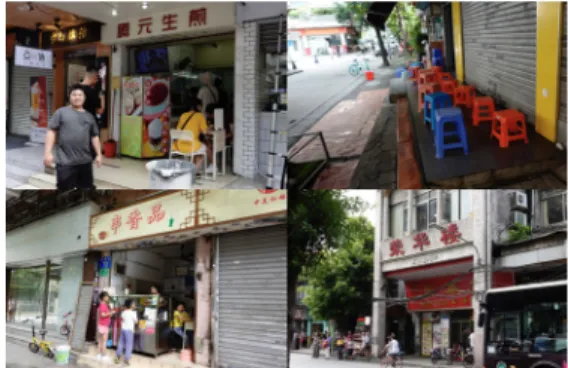
Although gastronomic research can add a new perspective to sustainable tourism[13], few empirical studies on gastronomy tourism from a sociocultural perspective[14,15]. To explore gastronomy tourism's role in the development and maintenance of regional identity, while further understand the effectiveness of docent-guided tour in gastronomy tourism and studying the problems encountered by docents and tourists in the docent-guided tour. The exploratory case study was conducted through a food docent-guided tour in Xiguan, Guangzhou, in the summer of 2019 (Fig. 3). Through in-depth interviews with participants and cross-validation with published marketing research, qualitative data revealed various factors affecting the relationship between gastronomy tourism and regional identity.

Fig. 3. The docent (upper left) and some guided spots

(4)

As an essential part of folk customs, the food needs to study through Cultural Lens[16], which provides a new direction for cultural and heritage tourism research and puts forward new methods for realizing sustainable tourism development. By studying the interrelationship between food, place, and identity that constitute folk customs, gastronomy tourism's impact on society and culture can be genuinely understood (Fig. 4). Food has become an essential source of identity formation in postmodern society[17].

The essence and understanding of identity have an intrinsic connection with experiencing others' identity and pursuing cross-cultural consumption[18].

The use of docent-guided tours can promote cultural understanding and strengthen cultural and social identity between residents and tourists in the state of folk consultation.

Fig. 4. Comparison of the Cognition of Folklore between Self-service Gastronomy Tourism (above), Gastronomy Tourism (middle) and Food Docent-Guided Tour (below)

Questionnaire survey and interview were interposed before and after the whole tour. The docents formulated the trip according to his own experience. Before the tour, the participants did not know the tour's information. The entire tour is on foot, except for the last part which is far away and uses public transport. To obtain credible data, the whole tour is recorded by digital equipment. In order to better understand the effect of docent-guided tours, the participants included local tourists (as a sample to understand the local culture), tourists from

surrounding cities (as a sample to understand the local culture partially), and tourists from other provinces and cities (as a sample to not understand the local culture at all). This paper studied the effect of docent-guided tours on different people and put forward approaches in how to use docent-guided tours to improve the relationship between residents and tourists, and then to realize the goal of sustainable tourism.

The sample characteristics of participants were shown in Table 1.

Table 1. Background of Docent-Guided Tour Participants No. Gen der Age Marital

Status Occupation Born in Guangzho

u?

Time of residence in

Guangzhou

A F 40+ Yes Freelance No 18

B M 31-40 Yes Professional Yes 39

C M 31-40 Yes Freelance Yes 39

D F 26-30 No Freelance Yes 27

E M 21-25 No Student No 1

F F 21-25 No Student No 5

G F 21-25 No Student No 6

Table 2. Classification of tourist tourism experience purpose Experience

Category Tourist category Explanation Peak Touristic

Experience Sightseer Taking view natural or human-made scenery as the primary purpose of

tourism Supporting

Consumer

Experiences Foodie Taking taste food as the primary purpose of tourism Daily Routine

Experiences

Culturetrotter Taking experience culture as the primary purpose of tourism Shopper Taking shopping or buying souvenirs

as the primary purpose of tourism Other The primary purpose of tourism was

not consistent with the above

3.2 Analysis

The journey started at 9 am and ended at 4 pm,

with a walking distance of more than 5 km. During

the tour, 15 places related to local folklore were

visited and explained, and tasted 10 of them. Among

these places, 2 are Street Vendors, 1 is the

traditional Canton herbal tea shop, 2 are bakeries

for traditional cake, 2 are no name Diners, and the

remaining 3 are Eateries (Fig. 7). The average per

capita of each restaurant is about 20 RMB (Fig. 8).

(5)

The tour also visited 2 local wet markets and introduced another 3 restaurants related to local folk customs. Before the tour, a questionnaire survey was first conducted to classify the participants. To understand the demand for tourism of age and occupation, five types of tourists are defined, which shown in Table 2. In Quan &

Wang's[12] conceptual model of tourism experience, the experience is divided into Peak Touristic Experiences, Supporting Consumer Experiences, and Daily Routine Experiences. Peak Touristic Experiences originate from the sociology's research on tourism, which means that tourists focus on the experiences mode, which is different from daily life.

Supporting Consumer Experiences comes from marketing and management research, which means that tourists focus on the experience of service quality. Daily Routine Experiences comes from the lack of research on sociology and marketing, especially tourists' demand for the cultural experience. The classification in Table 2 comes from the tourists' demand for the three experiences.

The classification takes experience as the classification basis and analyzes the data of the docent-guided tour.

To understand whether the participants' explorative spirit affects their sense of expectation, the Plog's model[19], which was most commonly used for tourists, was also added to the questionnaire for classification. Participants were also asked what the most concerning part of this tour. Most of the participants belonged to the Mid-centric type, which was consistent with the typical tourist data; the rest were Allocentric type, which showed that the Psychocentric type was reluctant to take risks, so they had little interest in docent-guided tour. Compared with Allocentric tourists, Mid-centric tourists were more explicit about their positioning and were accurately locatetheir purpose. In contrast, most Allocentric tourists could notclearly define their categories, which may be related to the interest of Allocentrictourists in all things. See Table 3 for data.

No. Classification Plog’s Mode Concerns*

A Other Allocentric Price, Taste, Tastable B Foodie, Culturetrotter Mid-centric Taste, Amenity,

Tastable

C Foodie Mid-centric Taste, Amenity,

Convenience D Sightseer, Culturetrotter Mid-centric Taste, Amenity,

Convenience E Culturetrotter Mid-centric Taste, Amenity,

Service F Sightseer, Foodie,

Culturetrotter, Shopper Allocentric Taste, Amenity, Convenience

G Foodie Mid-centric Taste

* The options of interest include Price, Authentic Taste, Amenity, Service, Convenience, Traffic, Food Tastable.

Table 3. Comparison of pre-travel survey data

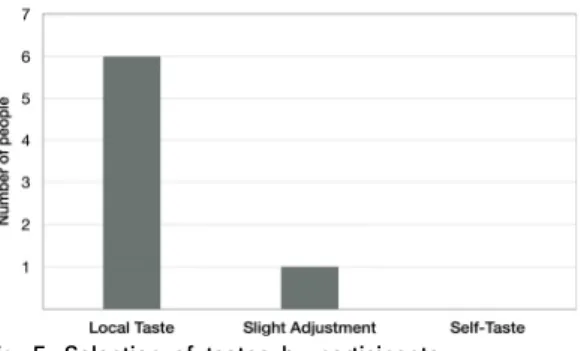
According to the survey before the tour, most people chose the authentic local taste in terms of taste requirements (see Fig. 5). The definition of authentic taste includes pungent tastes such as pungent, stinky, and rammish, and some ingredients such as offal that are not acceptable to everyone. In the 1st Eatery (see Fig. 7 for the Eatery's environment), through the docent's explanation, participants learned that the seasoner on the table (Fig. 7 upper left) is homemade hot sauce and pickled radish. In the 7th restaurant (Fig. 8 lower right), chicken offal and pig blood are used. Although these ingredients are not acceptable to everyone, the participants can understand these flavors' role in folklore by explaining the therapeutic effects of food on the female.

Fig. 5. Selection of tastes by participants

Amenity, on the other hand, was an option of concern to more people. The choice for amenity includes several layers of consideration (see Fig. 6).

First is food hygiene. Most of Street Vendor and

(6)

Diner do not have the business license, food hygiene only be controlled by the owner. The second is the comfort of environment. Especially in the hot and humid summer, air conditioning is very necessary. But Street Vendor and Diner do not have air conditioning, even the fans (Fig. 8, upper right and lower left). Finally, the sanitation facilities, includes whether there are toilets. Most of the houses were builted in Guangzhou's old town before the 1940s, the sewers were imperfect, and the toilets were communal. Therefore, even at the level of the Eatery, there was no toilet. Based on the above considerations, half of the respondents could accept the Street Vendor, and the remaining half chose the Diner and Eatery, respectively (Fig. 6). No one chose the Restaurant and Gourmet Restaurant, which was related to the participants' desire to better experience the local culture and customs and participate in docent-guided tours. The classification of restaurant explanations is shown in Table 4.

Fig. 6. Selection of restaurant amenity by participants

Table 4. Classification of restaurant Restaurant

category Explanation

Street Vendor A low-priced food vendor without fixed shop, no seats, no business license, and no air conditioner Diner A low-priced small restaurant with fixed shop, but no

seats, no business license, and no air conditioner Eatery A small mid-priced restaurant with fixed shop, seat,

business license, and air conditioner Restaurant A mid-priced restaurant with fixed shop, seat,

business license, and air conditioner Gourmet

Restaurant A high-priced restaurant with fixed shop, seat, business license, and air conditioner

After the docent-guided tour, a satisfaction survey of the tour was conducted. From the final survey results, participants were more dissatisfied with transportation and services, which was related to the organizers' grasp of the route.

From the feedback, because the summer temperature in Guangzhou is high and humid, it is easy to produce fatigue, so walking adistance of 5 km, both organizers and participants produce fatigue. Also, some of the diners did not have air-conditioning facilities and were hotter when eating hot food, which was where participants are dissatisfied with the service.

However, on the whole, under the leadership of the docent, the participants believed that they were somewhat satisfactorily achieved the goal of tasting Guangzhou traditional food and experiencing the folk culture.

Fig. 7. The interior environment of a traditional eatery

Fig. 8. Payment at difference guided spots (Upper left:

Bakery; upper right: Street Vendor; lower left:

Diner; lower right: Eatery)

(7)

4. Results

In the survey before the tour, more than half of the participants took Foodie as the purpose of the tourist experience. Moreover, those who choose Foodie are almost Mid-centric tourists. In other literature, Mid-centric tourists are also the primary type of tourists. It can be seen that gastronomy tourism is attractive to most tourists.

From this food docent-guided tour, it is found that both local and non-local people have a great interest in exploring local food. With the help of food and environment and the docent's memories and stories, the folk culture of this city was re-examined so that the participants could have a better experience of the folk culture and its significance. From the perspective of participants' demand for the environment, the prime of life over 31 was pickier about the taste and amenity than those youth of 21-30. The prime of life participants prefers a shorter walking distance and learn about food and folk customs in a comfortable environment.

Participants in the youth did not mind walking distance as long as they had a new experience.

Furthermore, they do not have much demand for the comfort of the environment. From the perspective of acceptance, females are more likely to accept exceptional food than males, even under the docent's guidance. The docent could try to make reluctant participants feel the folk flavor through vision and smell during the presentation to let them overcome their resistance to taste or ingredients. The docent should explain the relevant background before introducing some food with a pungent taste or using unique ingredients. Furthermore, explain the role of these foods in folk customs (e.g., medicinal value), so that even the tourists who cannot taste the food can understand its meaning. For Mid-centric and Allocentric tourists in Plog's model, seeking novel food experiences has become a vital part of their peak touristic

experience in tourism. Tourists will take the experience of pursuing novel foods as the need to create the peak touristic experience, which contains two aspects: first, the ingredients of foods that make people feel novel and pleasant;

second, there have novel ways of delivering or eating[12]. Under the tourists' needs, the docent-guided tour can consider how to meet the needs of them. From the perspective of the docent-guided tour, in a specific place, guiding by residents with local folk culture to taste novel food in local restaurants or eatery can connect the interrelationship between food, place, and identity. Besides potentially reaping an unforgettable gastronomy experience, food consumption as a supporting consumer experience may also become part of the peak touristic experience. This process depends on the memory and intensity of this experience in the overall quality of tourism. The docents should highlight each restaurant’s focus and allow tourists to experience the process of consumption through explanations or actions directly. Although the study only aims at Guangzhou, it is expected that the research results or theories in this study have reference significance for other regions and even countries in the use of gastronomy tourism to promote local folk culture to tourists. The limitations of this small-scale study are recognized. However, people can use it to find new research methods for gastronomy tourism and ensure that folk culture does not be lack of research because it is in the "gray area"[13] of culture and heritage tourism.

5. Conclusion and discussion

The docent's multiple locations show that most

of the Street Vendors and Diners are run by the

middle and lower classes, which hard to meet the

tourists' requirements for the environment. Also,

(8)

due to the lack of relevant guidance and publicity, tourists' attraction is mostly insufficient. They rely more on regular diners than other restaurants with a better environment to increase the number of diners catering to these restaurants, besides relying on the docent-guided tour to bring tourists to the restaurant. Simultaneously, the docent should tell the stories of these restaurants and the local area, or describe the stories in combination with the docent's own life. The docent has a practical significance in sustaining small local businesses' business and improving the lives of the middle and lower classes to achieve better the Sustainable Development Goals set by the United Nations.

After the 1970s, many tourist destinations developed residents' homes as accommodations, and the residents acted as guides to allow tourism to achieve sustainable development goals. Although most of them were familiar with the local folk culture for the middle and lower class, they were unable to provide accommodation for various reasons, and tourism was hard to bring direct benefits to them.

Through the docent method, the middle and lower class can participate in the development of tourism and contribute to the sustainable development of local culture. For those who want to make a living through the food docent-guided tour, how to provide related services for youth, the prime of life and old age tourists; How to cater to the needs of people from different countries to conduct food docent-guided tour;

How to coordinate with the season to carry on the division of the different route have become further issues to be considered. The local business can organize the docents, provide them with an evaluation and training system, and establish a content platform based on the tourists' sharing economy. It can not only bring better service for tourists but also provide a new working way for residents.

The limited size of this exploratory case study makes it difficult to draw uncontroversial conclusions. However, this study provides additional research materials for gastronomy tourism and attempts to find the direction of development between sustainability and local folk customs maintenance. Although the case study strategy is summarized in statistics[20], some interesting links and related problems can be seen in the case. A more detailed study of these links and problems can actively promote the publicity of folk culture through gastronomy tourism in other fields. Through this study, as a form that can be applied to gastronomy tourism, a docent-guided tour can provide a new perspective for sustainable tourism. At the same time, it emphasizes that the study of gastronomy tourism and regional cultural renaissance can produce complementary effects. Meanwhile, through interdisciplinary literature analysis, the gap between different disciplines for the study of gastronomy tourism can be seen. The discussion of classification and needs in the study of the docent-guided tour can be adopted to increase employment and expand tourism consumption without damaging the environment or destroying social and folk structures. The tourism motivation behind this development helps achieve sustainable development goals and solve the middle and lower class's employment. It can act as a vital decision-making consideration for the relevant policy departments or corporate social responsibility.

REFERENCES

[1] G. Monbiot. (1994). No Man's Land: An Investigative Journey Through Kenya and Tanzania . London : Macmillan.

[2] E. M. Bennett & E. Thompson. (1990). The Exhibit

Interpreter: An Attention-Focuser in Science

Museums. In Paper presented at the annual meeting

of the National Association for Research in Science

Teaching . Atlanta.

(9)

[3] J. Diamond, M. S. John, B. Cleary & D. Librero. (1987).

The exploratorium’s explainer program: The long-term impacts on teenagers of teaching science to the public. Science Education, 71(5), 643-656.

DOI : 10.1002/sce.3730710502

[4] M. Martin, S. Brown & T. Russell. (1991). A study of child-adult interaction at anatural history centre.

Studies in Educational Evaluation, 17(2–3), 355–369.

DOI : 10.1016/S0191-491X(05)80090-2

[5] J. L. Gottfried. (1979). A naturalistic study of children’s behavior in a free choice learning environment . University of California, Berkeley.

[6] M. S. Sakofs. (2010). Optimizing the Educational Impact of a Museum Tour. Curator: The Museum Journal, 27(2), 135-140.

DOI :10.1111/j.2151-6952.1984.tb00966.x

[7] S. Price & G. E. Hein. (1991). More than a field trip:

Science programmes for elementary school groups at museums. International Journal of Science Education, 13(5), 505-519.

DOI : 10.1080/0950069910130502

[8] J. R. Lehman & K. M. Lehman. (1984). The relative effects of experimenter and subject generated questions on learning from museum case exhibits.

Journal of Research in Science Teaching, 21(9), 931-935.

DOI : 10.1002/tea.3660210907

[9] D. R. Stronck. (1983). The comparative effects of different museum tours on children’s attitudes and learning. Journal of Research in Science Teaching, 20(4), 283-290.

DOI : 10.1002/tea.3660200403

[10] The Center for Responsible Travel. (2016). The Case for Responsible Travel: Trends& Statistics 2016.

[Online].

https://sustain.pata.org/case-responsible-travel/

[11] J. Krippendorf. (1987). The Holiday Makers:

Understanding the Impact of Leisure and Travel . Portsmouth : Heinemann.

[12] S. Quan & N. Wang. (2004). Towards a structural model of the tourist experience: An illustration from food experiences in tourism. Tourism Management, 25(3), 297-305.

DOI : 10.1016/S0261-5177(03)00130-4

[13] R. Scarpato. (2002). Sustainable gastronomy as a tourist product. In Tourism and Gastronomy . (pp.

132-151). London : Routledge.

[14] P. Boniface. (2003). Tasting Tourism: Travelling for Food and Drink . New York : Routledge.

[15] A. Hjalager & G. Richards. (2002). Tourism and Gastronomy . London : Routledge.

[16] P. Boniface. (2003). Tourism and Gastronomy . London : Routledge.

[17] G. Richards. (2002). Gastronomy: an essential

ingredient in tourism production and consumption?.

In Tourism and Gastronomy . (pp. 3–20). London : Routledge.

[18] D. Howes. (1996). Cross-Cultural Consumption: Global markets, local realities. London : Routledge.

[19] S. C. Plog. (1974). Why Destination Areas Rise and Fall in Popularity. Cornell Hotel and Restaurant Administration Quarterly, 14(4), 55-58.

DOI :10.1177/001088047401400409

[20] R. K. Yin. (2018). Case Study Research and Applications: Design and Methods (Sixth Edit.) . London : SAGE Publications, Inc.

첸 딩 딩(Ding-Ding Chen) [학생회원]

․ 2006년 7월 : Guangzhou Academy of Fine Arts 디자인 이론(석사)

․ 2018년 3월 ~ 현재 : 국민대학교 테 크노디자인전문대학원 경험디자인학 과 박사과정

․ 관심분야 : 서비스 디자인, 푸드 디자인

․ E-Mail : [email protected]

장 완 석(Wan-Sok Jang) [정회원]

․ 1997년 2월 : 성균관대학교 한국철학 과(학사)

․ 2000년 6월 : Wuhan University 미 학과(석사)

․ 2004년12월 : Wuhan University 미학과(박사)

․ 2020년11월 ~ 현재 : Qingdao University of Science and Technology College of Communication 교수

․ 관심분야 : 사용자 경험, 서비스 디자인

․ E-Mail : [email protected]

반 영 환(Young-Hwan Pan) [정회원]

․ 1991년 2월 : 한국과학기술원 산업공 학과(공학사)

․ 1993년 2월 : 한국과학기술원 인간공 학(공학석사)

․ 1999년 8월 : 한국과학기술원 인간공 학(공학박사)

․ 2006년 9월 ~ 현재 : 국민대학교 테 크노디자인전문대학원 교수

․ 관심분야 : 인터랙션 디자인, 사용자 경험(UX)

․ E-Mail : [email protected]

수치

Fig.  1.  Comparison  between  Mass  Tourism  and  Sustainable  Tourism
Fig.  3.  The  docent  (upper  left)  and  some  guided  spots
Fig. 4. Comparison of the Cognition of Folklore between  Self-service  Gastronomy  Tourism  (above),  Gastronomy  Tourism  (middle)  and  Food  Docent-Guided  Tour  (below)
Fig.  5.  Selection  of  tastes  by  participants
+2

참조

관련 문서

 The Dutch physicist Pieter Zeeman showed the spectral lines emitted by atoms in a magnetic field split into multiple energy levels...  With no magnetic field to align them,

The study first analyzed previous research on the reading competencies of multicultural families, then explored how past studies outside Korea examined

Modern Physics for Scientists and Engineers International Edition,

첫째, UTAUT모형을 이용하여 스마트폰 어플리케이션의 구매에 대해 검정한 결과 독립변수들 (성과기대, 예상노력, 사회적 영향, 유희적 가치,

웹 표준을 지원하는 플랫폼에서 큰 수정없이 실행 가능함 패키징을 통해 다양한 기기를 위한 앱을 작성할 수 있음 네이티브 앱과

_____ culture appears to be attractive (도시의) to the

The “Asset Allocation” portfolio assumes the following weights: 25% in the S&P 500, 10% in the Russell 2000, 15% in the MSCI EAFE, 5% in the MSCI EME, 25% in the

1 John Owen, Justification by Faith Alone, in The Works of John Owen, ed. John Bolt, trans. Scott Clark, "Do This and Live: Christ's Active Obedience as the