• 검색 결과가 없습니다.

Study of Fabrication and Improvement of Mechanical Properties of Mg-based Inorganic Fiber using Reflux Process and Silica Coating

N/A
N/A
Protected

Academic year: 2021

Share "Study of Fabrication and Improvement of Mechanical Properties of Mg-based Inorganic Fiber using Reflux Process and Silica Coating"

Copied!
6
0
0

로드 중.... (전체 텍스트 보기)

전체 글

(1)

ISSN 1225-7591(Print) / ISSN 2287-8173(Online)

Study of Fabrication and Improvement of Mechanical Properties of Mg-based Inorganic Fiber using Reflux Process and Silica Coating

Ri Yu and YooJin Kim*

Engineering Ceramic Center, Korea Institute of Ceramic Engineering and Technology, Icheon 17303, Republic of Korea (Received April 23, 2019; Revised June 17, 2019; Accepted June 18, 2019)

···

Abstract Whisker-type magnesium hydroxide sulfate hydrate (5Mg(OH)

2

·MgSO

4

·3H

2

O, abbreviated 513 MHSH), is used in filler and flame-retardant composites based on its hydrate phase and its ability to undergo endothermic dehydration in fire conditions, respectively. In general, the length of whiskers is determined according to various synthetic conditions in a hydrothermal reaction with high temperature (~180

o

C). In this work, high-quality 513 MHSH whiskers are synthesized by controlling the concentration of the raw material in ambient conditions without high pressure. Particularly, the concentration of the starting material is closely related to the length, width, and purity of MHSH. In addition, a ceramic-coating system is adopted to enhance the mechanical properties and thermal stability of the MHSH whiskers. The physical properties of the silica-coated MHSH are characterized by an abrasion test, thermogravimetric analysis, and transmission electron microscopy.

Keywords: MHSH, Fibers, Ceramics, Microstrucure, Thermal analysis

···

1. Introduction

There is currently interest in incorporating inorganic whiskers into various materials because of their effects on enhancing their mechanical properties and thermal stability. Whiskers exhibit fiber-shaped single crystals, super-high tensile strength and a high melting point owing to their ideal microstructure, which is nearly free from internal flaws [1, 2]. In particular, one-dimensional 513 MHSH whiskers (5Mg(OH)

2

·MgSO

4

·3H

2

O, abbreviated 513 MHSH) has attracted attention due to its practical applicability including use in resins, rubber, fillers and reinforcement [3-5].

Various compositions of MHSH, xMg(OH)

2

·yMgSO

4

· zH

2

O (x-y-z phase; 513 MHSH, 512 MHSH, 511 MHSH) have been prepared by varying of the molar ratio of Mg(OH)

2

, MgSO

4

, and H

2

O [6, 7]. 513 MHSH whiskers meet the fundamental requirements of a flame retardant (FR) additive such as magnesium hydroxide (Mg(OH)

2

), according to a flame retardant mechanism based on phys-

ical effects governing the endothermic processes [8, 9]

513 MHSH whiskers can be obtained by using various starting materials such as MgO, MgSO

4

and MgCl

2

or Mg(OH)

2

[10-12]. In a high concentration of OH

, it is difficult to produce high-quality MHSH using a compara- tively simple synthesis technology. Mg(OH)

2

impurities are formed in high concentrations of OH

and in the interaction between Mg

2+

and NH

4+

. Mg(OH)

2

molecules usually aggregate with each other, leading to a poor crys- talline structure that strongly limits practical applications [13, 14].

A hydrothermal method was hard to control the purity and it need to complicated process with high pressure/

temperature. Therefore, to obtain high quality 513 MHSH whisker, our groups studied that the synthesis and mor- phologies of MHSH using ambient condition using only a single precursor of MgSO

4

instead of double precursor in a hydrothermal system [13, 14]. Therefore, simple reac- tion system with low pressure were need.

In order to enhance the property of the whiskers, a sil-

- 유 리: 위촉연구원, 김유진: 책임연구원

*Corresponding Author: YooJin Kim, TEL: +82-31-645-1427, FAX: +82-31-645-1420, E-mail: [email protected]
(2)

ica coating can be applied. Among the various oxide shells available, silica shells (SiO

2

) are a very common and useful class of materials offering easy surface modi- fication [15, 16].

In this work, we synthesized high quality 513 MHSH whiskers in the ambient conditions with single source or MgSO

4

·7H

2

O instead of dual materials of MgSO

4

and MgO without applying high pressure. Also, we adopted a silica coating approaches to enhance the mechanical and thermal stability of the 513 MHSH whiskers. Physical properties of the silica-coated 513 MHSH whiskers were characterized by an abrasion test, thermogravimetric anal- ysis (TGA) and transmission electron microscopy (TEM).

2. Experimental

2.1. Synthesis of 5Mg(OH)

2

·MgSO

4

·3H

2

O whisker Magnesium sulfate (MgSO

4

·7H

2

O, 98%, Daejung Chem., Korea) and ammonium hydroxide (NH

4

OH, 28%, Dae- jung Chem., Korea) were used without further purifica- tion as starting materials. An aqueous solution of the

precursors systems was prepared with appropriates quan- tities of reagents in distilled water using different syn- thetic condition to obtain 513 MHSH whiskers. MgSO

4

·7H

2

O in a desired concentration (0.5~4.0 mol) was dissolved in deionized water (50 mL) and subjected to ultra-sonica- tion for 10 min. The solution was maintained at 110

o

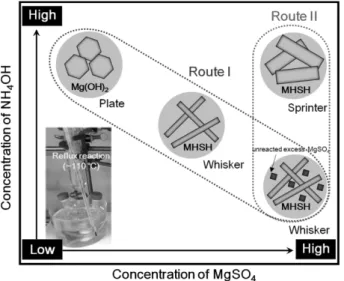
C for 6 hours under reflux in a round bottom flask and then naturally cooled to room temperature. A schematic illus- tration of the reaction set up is shown in Fig. 1. Table 1 shows the detailed reaction conditions of the synthetic parameters. In route I, whisker type MHSH was pre- pared by changing the MgSO

4

concentration such as [Mg

2+

]/[OH

] = 1.2 fixed concentration and amount NH

4

OH.

In route II, the length and width of 513 MHSH whiskers is controlled depending of the concentration of MgSO

4

and NH

4

OH and amount of NH

4

OH is twice.

The obtained products were centrifuged, washed with deionized water and dried in air at 80

o

C for one day. The morphologies and structures were then examined with a scanning electron microscope (SEM, Model JSM-6390, JEOL, Japan) and with powder X-ray diffraction (XRD, Model D/Max 2500, Rigaku, Japan). A thermo-gravimet- ric analyzer (TGA, Model SDT Q600, TA instruments, USA) was used to identify the thermal behavior of the product.

2.2. Silica coating

The silica-coated MHSH whiskers were obtained by modifying the process reported in the literature [15, 16].

The MHSH (1.0 g) was re-dispersed in a mixed solution of ethanol (50 mL) and DI water (50 mL) under ultrason- ication for 5 min. The NH

4

OH (28%) solution (1 mL) was added to the solution and stirring was applied for 15 min. Tetraethylorthosilicate (TEOS, 98%, Sigma Aldrich;

1 mL) was introduced to the solution at room tempera- ture. Core-shell whisker could be obtained in 24 h. The

Table 1. Synthetic parameters for controlling the length and width of the products

Sample MgSO

4

(M) NH

4

OH (mL) Phase

Route I

1 0.5

2.6 M

5.0 Mg(OH)

2

2 3.0 5.0 513 MHSH

3 4.0 5.0 513 MHSH + MgSO

4

Route II

4 4.0 10 513 MHSH

5 4.0

4.0 M

10 513 MHSH

6 6.0 10 513 MHSH

7 8.0 10 513 MHSH

Fig. 1. Synthetic scheme of the 5Mg(OH)

2

·MgSO

4

·3H

2

O

whiskers.

(3)

resulting 513 MHSH whiskers were collected by centri- fuge and washed several times with pure ethanol and dried in vacuum dry oven at 80

o

C.

And then, silica-coated 513 MHSH whiskers were characterized by a fade test and an abrasion test in order to determine their mechanical properties. Two different brake pad named Mg fiber non-added pad and Mg fiber addition pad. The friction test of brake pad is modified JASO C406-P1. The test conditions are braking number 15 times, deceleration 0.45 h and baking interval 35 seconds.

3. Results and Discussion

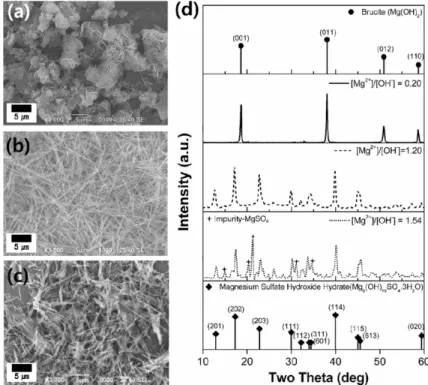
Fig. 2 show the SEM images and XRD patterns of the products obtained at different mole ratios of starting materials such as MgSO

4

·7H

2

O and NH

4

OH catalysis.

The molar ratios of MgSO

4

·7H

2

O/NH

4

OH are in a range of 0.2~1.5. When the ratio of [Mg

2+

]/[[OH

] is 0.2, a large amount of hexagonal Mg(OH)

2

was formed, for which the peaks were indexed by XRD (JCPDS No. 98-000- 0021).(Fig. 2a, 2d) In Fig. 2(a), the precipitant was com- posed of aggregate Mg(OH)

2

particles. In previous stud- ies, we obtained high purity MHSH depending on the

increased concentration of MgSO

4

in a hydrothermal sys- tem [13, 14]. When the molar ratio of MgSO

4

and MgO was 7:1, length exceeding 30 µm was obtained by a hydrothermal reaction [14]. As shown in Figs. 2b~2c, 513 MHSH whisker diameters ranged from 1 µm to 2 µm and lengths typically exceeded 10 µm (Fig. 2c, 2d).

All diffraction peaks can be indexed with respects to the orthorhombic structure of 513 MHSH whiskers (JCPDS No. 00-07-0415) (Fig. 2d).

Concentration of MgSO

4

is high in low levels the NH

4

OH, still remain of MgSO

4

·7H

2

O were indexed by XRD. (Fig. 2d) The remained MgSO

4

·7H

2

O can be removed the filter washing. In particular, high quality and yield of 513 MHSH whiskers was obtained when the ratio of [Mg

2+

]/[[OH

] was 1.2. The pH value of the reaction solution exerts a considerable effect on the dissolution equilibrium of the Mg(OH)

2

, there by controlling the con- centration of Mg

2+

ions and MgOH

+

ions in solution [12].

We found that NH

4

OH effect in high concentration of MgSO

4

is closely related to the morphology of 513 MHSH whiskers. Fig. 3 shows SEM images the as-pre- pared products synthesized under different synthetic con- ditions such as concentration of MgSO

4

and NH

4

OH.

Fig. 2. SEM images of the prepared products synthesized at different ratios of starting materials ratio ([Mg

2+

]/[OH

]); (a)

MgSO

4

:NH

4

OH=0.5M:2.6M, (b) MgSO

4

:NH

4

OH=3.0M:2.6M and (c) MgSO

4

:NH

4

OH=4.0M:2.6M. (d) XRD patterns of the as-

prepared products synthesized at different molar ratio of starting materials. (Route I in Fig. 1 and Table 1)

(4)

The molar ratio of [Mg

2+

]/[OH

] as starting materials is in a range of 1.0~2.0. Although the same molar ratio of Fig. 3a and Fig 3c, the concentration of starting material is higher in Fig. 3c. By increasing the amount of NH

4

OH catalysis up to 10 mL, the remaining 513 MHSH whis- kers had even greater length. (Fig. 3a) Comparing Fig. 3a with Fig. 2c, the amount of magnesium sulfate in the products disappeared and single phase 513 MHSH whis- kers were obtained.

On the other hand, length and diameter of 513 MHSH whiskers is short and thick when high concentration of MgSO

4

and NH

4

OH (Fig. 3b~3d). The concentration of MgSO

4

also accounts for the growth mechanism of the 513 MHSH splinters. 513 MHSH whiskers crystals dis- play morphology with diameters ranging from 2 µm to 6 µm and length typically exceeding 10 µm. According to Yan research, 513 MHSH whiskers is composed of fragments of Mg(OH)

64−

and SO

42−

ions, while the hydro- gen atoms link the neighboring helical Mg-O-S chains via hydrogen bonds. Along the b-axis, the Mg(OH)

64−

fragments are compactly connected by the strong Mg-O bonds, while the total bond strength is stronger than those along both the c and a axes [12]. Also, we found that 513 MHSH whiskers was changed splinters when high concentration of MgSO

4

and NH

4

OH.

To study thermal behavior of the 513 MHSH whiskers, we adopted a silica coating approaches. Fig. 4 shows a TEM image of silica-coated MHSH whiskers and TG- DTA data of non-coated and silica-coated MHSH. Fig. 4a shows TEM images of the as-synthesized silica-coated 513 MHSH whiskers. The SiO

2

layer is obtained sepa- rately in corresponding solution by hydrolysis via the stöber methods [15, 16]. High magnification TEM images confirm that each silica shell contains a 513 MHSH whiskers. The SiO

2

shell were about 10 and 20 nm in thickness. Figs. 4b and 4c shows the thermal analysis curves for thermal gravimetry (TGA) and differential thermal gravimetry (DTG). The thermal analysis of 513 MHSH whiskers was carried out to understand the mech- anism of dehydration and desulfuration. The dehydration of hydrous 513 MHSH whiskers has been studied by a thermal analysis to control the transition from 513 MHSH whisker to anhydrous MgO whiskers. The thermal de- composition of whiskers can be divided into four stages.

The first weight loss at around 150

o

C was due to the

evaporation of absorbed water. The second and third

weight losses at 250 - 300

o

C, 370 - 400

o

C were due to

removal of 3H

2

O and 5H

2

O, respectively. In particular,

water evaporation of SiO

2

-coated MHSH samples is higher

than that of non-coated MHSH samples above 17

o

C. The

Fig. 3. SEM images of the as-prepared products synthesized under different synthetic condition of MgSO

4

and NH

4

OH

concentration. (a) MgSO

4

:NH

4

OH = 4M:2.6M, (b) MgSO

4

:NH

4

OH = 4M:4.0M, (c) MgSO

4

:NH

4

OH = 6.0M:4.0M, (d) MgSO

4

:

NH

4

OH = 8.0M:4.0M. (Route II in Fig. 1 and Table 1)

(5)

weight loss up to 900

o

C was caused by SO

3

. Finally, 513 whiskers decomposed gradually and were converted to MgO whiskers after being heated in air at temperature up to 1050

o

C [9, 10]. It is believed that the degradation pro- cesses can be described by the following reactions ~ (1) - (3):

5Mg(OH)

2

·MgSO

4

·3H

2

O → 5Mg(OH)

2

·MgSO

4

+ 0.5H

2

O

(≈ 260 to 360

o

C) (1)

5Mg(OH)

2

·MgSO

4

+ 0.5H

2

O → MgSO

4

+ 5MgO

(≈ 360 to 800

o

C) (2)

MgSO

4

+ 5MgO → 6MgO + SO

3

(↑) (above 800

o

C) (3) Maybe, the endothermic decomposition, the accompa- nying release of water vapor and the generation of silica- coated MHSH whisker residue at the temperature that the 513 MHSH whiskers themselves degrade, correspond

with the flame retardant mechanism that is based on the physical effects governing the endothermic processes.

513 MHSH whiskers were characterized by a fade test and an abrasion test in order to determine their mechani- cal properties. (Fig. 5) Two different brake pad named Mg fiber non-added pad and Mg fiber addition pad. The friction test of brake pad is modified JASO C406-P1.

Fig. 5a shows the fade test of the brake pad measured in braking number 15 times, deceleration 0.45 g, and a brak- ing interval of 35 seconds. The initial temperature (T

i

) is compared to final the temperature (T

f

), and the raised temperature of the pad with 513 MHSH whiskers filler is lower than that of the Mg fiber non-added pad. Also, the minimum coefficient of friction was confirmed as 0.36 for the Mg fiber addition pad, which is higher than that (0.31) of the Mg fiber non-added pad. In Fig. 5a, Mg fiber addition pad showed higher friction coefficients Fig. 4. (a) TEM image of silica-coated 513 MHSH whisker. TG-DTA data of (b) 513 MHSH whiskers and (c) SiO

2

-coated MHSH whisker.

Fig. 5. The friction data of brake pad under JASO C406-P1. (a) Fade test, (b) wear amount test.

(6)

than the Mg fiber non-added pad. This is attributed to the 513 MHSH whiskers filler generating H

2

O during heat degradation with increasing temperature because the sur- face temperature of the friction pad is lower. Fig. 5b shows the relationship between the amount of pad wear and filler. As shown in Fig. 5b, the wear resistance of the pad is enhanced by addition of the fibrous 513 MHSH whiskers filler because the strength of the friction mate- rial is increased and it acts as reinforcement fiber. In other words, we confirmed that the 513 MHSH whiskers filler improved the fade resistance and wear resistance of the friction pad.

4. Conclusions

We synthesized 513 MHSH whiskers using a reflux system by the reaction between MgSO

4

·7H

2

O and NH

4

OH in an aqueous solution. Morphologies of 513 MHSH whiskers were controlled through a variety of parameters including the molar ratio of the starting materials such as MgSO

4

/NH

4

OH. High quality 513 MHSH whiskers were formed from 3.0 M MgSO

4

and 2.6 M NH

4

OH after reflux treatment at 110

o

C for 6 h. The water evaporation temperature of silica-coated 513 MHSH whiskers (above 17

o

C) is higher than that of non-coated 513 MHSH whis- kers The fade resistance and the wear resistance of the brake friction pad are increased by the addition of 513 MHSH whiskers whisker filler. We confirmed the silica- coated 513 MHSH whiskers improved the dehydration temperature and the coefficient of friction on the basis of its thermal behavior and physical properties. It is antici- pated that 513 MHSH whiskers will find applications as fillers in flame and friction reinforcement for brake pads.

Acknowledgement

This work was supported by the Industrial technology innovation program (10080275) funded by the Ministry of Trade, Industry and Energy (MOTIE), Republic of Korea.

References

8[1] H. Lu, Y. Hu, L. Yang, Z. Wang, Z. Chen and W. Fan:

Macromol. Mater. Eng ., 289 (2004) 984.

8[2] S. Fang, Y. Hu, L. Song, J. Zhan and Q. He: J. Mater.

Sci., 43 (2008) 1057.

8[3] Y. Tao, G. Shiyang, Z. Lixia, X. Shuping and Y. Kaibei: J.

Mol. Struct., 616 (2002) 247.

8[4] E. Hamada, N. Ishizawa, F. Marumo, K. Ohsumi, Y. Shi- mizugawa, K. Reizen and T. Matunami: Acta Cryst. B, 52 (1996) 266.

8[5] Y. Ding, G. Zhang, S. Zhang, X. Huang, W. Yu and Y.

Qian: Chem. Mater., 12 (2000) 2845.

8[6] H. Lu, Y. Hu, L. Yang, Z. Wang, Z. Chen and W. Fan:

Macromol. Mater. Eng., 289 (2004) 984.

8[7] H. Lu, Y. Hu, J. Xiao, Z. Wang, Z. Chen and W. Fan: J.

Mater. Sci., 41 (2006) 363.

8[8] J. Lv, L. Qiu and B. Qu: Nanotechnology, 15 (2004) 1576.

8[9] C. Cao, X. Li, L. Feng, Z. Xiang and D. Zhang: Chem.

Eng. J., 150 (2009) 551.

[10] X. T. Sun, W. T. Shi, L. Xiang and W. C. Zhu: Nanoscale Res. Lett., 3 (2008) 386.

[11] J. Lv, L. Qiu and B. Qu: J. Crystal Growth, 267 (2004) 676.

[12] X. Yan, D. Xu and D. Xue: Acta Mater., 55 (2007) 5747.

[13] R. Yu, J. H. Pee, H. T. Kim, K. J. Kim, Y. W. Kim, W.

Kim and Y. Kim: J. Korean Powder Metall. Inst., 18 (2011) 283.

[14] R. Yu, J. H. Pee, H. T. Kim, K. J. Kim, Y. W. Kim and Y.

Kim: Key Eng. Mater., 512-515 (2012) 91.

[15] R. Yu and Y. Kim: J. Nanosci. Nanotechnol., 14 (2014) 8711.

[16] R. Yu, J. H. Pee, K. J. Kim and Y. Kim: Chem. Lett., 40

(2011) 1400.

수치

Table 1. Synthetic parameters for controlling the length and width of the products
Fig. 2 show the SEM images and XRD patterns of the products obtained at different mole ratios of starting materials such as MgSO 4 ·7H 2 O and NH 4 OH catalysis.
Fig. 5. The friction data of brake pad under JASO C406-P1. (a) Fade test, (b) wear amount test.

참조

관련 문서

“ Sheikh Nasser has a written message from HH the Amir, Sheikh Sabah Al-Ahmad Al-Jaber Al-Sabah to the Chinese President, Chi Gen Beng related to enhancing mutual

On his part, CEO of Express Roads Authority, Saud Al-Naqqi said that the heavy rains of the previous day led to clogging parts of the express

Kuwait will celebrate on Sunday the fourth anniversary of the UN honoring and proclamation of His Highness the Amir, Sheikh Sabah Al-Ahmad Al-Jaber Al-Sabah as

• 이명의 치료에 대한 매커니즘과 디지털 음향 기술에 대한 상업적으로의 급속한 발전으로 인해 치료 옵션은 증가했 지만, 선택 가이드 라인은 거의 없음.. •

Unlike Hot-Dip Galvanized Steel, it has less amount of zinc coated but retains corrosion resistance due to its evenness of the coating; and since the coating process does

The proposal of the cell theory as the birth of contemporary cell biology Microscopic studies of plant tissues by Schleiden and of animal tissues by Microscopic studies of

_____ culture appears to be attractive (도시의) to the

It considers the energy use of the different components that are involved in the distribution and viewing of video content: data centres and content delivery networks