Comparative Analysis of Functional Compounds in Perilla frutescens at Different Stages and Growth Times
Hae Eun Kim
†, Hee Rang Yun
†and Jae Bok Heo*
Department of Molecular Genetic Engineering, Dong-A University, 37, Nakdong-daero 550 beon-gil, Saha-gu, Busan 49315, Korea Received February 22, 2021 /Revised April 12, 2021 /Accepted April 13, 2021
The Perilla frutescens var. japonica HARA is widely cultivated in Korea for vegetable leaves and oil seeds. Perilla species have been used for food and medicine and are known to contain many functional compounds. In this study, we investigated the functional compound contents of Perilla during its growth stages to analyze the optimal harvest time and conditions. The contents of the Perilla sprouts were analyzed according to culture environment and days of growth. Sprouts grown in soil under natural light conditions showed high rosmarinic acid (23.19±0.16 mg/g) and GABA (0.55±0.05 mg/
g) content. Therefore, the results suggest that 6 to 8 days after sowing in soil under natural light con- ditions was the optimum harvest condition for sprouts. Also, the functional compounds of Perilla were analyzed according to growth stage and plant part. As a result, caffeic acid and rosmarinic acid ex- hibited the highest content in the stage from vegetative growth to reproductive growth (0.28±0.03 ~ 0.30±0.07 mg/g rosmarinic acid and 20.60±7.02 ~ 19.37±3.18 mg/g caffeic acid), and luteolin and GABA showed the highest content in the reproductive growth stage and in the early stages of vegeta- tive growth, respectively (31.11±2.98 ~ 22.35±1.64 μg/g luteolin and 0.42±0.09 ~ 0.37±0.04 mg/g GABA). It was confirmed that the content of caffeic acid (0.34±0.03 mg/g), rosmarinic acid (55.22±9.33 mg/g) and luteolin (1,044.89±6.72 μg/g) was the highest during the bolting stage. Overall, we identi- fied the timing of the highest level of functional compounds in the sprouts and mature leaves of Perilla. These results suggest a suitable harvest time and conditions for sprouts and leaves for the use of Perilla as a functional material.
Key words : Functional compounds, growth stage, harvest parts, Perilla frutescens, Perilla sprouts
†
Authors contributed equally.
*Corresponding author
*Tel : +82-51-200-7520, Fax : +82-51-200-7505
*E-mail : [email protected]
This is an Open-Access article distributed under the terms of the Creative Commons Attribution Non-Commercial License (http://creativecommons.org/licenses/by-nc/3.0) which permits unrestricted non-commercial use, distribution, and reproduction in any medium, provided the original work is properly cited.
서 론
들깨(Perilla frutescens var. japonica HARA)는 동부아시아 지역이 원산지인 꿀풀과(Lamiaceae)에 속하는 일년생 초본식 물로 우리나라 대표 유지작물 중 하나이다. 목적에 따라 종자 를 생산하는 종실용 들깨와 깻잎을 수확하는 잎들깨로 구분된 다. 들깨의 잎, 종자, 줄기에는 페놀산, 플라보노이드, 정유, 카로티노이드, 지방산 등 다양한 기능성 화합물을 함유하고 있다고 알려져 있다[1].
들깨의 주요 기능성 화합물은 fatty acids, flavonoids, phe- nolic compounds, volatile compounds 등으로 분류된다. 들깨 의 종실에는 oleic acid, α-linoleic acid 등 fatty acids를 다량 함유하고 있는데, 특히 α-linoleic acid은 체내에서 심혈관 질환 예방 및 뇌기능촉진효과를 가지고 있다고 알려져 있다[2]. 들
깻잎에는 apigenin, luteolin, antocyanins 등의 flavonoids 성 분을 다량 함유하고 있으며, caffeic acid, rosmarinic acid, ferulic acid 등의 phenolic compounds와 perillaldehyde, per- illaketone 등의 volatile compounds를 다량 함유하고 있다[1].
Polyphenol계 화합물인 caffeic acid는 발암억제제, 항산화 제로서 작용하고, 산화스트레스 유발 및 아플라톡신의 생산을 억제할 수 있다고 알려져 있다[20]. Caffeic acid의 dimer인 rosmarinic acid는 들깨의 주요 기능성 화합물 중 하나로서 항산화작용, 항염증작용, 항알레르기작용 및 치매예방효과가 있다고 알려져 있다[12, 13, 18, 23, 24]. Luteolin은 flavonoids 계 화합물로 항산화작용, 미백활성, 항암활성, 항알러지작용 등을 가지고 있다고 알려져 있다[8, 26]. γ-Aminobutyric acid (GABA)는 비단백질 아미노산의 일종으로 중추신경계의 억제 성 신경전달물질로 뇌기능 촉진, 신경안정작용, 혈압강하, 주 름개선 등의 효과로 다양한 기능성 식품소재로서 이용되고 있다[16, 17, 19]
본 연구는 들깨를 식용소재로서가 아닌 기능성 식품소재 및
의약소재로서 이용하고자 새싹 들깨 및 생장단계별과 부위별
로 들깨의 Caffeic acid (CA), Rosmarinic acid (RA), Luteolin
(LT), γ-Aminobutyric acid (GABA) 함량 변화를 분석하여 적
합한 수확시기와 수확부위를 확인하고자 하였다.
A B
C D
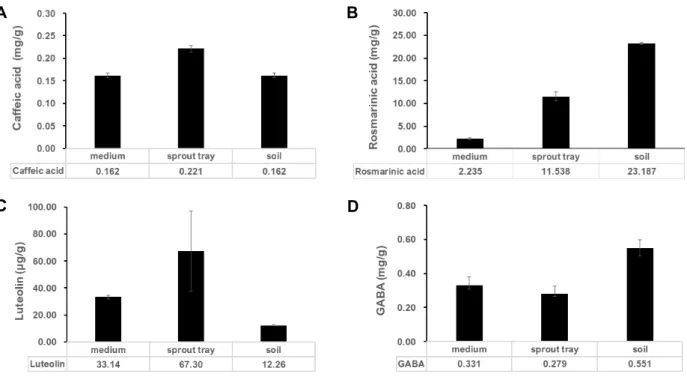
Fig. 1. Comparison of CA, RA, LT, GABA contents of the PF sprout according to culture environment. (A) Caffeic acid (B) Rosmarinic acid (C) Luteolin (D) GABA. The PF sprouts were cultivated for 10 days. Growth medium and sprout tray were grown in a growth chamber with long-day (16L:8D) conditions at 22℃ and 60% humidity. Soil conditions were grown in a greenhouse.
All values are presented as the mean ± SD of triplicate; ND, not detected.
재료 및 방법
실험 재료
실험에 사용된 들깨(Perilla frutescens var. japonica Hara)는 잎들깨 품종인 남천들깨(Perilla frutescens cv. Namcheon)와 보 라들깨(Perilla frutescens cv. Bora)를 사용하였다. 들깨는 육묘 판에 파종한 후, 1본엽 전개시 포트에 정식하여 유리온실에서 재배하였다. 생육단계별 함량변화 분석을 위해 일주일 간격으 로 생육단계에 있는 들깨의 잎, 줄기, 추대를 수확하였다. 새싹 들깨는 남천들깨를 사용하였으며, MS배지와 새싹재배기에 파종하여 22℃, 상대습도 60%, long-day (16L;8D) 조건의 Growth Chamber에서 재배하였다. 배양조건별 새싹들깨는 파 종 후 10일에 수확하였고, 생육일수별 새싹들깨는 파종 후 6일 에서 18이란 2일 간격으로 수확하였다. 수확한 샘플은 50℃에 서 1주일간 건조시킨 후, 막자사발을 이용하여 분쇄하였다. 분 쇄된 샘플은 분석 전까지 -78℃에 보관하였다. 모든 샘플은 건조중량을 기반으로 하였고, 분석 값은 3반복의 평균치를 기 록하였다.
시약 및 기기
실험에 사용한 표준품은 Caffeic acid, 4-Aminobuytric acid, 3‘,4’,5,7-Tetrahydroxyflavone (Luteolin)은 TCI사(Tokyo, Ja- pan)의 제품을 사용하였으며, Rosmarinic acid는 Sigma- Aldrich사(St. Louis, MO, USA) 제품을 사용하였다. HPLC 분
석 용매는 Analytical grade의 Acetonitrile, Methanol, Water 로 Honeywell사(NJ, USA) 제품을 사용하였다. 49~51% acetic acid solution은 Sigma-Aldrich사(St. Louis, MO, USA), for- mic acid는 Wako사(Osaka, Japan)제품을 사용하였다. 유도체 화를 위해 Sodium tetraborate decahydrate, 2-hydroxy-1- naphthaldehyde (HN)는 Sigma-Aldrich사(St.Louis, MO, USA)를 사용하였다.
HPLC 분석기기는 Waters 2707 autosampler, Waters 1525 binary pump, Waters 2489 UV/Vis detector로 구성된 Waters 1500 series system (MA, USA)을 사용하였다. Column은 Optima Pak C
18column (4.6X250 mm, 5 μm, RS tech, Daejeon, Korea)를 사용하였다.
추출물 제조
들깨 분말(0.2 g)에 HPLC grade의 80% Methanol 3 ml을 첨가하여 상온에서 3시간동안 교반하였다. 추출물은 원심분 리(9,000 rpm, 8 min, 4℃) 후 상등액을 취하여 0.2 μm RC syringe filter로 여과한 뒤 HPLC로 분석하였다.
Caffeic acid, Rosmarinic acid, Luteolin 분석
Caffeic acid, Rosmarinic acid, Luteolin 함량분석은 이전에
보고된 Lee et al. 등의 방법을 참고하여 수행하였다[15]. 이동
상 용매는 0.05% acetic acid in acetonitrile (A)와 0.05% acetic
acid in water (B)을 사용하였다. 이동상 조건은 농도구배용리
A B
C D
Fig. 2. Changes in CA, RA, LT, GABA contents in the PF sprout at six different growth times. (A) Caffeic acid (B) Rosmarinic acid (C) Luteolin (D) GABA. The PF sprouts were cultivated in a growth chamber for 6 to 16days with long-day (16L:8D) conditions at 22℃ and 60% humidity. All values are presented as the mean ± SD of triplicate; ND, not detected.
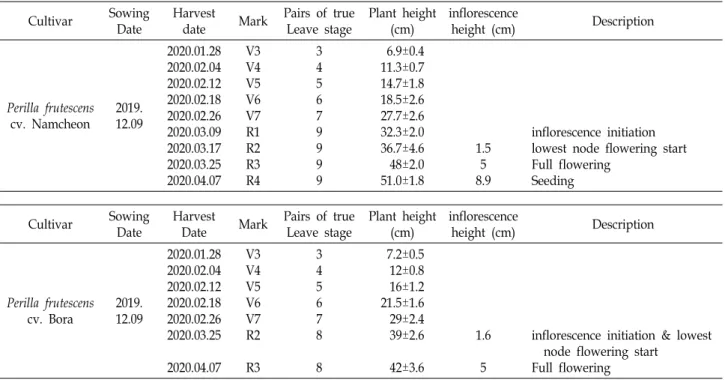
Table 1. Physiological parameters of Perilla frutescens during the growth stages
Cultivar Sowing
Date
Harvest
date Mark Pairs of true Leave stage
Plant height (cm)
inflorescence
height (cm) Description
Perilla frutescens cv. Namcheon
2019.
12.09
2020.01.28 2020.02.04 2020.02.12 2020.02.18 2020.02.26 2020.03.09 2020.03.17 2020.03.25 2020.04.07
V3 V4 V5 V6 V7 R1 R2 R3 R4
3 4 5 6 7 9 9 9 9
6.9±0.4 11.3±0.7 14.7±1.8 18.5±2.6 27.7±2.6 32.3±2.0 36.7±4.6 48±2.0 51.0±1.8
1.5 5 8.9
inflorescence initiation lowest node flowering start Full flowering
Seeding
Cultivar Sowing
Date
Harvest
Date Mark Pairs of true Leave stage
Plant height (cm)
inflorescence
height (cm) Description
Perilla frutescens cv. Bora
2019.
12.09
2020.01.28 2020.02.04 2020.02.12 2020.02.18 2020.02.26 2020.03.25 2020.04.07
V3 V4 V5 V6 V7 R2 R3
3 4 5 6 7 8 8
7.2±0.5 12±0.8 16±1.2 21.5±1.6 29±2.4 39±2.6 42±3.6
1.6 5
inflorescence initiation & lowest node flowering start
Full flowering 법을 사용하여 0 min, 5% A; 5 min, 10% A; 10 min, 20%
A; 15 min, 25% A; 20 min, 30% A; 30 min, 50% A; 40 min, 65% A; 41 min, 5% A; 52 min, 5% A로 분석하였다. 샘플 주입량은 10 μl, 컬럼온도는 30℃, 유속은 1.0 ml/min로 설정 하였다. 검출은 UV/Vis detector로 흡광도 330 nm에서 검출
하였다.
GABA 분석
GABA는 2-hydroxy-1-napthaldehyde (HN)을 사용하여 컬
럼전 유도체화 방법을 통해 분석하였으며, Panrod 방법을 일
A
B
Fig. 3. Comparison of Caffeic acid contents of different P.frutescens Parts during the growth stages. (A) Namcheon (B) Bora. Plants were cultivated in pots in a greenhouse for 4 months until it reaches a maximum growth stages. All values are presented as the mean ± SD of triplicate; ND, not detected.
부 수정하여 사용하였다[21]. Methanol로 용해한 0.3% HN 반 응시약을 준비한다. 표준품 용액 및 들깨 추출물 500 μl에 50 mM Borate buffer (pH 8.0) 300 μl와 0.3% HN 500 μl을 넣고 혼합한 후 80℃의 water bath에 10분간 반응시킨다. 반응 후 빛이 차단된 조건에서 cool down 시켰다. 준비된 샘플은 곧바 로 HPLC 분석에 사용하였다.
GABA-HN의 HPLC 분석 시 이동상 용매는 Methanol (A) 와 0.1% formic acid in Water (B)로 사용하였다. 이동상 조건 은 등용매용리법을 사용하여 Methanol : 0.1% formic acid in Water = 66 : 34 (V/V) 비율로 분석하였다. 샘플주입량은 10 μl, 컬럼온도는 30℃, 유속은 0.8 ml/min로 설정하였다. 검출 은 UV/Vis detector로 흡광도 230 nm에서 검출하였다.
표준검량곡선
Caffeic acid, Rosmarinic acid, Luteolin 표준품은 HPLC순 도 Methanol에 용해하여 10 mg/l 농도의 Stock solution을
제조하였다. 표준검량곡선은 Stock solution을 약 10개의 농도 로 Methanol을 이용해 희석시켜 결정하였다. Caffeic acid (0.5-100 μg/ml), Rosmarinic acid (10-2,000 μg/ml), Luteolin (0.2-10 μg/ml)의 농도로 제조하였다. GABA 표준품은 HPLC 순도 80% Methanol에 용해하여 10 mg/l 농도의 Stock sol- ution을 제조하였다. 표준검량곡선은 Stock solution을 80%
Methanol로 희석시켜 결정하였다. GABA (5-150 μg/ml)의 농 도로 제조하였다. 4개의 표준검량선의 결정계수(r²)는 0.995 이 상으로 검량선의 직선성이 양호함을 확인하였다.
결과 및 고찰
배양환경에 따른 새싹들깨의 기능성 화합물 함량 변화
종자의 발아가 시작되면서 필수 영양소뿐만 아니라 다양한
기능성 화합물의 활성이 증가한다는 연구와 새싹채소의 기능
성에 대한 관심이 증가하고 있다. 종자 내 탄수화물과 단백질
A
B
Fig. 4. Comparison of Rosmarinic acid contents of different P. frutescens Parts during the growth stages. (A) Namcheon (B) Bora.
Plants were cultivated in pots in a greenhouse for 4 months until it reaches a maximum growth stages. All values are presented as the mean ± SD of triplicate; ND, not detected.
등의 필수 영양소는 종자가 발아하고 성장하는 과정에서 일어 나는 다양한 효소의 대사작용에 필요한 에너지를 공급하는데 소모된다. 이 과정에서 새싹채소는 필수 아미노산, 미네랄 등 영양소와 작물에 따라 플라보노이드, 사포닌, 폴리코사놀 등 새싹 작물의 고유 파이토케미칼을 다량 생성하게 된다[23].
기능성 소재로서 새싹들깨의 적합한 배양환경을 파악하기 위해 배양환경에 따른 새싹들깨의 caffeic acid, rosmarinic acid, luteolin, GABA 함량을 비교 분석하였다(Fig. 1). 새싹틀 에서 재배한 새싹들깨에서 caffeic acid 0.22±0.01 mg/g과 lu- teolin 67.30±29.80 μg/g으로 높은 함량을 나타내었다(Fig. 1A, Fig. 1C). 자연광 조건하에서 재배한 새싹들깨에서는 rosmar- inic acid 23.19±0.16 mg/g과 GABA 0.55±0.05 mg/g으로 성 숙한 들깻잎에서의 로즈마린산과 가바의 함량보다 높은 함량 을 나타내었다(Fig. 1B, Fig. 1D). 이러한 결과는 종자의 발아를 시작으로 새싹들깨에서 기능성 화합물의 활성이 증가하며, 새
싹들깨 또한 잎들깨와 마찬가지로 높은 영양학적 가치와 기능 성을 가지고 있음을 시사한다.
생육일수에 따른 새싹들깨의 기능성 화합물 함량 변화
새싹들깨를 기능성 소재로서 이용하기 위한 최적의 생육시
기를 파악하기 위해 생육시간에 따른 caffeic acid, rosmarinic
acid, luteolin, GABA 함량 변화를 분석하였다(Fig. 2). Poly-
phenol계 화합물인 caffeic acid와 rosmarinic acid는 파종 후
6일과 8일에서 가장 높은 함량이 검출되었고, 생육일수가 지
날수록 서서히 감소하는 현상을 보였다. Caffeic acid는 파종
후 6일에 0.25±0.01 mg/g, 8일에 0.23±0.01 mg/g로 높은 함량
이 검출이 되었으나, 파종 후 16일에 0.15±0.01 mg/g으로 감소
하였다(Fig. 2A). Rosmarinic acid가 파종 후 6일에 18.26±0.01
mg/g, 8일에 18.22±0.63 mg/g으로 함량이 높게 검출되었으
나, 파종 후 16일에 11.08±0.21 mg/g으로 감소하였다(Fig. 2B).
A
B
Fig. 5. Comparison of Luteolin contents of different P.frutescens Parts during the growth stages. (A) Namcheon (B) Bora. Plants were cultivated in pots in a greenhouse for 4 months until it reaches a maximum growth stages. All values are presented as the mean ± SD of triplicate; ND, not detected.
GABA 분석 결과, 파종 후 6일에 0.33±0.01 mg/g, 8일에 0.30±
0.00 mg/g으로 가장 높은 함량이 검출되었고, 이후에 서서히 감소하는 현상을 보였다(Fig. 2D). Flavonoid계 화합물인 lu- teolin은 생육일수가 지날수록 서서히 함량이 증가하였다. 파 종 후 6일에 7.24±0.26 μg/g이었으나, 파종 후 14일차에 14.47±
0.70 μg/g으로 가장 높은 함량을 보였다(Fig. 2C).
생육단계에 따른 부위별 기능성 화합물의 함량 변화 기능성 소재로서 들깨의 최적의 수확시기를 파악하기 위해 성숙한 잎들깨의 생육단계별, 부위별 caffeic acid, rosmarinic acid, luteolin, GABA의 함량변화를 분석하였다. 분석을 위한 남천들깨와 보라들깨의 생육단계를 영양생장단계는 V (Vege- tative)로 명명하였고, 생식생장단계는 R (Reproductive)로 명 명하였다. 각 단계의 생리적 지표는 Table 1에 표기되어있다.
Caffeic acid 함량변화
성숙한 잎들깨의 생육단계에 따른 부위별 caffeic acid의 함
량을 분석하였다(Fig. 3). 남천들깨와 보라들깨를 비교하였을
때, 남천들깨가 보라들깨보다 카페인산 함량이 높은 것으로
확인되었다[14]. 생육단계별 분석결과, caffeic acid는 줄기와
잎에서 영양생장에서 생식생장으로 넘어가는 단계 부근인
V6, V7, R1 stage에 가장 높은 함량을 보였다, 남천들깨에서
V6단계에 잎은 0.28±0.03 mg/g, 줄기는 0.04±0.01 mg/g, V7
단계에 잎은 0.23±0.02 mg/g, 줄기는 0.05±0.02 mg/g, R1단계
에서 잎은 0.30±0.07 mg/g, 줄기는 0.12±0.00 mg/g을 나타내
었다(Fig. 3A). Caffeic acid의 함량은 생식생장 이후 서서히
감소하였다. 부위별 분석 결과, 추대 부위에서 0.39±0.03 mg/g
으로 가장 많은 caffeic acid가 검출이 되었고, 잎, 줄기 순으로
caffeic acid를 함유하고 있는 것으로 나타났다.
A
B
Fig. 6. Comparison of GABA contents of different P.frutescens Parts during the growth stages. (A) Namcheon (B) Bora. Plants were cultivated in pots in a greenhouse for 4 months until it reaches a maximum growth stages. All values are presented as the mean ± SD of triplicate; ND, not detected.
Rosamarinic acid 함량 변화
성숙한 잎들깨의 생육단계에 따른 부위별 rosmarinic acid 의 함량을 분석하였다(Fig. 4). Rosmarinic acid는 caffeic acid 의 이량체로서 생육단계별 caffeic acid의 함량 패턴과 유사하 였다(Fig. 3). 남천들깨와 보라들깨를 비교하였을 때, 보라들깨 가 남천들깨보다 rosmarinic acid 함량이 높은 것으로 확인되 었다. 생육단계별 분석 결과, rosmarinic acid는 caffeic acid와 유사하게 영양생장에서 생식생장으로 넘어가는 단계인 V7, R1 stage에서 줄기와 잎에 가장 높은 함량을 보였다. V7 단계 의 남천들깨 잎에서 20.603±7.02 mg/g, 보라들깨의 잎에서 22.73±1.15 mg/g으로 가장 높은 함량을 보였다(Fig. 4A).
Rosmarinic acid는 생식생장 이후 서서히 감소하는 경향을 보 였다. 부위별 분석결과, 추대부위에서 남천이 55.22±9.33 mg/
g, 보라가 31.62±0.00 mg/g으로 가장 높은 rosmarinic acid 함량이 검출되었다.
Luteolin 함량 변화
성숙한 잎들깨의 생육단계에 따른 부위별 Luteolin의 함량 을 분석하였다(Fig. 5). Luteolin은 flavone계열의 화합물로 4 가지 화합물 중 가장 낮은 함량을 보였다. 남천들깨와 보라들 깨를 비교하였을 때, 보라들깨가 남천들깨보다 높은 함량을 함유하고 있는 것으로 확인되었다(Fig. 5B). 생육단계별 분석 결과, luteolin은 영양생장보다 생식생장단계에서 가장 높은 함량이 검출되었고, 개화 단계인 R2, R3 단계에 남천들깨 잎에 서 31.11±2.98 μg/g, 22.35±1.64 μg/g 검출되었고, 보라들깨 잎에서 30.74±3.04 μg/g, 17.04±1.42 μg/g으로 가장 높은 함량 을 보였다(Fig. 5B). 부위별 분석결과, 추대부위에서 가장 높은 함량이 검출이 되었다. 남천 추대 부위에서 248.10±21.97 μg/g, 1044.89±6.72 μg/g이 검출되었고, 보라 추대 부위에서 374.31±
0.00 μg/g이 검출되었다.
GABA 함량 변화
성숙한 잎들깨의 생육단계에 따른 부위별 GABA의 함량을 분석하였다(Fig. 6). 남천들깨와 보라들깨를 비교하였을 때, 남 천들깨가 보라들깨보다 GABA 함량이 높은 것으로 확인되었 다. 생육단계별 분석결과, 영양생장의 초기 단계인 V3~V6단 계에서 높은 함량이 검출되었다. V3단계 남천들깨의 잎에서 0.42±0.09 mg/g, 보라들깨의 잎에서 0.30±0.10 mg/g이 확인 되었고, V6 단계 남천들깨의 잎에서 0.37±0.04 mg/g, 보라들 깨의 잎에서 0.44±0.02 mg/g으로 확인되었다. 부위별 분석결 과, 영양생장단계에서는 잎이 줄기에 비해 GABA 함량이 높게 검출되었고, 생식생장이후에는 줄기가 잎에 비해 GABA 함량 이 높게 검출되었다.
결론적으로 들깨의 천연화합물을 기능성소재로서 이용하 고자 할때 최적의 수확시기 및 조건은 파종 후 6일에서 8일의 자연광 조건의 새싹들깨가 caffeic acid, rosmarinic acid, GABA 의 함량이 제일 높은 시기로 최적의 수확시기로 여겨진다. 반 면 luteolin의 경우 파종 후 8일 이후의 새싹들깨와 생식단계의 추대에서 다량의 luteolin이 분포하여 최적의 수확시기인 것으 로 여기진다.
감사의 글
이 논문은 동아대학교 교내연구비(연구년) 지원을 받아 수 행된 연구임.
The Conflict of Interest Statement
The authors declare that they have no conflicts of interest with the contents of this article.
References