• 검색 결과가 없습니다.

A Research on the Classification of Intelligence Level of Unmanned Grain Harvester

N/A
N/A
Protected

Academic year: 2021

Share "A Research on the Classification of Intelligence Level of Unmanned Grain Harvester"

Copied!
9
0
0

로드 중.... (전체 텍스트 보기)

전체 글

(1)

A Research on the Classification of Intelligence Level of Unmanned Grain Harvester

Zhao Na

1,2

, Young-Hwan Pan

3*

1

Lecturer, School of Agriculture Engineering and Food Science, Shandong University of Technology (China)

2

Ph. D. Course, Institute of Interaction Design, Kookmin University

3

Professor, Institute of Interaction Design, Kookmin University

무인 곡물 수확기 지능수준 등급구분에 관한 연구

조나

1,2

, 반영환

3*

1

산동이공대학교 농업공정&식품과학학원 전임강사(중국)

2

국민대학교 인터액션디자인연구소 박사과정

3

국민대학교 인터액션다자인연구소 교수

Abstract The emergence of unmanned agricultural machinery has brought new research content to the development of precision agriculture. In order to speed up the research on key technologies of unmanned agricultural machinery, classification of intelligence level of unmanned agricultural machinery has become a primary task. In this study, the researchers take the complex interactive system consisting of unmanned grain harvester, task and driving environment as the research object, and carry out a research on the grading and classification of intelligent level of unmanned grain harvester. The researchers of this study also establish an evaluation model of unmanned grain harvester vehicle, which consists of human intervention degree, environmental complexity, and task complexity. Besides, the grading and classification of intelligence level of the unmanned grain harvester is carried out according to the human intervention degree, environmental complexity and the task complexity of the unmanned grain harvester. It provides a direction for the future development of unmanned agricultural machinery.

Key Words : Grain harvester, Grading and classification, Intelligence level, integrated research, Unmanned driving

요 약 무인 농기계의 출현으로 정밀 농업의 발전에 새로운 연구 콘텐츠가 등장했다. 무인 농기계의 핵심 기술 연구를 가속화시키기 위해 먼저 무인 농기계 지능 수준 분류가 일 차적 과제가 되어 왔다. 이에 본 연구는 무인 곡물 수확기, 작업, 운전 환경으로 구성된 복합 양방향 시스템을 연구 대상으로 하고, 무인 곡물 수확기의 지능화 수준을 등급화하고 분류하는 연구를 수행한다. 본 연구의 연구자들은 인적 개입 정도, 환경적 복잡성, 작업 복잡성으로 구성된 무인 곡물 수확기 차량의 평가 모델을 확립한다. 또한, 무인 곡물 수확기의 지능화 수준 등급화와 분류는 인적 개입 정도, 환경적 복잡성과 작업 난이도에 따라 이루어진다. 무인 농기계의 미래 발전 방향을 제시하고 있다.

주제어 : 곡물 수확기, 등급분류, 지능수준, 통합연구, 무인주행

*Corresponding Author : Young-Hwan Pan([email protected]) Received April 8, 2020

Accepted May 20, 2020 Revised May 4, 2020

Published May 28, 2020

(2)

1. Introduction

Precision agriculture is the only way for agricultural modernization and the direction of future agricultural development[1]. The emergence of unmanned agricultural machinery has brought new content to the development of precision agriculture. In many regions today, the lack of agricultural labor and the increasing requirements for the efficiency of agricultural machinery operations, unmanned agricultural machinery will mark an exciting and huge technological progress. Unmanned agricultural machinery controlled by fixed operating stations, working under the navigation of satellite global positioning system or ground system near the field, has many advantages[2]. The expression of

"intelligent type" has a wide meaning, so it is more abstract than expressions of specific technologies or functions[3].

Unmanned intelligent behavior generally refers to an unmanned vehicle sensing the surrounding environment information and road information through the loaded sensors, and then sending the data to a computer. The computer analyzes and makes plans and decisions, and then uses the control system to control the vehicle. It performs horizontal and vertical control to the vehicle[4], so that the vehicle can drive on the road autonomously and safely[5]. At present, some countries, such as Europe, the United States, and Japan, have conducted researches on path tracking control technologies for agricultural machinery, especially in navigation control and navigation positioning. However, these studies mainly focus on single GPS or inertial navigation technology in vehicles in the application of navigation[6-8], and no relevant knowledge of intelligence grading and classification of agricultural machinery has been mentioned. In order to accelerate the research on key technologies of unmanned agricultural machinery, it is a primary task to classify the intelligence level of

unmanned agricultural machinery.

2. Types of agricultural machinery

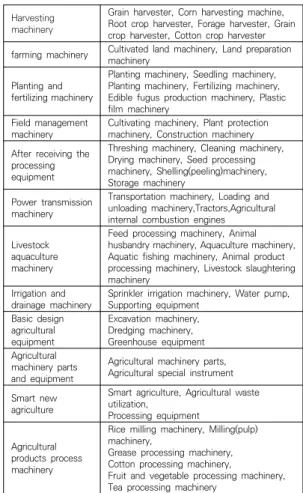
Agricultural machinery can be divided into harvesting machinery, farming machinery, planting and fertilizing machinery, field management machinery, after receiving the processing equipment, agricultural products process machinery, livestock aquaculture machinery, power transmission machinery, irrigation and drainage machinery, basis design agricultural equipment, and smart new agriculture, agricultural machinery parts and equipment[9].

Harvesting machinery

Grain harvester, Corn harvesting machine, Root crop harvester, Forage harvester, Grain crop harvester, Cotton crop harvester farming machinery Cultivated land machinery, Land preparation

machinery Planting and

fertilizing machinery

Planting machinery, Seedling machinery, Planting machinery, Fertilizing machinery, Edible fugus production machinery, Plastic film machinery

Field management

machinery Cultivating machinery, Plant protection machinery, Construction machinery After receiving the

processing equipment

Threshing machinery, Cleaning machinery, Drying machinery, Seed processing machinery, Shelling(peeling)machinery, Storage machinery

Power transmission machinery

Transportation machinery, Loading and unloading machinery,Tractors,Agricultural internal combustion engines

Livestock aquaculture machinery

Feed processing machinery, Animal husbandry machinery, Aquaculture machinery, Aquatic fishing machinery, Animal product processing machinery, Livestock slaughtering machinery

Irrigation and

drainage machinery Sprinkler irrigation machinery, Water pump, Supporting equipment

Basic design agricultural equipment

Excavation machinery, Dredging machinery, Greenhouse equipment Agricultural

machinery parts and equipment

Agricultural machinery parts, Agricultural special instrument Smart new

agriculture

Smart agriculture, Agricultural waste utilization,

Processing equipment Agricultural

products process machinery

Rice milling machinery, Milling(pulp) machinery,

Grease processing machinery, Cotton processing machinery,

Fruit and vegetable processing machinery, Tea processing machinery

Table 1. The types of agricultural machinery

(3)

Harvesting machinery can be divided into grain harvester, corn harvesting machine, root crop harvester, forage harvester, grain crop harvester, cotton crop harvester.

Grain harvesting machinery
Windrower, Baler, Self-propelled wheel combine, Self-propelled tracked grain, Semi-feed combine, Special harvester for soybean

Corn harvesting machinery

Self-propelled corn harvester, Knapsack corn harvester ,

Corn kernel harvester,

Ear stem and corn harvester, Corn harvesting Root crop

harvesting

Potato harvester, Onion garlic harvester, Radish harvester, Super cane harvester, Peanut harvester, Medicinal harvester Forage crop

harvester Lawn mower, Tedder, Mower, Green forage harvester, Baler, Round bale wrapper Grain crop

harvesting

Rapeseed harvester, Sunflower harvester, Grass seed harvester Cotton and linen

crop Cotton harvesting machinery, Hemp crop harvesting

Stem collection Straw crushing and returning, Stem harvester, Flattening machinery

Table 2. The types of harvesting machinery

3. Basis for grading and classification of intelligence level of unmanned grain harvester

Currently, unmanned intelligence level of global auto industry widely adopts the Society of Automotive Engineers (SAE) 6-level classification method (J3016TM)[10]. It provides a six-level automatic driving classification scheme and describes various types of driving automation on the road and the functional definitions of the related terms and definitions. The automotive intelligence grading and classification standard formulated by SAE divides automotive intelligence into six levels of L0-L5 from the aspects of driving, environmental monitoring, fallback, and application scenarios.

There is a development trend for automobiles to be lightweight, intelligent and unmanned[11].

Unmanned agricultural machinery is also the future development direction of agricultural

machinery. There is little literature on the research on the intelligence level of unmanned agricultural machinery. Unmanned grain harvester is categorized into unmanned agricultural machinery. The difference between unmanned agricultural machinery and unmanned vehicles is that the main function of the former is driving plus working while the latter is driving.

The driving environment of the two is very different, and the complexity of the task and the degree of human interference are different. The grading and classification of intelligence standard of unmanned vehicles has a reference effect on the grading and classification of driverless grain harvesters, but it cannot be completely based on the classification method of unmanned vehicles to classify the unmanned grain harvester. The unmanned grain harvester can be categorized into the unmanned ground system. The ALFUS evaluation framework for the autonomous level of the unmanned ground system proposed and established by the National Institute of Standards and Technology has a significant reference to it.

3.1 ALFUS evaluation framework classification The National Institute of Standards and Technology has proposed and established an unmanned system autonomous level (ALFUS) framework for the classification and evaluation of unmanned ground platforms [12]. According to the ALFUS evaluation framework, a corresponding autonomous level is generated.

When the unmanned system is completely

controlled by humans and has no autonomy, it

means that the intelligence level is the lowest

level. The highest level characterization tasks are

extremely complex, the environment is extremely

harsh, and they can be fully autonomous with an

excellent level of autonomy. The intermediate

level represents task complexity, high collaboration

requirements, complex environment, and good

(4)

level of autonomy. Based on these evaluation levels, the difference in the degree of autonomy of intelligent unmanned systems can be intuitively reflected in the classification of levels.

3.2 Unmanned grain harvester interactive model According to the National Institute of Standards and Technology's ALFUS framework for the classification and evaluation of ground-based unmanned platforms, it can be seen that the intelligence level of unmanned vehicles is determined by the task complexity, driving environment, and human interference of unmanned vehicles. Whenever there is a change in task, a change in the environment, or a change in the degree of human interference, it will affect the change in unmanned behavior.

Thus, the intelligent behavior of the unmanned harvester can be stimulated through the interaction of the environment-task-human interference-unmanned harvester.

Fig. 1. The driving environment-job complexity- human interference-unmanned harvester model

4. Classification of intelligence level of unmanned grain harvester

In order to better limit the classification of the job complexity, driving environment, and human interference of the unmanned grain harvester, we

conducted interviews with relevant agricultural experts. They are scholars and technicians from China Academy of Agricultural Mechanization Sciences, China Rural Technology Development Center, Shenyang Agricultural University, Shandong Agricultural University, Shandong University of Technology, and Nanjing Research Institute for Agricultural Mechanization Ministry of Agriculture.

The ratio of male and female experts interviewed was 5:2. The average age is 46, the minimum age is 38, and the maximum age is 52. The professional direction is as follows: 1 researcher from the field of agricultural machinery autonomous navigation, 1 from the field of precision agriculture, 3 from the field of intelligent equipment, 2 from the field of grain harvest.

The interview results obtained the technical knowledge of the intelligent classification of the human interference, environmental complexity and job complexity of the unmanned grain harvester.

4.1 Classification of human interference degree of unmanned grain harvesters

Unmanned vehicle path planning[13] refers to an unmanned vehicle planning an optimal route to a destination based on perceived environmental information and positioning information[14].

Path planning including global and local path planning. Information feedback based on the environment perception system and its own positioning system is crucial for the decision-making of unmanned vehicle[15].

Unmanned vehicle need to analyze the decisions

that need to be made next based on the obtained

information. The human interference degree in

unmanned grain harvester mainly includes path

planning and execution decisions. The human

interference degree is classified according to the

SAE driverless classification standard and the role

of human interference in the operation of the

unmanned grain harvester. Level A: The

(5)

unmanned grain harvester cannot make decisions about walking, working and other behaviors. It requires the operator to set walking and working paths and and make decisions about walking, working and other behaviors. Level B: The operator performs walking and working according to the surrounding environment information perceived by the unmanned grain harvester. Most of the sensing tasks are performed by the operator, who controls the walking and working behavior of the unmanned grain harvester. Level C: The operator receives an environment perception report from the unmanned grain harvester. The walking and working path planning and decision-making tasks are performed by the operator, and the perception and task execution are performed by the operator and the unmanned grain harvester.

Level D: The operator and the unmanned grain harvester jointly analyze, plan and decide walking and working tasks, and the unmanned grain harvester performs most of the sensing, walking and working tasks. Level E: The unmanned grain harvester is not under the control of the operator, and the operator has almost no intervention in the walking and working behavior of the unmanned grain harvester. Level F: The unmanned grain harvester is solely responsible for all environment perception, walking and working tasks. The operator has no interference with the walking and working behavior of the unmanned grain harvester.

4.2 Classification of environmental complexity for unmanned grain harvester

A large number of sensors are installed on the body of the unmanned vehicle to detect obstacles, identify road traffic signs, pose positioning, etc.[16], and then send the perceived information to the unmanned vehicle. Therefore, in unmanned technology, sensors are equivalent

to organs such as human eyes, ears, and ears, which can accurately enable unmanned vehicles to know what environment they are in, thereby achieving safe driving[17]. In the course of driving, the existing sensors, ultrasonic waves, and communication are difficult to identify under severe weather conditions[18].

Therefore, recognition of the environment by the unmanned ground vehicle is often one of the most closely evaluated parameters for its intelligence level. Both ground inclination and weather conditions affect the driving of unmanned vehicles[19]. According to the working environment of the unmanned harvester, the environmental complexity is classified according to the level of human interference. Level A (lowest environmental complexity): simple plot with flat ground and large working area. There are no crops blocking the view around the plot.

The weather is fine and the light is plenty. Level B (low environmental complexity): general working ground with small potholes, not flat enough. The light is normal, and there are a few crops around the working environment to block the view. Level C (medium environmental complexity): relatively complex working plots, small land area, uneven ground, a few obstacles between the plots, many crops around, making it difficult to identify the surrounding environment.

Level D (high environmental complexity):

complex working plots with small land areas,

slopes on the ground and local potholes, making

it difficult to identify the surrounding

environment between the plots. Level E (higher

environmental complexity): steep slope land,

small land area, muddy ground, cloudy day, weak

light and unclear sight line. Level F (highest

environmental complexity): particularly complicated

ground, obstacles on steep sloping plots, small

land area, big wind, dust on the ground, keep out

the line of sight. In rainy and foggy days, the

light is weak and the crop upturn rate is high.

(6)

4.3 Classification of task complexity for unmanned grain harvester

The task complexity of unmanned vehicles is also an important indicator for measuring the intelligence level of unmanned vehicles. The task complexity of unmanned grain harvesters is graded based on the number and quality of independent tasks. Level A manually controls the driving, steering, braking, field working, parking, without perception ability and decision-making ability. Level B uses Beidou Navigation System and GPS Navigation System to plan the path manually and make decisions based on the path set manually. Level C can make decisions about driving, braking, steering, working, and parking, etc. It also can identify static obstacles and avoid obstacles and accomplish a certain number of path planning. Level D can avoid dynamic obstacles. When the Beidou Navigation System or GPS signal is missing, it can avoid obstacles, complete local path planning, and make parking and working decisions. Level E can identify the surrounding environment of the plot and identify the harvesting crops and other crops that cannot be harvested. It cannot damage other immature crops when harvesting, and can make global path planning and other behavioral decisions in complex environments. Level F can autonomously complete decisions about driving, braking, steering, working, parking, etc. It also can identify static obstacles and avoid obstacles, thus completing path planning.

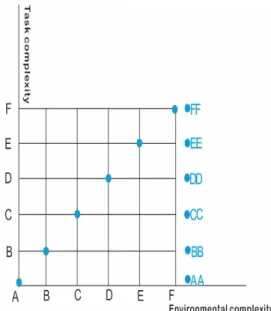
4.4 Grading and classification of intelligence level of unmanned grain harvester The evaluation of the intelligence level of the unmanned grain harvester depends on the complexity of the environment, the complexity of the task, and the degree of human interference. The environmental complexity is divided into six levels of A-F, and the task complexity is divided into six levels of A-F.

Evaluate the intelligence level of the unmanned grain harvester according to the level of the comprehensive level (A is the lowest and F is the highest). For example, if the environment complexity is the lowest and the task complexity is the lowest, the comprehensive level is (A, A). In this way, the environmental complexity and task complexity can be divided into levels AA, BB, CC,

DD, EE, and FF.

Fig. 2. Environmental and task complexity grading and classification model for unmanned grain harvester

The classification of manual intervention is divided into level A, B, C, D, E, F and other levels from the aspects of walking and working, steering and acceleration and deceleration, monitoring of driving environment, and fallback of the unmanned grain harvester.

The final intelligent classification model of the

unmanned grain harvester can be constructed by

combining the environmental and task

complexity classification model and the manual

intervention classification model.

(7)

Fig. 3. Classification model of manual intervention degree of unmanned grain harvester

The level 0 system is completely driven by the driver. The main body of the alarm system, vehicle control, environmental monitoring and system response are the drivers. At the same time, the level of environmental complexity and task complexity is AA. The level 1 system can assist the driver to complete certain driving tasks, and the level of environmental complexity and task complexity is BB. The level 2 system can simultaneously and horizontally control the vehicle, such as the parking assistance system. In this level, the driver needs to monitor the surrounding environment, and when the system makes a wrong judgment, it can timely correct the system and take over the system. The level of environmental complexity and task complexity is CC. The level 3 system is conditional autonomous driving. The system can replace some drivers to complete some driving tasks and complete some environmental monitoring functions. However, the driver needs to regain driving control in time when the system sends a request. The level of environmental complexity and task complexity is DD. The level 4 system is highly autonomous. The main body of vehicle control, environmental monitoring and system response are systems, but there are also modes in

which the driver controls the vehicle. The level of environmental complexity and task complexity is EE. The level 5 system is fully autonomous, meaning unmanned driving. The level of environmental complexity and task complexity is FF.

Fig. 4. Unmanned grain harvester evaluation model

5. Discussion and Suggestions

In this study, we take the complex interactive system consisting of unmanned grain harvester, task and driving environment as the research object, and carry out a research on the grading and classification of intelligence level of unmanned grain harvester. We also establish a vehicle evaluation model of unmanned grain harvester consisting of environmental complexity, task complexity, and human interference. The intelligent level of the unmanned grain harvester is classified according to the degree of human interference degree, the complexity of the environment and the complexity of the task.

At present, there is little literature related to the grading and classification of intelligence level of unmanned agricultural machinery, and there is no literature on the grading and classification of intelligence level of unmanned grain harvesters.

It is recommended that the grading and

(8)

classification evaluation model of unmanned grain harvester be applied to agricultural machinery practice to verify the rationality of the model, which we need to study in the next period.

REFERENCES

[1] H. X. Qi, Y. B. Lan & Z. X .Lin. (2017). Application of Big Data in Precision Agriculture. Journal of Agricultural Science and Technology, 21(1), 1-10.

DOI:10.13304/j.nykjdb.2018.0342

[2] M. Yang. (2006). Review and Prospect of Unmanned Automatic Vehicle Research. Journal of Harbin Institute of Technology, 8(38), 1259-1262.

[3] S. H. Kim & K. H. Lee. (2012). User Authentication Risk and Countermeasure in Intelligent Vehicles.

Journal of the Korea Convergence Society, 3(1), 95-100.

DOI:10.15207/JKCS.2012.3.1.007

[4] M. Parent & M. Yang. (2004,05). Road Map Towards Full Driving Automation . Applications of Advanced Technologies in Transportation Engineering , (PP.663-668). BEIJING:ASCE.

[5] Y. Jiang, Q. Wang, J. W. Gong & H. Y. Chen. (2015).

Study on Time Consistency and Robustness of Local Path Planning for Unmanned Vehicles. Acta Automatica Sinica, 41(3), 518-527.

DOI:10.16383/j.aas.2015.c140341

[6] Torii T. (2000). Research in autonomous agriculture vehicles in Japan. Computers & Electronics in Agriculture, 25(99), 133-153.

DOI:10.1016/S0168-1699(99)00060-5

[7] Reid. J. F, Q. Zhang & Noguchi. (2000). Agricultural Automatic Guidance Research In North America.

Computers & Electronics in Agriculture, 25(1), 155-167.

DOI:10.1016/S0168-1699(99)00061-7

[8] Keicher. R. & Seufert. H. (2000). Automatic guidance for agricultural vehicles in Europe. Computers &

Electronics in Agriculture, 25(99), 169-194.

DOI:10.1016/S0168-1699(99)00062-9

[9] G. Yang. (2013). The Classification and Development Trend of Agricultural Machinery. Agricultural Science

& Technology and Equipment, 6(228), 101-102.

DOI:10.16313/j.cnki.nykjyzb.2013.06.020

[10] SAE J3016-201806. (2018. 06). Taxonomy and Definitions for Terms Related to Driving Automation Systems for On-Road Motor Vehicles. New York:SAE.

[11] B. H. Kim, Y. J. Jeong, C. Lee & B. H. Lee. (2018). A Study on the Optimum Design of a Motor Shaft in Electric Vehicle Using HEEDS. Journal of the Korean Society of Mechanical Technology, 20(6), 751-756.

DOI:10.17958/ksmt.20.6.201812.751

[12] Y. Yan, Z. M. Tang & J. F. Lu. (2011). Research on the Autonomous Evaluation of Ground Intelligent Robots.

Journal of Huazhong University of Science and Technology (Natural Science Edition), (Supplement 2), 68-71.

DOI:10.13245/j.hust.2011.s2.021

[13] B. Liu, X. Luo & J. Zhu. (2018). Simulation Research on Automatic Obstacle Avoidance Path Planning for Unmanned Vehicles. Computer Simulation, 35(2), 105-110.

[14] M. Dursun & A. Assmet (2018). Risk Based Multi Criteria Decision Making for Secure Image Transfer Between Unmanned Air Vehicle and Ground Control Station. Reliability Engineering & System Safety, 1(178), 31-39.

DOI:10.1016/j.ress.2018.05.011

[15] M. Pierzchala, P. Giguere & R. Astrup. (2018).

Mapping forests using an unmanned ground vehicle with 3D LiDAR and graph-SLAM. Computers&Electronic in Agriculture, 11(4), 217-225.

DOI:10.1016/j.compag.2017.12.034

[16] H. Y. Chen, G. M. Xiong & J. W. Gong. (2014).

Introduction to Driverless Cars. Beijing: Beijing Institute of Technology Press.

[17] Y. X. Yu. (2015). Application of Global Positioning Technology in Modern Agricultural Machinery. China Agricultural Mechanization, 3(7), 22-28.

DOI:10.13733/j.jcam.issn.2095-5553.

[18] D. S. Seo. (2019). A Study on the Application of AI and Linkage System for Safety in the Autonomous Driving.

Journal of the Korea Convergence Society, 10(11), 95-100.

DOI:10.15207/JKCS.2019.10.11.095

[19] H. D. Jung, G. H. Kim, C. W. Park & D. R. Lee. (2016).

A Study on the Cooling Effect of an Electric Car Battery between Battery with Heat Sink and without Heat Sink. Journal of the Korean Society of Mechanical Technology, 18(6), 879-885.

DOI:10.17958/ksmt.18.6.201612.879

조 나(Zhao Na) [정회원]

․ 2002년 6월 : 정저우 경공업대학교(중 국) 산업디자인과(문학학사)

․ 2009년 6월 : 수도사범대학교 예술디 자인과(문학석사)

․ 2018년 8월 ~ 현재 : 국민대학교TED 대학교 스마트 체험 디자인학과(박사 과정)

․ 관심분야 :인터랙션디자인, 서비스디자인,정밀농업

․ E-Mail : [email protected]

(9)

반 영 환(Young-Hwan Pan) [정회원]

․ 1991년 2월 : 한국과학기술원 산업공 학과(공학사)

․ 1993년 2월 : 한국과학기술원 인간공 학 (공학석사)

․ 1999년 8월 : 한국과학기술원인간공 학(박사) 삼성전자 DTV UX 책임

․ 2006년 9월 ~ 현재 : 국민대학교 테크 노디자인전문대학원 인터랙션디자인(교수)

․ 관심분야 : 인터랙션디자인, 서비스디자인,사용자 경험(UX)·

․ E-Mail : [email protected]

수치

Table  1.  The  types  of  agricultural  machinery
Table  2.  The  types  of  harvesting  machinery
Fig.  1.  The  driving  environment-job  complexity-  human  interference-unmanned  harvester  model
Fig.  2.  Environmental  and  task  complexity  grading  and  classification  model  for  unmanned  grain  harvester
+2

참조

관련 문서

Common corporate digital crimes include piracy, financial fraud, espionage, and theft of services.. _______________________________________ such as

So, the presence of a grain removes a strange barrier between unitary dynamics and the collapse of the wave vector, which is a hindrance for modeling dynamics, since the use

1 John Owen, Justification by Faith Alone, in The Works of John Owen, ed. John Bolt, trans. Scott Clark, "Do This and Live: Christ's Active Obedience as the

 The intact stability characteristics of any ship carrying bulk grain must be shown to meet, throughout the voyage, the following criteria relating to the moments due to

This study was conducted from 24 May to 3 November in Cheju to investigate the effects of planting date and plant distance on the grain yield of black

• Select one of the elemental technologies of Smart City and describe the current level of this technology, the direction of future technology development, and the urban space to

On behalf of our institute, the Korea Research Institute for Vocational Education and Training, I would like to welcome you to the International Conference on

Based on the result of such assessment, this study attempted to establish a basis for establishment of physical epidemiology research evaluation system