INTRODUCTION
Clostridium perfringens is a Gram-positive, ubiqui- tous, anaerobic, spore forming bacterium which is found widely in the environment and also in the intestinal tract of humans and animals (Vaikosen and Ikhatua, 2005).
Due to the production of several exotoxins C. perfrin- gens is of great importance as a pathogen in humans, domestic animals and wildlife (Songer, 1996; Sipos et al, 2003). The production of four major toxins alpha (α), beta (β), epsilon (ε) and iota (ι) allows its discrimination into five types from A to E (Hatheway, 1990; Vaikosen and Ikhatua, 2005). In veterinary medicine, each of
these types has been linked to specific diseases (Songer, 1996; Petit et al, 1999). C. perfringens enterotoxin (CPE) serves as an additional virulence factor which is believ- ed to cause enteritis in various animal species (Werde- ling et al, 1991; Songer, 1996).
C. perfringens can be a normal inhabitant of the inte- stines of most animal species (Nilo, 1980) including humans (Johnson & Gerding, 1997), but when the intes- tinal environment is altered by sudden changes in diet or other factors, C. perfringens proliferates in large num- bers and produces several potent toxins (Uzal, 2004).
These toxins can act locally; can be absorbed into the general circulation producing systemic effects or can act both locally and systemically usually with devastating effects on the host (Uzal and Kelly, 1996; Lewis, 2000).
Detection of Clostridium perfringens and its toxinotypes by enzyme linked immunosorbent assay
from enterotoxaemic goats in Bangladesh
K. B. M. S. Islam*, M. S. Rahman
1, Md. Ershaduzzaman
2, M. J. F. A. Taimur
2, Hyung-Kwan Jang
3, Hee-Jong Song
3Animal Health Research Division, Bangladesh Livestock Research Institute, Savar, Dhaka,
and Research fellow, Laboratory of Microbial Physiology, Graduate School of Agriculture, Hokkaido University, Japan
1Department of Medicine, Bangladesh Agricultural University, Mymensingh-2202, Bangladesh
2Senior Scientific Officer, Bangladesh Livestock Research Institute, Savar, Dhaka
3Department of Infectious Diseases and Avian Diseases, College of Veterinary Medicine, and Korea Zoonoses Research Institute, Chonbuk National University, Jeonju 561-712, Korea
(Received 3 December 2009, accepted in revised from 26 February 2010)
37
* Corresponding author: K. B. M. S. Islam, Tel. +81-11-716-3430, E-mail. [email protected]
An enzyme-linked immnnosorbent assay (ELISA) has been performed for the detection of the prevailing toxinotypes of Clostridium perfringens obtained from conventional culturing of intestinal contents of goats which have died of suspected enterotoxaemia. The test was found effective to detect the toxins as well as types of the organism with less time and labor. The most prevailing type of C. perfringens causing enter- otoxaemia in goat was C. perfringens type D (68.75%) and followed by C. perfringens type B (25%) and C (6.25%). No C. perfringens type A was detected. This study showed an intelligible picture of prevailing toxinotypes of C. perfringens in goats in Bangladesh. The use of the ELISA for the detection of clostridial types and toxins allows the differential diagnosis of C. perfringens types A, B, C and D enterotoxaemias from samples of intestinal contents and the typing of cultures of C. perfringens.
Key words : Enterotoxaemia, Clostridium perfringens, Toxins, Toxinotypes, ELISA Abstract
Little or no work has been reported on the prevalence and toxinotypes of this organism causing enterotoxemia in goat in Bangladesh. Enterotoxaemia of sheep and goats is mainly caused by C. perfringens type D world wide although other type were also been reported as causal agents (Guss, 1977; Delgaris, 1978; Chakrabarti et al, 1980; Uzal et al, 1994; Songer, 1996; Uzal and Kelly, 1996). The predisposing cause of the disease is often a sudden change from a relatively poor to rich diet.
Those animals that thrive best and are presumably good feeders appear to be most susceptible (Bullen, 1970;
Odendaal et al, 1989). Naylor et al, 1987 reported that the principal toxin of C. perfringens type D is epsilon (ε-toxin) formed in the intestine of animals as a non toxic precursor (protoxin).
The classical identification of the toxins is based on neutralization tests in mice or in the skin of guinea pigs (Sterne and batty, 1975). In recent years, various enzy- mes immunoassays have been developed (Naylor et al, 1987, 1997; Martin et al, 1988; El-Idrissi and Ward, 1992;
Younan et al, 1994) and molecular methods have been adapted to identify the C. perfringens toxinotypes (Daube et al, 1994; Buogo et al, 1995; Yoo et al, 1997).
The ELISA was found efficient in toxinotyping of C.
perfringens because of the stability of the reagents, ease of manipulation; high sensitivity and specificity (Jack- son et al, 1985). In the present study an enzyme linked immunosorbent assay was carried out to identify the toxi- ontypes of C. perfringens causing caprine enterotoxae- mia in native Black bangle goats in Bangladesh so that it can be used to keep a check on prevailing toxino- types involved in caprine enterotoxaemia in the future.
Such information can be useful in vaccine development can be carried out keeping view.
MATERIALS AND METHODS
An ELISA kit (Cypress Diagnostics, ref. VBO44, Belgium) was used to detect C. perfringens enterotoxins (alpha, beta and epsilon) as well as semi quantitative detection of the bacterium itself.
Bacterial strains
Organism in pure culture was isolated from goats died of suspected enterotoxaemia by conventional culture based methods and kept at -20°C until use.
Principle of the test
Specific monoclonal and polyclonal antibodies pro- duced against alpha, beta, and epsilon toxins of C.
perfringens and a monoclonal antibody specific for a structural which protein of this bacterium have been immobilized on alternative rows of the micro titer plates.
These antibodies allow specifical capture of the corres- ponding toxins or bacteria that may be present in the samples. Rows A, C, E, and G have been sensitized with these antibodies and rows B, D, F, and H with specific antibodies.
Test procedure
The ELISA test was carried out following the manu- facturer’s instruction with some modifications. Briefly, the ELISA kit was brought to room temperature at least half an hour before use and the dilution buffer was diluted 1 : 5 with deinonized water. This reconstituted dilution buffer was stored at 4°C until use. Organisms isolated from the collected samples were grown on 5%
sheep blood agar media until considered pure and used as the sample for ELISA. The samples were diluted volume per volume in to dilution buffer. A concentrated washing solution (containing 0.85% NaCl, 0.05% Tween 20 and 0.5% bovine serum albumin) was diluted 20 fold in deionized water to make a working solution and stored at 4°C prior to use. Then 100µl aliquots of the diluted samples were added to the wells as follows:
Sample 1 in the wells of column 2, Sample 2 in the wells of column 3 and so on. After this, 100µl of control antigen was added to the wells of column 1. The plate was then incubated at room temperature for 1 hour.
After the first one-hour incubation at room temperature, the kit was subjected to wash with the reconstituted washing solution. The washing procedure involved removing the contents of the wells by flipping it sharply over a sink, tapping the micro plates upside down again-
st a piece of clean absorbent paper to remove all the liquid, filling the wells with 100µl of freshly prepared washing solution per well and gently shaking the plate, then the wells were emptied once more by turning the plate over a sink. The entire washing procedure was repeated three times and care was taken to avoid the formation of bubbles in the micro wells. The conjugate was diluted 20 fold with the buffer dilution and 100µl of the diluted conjugate solution was added to each well as follows: anti-alpha toxin conjugate in rows A and B, anti-beta toxin conjugate in rows C and D, anti-epsilon toxin conjugate in rows E and F, and anti-C. perfringens conju-gate in rows G and H. The ELISA plate was then incubat-ed at room temperature for another one hour.
After the second incubation, washing of the micro wells were carried out with the washing solution following the same procedure as described above. Then 10ml of indi- cator solution was prepared by adding 12 drops (500µl) of chromogen to 9.5ml of substrate solution just prior to use and the chromogen-substrate mixture was added to the plate in volume of 100µl per micro well and incubated for 10~15 minutes at room temperature. Lastly 50µl of stop solution was added to each well and the plate was subjected to reading. The optical densities in the micro wells were read at 450nm using a plate reader (das, Italy, Model No. AT-365; 2001). Results were read carefully soon after the stopping solution had been added since
the chromogen might be crystallized in the wells with strong signals and thereby distort result.
Interpretation of the result
The net optical density was calculated for control antigens as well as each sample. To do so, the signal of the corresponding negative control wells (B, D, F, H) were subtracted from each value recorded in rows A, C, E and G. The test was considered valid only if the posi- tive control antigens yield a difference in optical density at 10 minutes that is greater or equal to the values given on the QC data sheet (α›1.774, β›1.988, ε›1.128, C.
perf›1.161). Any sample that yielded an optical den- sity difference greater or equal to 0.150 was considered positive for the valence in question.
RESULTS AND DISCUSSION
There was development of color (bright yellow) in the wells (col-1) for control antigens as well as in the wells of rows for samples. Strong bright color was observed in the wells sensitised by specific antitoxin for which the sample was positive while light or no color was developed in the wells sensitized by nonspecific anti- body.
The calculated net optical density values for each
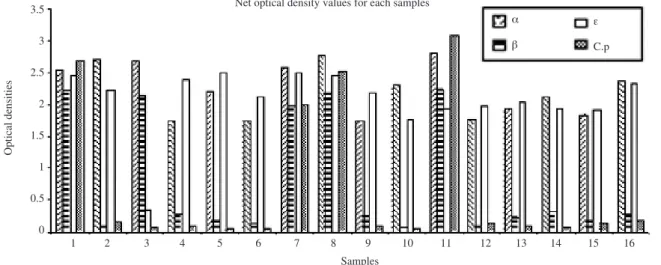
Fig. 1. Calculated net optical density values for each samples for the detection of C. perfringens enterotoxin. The OD at 450nm plotted for each enterotoxin and sample was determined by subtraction of the OD 450 of the corresponding negative control wells (rows B, D, F, H; wells sensitized by aspecific antibodies) from that of test samples containing enterotoxin (rows A, C, E & G; wells sensitized by specific antibodies for α, β‚ ε and C. perfringens, respectively).
3.5
3
2.5
2
1.5
1
0.5
0
Optical densities
Net optical density values for each samples
α β
ε C.p
1 2 3 4 5 6 7 8 9 10 11 12 13 14 15 16
Samples
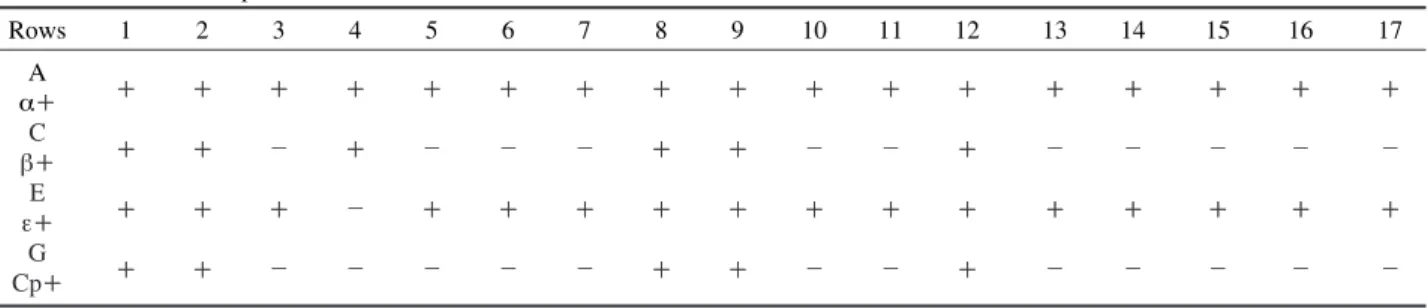
sample and control antigens based on which toxinotypes of each sample were determined are given in Fig. 1. The differences in net optical density values for positive control antigens at 10 minutes were with in the accepted limit as described in materials and methods. The result of 16 samples tested is summarized in Table 1.
Among the 16 samples tested 11 samples produced bright color both in the rows sensitised for alpha and epsilon toxins (i.e. rows A and E). Besides these, four samples were found producing bright color both in the rows sensitive for alpha, beta and epsilon toxins (i.e.
rows A, C and E). The remaining one sample was found positive to row A and C. Four samples developed color in the wells of row which was specially sensitised for C.
perfringens type B. Other types of C. perfringens were also determined from the result, type A producing only alpha toxin, type B alpha, beta and epsilon toxins, type C alpha and beta toxins and type D alpha and epsilon toxins (Table 2).
Thus 11 samples were found producing alpha and epsilon toxins and considered as C. perfringens type D.
On the other hand, 4 samples were considered as C.
perfringens type B as they were found to produce alpha, beta and epsilon toxins while the remaing one was
identified as C. perfringens type C as it produced alpha and beta toxins. Thus 68.75% of goat enterotoxaemia at BLRI goat farm were considered due to C. perfringens type D where as C. perfringens type B was responsible for 25% caprine enterotoxaemia. Only 6.25% cases of goat enterotoxaemia was due to C. perfringens type C among the 16 samples tested (Table 2).
The ELISA test used in this study for the detection of the toxinotypes of C. perfringens causing enterotoxae- mia in goats is the first time of its kind in Bangladesh.
Although other investigators have described ELISA procedures for the detection of C. perfringens and its toxins from enterotoxaemia suspected animals abroad (Narayan et al, 1983; Bartholomew et al, 1985; Jackson et al, 1985; Naylor et al, 1987; Martin et al, 1988; Naga- hama et al, 1991; El-Idrissi and Ward, 1992; Holds- worth and Parratt 1994; Hale and Stiles, 1999; Uzal et al, 2003) no report has being available regarding this issue in Bangladesh.
Routinely, diagnosis of enterotoxaemia is based on the presence of toxins of C. perfringens in intestinal contents (Sterne and Batty, 1975). The key components of the diagnosis system of enteritis caused by C. per- fringens in domestic animals are the evaluation of clini- cal signs and gross and microscopic lesions, bacterio- logic cultures of appropriate specimen and detection of toxins in pathologic specimens and in supernatant fluids of pure cultures (Smith, 1980; Hoefling, 1989). Selec- tive media may be employed (Dafwang et al, 1987).
However, the isolation of C. perfringens type D from intestinal contents is not necessarily confirmatory diag- nosis as this organism can be a normal inhabitant of the
Table 1. Summary of ELISA test for the detection of Clostridium perfringens and toxinotype identification. Rows A, C, E and G were sensitized by anti-alpha toxin, anti-beta toxin, anti-epsilon toxin and anti C. perfringens respectively and rows B, D, F, and H were sensitised by aspecific antibodies. Column-1 indicates the result of control while Column-2 to 17 show the results of different samples
Rows 1 2 3 4 5 6 7 8 9 10 11 12 13 14 15 16 17
A
α++ ++ ++ ++ ++ ++ ++ ++ ++ ++ ++ ++ ++ ++ ++ ++ ++ ++
C
β++ ++ ++ - ++ - - - ++ ++ - - ++ - - - - -
E
ε++ ++ ++ ++ - ++ ++ ++ ++ ++ ++ ++ ++ ++ ++ ++ ++ ++
G
Cp++ ++ ++ - - - - - ++ ++ - - ++ - - - - -
Table 2. Prevailing toxinotypes of C. perfringens at BLRI goat farm determined by ELISA
Type Toxins No. positive (n==16) % Positive
A α Nil Nil
B α, β & ε 4 25
C α & β 1 6.25
D α & ε 11 68.75
E α & ι Nil Nil
bowel of healthy sheep and goat (Warren et al, 1999).
Demonstrations of major toxins in the gut, the blood- stream or serous exudates (Carter, 1984; Timoney et al, 1988) by in vivo assays were also used. Cytotoxicity assays for enterotoxins have also been reported (Berry et al, 1988; Estrada-Correa and Taylor, 1989). Most other in vitro methods for the detection of toxigenic C. perfrin- gens are based on enzyme immunoassays, gene probes or PCR for detection of toxin genes (Songer, 1996). Enter- otoxin has been detected by immunoassays including enzyme linked immunoassay (ELISA) and reverse pas- sive latex agglutination (Narayan et al, 1983; McClane and Strouse 1984; Bartholomew et al, 1985; Jackson et al, 1985; Harmon and Kautter, 1986; Jackson et al, 1986;
McClane and Synder, 1987; Berry et al, 1988; Metha et al, 1989; Germany et al, 1990; Hunter et al, 1993).
ELISA can be used to determine the presence of toxins and C. perfringens in suspected samples, pure cultures, culture supernatant fluids etc. The present study result demonstrated that ELISA could be used to determine the presence of toxins and as well as to deter- mine the toxinotypes of the organism and indicated that this assay might be useful in examining the production of toxins by various types of C. perfringens to identify toxinotypes within a few hours which much faster than conventional assays like mouse protection test, dermon- ecrotic test etc. In the present study the toxigenic strains of C. perfringens identified by ELISA produced alpha (α), beta (β) and epsilon (ε) toxins. No strain of C. per- fringens was found to produce only one of the toxins.
Based on the observations, it was possible to estimate the toxinotypes of the organism as divided in five types;
A through E based on the toxin produced by them (Cato et al, 1986; Hatheway, 1990; Vaikosen and Ikhatua,
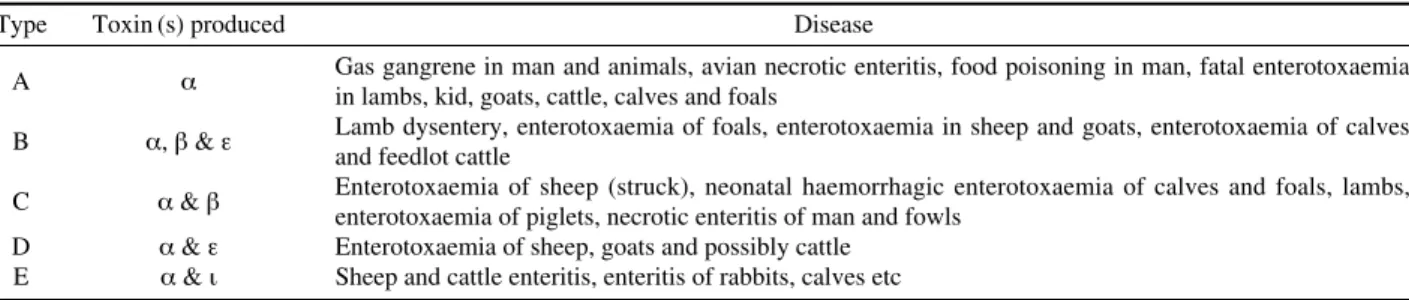
2005) and each type is associated with specific enteric infections of various animal species (Table 3) (Mc- Donel, 1986). All types of C. perfringens produce alpha toxin (Warren et al, 1999). In addition, type B produces beta and epsilon toxins, type C produces beta toxins, type D produces epsilon toxins and type E produces iota toxin (Niilo, 1980).
In the present study, 68.25% of the samples were identified as C. perfringens type D as they produced α and ε toxins, 25% of cases were reported to be C. per- fringens type B (produced α, β and ε toxins) and only 6.25% cases were found to be C. perfringens type C (produced α and β toxins). Previous investigators reported type D as the principal type of C. perfringens associated with caprine enterotoxaemia (Chakrabarti et al, 1980; Uzal et al, 1994; Songer, 1996; Uzal and Kelly, 1996) although C. perfringens type A, B and C have also been reported as the causal agents of enterotoxaemia in goat (Guss, 1977; Delgaris, 1978). Thus present study was in accordance with the previous reports although no C. perfringens type A strain was detected to cause enter- otoxaemia in goat in the study area. This may be due to the variation of location and type A seldom causes dise- ase. It was reported that epsilon toxin played the most important role in the pathogenesis of the disease in goats (Uzal and Kelly, 1996). The epsilon toxin is pro- duced as the minimally toxic ε prototoxin (McDonel, 1986), which is converted to a ¤1,000 fold more toxic form by proteolytic removal of 14 N-terminal amino acids (Bhown and Habeeb, 1977). Although its precise biological activity has not been identified, epsilon toxin is necrotizing and lethal (Batty and Glenny, 1947; Bux- ton, 1978).
The α toxin produced in various amounts by all iso-
Table 3. Types of Clostridium perfringens responsible for diseases in different animal species
Type Toxin (s) produced Disease
A α Gas gangrene in man and animals, avian necrotic enteritis, food poisoning in man, fatal enterotoxaemia in lambs, kid, goats, cattle, calves and foals
B α, β & ε Lamb dysentery, enterotoxaemia of foals, enterotoxaemia in sheep and goats, enterotoxaemia of calves and feedlot cattle
C α & β Enterotoxaemia of sheep (struck), neonatal haemorrhagic enterotoxaemia of calves and foals, lambs, enterotoxaemia of piglets, necrotic enteritis of man and fowls
D α & ε Enterotoxaemia of sheep, goats and possibly cattle E α & ι Sheep and cattle enteritis, enteritis of rabbits, calves etc
lates of C. perfringens and the only toxin produced by type A, which is hemolytic (Songer, 1996), necrotizing (Timoney et al, 1988) and potentially lethal (Rood and Cole, 1991) also reported to be responsible for goat enter- otoxaemia (Guss, 1977; Delgaris, 1978). But in the pre- sent study, no strain was found to produce alpha toxin alone and hence could not be placed in C. perfringens type A.
The beta toxin is highly trypsin sensitive protein (Sakurai and Duncan, 1977; Jolivet-Reynaud et al, 1986), which is responsible for mucosal necrosis and possibly for central nervous system signs in C. per-fringens induced diseases in domestic animals (Jolivet-Reynaud et al, 1986; McDonel, 1986).
Type C producing alpha and beta toxins and reported to be responsible for goat enterotoxaemia in some extent (Guss, 1977; Delgaris, 1978). In the present study, one sample was found to produce alpha and beta toxins and considered as type C. It appears that C. perfringens type C is less frequent in enterotoxaemic goats. This finding is also correlated with previous reports.
The prevalence of C. perfringens type E (major toxins α & ι) could not be calculated due to the lack of inve- stigation facilities. But it could be assumed that no C.
perfingens type E was responsible for goat enterotox- aemia in the study area as all the samples could be placed to different types. If any sample that was found as C. perfringens by culturing could not be placed to any type, there might be a question of being type E. But there was none. In addition, type E has not yet been reported to cause goat enterotoxaemia (Songer, 1998;
Uzal, 2004). So, the possibility of occurrence of C.
perfringens type E was omitted for the study samples.
But for definite result, further study should be carried out.
CONCLUSIVELY
For the first time, ELISA was employed to identify the toxinotyping of C. perfringens which causes entero- toxaemia in goats in Bangladeshand the prevalence of C. perfringens type B, C and D was determined. Among
the types, type D was found most prevalent and follow- ed by type B and C.
REFERENCES
Bartholomew BA, Stringer MF, Watson GN, Gilbert RJ. 1985.
Development and application of an enzyme linked immunosorbent assay for Clostridium perfringens type A enterotoxin. J Clin Pathol 38: 222-228.
Batty I, Glenny AT. 1947. Titration of Clostridium welchii epsilon toxin and antitoxin. Br J Exp Pathol 28: 110- 126.
Berry PR, Rodhouse JC, Hughes S, Bartholomew BA, Gilbert RJ. 1988. Evaluation of ELISA, RPLA and Verocell assays for detecting C. perfringens enterotoxin in fae- cal specimens. J Clin Pathol 41: 458-461.
Bhown AS, Habeeb AFSA. 1977. Structural studies of ⇨ protoxin of Clostridium perfringens type D: loclization of the site of tryptic scission necessary for activation to ⇨toxin. Biochem Biophys Res Commun 78: 889- 896.
Bullen JJ. 1970. Role of Toxins In Host Parasite Relation- ships. B848 Bd1 Microbial Toxins. Academic Press, Inl. London, pp. 233-275.
Buogo C, Capaul S, Hani H, Frey J, Nicolet J. 1994. Diagnpsis of C. perfringens type C enteritis in pigs using a DNA amplification technique (PCR). Zentrallblatt fur Veter- inarmedizin (B) 42: 51-58.
Buxton D. 1978. Further studies on the mode of action of Clostridium perfringens type D epsilon toxin. J Med Microbiol 11: 293-298.
Carter GR. 1984. Diagnostic procedures in Veterinary Micro- biology. Charles C. Thomas, spring field, III.
Cato EP, George WL, Fine-gold SM. 1986. Genus Clostri- dium pp. 1141-1182. In P. Sneath (edn) Bergey’s manual of systemic bacteriology, vol. 2. The Williams
& Wilkins Co. Baltimore, Md.
Chakrabarti K, Dutta BM, Sharma AK, Mukit A, Baruan GK, Boro BR, Das SK. 1980. Enterotoxaemia in goats due to Clostridium perfringens type D. Ind Vet J 57: 195- 197.
Dafwang II, Ricke SC, Schaefer DM, Brotz PG, Sunde ML, Pringle DJ. 1987. Evaluation of some commercial me- dia for the cultivation and enumeration of Clostridium perfringens from the chick intestine. Poult Sci 66:
652-658.
Daube G, China B, Simon P, Hvala K, Mainil J. 1994. Typing of Clostridium perfringens by in vitro application of toxin genes. J Appl Bacteriol 77: 650-655.
Deligaris NM. 1978. Study of enterotoxaemia in small rumi- nants (Sheep & goats). Types of Clostridium perfrin- gens responsible for the disease in Green. Hellenike
Ktenictrike Hellinic Vet Med 21(2): 74-76.
El-Idrissi AH, Ward GE. 1992. Development of double sandwish ELISA for Clostridium perfringens beta and epsilon toxins. Vet Microbiol 31: 89-99.
Estrada-correa AE, Taylor DJ. 1989. Porcine Clostridium per- fringens type A spores, enterotoxin and antibody to enterotoxin. Vet Rec 124: 606-610.
Germany Y, Popoff MR, Begaud E, Guesdon JL. 1990. Com- petitive erythroimmunoossay for detecting Clostridium perfringens type A enterotoxin in stool specimens. Res Microbiol 141: 563-571.
Guss SB. 1977. Management & diseases of dairy goats. Dairy Goat. J. Pub. Corp. Arizona, USA 106-109.
Hale ML, Stiles BG. 1999. Detection of Clostridium per- fringens alpha toxin using a capture antibody ELISA.
Toxicon Toxicon 37(3): 471-84.
Harmon SM, Kautter DA. 1986. Evaluation of a reversed pas- sive latex agglutination test kit for Clostridium per- fringens enterotoxin. J Food Prot 49: 523-525.
Hatheway CL. 1990. Toxigenic clostridia. Clin Microbiol Rev 3: 66-98.
Havard HL, Hunter SEC, Titball RW. 1992. Comparison of the nucleotide sequence and development of a PCR test for the epsilon toxin gene of Clostridium perfrin- gens type B and type D. FEMS Microbiol Lett 97: 77- 82.
Hoefling DC. 1989. Recognizing diarrhoea caused by Clostri- dium perfringens type C. Vet Med 84: 437-440.
Holdsworth RJ, Parratt D. 1994. Development of an ELISA assay for Clostridium perfringens phospholipase C (alpha toxin). J Immunoassay 15: 293-304.
Hunter SEC, Brown JE, Oyston PCF, Sakurai J and Titball RW. 1993. Molecular genetic analysis of beta toxin of Clostridium perfringens reveals seqnence homology with alpha toxin, gamma toxin and leukocidin of Sta- phylococcus aureus. Infect Immunol 61: 3958-3965.
Jackson SG, Yip-Chuck DA, Brodsky MH. 1985. A double antibody sandwich enzyme immunoassay for Clostri- dium perfringens type-A enterotoxin detection in stool specimens. J Immunol Methods 83: 141-150.
Jolivet-Reynaud C, Popoff MR, Vinit MA, Ravisse P, Moreau H, Alouf JE. 1986. Enteropathogenicity of Clostridium perfringensβ‚ toxins and other clostridial toxins. Zen- tralbl Bakteriol Mikrobiol Hyg Suppl 15: 145-151.
Lewis CJ. 2000. Clostridial diseases. In: Martin WB, Aitken ID, editors. Diseases of sheep. Oxford: Blackwell Science.
McClane BA, Strouse RJ. 1984. Rapid detection of Clostri- dium perfringens type A enterotixin by enzyme linked immunosorbent assay. J Clin Microbol 19: 112-115.
McClane BA, Snyder JT. 1987. Development and preliminary evaluation of a slide latex agglutination assay for detec- tion of Clostridium perfringens type A enterotoxin. J Immunol Methods 100: 131-136.
McClane BA, Songer JG, Titball RW. 1997. The Clostridia:
molecular biology and pathogenesis. Academic Press, San Diego, CA: 117-40.
McDonel JL. 1986. Toxins of Clostridium perfringens type A, B, C, D and E. In: Pharmacology of bacterial toxins.
Dorner F, Drews J (ed). Pergamon press, Oxford: 477- 517.
Metha R, Narayan KG, Notermans S. 1989. DOT enzyme linked immunosorbent assay for detection of Clostri- dium perfringens type A enterotoxin. Int J Food Mic- robiol 9: 45-50.
Nagahama M, Kobayshi K, Ochi S, Sakurai, J. 1991. Enzyme linked immunosorbent assay for rapid detection of toxins from Clostridium perfringens. FEMS Microbiol Let 84: 41-44.
Narayan KG, Genigeorgis C, Behymer D. 1983. Use of enzy- me linked immunosorbent ossay (ELISA) in the quan- titation of Clostridium perfringens type A enterotoxin and antienterotoxin antibodies. Int J Zoonoses 10:
105-110.
Naylor RD, Martin PK, Barker LT. 1997. Detection of C. per- fringens alpha toxin by enzyme linked immunosorbent assay. Res Vet Sci 63: 101-102.
Naylor RD, Martin PK, Sharpe RT. 1987. Detection of Clos- tridium perfringens epsilon toxin by ELISA. Res Vet Sci 42: 255-256.
Niilo L. 1980. Clostridium perfringens in animal disease: a review of current knowledge. Can Vet J 21: 141-148.
Odendaal MW, Visser JJ, Bergh H, Botha WJS. 1989. The effect of Passive immunization of active immunity against C. perfringens type D in Lambs. Onderste- poort. J Vet Res 56: 251-255.
Petit L, Gibert M, Popoff MR. 1999. C. perfringens: toxino- type and genotype. Trends Microbiol 7: 104-110.
Rood JI, Cole ST. 1991. Molecular genetics and pathogenesis of Clostridium perfringens. Microbiol Rev 55: 621- 648.
Sakurai J, Duncan CL. 1977. Purification of beta toxin from C. perfringens type C. Infect Immun 18: 741-745.
Sipos W, Fischer L, Schindler M, Schmoll F. 2003. Genoty- ping of Clostridium perfringens isolated from domes- tic and exotic ruminants and swine. J Vet Med B 50:
360-362.
Smith L. 1980. Clostridial infections. In isolation and identi- fication of avian pathogens. Hitchner SB, Domermuth CH, Purchase HG, Williams JE (ed). Am Assoc Avian Pathol Kennet Jauare: 33-35.
Songer JG. 1998. Clostridial diseases of small ruminants. Vet Res 29: 219-232.
Songer JG. 1996. Clostridial enteric diseases of domestic animals. Clin Microbiol Rev 9: 216-234.
Sterne M, Batty I. 1975. Diagnostic criteria for Clostridium infections. Pathogenic clostridia. Butherworth Ltd., London: 79-84.
Timoney JF, Gilliespie JH, Scott FW, Barloagh JE. 1988. Ha- gan and Bruner’s microbiology and infections disease of domestic animals. Comstock publishing Associates, Ittaca, NY: 214-240.
Uzal FA. 2004. Diagnosis of Clostridium perfringens intesti- nal infections in sheep and goats. Anaerobe 10: 135- 143.
Uzal FA, Kelly WR, Thomas R, Hornitzky M, Galea F. 2003.
Comparison of four techniques for the detection of Clostridium perfringens type D epsilon toxin in intes- tinal contents and other body fluids of sheep and goats. J Vet Diag Invest 15(2): 94-99.
Uzal FA, Kelly WR. 1996. Enterotoxaemia in goats: a review.
Vet Res Commun 29(2): 481-492.
Uzal FA, Pasini MI, Olaechea FV, Robles CA, Elizondo A.
1994. An out break of enterotoxaemia caused by Clos- tridium perfringens type D in goats in Patagonia. Vet Rec 135(12): 79-80.
Vaikosen ES, Ikhatua UJ. 2005. Detection of high level of
enterotoxin of Clostridum perfingens types C and D in small ruminants in Nigeria. Small Ruminant Res 58:
287-290.
Warren AL, Uzal FA, Blackwell TE. 1990. PCR detection of Clostridium perfringens type D in formalin fixed, par- affin-embedded tissues of goats and sheep. Lett Appl Microbiol 29(1): 1-15.
Werdeling F, Amtsberg G, Tewes S. 1991. Zum Vorkommen enterotoxinbildender Clostridium perfringens-Stämme im Kot von Hunden und Katzen. Berl. Münch. Tierär- ztl Wschr 104: 228-233.
Yoo HS, Sang UL, Park KY, Park YH. 1997. Molecular typ- ing and epidemiological survey of prevalence of Clo- stridium perfringens types by multiplex PCR. J Clin Microbiol 35(1): 228-232.
Younan M, Both H and Muller W. 1994. Frequency of C.
perfringens types in Jordanian sheep. Zentralblatt fur Bakteriolaogie 281: 240-247.