RESEARCH ARTICLE
Plant TaxonomyImpatiens cardamomensis (Balsaminaceae), a new species from Cambodia
Bo-Yun KIM, Hyosig WON
1, Chhang PHOURIN
2, Chang-Kun LIM
3, Jae-Seo SHIN
4, Yeong-Sil KIM
4and Seong-Hyun CHO*
National Institute of Biological Resources, Incheon 22689, Korea
1
Department of Biological Science, Daegu University, Gyeongsan 38453, Korea
2
Forestry Administration, 40 Preah Norodom Blvd, Phnom Penh, Cambodia
3
Department of Korean Medicinal Resource Development, NIKOM, Jangheung 59338, Korea
4
Department of Life Science, Hallym University, Chuncheon 24252, Korea (Received 13 November 2019; Revised 21 November 2019; Accepted 9 December 2019)
ABSTRACT:
Impatiens cardamomensis S. H. Cho, C. K. Lim & H. Won, a new species of the family Balsaminaceae from the Cardamom Mountain Range in southwestern Cambodia, is described and illustrated. The species is similar to I. noei from Thailand in that it possesses solitary flowers, fusiform capsules, and compressed seeds, but is readily distinguished by its ovate to widely ovate leaves, shorter petioles, widely elliptic dorsal petals and smaller seeds.
Keywords:
Cardamom Mountain range, new species, Impatiens, Cambodia
The genus Impatiens L. (Balsaminaceae) consist of about 1,000 species mainly distributed in tropical Africa (esp.
Madagascar), the E. Himalayas, S. India and Sri Lanka, and S.E. Asia and is absent from Australia and S. America (Fischer, 2004; The Angiosperm Phylogeny Group, 2009). This genus includes fleshy herbs with more or less translucent stems to sub-shrubs. It is distinguished from most closed monotypic genus (Hydrocera Blume) by lateral petals united in pairs and explosive capsule (Chen et al., 2007; The Angiosperm Phylogeny Group, 2009).
The first comprehensive study of Impatiens in Indochina, at the beginning of the 20th century, began with Hooker (1911), who in Flore Generale de l'Indo-Chine described 25 species. In Indochina, now there are around 120 species of Impatiens (Tardieu, 1944; Grey-Wilson, 1971; Ho, 1999;
Shimizu, 2000; Shimizu and Suksathan, 2004; Santisuk et al., 2006; Newman et al., 2007; Newman, 2008; Suksathan and Triboun, 2009; Ruchisansakun et al., 2014;
Souvannakhoummane and Suksathan, 2015; Vietnam Plant Data Center, 2019; Pham et al., 2019; Ruchisansakun and Suksathan, 2019).
Research on Cambodian Impatiens was initiated by Hooker
(1908), who reported Impatiens zygosepala. Hooker (1909a, 1909b) described I. cardiophylla, I. notoptera, I. relaxata, and I. vagans in Notulae systematicae and described I. diffusa in Bulletin of Miscellaneous Information, respectively. Hooker (1911) recognized six native species of Impatiens in Cambodia.
Recently, Impatiens bokorensis was described as a new endemic species from Phnum Bokor National Park in southwestern Cambodia (Cho et al., 2017). Currently, Cambodian Impatiens consist of eight species (Cho et al., 2016, 2017). Except for I. balsamina and I. cardiophylla, most species in Cambodia have been considered endemic species, with I. bokorensis, I. diffusa, I. notoptera, I. relaxata, I. vagans, and I. zygosepala restricted to a local area with only a very small number of specimens.
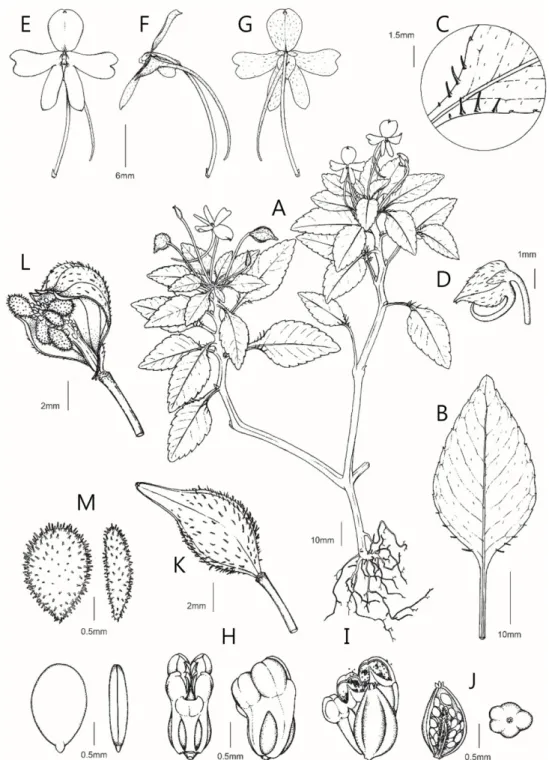
During the recent floristic survey, one species of Impatiens was collected at Knong Krapeur Mt. in the Cardamom Mountain Range of Cambodia that does not appear to be similar to previously described species (Figs. 1, 2). It is most similar to Impatiens noei Craib from Thailand (Craib, 1926), but a comparison with the type specimens and descriptions revealed that it differs from I. noei and is therefore described here as a new species.
*Author for correspondence: [email protected]
http://e-kjpt.org, © 2019 the Korean Society of Plant Taxonomists. This is an open-access article distributed under the terms of the Creative Commons Attribution Non-Commercial License (http://creativecommons.org/licenses/by-nc/4.0) which permits unrestricted non-commercial use, distribution, and reproduction in any medium, provided the original work is properly cited.
320 Bo-Yun KIM et al.
Taxonomic Treatment
Impatiens cardamomensis S. H. Cho, C. K. Lim & H. Won, sp. nov. (Figs. 1, 2). ─TYPE: Cambodia. Kampong Speu Province, Knong Krapeur Mt., sandstone area in forest margin, 11
o41'43.4"N, 103
o47'31.4"E, a.s.l. 950 m, 11 Nov 2015, Hyosig
Won, Changkun Lim, Seong-Hyun Cho, Phourin Chhang Won et al. 13209 (holotype, KB; isotypes DGU, HHU, KB).
Diagnosis: Impatiens cardamomensis is most similar to the Thailand endemic species I. noei Craib in habit but is readily distinguished from the latter by the ovate to widely ovate
Fig. 1. Impatiens cardamomensis S. H. Cho, C. K. Lim & H. Won. A. Habit. B. Leaf. C. Strigose-ciliate at leaf base. D. Developing flower bud. E–G. Mature flower. H, I. Developing androecium and gynoecium. J. Immature fruit. K, L. Mature fruit and seeds. M. Seeds. Won et al.
13113, 13209. Illustration by Kyung Soo Eo.
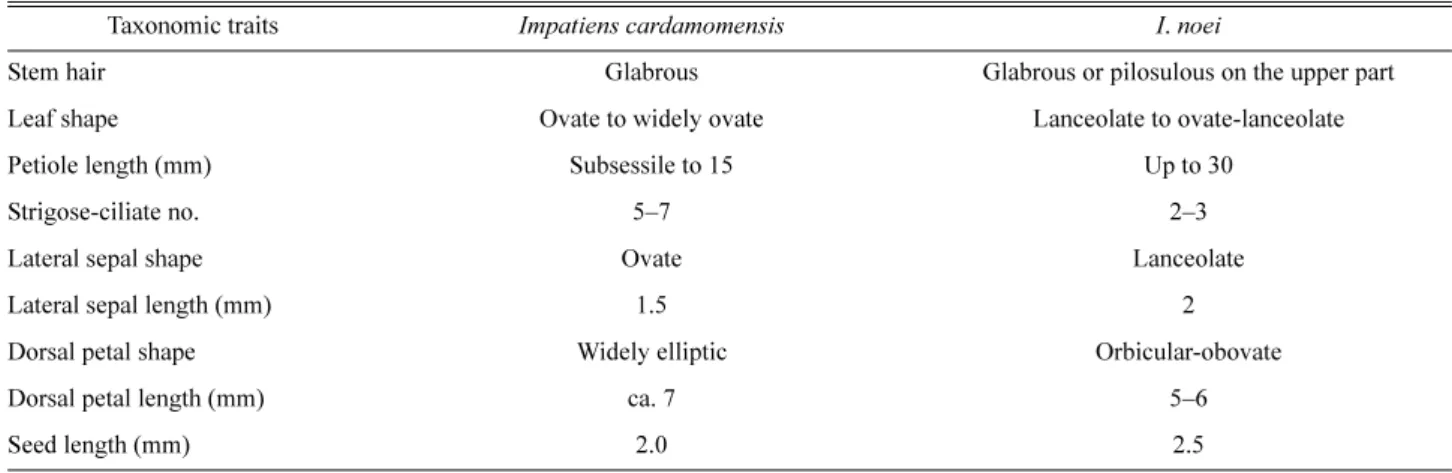
leaves, shorter petioles, widely elliptic dorsal petals and smaller seeds (Table 1).
Herbs, annual, terrestrial, hermaphroditic. Stems erect, 20–
30 cm tall, branched, glabrous. Leaves simple, alternate, crowded on upper part of branch; petioles subsessile to 15 mm;
leaf blade ovate to widely ovate, apex acute, mucronate, base
cuneate to attenuate, 1.0–4.0 × 0.6–2.2 cm, upper surface slightly pubescent, lower surface glabrous, secondary veins pinnate, 5 to 7 on each side of mid-vein, margin serrate, teeth mucronate, strigose-ciliate at base; strigose-ciliate, 5–7, 0.5–
1.0 mm long, purple. Flowers axillary, solitary, zygomorphic, minutely puberulous; pedicels slender, erect, brightly purplish
Fig. 2. Photographs of Impatiens cardamomensis S. H. Cho, C. K. Lim & H. Won. A. Habit. B, C. Flower. D. Strigose-ciliate at leaf base. E.Capsule. Photos by Seong-Hyun Cho.
322 Bo-Yun KIM et al.
red, 1.5–2.0 cm long (up to 3.5 cm in fruiting time), glabrous, bracteate at base; bracts triangular, ca 0.5 mm, mucronate;
lateral sepals 2, ovate, 1.5 mm long, glabrous; lower sepal funnel-form, pink, ca. 4 mm long, ca. 3 mm deep; spur 20–
22 mm long, slightly curved, glabrous; dorsal petal, widely elliptic, ca. 7 × 6.8 mm, apex mucronate; lateral united petals separate, bilobed, ca. 9 mm long; upper petals oblong, ca 7.0 × 5.2–5.5 mm; lower petals, 6.7–6.8 × 2.7–2.8 mm; androecium ca. 2.7 × 2.1 mm; stamens 5, connate, surrounding gynoecium;
filaments ca. 0.8 mm; ovary fusiform, minutely puberulous, ca.
2.0 × 1.2 mm; style glabrous, ca. 0.2 mm long; stigma 5. Fruit a capsule, fusiform, ca. 12 × 6.5 mm, pubescent, 26–39-seeded.
Seeds obovoid, slightly compressed, 2.0 × 1.2–1.3 mm, pubescent.
Flowering: October to November.
Distribution: Knong Krapeur Mt. in the Cardamom Mountain Range of Cambodia (Kampong Speu Prov., Koh Kong Prov.)
Habitats: Impatiens cardamomensis grows on sandstone tables in evergreen forest margins at 900 m a.s.l.. Endemic to Cambodia, I. cardamomensis is at present known only in the type locality.
Additional specimens examined (paratype): Cambodia.
Koh Kong Province: Knong Krapeur Mt., 11 Nov 2015, Won et al. 13113 (DGU, HHU, KB).
GenBank accession No. Won et al. 13113: MN699568, MN699569 (ITS).
Conservation status. Impatiens cardamomensis was collected in Knong Krapeur Mt. in the Cardamom Mountain Range of Cambodia. Until now, only two populations, consisting of ca. 300 individuals, has been discovered in the park area; therefore, it is preliminarily classified as data deficient (DD) according to the IUCN Red List criteria (IUCN, 2001).
ORCID:
Bo-Yun KIM https://orcid.org/0000-0002-1269-4068;
Hyosig WON https://orcid.org/0000-0001-7619-943X; Chang- Kun LIM https://orcid.org/0000-0002-1799-7818; Jae-Seo SHIN https://orcid.org/0000-0001-9632-1930; Yeong-Sil KIM https://orcid.org/0000-0002-2457-5242; Seong-Hyun CHO https://orcid.org/0000-0002-6406-1473
Acknowledgments
We thank Mr. Kyung Soo Eo for preparing the line drawing.
This work was supported by a grant from the National Institute of Biological Resources (NIBR), funded by the Ministry of Environment of the Republic of Korea (NIBR201906201).
Conflict of Interest
The authors declare that there are no conflicts of interest.
Literature Cited
Chen, Y., S. Akiyama and H. Ohba. 2007. Impatiens L. In Flora of China, Vol. 12. Hippocastanaceae through Theaceae. Wu, Z.
Y., P. H. Raven and D. Y. Hong (eds.), Science Press, Beijing and Missouri Botanical Garden Press, St. Louis, MO. Pp. 43–
113.
Cho, S.-H., P. Chhang and Y.-D. Kim. 2016. A Checklist for the Seed Plants of Cambodia. National Institute of Biological Resources, Ministry of Environment, Incheon, 272 pp.
Cho, S.-H., B.-Y. Kim, H.-S. Park, P. Chhang and Y.-D. Kim.
2017. Impatiens bokorensis (Balsaminaceae), a new species from Cambodia. PhytoKeys 77: 33–39.
Craib, W. G. 1926. Contributions to the Flora of Siam. Additamen- tum XVIII. Bulletin of Miscellaneous Information (Royal Botanic Gardens, Kew) 1926: 154–174.
Table 1. Comparison of key features of Impatiens cardamomensis S. H. Cho, C. K. Lim & H. Won and I. noei Craib.
Taxonomic traits Impatiens cardamomensis I. noei
Stem hair Glabrous Glabrous or pilosulous on the upper part
Leaf shape Ovate to widely ovate Lanceolate to ovate-lanceolate
Petiole length (mm) Subsessile to 15 Up to 30
Strigose-ciliate no. 5–7 2–3
Lateral sepal shape Ovate Lanceolate
Lateral sepal length (mm) 1.5 2
Dorsal petal shape Widely elliptic Orbicular-obovate
Dorsal petal length (mm) ca. 7 5–6
Seed length (mm) 2.0 2.5