44(3) : 291∼ 297 (2013)
291
LPS 로 유도된 RAW264.7 세포주에서 개화정도별 괴화 EtOH 추출물의 항염증 효과 비교연구
고원민1,2#·이동성3#·장 미2·김경수1,2·이희숙4·백흠영5·오현철1,2,3,4·김윤철1,2,3,4*
1원광대학교 약학대학 천연물신소재은행, 2원광대학교 약품연구소, 3원광대학교 한방체액조절연구센터,
4원광대학교 대학원 식품융복합학과, 5한국인스팜
A Comparison of Anti-inflammatory Effects of Sophorae Flos EtOH Extracts at the Different Flowering Stages on LPS-induced
Inflammation in RAW264.7 cells
Won-Min Ko1,2#, Dong-Sung Lee3#, Mi Jang2, Kyoung-Su Kim1,2, Hee-Suk Lee4, Hum-Young Baek5, Hyuncheol Oh1,2,3,4, and Youn-Chul Kim1,2,3,4,*
1Standardized Material Bank for New Botanical Drugs, College of Pharmacy, Wonkwang University, Iksan 570-749, Korea
2Institute of Pharmaceutical Research and Development,College of Pharmacy, Wonkwang University, Iksan 570-749, Korea
3Hanbang Body-Fluid Research Center, Wonkwang University, Iksan 570-749, Korea
4College of human environmental sciences, Department of food industry convergence, Wonkwang University, Iksan 570-749, Korea
5Korea INSpharm Research Institute, 1065 Daepo-ri, Dong-myeon, Hwasun-gun, Jeonnam 519-882, Korea
Abstract − Sophorae Flos (SF), a composite of flowers and flower-buds of Sophora japonica, has long been used in traditional Korean and Chinese medicines for the treatment of hemostasis and inflammation. In this study, we investigated anti-inflam- matory effect of four EtOH extracts at the difference in blooming stages of flowers on LPS-induced inflammation in RAW264.7 cells. We classified the flowers of Sophora japonica with SF-1 (length of flower is shorter than calyx), SF-2 (length of calyx is shorter than flower), SF-3 (full bloom), and SF-4 (not blooming at all). We examined HPLC analysis, whether quercetin and rutin are major component of these Sophorae Flos extracts or not. As a result, SF-1 contained quercetin, but the others did not.
In addition, quercetin, SF-1, and SF-4 act on the suppression of pro-inflammatory mediators including inducible nitric oxide synthase (iNOS), cyclooxygenase (COX)-2, nitric oxide (NO), prostaglandin E2 (PGE2) against lipopolysaccharide (LPS)- induced activation in RAW264.7 cells. Of these, SF-1 showed the best anti-inflammatory effect. These results suggest that Sophorae Flos with the highest content of quercetin would be used for the treatment of various inflammation diseases.
Key words − Sophorae Flos, anti-inflammation, collecting time, quercetin, RAW264.7 cells
괴화(槐花, Sophorae Flos)는 콩과에 속하는 회화나무 (Sophora japonica L.)의 꽃송이 혹은 꽃봉오리로서 신농본 초경(神農本草經)에 괴각(槐角)과 함께 상품(上品)으로 수재 되어있다.1)꽃이 피는 시기는 7~8월 경이며 한국, 중국 및 일본의 전역에서 생산된다.2)괴화는 괴화미(槐花米), 괴미 (槐米) 등으로 불리기도 하고, 역대 중국본초서(本草書)에는 회화나무의 괴실(槐實)을 괴화의 이명으로 기록하고 있으며, 조선시대 본초서에는 회화나무꽃이라 기록하고 있다. 괴화
는 한방약리학적으로 맛(味)은 쓰고 성질(性)은 서늘하고 간 과 대장으로 귀경(歸經)하여, 열을 내리고 피를 차게 하며 출혈을 멎게 하고, 혈압강하작용 및 중풍을 치료한다고 알 려져 있다.2)약리작용으로 지혈, 모세혈관투과성 감소, 혈압 강하, 콜레스테롤 감소, 항경련, 항궤양, 항방사능작용 등이 보고되었다.3-8) 괴화에는 rutin, quercetin 등의 flavonoid와 betulin, sophoradiol 등의 triterpenoid계열의 화합물을 함유 하고 있으며,9) rutin과 quercetin이 주성분으로 알려져 있다.
Rutin이 위장관에서 glucosidase에 의해 가수분해되어 생성 되는 quercetin은 강한 항산화 작용, 지혈작용10,11)이 보고되 어 있으며, quercetin을 콜레스테롤 함유식으로 사육한 실험
#
These authors contributed equally to this work.
*교신저자(E-mail):[email protected]
(Tel):+82-63-850-6823
동물에 경구투여하면 혈중 지질농도가 낮아진다고 알려져 있다. quercetin은 iNOS와 COX-2의 발현을 억제함으로써 LPS로 유도한 NO의 생성을 저해한다.12,13)
염증(inflammation)은 외래의 자극원이나 다른 질병에 대 한 생체의 방어 반응으로, 다양한 세포와 cytokine들이 관여 하는 일련의 과정이다. 이러한 과정은 lipopolysaccharide (LPS)와 같은 외부 자극이나 arachidonic acid 대사물과 같 은 내부 자극을 매개로 하여 대식세포(macrophage)나 과립 구(granulocyte) 등의 염증 관련 세포들의 염증 부위로의 유 입과 축적을 주요 특징으로 한다.14,15) 염증발생 시 염증부 위에 면역세포들이 침투되고 이들 세포들에 의해 여러 종 류의 화학물질 및 cytokine를 생산, 분비하여 생체방어 및 염증 반응을 일으킨다. 이들 면역세포 중 탐식 및 항원제공 에 관여하는 대식세포는 감염초기에 nitric oxide (NO), tumor necrosis factor-alpha (TNF-α) 등을 생산 분비하여 생체방어 에 중요한 역할을 한다.16-18) 이 물질들에 의한 생체방어 과 정에서 염증이 유발하기 때문에 일명 염증매개물질이라 하 기도 한다. 특히 대식세포에서 싸이토카인(cytokine)이나 lipopolysaccharide (LPS)와 같은 자극은 염증 반응 전사 인 자인 nuclear factor kappaB (NF-κB)를 활성화 시켜 inducible nitric oxide synthase (iNOS)와 cyclooxygenase-2 (COX-2)를 발현시키고, iNOS와 COX-2는 다시 NO와 prostaglandin E2 (PGE2)를 생성하여 염증반응을 일으킨
다.19,20) 특히 NO는 항박테리아, 항종양 등의 효과를 나타낼
수 있지만, 병리적 원인에 의해 과도하게 생성되어 분비되 면 염증을 유발하게 되고 과도한 혈관 확장에 의한 패혈성 쇼크 및 신경조직의 손상 등의 작용을 나타낼 수 있다고 알 려져 있다.21,22) NF-κB를 통해 활성화된 싸이토카인은 다시 NF-κB를 활성화시켜 cytokine cascade를 증폭하고 염증상 태를 확장시킨다.23) 이처럼 염증성 싸이토카인과 염증 매개 인자들은 염증과정에 주도적인 역할을 하기 때문에 이들의 비정상적인 생성을 효과적으로 조절하는 것이 염증성 질환 의 치료법으로써 제시되고 있다.
괴화는 회화나무의 꽃을 이용하는 생약으로써, 지금까지 는 개화 시기에 따른 지표물질의 함량과 그 약리활성과의 상관성에 관한 연구는 미흡한 실정이나, 회화나무 재배 시 플라보노이드 성분의 계절별 변화에 대한 연구가 보고된 바 있다.24) 본 연구에서는 전통적으로 알려진 괴화의 항염증 작 용을 바탕으로 하여, 괴화의 개화정도에 따라 나타나는 항 염증 효과의 차이를 비교하였다. 개화의 정도에 따라 꽃이 꽃받침보다 길이가 작은 경우, 꽃이 꽃받침보다 길이가 큰 경우, 완전 개화한 경우, 미개화한 경우로 나누어 각각의 개 화 정도에 따라 항염증 효과가 차이를 보이는지를 생쥐의 대식세포인 RAW264.7 세포주를 사용하여 비교하였다. 또 한 HPLC를 이용해서 각각의 지표물질의 함량분석을 진행 하여 quercetin의 함량에 따른 항염효과의 차이가 나타나는
지도 조사하였다.
재료 및 방법
실험재료 − 본 실험에 사용한 괴화는 2012년 8월 대전 광역시 둔산동 햇님공원에 식재된 회화나무 중 한 그루에 서 채집하였으며, 형태학적 평가를 통하여 동정하였고 표 본시료는 천연물신약표준화소재은행에 보관하였다. 개화정 도에 따른 4종류의 괴화 에탄올 추출물(NNMBS000303-1, NNMBS000304-1, NNMBS000305-1, NNMBS000306-1)은 천연물신약표준화소재은행에 보관하고 있다.
시료제조 − 꽃이 꽃받침보다 길이가 작은 괴화 1 g (NN- MBS000303-1, SF-1), 꽃이 꽃받침보다 길이가 큰 괴화 1 g (NNMBS000304-1, SF-2), 완전 개화한 괴화 1 g (NNMBS- 000305-1, SF-3), 미개화한 괴화 1 g (NNMBS000306-1, SF- 4)을 각각 100% 에탄올 200 ml로 40oC에서 1시간 동안 초 음파추출을 한 뒤 여과하고, 2차 추출을 1차 추출과 같은 조건으로 한 뒤 여과한 다음 여액을 합한 후 감압농축하여 에탄올 추출물(SF-1: 0.08 g, SF-2: 0.13 g, SF-3: 0.24 g, SF-4: 0.5g)을 얻었다.
시약 및 기기 − RPMI 1640 배지와 trypsin-ethylene- diaminetetraacetic acid (EDTA), fetal bovine serum (FBS) 는 Gibco Laboratories사에서 구입하였다. Lipopolysaccharide (LPS)와 3'-(4,5-dimethylthiazol-2-yl)-2,5-diphenyltetrazolium bromide (MTT)는 Sigma사에서 구입하였다. 96-Well tissue culture plates와 기타 tissue culture dishes는 Falcon사 제품 을 이용하였다. 흡광도는 BioRad사의 Microplate Reader를 이용하여 측정하였다.
세포배양 − RAW264.7 대식세포는 ATCC에서 동결상태로 구입하였다. RAW264.7 대식세포는 FBS (10%)과 penicillin (100 U/ml)와 streptomycin sulfate (100 µg/ml)가 함유된 RPMI 1640배지에서 습한 조건의37oC, 5% CO2 incubator 에서 배양하였다.
Nitrite Assay − NO생성 양 측정하는 nitrite assay는 Titheradge25)등의 방법에 의해 다음과 같이 측정하였다. 배 양된 세포를 4×10⁵ cells/well 수준으로 24 well plate에 1 ml 씩 배양한 다음 24시간 동안 배양하고, 24시간 후 medium 을 제거한 후 RPMI1640으로 희석된 각 농도별 시료 처리 후 LPS (1 µg/ml)를 처리하여 24시간 후 세포에서 medium 으로 분비되어 나온 NO의 양을 Griess 시약[0.1% (w/v) N- (1-naphathyl)-ethylenediamine and 1% (w/v) sulfanilamide in 5% (v/v) phosphoric acid]을 사용하여 반응하였다. 반응 후 ELISA microplate reader (Bio Rad Laboratories Inc., California, USA)를 사용하여 540 nm에서 측정 하였다.
HPLC 분석 − 본 연구에서 사용한 괴화 추출물은 HPLC 를 사용하여 함유 성분의 패턴을 분석하였다. 사용한 HPLC
장치는 Sykam S2100 system (Sykam, 독일)이었으며, 컬럼 은YMC-Triart C18 (4.6×150 mm, 5 µm)을 사용하였다. 이 동상은 acetonitrile, (JT Baker, 영국), 0.1% formic acid in water를 사용하였으며, 온도는 실온이었으며, 유속은 분당 1 ml이었다. 크로마토그램은Sykam S3200 UV/VIS Detector (Sykam, 독일)를 이용하여 254 nm에서 검출하였다. 이동상 용매로는 acetonitrile:water (1:4)에서 acetonitrile:water (2:3) 의 조성으로 50분간 변화시켰다.
Western Blot Analysis − Western blot analysis는 Lee26) 등의 방법에 의해 다음과 같이 측정하였다. RAW264.7 대 식세포를 6-Well tissue culture plates에 5×10⁵ cells/well 밀 도로 24시간 배양한 후 각각의 시료를 농도별로 처리하였 다. RAW264.7 대식세포에 RIPA buffer를 첨가한 다음, 4oC, 16,000 rpm에서 25분간 원심분리하고 상등액을 튜브에 옮 겼다. 단백질 정량은 BSA 단백질 실험 키트를 이용하였고 각각의 시료를 7.5% SDS-polyacrylamide gel에서 영동하고 nitrocellulose membrane (NC membrane)으로 전사하였다.
전사된 NC membrane을 5% 무지방유가 포함된 신선한 blocking buffer (0.1% Tween 20 in Tris-buggered saline) 에서 blocking한 후 iNOS, COX-2 antibody를 1:1000으로
희석하여 넣고 1시간 동안 반응시켰다. 다시 2차 antibody (Anti-rabbit IgG)를 1:1000으로 희석하여 넣고 1시간 동안 반응한 다음, ECL 용액을 1:1로 잘 섞어서 NC membrane 위에 가하여 발광시키고 암실에서 X선 필름에 감광한 후 현상하였다. 같은 방법으로 actin antibody를 이용하여 actin 을 측정하였다.
EIA에 의한 PGE2 측정 − PGE2 생성 양 측정은 Lee27) 등 의 방법에 의해 다음과 같이 측정하였다. PGE2의 측정은 항 체(lyophilized prostaglandin E2 conjugate to horseradish peroxidase)를 사용하여 prostglandin E2 enzyme immuno- assay system (EIA, Amersham Pharmacia Biotech, Inc., Piscataway, NJ)을 이용하였다.
통계처리 − 본 실험의 통계처리는 Student’s test 방법을 사 용하였으며, 값은 평균과 표준오차로 나타내었다.
결과 및 고찰
본 연구에서는 괴화의 개화정도의 차이에 따른 항염증 효 과를 검토하기 위해서, RAW264.7 대식세포에서 LPS로 유 도한 iNOS, COX-2 단백질의 발현 정도와 그에 따른 생성
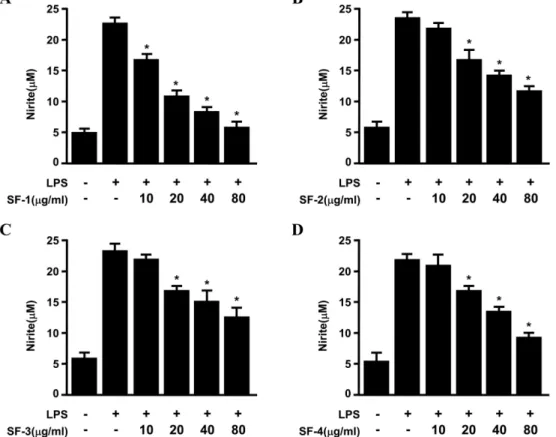
Fig. 1. Effects of Sophorae Flos (SF) on nitrite production in RAW264.7 macrophages stimulated with LPS. Cells were pre-treated for 3 h with indicated concentrations of Sophorae Flos extract (SFE), and stimulated 24 h with LPS (1µg/mL). The concentration of nitrite (A), (B), (C), (D) were determined as described under Materials and method. Data represent the mean values of three experiments ± SD. *p<0.05 compared to the group treated with LPS.
물인 NO, PGE2 생성을 측정하였다. 괴화의 함유 성분 중 항염증 작용물질로 알려진 quercetin의 NO 생성 억제 효과 와 iNOS, COX-2 단백질 발현의 억제 효과를 확인하였고, 개화정도의 차이에 따른 각 괴화 에탄올 추출물에 대한 HPLC 패턴 분석을 실시하여 함유성분과 항염증 효과와의 상관관계에 관하여 검토하였다.
NO는 IL-1β, TNF-α, LPS 등과 같은 염증유발인자 및 암 발생인자에 의해 발현되는 inducible nitric oxide synthase (iNOS)에 의해 과량 발생하며,28) 생성된 NO의 지속적 과발 현은 점막손상을 촉진하고, 그 결과 일부에서는 암 발생 등 의 질환을 유도한다.29) 괴화 추출물을 농도별로 RAW264.7 대식세포에 처리 하였을 때, 세포 독성을 나타내지 않은 10, 20, 40, 80µg/ml을 실험 가능한 농도로 정하여 실험을 진행 하였다(data not shown). RAW264.7 대식세포에 괴화의 각 시기별 추출물을 10, 20, 40, 80 µg/ml로 처리한 후, 3시간 동안 incubator에 배양하고 LPS 1 µg/ml을 처리하였고, 24 시간 후에 NO의 생성을 확인하였다(Fig. 1). 그 결과 4개의 시료 모두 NO의 생성을 억제하는 효과가 있었으나 SF-1과 SF-4에서 NO의 생성이 농도 의존적으로 억제되는 효과가 우수한 것을 확인하였다. 같은 방법으로 배양한 RAW264.7
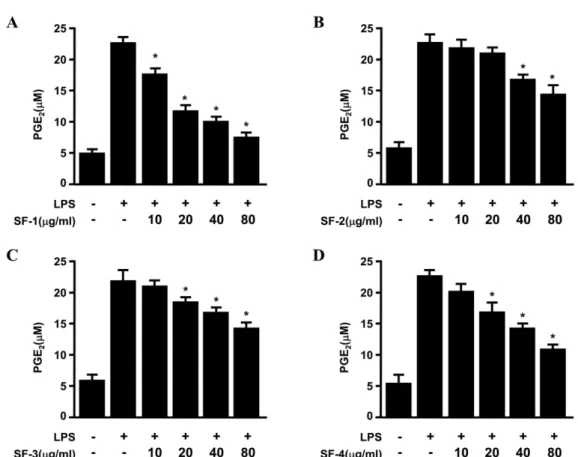
대식세포에서 생성된 PGE2 또한 SF-1과 SF-4에서 SF-2와 SF-3에 비해 PGE2 생성이 억제되는 효과가 우수하였다(Fig.
2). 다음으로, RAW264.7 대식세포에 개화정도 차이별 괴화 추출물을 40, 80 µg/ml로 3시간 동안 전처리한 후, LPS 1µg/ml을 처리하고 24시간 후에 대표적인 염증발현 protein 인 iNOS와 COX-2의 발현 정도를 Western blot을 통해 관 찰하였다(Fig. 3). 그 결과, NO와 PGE2의 경향과 마찬가지 Fig. 2. Effects of Sophorae Flos (SF) on PGE2 production in RAW264.7 macrophages stimulated with LPS. Cells were pre-treated for 3 h with indicated concentrations of SFE, and stimulated 24 h with LPS (1µg/mL). The concentration of PGE2 (A), (B), (C), (D) were determined as described under Materials and method. Data represent the mean values of three experiments ± SD. *p<0.05 compared to the group treated with LPS.
Fig. 3. Effects of Sophorae Flos (SF) on protein iNOS and COX-2 expression in RAW264.7 macrophages stimulated with LPS. Cells were pre-treated for 3 h with indicated concentra- tions of SFE, and 24 h with LPS (1µg/mL). Western blot analysis was performed as described in Materials and method, and representative blots of three independent experiments are shown.
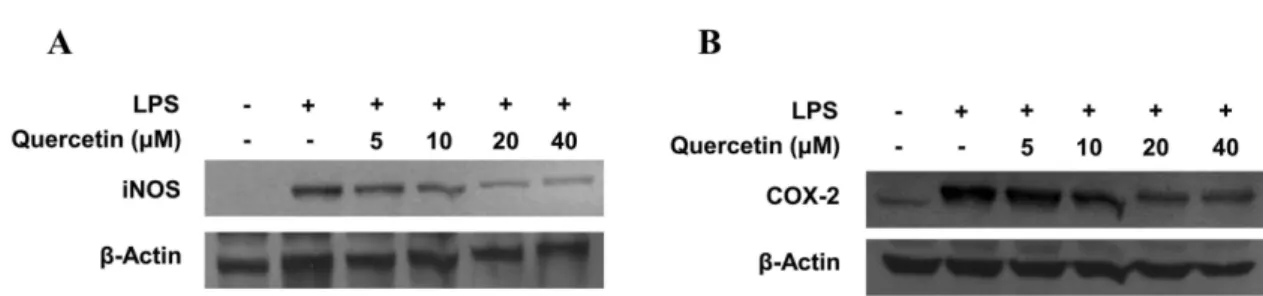
로 LPS(1 µg/ml)로 유도된 iNOS와 COX-2의 발현이 SF-1 과 SF-4에서 억제되는 것을 확인할 수 있었다. 다음으로, 괴 화에 함유된 성분 중 주요 flavonoid류인 rutin과 quercetin 의 표준품을 이용하여 각각의 단일 화합물이 가지는 항염 증 효과를 확인하였다. Quercetin의 배당체인 rutin은 본 실 험에서 유의한 항염증효과를 나타내지 않았다(data not shown). 대식세포에 quercetin을 5, 10, 20, 40 µM로 처리한 후, 3시간 동안 incubator에 배양하고 LPS 1 µg/ml을 처리 하고 24시간 후에 western blot을 통하여 iNOS와 COX-2의 발현 정도를 확인하였고(Fig. 4.), NO와 PGE2의 생성 또한 확인하였다(Fig. 5). LPS (1 µg/ml)로 유도된 iNOS와 COX- 2의 발현은 농도 의존적으로 억제되었으며, NO와 PGE2의 생성도 농도 의존적으로 억제되었다.
HPLC chromatogram 분석을 통해 각 개화정도별 괴화 에 탄올추출물의 rutin과 quercetin의 함유 패턴을 검토한 결과, rutin는 괴화의 모든 시료에서 유사한 HPLC pattern을 나타 냈으나, quercetin은 SF-1에서 현저하게 높은 함유량을 나타 냄을 알 수 있었다(Fig. 6).
본 연구를 통해서 괴화의 개화정도별 에탄올 추출물의 항 염증 효과를 비교한 결과, SF-1과 SF-4에서 유의한 항염증
효과가 나타났고, 괴화의 함유성분 중 quercetin이 우수한 항염증 효과가 있음을 확인하였다. HPLC pattern 분석을 통 해 SF-1에 quercetin이 다량 함유되어 있음을 확인하였다.
본 연구에서는 정량적인 품질평가를 수행하지 않았기 때문 에 괴화의 항염증 효과와 quercetin 함량과의 상관관계를 단 정할 수는 없으나, 최소한 SF-1의 경우 iNOS, COX-2 발현 등 실험결과와 quercetin 함유량과의 밀접한 관련성이 추정 된다. 이상의 결과로부터 괴화는 회화나무의 미개화시기에 해당하는 꽃봉오리를 약용으로 사용하는 것이 바람직하다 고 판단된다.
결 론
본 연구는 괴화의 항염증 효과가 괴화의 개화정도에 따라 차이가 나타나는지에 대해 연구하였다. 꽃 부분의 길이가 꽃받침 부분의 길이에 비하여 작은 시료(SF-1)와 미개화한 시료(꽃받침만 존재하는 경우; SF-4)에서 우수한 항염증 효 과가 나타냄을 확인하였다. 괴화의 항염증 효과는 완전 개 화한 시기보다 미개화 또는 꽃봉오리 시기일 때 가장 우수 한 활성을 나타내는 것으로 판단된다. 또한, rutin과 quercetin Fig. 4. Effects of quercetin on protein iNOS and COX-2 expression in RAW264.7 macrophages stimulated with LPS. Cells were pre-treated for 3 h with indicated concentrations of quercetin, and 24 h with LPS (1µg/mL). Western blot analysis was performed as described in Materials and method, and representative blots of three independent experiments are shown.
Fig. 5. Effects of quercetin on NO and PGE2 production in RAW264.7 macrophages stimulated with LPS. Cells were pre-treated for 3 h with indicated concentrations of quercetin, and stimulated 24 h with LPS (1µg/mL). The concentrations of nitrite (A), PGE2 (B) were determined as described under Materials and method. Data represent the mean values of three experiments ± SD. *p<0.05 compared to the group treated with LPS.
의 HPLC pattern을 검토한 결과, 우수한 항염증 활성물질 인 quercetin의 함량이 꽃봉오리 시기인 SF-1에서 가장 많 이 함유된 것을 확인하였다. 이상의 결과로부터 괴화는 항 염증 목적으로 이용할 경우, 회화나무의 미개화시기에 해당 하는 꽃봉오리를 약용으로 사용하는 것이 바람직하다고 판 단된다.
인용문헌
1.서부일, 이제현, 최호영, 권동렬, 부영민. (2004) 한약본초 학, 543, 영림사, 서울.
2. Lee, K. S. and Shin, M. K. (1997) The encyclopedia of ori- ental herbal medicine, 381, Jungdam, Seoul, Korea.
3. Kite, G. C., Veitch, N. C., Boalch, M. E., Lewis, G. P., Leon, C. J. and Simmonds, M. S. (2009) Flavonol tetraglycosides from fruits of Styphnolobium japonicum (Leguminosae) and the authentication of Fructus Sophorae and Flos Sophorae.
Phytochemistry 70: 785-794.
4. Kim, J. M. and Yun Choi, H. S. (2008) Anti-platelet effects of flavonoids and flavonoid-glycosides from Sophora japonica.
Arch. Pharm. Res. 31: 886-890.
5. Tang, Y. P., Zhu, H. X. and Duan, J. A. (2008) Two new isoflavone triglycosides from the small branches of Sophora japonica. J. Asian Nat. Prod. Res. 10: 65-70.
6. Tang, Y., Yang, R., Duan, J. A., Shang, E., Su, S., Zhu, M.
and Qian, D. (2008) Isoflavone tetraglycosides from Sophora japonica leaves. J. Nat. Prod. 71: 448-450.
7. Jung, C. H., Zhou, S., Ding, G. X., Kim, J. H., Hong, M. H., Shin, Y. C., Kim, G. J. and Ko, S. G. (2006) Antihyper- glycemic activity of herb extracts on streptozotocin-induced diabetic rats. Biosci. Biotechnol. Biochem. 70: 2556-2559.
8. Kim, B. H., Chung, E. Y., Min, B. K., Lee, S. H., Kim, M. K., Min, K. R. and Kim, Y. (2003) Anti-inflammatory action of legume isoflavonoid sophoricoside through inhibition on cyclooxygenase-2 activity. Planta Med. 69:474-476.
9.생약교재편찬위원회 (2006) 생약학, 565, 동명사, 서울.
10. Moon, H. I., Ahn, K. T., Lee. K. R. and Zee, O. P. (2000) Fla- Fig. 6. HPLC chromatograms of the various extracts at the differenent blooming stages of Sophorae Flos.
vonoid compounds and biological activities on the aerial parts of Angelica gigas. J. Pharm. Soc. Kor. 44: 119-127.
11. Ishida, H., Umino. T., Tsuji, K. and Kosuge, T. (1989) Studies on the antihemostatic substances in herbs classified as hemo- statics in traditional Chinese medicine. I. On the antihemo- static principles in Sophora japonica L. Chem. Pharm. Bull.
37: 1616-1618.
12. Kang, T. B. and Liang. N. C. (1997) Studies on the inhibitory effects of quercetin on the growth of HL-60 leukemia cells.
Biochem. Pharmacol. 54: 1013-1018.
13. Shen, S. C., Lee, W. R., Lin, H. Y., Huang, H. C., Ko, C. H., Yang. L. L. and Chen, Y. C. (2002) In vitro and in vivo inhib- itory activities of rutin, wogonin, and quercetin on lipopolysaccharide-induced nitric oxide and prostaglandin E(2) production. Eur. J. Pharmacol. 446: 187-194.
14. Zamora, R., Vodovotz, Y. and Billiar, T. R. (2000) Inducible nitric oxide synthase and inflammatory diseases. Mol. Med.
6: 347-373.
15. Trowbridge, H. O. and Emling, R. C. (1997) Inflammation: a review of the process, 5th ed. Quintessence Pub. Co., Chi- cago.
16. Arenzana-Seisdedos, F., Teyton, L. and Virelizier, J. L. (1987) Immunoregulatory mediators in the pathogenesis of rheu- matoid arthritis. Scand. J. Rheumatol. Suppl. 66: 13-17.
17. Le, J. and Vilcek, J. (1987) Tumor necrosis factor and inter- leukin 1: cytokines with multiple overlapping biological activities. Lab. Invest. 56: 234-248.
18. Snyder, S. H. and Bredt, D. S. (1992) Biological roles of nitric oxide. Sci. Am. 266: 68-71.
19. Shew, R. L., Papka, R. E., McNeill, D. L. and Yee, J. A.
(1993) NADPH-diaphorase-positive nerves and the role of nitric oxide in CGRP relaxation of uterine contraction. Pep- tides. 14: 637-641.
20. Kwqamata, H., Ochiai, H., Mantani, N. and Terasawa, K.
(2000) Enhanced expression of inducible nitric oxide syn-
thase by Juzen-taiho-to in LPS activated RAW 264.7 cells, a murine macrophage cell line. Am. J. Chin. Med. 28: 217-226.
21. Wu, G. H., Zhang, Y. W. and Wu, Z. H. (2001) Modulation of postoperative immune and inflammatory response by immune-enhancing enteral diet in gastrointestinal cancer patients. World J. Gastroenterol. 7: 357-362.
22. Bryan, N. S. (2006) Nitrite in nitric oxide biology: cause orconsequence? A system based review. Free Radic. Biol.
Med. 41: 691-701.
23. Ghosh, S., May, M. J. and Kopp, E. B. (1998) NF-κB and REL proteins: Evolutionarily conserved mediators of immune responses. Ann. Rev. Immunol. 16: 225-260.
24. Gevrenova, R., Kitanov, G. and Ilieva, D. (2007) Ontogenetic and seasonal variation in the flavonoid composition of Sophora japonica cultivated in Bulgaria. Pharm. Biol. 45:
149-155.
25. Titheradge, M. A. (1998) The enzymatic measurement of nitrate and nitrite. Meth. Mol. Biol. 100: 83-91.
26. Lee, D. S., Jeong, G. S., Li, B., Park, H. and Kim, Y. C.
(2010) Anti-inflammatory effects of sulfuretin from Rhus verniciflua Stokes via the induction of heme oxygenase-1 expression in murine macrophages. Int. Immunopharmacol.
10: 850-858.
27. Lee, D. S., Jeong, G. S., Li, B., Park, H. and Kim, Y. C.
(2010) Anti-inflammatory effects of sulfuretin from Rhus verniciflua Stokes via the induction of heme oxygenase-1 expression in murine macrophages. Int. Immunopharmacol.
10: 850-858.
28. Tenhunen, R., Marver, H. S. and Schmidt, R. (1970) The enzymatic catabolism of hemoglobin: stimulation of microso- mal hemeoxygenase by hemin. J. Lab. Clin. Med. 75: 410- 421.
29. Knowles, R. G. and Moncada, S. (1994) Nitric oxide syn- thases in mammals. Biochem. J. 298: 249-258.
(2013. 8. 6 접수; 2013. 8. 30 심사; 2013. 9. 13 게재확정)