Journal of Internet Computing and Services(JICS) 2015. Dec.: 16(6): 79-88 79
An Improved Combined Content-similarity Approach for Optimizing Web Query Disambiguation
ShahidKamal
1RolianaIbrahim
1**Imran Ghani
1ABSTRACT
The web search engines are exposed to the issue of uncertainty because of ambiguous queries, being input for retrieving the accurate results. Ambiguous queries constitute a significant fraction of such instances and pose real challenges to web search engines.
Moreover, web search has created an interest for the researchers to deal with search by considering context in terms of location perspective. Our proposed disambiguation approach is designed to improve user experience by using context in terms of location relevance with the document relevance. The aim is that providing the user a comprehensive location perspective of a topic is informative than retrieving a result that only contains temporal or context information. The capacity to use this information in a location manner can be, from a user perspective, potentially useful for several tasks, including user query understanding or clustering based on location. In order to carry out the approach, we developed a Java based prototype to derive the contextual information from the web results based on the queries from the well-known datasets. Among those results, queries are further classified in order to perform search in a broad way. After the result provision to users and the selection made by them, feedback is recorded implicitly to improve the web search based on contextual information. The experiment results demonstrate the outstanding performance of our approach in terms of precision 75%, accuracy 73%; recall 81% and f-measure 78% when compared with generic temporal evaluation approach and furthermore achieved precision 86%, accuracy 71%; recall 67% and f-measure 75% when compared with web document clustering approach.
☞
keyword : Content similarity, query disambiguation, web search, location, temporal information1. INTRODUCTION
In recent times, web search optimization has become a very active research area among professionals from both the industry and the academia involved in information retrieval and web search [1].This is because it is most likely that Internet and search engines have become essential gears in our daily life.
Regardless of marvelous improvements being made to optimize the web search over the last decade, still much has to be done to deal with the ever-increasing size of the web and needs of the users.
A collection of search results that correspond to a search query are retrieved by conventional search engines. Among these search results, some may lead a user to those internet resources that are different to his/her interests, even though having similarity with the search query. Often this situation arises when search queries are related to more than one topic,
1
Faculty of Computing, Universiti Teknologi Malaysia (UTM), 81310 skudai, Johor Malaysia
*
Corresponding author ([email protected])
[Received 4September 2015, Reviewed 12 September 2015, Accepted 17November 2015]
some or all of which being of little or no interest to the user, in which case the search results are produced that are descriptive of each of the different topics[2].The search result acquirement process (See Figure 1) begins with a query defined by a user. Based on this query, a document search is conducted in different data sources for example Yahoo, Google etc. in general, between 50-200 results from traditional search engines are collected containing a minimum URL, a snippet and a title and returned back to the user[3].
In pursuit of web search optimization, the Temporal Information Retrieval (T-IR) has gained greater attention in recent years. However, majority of these solutions either focus on development of suitable tools or perform behavioral analysis based on log data. Significant numbers of user search queries have strong temporal components or characteristics. These are the queries whose underlying intent may be to obtain newest information, past or anticipated events and largely depend on time [4].
Context is an important source of information in computing environments. The term context is defined by the authors of [5] as “any information that can be used to characterize the situation of an entity”.
ISSN 2287-1136 (Online)
http://www.jksii.or.kr
Figure 1. Conventional Search Process
An entity is a person, place, or object that is considered relevant to the interaction between a user and an application, including the user and applications themselves. Based on the information being defined as context, the query disambiguation can be greatly improved by applying contextual information[1].
In essence, we focus on disambiguating a text query with respect to its contextual as well as temporal purpose and propose a combined approach that takes into account the contextual and temporal information exist in the search results.
Furthermore, we have introduced a different concept of utilizing implicit user feedback based on the selection frequency for the purpose of refining the search results according to the user requirements. In essence, our method is a three stage process, taking the identified ambiguous queries from the well-known datasets[6, 7] to make them clear in concept with respect to defined parameters i.e. location and year in this case. Based on those queries, the search results are refined according to the user requirements having connectivity with the text query. Furtherance in, the user selects the results and on the basis of their selection, the search process is refined to get more accurate results accordingly.
In this paper, acombined methodology has been created containing on relevant (location) and temporal (year) data to be transformed for improved web information retrieval. So as to assess the methodology, two current methodologies[1, 8]
have been chosen for the benchmarking. An algorithm has additionally been proposed for the better hunt as indicated by user needs. The methodology is focused around the algorithm and the results are defined in such a path, to the point that it can understand the logical and additionally transient data
accordingly of user queries. The remainder of this paper is structured as follows. In section 2 we present the related work.
In section 3 we introduce our methodology. Result and discussion are given in section 4. Finally, we conclude this paper in section 5 with some final remarks and future research directions.
2. RELATED WORK
Disambiguating the search intent and improving the accuracy of resulting information is a hot research area where numerous contributions have been made to address these issues. It is widely believed that some queries submitted to search engines are ambiguous by nature e.g. World Cup, Cultural Show etc. Different studies have investigated the inherent ambiguity issues of search queries in various ways.
The work presented in [9, 10] describes what ambiguous queries are. For instance referring to word “java” in search query, it is not clear whether the user intent is the application or the Indonesian city.In information retrieval, removal of ambiguity is of paramount importance both from the user and system perspective [11]. In this section we briefly describe the various contributions that have been made for query disambiguation and search optimization.
Ferragina and Scaiella [12] addressed the problem of query disambiguation by employing a voting system that resolved all ambiguous terms simultaneously. Their system makes use of various characteristics associated with different fragments of the input strings and completely overlooks the temporal and contextual features.Alonso et al. [13] first introduced the temporal clustering on the basis of topics and time. Ricardo, at al. [14]highlighted the disambiguation of text queries with respect to temporal feature. They proposed a two-stage process where relevant temporal expressions are extracted from results and then grouped into same clusters with respect to common year. Their approach was based on the idea of finding one non trivial term in text and focused on temporal clustering.
Their work solely relies on temporal features thereby compromising the accuracy of the results.
In a new way, Anastasiu, D.C, et al [1] investigated the
problem of query disambiguation by making use of keywords
search and contextual information. First the articles were
retrieved on the basis of both combined fragments of query as well as contextual terms. Next they retrieved the articles based on only query terms and finally similarities were computed. Eventually, the commonly retrieved results were presented to users for their selection.Loia et al. [15] has exploited the user behavior and preferences that are extracted during user’s navigation to present the personalized clusters.Yu and Jeon[16] have proposed a context-aware recommender system. In order to provide preferable items to the user, the system uses the user’s history and current context to filter the content-based information.
Richardson et al. [17]analyzed the user feedback as clicks on ads and used a method to predict user actions. The user feedback for web query disambiguation has not been taken into account previously up to extent of our knowledge.
Nevertheless [18]suggested users a solution so they can directly provide feedback and can utilize this feedback for extracting the information, however, it lacks in usage of user feedback properly in order to improve the search results. Most of the work has been done in query disambiguation as mentioned above, but the problem has still not been resolved completely.
In search results, certainly there exist errors because user feedback has not been given weight. In this paper, we employ user feedback for search results refinement at continuous level that can reduce the disambiguation constantly.
3. PROPOSED METHODOLOGY
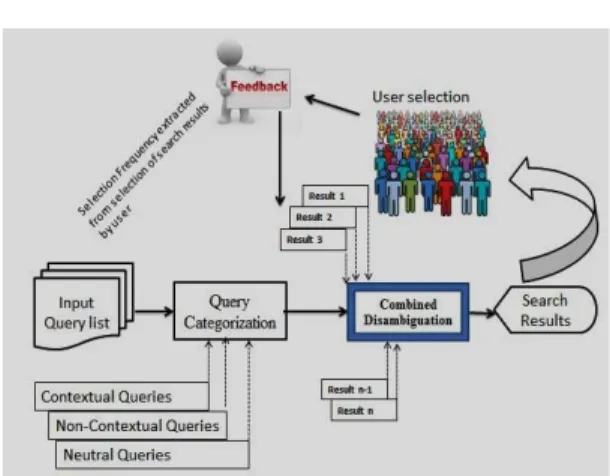
Research methodology is an academia established regularity framework for the collection and evaluation of existing knowledge for the purpose of arriving at, and validating the new knowledge. Research methodology not only frames the study but also identify the tools, strategies, ad criteria for the success of the research. In order to carry out this research, the methodology is based on a hybrid approach, i.e. a combination of exploratory research and experimentation. The research work focuses on the web queries ambiguity identification and disambiguation approaches and their correctness for web information retrieval. The Figure 2 below presents the hybrid procedure for the web query disambiguation that has been proposed in this paper.
Figure 2. Proposed Research Methodology
The following sub-sections describes the details of the each step in order understand the functioning of each component in the proposed methodology.
3.1 QUERY INPUT
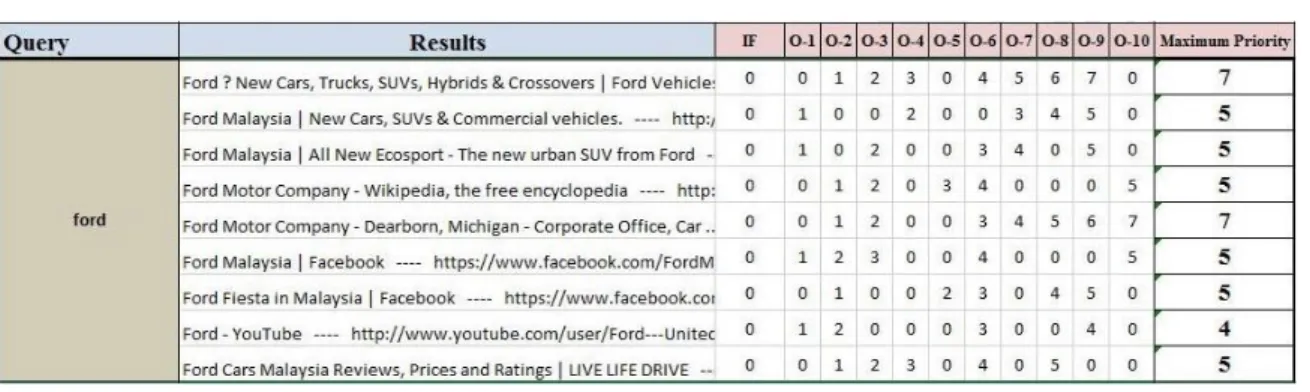
In this component of the proposed approach, we deal with the input queries where the availability of contextual information is helpful in refining the search results. We denote the input query by q and consider a result set n of 10 entries against each query of two different datasets namely;
GISQC_DS andAMBIENT datasetsshown in Figure.3 and Figure.4 independently. We use Google Web Services for information retrieval in accordance with the input queries.
Figure 3. Search results against query “harry potter”
Figure 4. Search results against query “Locust”
3.2 QUERY CATEGORIZATION
After taking the query from user, next we categorize it in accordance with its concept ambiguity. Similar approach has been adopted in [19-21] where three different types of concept queries are defined: ambiguous, broad and clear. In our approach, we further classify the ambiguous queries on the basis of both contextual and temporal information into contextual (location based), non-contextual (year based), and ambiguous given in Table 1 below.
Table 1. Different types of queries categorization and distribution percentage values
Total Number of Queries (450) [GISQC-DS]Query Type No: of Queries Query Percentage (%)
Ambiguous 220 49
Clear 176 39
Broad 54 12
Input: Ambiguous Queries (220)
Contextual 62 28
Non-contextual 51 23
Ambiguous 107 49
Improvement Input: Queries (450)
Ambiguous 107 24
Clear 289 64
Broad 54 12
Input: Ambiguous Queries (44) [ Ambient Dataset]
Contextual 23 52
Non-Contextual 13 30
Ambiguous 8 18
3.3 SEARCH RESULT SELECTION AND USER FEEDBACK
In this step, the obtained results are clarified based on the nature of the information found in query i.e. temporal as well as contextual comprising of location in form of country name or city name. After organizing the results, the similarities are computed in order to extract the most desired information from the search records. Then the results will be presented to the users for selection according to their preference and in the way of their selection made, the implicit feedback based on selection will be recorded to be utilized further in refinement. The Figure 5 below presents a snapshot of the results being displayed and user feedback recorded in form of selection frequency.
4. RESULTS AND DISCUSSION
The primary goal of our query disambiguation approach is to improve the accuracy of the search results according to user requirements. For the evaluation of an information retrieval mechanism, the most commonly used measures are precision, accuracy, recall, and F1-measure. In informal retrieval context, precision (Eq.1) represent the percentage relevance of the retrieved documents with the user’s information needs.
Accuracy (Eq.2) is the degree of closeness of retrieved documents to the actual intent of user. Similarly, recall (Eq.3) is the fraction of documents that are relevant to the query that are successfully retrieved. Likewise, F1-measure (Eq.4) is the weighted harmonic mean of precision and recall.
Where True Positive (TP) is the number of locations /years
are correctly identified as relevant, True Negative (TN) is the
number of locations /years correctly identified as irrelevant or
incorrect, False Positive (FP) is the number of locations /years
wrongly identified as irrelevant and False Negative (FN) is the
Figure 5. Results selection frequency in result of different responses
On comparison of precision parameter under evaluation for the proposed approach and existing General Temporal Evaluation (GTE) approach used by [22], the same dataset set is analyzed and results are plotted on the basis of precision, accuracy, recall and f-measure. The Table 2 presents the results being derived after execution.
Table 2. Results obtained using GISQC data set
Approach QueryCount Performance Parameters
GTE 220 Precision Accuracy Recall F-measure
0.64 0.85 0.72 0.78
Our approach
@ 61 0.70 0.65 0.79 0.74
@ 122 0.73 0.71 0.80 0.76
@ 183 0.73 0.74 0.82 0.77
@ 220 0.83 0.82 0.85 0.84
Overall
(@220) 0.75 0.73 0.81 0.78
Improvement 0.11 -0.12 0.09 0
Although our approach lacks in accuracy in compraison with GTE but however the overall precision and recall gain is 11%
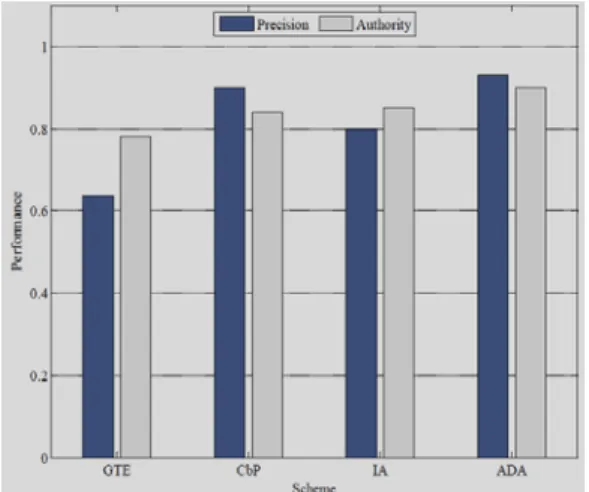
and 9% respectively. Though it seems marginal improvement but the improvement is progressively increasing over the number of queries being increased. This trend leed to the conclusion that proposed approach will produce more precised results when number of queries will be higher. The Figure 6 shows the performance graph of our approach when it is compared with the GTE at different number of queries. The significant difference between our approacha GTE is that we have applied the progressive query evaluation technqiue to correctly observe the performance while GTE has taken all the queries at once for the purpose.
Figure 6. Comparative results with GTE
In the above Figure 6, we have used legend comprising four
IR measures namely; precision as in blue line, accuracy as in
red line, recall as in green line and f-measure as in purple
colored line. The Figure 6is based on the data presented in the
Table 2earlier. In comparison with the precision obtained
through GTE, our approach has achieved relative performance
while in different segments of the queries. Henceforth at overall
our approach attained the performance 0.75 and outperformed
the GTE by achieving 0.11 more percentage shown in the Figure
6. But in terms of accuracy, our approach did not meet the
values obtained through using GTE, however the significant
result i.e. 0.82 is obtained when the number of queries are
increased to 220. This shows that in future the increasing
number of ambiguous queries will result better while utilizing
our approach. Again in terms of recall, our approach produced
promising results i.e. 0.81 and hence achieved an overall
conquest of 0.09 over GTE. Unfortunately, in terms of f-measure
the results obtained for both approaches are same i.e. 0.78 and
hence remains equal in this measure. But from the obtained
results, we can perceive that the increased number of queries will boost our approach to get better results as in this case, we get 0.84 while the maximum number of queries i.e. 220.
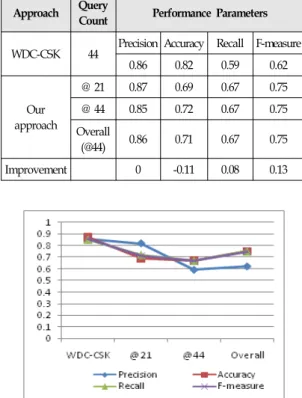
In the similar way, on comparison of precision parameter under evaluation for the proposed approach and existing approach WDC-CSK used by [23]the same dataset set is analyzed and results are plotted on the basis of precision, accuracy, recall and f-measure. The Table 3 presents the results being derived after execution.
Although our approach lacks in accuracy in comparison with WDC-CSK but however the overall recall and f-measure gain is 8% and 13% respectively. Though it seems marginal improvement but the improvement is progressively increasing over the number of queries being increased. This trend lead to the conclusion that proposed approach will produce more precise results when number of queries will be higher. The Figure 7 shows the performance graph of our approach when it is compared with the WDC-CSK at different number of queries.
Table 3.Results obtained by using AMBIENT data set
Approach Query
Count Performance Parameters

![Table 1. Different types of queries categorization and distribution percentage values Total Number of Queries (450) [GISQC-DS]](https://thumb-ap.123doks.com/thumbv2/123dokinfo/4718058.508957/4.808.439.665.724.855/table-different-queries-categorization-distribution-percentage-number-queries.webp)