• 검색 결과가 없습니다.

Effects of Rape Residue on Nitrogen Fertilizer Reduction in Paddy Soil under Double Cropping System

N/A
N/A
Protected

Academic year: 2021

Share "Effects of Rape Residue on Nitrogen Fertilizer Reduction in Paddy Soil under Double Cropping System"

Copied!
5
0
0

로드 중.... (전체 텍스트 보기)

전체 글

(1)

Effects of Rape Residue on Nitrogen Fertilizer Reduction in Paddy Soil under Double Cropping System

Hyun-Jun Cho*, Byung-Keun Hyun, Yeon-Kyu Sonn, and Kook Sig Shin National Academy of Agricultural Science, RDA, 55365, Wanju-gun, Jeonrabug-do, Korea

(Received: September 25 2015, Revised: January 6 2016, Accepted: January 8 2016)

Winter crops have been recognized as an alternative to soil management for fertility and crop productivity in paddy soil. Recently, rape has been produced at winter season and there is little research results on reduction of N fertilizer by adding rape residues for rice cultivation. In this study, we investigated the productivity and quality of rice by applying with 0, 27, 63, 90 kg ha -1 of N fertilizer after input of rape residues into soil for two years. The highest yield of rice was average 4.68 Mg ha -1 at the treatment applied with the 90 kg N ha -1 with rape residue. It was reduced to N rate from 31.6 to 43.2 kg N ha -1 in comparison to 4.53 Mg ha -1 of maximum yield in treatment added 90 kg N ha -1 with rape. Amylose content in rice was similar among treatments with/without rape residue, but protein content was lower in treatment with rape residue than in those without rape residue. In conclusion, input of rape residue in rice cultivation could be alternative to reduction of N fertilization and improvement of quality by adjusting rice productivity in paddy soil under cropping system.

Key words: Nitrogen, Rape, Cropping system, Paddy

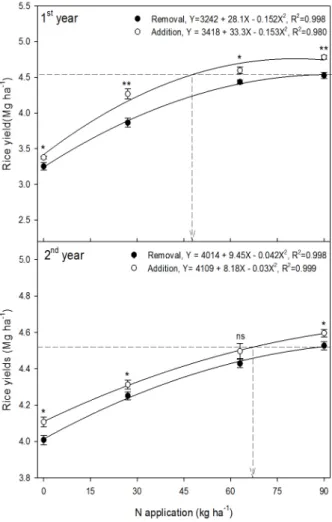
Yield response in nitrogen application at paddy soil with/without rape residue for 2 years (* and ** denote significance at 5 and 1% level, respectively, and ns means not significant).

1)

*Corresponding author: Phone: +82632382428, Fax: +82632383822, E-mail: [email protected]

§ Acknowledgement: This study was carried out with the support of “Cooperative Research Program for Agriculture Science & Technology

Development (Project No. PJ01085302)” Rural Development Administration, Republic of Korea.

(2)

Table 1. Soil chemical properties before experimental accomplishment.

Content pH OM T-N Avail Exch. Cations CEC

P 2 O 5 SiO 2 K Ca Mg

1:5 g kg -1 g kg -1 --- mg kg -1 --- --- coml kg -1 --- coml c kg -1

Mean 5.7 14 0.78 199 91 0.36 3.1 1.2 9.5

*Surface soil 0∼15 cm

† OM: Organic matter, CEC: Cation exchange capacity

Table 2. Major element contents of rape straw at harvesting stage.

Contents Biomass T-C T-N P 2 O 5 K 2 O CaO MgO SiO 2 Moisture

(kg ha -1 ) --- (%) --- (%)

Rape 4,480 42.5 1.54 1.53 2.92 1.11 0.36 0.69 56.7

Introduction

벼는 세계 3대 식량작물로 벼 생산성은 토양질소 공급력 에 좌우된다. 토양에서 벼 체내로 흡수된 질소는 광합성, 질 소동화작용, 대사과정에 관여하므로 벼 체내에서 질소의 결 핍은 NPK 대비 최대 40%의 벼 수량을 감소시키며 (Lee et al., 2005), 질소의 과다는 도복 및 등숙율 때문에 수량과 더불어 미질이 저하될 수 있다 (Takahashi et al., 1990;

Lee et al., 2010). 논에서 안정적인 벼 생산과 미질향상에 합리적인 질소시비가 필요하다.

답리작에서 벼-동계작물을 재배는 사료생산 이외에도 그 루터기 및 잔재물을 이용하여 질소공급으로 질소비료 절감 이 가능하다. 동계 작물의 질소공급은 환원시기와 투입량, 화학적 조성과 토양비옥도에 영향을 받는다. 동계작물의 탄 질비는 질소유효도 기준이 될 수 있는데, 두과작물은 탄질 율이 8∼15으로 작물에 질소 공급하고 수량을 향상시킨다 (Sainju et al., 1999), 이와 반대로 화본과는 탄질비가 30∼

60으로 높기 때문에 토양에서 질소부동화를 초래하며, 분해 율이 낮아 작물에 질소공급이 낮아진다 (Wagger, 1989). 예 를 들어, 콩과인 자운영에 함유된 질소의 51∼64%를 벼에 공급할 수 있으며, 자운영을 30 Mg ha -1 환원할 때는 벼 생 산에 필요한 질소비료 전량을 대체할 수 있다 (Lee et al., 2012). 또한 논에서 벼 생산성에 대한 콩과인 헤어리벳치와 화본과인 보리의 환원 효과를 비교한 결과, 탄질비에 따른 질소공급력의 차이로 인해 헤어리벳치의 환원이 보리환원 에 비해 벼 수량을 50% 높였다 (Cho et al., 2011). 그러므로 답리작에서 동계작물은 벼 생산을 위한 질소공급원이 될 수 가 있다

한편, 유채는 쌍떡잎식물 양귀비목 십자화과의 두해살이 풀로 국내에서는 1962년부터 유료작물 (油料作物)로서 본격 적으로 재배하였다. 유채는 식용, 유지, 사료, 유박, 경관작 물로써 쓰임새가 다양하며 (Hur et al., 1986.), 부산물인 유 채대도 볏짚처럼 유기물자원으로 농토배양에 기여하기 때

문에 바이오디젤 원료뿐만 아니라 유채대의 자원가치로도 주목 받고 있다. 최근 답리작에서 동계 유채 재배에 따른 후 작물의 벼 생산에 대한 관심이 증대되고 있다. 그러나 일부 지역에서는 유채 줄기가 벼 이앙 작업에 불편하여 제거 및 소각하고 있으며, 아직 까지 유채 환원에 따른 질소비료가 벼 생산에 미치는 영향에 대한 연구는 미미한 실정이다. 따 라서 본 연구는 답리작에서 유채 환원에 따른 질소비료 시 비가 벼 생산성과 미질에 미치는 영향을 조사하여 유채 환 원이 질소비료 절감 효과를 평가하고자 하였다.

Materials and Methods

시험구 배치 2009년부터 2010년 까지 2년 동안 전남 영광군에 위치한 논에서 포장시험을 수행하였다. 토양은 지 산 양토 (Fine loamy, mixed, mesic family of Fluvaguentic Endoaguepts)로 경사는 2∼7%인 곡간지에 분포하고 배수 가 약간 불량한 보통논이었다. 유채를 파종하기 전에 경운 층 (0∼15 cm)에서 채취한 토양의 화학적 특성은 Table 1과 같다.

시험구의 총면적 (4,500 m 2 )에 주구로 유채대 환원구와 비환원구를 두었고, 세구로 4 수준의 질소시비 처리구를 3 반복 난괴법으로 배치하였다. 이때 각 시험구의 면적은 175.5 m 2 (22.5 m×7.8 m)이었다.

작물재배 답리작으로 동절기에 유채를 재배한 후에 벼

를 재배하였다. 벼 수확 후, 10월 15∼30일경에 유채종자 (선

망)를 20 kg ha -1 파종하였고, 이듬해 5월 상중순에 유채를 수

확하였다. 이때, 벼 수확기 토양검정으로 구한 N-P 2 O 5 -K 2 O

(150-80-80 kg ha -1 )시비량을 유채재배기간동안 시비하여

유채를 재배하였다. 유채 수확시기에 수분함량은 약 57% 이

었고, 2년 동안 수확기의 유채대 생산량과 무기성분의 평균

함량은 Table 2과 같다. 유채대의 전량 환원을 통해 질소,

인산, 가리는 각각 29.9 29.7, 56.6 kg ha -1 이 토양에 공급

(3)

Fig. 1. Yield response in nitrogen application at paddy soil with/without rape residue for 2 years (* and ** denote significance at 5 and 1% level, respectively, and ns means not significant).

될 수 있었다.

벼 재배시 유채대 환원에 따른 질소시비수준이 벼 생산 성에 미치는 영향을 조사하고자 하였다. 벼 재배를 위한 토 양검정 시비량은 N-P 2 O 5 -K 2 O=90-30-30 kg ha -1 으로 산 정되었다. 이때, 질소시비는 토양검정 질소시비량 90 kg ha -1 을 기준으로 100, 70, 30, 0% = 90, 63, 27, 0 kg ha -1 을 시 용하였다. 질소와 가리는 각각 50과 70%를 인산은 전량 밑 거름하였고, 질소웃거름은 분얼기와 출수기에 20, 30%를, 가리웃거름은 출수기에 30% 시용하였다.

수량 및 미질 벼 수량은 농사시험연구조사기준에 준

하여 3.3 m 2 의 등숙된 벼를 수확하여 산정하였다 (NIAST, 2000). 미질평가는 식미에 직접적인 영향을 미치는 것으로 알려진 아밀로스 함량과 단백질 함량을 조사하였다. 아밀로 스함량은 Juliano의 요오드 비색 정량법으로 조사하였으며 (Juliano et al., 1981; Perez and Juliano, 1978), 단백질 함 량은 Kjeldahl 정량법으로 구한 질소함량 (%)에 단백질 환 산계수 5.95를 곱하여 환산하였다.

통계분석 SAS 9.2 프로그램을 이용하여 질소수준에 따 른 쌀수량 변화를 위해 회귀분석을 실시하였고, 분산분석 (ANOVA)을 통해 처리평균간 비교를 실시하였다.

Results and Discussion

쌀수량 변화 유채대 환원 유·무에 따른 질소시비 조건

하에서 2년 동안 쌀수량을 조사한 결과는 Fig. 1과 같다. 질 소시비량의 증가는 쌀수량을 증가시켰고, 유채대의 환원과 비환원에 따른 쌀수량은 약 3∼9%가 증수되었다. 유채대 환원에 따른 질소 시용량을 기준으로 2년 평균 쌀수량은 0 kg N ha -1 에서는 3.74 Mg ha -1 , 27 kg N ha -1 에서는 4.28 Mg ha -1 , 63 kg N ha -1 에서는 4.40 Mg ha -1 , 그리고 90 kg N ha -1 에서는 4.69 Mg ha -1 이었다. 그러나 유채대의 비환 원에 따른 질소 시용량을 기준으로 2년 평균 쌀수량은 각각 3.63, 3.88, 4.43, 4.53 Mg ha -1 이었다. 기상조건은 연차간 차이가 있었지만, 유채대의 환원조건하에서 질소시비량이 증가하더라도 연차간 쌀수량의 변화는 통계적인 유의차가 없었다. 그러나 유채대 환원에 관계없이 질소시비량이 증가 함에 따라 등숙율이 각각 93.7, 92.8, 92.8, 90.6으로 감소 되었다. 논에 질소시비가 높아질수록 벼의 등숙율은 감소된 다고 보고한 Lee et al. (2005)의 연구결과와 유사하였다.

1년차에 유채대를 전량 환원과 질소 90 kg ha -1 를 시용한 처리구의 쌀수량은 4.78 Mg ha -1 으로 비환원구의 동량의 질 소처리구의 쌀수량에 비해 5.6% 높았다 (p<0.01). 그리고 2 년차에는 질소 90 kg N ha -1 의 시용한 유채환원과 비환원구 의 쌀수량은 각각 4,60, 4.53 Mg ha -1 으로 유채대 환원구가

비환원구에 비해 1.5%의 쌀수량이 증수되었다 (p<0.01). 유 채 환원과 비환원의 벼 수량을 비교할 결과, 1년차에 5.6%

증수에서 2년차에 1.5%으로 유채 환원에 따른 벼 수량의 증 수는 감소되었다. 이는 벼-유채재배에 따른 그루터기로 통 해 투입되는 유기물 및 질소공급효과의 결과로 해석된다.

유채 환원에 따른 적정 질소시비량을 산정하고자 질소시비 량과 쌀수량의 관계를 회귀식으로 조사하였다 (Fig. 1). 유채 비환원구에서 대조구인 3요소 (NPK)시비량 N-P 2 O 5 -K 2 O=

90-30-30 kg ha -1 에서 1년차 쌀수량은 4.53 Mg ha -1 , 2년 차는 4.53 Mg ha -1 이므로 유채를 전량 환원시 이에 해당하 는 량은 1년차에 질소 46.8 kg N ha -1 , 2년차에 질소 68.4 kg N ha -1 이었다, 이를 질소 90 kg N ha -1 으로 환산시 24∼

48%의 질소시비량이 감소하는 것으로 평가되어 답리작에서 유채대 환원으로 벼 재배시 질소비료 절감이 확인되었다.

미질특성 식미총평과 밀접한 관계를 나타내는 백미의

화학적 특성 중에서 쌀알의 찰성 지표로 사용되는 아밀로스

함량과 단백질 함량, 그리고 밥의 점성을 나타내는 지표로

(4)

Fig. 2. Amylose contents in nitrogen application at paddy soil with/without rape residue for 2 years (ns means not significant).

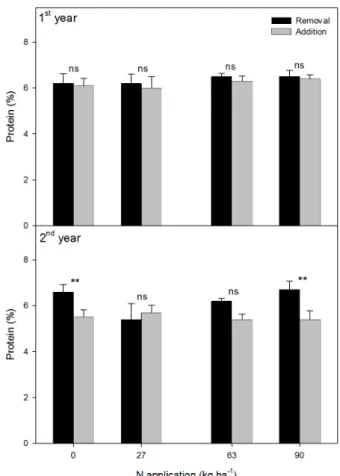
Fig. 3. Protein contents in nitrogen application at paddy soil with/without rape residue for 2 years (** denotes significance at 0.1% level, and ns means not significant).

Mg/K비 등이 있다. 식미와 관련된 쌀의 이화학적 특성은 Fig. 2와 3과 같다. 아밀로스 함량은 주로 밥의 경도와 찰성 을 나타내며 20% 이하가 양질미에 속하는데, 1년차에 아밀 로스함량은 19.1∼20.0% 사이에 있었고, 2년차에 18.1∼

19.0%으로 1년차에 비해 아밀로스 함량이 감소되었다. 그러 나 백미의 아밀로스 함량은 유채대 환원 및 질소시비량에 따른 처리간 통계적인 유의차가 없었다.

단백질 함량은 밥의 경도와 밀접한 관계를 갖으며 7~9%

범위가 양질미에 속하는데, 경종학적 측면에서 미질에 영향 을 주는 인자로서는 질소 시비량이 가장 크게 영향을 주며, 시비량이 증가될수록 쌀 중 단백질 함량 증가로 미질이 나 빠지는 것으로 알려져 있다 (Lee et al., 1991; Jeong et al., 1995; Cha et al., 1984; Hur et al., 1994). 1년차 백미의 단 백질 함량은 6.0~6.5% 사이에 있었고, 질소시비량과 단백 질함량의 정의상관관계를 나타내었다 (p<0.05). 그러나 2년 차에 유채가 환원된 백미의 단백질 함량은 5.4~5.7% 사이 로 질소시비량이 증가함에 따라 뚜렷한 경향을 나타내지 않 았다. 이에 반해 유채 비환원구는 단백질 함량이 5.4~6.7%

으로 질소시비량과 정의상관관계를 나타내었다. 2년차에 유채 환원구에서 백미의 단백질 함량은 대조구 (비환원구)

대비 낮은 결과를 나타내었는데, 이는 유채 환원에 따른 질 소부동화가 촉진된 결과로 사료된다. 쌀의 식미치는 단백질 함량 및 amylose 함량간에 부의 상관관계가 있는데 (Kim et al., 1990), 유채환원구의 2년차 단백질 함량은 비환원구에 비해 낮은 결과를 나타내고 있어, 유채환원구의 식미치는 향상될 것으로 여겨진다. 비환원구의 90 kg N ha -1 의 벼 수 량 대비 유채 환원구의 질소비료의 절감효과가 24∼48%인 감안한다면, 유채대의 환원에 따른 질소시비량은 미질에 영 향을 미치지 않는 것으로 판단되었다.

Conclusion

동계 답리작으로 유채를 재배한 후 이듬해에 관개 논에

서 벼 생산성과 미질에 미치는 영향을 구명하고자 2009년부

터 2010년 까지 2년 동안 전남 영광군에 위치한 양토에서

벼-유채 작부체계로 포장시험을 수행하였다. 유채대 환원

에서 표준구인 3요소 (NPK)시비량 N-P 2 O 5 -K 2 O=90-30-30

kg ha -1 에 해당하는 질소시비량은 1년차에 46.8, 2년차에

68.4 kg N ha -1 으로 벼-유채 작부체계에서 질소비료 절감

이 확인되었다. 벼 단작구에서는 질소시비량이 높아짐에 따

라 단백질 함량이 증가되었으나 유채 환원구에서는 때로는

(5)

반대의 경향을 나타내어 유채대의 환원은 미질에 영향을 미 치지 않는 것으로 판단되었다. 따라서 답리작으로 하절기에 벼를 재배하고 동절기에는 유채를 재배하는 벼-유채 작부 체계는 쌀의 미질과 관계없이 질소 시비량 31.6∼43.2 kg N ha -1 가 절감되는 것으로 확인되었다.

References

Cha, K.H., Y.S. Kim, H.J. Kim, D.Y. Lee, and M.S. Kim.

1982. Effects of application levels fertilizer on the susceptibility to bacterial leaf blight, yield and quality of grains in nineteen rice cultivars in Jeonnam region. Korea J. Plant Protection Sci. Fert. 21(4):216-221.

Cheong, J.I., S.J. Seok, W.Y. Choi, and T.O. Kwon. 1995.

Variation of rice grain quality under different cultivation type in Honam area. RDA. J. Agri. Sci. Fert. 37(2):61-67.

Cho, H.S., W.Y. Park, W.T. Jeon, K.Y. Seong, C.G. Kim, T.S. Park, and J.D. Kim. 2011. Effect of green manure barley and hairy vetch on soil characteristics and rice yield in paddy. CNU J. Agric. Sci. 38(4):703-709.

Hasegawa, H., Y. Furukawa, and S. D. Kimura. 2005. On- Farm assessment of organic amendments effects on nutrient status and nutrient use efficiency of organic rice fields in northeastern Japan. Agric. Ecosys. Environ. 108:350-362.

Heu, M.H., H.S. Suh, K.H. Kim, S.Z. Park, and H.P. Moon.

1994. The environmental variation of protein content, amylose content and alkali digestibility of rice grain. Fert. 1(1):

21-37.

Hur, B.K., L.Y. Kim, I.S. Jo, Y.S. Park. K.T. Um, and M.S.

Kim. 1986. Effects of organic matter resources on the soil improvement and crop growth. Res. Rept. RDA. 28(1):7-12.

Im, J.N. 1978. Soil physical properties and organic matter.

Korean J. Soil Sci. Fert. 11(3):145-160.

Juliano, B.O., C.M. Perez, A.B. Blakeney, T. Castillo, N.

Kongeseree, B. Laignellet, E.T. Lapis, V.V.S. Murty, C.M.

Paule, and B.D. Webb. 1981. International cooperative testing on the amylose content of milled rice. Starch. 33:157-162.

Kim, J.G., K.B. Lee, S.B. Lee, D.B. Lee, and S.J. Kim. 1999.

The effect of long-term application of different organic material sources on chemical properties of upland soil.

Korean J. Soil Sci. Fert. 32:239-253.

Kim, K.H., and H.K. Joo. 1990. Variation of grain quality of rice varieties grown at different locations. Ⅱ. Relationship

between characteristics related to grain quality. Korea J.

Crop Sci. 35(2):137-145.

Kim, L.Y., H.J. Cho, and K.H. Han. 2004. Changes of physical properties of soils by organic material application.

Korean J. Soil Sci. Fert. 37(5):304-314.

Kim, S.H., S.G. Lee, J.H. Shin, Y.H. Lee, D.H. Choi, Y.J.

Lee, and H.M. Kim. 2004. Studies on the proper utilization of organic materials for the organic farming systems in Korea. Crop Life Safety Research. Department of Crop Life Safety RDA. pp. 89-100.

Lee, C.H., M.S. Yang, K.W. Chang, Y.B. Lee, K.Y. Chung, and P.J. Kim. 2005. Reducing nitrogen fertilization level of rice(Oryza sativa L.) by silicate application in Korean paddy soil. Korean J. Soil Sci. Fert. 38(4):194-201.

Lee, J.H., and Y.J. Oh. 1991. Effects of 23-years successive application of N, P, K and organic matter on rice yield quality. Korea J. Crop Sci. 36(4):332-339.

Lee, S.T., D.C. Seo1, J.S. Cho1, R.A. Dahlgren, and Y.H.

Lee. 2010. Effect of annual and basal dressing with liquid pig manure on growth and quality of rice in double cropping system of rice-malting barley. Korean J. Soil Sci.

Fert. 43(5):624-630.

MAF. 2006. A five-year plan(2006-2010) for raising environ- mental-friendly agriculture.

NIAST. 1988. The method of soil and plant analysis. pp 35-130.

NIAST. 2000. The Method of soil chemical analysis. National Institute of Agricultural Science and Technology, RDA, Suwon Korea.

Perez, C.M., and B.O. Juliano. 1978. Modification of the simplified amylose test for milled rice. Starch. 30:424-426.

Recel, M.R. 1994. International Seminar on the Use of Microbio and Organic Fertilizers in Agricultural Production.

RDA & FFTC.

Sainju, U.M., B.P. Singh, S. Rahman, and V.R. Reddy. 1999.

Soil nitrate-nitrogen under tomato following tillage, cover cropping, and nitrogen fertilization. J. Environ. Qual. 28:

1837-1844.

Sohn, S.M., and D.H. Han. 2000 Assessment of environmentally sound function on the increasing of soil fertility by Korean organic farming. Korean J. Soil Sci. Fert. 33(3):193-204.

Wagger, M.G. 1989. Time of desiccation effects on plant

composition and subsequent nitrogen release from several

winter annual cover crops. Agron. J. 81:236-241.

수치

Table 1. Soil chemical properties before experimental accomplishment.
Fig. 1. Yield response in nitrogen application at paddy soil  with/without rape residue for 2 years (* and ** denote  significance at 5 and 1% level, respectively, and ns means  not significant).될 수 있었다.벼 재배시 유채대 환원에 따른 질소시비수준이 벼 생산성에 미치는 영향을 조사하고자 하였다
Fig. 2. Amylose contents in nitrogen application at paddy  soil with/without rape residue for 2 years (ns means not  significant).

참조

관련 문서

Distribution of Cd in stream sediments, paddy soils, rice stalks and grains from the Kubong

The purpose of this research was to suggest the water quality improvement in streams by evaluating the distribution characteristics of organics and ammonia nitrogen

Likewise, other regions where highly contributed to the growth of national agriculture showed a rapid changes in compositions of the agricultural production from paddy

Relationship between soil pH and phosphatase activity in volcanic ash soil of citrus orchards on the different surface soil management practices at

High level of nitrogen fertilizer application increased the nitrogen contents in all the parts of citrus trees.. But there was no change in sugar and

A laboratory experiment was performed to investigate the removal of nitrogen and phosphorus from plating factory effluent using the soil column.. Soil,

In an effort to develop a new method to remove nitrogen, this study examined the effects of C/N ratio, carbon source and nitrogen concentration on

Mindfulness-based stress reduction in relation to quality of life, mood, symptoms of stress and levels of cortisol, dehydroepiandrosterone sulfate (DHEAS)