구강 내에서 가장 많이 발생하는 양대 구강병인 치아우식증과 치주질 환은 구강 내 세균이 주요한 원인 인자 중 하나인 대표적인 만성 질환 이다. 치아우식증은 치면세균막 내에 존재하는 세균들의 당질 대사 부 산물인 유기산(젖산이 대표적)에 의해 치아 법랑질이 탈회되면서 발생 되고, 주요한 원인균 중 하나가 Streptococcus mutans이다[1]. 치주 질환은 진행 정도에 따라 치은의 염증뿐만 아니라 치조골 소실 등의 증 상이 나타나며, 심할 경우 치아 상실까지 초래한다[2]. 치주질환은 면 역력 및 영양 결핍, 당뇨 등의 전신적 요인과 치은연하 치면세균막에 존재하는 세균들에 의한 국소적 요인에 의해 발생하며, 성인성 치주염 의 경우 세균이 가장 중요한 인자로 알려져 있다[3,4]. 주요한 치주질환 원인균으로는 Porphyromonas gingivalis, Prevotella intermedia, Fusobacterium nucleatum 및 Aggregatibacter actinomycetem- comitans 등을 포함한 그람 음성 혐기성 세균으로 알려져 있다[5].
이러한 치아우식증과 치주질환의 예방 또는 치료를 위해서는 원인 세 균을 화학적으로 제거하는 항생제를 가장 먼저 생각할 수 있지만, 항생 제의 오남용에 의한 내성 균주가 발생하는 단점이 있다[6]. 항생제의 단
점을 극복하기 위해 전통적으로 오랫동안 동양의학이나 민간요법에서 항균작용을 위해 사용된 천연물을 이용하려는 연구들이 활발히 진행되 고 있다[7,8]. 이러한 천연물 중 프로폴리스는 항균 및 항염 효능이 우 수한 것으로 알려져 있고, 많은 나라에서 민간요법으로 널리 이용되고 있다. 프로폴리스에 함유된 플라보노이드 성분은 항균 및 항산화 효능 이 뛰어나서 치주질환 환자의 점막 염증을 완화시키고[9,10], 치아우식 활성을 감소시키는 효과가 있음이 보고되었다[11]. 이러한 프로폴리스 의 플라보노이드는 수용성이 떨어지기 때문에 인체에 사용하기 위해서 는 에탄올에 녹여서 사용해야 하는 단점이 있다. 그러므로 본 연구는 에 탄올로 추출한 프로폴리스 분말(70%)과 덱스트린(dextrin, 30%)을 혼 합하여 플라보노이드의 수용성을 향상시킨 호주산 프로폴리스의 치아 우식증 및 치주질환 원인균에 대한 항균능을 알아보기 위해 시행하였 다.
본 연구에서 사용한 균주는 P. intermedia KCOM 1107, F. poly- morphum (= F. nucleatum subsp. polymorphum) KCOM 1232, A. actinomycetemcomitans KCOM 1306, P. gingivalis KCOM
Int J Oral Biol 44:191-194, 2019
pISSN: 1226-7155 • eISSN: 2287-6618 https://doi.org/10.11620/IJOB.2019.44.4.191
Antimicrobial effect of Australia propolis on cariogenic and periodontopathic bacteria
Yun Kyong Lim 1,2 , So Young Yoo 3 , Dae Sung Lee 3 *, and Joong-Ki Kook 1,2 *
1 Korean Collection for Oral Microbiology, College of Dentistry, Chosun University, Gwangju 61452, Republic of Korea
2 Department of Oral Biochemistry, College of Dentistry, Chosun University, Gwangju 61452, Republic of Korea
3 Medi Bio Lab Co., Ltd., Seoul 08389, Republic of Korea
The purpose of this study was to investigate the antimicrobial effects of Australia propolis against cariogenic and periodontopathic bacteria. Antimicrobial activity was determined by evaluating the minimal bactericidal concentration (MBC). Cell cytotoxicity of propolis extract on normal human gingival fibroblast (HGF-1) cells was observed using the methylthiazolyldiphenyl-tetrazolium bromide assay. The data indicated that, with the exception of Aggregatibacter actinomycetemcomitans (KCOM 1306), the MBC values of the propolis strains were 0.25–1% without HGF-1 cell cytotoxicity. These results suggest that propolis can be used to develop oral hygiene products for the prevention of oral infectious disease.
Keywords: Antimicrobial effect, Dental caries, Periodontitis, Propolis
Received September 10, 2019; Revised October 27, 2019; Accepted November 5, 2019
*Correspondence to: Dae Sung Lee, E-mail: [email protected] https://orcid.org/0000-0003-2317-7848
*Correspondence to: Joong-Ki Kook, E-mail: [email protected] https://orcid.org/0000-0003-2628-2870 Copyright © The Korean Academy of Oral Biology
CC
This is an open-access article distributed under the terms of the Creative Commons Attribution Non-Commercial License (http://creativecommons.org/licenses/by- nc/4.0/), which permits unrestricted non-commercial use, distribution, and reproduction in any medium, provided the original work is properly cited.
Letter to Editor IJOB International Journal of Oral Biology
Int J Oral Biol Vol. 44, No. 4, December 2019
192 www.kijob.or.kr
2804 및 S. mutans KCOM 1054 등이었다. 이들 균주들은 한국구강 미생물자원은행(Korean Collection for Oral Microbiology [KCOM], Gwangju, Korea)에서 분양받아 사용하였다.
본 연구에 사용된 S. mutans 균주는 brain heart infusion broth에 접종하여 5% CO
2
조건에서 배양하였고, 나머지 균주들은 tryptic soy broth에 0.5% yeast extract, 0.05% cysteine HCl-H2
O, 0.5 mg/mL hemin 및 2 μg/mL vitamin K
1
이 포함된 배지에 접종하여, 37℃anaerobic chamber (Bactron I, Sheldon Manufacturing Inc., Cornelius, OR, USA)와 혐기성 조건(10% H
2
, 5% CO2
, and 85%N
2
)에서 배양하였다.Minimal bactericidal concentration (MBC) 측정은 Clinical and Laboratory Standards Institute (CLSI) [12]에서 제시한 미세희석 (micro-dilution)법을 변형하여 사용하였다. 즉, 세균들을 각각의 배지 에 접종하여 37℃에서 16시간 동안 배양한 후 1 × 10
6
CFU/mL가 되 도록 세균 배양액을 이용하여 희석한 다음, 96-well plate에 100 μL 씩 분주하였다. 호주산 프로폴리스 분말(Threespears Nutritional Pty Ltd., Deniliquin, Australia)을 물을 이용하여 16% (w/v)부터 2배씩 10단계 희석하고 이들을 세균 배양액에 100 μL씩 첨가하여 최종농도 가 8%부터 0.015%까지 되도록 하였다. 이때 침전물을 제거하기 위해 13,000 rpm에서 10분간 원심분리하고 상층액을 채취하여 시료로 사 용하였다(non-freezing propolis). 또한, 프로폴리스 추출물에 남아 있 는 비수용성 물질을 좀 더 제거하기 위해 물에 완전히 용해되는 최고 농 도인 32% 희석용액을 –20℃ 냉동고에서 24시간 동안 냉동 후 13,000 rpm에서 15분간 원심분리하고 상층액을 채취하여 시료로 사용하였다 (freezing propolis). 그리고 음성대조군은 세균배양액만 사용한 것으 로 하고, 양성대조군은 ampicillin 100 μg/mL을 사용하였다. 그런 후 96 well plate에 200 μL씩 분주한 것을 37℃에서 48시간 동안 배양 한 다음, 세균배양액에서 10 μL를 취하여 한천배지에 도말하고 37℃에 서 48시간 동안 배양한 뒤 형성된 군락을 확인하여 99.9% 살균력을 보 이는 농도를 MBC 값으로 결정하였다. 각 반응은 3회 반복 실시하였다.본 연구에서 사용한 사람 치은섬유아세포(normal human gingival fibroblast, human gingival fibroblast [HGF]-1)는 ATCC (Ameri-
can Type Culture Collection, Manassas, VA, USA)에서 구입하 여 사용하였다. Dulbecco’s Modified Eagles Medium (DMEM, Sigma Aldrich, St. Louis, MO, USA)에 10% fetal bovine serum (Hyclone, Logan, UT, USA)과 antibiotic-antimycotic solution (Invitrogen, Grand Island, NY, USA) 이 혼합된 세포배양액을 이용 하여 37℃, 5% CO
2
, 100% 습도가 유지되는 세포 배양기에서 배양하 였다. HGF-1 세포를 24-well plate에 5 × 10⁴
cells를 seeding하 여 하룻밤 배양한 후 80% confluence 했을 때 2X DMEM 배지와 시 료를 동량 혼합하여 최종농도가 4%부터 0.06%까지 되도록 하여 세포 에 첨가하였다. 이를 24시간 배양한 후 배지를 제거하고 5 mg/mL의 3-(4,5-dimethylthiazol-2-yl)-2,5-diphenyltetrazolium bromide (MTT, Sigma Aldrich) 용액이 1/10 들어간 배지를 각 well에 넣고 4 시간 배양하였다. 생성된 formazon 결정을 dimethyl sulfoxide로 용 해시켜 EpochTM
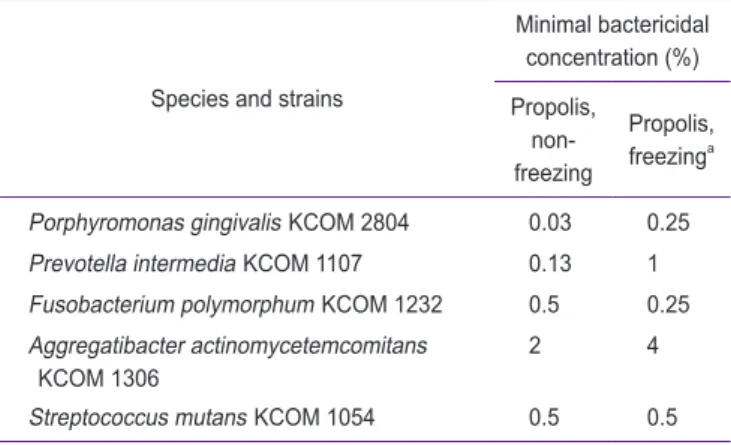
Microplate Spectrophotometer (BioTek Instru- ments Inc., Winooski, VT, USA)기로 570 nm에서 흡광도를 측정하 고 결과를 분석하였다. 각 반응은 3회 반복 실시하였다. 모든 실험 결과 는 대조군에 대한 백분율로 계산하였다.Non-feezing propolis의 경우, 4종 치주질환원인균에 대한 MBC 값은 0.03–2%였다(Table 1). 또한, 치아우식증의 주요한 원인균종 인 S. mutans에 대해서도 MBC 값은 0.5%였다. 한편 non-freezing propolis의 경우 0.13% 농도에서는 사람 치은섬유모세포인 HGF-1 에 대하여 세포독성이 보이지 않았으나, 0.25% 농도에서는 6%의 세 포생존율을 나타내었다(Fig. 1). 즉, 세포독성이 없는 0.13% 농도에 서는 P. intermedia (KCOM 1107)와 P. gingivalis (KCOM 2804) 에 대해서만 항균력을 보였다. 반면에 freezing propolis의 경우 A.
actinomycetemcomitans (KCOM 1306)를 제외한 본 시험에서 사용 된 모든 균주(3종 치주질환 원인균 및 1종 치아우식증 원인균)에 대하 여 HGF-1에 대한 세포 독성이 없는 1% 이하의 농도에서 MBC 값을 가졌다. A. actinomycetemcomitans는 사춘기 전 치주염과 같은 특 수한 치주질환에 주요한 병원성 균종이고, F. nucleatum은 치주질환
Table 1. Summary of Antimicrobial activity of propolis Species and strains
Minimal bactericidal concentration (%) Propolis,
non- freezing
Propolis, freezing a Porphyromonas gingivalis KCOM 2804 0.03 0.25 Prevotella intermedia KCOM 1107 0.13 1 Fusobacterium polymorphum KCOM 1232 0.5 0.25 Aggregatibacter actinomycetemcomitans
KCOM 1306 2 4
Streptococcus mutans KCOM 1054 0.5 0.5
a Supernatant of propolis after spinning down propolis solution after freezing at –20℃ for 24 hours.
Control 0.06 0.13 0.25 0.5 1 2 4
140 120 100 80 60 40 20
Cell viability (% )
Concentration of propolis extract (%) 0
Propolis (non-freezing) Propolis (freezing) MTT
100 124
92 115
91
6 92
5
109
16 13 100
6 6 5
100
Fig. 1. Cell viability test of propolis extract on normal human gingival fibro-
blast (HGF-1) cells. This was performed by the MTT (3-(4,5-dimethylthia-
zol-2-yl)-2,5-diphenyltetrazolium bromide) assay.
Yun Kyong Lim, et al. Antimicrobial effect of Australia propolis
www.kijob.or.kr 193
병소뿐만 아니라 정상부위에도 존재하고 있다. 그리고 대부분의 치주 질환에 속하는 성인성 치주염에서는 P. gingivalis가 주요한 병원성 세 균 종에 속하며[13], P. intermedia는 한국인의 초기 치주질환치료 예 후와 밀접한 관련성이 있다[14]는 점을 고려할 때, 본 연구에서 사용된 호주산 프로폴리스는 냉동 후 원심 분리하여 상청액만 취한 freezing propolis의 1% 농도에서 치주질환 및 치아우식증 예방을 위한 구강위 생용품(구강양치용액, 치약 등) 개발에 사용 가능할 것으로 생각된다.
프로폴리스는 항균효과, 항암효과, 항산화 효과, 항돌연변이 효과 등 다양한 생리활성을 나타내어 사람에게 유익한 천연물 소재로 사용되고 있다[15]. 프로폴리스는 그람양성균 및 그람음성균에 의해 발생되는 치 주질환에 대하여 효과적인 항균활성을 가진다[16]. 또한, 프로폴리스는 S. mutans, P. gingivalis, P. intermedia 등에 의하여 발생되는 치주 질환에 효과적인 활성을 갖는다고 보고되었다[16]. 프로폴리스 내의 각 종 유기물과 미네랄 물질에는 20종이 넘는 다양한 플라보노이드가 다 량으로 함유되어 있고, 이러한 플라보노이드가 강력한 항균효능을 나타 내는 것으로 보고되어 있다[17]. 이에 본 연구에서는, 천연 항생제인 프 로폴리스의 수용성 플라보노이드 함량을 증가시켜 항균력을 알아보았 다.
프로폴리스의 추출방법으로는 미셀화 추출법, 수용성 추출법, 초임계 추출법, 에탄올 추출법 등이 있다. 에탄올 추출법이 가장 보편적으로 사 용되고 있는 방법이지만, 높은 온도에서 추출이 이루어지므로 플라보노
이드의 화학적 변화와 회수율이 낮아질 수 있고 왁스 성분의 추출량이 많아진다는 단점이 있다. 또한, 에탄올을 포함한 유기용매로 인해 알러 지 등의 부작용이 간혹 발생할 수 있고 프로폴리스가 점막에 염증 또는 궤양을 일으켜 천식 등의 과민반응을 일으킬 수 있다고 보고되고 있다 [18]. 수용성 추출법은 맛과 냄새가 자극적이지 않고, 흡수율이 높은 장 점을 가지고 있다. 본 연구에서 비수용성 성분을 가능한 많이 제거하기 위해 냉동 후 원심 분리하여 침전물을 제거한 후 상청액을 이용한 방법 은 세포독성을 줄이고, 항균능을 높혀 치주질환 및 치아우식증 예방을 위한 구강위생용품 및 건강기능 제품 개발에 사용이 증가할 것으로 생 각된다.
Acknowledgements
This research was supported by Med Lab Co., Ltd. (2015- 0573).
Conflicts of Interest
No potential conflict of interest relevant to this article was reported.
References
1. Loesche WJ. Role of Streptococcus mutans in human dental decay. Microbiol Rev 1986;50:353-80.
2. Armitage GC. Development of a classification system for peri- odontal diseases and conditions. Northwest Dent 2000;79:
31-5. doi: 10.1902/annals.1999.4.1.1.
3. Montes CC, Pereira FA, Thom é G, Alves ED, Acedo RV, de Souza JR, Melo AC, Trevilatto PC. Failing factors associ- ated with osseointegrated dental implant loss. Implant Dent 2007;16:404-12. doi: 10.1097/ID.0b013e31815c8d31.
4. Nishihara T, Koseki T. Microbial etiology of periodontitis. Peri- odontol 2000 2004;36:14-26. doi: 10.1111/j.1600-0757.
2004.03671.x.
5. Socransky SS, Haffajee AD, Cugini MA, Smith C, Kent RL Jr.
Microbial complexes in subgingival plaque. J Clin Periodontol 1998;25:134-44. doi: 10.1111/j.1600-051x.1998.tb02419.x.
6. Newman MG, Takei HH, Carranza FA. Carranza’s clinical peri- odontology. 9th ed. Philadelphia : W.B. Saunders Co.; 2002. p.
16-35, 96-112, 253-62, 431-53, 675-87.
7. Ahn SJ, Cho EJ, Kim HJ, Park SN, Lim YK, Kook JK. The anti- microbial effects of deglycyrrhizinated licorice root extract on Streptococcus mutans UA159 in both planktonic and biofilm cultures. Anaerobe 2012;18:590-6. doi: 10.1016/j.anae-
robe.2012.10.005.
8. Park SN, Lim YK, Freire MO, Cho E, Jin D, Kook JK. Antimi- crobial effect of linalool and α-terpineol against periodonto- pathic and cariogenic bacteria. Anaerobe 2012;18:369-72.
doi: 10.1016/j.anaerobe.2012.04.001.
9. Cushnie TP, Lamb AJ. Antimicrobial activity of flavonoids.
Int J Antimicrob Agents 2005;26:343-56. doi: 10.1016/
j.ijantimicag.2005.09.002.
10. Lee SW, Kim HJ, Hwang BS. Studies on the chemical char- acteristics of Korean propolis. Korean J Food Sci Anim Resour 2001;21:383-8.
11. Rodrigues PH, Carvalho SA, Costa JE, Carvalho MAR, Farias LM, Petrillo-Peixoto ML. Black-pigmented Gram-negative anaerobes in Brazilian adults with periodontal disease. Anaer- obe 1999;5:267-8. doi: 10.1006/anae.1999.0243.
12. Clinical and Laboratory Standards Institute. Methods for dilu- tion antimicrobial susceptibility tests for bacteria that grow aerobically; approved standard. CLSI document M7-A6. 6th ed. Wayne Pennsylvania: Clinical and Laboratory Standards Institute; 2005.
13. Uematsu H, Hoshino E. Predominant obligate anaerobes in
human periodontal pockets. J Periodontal Res 1992;27:15-9.
Int J Oral Biol Vol. 44, No. 4, December 2019