Effects of virtual reality training on upper extremity function and activities of daily living in patients with sub-acute stroke
Min-Jae Jeon, Jong-Hoon Moon *
Researcher, Dept. of Healthcare and Public Health Research, National Rehabilitation Research Institute, National Rehabilitation Center
가상현실 훈련이 아급성 뇌졸중 환자의 상지기능과 일상생활활동에 미치는 효과
전민재, 문종훈 *
국립재활원 재활연구소 건강보건연구과 연구원
Abstract The aim of this study was to investigate the effects of virtual reality training on upper extremity function and activities of daily living in patients with sub-acute stroke. The present study enrolled 18 patients with sub-acute stroke. All subjects were assigned into either the experimental group (n=9) or control group (n=9). Both groups received conventional occupational therapy for 30 minutes/day, 5 times a week, for 4 weeks. Additionally, the experimental group performed virtual reality training in each session for 30 minutes/day, and the control group conducted conventional occupational therapy in each session for 30 minutes/day. The outcome measures were performed through the Fugl-Meyer Assessment (FMA) and the Korean-modified Barthel Index (K-MBI) before and after intervention.
In results, the experimental group showed significant improvements in the scores of FMA and K-MBI after intervention (p<.05). The control group showed significant improvements in the shoulder/elbow/forearm, wrist, and hand sub-domains of the FMA and K-MBI (p<.05). After intervention, the experimental group showed significantly greater improvements in the total score and in the wrist and hand sub-domains of the FMA than control group (p<.05). These findings suggest that virtual reality training may have positive effects on the improvements of upper extremity function in patients with sub-acute stroke.
Key Words : Activities of daily living, Stroke, Upper extremity function, Virtual reality
요 약 본 연구의 목적은 가상현실 훈련이 아급성 뇌졸중 환자의 상지기능과 일상생활활동에 미치는 효과를 규명하는 것이다. 아급성기 뇌졸중 환자 18명이 본 연구에 참여하였다. 모든 대상자는 실험군 9명과 대조군 9명으로 배정되었다.
두 군은 하루 30분, 주 5회, 4주 동안 보편적인 작업치료를 받았다. 실험군은 가상현실 훈련을 회기 마다 30분 더 받았으며, 대조군은 보편적인 작업치료를 회기 마다 30분 더 받았다. 결과 측정은 중재 전과 후에 Fugl-Meyer 평가와 한국판 수정바델지수에 의해 수행되었다. 연구 결과, 실험군은 중재 후 Fugl-Meyer 평가 점수와 한국판 수정바델지수 점수에서 유의한 향상을 보였다(p<.05). 대조군은 Fugl-Meyer 평가의 어깨/팔꿈치/전완, 손목, 손 하위항목과 한국판 수정바델지수에서 유의한 향상을 보였다(p<.05). 중재 후 실험군은 대조군보다 Fugl-Meyer 평가의 총점, 손목과 손 하위항목에서 유의하게 더 큰 향상을 보였다(p<.05). 이러한 결과들은 가상현실 훈련이 아급성기 뇌졸중 환자의 상지기 능 향상에 긍정적인 효과를 나타낼 수 있음을 시사한다.
주제어 : 가상현실, 뇌졸중, 상지기능, 일상생활활동
*Corresponding Author : Jong-Hoon Moon([email protected])
Received July 2, 2019 Revised August 3, 2019
Accepted September 20, 2019 Published September 28, 2019
1. Introduction
1.1 Background
Stroke is a chronic disease that causes a sudden neurological deficit due to cerebral ischemia or hemorrhage. Symptoms following strokes include physical dysfunction such as hemiplegia, cognitive impairment, speech disorders, and emotional disorders [1]. After a stroke, 55-75% of patients experience impaired upper limb function, and these patients have great difficulty with basic activities of daily living such as eating, dressing, and personal hygiene [2]. These problems lead to an increase in the burden of care placed on the family members of stroke patients [3], which results in a reduction in the quality of life for the caregiver and patients. Therefore, management for stroke patients, such as rehabilitation mediated by various rehabilitation specialists, is required [4].
The definition of virtual reality is a human-computer interface in which a user interacts with a virtual environment in real-time.
The term ‘virtual reality’ was first used by Jarson Lanier in 1989, and since then it has spread globally [5]. The advantage of virtual reality is that patients can undergo training for activities of daily living in various environments while still within the confines of the hospital. It is also possible to receive feedback through software while performing various exercises and to adjust the difficulty according to the patient's abilities by quantifying the results of the training [6].
Virtual reality training has been studied and developed to include a mixture of past feedback and games related to activities of daily living [7-9]. Faria et al. [10] showed better results through the development of Reh@City, which is related to activities of daily living, than with traditional rehabilitation. Kim et al. [11] found that the game-based virtual reality program showed better findings of upper limb function
using IREX system. The advantage of virtual reality for stroke patients is that, in a limited rehabilitation environment, the therapist can provide new and continuous iterations of training in a virtual environment involving activities of daily living to restore patient function [7-11].
Recent trends in research abroad include virtual reality mirror therapy [12], smart glove [13], and a robot-virtual reality [14]. In the Korean studies, a number of studies using the Nintendo Wii [15] have been reported, and XBox [16] and virtual reality-based telerehabilitation [17] have been studied. Previous reported studies have been developed for the purpose of improving upper limb function, lower limb function and activities of daily living in stroke patients[7-17].
However, the effect of virtual reality training on upper limb function has not been clearly described. Although recent meta-studies have reported that virtual reality training has a moderate effect on improving upper limb function in stroke patients [6], the results of recent randomized controlled trials have not been validated. Therefore, whether virtual reality training is more effective than existing therapy has not been fully determined [7-17].
Thus, the aim of this study was to investigate the effects of virtual reality training on upper extremity function and activities of daily living in sub-acute stroke patients.
2. Methods
2.1 Subjects
The present study included 18 patients with
sub-acute stroke at a general hospital. All
subjects were selected through convenience
sampling. The subjects were recruited through
contact between the advertiser and the therapist.
The criteria for selection were as follows: 1) stroke was diagnosed by a medical doctor, 2) the duration of the stroke was between 1 to 6 months [18], and 3) the Korean Mini-Mental Status Examination score was 24 or more [19].
The exclusion criteria were as follows: 1) visual and auditory problems, 2), severe apraxia [20], 3) patient unable to sit independently, and 4) no movement of the paralyzed side. All subjects fully understood the experiment and voluntarily agreed to participate in the experiment.
2.2 Measurements
2.2.1 Fugl-Meyer Assessment
The Fugl-Meyer assessment (FMA) was developed to investigate the physical function of the detailed movement of stroke patients. This test evaluates shoulder/elbow/forearm, wrist, and hand coordination [21]. In the present study, the FMA of the upper extremities was measured, with 33 items and a total score of 66 points. The inter-tester reliability of the FMA is 0.96 [22].
2.2.2 Korean Modified Barthel Index
The modified Barthel index (MBI) is a test that evaluates activities of daily living. These tests are divided into 10 sub-domains, including personal hygiene, bathing, self-feeding, toileting, stair climbing, dressing, bowel control, bladder control, ambulation, wheelchair, and chair/bed transfer. The MBI score ranges from a minimum of 0 points to a maximum of 100 points, with a total dependence of 0 to 100 activities, if the activities of daily living are completely independent. In this study, the Korean-modified Barthel index (K-MBI) was used. The inter-tester reliability of the K-MBI is 0.95 and the tester's reliability is 0.89 [23].
2.3 Procedures
Eighteen subjects were evenly assigned to the experimental group or control group. The
assignment of the subjects was conducted by the coordinator, and the coordinator were divided into two groups considering the general characteristics of the subjects. After assignment, pre-evaluation was performed. All subjects underwent conventional occupational therapy for 30 minutes/day, 5 times a week, for 4 weeks. The experimental group performed virtual reality training for 30 minutes after each session, and the control group performed the conventional occupational therapy for 30 additional minutes.
Conventional occupational therapies involved purposeful activities using upper extremity rehabilitation equipment, active aids, range of motion exercises, active and passive stretching, and task-based training [24-27]. Post-evaluation was performed after all interventions.
2.3.1 Virtual Reality Training
In this study, virtual reality training (Joystim,
Cybermedic, Korea) was developed to improve
upper limb function related to activities of daily
living. The Joystim consists of a variety of knobs,
electronic keys, and touch screens, which allow
the user to perform exercises related to daily
tasks. The advantage of this system is that the
difficulty of each task is adjustable to suit the
user. Training consists of a basic course, game
course, and mission course. The basic course
includes simple tasks; the game course is
designed to be somewhat complicated, but
stimulates excitement and motivation; and the
mission course is a complex task with a story
that requires sufficient upper limb and cognitive
function. The basic course consists of turning on
the gas stove, opening an O-type handle,
opening the door, driving, opening an A-type
door, turning off lights, tapping keys, squeezing
ketchup, and hammering. The game course
consists of playing a piano, card matching,
shooting, fencing, arm wrestling, boxing, bomb
removal, and frequency matching. Lastly, the
mission course was developed for more complex tasks such as making cookies, making pizza, washing clothes, washing hair, or taking a bath.
All training was conducted under the supervision of an occupational therapist. When the patient complained of fatigue during the training, he or she was allowed rest before continuing on to the next level of training.
2.4 Statistical analysis
All collected data was analyzed using SPSS 22.
Comparison of general characteristics, pre-intervention upper limb function, and activities of daily living between the two groups were analyzed using the Mann-Whitney U test or the χ-squared test.
Changes in the pre- and post-intervention status of the two groups were analyzed using the Wilcoxon signed rank-test. Comparisons of changes between the two groups were analyzed using the Mann-Whitney U test. The statistical significance level of this study was set to 0.05.
3. Results
3.1 General and clinical characteristics of subjects
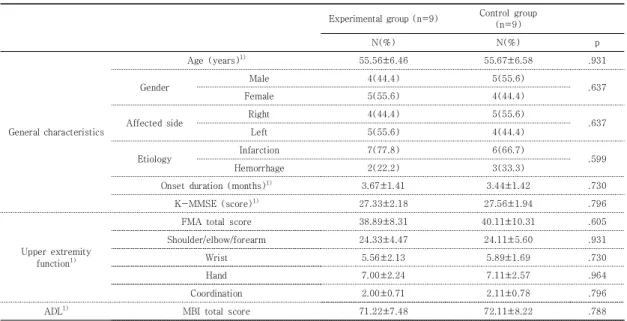
There was no significant difference in the general characteristics of the subjects between the two groups. The FMA and K-MBI were not significantly different between the two groups (see Table 1).
3.2 Changes of upper extremity function and activities of daily living within groups before and after intervention
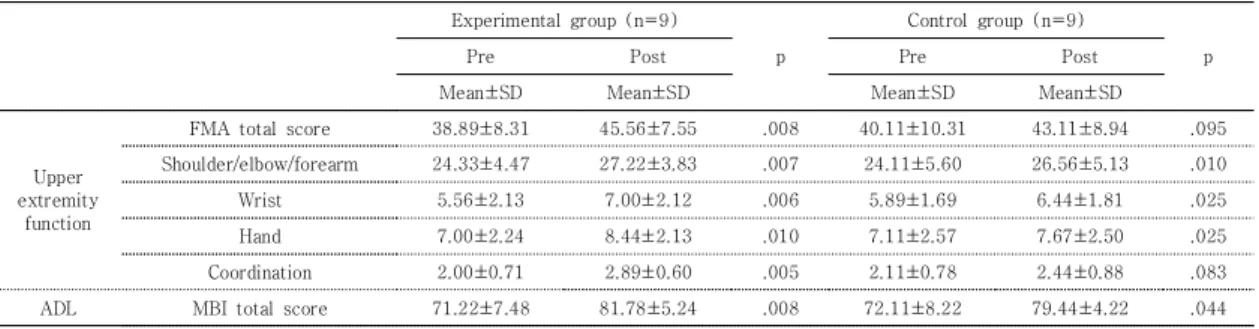
The experimental group showed significant improvements in the FMA and K-MBI before and after intervention (p<.05). The control group showed significant improvements in the shoulder/elbow/forearm, wrist, and hand sub-domains of the FMA and in the K-MBI (see Table 2).
Experimental group (n=9) Control group (n=9)
N(%) N(%) p
General characteristics
Age (years)
1)55.56±6.46 55.67±6.58 .931
Gender Male 4(44.4) 5(55.6)
Female 5(55.6) 4(44.4) .637
Affected side Right 4(44.4) 5(55.6)
.637
Left 5(55.6) 4(44.4)
Etiology Infarction 7(77.8) 6(66.7)
.599
Hemorrhage 2(22.2) 3(33.3)
Onset duration (months)
1)3.67±1.41 3.44±1.42 .730
K-MMSE (score)
1)27.33±2.18 27.56±1.94 .796
Upper extremity function
1)FMA total score 38.89±8.31 40.11±10.31 .605
Shoulder/elbow/forearm 24.33±4.47 24.11±5.60 .931
Wrist 5.56±2.13 5.89±1.69 .730
Hand 7.00±2.24 7.11±2.57 .964
Coordination 2.00±0.71 2.11±0.78 .796
ADL
1)MBI total score 71.22±7.48 72.11±8.22 .788
1)
Mean±SD, FMA: Fugl-Meyer Assessment; ADL: Activities of daily living; K-MBI: Korean Modified Barthel Index
Table 1. General and clinical characteristics of subjects (N=18)
3.3 Comparison of upper extremity function and activities of daily living between two groups after intervention
After intervention, the experimental group showed significantly greater improvements in the FMA total score and in the wrist and hand sub-domains than control group (p<.05) (see Table 3).
4. Discussion
This study examined the effects of virtual reality training on upper extremity function and activities of daily living in patients with sub-acute stroke. The results indicate that the experimental group showed a significantly larger improvement in upper extremity function than
the control group. The virtual reality training applied in this study consisted of a basic course, a game course, and a mission course, all of which focused intensively on performing tasks related to activities of daily living. In the basic course, various tasks such as opening the door, exercising, and hammering were repeatedly performed under biofeedback. In the game courses, active training such as boxing, arm wrestling, and playing a piano was performed.
Game-based virtual reality training and biofeedback have been reported to be more effective than conventional therapy [28-31].
Broeren et al. [28] reported that virtual reality training using biofeedback improved the hand dexterity and stretch ability of chronic stroke patients. Merians et al. [29] found that virtual reality training improved the motion velocity of
Experimental group (n=9)
p
Control group (n=9)
p
Pre Post Pre Post
Mean±SD Mean±SD Mean±SD Mean±SD
Upper extremity
function
FMA total score 38.89±8.31 45.56±7.55 .008 40.11±10.31 43.11±8.94 .095
Shoulder/elbow/forearm 24.33±4.47 27.22±3.83 .007 24.11±5.60 26.56±5.13 .010
Wrist 5.56±2.13 7.00±2.12 .006 5.89±1.69 6.44±1.81 .025
Hand 7.00±2.24 8.44±2.13 .010 7.11±2.57 7.67±2.50 .025
Coordination 2.00±0.71 2.89±0.60 .005 2.11±0.78 2.44±0.88 .083
ADL MBI total score 71.22±7.48 81.78±5.24 .008 72.11±8.22 79.44±4.22 .044
FMA: Fugl-Meyer Assessment; ADL: Activities of daily living; K-MBI: Korean Modified Barthel Index
Table 2. Changes of upper extremity function and activities of daily living within groups before and after intervention
(N=18)
Experimental group (n=9) Control group (n=9)
Change value Change value
p
Mean±SD Mean±SD
Upper extremity function
FMA total score 6.67±2.45 3.00±3.67 .024
Shoulder/elbow/forearm 2.89±1.17 2.44±1.13 .546
Wrist 1.44±0.53 0.56±0.53 .011
Hand 1.44±0.88 0.56±0.53 .040
Coordination 0.89±0.33 0.33±0.50 .050
ADL MBI total score 10.56±9.36 7.33±9.89 .546
FMA: Fugl-Meyer Assessment; ADL: Activities of daily living; K-MBI: Korean Modified Barthel Index
Table 3. Comparison of upper extremity function and activities of daily living between two groups after intervention
(N=18)
the fingers on the affected side, range of motion, and strength of hemiplegic patients. Choi et al.
[30] measured the upper limb function of stroke patients using the FMA and showed significantly greater improvement in virtual reality training than conventional rehabilitation. Housman et al.
[31] also found that virtual reality training was more effective for patients with chronic stroke than conventional training.
Neuroscientific studies have also found evidence of the effects of virtual reality training on stroke patients. Jang et al. [32] confirmed the effect of virtual reality training through functional magnetic resonance imaging (fMRI). In this study, cerebral hemispheres damaged before training had increased brain activity and functional recovery after training. In addition, August et al. [33] reported that virtual reality-based upper extremity training through fMRI increased activity in the primary and secondary motor cortex in chronic stroke patients with hemiplegia; thus, they demonstrated that the primary and secondary motor cortex are responsible for voluntary motor output. Therefore, when performing hand-related tasks through virtual reality training, the mirror neuron system is activated. The results of previous studies that have demonstrated the effects of virtual reality training on these upper extremity functions support the results of this study [32, 33].
Virtual reality training did not show a significant difference from conventional occupational therapy in the K-MBI. The self-care area, which is a sub-item of the K-MBI, is composed of personal hygiene, bathing self, feeding, toileting, and dressing. Woo et al. [34] reported a moderate correlation between upper extremity function and the self-care area of the K-MBI in 100 stroke patients. This suggests that the improvement of upper limb function may improve the self-care sub-domain of daily living activities in this study; however, we did not distinguish the sub-scores of the K-MBI. In a
future study, it is necessary to check whether self-management ability improves.
The control group showed a significant improvements before and after intervention in the sub-domains of the FMA and K-MBI. These suggest that conventional occupational therapy may have a positive effect on the improvement of upper extremity function and activities of daily living in stroke patients. Such evidences has been reported for intensive occupational therapy[35], conventional occupational therapy[36], and review of classification of occupational therapy intervention[37]. Because of the limitations of this study, studies of comparative effectiveness in specific rehabilitation areas will need to be reviewed closely.
The limitations of this study are as follows: 1) since the sample size is small, generalization is difficult; 2) the study subjects were limited to patients with sub-acute stroke; 3) follow-up tests were not performed, so the continuous effect of training is unknown; 4) group allocation was not performed randomly so there is the possibility of selection bias; and 5) the placebo effect cannot be ruled out because the subjects could not be blinded. Therefore, further study will be needed to account for the limitations mentioned above.
5. Conclusion
The aim of this study was to investigate the
effects of virtual reality training on upper
extremity function and activities of daily living in
patients with sub-acute stroke. The experimental
group showed significant improvements in the
FMA and K-MBI after intervention (p<.05). The
control group showed significant improvements
in the shoulder/elbow/forearm, wrist and hand
sub-domains of the FMA and in the K-MBI
(p<.05). After intervention, the experimental
group showed significantly greater improvements
in the total score and in the wrist and hand
sub-domains of the FMA than control group (p<.05). These findings suggest that virtual reality training may have positive effects on the improvements of upper extremity function in patients with sub-acute stroke.
REFERENCES
[1] P. W. Duncan et al. (2005). Management of adult stroke rehabilitation care. Stroke, 36(9), 100-143.
[2] S. A. Maulden, J. Gassaway, S. D. Horn, R. J. Smout &
G. DeJong. (2005). Timing of initiation of rehabilitation after stroke. Archives of physical medicine and rehabilitation, 86(12), 34-40.
[3] R. B. King. (1996). Quality of Life after Stroke. Stroke, 27(9) , 1467-1472.
[4] H. M. Feys et al. (1998). Effect of a therapeutic intervention for the hemiplegic upper limb in the acute phase after stroke. Stroke, 29(4) , 785-792.
[5] D. Jack et al. (2001). Virtual reality-enhanced stroke rehabilitation. IEEE transactions on neural systems and rehabilitation engineering, 9(3) , 308-318.
[6] M. C. Howard. (2017). A Meta-Analysis and Systematic Literature Review of Virtual Reality Rehabilitation Programs. Computers in Human Behavior, 70(1) , 317-327.
[7] C. W. Yin, N. Y. Sien, L. A. Ying, S. F. C. M. Chung &
D. Tan May Leng. (2014). Virtual reality for upper extremity rehabilitation in early stroke: a pilot randomized controlled trial. Clinical rehabilitation, 28(11) , 1107-1114.
[8] G. Saposnik et al. (2010). Effectiveness of virtual reality using Wii gaming technology in stroke rehabilitation. Stroke, 41(7) , 1477-1484.
[9] A. Henderson, N. Korner-Bitensky & M. Levin. (2007).
Virtual reality in stroke rehabilitation: a systematic review of its effectiveness for upper limb motor recovery. Topics in stroke rehabilitation, 14(2) , 52-61.
[10] A. L. Faria, A. Andrade, L. Soares & S. B. i Badia.
(2016). Benefits of virtual reality based cognitive rehabilitation through simulated activities of daily living: a randomized controlled trial with stroke patients. Journal of neuroengineering and rehabilitation, 13(1) , 96-103.
[11] D. Y. Kim et al (2010). Assessment of post-stroke extrapersonal neglect using a three-dimensional immersive virtual street crossing program. Acta Neurologica Scandinavica, 121(3) , 171-177.
[12] L. M. Weber, D. M Nilsen, G. Gillen, J. Yoon & J. Stein.
(2019). Immersive virtual reality mirror therapy for
upper limb recovery following stroke: A pilot study.
American journal of physical medicine &
rehabilitation.
DOI : 10.1097/PHM.0000000000001190. [Epub ahead of print]
[13] H. Kim, A. Lee, Y. I. Shin, W. H Chang, K. H. Koo, H.
Seong & Y. H. Kim. (2018). Effects of digital smart glove system on motor recovery of upper extremity in subacute stroke patients. Annals of Physical and Rehabilitation Medicine, 61, e28.
DOI : 10.1016/j.rehab.2018.05.061
[14] A. Mirelman, P. Bonato & J. E. Deutsch. (2009). Effects of training with a robot-virtual reality system compared with a robot alone on the gait of individuals after stroke. Stroke, 40(1) , 169-174.
DOI : 10.1161/STROKEAHA.108.516328
[15] S. Y. Heo, H. J. Lee, A. J. Ham, Y. N. Kim, S. N. Jeong
& K. M. Kim. (2016). The Effects of Virtual Reality Therapy on Executive Function and Balance for Stroke Patients: A Randomized Controlled Clinical Trial. The Journal of Korean Society of Occupational Therapy, 24(4) , 1-14.
[16] D. S. Lee & D. J. Kim. (2018). The Effect of XBOX based Virtual Reality Training on Stroke Patients’
Upper Limb Function and Activities of Daily living.
Korean Aging Friendly Industry Association, 10(2) , 53-63.
DOI : 10.34264/jkapa.2018.10.2.53
[17] Y. M. Lim, J. Y. Lee, S. J. Jo, Y. S. Ahn & D. H. Yoo.
(2017). A Systematic Review on the Effects of Virtual reality-based Telerehabilitation for Stroke Patients.
The Journal of Korean Society of Community Based Occupational Therapy, 7(1), 59-70.
DOI : 10.18598/kcbot.2017.07.01.07
[18] D. H. Bang, Y. J. So & H. S. Cho. (2013). Imagery training effects of Upper limb function and Activities of daily living in Subacute stroke patients. Journal of Digital Convergence, 11(8) , 235-242.
[19] Y. Kang, D. L. Na & S. Hahn. (1997). A validity study on the Korean Mini-Mental State Examination (K-MMSE) in dementia patients. Journal of the Korean Neurological Association, 15(2) , 300-308.
[20] S. J. Shin. (2016). The Effect of Apraxia on Activity of Daily Living in Stroke Patients. Journal of Digital Convergence, 14(6) , 527-533.
[21] A. R. Fugl-Meyer, L. Jaasko, I. Leyman, S. Olsson & S.
Steglind. (1975). The post-stroke hemiplegic patient.
1. a method for evaluation of physical performance.
Scandinavian journal of rehabilitation medicine, 7(1) , 13-31.
[22] J. Sanford, J. Moreland, L. R. Swanson, P. W. Stratford
& C. Gowland. (1993). Reliability of the Fugl-Meyer assessment for testing motor performance in patients following stroke. Physical therapy, 73(7) , 447-454.
[23] C. V. Granger, G. L. Albrecht & B. B. Hamilton. (1979).
Outcome of Comprehensive Medical Rehabilitation:
Measurement by PULSES Profile and The Barthel Index. Archives of physical medicine and rehabilitation, 60(4) , 145-154.
[24] J. H. Moon, J. Y. Park, Y. S. Kim & I. H. Bak. (2018).
Effect of Art Therapy-based Purposeful Activities on Hand Function, Daily Living, Depression, and Volition for Rehabilitation in Patients With Acute Stroke: A Pilot Study. Journal of Korean Society of Neurocognitive Rehabilitation, 10(1) , 15-24.
DOI : 10.29144/KSCTE.2018.10.1.15
[25] J. H. Moon, K. H. Kim, S. H. Lee, & Y. S. Won. (2017).
Effects of Purposeful Activities Combined with Music on Upper Extremity Function, Therapeutic Motivation, and Mood in Acute Stroke Patients. PNF and Movement, 15(3) , 267-279.
DOI : 10.21598/JKPNFA.2017.15.3.267
[26] J. H. Moon, C. H. Na, K. Y. Park, S. J. Heo & C. H. Lee.
(2018). A Pilot Investigation for usage Problems, Improvement Needs and Current Status of Upper Extremity Rehabilitation Equipment using SNS. The Journal of the Korea institute of electronic communication sciences, 13(2) , 463-472.
[27] J. H. Moon, K. Y. Park, H. J. Kim & C. H. Na. (2018).
The Effects of Task-Oriented Circuit Training Using Rehabilitation Tools on the Upper-Extremity Functions and Daily Activities of Patients with Acute Stroke: A Randomized Controlled Pilot Trial. Osong public health and research perspectives, 9(5) , 225-230.
DOI : 10.24171/j.phrp.2018.9.5.03
[28] J. Broeren, M. Rydmark, A. Bjorkdahl & K. S.
Sunnerhagen. (2007). Assessment and training in a 3-dimensional virtual environment with haptics: a report on 5 cases of motor rehabilitation in the chronic stage after stroke. Neurorehabilitation and neural repair, 21(2) , 180-189.
[29] A. S. Merians, H. Poizner, R. Boian, G. Burdea & S.
Adamovich. (2006). Sensorimotor training in a virtual reality environment: does it improve functional recovery poststroke?. Neurorehabilitation and neural repair, 20(2) , 252-267.
[30] Y. H. Choi, J. Ku, H. Lim, Y. H. Kim & N. J. Paik.
(2016). Mobile game-based virtual reality rehabilitation program for upper limb dysfunction after ischemic stroke. Restorative neurology and neuroscience, 34(3), 455-463.
[31] S. J. Housman, K. M. Scott & D. J. Reinkensmeyer.
(2009). A randomized controlled trial of gravity-supported, computer-enhanced arm exercise for individuals with severe hemiparesis.
Neurorehabilitation and neural repair, 23(5), 505-514.
[32] S. H. Jang et al. (2005). Cortical Reorganization and Associated Functional Motor Recovery after Virtual Reality in Patients with Chronic Stroke: An Experimenter-Blind Preliminary Study. Archives of
physical medicine and rehabilitation, 86(11), 2218-2223.
[33] K. August, J. A. Lewis, G. Chandar, A. Merians, B.
Biswal & S. Adamovich. (2006). FMRI analysis of neural mechanisms underlying rehabilitation in virtual reality: activating secondary motor areas. In 2006 International Conference of the IEEE Engineering in Medicine and Biology Society (pp. 3692-3695). IEEE.
[34] H. S. Woo, W. K. Park & T. H. Cha. (2012). Correlation Between Korean-WMFT Functional Score and Activities of Daily Living. The Journal of Korean Society of Occupational Therapy, 20(3) , 95-104.
[35] W. Kakuda et al. (2012). A multi-center study on low-frequency rTMS combined with intensive occupational therapy for upper limb hemiparesis in post-stroke patients. Journal of neuroengineering and rehabilitation, 9(1) , 4.
DOI : 10.1186/1743-0003-9-4.
[36] C. J. Parker et al. (2001). A multicentre randomized controlled trial of leisure therapy and conventional occupational therapy after stroke. Clinical rehabilitation, 15(1) , 42-52.
[37] S. Smallfield & J. Karges. (2009). Classification of occupational therapy intervention for inpatient stroke rehabilitation. American Journal of Occupational Therapy, 63(4) , 408-413.
DOI : 10.5014/ajot.63.4.408
전 민 재(Min-Jae Jeon) [정회원]
․ 2014년 8월 : 연세대학교 보건환경대 학원 인간공학치료학(석사)
․ 2018년 2월 : 연세대학교 일반대학원 물리치료학(박사)
․ 2018년 5월 ~ 현재 : 국립재활원 재활 연구소 건강보건연구과
․ 관심분야 : 건강증진, 건강관리
․ E-Mail : [email protected] / [email protected]
문 종 훈(Jong-Hoon Moon) [정회원]