- 859 -
포도씨의 proanthocyanidin 함량 및 항산화 활성
황인욱․이혜련․김숙경․정호철․최종욱․이상한․이숙희1․정신교† 경북대학교 식품공학과, 1경북농업기술원
Proanthocyanidin Content and Antioxidant Characteristics of Grape Seeds
In-Wook Hwang, Hye-Ryun Lee, Suk-Kyung Kim, Hu-Zhe Zheng, Jong-Uck Choi, Sang-Han Lee, Suk-Hee Lee1 and Shin-Kyo Chung†
Department of Food Science and Technology, Kyungpook National University, Daegu 702-701, Korea
1
Kyongbuk Agricultural Technology Administration, Daegu 702-320, Korea
Abstract
The proanthocyanidin content and antioxidant characteristics of seeds of grape cultivars were examined. Grape seeds were extracted in 70% acetone solution for 12 hr. The total phenolic content of the extracts ranged from 16.71 to 28.60 mg/100 g. The proanthocyanidin content ranged from 18.36 to 55.30 mg/100 g. The Jaok cultivar had the highest total phenolic and proanthocyanidin content, and showed the strongest antioxidant activity in the FRAP and DPPH assays. The total phenolic and proanthocyanidin content of grape seeds was correlated with their antioxidant capacities (r > 0.92). Acetone extracts of grape seeds could be effective antioxidant materials.
Key words:DPPH, FRAP, grape seeds, proanthocyanidin, total phenolic contents
서 론
1)
포도(Vitis vinifera)는 갈대나무목(Rhamnales) 포도과 (Vitaceae)에 속하는 낙엽성 덩굴식물로, 포도과에는 11속, 700여종의 포도가 있다. 우리나라에서는 1994년 우루과이 협상 이 후에 농가소득 증대의 차원에서 작목 전환이 이루 어져 점차 포도의 재배면적이 증가하고 있으며 연간 약 30~40만 톤의 포도가 생산되고 있다(1). 재배되고 있는 포도의 약 85~90% 정도는 생식용으로 소비되고 나머지 10~15% 정도가 포도 주스, 포도주, 포도즙과 같은 포도 가공식품으로 사용되고 있다(2). 일반적으로 포도를 가공 하는 과정에서는 포도 중량의 약 3~5% 정도의 포도씨가 부산물로 배출되고 있으며, 이를 다른 씨와 같이 건강 기능 성 식품으로 이용하는 방안이 연구되고 있다(3).
포도씨에는 (+)-catechins, (-)-epicatechin, (-)-epicatechin -3-o-gallate등의 monomer 페놀 화합물, polyhydroxy flavan-
†Corresponding author. E-mail:[email protected], Phone:82-53-950-5778, Fax:82-53-950-6772
3-ol 단위의 oligomer, 그리고 polymer인 proanthocyanidin이 라고 하는 폴리페놀 화합물이 함유되어 있는데, 이들 폴리 페놀 화합물의 항산화 활성과 라디칼 소거능이 보고되어 있다(4-7). 포도씨에 함유된 생리활성 물질인 proanthocyanidin 은 자유 라디칼 소거능, 항산화 활성, 항박테리아, 항바이러 스, 항발암, 항염증, 지질 과산화 억제, 혈소판 응집 억제 등이 있으며, 유럽에서는 정맥 기능부전, 미세혈관장애 등 과 같은 혈관 질환의 치료에 사용되고 있다(8).
다양한 생리활성을 가진 proanthocyanidin은 강력한 항산 화 활성으로 가장 잘 알려져 있으며, 항산화 능력이 vitamin E 보다는 20배, vitamin C 보다는 50배 높은 것으로 보고되 어 있다(9). 이러한 proanthocyanidin은 vitis속인 포도와 머 루 등에 다량 함유되어있으며, 과육보다는 과피와 씨에 많 이 함유되어있고, 과피보다는 씨에 많이 함유되어있다. 하 지만 근래의 다양한 제품에서 폭넓게 이용되고 있는 항산화 제는 butylated hydroxyanisole (BHA), buytlated hydroxytoluene (BHT), tertiary butylhydroquinonoe (TBHQ) 등의 페놀계 인 공 합성물질이다. 이들 합성 항산화물질은 독성 및 발암성
이 지적되었으며, 이를 해결하기 위해 안전성과 관능상으 로 문제가 되지 않는 식물 기원의 천연 항산화제의 개발이 광범위하게 시도되고 있다(10-14).
따라서 본인 등은 포도가공 부산물인 포도씨를 항산화 건강기능성 소재로 활용할 수 있도록, 국내의 포도씨를 품 종별로 수집하고, 추출물을 제조하여 항산화 성분인 총 페 놀 함량과 proanthocyanidin의 함량을 정량하고, DPPH와 FRAP 방법에 의하여 항산화 활성을 검정하고, 이들의 상관 성을 조사하였다.
재료 및 방법
재 료
본 실험에 사용한 포도씨는 경상북도 농업기술원에서 제공받아 4℃에서 보관하며 사용하였고, 산머루씨는 경남 함양군 두레마을 회사에서 2004년도 착즙씨를 구입해 음건 (陰乾)하여 4℃에서 보관하며 사용하였다. 품종 및 학명은 다음과 같다. 탐나라(Vitis hybrid), 자옥(Vitis labruscana), 흑구슬(Vitis sp.), 캠벨(Vitis labruscana), 산머루(Vitis amurensis).
실험에 사용한 gallic acid, trolox, L-ascorbic acid, quercetin, (+)-catechin, vanillin, Folin-Ciocalteu's phenol reagent, 2,4,6-tris(2-pyridyl)-s-triazine (TPTZ), 1,1-diphenyl-2-picrylhydrazyl (DPPH)은 Sigma Chem. Co. (St. Louis, MO., USA)의 제품을 사용하였으며, 그 외 분석용으로 사용한 시약류는 분석용 특급 시약을 사용하였다.
추출물 제조
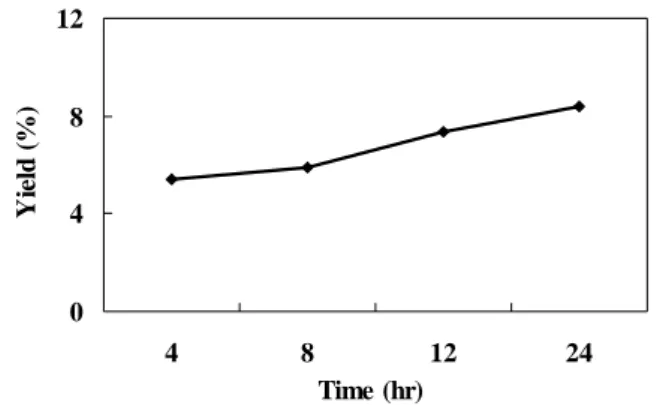
시료를 건조한 후 막자사발을 이용하여 분쇄한 것을 사 용하여 시료 분말 2 g에 70% 아세톤을 가하여 4시간, 8시간, 12시간, 24시간 별로 추출하고 여과하여 농축한 것을 분석 에 사용하였고, 최적 추출 조건 확립을 위해 포도씨 추출물 의 수율을 비교하여 최적 추출 조건을 알아보았다.
Proanthocaynidin 함량
분리한 포도씨의 proanthocaynidin 함량은 vanillin-sulfuric acid법(15)으로 측정하였다. 시료 200 μL에 1.2% vanillin 용액 500 μL와 20% H2SO4 용액 500 μL를 혼합하여 20분간 방치하고, 500 nm에서 흡광도를 측정하였다. Proanthocaynidin 함량은 (+)-catechin를 이용하여 검량곡선을 작성하고 (+)-catechin 에 대한 당량으로 환산하였다.
총 페놀 함량
총 페놀의 함량은 Folin-Ciocalteu 방법(16)으로 측정하였 다. 시료 100 μL에 2 N Folin-Ciocalteu's phenol reagent 50 μL와 20% Na2CO3 300 μL를 가하여 15분 동안 실온에서 방치하고, 1 mL 증류수를 넣은 다음 1,250 rpm으로 5분
동안 원심분리 한 후 급냉하여 상등액의 흡광도를 725 nm 에서 측정하였다. 총 페놀 함량은 gallic acid를 이용하여 검량곡선을 작성하고 gallic acid에 대한 당량으로 환산하 였다.
DPPH 라디칼 소거 활성 측정
포도씨 추출물의 DPPH(1,1-Diphenyl-2-picrylhydrazyl) 라디칼에 대한 소거활성은 시료 100 μL와 DPPH 용액 900 μL를 혼합하고, 암실에서 30분간 방치한 후 517 nm에서 흡광도를 측정하여 대조구와 비교하였고, DPPH 라디칼 소거능은 아래와 같이 계산하였다(17).
DPPH radical scavenging activity (%) = [1- (Abs/Abc)] × 100(%)
A
bc: Absorbance of DPPH solution without sample at 517 nmA
bs: Absorbance of DPPH solution with sample at 517 nmFRAP (Ferric ion reducing antioxidant power) 활성 측정
FRAP 활성은 Benzie 등(18)의 방법으로 측정하였다.
C2H3NaO2와 acetic acid(C2H4O2)를 이용하여 acetate buffer (pH 3.6, 23 mM)를 만들고, 40 mM HCl과 TPTZ(2,4,6- tripyridyl-s-triazine)를 이용하여 10 mM TPTZ solution을 만든다. 실험을 위한 반응용액(cocktail solution)은 acetate buffer(pH 3.6, 23 mM), 10 mM TPTZ(2,4,6-tripyridyl -s-triazine) 및 20 mM FeCl3·6H2O를 10 : 1 : 1의 비율로 섞어 만든 후, 실험 전까지 37℃를 유지하여 사용하였다.
시료 25 μL와 cocktail solution 175 μL를 혼합하여, 암실에서 30분 방치한 후 590 nm에서 흡광도를 측정하였다. 환원력 은 trolox를 이용하여 검량곡선을 작성하고 trolox에 대한 당량으로 환산하였다.
통계 처리
모든 실험은 3반복으로 시행하였으며, 평균, 표준편차, 상관 계수를 SAS 9.0 software(version 9.0, SAS institute Inc., USA)에 의하여 구하였다.
결과 및 고찰
추출 조건
시간별 조추출물의 수율을 비교하여 분석을 위한 최적 추출 조건을 얻었다. 12시간 추출물의 수율이 8시간 추출물 의 수율보다 1.5배 높았고, 24시간 추출물의 수율이 제일 높았지만 12시간 추출물과 24시간 추출물의 수율은 차이가 거의 없어 이후의 시료는 12시간 추출한 것을 사용하였다.
Proanthocaynidin 함량
포도씨 추출물과 머루씨 추출물의 proanthocyanidin 함량
Table 1. Acetone extract yields from the grape seeds for 12hr extraction
Cultivar Campbell
Early Heukgoosul Shigyoku Tamnara Wild grape Acetone
extracts (mg) 147.5 203.0 218.9 206.2 204.3
을 측정한 결과는 Table 2와 같다. 추출물들의 proanthocyanidin 함량은 18.36 ± 0.79 ~ 55.30 ± 8.86 mg/100 g의 범위를 나타내었으며, 시료 모두 적색을 띄어 proanthocyanidin의 독특한 반응 특성과 일치하였다. 그 중 자옥 품종이 55.30
± 8.86 mg/100 g으로 가장 높은 함량을 나타내었고, 다음으 로 흑구슬, 캠벨, 탐나라, 산머루 순으로 함량이 높았다.
Table 2. Proanthocyanidin contents of the acetone extracts from grape seeds
Cultivar Campbell
Early Heukgoosul Shigyoku Tamnara Wild grape Contents
(mg/100 g) 22.25 ± 2.25 35.59 ± 2.15 55.30 ±
8.86 21.35 ±
0.52 18.36 ± 0.79 Values present the means ± SD (n=3).
1)Test concentraion was 0.5 mg/mL.
총 페놀 함량
포도씨 추출물과 머루씨 추출물의 총 페놀 함량을 측정 한 결과는 Table 3과 같다. 추출물들의 총 페놀 함량은 16.71
~ 28.60 mg/100 g의 범위를 나타내었으며, proanthocyanidin 함량과 마찬가지로 자옥 품종이 28.60 ± 4.03 mg/100 g으로 가장 높은 함량을 나타내었다. 다음으로 흑구슬, 탐나라, 켐벨, 산머루 순으로 함량이 높았다.
Table 3. Total phenolic contents of acetone extracts from the grape seeds
Cultivar Campbell
Early Heukgoosul Shigyoku Tamnara Wild grape Contents
(mg/100 g) 18.53 ±
1.13 26.90 ±
0.49 28.60 ±
4.03 20.42 ±
0.10 16.71 ± 4.63 Values present the means ± SD (n=3).
1)Test concentraion was 0.2 mg/mL.
DPPH 라디칼 소거 활성
포도씨와 머루씨 추출물의 DPPH 라디칼 소거 활성을 알아본 결과는 Fig. 1과 같다. Proanthocyanidin 함량, 총 페놀 함량의 실험 결과와 같이 자옥 품종이 90% 이상으로 가장 활성이 강하였고, 다음으로 흑구슬, 탐나라, 캠밸, 산 머루 순으로 활성이 높았다. 또한 이들 추출물들은 100 uM gallic acid, trolox 표준물질에 비해 더 강력한 항산화 활성을 나타내었다.
0 4 8 12
4 8 12 24
Time (hr)
Yield (%)
Fig. 1. Change of extraction yields from the rape seed by extraction time.
FRAP (Ferric ion reducing antioxidant power) 활성
포도씨와 머루씨 추출물의 FRAP 활성은 Table 4에 나타 내었다. 앞의 실험 결과와 같이 자옥 품종이 308 ± 16.64 μM으로 가장 강한 활성을 나타내었고, 다음으로 흑구슬, 탐나라, 캠밸, 산머루 순으로 강한 활성을 나타내었다. 이는 앞에서의 총 페놀 함량, DPPH 라디칼 소거 활성의 결과와 일치하였다. 자옥은 미국종 야생포도 (Vitis labrusca)와 유럽종 (Vitis vinifera)를 상호 교잡종한 것으로, 내한성과 내병성이 강한 것이 특징이다. 이는 phytoalexin이 다른 품 종에 비해 풍부하기 때문인 것으로 추정되며, 실험 결과에 서도 proanthocyanidin, 총 페놀 함량이 가장 많았고, DPPH 라디칼 소거 활성과 FRAP 활성도 가장 강하게 나타났다.
탐나라와 캠밸은 실험 결과가 유사하게 나타났는데 이는 탐나라 품종이 campbell early와 himrod seedless의 교배종이 기 때문에 두 품종의 성분 함량과 항산화 특성이 비슷한 것으로 추정된다.
Table 4. Ferric ion reducing antioxidant powers of acetone extracts from the grape seeds
Cultivar Campbell
Early Heukgoosul Shigyoku Tamnara Wild grape Trolox
equivalent (uM)
150 ±
11.92 209 ±
31.61 308 ±
16.64 176 ±
3.68 121 ± 9.22 Values present the means ± SD (n=3).
1)Test concentraion was 0.5 mg/mL.
상관 계수
포도씨의 품종에 따른 총 페놀 함량, proanthocyanidin 함량, FRAP 및 DPPH에 의한 항산화 활성간의 각각의 상관 계수를 Table 5에 나타내었다. 총 페놀 함량과 proanthocyanidin 함량은 상관계수 값이 0.921로서 비교적 높은 상관성을 보 였으며, FRAP과 DPPH에 의한 항산화 활성 간에는 0.960으
로서 더욱 높은 상관성을 나타내었다. 총 페놀 함량과 proanthocyanidin 함량의 항산화 성분과 FRAP과 DPPH에 의한 항산화 활성 간의 상관성은 모두가 0.92 이상이었으 며, 총 페놀 함량과 DPPH 소거 활성 사이의 상관성이 가장 높았다(0.984). 따라서 포도씨의 총 페놀은 거의 대부분이 proanthocyanidin 성분일 것으로 생각되며, 이들 성분에 의 하여 항산화 활성이 높게 나타난 것으로 추정된다.
0 20 40 60 80 100
gallic acid trolox Campbell Heukgoosul Shigyoku Tamnara Wild grape Grape seeds
Inhibition (%)
Fig. 2. The DPPH free radical scavenging activities of the grape seeds.
Table 5. Correlation coefficients among total phenolic contents, proanthocyanidin contents, DPPH and FRAP values from 5 cultivars of grape seeds
Total phenol Proanthocyanidin DPPH FRAP
Total phenol - 0.921 0.984 0.923
Proanthocyanidin 0.921 - 0.974 0.976
DPPH 0.984 0.974 - 0.960
FRAP 0.923 0.976 0.960 -
요 약
포도씨의 품종에 따른 총 페놀 함량과 proanthocyanidin 의 함량과 항산화 활성을 알아보았다. 총 페놀 함량은 Folin-Ciocalteu법으로 측정하였고, 16.71 ~ 28.60 mg/100 g의 함량을 나타내었다. Proanthocyanidin 함량은 vanillin sulfuric acid법으로 측정하였고, 18.36 ~ 55.30 mg/100 g의 함량을 나타내었다. 품종 중에서 자옥 품종이 가장 높은 페놀 함량과 proanthocyanidin 함량을 나타내었다. 항산화 활성은 자옥 품종이 역시 가장 강한 항산화 활성을 나타내 었다. 총 페놀 함량과 proanthocyanidin 함량은 항산화 활성 과 높은 상관성을 보였다 (>0.92). 따라서 포도씨 추출물은 항산화 건강 기능성 식품의 소재로서 유용하게 활용될 수 있을 것으로 기대된다.
감사의 글
본 연구 결과는 농림부․농림기술관리센터 지정 포도연 구사업단의 일부 연구비 지원에 의하여 수행되었습니다.
참고문헌
1. Kim, W.S. (1995) Grape processing industries. In New
Cultivation Method of Grape. Kim W.S., ed. Munun
Publishing Co, Seoul. pp. 58-92.2. Sung, J.K. (1996) The present of grape processing industries. In Grape, from Plantation to Sales. Sung J.K., ed. The Nongmin Press, Seoul. pp. 23-41.
3. Yoo, M.A., Chung, H.K. and Kang, M.H. (2004) Evaluation of physicochemical properties in different cultivar grape seed waste. Food. Sci. Biotechnol., 13, 26-29.
4. Saito, M., Hosoyama, H., Ariga, T., Kataoka, S. and Yamaji, N. (1998) Antiulcer activity of grape seed extract and procyanidins. J. Agric. Food. Chem., 46, 1460-1464.
5. Jorge, M., Ricardo, D. S., Jacques, R., Veronique, C., Annie, C. and Michel, M. (1991) Procyanidin dimers and trimers from grape seeds. Phytochemistry, 30, 1259-1264.
6. Ricardo da Silva, J.M., Darmon, N., Fenandez, Y. and Mitjavila, S. (1991) Oxygen free radical scavenger capacity in aqueous models of deferent procyanidins from grape seeds. J. Agric. Food. Chem., 39, 1549-1552.
7. Ariga, T., Koshiyama, I. and Fukushima, D. (1998) Antioxidative properties of procyanidins B-1 and B-3 from azuki beans in aqueous systems. Agric. Biol. Chem., 52, 2717-2722.
8. Murray, M. and Pizzomo, J. (1999) Procyanidolic oligomers. In: Murray M., Pizzomo J., eds. The Textbook
of Natural Medicine. 2
nded. London: Churchill Livingston;899-902.
9. John, S., Jianmel, Y., Joseph, E. and Yukio, K. (2003) Polyphenolics in grape seeds-biochemistry and functionality.
J. Med. Food., 6, 291-299.
10. Buxiang, S. and Fukuhara, M. (1997) Effects of co-administration of butylated hydroxytoluene, butylated hydroxyanisole and flavonoide on the activation of mutagens and drug-metabolizing enzymes in mice.
Toxicology, 122, 61-72.
11. Hirose, M., Takesada, Y., Tanaka, H., Tamano, S., Kato, T. and Shirai, T. (1998) Carcinogenicity of antioxidants
BHA, caffeic acid, sesamol, 4-methoxyphenol and catechol at low doses, either alone or in combination and modulation of their effects in a rat medium-term multi-organ carcinogensis model. Carcinogenesis, 19, 207-212.
12. Namiki, M. (1990) Antioxidants/antimutagens in food.
Crit. Rev. Food. Sci. Nutr., 29, 207-212.
13. Pokorny, J. (1991) Natural antioxidant for food use.
Trends Food. Sci. Technol., 9, 223-227.
14. Jayaprakasha, G.K., Negi, P.S., Silder, S., Rao, L.J. and Sakariah, K.K. (2000) Antibacterial activity of citrus reticulata peel extracts. Z. Naturforsch., 55, 1030-1034.
15. Baoshan, S., Jorge, M., Ricardo, D.S. and Isabel, S.
(1998) Critical Factors of Vanillin Assay for Catechins and Proanthocyanidins. J. Agric. Food. Chem., 46, 4267-4274.
16. Sato, M., Ramarathnam, N., Suzuki, Y., Ohkubo, T.,
Takeuchi, M. and Ochi, H. (1996) Varietal differences in the phenolic content and superoxide radical scavenging potential of wines from different sources. J. Agric. Food.
Chem., 44, 37-44.
17. Kang, M.H., Park, C.G., Cha, M.S., Seong, N.S., Chung, H.K. and Lee, J.B. (2001) Component characteristics of each extract prepared by different extract methods from by-products of glycyrrhizia uralensis. J. Korean Soc.
Food. Sci. Nutr., 30, 138-142.
18. Benzie, I.F.F. and Stranin, J.J. (1996) The ferric reducing ability of plasma (FRAP) as a measure of "antioxidnat power": the FRAP assay. Anal. Biochem., 239, 70-76.
19. Liu, T.Z., Chin, N., Kiser, M.D., and Bigler, W.N. (1982) Specific spectrophotometry of ascorbic acid in serum or plasma by use of ascorbate oxidase. Clin. Chem., 28, 2225-2228.
(접수 2008년 7월 14일, 채택 2008년 11월 14일)