• 검색 결과가 없습니다.

The Natural Course of Endobronchial Inflammatory Polyps as a Complication after Endobronchial Ultrasound-Guided Transbronchial Needle Aspiration

N/A
N/A
Protected

Academic year: 2021

Share "The Natural Course of Endobronchial Inflammatory Polyps as a Complication after Endobronchial Ultrasound-Guided Transbronchial Needle Aspiration"

Copied!
4
0
0

로드 중.... (전체 텍스트 보기)

전체 글

(1)

419

The Natural Course of Endobronchial Inflammatory Polyps as a Complication after Endobronchial Ultrasound-Guided Transbronchial Needle Aspiration

Kyu Min Lee, M.D.

1,

*, Sun Mi Jang, M.D.

1,

*, Seo Young Oh, M.D.

1

, Do Young Kim, M.D.

1

, Geewon Lee, M.D.

2

, Ahrong Kim, M.D.

3

, Min Ji Kim, M.D.

1

, Tae Hwa Kim, M.D.

1

, Joon Woo Park, M.D.

1

, Kwangha Lee, M.D.

1

, Ki Uk Kim, M.D.

1

, Min Ki Lee, M.D.

1

and Jung Seop Eom, M.D.

1

Departments of

1

Internal Medicine,

2

Radiology, and

3

Pathology, Pusan National University School of Medicine, Busan, Korea

We presented a case of unusual endobronchial inflammatory polyps as a complication following endobronchial ultrasound–guided transbronchial needle aspiration (EBUS-TBNA) in a patient with tuberculous lymphadenitis. EBUS- TBNA of the right hilar lymph node was performed in a 29-year-old, previously healthy man. The patient was confirmed with tuberculous lymphadenitis and received antituberculosis medication over the course of 6 months. Chest computed tomography, after 6 months of antituberculosis therapy following the EBUS-TBNA showed nodular bronchial wall thickening of the right main bronchus. Histological and microbiological examinations revealed inflammatory polyps.

After 7 months, the inflammatory polyps regressed almost completely without need for removal.

Keywords: Needles; Complications; Lymphadenitis; Polyps; Tuberculosis

plications are occasionally reported with the recent wide- spread use of EBUS-TBNA, including hemorrhage, infection, and inflammatory polyps

4-6

.

Reports have described the successful removal of inflam- matory polyps, which had developed after EBUS-TBNA, using biopsy forceps

6

. However, the natural clinical course of inflam- matory polyps after EBUS-TBNA is still unclear. We report a patient with tuberculous lymphadenitis who developed inflammatory polyps 6 months after EBUS-TBNA, but did not undergo polyp removal, and discuss the natural progression of the polyps over the course of 7 months.

Case Report

A 29-year-old man visited our clinic with a 1-month history of a dry cough and night sweats. He had been healthy and had no specific family medical history related to these symptoms.

Chest computed tomography (CT) showed conglomerated, enlarged lymph nodes with central necrosis in the right upper paratracheal, both lower paratracheal, subcarinal, and right Copyright © 2015

The Korean Academy of Tuberculosis and Respiratory Diseases.

All rights reserved.

Introduction

Endobronchial ultrasound–guided transbronchial needle aspiration (EBUS-TBNA) is a useful technique for investigat- ing patients with various mediastinal diseases

1-3

. Although EBUS-TBNA is generally considered to be safe, various com-

CASE REPORT

http://dx.doi.org/10.4046/trd.2015.78.4.419

ISSN: 1738-3536(Print)/2005-6184(Online) • Tuberc Respir Dis 2015;78:419-422

Address for correspondence: Jung Seop Eom, M.D.

Department of Internal Medicine, Pusan National University School of Medicine, 179 Gudeok-ro, Seo-gu, Busan 49241, Korea

Phone: 82-51-240-7889, Fax: 82-51-254-3127 E-mail: [email protected]

*Kyu Min Lee and Sun Mi Jang contributed equally to this work.

Received: May 10, 2015 Revised: Jun. 11, 2015 Accepted: Jun. 29, 2015

cc
It is identical to the Creative Commons Attribution Non-Commercial

License (http://creativecommons.org/licenses/by-nc/4.0/).

(2)

KM Lee et al.

420 Tuberc Respir Dis 2015;78:419-422 www.e-trd.org

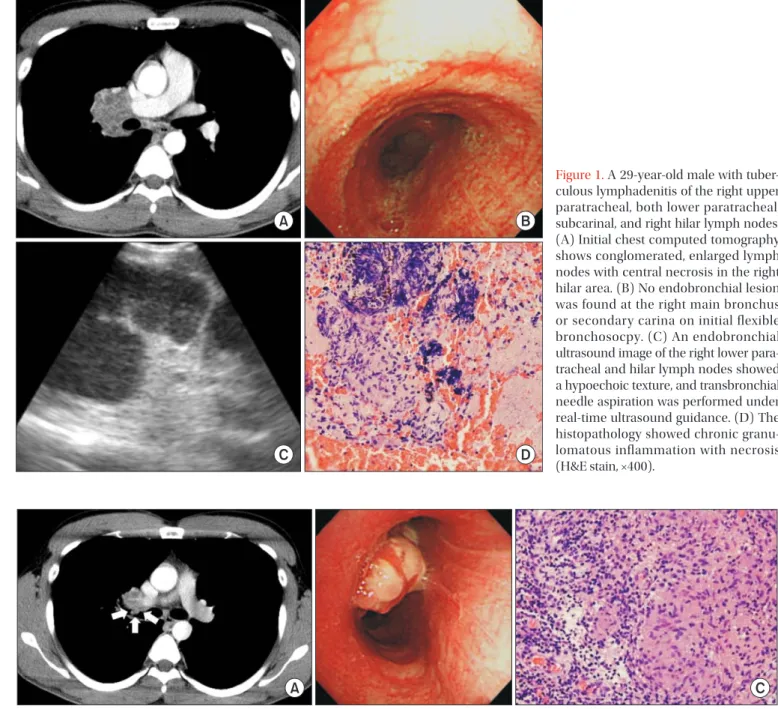
hilar areas (Figure 1A). Since no endobronchial lesion was visible on flexible bronchoscopy (BF-1T260; Olympus, Tokyo, Japan) (Figure 1B), we performed EBUS-TBNA (BF-UC260F- OL8; Olympus) to examine the right lower paratracheal and hilar lymph nodes histologically and microbiologically (Figure 1C). Chronic granulomatous inflammation with necrosis was evident (Figure 1D), and the EBUS-TBNA samples stained

positively for acid-fast bacilli (AFB). As the histological find- ings of tuberculosis and positive AFB staining were compat- ible, we prescribed standard anti-tuberculosis treatment.

Subsequently, although the post-bronchoscopy sputum speci- men stained negatively for AFB, Mycobacterium tuberculosis was cultured. Sputum tests performed 1 month after initiating anti-tuberculosis treatment were AFB staining- and culture-

A B

C D

Figure 1. A 29-year-old male with tuber- culous lymphadenitis of the right upper paratracheal, both lower paratracheal, subcarinal, and right hilar lymph nodes.

(A) Initial chest computed tomography shows conglomerated, enlarged lymph nodes with central necrosis in the right hilar area. (B) No endobronchial lesion was found at the right main bronchus or secondary carina on initial flexible bronchosocpy. (C) An endobronchial ultrasound image of the right lower para- tracheal and hilar lymph nodes showed a hypoechoic texture, and transbronchial needle aspiration was performed under real-time ultrasound guidance. (D) The histopathology showed chronic granu- lomatous inflammation with necrosis (H&E stain, ×400).

A C

Figure 2. Computed tomography was performed to assess the treatment response after 6 months of antituberculosis treatment. (A) A newly

developed endobronchial lesion was found on computed tomography (arrows). (B) Lobulating nodular lesions at the distal right main bron-

chus and right secondary carina were noted on flexible bronchoscopy. (C) Forceps biopsy of the newly developed endobronchial lesions

revealed chronic granulomatous inflammation (H&E stain, ×400).

(3)

Inflammatory polyps after EBUS-TBNA

http://dx.doi.org/10.4046/trd.2015.78.4.419 421

www.e-trd.org negative.

After 6 months of antituberculosis treatment, CT was per- formed to assess the patient’s response to treatment. Although the lymph nodes had decreased in size in comparison with the baseline CT, new endobronchial lesions were discovered in the right main bronchus (Figure 2A). Flexible bronchos- copy showed lobulating endobronchial lesions in the distal right main bronchus and right secondary carina (Figure 2B). A forceps biopsy of the endobronchial lesions revealed chronic granulomatous inflammation (Figure 2C). AFB cultures and tuberculosis–polymerase chain reaction using bronchial washing and tissue samples were negative. The lobulating en- dobronchial lesions were therefore diagnosed as endobron- chial inflammatory polyps.

Since the patient was asymptomatic, we observed the natu- ral course of the polyps without resorting to their removal.

Flexible bronchoscopy was performed 3 months later and the size of the endobronchial inflammatory polyps was found to have significantly decreased (Figure 3A, B). Moreover, the en- dobronchial inflammatory polyps had almost disappeared on bronchoscopy after 7 months (Figure 3C, D).

Discussion

No report has followed the natural course of endobronchial inflammatory polyps following EBUS-TBNA. Our case showed that endobronchial inflammatory polyps, as a complication of EBUS-TBNA, could regress spontaneously without treatment.

Therefore, this report may help in the management of asymp- tomatic endobronchial inflammatory polyps following EBUS- TBNA.

According to Dixit et al.

7

, the stroma of inflammatory polyps has a variable appearance depending on the number of blood vessels, the nature of the connective tissue, and the sever- ity of the inflammatory cellular infiltrate. Samter proposed a process explaining the development of the polyps; a variety of injuries including trauma, secondary infection, and sensitiza- tion to bacteria or to other agents leads to increased capillary permeability and the immigration of inflammatory cells, caus- ing vascular congestion and tissue edema. The pressure of this fluid pushes the mucous membrane forward, giving rise first to folds and projections and then to massive mucosal herni- ates in the respiratory tract

8

.

Compatible bronchoscopic and histological findings are re-

A B

C D

Figure 3. The natural course of the in-

flammatory polyps. (A) After 3 months,

flexible bronchoscopy indicated a

decreased size of the endobronchial in -

flammatory polyps . (B) A narrow-band

imaging bronchoscopic scan taken

after 3 months. (C) After 7 months, the

endo bronchial inflammatory polyps

had spontaneously regressed almost

com pletely. (D) A narrow-band imaging

bronchoscopic scan taken after 7 mon-

ths.

(4)

KM Lee et al.

422 Tuberc Respir Dis 2015;78:419-422 www.e-trd.org

quired to diagnose an inflammatory polyp

9,10

. In addition, both tuberculosis and inflammatory polyps show granulomatous inflammation histologically, making them difficult to distin- guish using this technique alone. We observed that a polypoid lesion developed in the right bronchial tree after EBUS-TBNA.

Staining of forceps biopsy material revealed chronic granu- lomatous inflammation. However, AFB cultures of polypoid tissue and a polymerase chain reaction for detecting M. tuber- culosis were negative. Moreover, the inflammatory polypoid

lesions essentially disappeared in the absence of further anti- tuberculosis treatment. This means that the inflammatory polyps were attributable to EBUS-TBNA, and not tuberculous inflammation.

Cases of inflammatory polyps following EBUS-TBNA are rare. In a previous case, because the patient had symptoms, including cough and dyspnea, the inflammatory polyps had to be removed. Therefore, it was difficult to recognize the natural progression of the inflammatory polyps

6

. However, our patient was asymptomatic and so we were able to observe the natural course over several months without removing the polyps. As a result, the polyps spontaneously regressed.

In conclusion, we found that endobronchial inflammatory polyps after EBUS-TBNA can regress spontaneously without treatment. Unless endobronchial inflammatory polyps lead to respiratory symptoms, observation without removal of the polyps is a reasonable treatment option.

Conflicts of Interest

No potential conflict of interest relevant to this article was reported.

Acknowledgements

This study was supported by a clinical research grant from the Biomedical Research Institute, Pusan National University Hospital (2015).

References

1. Navani N, Molyneaux PL, Breen RA, Connell DW, Jepson A, Nankivell M, et al. Utility of endobronchial ultrasound-guided transbronchial needle aspiration in patients with tuberculous intrathoracic lymphadenopathy: a multicentre study. Thorax 2011;66:889-93.

2. Kokkonouzis I, Strimpakos AS, Lampaditis I, Tsimpoukis S, Syrigos KN. The role of endobronchial ultrasound in lung cancer diagnosis and staging: a comprehensive review. Clin Lung Cancer 2012;13:408-15.

3. Kang HJ, Hwangbo B. Technical aspects of endobronchial ultrasound-guided transbronchial needle aspiration. Tuberc Respir Dis 2013;75:135-9.

4. Asano F, Aoe M, Ohsaki Y, Okada Y, Sasada S, Sato S, et al.

Complications associated with endobronchial ultrasound- guided transbronchial needle aspiration: a nationwide survey by the Japan Society for Respiratory Endoscopy. Respir Res 2013;14:50.

5. von Bartheld MB, van Breda A, Annema JT. Complication rate of endosonography (endobronchial and endoscopic ultra- sound): a systematic review. Respiration 2014;87:343-51.

6. Gupta R, Park HY, Kim H, Um SW. Endobronchial inflam- matory polyp as a rare complication of endobronchial ultra- sound-transbronchial needle aspiration. Interact Cardiovasc Thorac Surg 2010;11:340-1.

7. Dixit R, George J, Dave L, Rai SM. Endobronchial inflamma- tory polyp. J Indian Acad Clin Med 2010;11:312-5.

8. Samter M. Nasal polyps: an inquiry into the mechanism of formation. Arch Otolaryngol 1961;73:334-41.

9. Smith RE. Endobronchial polyp and chronic smoke injury.

Postgrad Med J 1989;65:785-7.

10. Rosenberg JC. Bronchial polyps of inflammatory origin. J

Thorac Cardiovasc Surg 1969;57:848-52.

수치

Figure 2. Computed tomography was performed to assess the treatment response after 6 months of antituberculosis treatment
Figure 3. The natural course of the in- in-flammatory polyps. (A) After 3 months,  flexible bronchoscopy indicated a  decreased size of the endobronchial in  -flammatory polyps

참조

관련 문서

Infectious complications following EBUS-TBNA Six of 110 febrile patients developed prolonged fever lasting longer than 24 hours, and pneumonia developed in two of the

Here, we report the case of a patient with malignant pleural mesothelioma that was not diag- nosed by other modalities and was eventually diagnos- ed by

Accordingly, in this study, the result of examining lymph node invasion via endobronchial ultrasound- guided transbronchial needle aspiration in patients, who had

EBUS-TBNA: endobronchial ultra- sound transbronchial needle aspiration; TBLB: trans- bronchial lung biopsy; VATS: video-assisted thoraco- scopic surgery..

So we evaluated the diagnostic utility of transbronchial needle aspiration (TBNA) through the fiberoptic bronchoscope in patients presenting with endoscopic abnormalities

초음파기관지내시경-세침흡인술(endobronchial ultrasound guided transbronchial needle aspiration, EBUS-TBNA)은 성인에서 폐암의 진단 및 병기 결정에 중요한

In potentially operable non- small cell lung cancer patients, MAP in endobronchial ultrasound-guided transbronchial needle aspiration specimens is strongly associated with

Endobron- chial ultrasound-guided transbronc hial needle aspiration of lymph nodes in the radiologically and positron emission tomography-normal mediastinum in patients