• 검색 결과가 없습니다.

Change in Hemocyte Populations of the Beet Armyworm, Spodoptera exigua, in Response to Bacterial Infection and Eicosanoid Mediation

N/A
N/A
Protected

Academic year: 2021

Share "Change in Hemocyte Populations of the Beet Armyworm, Spodoptera exigua, in Response to Bacterial Infection and Eicosanoid Mediation"

Copied!
8
0
0

로드 중.... (전체 텍스트 보기)

전체 글

(1)

Original article KOREAN JOURNAL OF APPLIED ENTOMOLOGY

한국응용곤충학회지 ⓒ The Korean Society of Applied Entomology

Korean J. Appl. Entomol. 51(4): 349-356 (2012) pISSN 1225-0171, eISSN 2287-545

DOI: http://dx.doi.org/10.5656/KSAE.2012.09.0.038

세균 감염에 따른 파밤나방 혈구 밀도 변화와 아이코사노이드 중개 역할

박지영ㆍ김용균*

안동대학교 자연과학대학 생명자원과학과

Change in Hemocyte Populations of the Beet Armyworm, Spodoptera exigua, in Response to Bacterial Infection and Eicosanoid Mediation

Jiyeong Park and Yonggyun Kim*

Department of Bioresource Sciences, Andong National University, Andong 760-749, Korea

ABSTRACT: Eicosanoid mediates various cellular immune responses in insects. This study aimed to discover its novel action on the modulation of hemocyte populations in response to an immune challenge. Upon bacterial challenge, the last instar larvae of the beet armyworm, Spodoptera exigua, increased their total hemocyte density in 2 h, and then decreased it to a basal hemocyte density level. This rapid increase in total hemocyte density was explained by an increase of plasmatocyte and spherulocyte densities. When larvae were treated with dexamethasone (a specific phospholipase A

2

(PLA

2

) inhibitor), they did not show any increase in hemocyte density in response to bacterial challenge. However, the addition of arachidonic acid (a catalytic product of PLA

2

) to larvae treated with dexamethasone recovered the up-regulation of hemocyte density in response to bacterial infection. Among eicosanoid, cyclooxygenase (COX), but not lipoxygenase (LOX), products seemed to mediate the increase of hemocyte density in response to bacterial infection because naproxene (a COX inhibitor) inhibited the hemocyte density increase, though esculetin (a LOX inhibitor) did not. Prostaglandin E

2

, a COX product, significantly increased the hemocyte density even without bacterial infection. These results suggest that eicosaniod mediates a rapid increase in total hemocyte density in response to immune challenge.

Key words: Eicosanoid, Prostaglandin, Hemocyte, immune, Spodoptera exigua

초 록: 아이코사노이드는 곤충의 다양한 세포성 면역 반응을 중개한다. 본 연구는 면역반응에 따라 혈구세포 밀도 변화에 대한 아이코사노이드의 새로운 중개 기능을 밝히기 위해 수행되었다. 파밤나방(Spodoptera exigua) 5령충은 세균 감염에 따라 2 시간이 지나면 총혈구수의 현격한 증가를 보였다. 이 총혈구수 증가는 주로 부정형혈구와 소구형혈구 밀도의 증가로 해석되었다. 파밤나방 유충에 phospholipase A

2

(PLA

2

) 억제자인 dexamethasone을 처리하면 세균 처리에 의한 총혈구수 변화가 일어나지 않았다. 하지만 dexamethasone을 처리한 유충에 PLA

2

의 촉매산물인 arachidonic acid를 첨가하면 총혈구수 증가가 회복되었다. 이러한 혈구 밀도 변화에 원인으로서 아이코사노이드 종류를 추적하기 위해 cyclooxygenase (COX)의 억제자인 naproxene을 처리한 결과 총혈구수 증가가 억제되고, lipoxygenase (LOX)의 억제자인 esculetin을 처리 하면 총혈구수 증가가 유지되어 COX 산물이 세균 침입에 따른 총혈구수 증가에 관여하는 것으로 나타났다. COX의 생산물인 prostaglandin E

2

(PGE

2

)를 세균 없이 단독으로 처리할 때도 총혈구수의 뚜렷한 증가를 나타냈다. 이러한 결과는 파밤나방의 세포성 면역반응 과정에서 총혈구수 증가를 중개하는 아이코사노이드의 새로운 기능을 제시하고 있다.

검색어: 아이코사노이드 , 프로스타글란딘 , 혈구 , 면역 , 파밤나방

*Corresponding author: [email protected] Received June 15 2012; Revised September 2 2012 Accepted September 16 2012

곤충의 면역반응은 척추동물의 후천성 면역반응을 갖고 있 지 않지만, 비교적 높은 효율의 선천성 면역기작을 보유하고 있

다. 이러한 곤충의 선천성 면역 기작은 혈구의 세포 작용에 따 른 세포성 면역과 항생단백질의 화학적 작용에 의한 체액성 면 역으로 나뉜다(Beckage, 2008). 다시 세포성 면역반응은 소형 외래 침입자를 포식하는 식균작용, 다수의 소형 외래자를 포위 하여 치사 및 멜라닌반응을 유도하는 소낭 형성반응 및 대형 외 래자를 둘러싸서 치사시키는 피낭 형성반응으로 대별된다

The Korean Society of Applied Entomology (KSAE) retains the exclusive copyright to reproduce and distribute for all KSAE publications.

(2)

(Lavine and Strand, 2002). 체액성 면역 반응은 혈구나 지방체 에서 주로 합성한 항생단백질의 반응으로 주로 세포성 면역작 용 이후 잔존하는 미생물을 제거하는 데 역할을 담당한다 (Stanley, 2005).

외래 병원체를 인식하는 단계에서 곤충 면역반응은 비롯되 며, 이때 패턴인식단백질이 관여한다(Yu et al., 2002). 세균과 곰팡이 표면에 존재하는 특징적 물질인 peptidoglycan, lipopoly- saccharide 또는 β-1, 3-glycan에 특이적으로 결합하는 단백질 이 이들 미생물의 침입을 인식하고 감염 부위 주변으로 면역 인 식신호를 유발하게 된다(Gillespie et al., 1997). 면역 인식신호 의 중개는 곤충의 사이토카인인 PSP (plasmatocyte-spreading peptide) 또는 옥토파민과 세로토닌과 같은 모노아민류 및 아이 코사노이드가 담당한다(Clark et al., 1997; Baines and Downer, 1994; Kim and Kim, 2010; Stanley, 2011).

아이코사노이드는 탄소수 20개의 산화된 불포화지방산으 로 곤충의 생식, 배설 및 면역반응을 중개한다(Stanley, 2006).

아이코사노이드는 인지질에 붙어 있는 20개 불포화지방산인 아라키도닉산이 인지질분해효소의 일종인 phospholipase A

2

(PLA

2

)의 촉매작용에 의해 유리되어 cyclooxygenase (COX) 나 lipoxygenase (LOX)의 작용에 의해 다양한 아이코사노이드 로 전환된다(Burke and Dennis, 2009). 미생물 감염에 따라 아 이코사노이드의 함량 증가는 이를 생합성하는 효소인 PLA

2

의 효소활성 증가에서 증명되었다. 세균 감염에 따라 박각시나방 류인 Manduca sexta는 혈구의 PLA

2

효소 활성 증가를 유도시 켰다(Tunaz et al., 2003). 곰팡이 감염에 따라 또한 PLA

2

효소 증가가 파밤나방(Spodoptera exigua)의 혈구 및 지방체에서 유 도되었다(Park and Kim, 2012). Jurenka et al. (1999)은 세균 감 염에 따라 프로스타글란딘의 일종인 PGF

2

가 혈장에 존재하는 것을 형광 표지 HPLC 분석으로 증명하였다. 따라서 아이코사 노이드는 곤충의 면역반응에 관련성이 높은 것으로 보여진다.

아이코사노이드는 곤충의 면역반응에서 다양한 미생물 감 염에 따라 세포성 및 체액성 면역 반응을 모두 야기시키는 것으 로 알려졌다(Stanley and Kim, 2011). 세균 감염에 따라 아이코 사노이드는 식균작용(Shrestha and Kim, 2007)과 소낭형성 (Miller et al., 1994) 을 유발시킨다. 아이코사노이드는 또한 바 이러스와 곰팡이 감염에 따라 소낭형성을 중개하는 것으로 보 고되었다(Lord et al., 2002; Büyükgüzel et al., 2007). 아이코 사노이드는 항생단백질의 발현에도 관여하여 초파리(Drosophila melanogaster) 의 경우 그람음성균의 감염에 따라 Imd 신호전 달과정에서 아이코사노이드 관계성을 밝혔고, 누에(Bombyx mori)에서는 아이코사노이드가 라이소자임과 세크로핀의 유 전자 발현을 유도하였다(Morishima et al., 1997; Yajima et al.,

2003).

아이코사노이드가 관여하는 세포성 면역반응은 이 물질이 직접적으로 혈구에 작용하여 이 세포의 생화학 및 행동적 변화 를 유도하는 데서 원인을 찾을 수 있다. Shrestha and Kim (2008)은 프로스타글란딘류가 편도혈구의 프로페놀옥시다아 제의 분비를 유도한다는 것을 증명하였다. 이 효소의 분비는 편 도혈구의 붕괴에 의해서 가능하고 이러한 혈구 붕괴를 유도하 는 프로스타글란딘 수용체 유전자를 동정하였고, 이 유전자의 기능을 밝혔다(Shrestha et al., 2011). 또한 Merchant et al.

(2008) 은 혈구가 감염부위로 이동하는 데 아이코사노이드 중 개 역할을 증명하였다.

곤충면역 작용에 대해서 아이코사노이드의 다양한 역할이 밝혀졌지만, 아직 아이코사노이드가 혈구밀도에 대한 영향 평 가와 혈액응고에 대한 기능이 밝혀지지 않았다. 본 연구는 아이 코사노이드에 대해서 비교적 많은 연구가 진행된 파밤나방을 시험동물로 면역반응에 대한 아이코사노이드의 중개 역할로서 혈구 밀도 변화에 미치는 영향을 분석하였다. 특별히 변동되는 혈구의 종류를 분석하기 위해 각 혈구 종류별로 밀도 분석을 실 시하였다. 아울러 아이코사노이드 종류를 밝히기 위해 생합성 경로에 따른 상이한 억제자를 이용하여 혈구 밀도 변화에 미치 는 아이코사노이드 종류를 결정하였다.

재료 및 방법

파밤나방 사육

파밤나방 유충을 1994년 파(Allium fistulosum) 재배지에서 채집하였고 실내에서 인공사료(Goh et al., 1990)로 누대 사육 하였다. 사육 배양기의 조건은 온도 25±1℃, 광주기 16:8 h (L:D) 이었다. 성충은 10%의 설탕물을 먹이로 공급했다.

미생물 배양

시험에 사용된 그람음성 세균은 Escherichia coli Top10으

로 Invitrogen (Carlsbad, CA, USA)에서 구입하였다. 그람양성

세균은 미국부저병(Paenibacillus polymixa), 곰팡이는 고추역

병(Phytophthora capsici)으로 안동대학교 식물의학과 이영근

교수 연구실에서 분양받았다. 두 세균은 Nutrient Broth (BD,

Franklin Lakes, NJ, USA) 배지를 이용하여 25℃에서 24시간

배양시켜 시험에 사용하였다. 곰팡이는 PDA (BD) 배지를 사

용하여 28℃에서 168시간 배양시켜 시험에 사용하였다.

(3)

(a)

(b)

Fig. 1. Change of hemocyte populations during last instar larvae of Spodoptera exigua. 'L5D1-L5D5' represents the daily age of fifth instar larvae. (A) Total hemocyte counts (THCs) (B) Differential hemocyte counts (DHCs). Granulocyte (GR), spherulocyte (SP), plasmatocyte (PL), oenocytoid (OE) and prohemocyte (PH) were morphologically classified by characters of Gardiner and Strand (2000). Each age was analyzed three times. Different letters above standard deviation bars indicate significant differences among means at Type I error = 0.05 (LSD test).

분석 시약

Dexamethasone (DEX) [(11β, 16α)-9-fluoro-11, 17, 21- trihydroxy-16-methylpregna-1, 4-diene-3, 20-dione], esculetin (ESC) [6,7 -dihydroxycoumarine], naproxen (NAP) [(S)-6-methoxy- α-methyl -2-naphthalene acetic acid], arachidonic acid (AA) [5, 8, 11, 14-eicosatetraenoic acid], prostaglandin E

2

(PGE

2

), dimethyl sulfoxide (DMSO)를 Sigma-Aldrich Korea (Seoul, Korea)에서 구입하여 사용하였다.

면역반응 유도

상기에서 배양된 세균과 곰팡이를 파밤나방 5령충 혈강에 주입함으로 면역 반응을 유도하였다. 세균과 곰팡이는 각각 멸 균수를 이용하여 3.3 × 10

3

세포수의 현탁액으로 만들었다. 파 밤나방 유충의 복부 허족을 통해 3 μL를 주입시켰다. 각 처리는 3반복으로 실시되었다.

혈림프 채취 및 혈구세포 동정

혈림프는 5령충 3일차에 해당되는 파밤나방에서 마리당 50~150 μL씩 얻었다. 혈림프(10 μL)를 hemocytometer (Marienfeld, Germany) 에 주입 후 25℃에서 40 분 동안 반응시켜 혈구 활착 을 유도하였다. 이후 총혈구수와 상대혈구수를 계수하였다. 이 때 총혈구수는 1 mL에 존재하는 전체 혈구수로 표기하였다. 혈 구 종류는 Gardiner and Strand (2000)의 형태적 특징에 따라 분류하여 총혈구수에서 각 혈구의 비율을 산출하여 상대혈구 수로 표기하였다.

아이코사노이드 생합성 억제자 처리

이 실험에서 사용한 모든 아이코사노이드 생합성 억제자 (DEX, NAP, ESC)는 DMSO로 500 nM의 농도로 만들어서 파 밤나방 혈장에 3 ㎕씩 주입시켰다. 처리할 때 억제자를 먼저 주 입시킨 다음 1 시간 뒤에 세균을 처리하여 세균만을 단독 처리 하였을 때와 총혈구수와 상대혈구수를 분석하였다.

PGE

2

처리

PGE

2

는 DMSO에 녹여 사용하였다. 아이코사노이드 생합성 억제자 처리와 동일한 방법으로 파밤나방 5령충에 혈강 주입하 였다. 처리 후 25℃에서 2시간 배양 후 총혈구수와 상대혈구수 를 분석하였다.

통계 분석

상대혈구수는 백분율 자료로서 arsine으로 변환 후 SAS의 PROC GLM (SAS Institute, 1989)을 이용하여 분석 및 비교하 였다. 총혈구수는 변환 없이 동일한 통계처리로 처리별 차이를 분석했다

결 과

파밤나방의 발육시기별 혈구수 변화

파밤나방 5령충의 발육시기별로 총혈구수와 상대혈구수를 분석하였다(Fig. 1). 종령 시기에 따라 총혈구수 변화를 비교한 결과 뚜렷한 발육 시기별 차이를 나타냈다(F = 6.57; df = 4, 10;

P = 0.0073). 대부분 시기에서 1 mL 혈림프 당 약 470,000개의

총혈구수를 보인 반면 5령 3일차에 1 mL 당 총혈구수가 약

(4)

(a)

Time (h) after bacterial challenge (b)

Time (h) after bacterial challenge

Fig. 2. Effect of bacterial challenge on hemocyte populations during last instar larvae of Spodoptera exigua. Escherichia coli (10

4

cells) was injected into the hemocoel of each larva (3 μL). (A) Total hemocyte counts (THCs) (B) Differential hemocyte counts (DHCs). Granulocyte (GR), spherulocyte (SP), plasmatocyte (PL), oenocytoid (OE) and prohemocyte (PH) were morphologically classified by characters of Gardiner and Strand (2000). Each treatment was analyzed three times. Different letters above standard deviation bars indicate significant differences among means at Type I error = 0.05 (LSD test).

(a)

(b)

Number of bacteria per larva

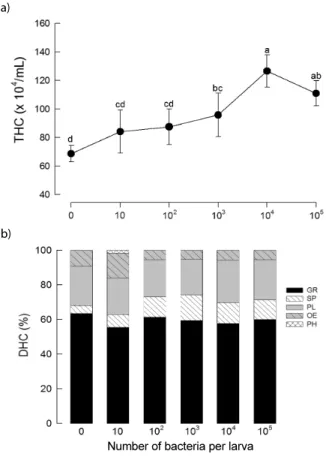
Fig. 3. Effect of different bacterial concentrations on hemocyte populations during the last instar larvae of Spodoptera exigua.

Different concentrations of Escherichia coli were injected into the hemocoel of each larva (3 μL) and they were then incubated for 2 h at 25 ℃. (A) Total hemocyte counts (THCs) (B) Differential hemocyte counts (DHCs). Granulocyte (GR), spherulocyte (SP), plasmatocyte (PL), oenocytoid (OE) and prohemocyte (PH) were morphologically classified by characters of Gardiner and Strand (2000). Each treatment was analyzed three times. Different letters above standard deviation bars indicate significant differences among means at Type I error = 0.05 (LSD test).

670,000개로 크게 증가하였다. 따라서 이후 면역반응 분석에 서는 이 시기보다 혈구수가 증가하는지를 보기 위해 파밤나방 5 령충 3일차를 사용하였다(Fig. 1A). 상대혈구수를 살펴보면 대부분 종령 발육 시기에서 과립혈구(granular cell)가 약 63.82%를 차지하나 5령 3일차에서는 69.38%를 차지하여 이 시기에 총혈구수가 높아질 때 과립혈구의 수가 현격하게 증가 하였다(F = 74.13; df = 1, 10; P =0.0001) (Fig. 1B).

세균의 침입으로 인한 혈구수 변화

파밤나방의 혈구 밀도가 면역 반응에 따라 변동이 일어나는 지 분석하기 위해 5령 3일차를 대상으로 세균을 감염시킨 후 혈 구밀도를 분석하였다(Fig. 2). 세균 감염에 따라 파밤나방은 총 혈구수의 급격한 변화를 보였다(F = 18.22; df = 4, 10; P =

0.0001). 세균 감염에 따라 총혈구수는 2시간 만에 거의 두 배 에 이르는 증가를 보였으며 이후 감소하여 처리 8시간이 소요 되면 비감염 상태의 혈구 밀도로 회복된다(Fig. 2A). 특히 처리 2시간 경 때 밀도가 증가된 혈구 종류는 부정형혈구(plasmatocyte) 와 소구형혈구(spherulocyte)였다. 부정형혈구의 경우 무처리 때 19.55%에서 26.85%로 뚜렷한 증가를 보였다(F = 59.97;

df= 1, 10; P = 0.0001) (Fig. 2B).

감염 세균 수와 혈구수와의 관계

파밤나방 5령충에 세균 밀도를 다르게 하여 처리한 결과 감

염 세균 수가 늘어날수록 총혈구수도 함께 증가하는 양상을 보

였다(F = 8.28; df = 5, 12; P = 0.0014). 이때 10

4

개 주입 세균 농

도에서 약 1,370,000 개의 총혈구수를 보여 대조구에 비해 약 2

(5)

Fig. 4. Effect of different microbes on hemocyte populations during last instar larvae of Spodoptera exigua. Paenibacillus polymixa was used as a Gram-positive ('Gram+') bacterial microbe and Escherichia coli was used as a Gram-negative ('Gram-') bacterial microbe. For fungal microbe, Phytophthora capsici was used as a fungal microbe for the immune challenge. All bacteria used a dose of 10

4

cells per larva for injection to hemocoel. Fungal injection used a dose of 10

4

spores per larva. Total hemocyte counts (THCs) were analyzed 2 h post injection. Each treatment was analyzed three times. Different letters above standard deviation bars indicate significant differences among means at Type I error = 0.05 (LSD test).

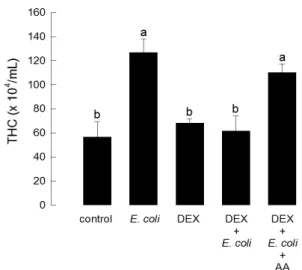
Fig. 5. Effect of eicosanoid on the increase of hemocyte density in response to bacterial challenge during the last instar larval stage of Spodoptera exigua. Escherichia coli (10

4

cells) was injected to hemocoel of each larva (3 μL) and they were then incubated for 2 h at 25oC. Hemocyte populations were analyzed for total hemocyte counts (THCs). Dexamethasone (DEX, 500 nM with DMSO) was prepared and injected into the larva (3 μL). Arachidonic acid (AA) was also injected into the larva (500 ng). Each treatment was analyzed three times. Different letters above standard deviation bars indicate significant differences among means at Type I error

= 0.05 (LSD test).

배 가깝게 혈구수의 증가를 보였다(Fig. 3A). 이러한 혈구수 증 가는 과립혈구보다는 부정형혈구과 소구형혈구의 밀도 증가에 의해 유발된 것으로 보여진다(Fig. 3B).

다양한 항원에 따른 총혈구수 변화

세균 감염에 따라 파밤나방의 혈구에서 나타나는 밀도 변동 이 다른 미생물 감염에 따라 나타나는 지를 분석하였다(Fig. 4).

이를 위해 그람양성균은 미국부저병(P. polymixa), 그람음성균 은 대장균(E. coli), 곰팡이는 고추역병(P. capsici)을 파밤나방 에 각각 주입시킨 후 2 시간 후에 혈림프를 뽑아 총혈구수를 관 찰하였다. 대부분 미생물 처리는 대조구에 비해 총혈구수의 현 격한 증가를 보였다(F = 25.41; df =3, 8; P = 0.0002). 그람양성 세균과 곰팡이는 무처리에 비해서 혈구수가 증가하긴 했지만 이들과 동일한 미생물 밀도로 처리된 그람음성세균 처리에 비 해 총혈구수 증가를 낮게 유도시켰다.

혈구 밀도 변화에 대한 아이코사노이드의 역할

세균 감염에 따라 총혈구수의 증가가 아이코사노이드에 의 해 중개되었는 지를 증명하기 위해 이 물질의 생합성 효소인 PLA

2

활성 억제에 따른 총혈구수 변화를 분석하였다. PLA

2

제자인 DEX을 단독으로 처리한 결과 무처리와 비슷한 혈구수 가 나타났으며, DEX와 세균을 함께 처리하였을 때도 무처리와 비슷한 혈구수를 보였다(Fig. 5). 이는 DEX에 의해 PLA

2

가 억 제됨으로써 결과적으로 아이코사노이드가 생성되지 않아 혈구 밀도 변화에 영향을 주지 못했다는 것을 나타내는 것으로 이를 증명하기 위해 PLA

2

의 촉매 작용 산물인 아라키도닉산(AA)을 다시 첨가하여 억제효과가 회복되는지 분석했다. 즉, 세균과 DEX 이 처리된 개체에 AA를 처리하였을 때 다시 혈구수 증가 가 회복되었다.

아이코사노이드 억제자 처리에 따른 혈구 밀도 변화

지금까지의 실험들로 아이코사노이드가 혈구밀도 변화에

영향을 준다는 것을 알게 되었다. 하지만 다양한 아이코사노이

드 중에 어떤 아이코사노이드가 직접적으로 관여하는지를 알

기 위해서 각 아이코사노이드 종류를 생합성하는 효소에 대해

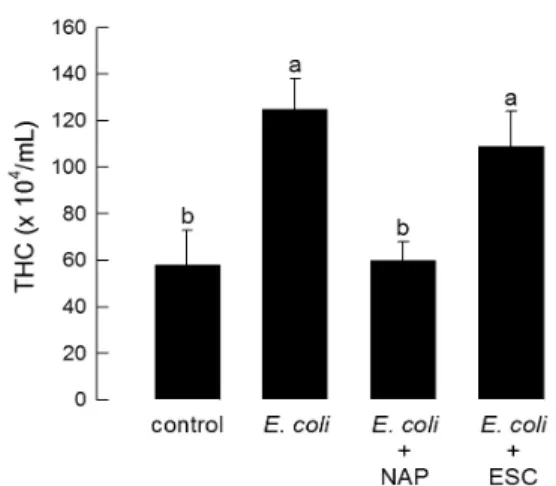
특이적 억제자를 처리하여 분석하였다(Fig. 6). 류코트리엔을

합성할 때 작용하는 효소인 LOX와 프로스타글란딘을 합성할

때 작용하는 COX의 억제자인 ESC과 NAP을 각각 처리하여

혈구수를 살펴보았다. 이때 프로스타글란딘의 합성을 억제시

켜주는 NAP을 처리하였을 때 총혈구수 증가가 억제된 반면,

류코트리엔이 합성을 억제하는 ESC을 처리하였을 때는 혈구

(6)

Fig. 6. Effect of different eicosanoids on the increase of hemocyte density in response to bacterial challenge during last instar larval stage of Spodoptera exigua . Escherichia coli (10

4

cells) was injected into hemocoel of each larva (3 μL) and they were then incubated for 2 h at 25 ℃. Hemocyte populations were analyzed for total hemocyte counts (THCs). Naproxene (NAP, 500 nM with DMSO) or esculetin (ESC, 500 nM with DMSO) was prepared and were injected into the larva (3 μL). Each treatment was analyzed three times. Different letters above standard deviation bars indicate significant differences among means at Type I error = 0.05 (LSD test).

Fig. 7. Effect of prostaglandin E

2

(PGE

2

) on the increase of hemocyte density during last instar larval stage of Spodoptera exigua. Different concentrations of PGE

2

were injected into the hemocoel and they were incubated for 2 h at 25 ℃. Hemocyte populations were analyzed for total hemocyte counts (THCs).

Each treatment was analyzed three times. Different letters above standard deviation bars indicate significant differences among means at Type I error = 0.05 (LSD test).

수 증가에 변화가 없었다. 즉, 프로스타글란딘류가 총혈구수의 증가를 유발하는 아이코사노이드류라는 것을 나타냈다.

프로스타글란딘 처리에 따른 혈구밀도 변화

Shrestha et al. (2011)은 프로스타글란딘 가운데 PGE

2

가 파

밤나방의 면역에 관여한다고 밝혔다. 총혈구수 변동에 대한 아 이코사노이드의 직접적 효과를 증명하기 위해 파밤나방에 PGE

2

를 단독으로 처리하였을 때 혈구수가 증가하는 것을 볼 수 있었다(Fig. 7). 그러나 5 ng 이상의 PGE

2

처리 농도들 사이 에 총혈구수 증가 차이는 보이지 않았다.

고 찰

아이코사노이드는 곤충 면역 중개 물질로서 작용하여 세포 성 면역 및 체액성 면역 반응을 활성화시킨다(Stanley and Kim, 2011). 사이토카인으로서 아이코사노이드는 병원균 감염 부위 로 혈구의 이동을 촉진시킨다고 알려졌다(Merchant et al., 2008). 그러나 병원균 감염에 따라 일어나는 혈구수 변화에 대 해서는 아이코사노이드 역할이 밝혀지지 않았다. 본 연구는 파 밤나방 5령충을 대상으로 병원균 침입에 따라 일어나는 총혈구 수 및 각 혈구 종류 변화에 대한 아이코사노이드 역할을 분석하 였다.

파밤나방 5령충의 혈구는 다섯 가지 형태로 나타났다. 대부 분은 과립혈구와 부정형혈구가 차지했으며 나머지 20~30%는 소구형혈구, 편도혈구(oenocytoid) 및 원시혈구(prohemocyte) 가 차지하였다. 이러한 혈구 종류 분석은 Gardiner and Strand (2000) 의 형태적 특징에 따라 분류했으며, 동일한 방법으로 파 밤나방의 혈구 종류에 대한 연구에 의해 다섯 종류의 혈구가 확 인되었다(Kim et al., 2008). 본 연구는 이 다섯 종류의 혈구가 파밤나방의 5령충에서 시기적으로 총혈구수와 상대혈구수에 서 변화를 갖는다는 것을 보여주었다. 전체 혈구수는 파밤나방 5 령충의 크기가 최대에 이르는 3일째에 최고 밀도 수준에 이르 고 이후 배회시기와 전용에 이르면서 전체 혈구수는 감소하였 다. Huang et al. (2010)은 배추좀나방(Plutella xylostella)의 혈 구 종류를 전자현미경으로 분석하였으며, 파밤나방과 동일하 게 5종류의 혈구를 확인하였고, 전체 혈구수의 증가에 따라 과 립혈구의 상대 밀도가 높아진다고 보고하였다. 박각시나방류 (M. sexta)에서는 최종령 초기에 과립혈구의 증가를 보이고 배 회시기 및 전용 단계에 부정형혈구의 밀도 증가를 보였다 (Beetz et al., 2008). 본 연구에서 5령 3일차에서 증가된 총혈구 수는 과립혈구로서 일반적으로 혈구의 생성기관인 조혈기관 (hematopoetic organ)에서 새롭게 세포분열을 통해 원시혈구 또는 부정형혈구가 생성되고, 이들이 혈림프에서 다시 과립혈 구로 분화된 것으로(Lavine and Strand, 2002) 추정된다. 나비 목 곤충의 경우 혈구수 변화는 탈피호르몬인 ecdysteroid 체내 함량과 밀접하다고 본다면(Wolfgang and Riddiford, 1986;

Riddiford, 1991), 파밤나방 5령충의 3일차에서 증가된 총혈구

(7)

수는 이 시기에 ecdysteroid 함량 증가와 관련이 있을 것으로 해 석되지만, 파밤나방의 이 호르몬 함량 분석이 아직 이뤄지지 않 아 정확한 인과 관계는 추후 호르몬 함량 분석 연구 이후에 밝 혀지리라 사료된다.

세균 감염에 따라 파밤나방 총혈구수는 처리 후 2시간에 거 의 2배에 가까운 증가를 보였다. 특별히 부정형혈구와 소구형 혈구의 밀도 증가가 이때 나타났다. 이러한 빠른 혈구수 증가는 조혈기관에서 새롭게 세포분열을 통해 생성되거나 또는 기존 의 혈구의 세포분열에 의해 이뤄지지 않았을 것으로 추정된다.

Gardiner and Strand (2000) 가 새롭게 형성되는 혈구를 bromo- deoxyuracil 로 표지하여 분석한 결과 면역 반응에 따라 증가된 혈구가 세포분열에 의존하려면 최소한 12시간이 소요된다고 보고하였다. 이에 반하여 초파리(Drosophila)의 경우 혈강에 존재하는 혈구세포는 두 종류로 혈장에서 순환되는 혈구와 체 벽에 붙어있는 고착혈구로 나뉜다(Markus et al., 2009). 즉, 세 균 감염은 이러한 고착혈구가 순환형으로 전환되었을 것이라 추정된다. 기존의 연구는 모노아민류인 옥토파민과 세로토닌 이 이러한 혈구 행동 변화를 유발한다고 보고하였다(Kim and Kim, 2010). 파밤나방의 경우 모노아민과 아이코사노이드의 상호신호 전달과정이 보고되었다(Kim et al., 2009). 따라서 본 연구는 세균 침입에 따라 형성된 모노아민류는 다시 아이코사 노이드의 생합성을 촉진시켜 증가된 아이코사노이드가 혈구의 행동 변화를 유발하였다고 해석된다. 왜냐하면 아이코사노이 드 생합성 억제자인 DEX는 혈구수 증가를 억제하였고, 이 약 제의 억제 대상 효소인 PLA

2

의 효소 촉매 생성물인 아라키도 닉산을 처리할 경우 다시 혈구수의 증가를 나타냈다. 또한 본 연구는 고착혈구가 부정형혈구와 소구형혈구로 추정되며, 이 에 관련되어 파밤나방의 경우 고착혈구가 존재하는 지 그리고 이들의 혈구 종류가 추후 결정될 필요가 있다.

아이코사노이드는 PLA

2

의 촉매작용에 의해 생성된 아라키 도닉산(AA)이 다시 cyclooxygenase의 작용에 의해 프로스타 글란딘을 형성하거나, lipoxygenase의 작용에 의해 류코트리엔 을 생성하게 된다(Stanley and Kim, 2011). 각 효소에 특이적으 로 억제하는 억제자를 이용한 결과 프로스타글란딘류가 이러 한 혈구세포수의 증가를 유래하였다. 더욱이 프로스타글란딘 류의 일종인 PGE

2

를 처리하면 처리 농도에 비례하여 총혈구수 의 증가를 나타냈다. 이러한 결과는 다양한 아이코사노이드류 의 특이적 중개반응을 제시하는 결과로서 특정한 프로스타글 란딘의 수용체가 혈구세포막에 존재하여 이러한 혈구행동 변 화를 유발하였을 것으로 사료된다. Shrestha et al. (2011)은 파 밤나방 편도 혈구에서 PGE

2

에 반응하는 G protein-coupled receptor (GPCR) 를 보고하였다. 이 수용체는 편도혈구에만 존

재하고 이 세포 붕괴를 유도하는 신호를 유발하는 것으로 본 연 구의 혈구 행동 변화에 관련된 수용체는 이와 다른 종류 수용체 형태로 존재할 것으로 사료된다. 비록 해당 막 수용체는 아직 밝혀져 있지 않지만 Kim and Kim (2010)의 연구는 Rac1 이라 는 small G protein이 이러한 혈구 행동 변화에 관여할 것으로 보고하였다. 추후 Rac1과 관계하는 GPCR을 선발하여 혈구 행 동 변화와 연관된 프로스타글란딘 수용체를 동정할 필요가 있다.

이상의 결과를 요약하면 병원체 감염에 따라 파밤나방은 총 혈구수의 증가를 나타내며, 이러한 혈구수 증가는 고착혈구가 순환혈구로 전환되면서 가능할 것으로 해석하고 있다. 또한 이 러한 혈구 행동 변화는 프로스타글란딘류에 의해 유발되는 것 으로 본 연구는 제시하였다. 추후 총혈구수 증가를 유발의 프로 스타글란딘 수용체를 동정하는 것이 이러한 면역 반응을 이해 하는 데 도움을 주리라 사료된다.

사 사

본 연구는 2012년도 농촌진흥청 아젠다 과제에서 지원한 연 구과제로 수행되었으며 이에 감사의 말씀을 드립니다.

Literature Cited

Baines, D., Downer, R.G., 1994. Octopamine enhances phagocytosis in cockroach hemocytes: involvement of inositol triphosphate.

Arch. Insect Biochem. Physiol. 26, 249-261.

Beckage, N.E., 2008. Insect immunology. Academic Press, New York.

Beetz, S., Holthusen, T.K., Koolman, J., Trenczek, T., 2008.

Correlation of hemocyte counts with different developmental parameters during the last larval instar of the tobacco hornworm, Manduca sexta. Arch. Insect Biochem. Physiol. 67, 63-75.

Burke, J.E., Dennis, E.A., 2009. Phospholipase A

2

structure /function, mechanism and signaling. J. Lipid Res. 50, S237-S242.

Büyükgüzel, E., Tunaz, H., Stanley D., Büyükgüzel, K., 2007.

Eicosanoids mediate Galleria mellonella cellular immune response to viral infection. J. Insect Physiol. 53, 99-105.

Clark, K.D., Pech, L.L., Strand, M.R., 1997. Isolation and identification of a plasmatocyte-spreading peptide from the hemolymph of the lepidopteran insect Pseudoplusia includens. J.

Biol. Chem. 272, 23440-23447.

Gardiner, E.M.M., Strand, M.R., 2000. Hematopoiesis in larval Pseudoplusia includens and Spodoptera frugiperda. Arch. Insect Biochem. Physiol. 43, 147-164.

Gillespie, J.P., Kanost, M.R., Trenczek, T., 1997. Biological mediators of insect immunity. Annu. Rev. Entomol. 42, 611-643.

Goh, H.G., Lee, S.G., Lee, B.P., Choi, G.M., Kim, J.H., 1990.

(8)

Simple mass-rearing of beet armyworm, Spodoptera exigua. Kor. J.

Appl. Entomol. 29, 180-183.

Huang, F., Yang, Y.Y., Shi, M., Li, J.Y., Chen, Z.Q., Chen, F.S., Chen, X.X., 2010. Ultrastructural and functional characterization of circulating hemocytes from Plutella xylostella larva: cell types and their role in phagocytosis. Tissue Cell 42, 360-364.

Jurenka, R.A., Pedibhotla, V.K., Stanley, D.W., 1999. Prostaglandin production in response to bacterial infection in true armyworm larvae. Arch. Insect Biochem. Physiol. 41, 225-232.

Kim, G., Kim, Y., 2010. Up-regulation of circulating hemocyte population in response to bacterial challenge is mediated by octopamine and 5-hydroxytryptamine via Rac1 signal in Spodoptera exigua. J. Insect Physiol. 56, 559-566.

Kim, K., Madanagopal, N., Lee, D., Kim, Y., 2009. Octopamine and 5-hydroxytryptamine mediate hemocytic phagocytosis and nodule formation via eicosanoids in the beet armyworm, Spodoptera exigua. Arch. Insect Biochem. Physiol. 70, 162-176.

Kim, J., Nalini, M., Kim, Y., 2008. Immunosuppressive activity of cultured broth of entomopathogenic bacteria on the beet armyworm, Spodoptera exigua, and their mixture effects with BT biopesticide on insecticidal pathogenicity. Kor. J. Pestic. Sci. 12, 184-191.

Lavine, M.D., Strand, M.R., 2002. Insect hemocytes and their role in cellular immune responses. Insect Biochem. Mol. Biol. 32, 1237-1242.

Lord, J.C., Anderson, S., Stanley, D.W., 2002. Eicosanoids mediate Manduca sexta cellular response to the fungal pathogen Beauveria bassiana: a role for the lipoxygenase pathway. Arch.

Insect Biochem. Physiol. 51, 46-54.

Markus, R., Laurinyecz, B., Kurucz, E., Honti, V., Bajusz, I., Sipos, B., Somogyi, K., Kronhamn, K., Hultmark, J., Ando, D.I., 2009.

Sessile hemocytes and hematopoietic compartment in Drosophila melanogaster. Proc. Natl. Acad. Sci. USA 106, 4805-4809.

Merchant, D., Ertl, R., Rennard, S.I., Stanley, D.W., Miller, J.S., 2008. Eicosanoids mediate insect hemocyte migration. J. Insect Physiol. 54, 215-221.

Miller, J.S., Nguyen, T., Stanley-Samuelson, D.W., 1994. Eicosanoids mediate insect nodulation responses to bacterial infections. Proc.

Natl. Acad. Sci. USA 91, 12418-12422.

Morishima, I., Yamano, Y., Inoue, K., Matsu, N., 1997. Eicosanoid mediate induction of immune genes in the fat body of the silkworm, Bombyx mori. FEBS Lett. 419, 83-86.

Park, J., Kim, Y., 2012. Eicosanoid biosynthesis is activated via Toll, but not Imd signal pathway. J. Invertebr. Pathol. 110,

382-388.

Riddiford, L.M., 1991. Hormonal control of sequential gene expression in insect epidermis, in: Binnington, K., Retnakaran, A. (Eds.), Physiology of the insect epidermis. CSIRO, Melbourne, Australia, pp. 46-54.

SAS Institute, Inc., 1989. SAS/STAT user's guide, Release 6.03, Ed. Cary, N.C.

Shrestha, S., Kim, Y., 2007. An entomopathogenic bacterium, Xenorhabdus nematophila, inhibits hemocyte phagocytosis of Spodoptera exigua by inhibiting phospholipase A

2

. J. Invertebr.

Pathol. 96, 64-70.

Shrestha, S., Kim, Y., 2008. Eicosanoids mediate prophenoloxidase release from oenocytoids in the beet armyworm, Spodoptera exigua. Insect Biochem. Mol. Biol. 38, 99-112.

Shrestha, S., Stanley, D., Kim, Y., 2011. PGE

2

induces oenocytoid cell lysis via a G protein-coupled receptor in the beet armyworm, Spodoptera exigua. J. Insect Physiol. 57, 1568-1576.

Stanley, D.W., 2005. Eicosanoids. in: Gilbert, L.L., Iatrou, K., Gill, S.S. (Eds.), Comprehensive insect molecular science. Vol. 4.

Elsevier, Amsterdam, The Netherlands, pp. 307-339.

Stanley, D.W., 2006. Prostaglandins and other eicosanoids in insects: biological significance. Annu. Rev. Entomol. 51, 25-44.

Stanley, D.W., 2011. Eicosanoids: progress towards manipulating insect immunity. J. Appl. Entomol. 135, 534-545.

Stanley, D., Kim, Y., 2011. Prostaglandins and their receptors in insect biology. Front. Endocrinol. 2, 1-11.

Tunaz, H., Park, Y., Büyükgüzel, K., Bedick, J.C., Nor Aliza, A.R., Stanley, D.W., 2003. Eicosanoids in insect immunity: bacterial infection stimulates hemocytic phospholipase A

2

activity in tobacco hornworms. Arch. Insect Biochem. Physiol. 52, 1-6.

Wolfgang, W.J., Riddiford, L.M., 1986. Larval cuticular morphogenesis in the tobacco hornworm, Manduca sexta, and its hormonal regulation. Dev. Biol. 113, 305-316.

Yajima, M., Takada, M., Takahashi, N., Kikuchi, H., Natori, S., Oshima, Y., Kurata, S., 2003. A newly established in vitro culture using transgenic Drosophila reveals functional coupling between the phospholipase A

2

-generated activation of the immune deficiency (imd) pathway in insect immunity. Biochem. J. 371, 205-210.

Yu, X.Q., Zhu, Y.F., Ma, C., Fabrick, J.A., Kanost, M.R., 2002.

Pattern recognition proteins in Manduca sexta plasma. Insect

Biochem. Mol. Biol. 32, 1287-1293.

수치

Fig. 1.  Change of hemocyte populations during last instar larvae  of  Spodoptera exigua
Fig. 2.  Effect of bacterial challenge on hemocyte populations  during last instar larvae of Spodoptera exigua
Fig. 4.  Effect of different microbes on hemocyte populations  during last instar larvae of Spodoptera exigua
Fig. 6.  Effect of different eicosanoids on the increase of hemocyte  density in response to bacterial challenge during last instar larval  stage of Spodoptera exigua

참조

관련 문서

In the current context, where the interconnectedness of the global economy has intensified greatly and the importance of a collective response to

In the API 20NE system, negative reaction for nitrate reduction, indole production, glucose fermentation, arginine dihydrolase, urease acti vity, gelatin hydrolysis,

2재화 2요소 헥셔-올린 모형에서는 어느 한 경제에서 어느 한 요소의 양이 증가하면, 그 요소를 집약적으로 사용하는 산업의 생산량은 증가하고 다른

The index is calculated with the latest 5-year auction data of 400 selected Classic, Modern, and Contemporary Chinese painting artists from major auction houses..

It considers the energy use of the different components that are involved in the distribution and viewing of video content: data centres and content delivery networks

After first field tests, we expect electric passenger drones or eVTOL aircraft (short for electric vertical take-off and landing) to start providing commercial mobility

1 John Owen, Justification by Faith Alone, in The Works of John Owen, ed. John Bolt, trans. Scott Clark, "Do This and Live: Christ's Active Obedience as the

- 우선, 외부 전원이 없는 회로, 즉 초기조건에 의해서 전류, 전압이 결정되 는 회로의 응답 : natural response.. - 다음, 직류 전압이나 전류가