• 검색 결과가 없습니다.

Sound Absorption Property of the Leaves of Two Evergreen Broad-Leaved Tree Species, Dendropanax morbiferus and Fatsia japonica

N/A
N/A
Protected

Academic year: 2021

Share "Sound Absorption Property of the Leaves of Two Evergreen Broad-Leaved Tree Species, Dendropanax morbiferus and Fatsia japonica"

Copied!
10
0
0

로드 중.... (전체 텍스트 보기)

전체 글

(1)

Sound Absorption Property of the Leaves of Two Evergreen Broad-Leaved Tree Species, Dendropanax morbiferus and

Fatsia japonica 1

Su Young JUNG 2 ⋅Da-Hye YEOM 3 ⋅Ree-Keun KONG 3 ⋅Gab Gyun SHIN 4 ⋅ Kwang Soo LEE 2 ⋅Hee Seop BYEON 5,†

ABSTRACT

1)

In this study, the effect of specimen size and layer thickness on the sound absorption of the leaves of two evergreen broad-leaved tree species, Dendropanax morbiferus and Fatsia japonica, was investigated. The specimen sizes of 0.5

× 0.5, 1.0 × 1.0, and 2.0 × 2.0 cm 2 and layer thicknesses of 1.00, 1.75, and 2.50 cm were considered. At the layer thickness of 2.5 cm, the leaf of the D. morbiferus showed no significant difference in sound absorption coefficients (SACs) as the sample size varied, however, a significant change in SACs was recorded in that of the F. japonica.

At 1.0-cm thickness, the SACs of the F. japonica leaf varied more remarkably with the sample size. The 2.50-cm-thick F. japonica leaf with the specimen size 0.5 × 0.5 cm 2 exhibited the highest sound absorption effect among all samples investigated.

Keywords: sound absorption, evergreen broad-leaved tree, impedance measurement tube

1. INTRODUCTION

Recently, with the improvement of social welfare, in- terest in noise in the living environment is increasing.

One of the main requirements for a comfortable hu- man life in a complex and modern society is sound absorption. The demand for the development of eco-

friendly sound absorbing materials is gradually in- creasing for high sound proof driving in automobiles, manufacturing environments, and equipment (Ersoy and Küçük, 2009; Bujoreanu et al ., 2017; Koizumi et al ., 2002). Industrial sound absorption generally uses these materials, such as sponge, glass or rock wool, foam, fabric, and synthetic fibers. In case of sound

1 Date Received May 11, 2020, Date Accepted July 28, 2020

2 Warm-Temperate and Subtropical Forest Research Center, National Institute of Forest Science, 22 Donnaeko-ro, Seogwipo-si, Jeju-do, 63582, Republic of Korea

3 College of Agriculture & Life Science, Gyeongsang National University, 501 Jinjudae-ro, Jinju-si, Gyeongsangnam-do, 52828, Republic of Korea

4 Jinju Bioindustry Foundation, 991 Wolasan-ro, Munsan-eup, Jinju, Gyeongsangnam-do, 52839, Republic of Korea

5 College of Agriculture & Life Science, IALS, Gyeongsang National University, 501 Jinjudae-ro, Jinju-si, Gyeongsangnam-do, 52828, Republic of Korea

† Corresponding author: Hee Seop BYEON (e-mail: [email protected], ORCID: 0000-0001-7952-9991)

Original Article

(2)

absorbers made of glass fiber and rock, micro-particles caused by weathering may cause air pollution during exposure to the air, and there are disadvantages of dif- ficult reuse and incineration treatment during disposal.

In addition, the bond strength between fibers may be weak, causing damage to transportation and han- dling, and direct contact with the human body due to sweat or moisture may cause irritation or itching and, in severe cases, skin cancer (Lee. 2001).

Therefore, for the health of human beings and the environment, the development of natural, cheap, renewable and abundant alternative materi- als is needed, and the whole world is paying atten- tion to the development of eco-friendly materials.

As the related research progresses, interest in abundant forest resources is naturally increasing, and the demand for research on improving the noise absorption performance of wood and wood products as an eco-friendly material is gradually in- creasing(Byeon et al ., 2010). Improvement of sound absorption capability of wood and wood- based board by resonant absorption was attempted, and stair type perforation higher than a normal speci- men (Kang and Park, 2001). Betula costata Trautv and other species additional experiments were found to closely correlate the size, shape, and ar- rangement of resonators, the structural direction and gravity of wood, and the sound absorption fre- quency domain (Hang et al ., 2008). Carbonization treatment was performed to improve sound absorp- tion property for MDF at carbonizing temperatures of 500 ℃ ~ 1,100℃. and the sound absorption co- efficient increased between the temperatures of 500 ℃ and 900℃, but decreased at a temperature of 1,100 ℃. (Won et al ., 2015). Using the Wise's method, the wood by delignification treatment was made small cracks, which increased the sound ab- sorption in a specific frequency range (Kang and Lee, 2005).

Wood bark was determined that by adjusting the thickness and apparent specific density and attaching plywood at the back, wood bark particle mats gen- erally offer excellent sound absorption and insulation performance (Kang et al ., 2019). The oak mushroom bed log showed sound absorption was two to three times higher than normal oaks wood in the frequency range of 2~6 kHz (Kang et al ., 2008). Bamboo fiber material was measured at the influences of thickness, air space depth, apparent density and bamboo fiber diameter using an impedance tube. Results showed that sound absorption coefficient of the bamboo fiber- board and the resonance-type bamboo fiberboard was found to be superior, especially in the high-frequency range (Koizumi et al ., 2002). The noise reduction co- efficient of rice hull mats was approximately 0.8, in- dicating a high sound-absorption property of the mats, therefore, rice straw matting is a suitable candidate material for sound-barrier walls against highway noise (Kang et al ., 2019). The sound absorption coefficient of flame resistant treated sawdust-mandarin peel com- posite particleboard was lower than that of untreated specimen, but higher than that of gypsum board (Kang and Kang, 2015). Coconut coir fiber com- pressed into bales and mattress sheet was found to demonstrate good sound absorption coefficient. When compared to a single layer, multi-layer coconut coir fibers with airspace layers increase the absorption co- efficient of the material at lower frequencies (Nor et al ., 2004).

In addition, as a result of analyzing the noise reduc- tion effect of trees in the surrounding living environ- ment (Kim and Oh, 1994), roadside forests such as mixed forests and willow shrubs have been reported to attenuate noise of more than 15dB.

The main objective of the present study is to com-

pare and analyze the sound absorption effect accord-

ing to the leaf size and layer thickness of evergreen

broadleaf trees as a natural sound insulation material.

(3)

2. MATERIALS and METHODS 2.1. Specimen preparation

To investigate the sound-absorbing properties of the evergreen hardwood leaves depending on the size and thickness of specimens, the leaves of Korean den- dropanax (Dendropanax morbiferus) and Japanese aralia (Fatsia japonica) were collected in National Institute of Forest Science (Jinju). Two evergreen broad leaved trees of D. morbiferus and F. japonica are mostly distributed in subtropical and warm temper- ate forest zone in Korea. Before this experiment, three samples for species were collected and estimated using thickness measuring instrument (PDN-21, Peacock, Japan) and leaf area measuring instrument (Li-3000C, Licor). The basic data are shown in Table 1, the mean leaf area of D. morbiferus 1370.36 cm² was greater than that of F. japonica 14.83 cm², F. japonica 1.279 mm and D. morbiferus 0.632 mm in mean leaf thickness. The mean moisture content was higher 243.35% in D. morbiferus leaves than 207.28% in F.

japonica leaves. It is believed that these leaf character- istics are due to genetic growth characteristics between these two species.

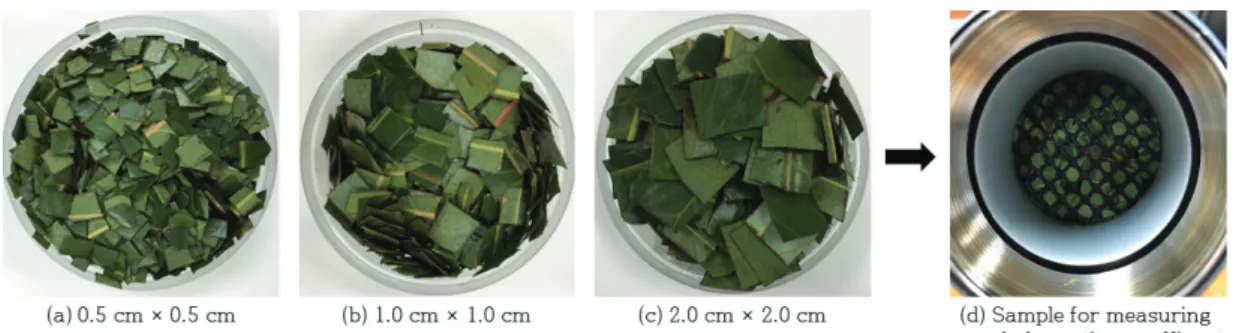
The specimen was cut into three types, 0.5 × 0.5 cm 2 , 1.0 × 1.0 cm 2 , and 2.0 × 2.0 cm 2 as specimen unit size, using a straw cutter for measurement. The cut specimens were sealed to maintain the initial moisture content. As shown in Fig. 1, when measuring the sound absorption, all the specimens as configurations of bio- mass materials (Oldham et al ., 2011), were made with the same pressure (0.0256 kgf/cm 2 ), and the case used was chosen to have very little sound absorption, the diameter of the case is 6.25 ( ∅) cm, the height is 5 cm.

2.2. The methods of sound absorption property measurement

The sound absorption properties test apparatus for the two microphone method consisted of an impe- dance measurement tube (Type 4206A, B&K, Denmark) in the right side of Fig. 2, a sign analyzer unit (Type 2035, B&K, Denmark), a power amplifier

Classification Leaf area Length Width Thickness Moisture content

(cm²) (cm) (cm) (mm) (%)

D. morbiferus 60.03 11.30 5.03 0.632 243.35

F. japonica 1370.36 138.83 18.20 1.279 207.28

Note: The data is the average of 3 samples measured.

Table 1. Basic data of the leaf specimen of evergreen broad-leaved trees

Fig. 1. Preparation of specimen for measurement of sound absorption coefficient.

(4)

(Type 2706, B&K, Denmark) and two microphones (Type 2670, B&K, Denmark), as shown in the left side of Fig. 2 (User manual, 2002). The range of the fre- quency measurement was 100 Hz ∼3,200 Hz in a mid- dle type impedance measurement tube. The SAC was determined according to ASTM C 384-04 (2011).

Following calibration with a sponge, the SAC of the material was measured 100 times each specimen and the mean value of the test results was estimated. Three replication tests were conducted on each condition.

After the measurement of sound absorption coefficient (SAC), an average sound absorption coefficient was calculated by dividing denominator into numerator in the frequency range of the measurement using the fol- lowing equation (1) (Won et al ., 2015).

(1)

SACs are shown in Table 2, and the values were statistically analyzed performed by Duncan's multiple range test using PASW Statistics 18.0 (SPSS Inc., Chicago, IL, USA).

3. RESULTS and DISCUSSION 3.1. Sound absorption properties by leaf

thickness and specimen size

Leaf thicknesses and specimen sizes varied with thicknesses of 1.00 cm, 1.75 cm, and 2.00 cm and/or with specimen sizes of 0.5 × 0.5 cm 2 , 1.0 × 1.0 cm 2 ,

Speices Leaf layer thickness (cm)

Leaf specimen size

0.5 × 0.5 (cm) 1.0 × 1.0 (cm) 2.0 × 2.0 (cm)

SAC ave. ρ (g/cm 3 ) SAC ave. ρ (g/cm 3 ) SAC ave. ρ (g/cm 3 )

D. morbiferus

1.00 0.356± 0.003Cb 0.29 0.413± 0.016Bc 0.28 0.479± 0.028Ab 0.28 1.75 0.586± 0.004Aa 0.29 0.563± 0.005Bb 0.29 0.578± 0.009Ba 0.29 2.50 0.575± 0.013Aa 0.28 0.593± 0.002Aa 0.30 0.589± 0.013Aa 0.28

F. japonica

1.00 0.279± 0.002Cc 0.26 0.307± 0.007Bc 0.25 0.414± 0.019Ac 0.26 1.75 0.422± 0.003Cb 0.25 0.518± 0.002Bb 0.24 0.564± 0.007Aa 0.24 2.50 0.601± 0.002Aa 0.26 0.585± 0.004Ba 0.26 0.530± 0.012Cb 0.27 SAC: Sound absorption coefficient, data are average values from 3 replications

A-C means that different capital letters in a row within each thickness differ significantly (p<0.05) a-c means that different small letters in a column within each size differ significantly (p<0.05) Table 2. Sound absorption properties and apparent density of evergreen broad-leaved trees

Fig. 2. Two-microphone impedance measurement tube (left side) and cut-away diagram of the impedance

measurement tube (right side).

(5)

and 2.0 × 2.0 cm 2 . Table 2 and Fig. 3 show the sound absorption properties of evergreen broad-leaved tree by leaf thickness and specimen size. In general, it is reported that the higher the density per unit volume,

the higher SACs for the same material (McGrory et al ., 2012). Therefore, in this study, as shown in Table 2, the SACs for each species were values obtained un- der almost the same apparent density conditions. That is, for D. morbiferus, the apparent density is within the range of 0.28-0.30 ρ (g/cm 3 ), and F. japonica is limited to a narrow range within the range of 0.24-0.27 ρ (g/cm 3 ). The apparent density was intended to be based on the same conditions with constant weight and pressure during the experiment. The apparent density was measured under constant weight and pressure con- ditions, so the apparent density value was constant and no standard deviation occurred (Table 2).

These results showed a tendency similar to the re- sult of the increase in SAC as the sample thickness increased to 2.0 cm, 3.0 cm, and 4.0 cm in the data palm test conducted by Taban et al . (2019), and they also found that introducing an air gap behind the sam- ple in an impedance tube can effectively improve the frequency bandwidth of absorption for thin samples.

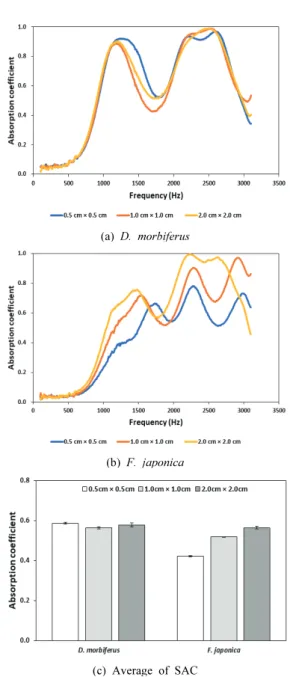
Of all the conditions in this study, the largest mean sound absorption coefficient of 0.601 was found at 0.5 cm × 0.5 cm leaf size conditions at 2.50 cm thickness in F. japonica species. The mean SAC of F. japonica in each treatment condition ranged from 0.279 to 0.601, and 0.356 to 0.593 for D. morbiferus. Under the leaf thickness of 1.00 cm, both species showed significantly higher SACs as the leaf sample size increased (Table 2). However, as the thickness increased, the difference in sound absorption effect according to the leaf size generally tended to decrease.

In particular, in the case of D. morbiferus, there was no significant difference in the coefficient between leaf sizes under 2.5 cm thickness condition (p<0.05). In the case of F. japonica, the difference in sound absorbing effect (0.071) between 0.5 × 0.5 cm 2 and 2.0 × 2.0 cm 2 leaf size under the condition of 2.50 cm thickness was slightly weaker compared to the case of 1.00 cm thick- ness (0.135). The SAC for all conditions of D. morbi- (a) D. morbiferus

(b) F. japonica

(c) Average of SAC

Fig. 3. The sound absorption properties of two evergreen

broad-leaved tree species with a thickness of 1.00 cm.

(6)

ferus was higher than that of the sponge used for cali- bration of the experiment, 0.303. At 1.75 cm and 2.50 cm thicknesses of F. japonica, the SAC of all leaf specimen sizes was higher than that of the sponge.

However, in the condition of 0.5 × 0.5 cm 2 specimen size at 1.00 cm thickness of F. japonica, the SAC was exceptionally 0.279, which was lower than that of the sponge.

Fig. 3(a) ~ (b) show the difference in SAC by leaf size according to the frequency. The sound absorption graph of two species shows three peaks: 1,000 ~ 1,500 Hz, 2,000 ~ 2,500 Hz, and 3,000 Hz, respectively. It is similar to the absorption property of the sponge.

SAC of 100 ~ 500 Hz is low but increases after that.

These results showed a similar tendency to the results of bamboo species by Koizumi et al . (2002) that the SACs for bamboo fibers as natural porous material were high in the mid- and high-frequency ranges. The properties of these porous materials are generally re- ported to be good absorbers at high frequencies and poor absorbers at low frequencies (Ismail et al ., 2010).

Under the condition of 1.00 cm thickness filled with a leaf size of 0.5 × 0.5 cm 2 , the SAC was generally low in both species, especially in the case of F. japon- ica, the coefficient was even lower than that of the sponge (Table 2). This occurred around 1,000 Hz, a relatively low frequency, as shown in Fig. 3. Therefore, in this study, the sound absorption effect by leaf size under 1.75 cm and 2.50 cm thickness conditions was intensively compared and analyzed for each frequency band, and the results are as follows.

3.2. Sound absorption properties at thickness 1.75 cm

The results of comparative analysis of the sound ab- sorption effect according to the size of the leaf sample under the condition that the thickness is 1.75 cm and the variation of the SAC as the frequency increases

for each species are shown in Fig. 4. In Table 2, as the leaf size of F. japonica increased, the SAC tended to increase, but the difference in value was not large.

In the case of D. morbiferus, the difference in SAC by leaf size with a thickness of 1.75 cm was also weak.

(a) D. morbiferus

(b) F. japonica

(c) Average of SAC

Fig. 4. The sound absorption properties of evergreen

broad-leaved trees with a thickness of 1.75 cm.

(7)

At a thickness of 1.75 cm, the difference between the SACs of each leaf size was less than 0.1, but this result showed significantly higher values than the SAC of the same leaf size condition at a thickness of 1.00 cm. Average sound absorption coefficients range from 0.422 to 0.564 with a thickness of 1.75 cm of F.

japonica.

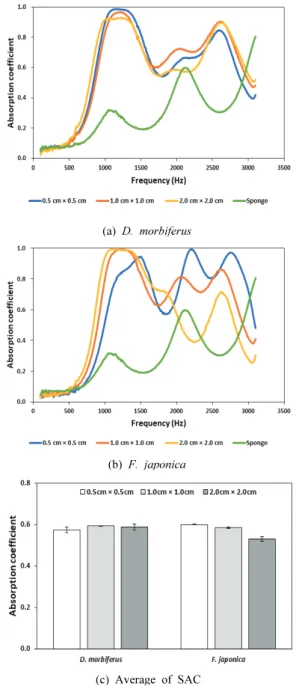
Fig. 4(a) and (b) show the result of comparing the variation of the SAC with the increase in frequency for each species and sponge. In both species, the SAC increased rapidly from 500 Hz, reaching mostly 1.0 in the 2,000~2,500 Hz range. And as the frequency increased from 1,000 HZ, the difference in SAC by leaf size was larger in F. japonica than in D.

morbiferus. That is, the change in SAC for each fre- quency according to leaf size conditions was higher in F. japonica species. The variation characteristics of the SACs according to the increase in the frequency showed a similar trend in the conditions of 1.75 cm and 2.50 cm in thickness, but showed slightly different characteristics in the 1.00 cm thickness condition.

From the above results, the difference in SAC accord- ing to the increase in frequency by leaf size was more sensitive and consistent in the F. japonica than in the D. morbiferus, and the SAC tended to increase as the frequency increased in the F. japonica. It is thought that this difference characteristic comes from the dif- ference in structural characteristics of the leaves be- tween two species.

3.3. Sound absorption properties at thickness 2.5 cm

Fig. 5(a)~(b) show the variation of SAC, according to the frequency, of leaves and sponges with the same thickness of 2.50 cm.

As a result of comparing the variation of the SACs indicated by the leaf size with the increase in the fre- quency between the two species, D. morbiferus showed more stable results than F. japonica.

In Fig. 3(b) and Fig. 5(b), as the frequency in- creased, the SAC of leaf size 2.0 × 2.0 cm 2 in F.

japonica was relatively low compared to other leaf sizes, and these results were different from the 1.00

(a) D. morbiferus

(b) F. japonica

(c) Average of SAC

Fig. 5. The sound absorption properties of evergreen

broad-leaved trees with a thickness of 2.50 cm.

(8)

cm thickness condition. That is, under the 1.0 cm thickness condition, the SAC of leaf size 2.0 × 2.0 cm 2 was higher than that of other leaf sizes, especially at the high frequency range of 3,000 Hz. Meanwhile in Fig. 3(c) and Fig. 5(c), it was found that the differ- ence in average of SAC according to the size of the leaf under the condition of 2.50 cm thickness was not significantly higher than that of the 1.00 cm thickness condition.

From the above results, the highest SAC of D. mor- biferus under the 2.5 cm leaf thickness condition was found to be a combination of 0.5 × 0.5 cm 2 leaf size and frequency range 1,000~1,500 Hz. In the F. japon- ica species, the coefficient was high in the combina- tion of 0.5 × 0.5 cm 2 leaf size and 2,000~2,500 Hz, and 1.0 × 1.0 cm 2 size and 1,000 Hz, respectively.

In Table 2, the average SACs at the leaf size of 0.5 × 0.5 cm 2 and 1.0 × 1.0 cm 2 in the F. japonica species were highest, respectively, 0.601 and 0.585.

These results are estimated to be higher than the SAC of 2.0 × 2.0 cm 2 in the frequency range of 2,000 Hz or higher (Fig. 5) ; The difference in SAC values according to the leaf size was not significantly below the frequency of 2,000 Hz, but the smaller the leaf size from 2,000 Hz, the higher the sound absorption effect.

In addition, in Table 2, the average SACs tended to increase significantly as the thickness increased un- der both conditions of 0.5 × 0.5 cm 2 and 1.0 × 1.0 cm 2 in the F. japonica species (p<0.05). It seems that this resulted from a phenomenon in which the sensi- tivity of the SAC reacted high from the low frequency band early.

Under the pressure in the same range for each spe- cies mentioned above, the higher the thickness of the leaf layer, the higher the SAC in both species. These results are presumed to be due to the occurrence of more resistive layers and air gaps occurring in thicker

leaf layer conditions than in thinner leaf layer conditions.

Therefore, the results of the SACs for each fre- quency band analyzed by the composition of the leaves of the two evergreen broad-leaved tree species performed in this study are considered to be valuable as basic data for use as an environmentally sound in- sulation material.

4. CONCLUSION

In this study, the SAC of Dendropanax morbiferus

and Fatsia japonica as subtropical evergreen broadleaf

tree species were estimated and compared sound ab-

sorption effects of each specimen; the leaf layer thick-

nesses of 1.00 cm, 1.75 cm, and 2.50 cm and the leaf

sizes of 0.5 × 0.5 cm 2 , 1.0 × 1.0 cm 2 , and 2.0 × 2.0

cm 2 . The measured values of sound absorption effects

for all conditions were statistically analyzed by

Duncan's multiple range test. The SAC at thickness

of 1.00 cm and 1.75 cm for both evergreen broad-

leaved tree species was generally increased with the

leaf size, respectively. The SACs of 1.75 cm thickness

were mostly greater than that of 1.00 cm thickness in

each leaf size for both tree species. However, as the

leaf layer thickness increased, the difference in sound

absorption effect according to leaf size tended to

decrease. There was no significant difference in SACs

according to leaf size of D. morbiferus at 2.5 cm

thickness condition, and there was a significant dif-

ference in F. japonica, but it was significantly weak-

er than that at 1.00 cm thickness condition. The 2.50

cm thick leaf layer composed of leaf specimen size

0.5 × 0.5 cm 2 of F. japonica has the highest sound

absorption effects for all conditions in this study and

is expected to be used as a material for natural sound

absorbers.

(9)

REFERENCES

ASTM C 384-04. 2011. Standard test method for impedance and absorption of acoustical materials by impedance tube method. American Society for Testing and Materials, Philadelphia, PA, USA Bujoreanu, C., Nedeff, F., Benchea, M., Agop, M. 2017.

Experimental and theoretical considerations on sound absorption performance of waste materials including the effect of backing plates. Applied Acoustics 119: 88-93.

Byeon, H.S., Park, J.H., Hwang, K.K., Park, H.M., Park, B.S., Chong, S.H. 2010. Sound absorption property of heat-treated wood at a low temperature and vacuum conditions. Journal of The Korean Wood Science and Technology 38(2): 101-107.

Ersoy, S., Küçük, H. 2009. Investigation of industrial tea-leaf-fibre waste material for its sound absorption properties. Applied Acoustics 70(1): 215-220.

Hang, K.H., Kim, G.H., Park, B,S., Park, J.H., Byeon, H.S., Lee, W.H. 2008. Sound absorption character- istic of resonater by hole position and wood species.

Journal of the Korean Wood Science and Tech- nology 36(3): 9-16.

Ismail, L., Ghazali, M.I., Mahzan, S., Zaidi, A.A. 2010.

Sound absorption of Arenga Pinnata natural fiber.

World Academy of Science, Engineering and Technology 67: 804-806.

Kang, C.W., Park, H.J. 2001. Improvement of sound absorption capability of wood and wood-based board by resonant absorption. Journal of the Korean Wood Science and Technology 29(1): 16-21.

Kang, C.W., Lee, N.H. 2005. Changes of sound absorption capability and anatomical features of wood by delignification treatment. Journal of The Korean Wood Science and Technology 33(4): 9-14.

Kang, C.W., Kang, U., Jung, I.S., Park, H.J., Jeon, S.S.

2008. Sound absorption capability and anatomical features of oak mushroom bed log. Journal of the Korean Wood Science and Technology 36(1):

54-60.

Kang, C.W., Kang, H.Y. 2015. Effect of flame resistant treatment on the sound absorption capability of sawdust-mandarin peel composite particleboard.

Journal of the Korean Wood Science and Tech- nology 43(4): 511-517.

Kang, C.W., Lee, N.H., Jang, S.S., Kang, H.Y. 2019.

Sound absorption coefficient and sound transmission loss of rice hull mat. Journal of the Korean Wood Science and Technology 47(3): 290-298.

Kang, C.W., Jang, E.S., Jang, S.S., Kang, H.Y., Kang, S.G., Oh, S.C. 2019. Sound absorption rate and sound transmission loss of wood bark particle.

Journal of the Korean Wood Science and Techno- logy 47(4): 425-441.

Kim, S., Oh, D.H. 1994. Noise attenuation effects of trees. Journal of Korean Forest Society 83(3): 400- 409.

Koizumi, T., Tsujiuchi, N., Adachi, A. 2002. The development of sound absorbing materials using natural bamboo fibers. WIT Transactions on The Built Environment, pp, 59.

Lee, J-M. 2001. A Study on the Acoustic Absorbent Characteristics of Recycled Materials. Master Thesis, Sun Moon University, Korea.

McGrory, M., Cirac, D.C., Gaussen, O., Cabrera, D.

2012. Sound absorption coefficient measurement:

Re-examining the relationship between impedance tube and reverberant room methods. Proceeding of Acoustics 2012, Fremantle, Australia. Australian Acoustical Society, pp. 1-8.

Nor, M.J.M., Jamaludin, N., Tamiri, F.M. 2004. A

preliminary study of sound absorption using multi-

layer coconut coir fibers. Electronic Journal Techni-

(10)

cal Acoustics 3: 1-8.

Oldham, D.J., Egan, C.A., Cookson, R.D. 2011. Sus- tainable acoustic absorbers form the biomass.

Applied Acoustics 72(6): 350-363.

Taban, E., Khavanin, A., Jafari, A.J., Faridan, M., Tabrizi, A.K. 2019. Experimental and mathemat- ical survey of soun absorption performance of data

palm fibers. Heliyon 5(6): 1-8.

Won, K.R., Hong, N.E., Kang, S.U., Park, S.B., Byeon,

H.S. 2015. Sound absorption property of carbonized

medium density fiberboards at different carbonizing

temperatures1. Journal of the Korean Wood Science

and Technology 43(2): 206-213.

수치

Fig. 1. Preparation of specimen for measurement of sound absorption coefficient.
Fig. 2. Two-microphone impedance measurement tube (left side) and cut-away diagram of the impedance  measurement tube (right side).
Fig. 3. The sound absorption properties of two evergreen broad-leaved tree species with a thickness of 1.00 cm.
Fig. 4. The sound absorption properties of evergreen broad-leaved trees with a thickness of 1.75 cm.
+2

참조

관련 문서

(4) Analyze the liaison of detachment, collection, screen, and transportation operation of the jujube harvester based on the information of the tree shape of jujube

The proposal of the cell theory as the birth of contemporary cell biology Microscopic studies of plant tissues by Schleiden and of animal tissues by Microscopic studies of

 The complex exhibits broad band absorption in the visible region of the EMR spectrum.  The wavelength of maximum absorption (λ max

웹 표준을 지원하는 플랫폼에서 큰 수정없이 실행 가능함 패키징을 통해 다양한 기기를 위한 앱을 작성할 수 있음 네이티브 앱과

_____ culture appears to be attractive (도시의) to the

이하선의 실질 속에서 하악경의 후내측에서 나와 하악지의 내측면을 따라 앞으로 간다. (귀밑샘 부위에서 갈라져 나와

【판결요지】[1] [다수의견] 동일인의 소유에 속하는 토지 및 그 지상 건물에 관하여 공동저 당권이 설정된 후 그 지상 건물이 철거되고 새로 건물이 신축된 경우에는

It considers the energy use of the different components that are involved in the distribution and viewing of video content: data centres and content delivery networks