1) 교신저자: Yoo, Taemyung, 145, Anam-ro, Seongbuk-gu, Seoul, 02841, Republic of Korea Tel: +82-2-3290-2322, E-mail: [email protected]
Journal of Korean Home Economics Education Association https://doi.org/10.19031/jkheea.2019.06.31.2.113 2019. Vol. 31, No. 2, pp.113-135
OECD Education 2030에서 제안된 핵심역량의 2015 개정 가정과 교육과정 반영 특성 분석
3)양지선*⋅유태명**1)
*이화여자대학교 강사⋅**고려대학교 가정교육과 교수
Analysis on Reflection Characteristics of the Key Competencies Proposed by the OECD Education 2030 in the 2015 Revised Home Economics Curriculum
Yang, Ji Sun*⋅Yoo, Taemyung**
1)*Lecturer, Graduate School of Education, Ewha Womans University
**Professor, Department of Home Economics Education, Korea University
Abstract
The purpose of this study was to analyze the characteristics reflected in the 2015 revised home economics curriculum for the key competencies presented in the OECD education 2030 project.
The results indicate that first, in general, about 46.5% of the competencies could be classified into the skill, attitude and value category; 17% into the learning concept framework category; 24.2% into the competency development cycle category; and 12.5% into the complex competency category. Overall, the competencies of the OECD learning framework are found to be reflected primarily in the achievement standards(59%), followed by characteristics(16.1%), teaching-learning and assessments orientation(9.4%), content system(8%), and goals(7.6%). Second, the key competencies were reflected in the middle school curriculum, more often in the descending order of action, problem-solving, communication, respect, creative thinking, conflict resolution, empathy, critical thinking, self-regulation, and student agency. In the high school curriculum, the competencies were reflected more often in the descending order of action, empathy, problem-solving, anticipation, global competence, self-regulation, student agency, literacy for sustainable development, reflection, and critical thinking. Third, the heat map shows that the competencies corresponding to the third and fourth levels are most frequently reflected in the curriculum. Therefore, it is advisable to develop effective plans to execute and support the reflection of key competencies in the curriculum. Through this study, home economics educators are expected to understand the inter-connectivity between the key competencies emphasized by the OECD learning framework and the competencies of home economics as a practical subject, and to scrutinize how to help individual students develop their overall competencies and be prepared for the future.
Key words: 핵심역량(key competency), 성취기준(achievement standard), OECD 교육 2030(OECD education 2030), 학습 개념 프레임워크(learning concepts framework), 기능, 태도, 가치(skill, attitude, value),
역량 개발 사이클(competency development cycle), 복합 역량(complex competency)
Ⅰ. 서 론
1. 연구의 필요성과 목적
최근 빠른 기술의 진보와 더불어 고령화, 저출산, 삶의 질 향상 등 사회 변화요인에 따라서 다양한 전문분야의 세계가 출현할 것으로 전망된다. 이러한 미래 추세를 예측하여 교육을 비롯하여 기업, 국가, 개인 거의 모든 분야에서 생존하고 번영 해나갈 방법을 모색하고 있다. World Economic Forum(2018)에 서는 미래의 학습자들이 그들에게 요구되는 과업을 수행하기 위한 올바른 역량을 습득하는 것은 예측 불가능하지만 가장 영 향력 있는 변수 중의 하나이며, 이러한 변수는 고등 교육의 발 빠른 교육과정 개발과 학생들의 사고와 의지에 따라 진화할 수 있다고 보았다. OECD(2018a)도 미래의 환경에 대하여 VUCA 즉 변동성(volatility), 불확실성(uncertainty), 복잡성(complexity), 모호성(ambiguity)으로 규정하였으며 이러한 상황에 대비하 는 수단을 탄력성, 혁신, 지속가능성으로 보고 불확실한 미래 에 필요한 기초 역량을 제공하기 위해서는 기존 교육의 혁신 이 필요하다고 강조한 바 있다.
경제성장의 관점에서 인적자본으로서 학습자의 능력을 강 화하려는 노력은 1997년부터 수행된 DeSeCo 프로젝트를 통해 가시화되었다. 이는 영국, 뉴질랜드, 호주 등 세계 각국의 교육 과정 개혁 기조와 맞물려 학교 교육의 역할과 기능에 대한 요 구를 부각하고 최근까지도 지식보다는 역량을 강조하는 방향 으로 학교 교육을 이끌어가는데 기여해왔다. DeSeCo 프로젝 트에서 제시한 역량의 개념틀은 사회적 행동, 자율적 행동, 도 구적 행동을 하는 행위자의 관점에서 구분하였으며 Klieme와 Leutner(2006)는 자기관리, 사회적 행동 및 도덕적 추론과 같이 특정 상황에서 대처할 수 있는 상황맥락적 특징을 포함한다고 강조하였다. 이러한 특징들은 추상적이어서 학습목표를 통해 교수학습과 연계시켜 현장에 적용하기 어려우며(Yoon, Kim, Choi, Kim, & Hwang, 2016), 핵심역량의 개념이 역량 못지 않게 모호하고 이들은 서로를 명확하게 구별짓지 못한다(Weinert, 2001) 고 지적된 바 있다.
DeSeCo 프로젝트 이후 OECD는 미래 사회에서 요구되는 역량 함양을 위한 학습 프레임워크를 개발하는 것을 목표로
교육과정 개혁의 토대를 마련하기 위한 새로운 시도로 다각적 인 국제 협력을 모색하는 ‘The Future of Education and Skills:
The OECD Education 2030’ 프로젝트를 추진하고 있다. 이 프 로젝트에서는 2030년 사회생활에 진입하게 되는 현재 초⋅중 등학교 학습자들이 대상이 되며 1단계에서 국가 수준 교육과 정 유무, 교육과정 체계, 개발 주기, 학교 현장적용의 탄력성 정도 등 각 국가의 교육과정을 맵핑한 내용을 토대로 국가별로 교육정책과 교육과정 흐름을 파악하였고, 2019년 이후 추진될 2 단계에서 21세기 역량을 어떻게 기를 것인지에 필요한 교수
⋅학습 방법, 평가 방법, 학습 환경 등에서 탐색하고자 하였다.
OECD 가 개인, 사회, 환경을 위한 더 나은 삶이 가능하도록 해야 한다는 요구에 부응하며 포괄적 성장(inclusive narrative)으 로 새로운 방향성을 제시하는 궁극적인 목적은 주관적인 개인 의 상태와 지속가능한 웰빙(well-being)에 있다. OECD Education 2030 프로젝트가 강조하는 ‘웰빙(well-being)’이라는 개념은 많이 통용되어온 일반화된 개념이지만 가정교과에서 추구하 는 가치인 웰빙의 개념은 개인, 가족, 사회의 안녕에 기초하여 OECD 에서 강조하는 개념보다 광범위하고 폭넓은 의미이다.
전문분야로서 근본적인 사회적 제도로 주요기능을 수행하는 개 인과 가족 구조의 중대한 변화(Pendergast, McGregor, & Turkki, 2012) 와 함께 해온 가정교과는 International Federation for Home Economics(2008) 의 성명에서 알 수 있듯이 이미 모학문인 가정 학에서 지속가능한 미래를 향해 나침판을 세우는 전략과 기능 을 명시적으로 연결시키려는 노력을 해왔다. Pendergast(2012) 에 따르면 웰빙은 가정과교육의 결과로 두드러지게 나타낼 수 있으며 미래에 효율적인 주체로서 개인의 능력을 향상시켜 개인, 가족, 공식적 학습 맥락, 삶의 사건, 문화적 지배 속에서 긍정적으로 강화해나갈 수 있다.
McGregor(2011) 는 전문분야가 미래에 대해 경쟁력을 갖춘 다면 예상치 못한 미래 발전에 대체되지 않고 보장받을 수 있을 것이라 보았다. 또한 가정교과가 급격하게 변화하는 환 경 속에서도 미래에 존립하기 위한 노력과 실천을 해나간다면 전문분야의 영역을 더욱 구축해나갈 수 있다고 강조하였는데 앞으로 우리가 바라는 미래를 살아갈 학습자들이 갖춰야할 능력에 대한 인식과 이해를 통해 지속적으로 교육을 혁신해나 갈 수 있는 조율과 노력이 필요하다.
이러한 시점에서 OECD(2018a)는 역량을 통해 ‘지식’ 또는
‘ 태도 및 가치’뿐만 아니라 ‘기능’(skill)도 함께 가르쳐질 수 있을지를 탐색하기 위해 국가 교육과정을 분석하여 범교과 역량에 대한 요구를 기존 과목에 포함시킬 수 있는 방법을 찾고자 하였다. OECD Education 2030 프로젝트를 통해 논의 의 장을 활성화하고 공동 비전을 달성을 위한 교사, 학생, 지역 사회에 힘을 부여하려면 새로운 커리큘럼의 설계와 개발에 대한 이해가 필요하지만 2007, 2009 및 2015 개정 교육과정과 같이 이미 교육과정이 수시로 개정된 우리나라의 상황을 대변 하기에는 어려움이 있다. 따라서 본 연구에서는 OECD 학습 프레임워크에서 강조하는 핵심역량을 중심으로 미래지향적 으로 바라볼 때 가정과 교육과정에서는 어떤 역량들이 반영되 었는지 분석하는 데 목적을 두었다. 이러한 반영을 분석함으 로써 역량 중심 교육과정으로 개편되어가는 세계 추세 속에서 향후 교육과정 개정 시 교과 차원에서 고려해야 할 시사점을 얻고자 한다.
2. 연구내용
첫째, 2015 개정 가정과 교육과정에서 OECD 학습 프레임 워크 2030이 제시한 핵심역량의 반영 특성을 핵심역량 범주별 로 비교⋅분석한다.
둘째, 2015 개정 가정과 교육과정에서 OECD 학습 프레임 워크 2030이 제시한 핵심역량의 반영 특성을 핵심역량 항목별 로 비교⋅분석한다.
셋째, 2015 개정 가정과 교육과정에서 OECD 학습 프레임 워크 2030이 제시한 핵심역량의 반영 정도에 따른 열지도(heat map) 로 나타낸다.
Ⅱ. 이론적 배경
1. OECD Education 2030 프로젝트
최근 교육개혁을 통해 국가의 지식 가치 창출에 이바지할
수 있는 인적 자원의 경쟁력을 높이고자 핵심역량이라는 개념 이 교육 분야에서 대두하고 있다. 21세기 미래 사회를 전망하 여 ‘핵심역량’이라는 개념을 사용한 OECD의 DeSeCo 프로젝 트에서는 역량을 ‘특정한 상황이나 맥락에서 발생하는 복잡 한 요구들을 개인의 총체적⋅심리사회적 자원(인지적, 기능 적, 개인 및 윤리적)을 동원하여 성공적으로 해결하는 지속적 이고 점진적 능력’으로 정의(Rychen & Salganik, 2003)하고 있 다. Rychen과 Salganik(2003)의 정의에 따르면 동적인 과정을 지향하는 개념으로 역량은 지식, 이해, 기능, 능력 및 태도와 같은 다양한 인간 능력과 자질을 포괄하는 다양한 자원들로 구성되어 있으며, 역량의 구성요소들은 개별적으로 존재하는 것이 아니라 씨줄과 날줄처럼 얽혀서 서로에게 영향을 미치는 내적 구조를 이루는 하나의 총체로 존재한다. 여기서 핵심역 량은 개인의 삶과 사회에 공헌할 수 있어야 하며, 삶의 다양한 상황에서 개인의 중요한 요구를 충족시킬 수 있어야 하고 전 문가에게만이 아니라 모든 개인에게 필요한 것이어야 한다 (OECD, 2005).
1997 년부터 시작하여 2003년까지 수행된 DeSeCo 프로젝 트에서 현재 학습자들이 전 생애에 걸쳐 필수적으로 갖추어야 하는 핵심역량을 다음과 같이 세 영역별로 하위 범주 3가지와 함께 나타낸다. 첫째, 상호작용을 위한 도구 활용 역량(using tools interactively) 은 도구를 상호작용적으로 활용하는 능력으 로 언어, 상징, 텍스트 등 다양한 소통 도구를 활용하는 능력, 지식과 정보를 상호작용적으로 활용하는 능력, 새로운 테크놀 리지를 활용하는 능력 등이 포함된다. 둘째, 이질적인 집단과의 사회적 상호작용 역량(interacting in heterogeneous groups)은 이 질적인 집단의 구성원들과 원만한 관계를 형성할 수 있는 능력 으로 인간관계 능력, 협업 및 협동 능력, 갈등관리 및 해결 능력 등이 포함된다. 셋째, 자율적 행동 역량(acting autonomously)은 자신의 삶을 주도적으로 계획하고 관리하며 책임이나 권익에 대해 인식함으로써 사회 속에서 자율적으로 행동할 수 있는 능력으로 사회 경제적 규범 등 주변 환경을 고려하면서 행동 하고 판단하는 능력, 자신의 인생계획 프로젝트를 구상하고 실현하는 능력, 자신의 권리와 필요 등을 옹호하고 주장하는 능력 등이 포함된다.
DeSeCo 프로젝트의 업데이트 버전이라고 할 수 있는 OECD
Education 2030 프로젝트의 궁극적 목적은 변동성이 있고, 불확
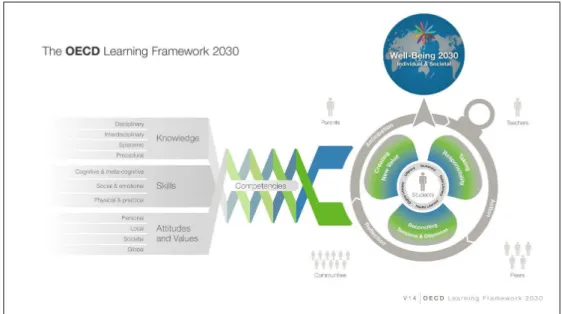
Source: OECD(2018a, p4)
Figure 1. OECD learning framework 실하며, 복잡하고 모호한 미래 사회에서 살아가는데 필요한
역량을 규명하고, 자신의 삶을 항해해나가는데 있어서 나침반 역할을 할 수 있는 학습 프레임워크를 개발하는 것이다. OECD 학습 프레임워크는 변혁적 역량을 중심으로 지식, 기능, 태도와 가치를 포함한다. 이 프로젝트의 목적은 미래를 준비하는 교육 (future-ready education)으로 프로젝트에 참여한 각 국가들에게 두 가지 광범위한 질문을 던진다. 즉, 현재의 학생들이 그들의 세계를 성장시키고 형성하는데 어떤 지식, 기능, 태도, 가치가 필요한지와 교육 시스템을 통해 어떻게 지식, 기능, 태도, 가치 를 효과적으로 개발할 수 있는지에 대한 답을 찾을 수 있도록 하는 것이다.
OECD 학습 프레임워크에서 교육 목적은 개인 및 공동의 웰빙(well-being)에 있다. OECD(2017a)는 2011년부터 2년마다 개인적 웰빙의 수준을 보여주는 better life index를 발표해왔는 데 이것은 11가지의 지표 즉 주거(housing), 소득(income), 직업 (jobs), 공동체(community), 교육(education), 환경(environment), 시 민참여(civic engagement), 건강(health), 삶의 만족(life satisfaction), 안전(security), 일과 삶의 균형(work-life balance)으로 구성되 어 있다. 여기에는 개인적 웰빙은 경제적 자원, 인적 자원, 사회적 자원, 천연 자원 등을 포함하는 사회적 웰빙의 기반이
되므로 개인, 사회, 환경을 위한 더 나은 삶이 가능하도록 해야 한다는 요구를 반영하고 있다. OECD(2018a)는 앞으로의 교육 은 학습자들이 직업 세계에 대비할 수 있도록 준비하는 것보 다 그 이상을 목표로 해야 하며 적극적이고, 책임감 있고, 참여 하는 시민이 되기 위해 요구하는 기능을 갖추어야 할 필요가 있다고 강조한다.
OECD 학습 프레임워크는 학생들이 아직 알려지지 않은 것을 항해하는데 방향을 제시하는 나침반 역할을 하는 데 목 적이 있기때문에 ‘학습의 나침판’이라는 비유를 사용하여 개 별 혹은 공동으로 우리가 원하는 미래를 향해 나아가기 위해 학생들이 필요로 하는 역량의 유형을 보여준다(<Figure 1>).
2. OECD Education 2030의 학습 프레임워크 요소
1) 학습자 주체성
OECD 학습 프레임워크의 기초가 되는 개념은 복잡하고
불확실한 세상을 탐색하는 학습자 주체성(learner agency)을
강조하고 있다. 주체(agents)는 원하는 미래를 성취하기 위하
여 타인에 의해 결정된 것을 받아들이기보다는 반성적이며 책임감 있는 결정과 선택을 하는 것이다.
이러한 주체의 개념을 학생과 교사, 상호관계에 따라 살펴 볼 수 있는데 ‘학생 주체성(student agency)’은 목표를 설정하고, 변화를 반영하고, 책임감 있게 행동할 수 있는 능력이며 과정 이자 목표로서 주체성과 학습은 순환적인 강화 관계를 가진다.
‘상호주체성(co-agency)’의 개념은 학습자가 그들의 가치를 둔 목표를 향하여 나가는데 도움이 되는 상호지원 관계이다. 이러 한 맥락에서 학생들뿐만 아니라 교사, 학교 관리자, 부모, 지역 사회까지 학습자로 간주해야 한다. 미래를 준비하는 학습자는 자신의 교육과 삶을 통해 주체적으로 활동할 필요가 있으며 세상에 참여해야 하고 이와 같은 참여를 통해 사람, 사건, 상황 에 더 나은 쪽으로 영향을 미칠 책임이 있다(OECD, 2018a).
학생 주체성과 마찬가지로 Menter와 Hulme(2013: 181)은 교 사 전문성 측면에서 ‘교사 주체성(teacher agency)’의 정도에 따라 네 가지 모델로 구분하였다. 네 가지 모델은 최소한의 선택의지 를 가지며 외부에서 설정한 우선 순위를 성공적으로 실행하는 교사(effective teacher)에서부터 성찰적인 교사(reflective teacher), 탐구적인 교사(enquiring teacher), 변혁적인 교사(transformative teacher) 순으로 주체성이 높은 것으로 간주한다. 여기서 변혁 적인 교사는 외부에서 주어진 것을 효과적으로 성찰하고 탐구 하여 이에 도전하거나 변화를 주는 교사이다. 변혁적인 교사는 창의적이고 비판적이며 비교적 자율적이며, 전문적 행동을 기 반으로 하고 실제로 도전적이거나 무엇이 좋은 교육을 만드는 가에 대한 명확한 가치와 판단을 요구한다(Biesta, 2010).
2) 변혁적 역량
OECD 핵심역량을 기반으로 한 OECD Education 2030 프로 젝트는 혁신적이고 책임감 있는 학습자로서 성장해나갈 요구를 함께 다루는 변혁적 역량을 세 가지 역량으로 나타내었다. 이러 한 세 가지 역량은 ‘새로운 가치 창조하기(creating new value)’,
‘긴장과 딜레마에 대응하기(reconciling tensions and dilemmas)’,
‘책임감 가지기(taking responsibility)’이다.
첫째, ‘새로운 가치 창조하기’는 보다 강력하고 지속가능한 발전을 위해서 새로운 성장 원천이 요구되는데 혁신은 경제적 인 비용으로 경제적, 사회적, 문화적 딜레마에 필수적인 해결책
을 제시할 수 있다(OECD, 2018a). 점점 더 새로운 사회, 새로운 사고방식을 원하는 혁신은 개인이 생각하고 혼자 일하는 것이 아니라 새로운 지식을 창안하기 위해 다른 사람들과 협력해야 하며 그 바탕에는 적응력(adaptability), 창의력(creativity), 호기 심(curiosity), 개방성(open-mindedness)과 같은 역량이 포함된다.
둘째, ‘긴장과 딜레마에 대응하기’는 학습자들이 불평등을 특징으로 하는 세계에서 형평성과 자유, 자율성과 공동체, 혁신 과 연속성, 효율성과 민주적 과정의 균형을 맞추는 것과 같은 절충과 긴장, 딜레마를 다루는데 적응할 수 있어야 한다. 미래를 준비하기 위해 개인은 단기 및 장기적인 관점에서 모순되거나 양립할 수 없는 아이디어, 논리, 위치 간의 상호 연결 및 관계를 고려하여 더욱 통합된 방식으로 생각하고 행동하는 법을 배워 나가는 시스템적 사고가가 되어야 한다(OECD, 2018a).
셋째, ‘책임감 가지기’는 다른 두 가지의 전제 조건이며 참신 함, 변화, 다양성, 불확실성을 다루는 것은 개인이 스스로 생각 하고 다른 사람과 함께 일할 수 있다고 가정한다. 마찬가지로 창의성과 문제해결은 스스로 행동에 대한 미래 결과를 고려하 고 위험과 보상을 평가하며 자신의 과업에 대한 책임을 인정할 수 있는 능력이 필요하다. 이것은 책임감과 도덕적, 지적 성숙 함을 암시하며, 인간은 자신의 경험과 개인적, 사회적 목표, 그 들이 가르치고 말한 것, 옳고 그름에 비추어 자신의 행동을 반 영하고 평가할 수 있기에 윤리적으로 행동하는 것은 규범, 가치, 의미 및 한계와 관련하여 질문하는 것을 의미한다(OECD, 2018a).
이 역량의 핵심은 자기 통제(self-control), 자기 효능감(self-efficacy), 책임감(responsibility), 문제해결 및 적응력(problem solving and adaptability)을 포함하는 자기 규제(self-regulation)의 개념이다.
3) 행동을 위한 지식, 기능, 태도와 가치
역량은 지식, 기능, 태도와 가치를 포함하는 것으로 정의한다.
지식은 ‘학문적 지식(disciplinary knowledge)’, ‘간학문적 지식 (inter-disciplinary knowledge)’, ‘인식론적 지식(epistemic know ledge)/절차적 지식(procedural knowledge)’으로 나눌 수 있다.
첫째, ‘학문적 지식’은 새로운 지식의 바탕이 되며 학문 분
야의 경계를 넘어 생각하고 지식을 연결 할 수 있는 능력과
함께 앞으로도 중요할 것이다. 익숙하지 않은 상황에서 유연하
게 지식을 적용한다는 것은 과거에 경험한 상황과 새로운 상황
과의 관련성을 유추하고, 대안을 상상하며, 실제 세계에서 활 용하는 것을 의미한다. 학문적 지식은 특정 학문의 기본적 개 념의 이해를 깊게 할 수 있을 뿐 아니라 다른 학문에서 활용하 기 어려운 지식에 대한 친밀도를 높인다(OECD, 2017b).
둘째, ‘간학문적 지식’은 다양한 학문을 통해 실제적 삶의 문제, 현상, 문제를 세계와 연결하여 볼 수 있는 능력으로 점차 중요해지고 있다. 간학문적 지식의 습득은 학문적 지식의 습 득을 기반으로 이루어진다(OECD, 2017b). 학생들이 ICT 리터 러시, 국제적 역량, 혁신과 모험, 지속 가능한 발전 등과 같은 간학문적 지식 및 역량을 발전시킬 수 있도록 대신 학생들에 게 간학문적 문제, 현상, 주제를 탐색하는 기회를 제공하여야 한다.
셋째, ‘인식론적 지식/절차적 지식’에서 인식론적 지식 또는 수학자, 역사가 또는 과학자처럼 생각하는 방법을 아는 것과 같은 학문에 대한 지식도 학생들이 지식을 확장하는 데 도움이 된다. 인식론적 지식은 ‘내가 배우는 것이 무엇이고 왜 배워야 하지?’, ‘실제 삶에서 지식을 어떻게 이용해야 하지?’, ‘전문가 들은 어떻게 생각하지?’와 같이 ‘진실성(authenticity)’과 관련 하여 학생들에게 동기를 부여하는 것으로서 점차 중요하게 여 겨지고 있다. 절차적 지식은 목표를 달성하기 위해 취해진 일 련의 단계 또는 행동과 같은 어떤 것이 어떻게 이루어지거나 만들어지는지를 이해함으로써 얻을 수 있다(OECD, 2017b). 절 차적 지식은 실제생활 문제의 해결을 통해 향상되며 이를 위해 현실에서의 문제를 인식하고 해결책을 찾거나 제안하는데 도 움이 되는 사고방식을 가르치는 것이 중요하다.
기능은 인지적⋅메타인지적 기능(cognitive & metacognitive skills), 사회적⋅감정적 기능(social & emotional skills), 신체적⋅
실용적 기능(physical & practical skills)을 포함한다. ‘인지적⋅
메타인지적 기능’은 언어, 숫자, 추론, 습득한 지식을 활용할 수 있는 사고 전략의 집합이다. 이 기능은 언어적, 비언어적 기 능, 고차원 사고 기능, 실행기능의 효과적인 사용, 문제해결 등 으로 구성된다. ‘메타인지적 기능’은 자신의 지식, 기능, 태도와 가치를 인식하는 능력을 포함한다. ‘사회적⋅감정적 기능’은 사고, 감정, 행동이 일관성 있는 패턴으로 표현될 수 있는 개인 역량의 집합이며 인격의 강화에 도움을 줄 수 있다. ‘신체적⋅
실용적 기능’은 기능 사용 능력, 생활 기능, 전문적인 기능, 운동 능력을 포함해 신체적인 도구, 작업, 기능을 사용하는 개인 역
량의 집합이다(OECD, 2017b).
태도는 개성이나 가치와 구분되며, 형성되고 변화할 수 있 으며, 특성이나 기질보다는 덜 지속적이고 덜 안정적이며 이 들보다 더 유연하게 습득할 수 있다. 성격적 경향과 가치관보 다 분리적이고 평가 측면에서 대상에 대해 특정한 방식으로 행동하는 경향을 수반할 수 있다(OECD, 2017b). 교육과정의 실행에 있어 학습자들이 학습에 대한 긍정적인 가치와 태도를 키운 후에 학습을 성공적으로 이끄는 기능을 발달시켜 나가는 과정(Attitudes-Skills-Knowledge)이 된다면 학생들은 지식을 이해하고 배우고자 할 것이다. 가치는 특정한 신념, 행동이 바람직하다고 판단하는데 근거가 되는 원칙을 의미한다. ‘태 도와 가치’는 신념, 윤리, 도덕, 태도, 개인적인 특성, 정서적인 산출물 등을 포함하며(OECD, 2016b), 개인의 태도와 판단 및 행동을 인도하는데 사용될 수 있다.
4) 역량 개발 사이클
변화의 주체로서 학생이 성장하도록 필요한 역량을 신장 하기 위한 역량의 개발 과정이 필요하며 OECD(2017b)는 학생의 역량은 ‘예측(anticipation)’, ‘행동(action)’, ‘반성(reflection)’의 순환적인 관계로 함양될 수 있다고 보았다.
첫째, ‘예측’은 학생이 변화 주체로서 미래 사회에서 필요한 역량을 개발하기 위해 중요한 역할을 하는 요소이다. 학생들은 미래가 어떤 요인들에 의하여 이미 결정되었다고 믿기보다 미 래 변화를 예측하고 이러한 변화에 영향력을 행사할 준비가 되 어 있어야 한다. 학생들이 미래에 필요한 것을 예측하거나 오늘 날에 취한 행동이 미래에 미칠 영향을 예측할 수 있도록 하기해 서는 지식, 인지 능력뿐만 아니라 동기, 정서, 헌신, 가치와 같은 사회⋅행동 능력들도 갖추어야 한다(Prabhakar, Coughlin, &
Ghetti, 2016).
둘째, ‘행동’은 미래 사회에 필요한 역량으로 복잡한 요구, 심
리⋅사회적 전제 조건, 그리고 특정한 맥락을 고려하여 능숙하게
수행하고 효과적으로 행동하는 행동 역량 모델(action competence
model)을 바탕으로 한다(Weinert, 2001). ‘주체(agency)’는 그
자체가 중립적이어서 사회와 전지구적인 웰빙에 매우 긍정적
이거나 부정적인 결과를 초래할 수 있으므로 확실한 가치기반
이 필요하다. 행동은 성찰과 기대의 과정을 거쳐 실질적으로
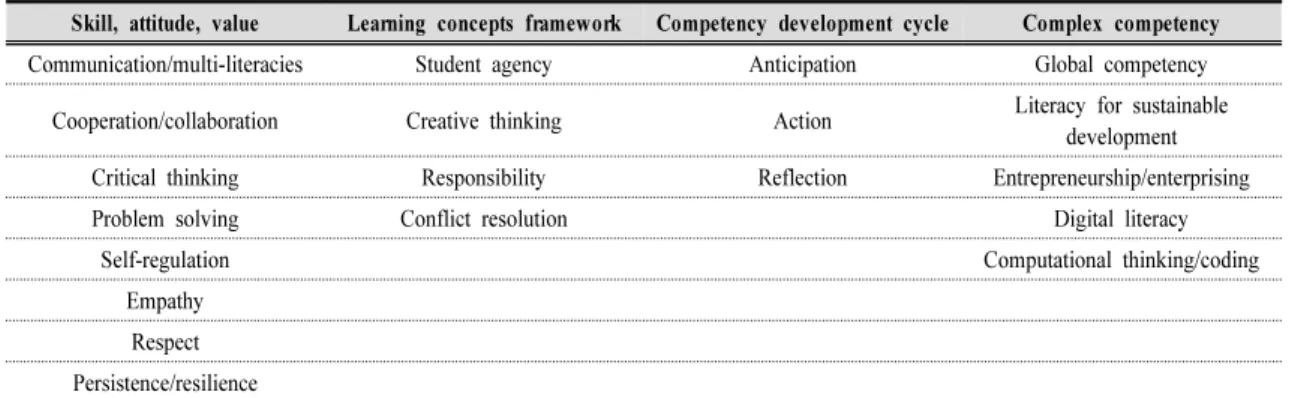
Skill, attitude, value Learning concepts framework Competency development cycle Complex competency
Communication/multi-literacies Student agency Anticipation Global competency
Cooperation/collaboration Creative thinking Action Literacy for sustainable
development
Critical thinking Responsibility Reflection Entrepreneurship/enterprising
Problem solving Conflict resolution Digital literacy
Self-regulation Computational thinking/coding
Empathy Respect Persistence/resilience Source: OECD(2017b).
Table 1. Category of competency
책임감 있는 행동으로 연결할 수 있는 능력이다(Gehlbach, 2004;
Selman, 2003).
셋째, ‘반성’은 무엇인가를 결정하고 선택하며 행동하기에 비판적인 자세를 취하는 능력이며 참신함, 변화, 다양성, 불확 실성을 책임감 있게 다루기 위해서 반성적 실천의 발달이 필 요하다. 한 걸음 물러나 생각해 보거나, 주어진 상황을 다양한 관점들로 비교하거나, 현재 상황뿐만 아니라 어떤 의사 결정 및 행동이 가져올 수 있는 장기적이고 간접적인 영향력까지 바라볼 수 있는 것 등이 여기에 포함될 수 있다(OECD, 2017b).
3. OECD Education 2030이 제시한 핵심역량
OECD(2017b)에 따르면 OECD Education 2030의 학습 프 레임워크 역량들은 네 가지 범주에 따라 분류할 수 있다. 이러 한 네 가지 범주는 기능, 태도, 가치(skill, attitude, value), 학습 개념 프레임워크(learning concepts framework), 역량 개발 사이클 (competency development cycle), 복합 역량(complex competency) 이다(<Table 1>).
첫째, 기능, 태도, 가치의 범주는 미래 환경에서 학습자가 그들이 가진 지식을 적용해야 하고 이를 위해 인지능력뿐만 아니라 비판적 사고, 창의적 사고, 배우기 위한 학습과 자기 통제 학습 메타인지 능력, 자기 공감과 같은 사회적, 감정적 능력을 포함한 광범위한 기능이 필요하다. 이 범주에는 의사 소통(communication/multi-literacies), 협동/협력(cooperation/
collaboration), 비판적 사고(critical thinking), 문제해결(problem solving), 자기 관리(self-regulation), 공감(empathy), 존중(respect), 지속성/탄력성(persistence/resilience)이 포함된다.
둘째, 학습 개념 프레임워크 범주는 자기 자신의 학습 발달 에서 적극적인 참여뿐만 아니라 환경과 적극적으로 상호작용 해나가야 하는 것을 의미한다. 주체에 대한 감각이 부족하다 면 동기 부족이나 의사 결정에 대한 무관심과 같이 부정적인 결과를 가져올 수 있으므로 변화의 주체로서 성장하는 과정에 서 요구되는 기능이다. 이 범주에는 학생 주체성(student agency), 창의적 사고(creative thinking), 책임감(responsibility), 갈등해결 (conflict resolution) 이 포함된다.
셋째, 역량 개발 사이클 범주는 DeSeCo 프로젝트를 바탕으 로 시작된 Education 2030의 학습 프레임워크에서 확인된 ‘변혁 적 역량’으로 혁신적이고, 책임감 있고, 인지해야 할 필요성이 커지는 것을 함께 다루고 있는 추가적인 기능이다. 이 범주에는 예측(anticipation), 행동(action), 반성(reflection)이 포함된다.
넷째, 복합 역량 범주는 학생들이 미래의 삶에서 적극적인 역할을 주도하기 위해 시간(과거, 현재, 미래), 사회 공간(가족, 공동체, 지역, 국가 및 세계)과 디지털 공간 등 다양한 상황에 서 가치를 인정받고 불리함과 불확실성을 헤쳐나가는데 필요 한 기능이다. 이 범주에는 글로벌 역량(global competency), 지 속가능한 발전 역량(literacy for sustainable development), 기업 가 정신/진취성(entrepreneurship/enterprising), 디지털 리터러 시(digital literacy), 컴퓨팅 사고/코딩(Computational thinking/
coding)이 포함된다.
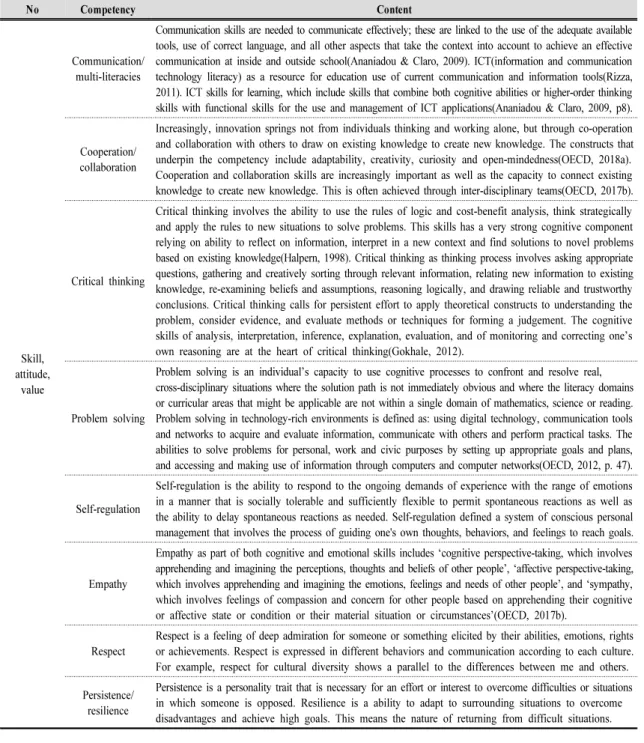
No Competency Content
Skill, attitude,
value
Communication/
multi-literacies
Communication skills are needed to communicate effectively; these are linked to the use of the adequate available tools, use of correct language, and all other aspects that take the context into account to achieve an effective communication at inside and outside school(Ananiadou & Claro, 2009). ICT(information and communication technology literacy) as a resource for education use of current communication and information tools(Rizza, 2011). ICT skills for learning, which include skills that combine both cognitive abilities or higher-order thinking skills with functional skills for the use and management of ICT applications(Ananiadou & Claro, 2009, p8).
Cooperation/
collaboration
Increasingly, innovation springs not from individuals thinking and working alone, but through co-operation and collaboration with others to draw on existing knowledge to create new knowledge. The constructs that underpin the competency include adaptability, creativity, curiosity and open-mindedness(OECD, 2018a).
Cooperation and collaboration skills are increasingly important as well as the capacity to connect existing knowledge to create new knowledge. This is often achieved through inter-disciplinary teams(OECD, 2017b).
Critical thinking
Critical thinking involves the ability to use the rules of logic and cost-benefit analysis, think strategically and apply the rules to new situations to solve problems. This skills has a very strong cognitive component relying on ability to reflect on information, interpret in a new context and find solutions to novel problems based on existing knowledge(Halpern, 1998). Critical thinking as thinking process involves asking appropriate questions, gathering and creatively sorting through relevant information, relating new information to existing knowledge, re-examining beliefs and assumptions, reasoning logically, and drawing reliable and trustworthy conclusions. Critical thinking calls for persistent effort to apply theoretical constructs to understanding the problem, consider evidence, and evaluate methods or techniques for forming a judgement. The cognitive skills of analysis, interpretation, inference, explanation, evaluation, and of monitoring and correcting one’s own reasoning are at the heart of critical thinking(Gokhale, 2012).
Problem solving
Problem solving is an individual’s capacity to use cognitive processes to confront and resolve real, cross-disciplinary situations where the solution path is not immediately obvious and where the literacy domains or curricular areas that might be applicable are not within a single domain of mathematics, science or reading.
Problem solving in technology-rich environments is defined as: using digital technology, communication tools and networks to acquire and evaluate information, communicate with others and perform practical tasks. The abilities to solve problems for personal, work and civic purposes by setting up appropriate goals and plans, and accessing and making use of information through computers and computer networks(OECD, 2012, p. 47).
Self-regulation
Self-regulation is the ability to respond to the ongoing demands of experience with the range of emotions in a manner that is socially tolerable and sufficiently flexible to permit spontaneous reactions as well as the ability to delay spontaneous reactions as needed. Self-regulation defined a system of conscious personal management that involves the process of guiding one's own thoughts, behaviors, and feelings to reach goals.
Empathy
Empathy as part of both cognitive and emotional skills includes ‘cognitive perspective-taking, which involves apprehending and imagining the perceptions, thoughts and beliefs of other people’, ‘affective perspective-taking, which involves apprehending and imagining the emotions, feelings and needs of other people’, and ‘sympathy, which involves feelings of compassion and concern for other people based on apprehending their cognitive or affective state or condition or their material situation or circumstances’(OECD, 2017b).
Respect
Respect is a feeling of deep admiration for someone or something elicited by their abilities, emotions, rights or achievements. Respect is expressed in different behaviors and communication according to each culture.
For example, respect for cultural diversity shows a parallel to the differences between me and others.
Persistence/
resilience
Persistence is a personality trait that is necessary for an effort or interest to overcome difficulties or situations in which someone is opposed. Resilience is a ability to adapt to surrounding situations to overcome disadvantages and achieve high goals. This means the nature of returning from difficult situations.
Table 2. OECD education 2030 competency
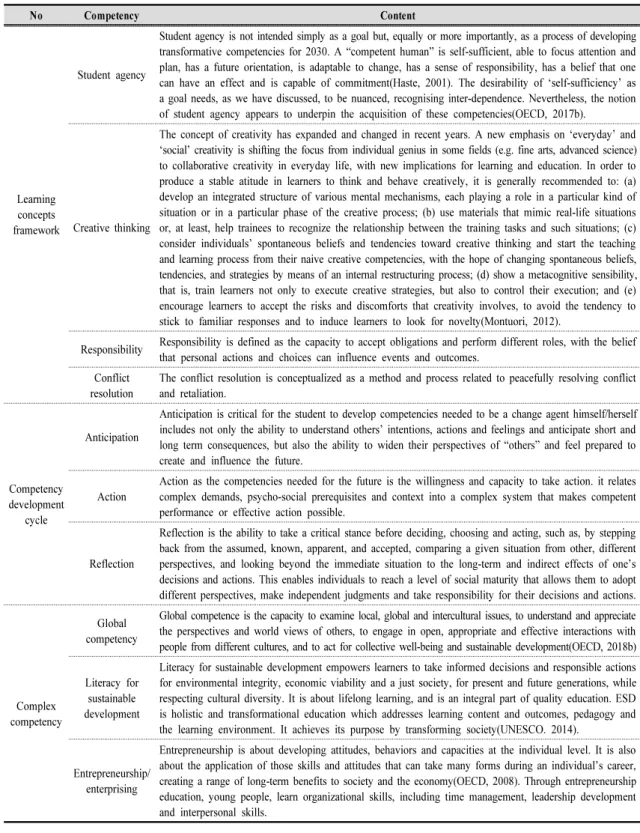
이러한 OECD Education 2030의 학습 프레임워크가 제시한 네 가지 범주, 하위 핵심역량들은 각각의 요소마다 정의를 포함하고 있는데 이에 대한 구체적인 의미는 <Table 2>와 같
이 나타낼 수 있다.
No Competency Content
Learning concepts framework
Student agency
Student agency is not intended simply as a goal but, equally or more importantly, as a process of developing transformative competencies for 2030. A “competent human” is self-sufficient, able to focus attention and plan, has a future orientation, is adaptable to change, has a sense of responsibility, has a belief that one can have an effect and is capable of commitment(Haste, 2001). The desirability of ‘self-sufficiency’ as a goal needs, as we have discussed, to be nuanced, recognising inter-dependence. Nevertheless, the notion of student agency appears to underpin the acquisition of these competencies(OECD, 2017b).
Creative thinking
The concept of creativity has expanded and changed in recent years. A new emphasis on ‘everyday’ and
‘social’ creativity is shifting the focus from individual genius in some fields (e.g. fine arts, advanced science) to collaborative creativity in everyday life, with new implications for learning and education. In order to produce a stable atitude in learners to think and behave creatively, it is generally recommended to: (a) develop an integrated structure of various mental mechanisms, each playing a role in a particular kind of situation or in a particular phase of the creative process; (b) use materials that mimic real-life situations or, at least, help trainees to recognize the relationship between the training tasks and such situations; (c) consider individuals’ spontaneous beliefs and tendencies toward creative thinking and start the teaching and learning process from their naive creative competencies, with the hope of changing spontaneous beliefs, tendencies, and strategies by means of an internal restructuring process; (d) show a metacognitive sensibility, that is, train learners not only to execute creative strategies, but also to control their execution; and (e) encourage learners to accept the risks and discomforts that creativity involves, to avoid the tendency to stick to familiar responses and to induce learners to look for novelty(Montuori, 2012).
Responsibility Responsibility is defined as the capacity to accept obligations and perform different roles, with the belief that personal actions and choices can influence events and outcomes.
Conflict resolution
The conflict resolution is conceptualized as a method and process related to peacefully resolving conflict and retaliation.
Competency development
cycle
Anticipation
Anticipation is critical for the student to develop competencies needed to be a change agent himself/herself includes not only the ability to understand others’ intentions, actions and feelings and anticipate short and long term consequences, but also the ability to widen their perspectives of “others” and feel prepared to create and influence the future.
Action
Action as the competencies needed for the future is the willingness and capacity to take action. it relates complex demands, psycho-social prerequisites and context into a complex system that makes competent performance or effective action possible.
Reflection
Reflection is the ability to take a critical stance before deciding, choosing and acting, such as, by stepping back from the assumed, known, apparent, and accepted, comparing a given situation from other, different perspectives, and looking beyond the immediate situation to the long-term and indirect effects of one’s decisions and actions. This enables individuals to reach a level of social maturity that allows them to adopt different perspectives, make independent judgments and take responsibility for their decisions and actions.
Complex competency
Global competency
Global competence is the capacity to examine local, global and intercultural issues, to understand and appreciate the perspectives and world views of others, to engage in open, appropriate and effective interactions with people from different cultures, and to act for collective well-being and sustainable development(OECD, 2018b)
Literacy for sustainable development
Literacy for sustainable development empowers learners to take informed decisions and responsible actions for environmental integrity, economic viability and a just society, for present and future generations, while respecting cultural diversity. It is about lifelong learning, and is an integral part of quality education. ESD is holistic and transformational education which addresses learning content and outcomes, pedagogy and the learning environment. It achieves its purpose by transforming society(UNESCO. 2014).
Entrepreneurship/
enterprising
Entrepreneurship is about developing attitudes, behaviors and capacities at the individual level. It is also about the application of those skills and attitudes that can take many forms during an individual’s career, creating a range of long-term benefits to society and the economy(OECD, 2008). Through entrepreneurship education, young people, learn organizational skills, including time management, leadership development and interpersonal skills.
Table 2. Continued
No Competency Content
Complex competency
Digital literacy
Digital literacy is cognitively similar to traditional forms and is most accessible to individuals who have mastered traditional literacy skills. Although traditional written literacy is acquiring a new dimension in digital environments, it can be argued this does not automatically imply a cognitive shift to a new type of literacy of a different nature(OECD, 2017b). The OECD digital skills framework identifies these as ‘ICT complementary skills’, essentially skills that allow people to ‘process complex information, communicate with co-workers and clients, solve problems, plan in advance and adjust quickly’(OECD, 2016a).
Computational thinking/coding
Computational thinking has been defined as: the process of recognizing aspects of computation in the world that surrounds us and applying tools and techniques from computing to understand and reason about natural, social and artificial systems and processes(Royal Society, 2012). The development of computational thinking through computer coding and technology-based ‘making’ is framed in various ways. It encompasses problem-solving, examining data patterns, decomposing problems, using algorithms and procedures, making simulations, computer-modelling and reasoning about abstract objects(Bocconi et al., 2016).
Table 2. Continued
Ⅲ. 연구방법
1. 분석대상 및 준거
본 연구에서는 역량 중심 교육과정을 적극적으로 반영한 2015 개정 기술⋅가정 교육과정(교육부 고시 제2015-74호 별 책 10)에서 가정과 교육과정 문서를 대상으로 분석하였다. 분 석대상인 교육과정 문서는 성격, 목표, 내용 체계 및 성취기준, 교수⋅학습 및 평가의 방향으로 이루어져 있다. 초등학교와 중등학교에 공통으로 적용되는 ‘성격’, ‘목표’, ‘내용체계 및 성취기준’, ‘교수⋅학습 및 평가 방향’ 항목이 포함되었으며,
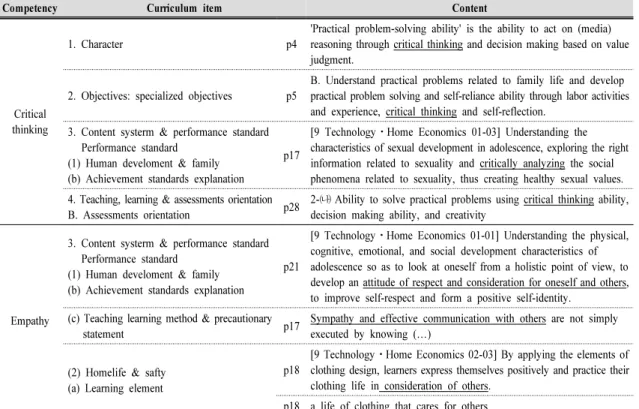
‘ 내용체계 및 성취기준’ 항목의 경우 초등학교와 중학교, 고등 학교가 독립적으로 제시되고 있는 점을 고려하여 중학교와 고등학교 영역으로 구분하여 OECD Education 2030 프로젝트 에서 제시하고 있는 핵심역량의 반영 특성을 분석하고자 하였 다. 분석 준거는 OECD Education 2030 프로젝트의 학습 프레 임워크에서 제시하는 20가지의 역량을 기준으로 하였으며 OECD 학습 프레임워크에서 강조하는 핵심역량과 부합하는 역량요소와 진술요소를 분석한 Lee 외(2017)의 사례를 참고하 였다. 본 연구에서 교육과정 항목에서 여러 역량이 반복적으 로 포함되는 경우 준거가 되는 역량에 가장 적합한 진술을 중점으로 반영될 수 있도록 하였다. 분석 준거가 된 20가지의 역량 중 ‘비판적 사고’와 ‘공감’의 분석 예시는 <Table 3>과 같이 나타낼 수 있다.
2. 분석절차
분석절차는 연구자에 의한 1차 분석과 전문가에 의한 2차
분석 및 검토, 협의로 이루어졌다. 1차 분석에서 연구자는 선
행연구에서 나타난 분석 준거와 분석과정을 참고로 하여 가정
과 교육과정 문서에서 나타난 OECD 학습 프레임워크의 20가
지 역량에 대한 반영 특성을 분석하였다. 2차 분석에서는 현직
교사이며 교육과정 개발과 교과서 집필 경력을 가진 전문가와
함께 분석에 대해 검토하고 누락된 부분을 점검하였다. 1차와
2 차 분석 후 분석한 내용을 상호협의하는 과정에서 충분한
논의를 통하여 재검토함으로써 결과에 대한 신뢰성을 확보할
수 있도록 하였다. 최종적으로 가정과 교육과정 문서에서
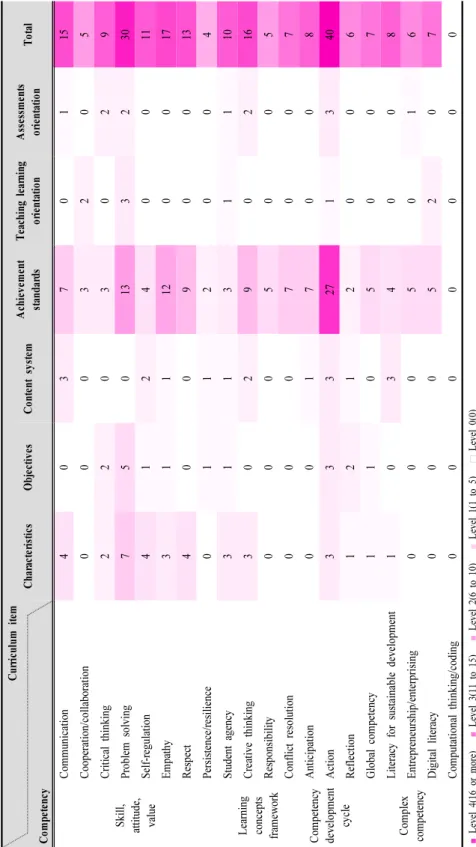
OECD 학습 프레임워크의 20가지 역량이 반영된 정도에 따라
열지도(heat maps) 형태로 나타내었다. OECD의 맵핑 준거를
4 단계로 설정한 Lee 외(2017)의 연구에서는 교육과정에 명시
된 형태와 교사들이 역량을 교수⋅학습 과정에서 포함시킬
가능성에 따라 판단 수준을 1단계에서 4단계까지로 설정하였
으나 본 연구에서는 교육과정 반영 빈도에 따라 0단계에서
4 단계까지를 설정하였다. 0단계는 교육과정에서 해당 역량이
포함된 항목이 나타나지 않은 경우이며, 1단계는 교육과정에
서 해당 역량이 1에서 5까지의 빈도가 포함된 경우이며, 2단계
는 교육과정에서 해당 역량이 6에서 10까지의 빈도가 포함된
경우이며, 3단계는 교육과정에서 해당 역량이 11에서 15까지
의 빈도가 포함된 경우이며, 4단계는 교육과정에서 해당 역량
Competency Curriculum item Content
Critical thinking
1. Character p4
'Practical problem-solving ability' is the ability to act on (media) reasoning through critical thinking and decision making based on value judgment.
2. Objectives: specialized objectives p5
B. Understand practical problems related to family life and develop practical problem solving and self-reliance ability through labor activities and experience, critical thinking and self-reflection.
3. Content systerm & performance standard Performance standard
(1) Human develoment & family (b) Achievement standards explanation
p17
[9 Technology⋅Home Economics 01-03] Understanding the characteristics of sexual development in adolescence, exploring the right information related to sexuality and critically analyzing the social phenomena related to sexuality, thus creating healthy sexual values.
4. Teaching, learning & assessments orientation
B. Assessments orientation p28 2-㈏ Ability to solve practical problems using critical thinking ability, decision making ability, and creativity
Empathy
3. Content systerm & performance standard Performance standard
(1) Human develoment & family (b) Achievement standards explanation
p21
[9 Technology⋅Home Economics 01-01] Understanding the physical, cognitive, emotional, and social development characteristics of adolescence so as to look at oneself from a holistic point of view, to develop an attitude of respect and consideration for oneself and others, to improve self-respect and form a positive self-identity.
(c) Teaching learning method & precautionary
statement p17 Sympathy and effective communication with others are not simply executed by knowing (…)
(2) Homelife & safty (a) Learning element
p18
[9 Technology⋅Home Economics 02-03] By applying the elements of clothing design, learners express themselves positively and practice their clothing life in consideration of others.
p18 a life of clothing that cares for others
Table 3. Analysis example
Level Frequency Category Criteria
0 0 Not targeted in the curriculum content item.
The competency is not included in the written curriculum of this learning area/subject area and it is unlikely that teachers would include this as part of their own teaching.
1 1 to 5 Targeted in the subject-specific curriculum content item but the frequency appeared low from 1 to 5.
The competency is explicitly low included in the written curriculum of a specific learning area/subject area, however, there is sufficient scope in the content for teachers to include the competency if they choose to do so.
2 6 to 10 Targeted in the subject-specific curriculum content item but the frequency appeared 6 to 10.
3 11 to 15 Targeted in the subject-specific curriculum content item, but the frequency appeared 11 to 15.
The competency is included in the written curriculum as the main target (characteristics, objectives, content system, and achievement standards).
4 16 or more
Targeted in the subject-specific curriculum content item and clearly articulated (e.g. main target)
The competency is included in the written curriculum as the main target(characteristics, objectives, content system, achievement standards, teaching learning orientation, and assessments orientation) or the selected competencies are clearly articulated in the curriculum.
Table 4. Criteria for reflection level
이 16에서 그 이상의 빈도가 포함된 경우로 교육과정에서 성 격, 목표, 내용체계, 성취기준, 교수⋅학습 방향, 평가 방향의 범주에 모두 포함되어 있을 경우에 해당된다(<Table 4>). 이러
한 단계 설정에 따라 교육과정 문서 항목(가로축)과 역량(세로
축)이 반영된 정도를 색의 농도로 표현하여 시각화하였다.
Competency School type
Curriculum item
Total(%) Characteristics Objectives Content
system
Achievement standards
Teaching, learning &
assessments orientation Skill, attitude,
value
Middle 14(6.3) 5(2.2) 3(1.3) 36(16.1) 6(2.7) 64(28.6)
High 10(4.5) 5(2.2) 4(1.8) 17(7.6) 4(1.8) 40(17.9)
Learning concepts framework
Middle 4(1.8) 1(0.4) 1(0.4) 16(7.1) 1(0.4) 23(10.3)
High 2(0.9) 0 2(0.9) 8(3.6) 3(1.3) 15(6.7)
Competency development cycle
Middle 2(0.9) 2(0.9) 1(0.4) 20(8.9) 2(0.9) 27(12.1)
High 2(0.9) 3(1.3) 4(1.8) 16(7.1) 2(0.9) 27(12.1)
Complex competency
Middle 1(0.4) 0 1(0.4) 3(1.3) 2(0.9) 7(3.1)
High 1(0.4) 1(0.4) 2(0.9) 16(7.1) 1(0.4) 21(9.4)
Total(%) 36(16.1) 17(7.6) 18(8.0) 132(59.0) 21(9.4) 224(100)
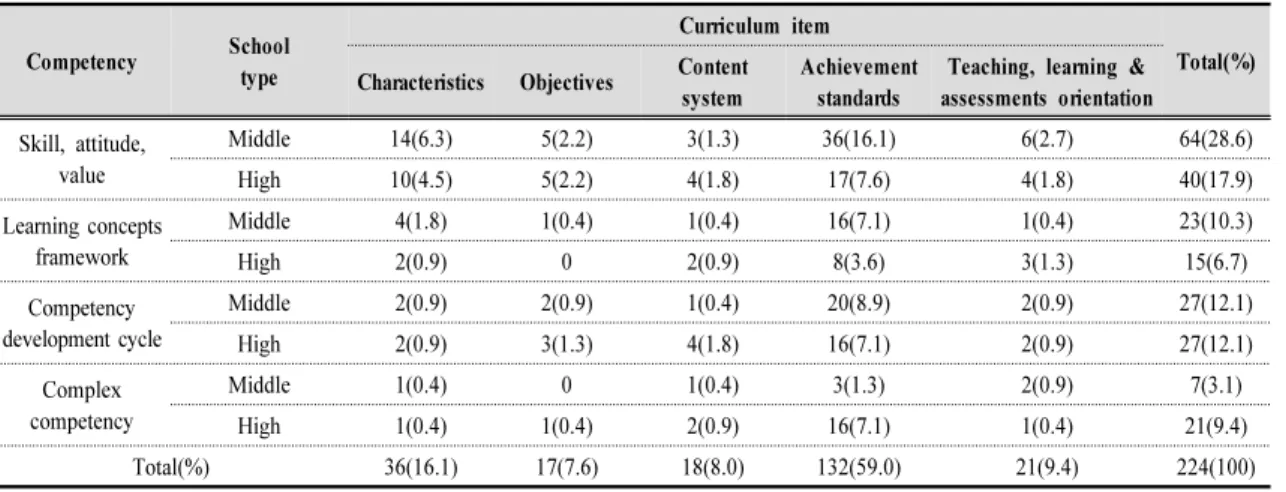
Table 5. Results of analysis on curriculum items and competency categories
Ⅳ. 연구결과
1. 핵심역량 범주별 분석 결과
1) 교육과정의 항목별 분석 결과
2015 개정 가정과 교육과정 항목별로 OECD 학습 프레임 워크의 핵심역량의 반영을 분석한 결과는 <Table 5>와 같다.
첫째, 기능, 태도, 가치 영역을 살펴보면 중학교 교육과정에서 는 28.6%, 고등학교에서는 17.9%를 차지하였다. 교육과정 항 목별로 살펴보면 중학교 교육과정에서는 성취기준(16.1%), 성격(6.3%), 교수⋅학습 평가 방향(2.7%), 목표(2.2%), 내용체 계(1.3%) 순으로 나타났다. 고등학교 교육과정에서는 성취기 준(7.6%), 성격(4.5%), 목표(2.2%), 내용체계(1.8%), 교수⋅학 습 평가 방향(1.8%) 순으로 나타났다. 둘째, 학습 개념 프레임 워크 영역을 살펴보면 중학교 교육과정에서는 10.3%, 고등학 교 교육과정에서는 6.7%를 차지하였다. 교육과정 항목별로 중학교 교육과정에서는 성취기준(7.1%), 성격(1.8%), 목표 (0.4%), 내용체계(0.4%), 교수⋅학습 평가 방향(0.4%) 순으로 나타났다. 고등학교 교육과정에서는 성취기준(3.6%), 교수⋅
학습 평가 방향(1.3%), 성격(0.9%), 내용체계(0.9%) 순으로 나 타났으며 목표 항목에서 반영은 나타나지 않았다. 셋째, 역량 개발 사이클 영역을 살펴보면 중학교 교육과정에서는 12.1%, 고등학교 교육과정에서도 12.1%를 차지하였다. 교육과정 항
목별로 중학교 교육과정에서는 성취기준(8.9%), 성격(0.9%), 목표(0.9%), 교수⋅학습 평가 방향(0.9%), 내용체계(0.4%) 순 으로 나타났다. 고등학교 교육과정에서는 성취기준(7.1%), 내 용체계(1.8%), 목표(1.3%), 성격(0.9%), 교수⋅학습 평가 방향 (0.9%) 순으로 나타났다. 넷째, 복합 역량 영역을 살펴보면 중학교 교육과정에서는 3.1%, 고등학교 교육과정에서는 9.4%
를 차지하였다. 교육과정 항목별로 중학교 교육과정에서는 성취기준(1.3%), 교수⋅학습 평가 방향(0.9%), 성격(0.4%), 내 용체계(0.4%) 순으로 나타났으나 목표항목은 반영이 나타나 지 않았다. 고등학교 교육과정에서는 성취기준(7.1%), 내용체 계(0.9%), 성격(0.4%), 목표(0.4%), 교수⋅학습 평가 방향(0.4%) 순으로 나타났다. 전체적인 영역에서 성취기준(59%), 성격 (16.1%), 교수⋅학습 평가 방향(9.4%), 내용체계(8%), 목표(7.6%) 순으로 반영이 나타나 OECD 학습 프레임워크의 핵심역량은 성취기준에 가장 많이 반영된 것으로 알 수 있다.
2) 학교급별 분석 결과
OECD 학습 프레임워크에서 제시하고 있는 핵심역량들이
반영된 결과들은 기능, 태도, 가치 영역(46.5%)이 가장 많이
반영되었으며 다음으로 역량 개발 사이클 영역(24.2%), 학습
개념 프레임워크 영역(17%), 복합 역량 영역(12.5%)이 차지하
였다. 이것을 중⋅고등학교 학교급별에 따라 범주별로 나누어
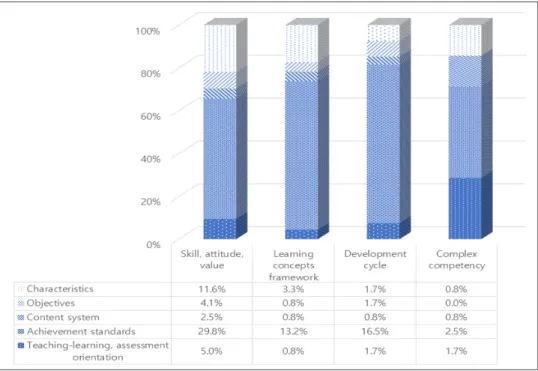
살펴보면 <Figure 2>와 <Figure 3>에서 비교할 수 있다.
Figure 3. Results of analysis on categories of key competencies in high school curriculum
Figure 2. Results of analysis on categories of key competencies in middle school curriculum
중학교 교육과정에서 성격 항목은 기능, 태도, 가치 영역 (11.6%), 학습 개념 프레임워크 영역(3.3%), 역량 개발 사이클 영역(1.7%), 복합 역량 영역(0.8%) 순으로 나타났다. 목표 항목 은 기능, 태도, 가치 영역(4.1%), 역량 개발 사이클 영역(1.7%), 학습 개념 프레임워크 영역(0.8%) 순으로, 내용체계 항목은 기 능, 태도, 가치 영역(2.5%), 역량 개발 사이클 영역(0.8%), 학습 개념 프레임워크 영역(0.8%), 복합 역량 영역(0.8%)이 각각 같은 빈도로 나타났다. 각 역량이 가장 많이 반영된 성취기준 항목은 기능, 태도, 가치 영역(29.8%), 역량 개발 사이클 영역(16.5%), 학습 개념 프레임워크 영역(13.2%), 복합 역량 영역(2.5%) 순으 로 역량이 반영되었다. 교수⋅학습평가 방향 항목에서는 기능, 태도, 가치 영역(5%), 복합 역량 영역(1.7%), 역량 개발 사이클 영역(1.7%), 학습 개념 프레임워크 영역(0.8%) 순으로 나타났다.
고등학교 교육과정에서 성격 항목은 기능, 태도, 가치 영역 (9.7%), 학습 개념 프레임워크 영역(1.9%), 역량 개발 사이클 영역 (1.9%), 복합 역량 영역(1.0%) 순으로 나타났다. 목표 항목은 기능, 태도, 가치 영역(4.9%), 역량 개발 사이클 영역(2.9%), 복합 역량 영역(1.0%) 순으로, 내용체계 항목은 기능, 태도, 가치 영역(3.9%) 과 역량 개발 사이클 영역(2.9%)이, 학습 개념 프레임워크 영역 (1.9%) 과 복합 역량 영역(1.9%)이 각각 같은 빈도로 나타났다.
성취기준 항목은 기능, 태도, 가치 영역(16.5%), 역량 개발 사이클 영역(15.5%)과 복합 역량 영역(15.5%), 학습 개념 프레 임워크 영역(7.8%) 순으로 역량이 반영되었다. 교수⋅학습평 가 방향 항목에서는 기능, 태도, 가치 영역(3.9%), 학습 개념 프레임워크 영역(2.9%), 역량 개발 사이클 영역(1.9%), 복합 역량 영역(1.0%) 순으로 나타났다. 특히 고등학교에서는 중학 교 교육과정에 비해 복합 역량 영역이 성취기준에서 높게 나 타나 학습자가 고차적 사고, 주도적인 사고를 갖출 뿐만 아니 라 스스로 능력을 개발하고 동료와 상호작용할 수 있는 교수⋅
학습 개발 전략을 활용할 필요가 있었다.
2. 핵심역량 항목별 분석 결과
1) 중학교 교육과정에서의 항목별 분석 결과 중학교 교육과정에서 나타난 OECD 학습 프레임워크에서
제시하고 있는 핵심역량의 항목별 반영을 분석한 결과는
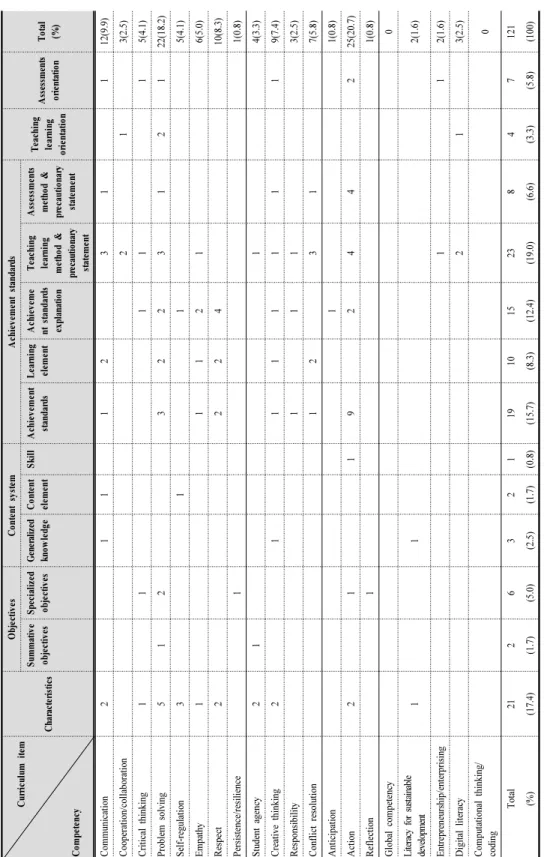
<Table 6> 과 같다. 구체적으로 각 역량별로 살펴보면 의사소 통은 전체 9.9%를 차지하였으며, 교육과정 항목별로 성격, 내 용체계 항목의 일반화된 지식, 내용요소, 성취기준 항목의 성 취기준, 학습요소, 교수⋅학습 방법 및 유의사항, 평가 방법 및 유의사항, 평가 방향에서 나타났다. 협동/협력은 전체 2.5%
를 차지하였으며, 교육과정 항목별로 성취기준 항목의 교수⋅
학습 방법 및 유의사항, 교수⋅학습 방향에서 나타났다. 비판 적 사고는 전체 4.1%를 차지하였으며, 교육과정 항목별로 성 격, 목표 항목의 세부목표, 성취기준 항목의 성취기준 해설, 교수⋅학습 방법 및 유의사항, 평가 방향에서 나타났다. 문제 해결은 전체 18.2%를 차지하였으며, 교육과정 항목별로 성격, 목표 항목의 총괄목표, 세부목표, 성취기준 항목의 성취기준, 학습요소, 성취기준 해설, 교수⋅학습 방법 및 유의사항, 평가 방법 및 유의사항, 교수⋅학습 방향, 평가 방향에서 나타났다.
자기관리는 전체 4.1%를 차지하였으며, 교육과정 항목별로 성격, 내용체계 항목의 내용요소, 성취기준 항목의 성취기준 해설에서 나타났다. 공감은 전체 5%를 차지하였으며, 교육과 정 항목별로 성격, 성취기준 항목의 성취기준, 학습요소, 성취 기준 해설, 교수⋅학습 방법 및 유의사항에서 나타났다. 존중 은 전체 8.3%를 차치하였으며, 교육과정 항목별로 성격, 성취 기준 항목의 성취기준, 학습요소, 성취기준 해설에서 나타나 대부분이 성취기준 항목에 포함되었다. 반면 회복탄력성은 전체 0.8%로 교육과정 목표 항목의 총괄목표에서만 나타났다.
학생 주체성은 전체 3.3%를 차지하였으며, 교육과정 항목 별로 성격, 목표 항목의 총괄목표, 성취기준 항목의 교수⋅학 습 방법 및 유의사항에서 나타났다. 창의적 사고는 전체 7.4%
를 차지하였으며, 교육과정 항목별로 성격, 내용체계 항목의 일반화된 지식, 성취기준 항목의 성취기준, 학습요소, 성취기 준 해설, 교수⋅학습 방법 및 유의사항, 평가 방법 및 유의사 항, 평가 방향에서 나타났다. 책임감은 전체 2.5%를 차지하였 으며, 교육과정 항목별로 성취기준 항목의 성취기준, 성취기 준 해설, 교수⋅학습 방법 및 유의사항에서 나타났다. 갈등해 결은 전체 5.8%를 차지하였으며, 교육과정 항목별로 성취기 준 항목의 성취기준, 학습요소, 교수⋅학습 방법 및 유의사항, 평가 방법 및 유의사항에서 나타났다.
예측은 전체 0.8%를 차지하였으며, 교육과정 성취기준 항
Curriculum item Competency
Characteristics
ObjectivesContent systemAchievement standards Teaching learning orientation Assessments orientationTotal (%)
Summative objectivesSpecialized objectivesGeneralized knowledgeContent elementSkillAchievement standardsLearning elementAchieveme nt standards explanation Teaching learning method & precautionary statement
Assessments method & precautionary statement Communication2111231112(9.9) Cooperation/collaboration213(2.5) Critical thinking111115(4.1) Problem solving512322312122(18.2) Self-regulation3115(4.1) Empathy111216(5.0) Respect222410(8.3) Persistence/resilience11(0.8) Student agency2114(3.3) Creative thinking211111119(7.4) Responsibility1113(2.5) Conflict resolution12317(5.8) Anticipation11(0.8) Action2119244225(20.7) Reflection11(0.8) Global competency0 Literacy for sustainable development112(1.6) Entrepreneurship/enterprising112(1.6) Digital literacy213(2.5) Computational thinking/ coding0 Total212632119101523847121 (%)(17.4)(1.7)(5.0)(2.5)(1.7)(0.8)(15.7)(8.3)(12.4)(19.0)(6.6)(3.3)(5.8)(100)
Ta bl e 6. R es ul ts o f an al ys is on spec ifi c ite m s in t he m iddl e sc hool c ur ric ul um
목의 교수⋅학습 방법 및 유의사항에서 나타났다. 행동은 전체 20.7% 를 차지하였으며, 교육과정 항목별로 성격, 목표 항목의 세부목표, 내용체계 항목의 기능, 성취기준 항목의 성취기준, 성취기준 해설, 교수⋅학습 방법 및 유의사항, 평가 방법 및 유의사항, 평가 방향에서 나타났다. 행동은 성취기준(7.4%), 교수⋅학습 방법 및 유의사항(3.3%), 평가 방법 및 유의사항 (3.3%)에서 반영이 높게 나타났다. 반성은 전체 0.8%를 차지 하였으며, 교육과정 목표 항목의 세부목표에서만 나타났다.
지속가능 발전을 위한 리터러시는 전체 1.6%를 차지하였으며, 교육과정 항목별로 성격, 내용체계 항목의 일반화된 지식에서 나타났다. 기업가 정신은 전체 1.6%를 차지하였으며 교육과 정 항목별로 성취기준 항목의 교수⋅학습 방법 및 유의사항, 평가 방향에서 나타났다. 디지털 리터러시는 전체 2.5%를 차 지하였으며, 교육과정 항목별로 성취기준 항목의 교수⋅학습 방법 및 유의사항, 교수⋅학습 방향에서 나타났으며 글로벌 역량과 컴퓨팅 사고/코딩은 반영된 항목이 나타나지 않았다.
교육과정 항목별로 의사소통은 성취기준 항목의 교수⋅학 습 방법 및 유의사항에서, 문제해결은 성격과 성취기준 항목 에서, 자기관리는 성격 항목에서, 행동은 성취기준 항목에서, 존중은 성취기준 항목의 성취기준 해설에서 높게 나타나 반영 이 높은 핵심역량들은 주로 교육과정의 성격과 성취기준 항목 에서 나타났다.
범주별로 구체적인 역량을 살펴보면 지식, 태도, 가치 영역 에서는 문제해결, 의사소통, 존중, 공감, 비판적 사고/자기관리, 협동/협력, 회복탄력성 순으로 높게 나타났다. 학습 개념 프레 임워크 영역에서는 창의적 사고, 갈등해결, 학생 주체성, 책임 감 순으로, 역량 개발 사이클 영역에서는 행동, 예측/반성 순으 로 나타났으며 복합 역량 영역에서는 디지털 리터러시, 지속가 능한 개발을 위한 리터러시/기업가 정신 순으로 나타났다.
2) 고등학교 교육과정에서의 항목별 분석 결과
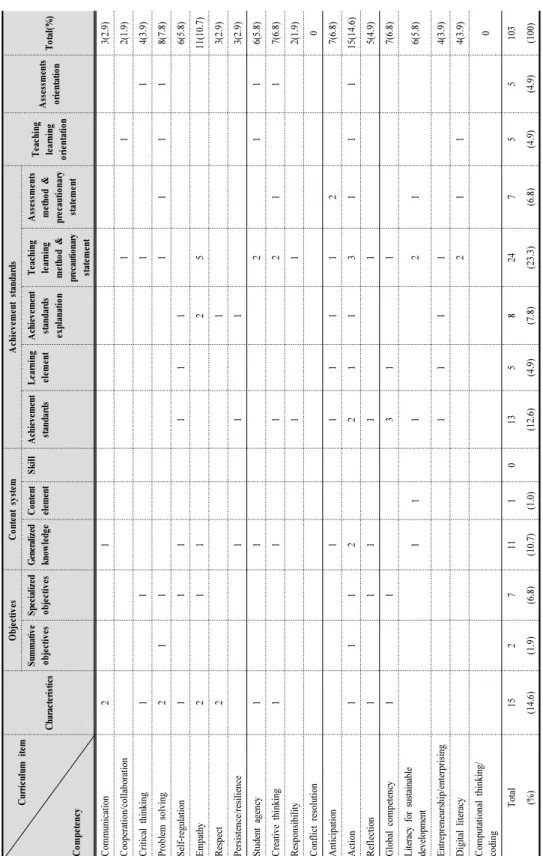
고등학교 교육과정에서 나타난 OECD 학습 프레임워크에 서 제시하고 있는 핵심역량의 항목별 반영을 분석한 결과는
<Table 7>과 같다. 구체적으로 각 역량별로 살펴보면 의사소 통은 전체 2.9%를 차지하였으며, 교육과정 항목별로 성격, 내 용체계 항목의 일반화된 지식에서 나타났다. 협동/협력은 전
체 1.9%를 차지하였으며, 교육과정 항목별로 성취기준 항목 의 교수⋅학습 방법 및 유의사항, 교수⋅학습 방향에서 나타 났다. 비판적 사고는 전체 3.9%를 차지하였으며, 교육과정 항 목별로 성격, 목표 항목의 세부목표, 성취기준 항목의 교수⋅
학습 방법 및 유의사항, 평가 방향에서 나타났다. 문제해결은 전체 7.8%를 차지하였으며, 교육과정 항목별로 성격, 목표 항 목의 총괄목표, 세부목표, 성취기준 항목의 교수⋅학습 방법 및 유의사항, 평가 방법 및 유의사항, 교수⋅학습 방향, 평가 방향에서 나타났다. 자기관리는 전체 5.8%를 차지하였으며, 교육과정 항목별로 성격, 목표 항목의 세부목표, 내용체계 항 목의 일반화된 지식, 성취기준 항목의 성취기준, 학습요소, 성취기준 해설에서 나타났다. 공감은 전체 10.7%를 차지하였 으며, 교육과정 항목별로 성격, 목표 항목의 세부목표, 내용체 계 항목의 일반화된 지식, 성취기준 항목의 성취기준 해설에 서 나타났으며, 교수⋅학습 방법 및 유의사항에서 가장 높게 나타났다. 존중은 전체 2.9%를 차치하였으며, 교육과정 항목 별로 성격, 성취기준 항목의 성취기준 해설에서 나타났다. 회 복탄력성은 전체 2.9%를 차지하였으며, 교육과정 항목별로 내용체계 항목의 일반화된 지식, 성취기준 항목의 성취기준, 성취기준 해설에서 나타났다.
학생 주체성은 전체 5.8%를 차지하였으며, 교육과정 항목 별로 성격, 내용체계 항목의 일반화된 지식, 성취기준 항목의 교수⋅학습 방법 및 유의사항, 교수⋅학습 방향, 평가 방향에 서 나타났다. 창의적 사고는 전체 6.8%를 차지하였으며, 교육 과정 항목별로 성격, 내용체계 항목의 일반화된 지식, 성취기 준 항목의 성취기준, 교수⋅학습 방법 및 유의사항, 평가 방법 및 유의사항, 평가 방향에서 나타났다. 책임감은 전체 1.9%를 차지하였으며, 교육과정 항목별로 성취기준 항목의 성취기준, 교수⋅학습 방법 및 유의사항에서 나타났다. 갈등해결은 중학 교 교육과정에서는 5.8%로 나타났으나 고등학교 교육과정에 서는 반영된 항목이 나타나지 않았다.
예측은 전체 6.8%를 차지하였으며, 교육과정 내용체계 항
목의 일반화된 지식, 성취기준 항목의 성취기준, 학습요소,
성취기준 해설, 교수⋅학습 방법 및 유의사항, 평가 방법 및
유의사항에서 나타났다. 행동은 전체 14.6%를 차지하였으며,
교육과정 항목별로 성격, 목표 항목의 총괄목표, 세부목표,
내용체계 항목의 일반화된 지식, 성취기준 항목의 성취기준,
Curriculum item Competency
Characteristics
ObjectivesContent systemAchievement standards Teaching learning orientation Assessments orientationTotal(%)
Summative objectivesSpecialized objectivesGeneralized knowledgeContent elementSkillAchievement standardsLearning elementAchievement standards explanation Teaching learning method & precautionary statement
Assessments method & precautionary statement Communication213(2.9) Cooperation/collaboration112(1.9) Critical thinking11114(3.9) Problem solving21111118(7.8) Self-regulation1111116(5.8) Empathy2112511(10.7) Respect213(2.9) Persistence/resilience1113(2.9) Student agency112116(5.8) Creative thinking1112117(6.8) Responsibility112(1.9) Conflict resolution0 Anticipation1111127(6.8) Action1112211311115(14.6) Reflection111115(4.9) Global competency113117(6.8) Literacy for sustainable development111216(5.8) Entrepreneurship/enterprising11114(3.9) Digital literacy2114(3.9) Computational thinking/ coding0 Total15271110135824755103 (%)(14.6)(1.9)(6.8)(10.7)(1.0)(12.6)(4.9)(7.8)(23.3)(6.8)(4.9)(4.9)(100)