서 론
인체 내 에너지 균형은 에너지 섭취와 소비로 이루어지는 데, 에너지 섭취는 음식물로부터 탄수화물, 단백질 및 지방 등 에너지 영양소의 공급을 통하여 이루어지며, 에너지소비 는 생명유지에 가장 기본적인 대사 활동에 필요한 기초대사 량, 신체 활동을 위한 활동대사량과 식품을 섭취한 후 영양 소의 소화, 흡수, 대사, 이동, 저장 및 식품 섭취에 따른 자율 신경 활동의 증진 등에 소모되는 식이성 발열효과(diet-in- duced thermogenesis, DIT)로 구성된다(1).
일반적으로 성인에 있어 기초대사량은 전체 소비에너지 중 65∼70%를 차지한다고 하며(2-4), 중등정도의 노동을 하 는 성인에 있어 활동대사량은 대략 30%를 차지한다고 하나 신체활동의 강도에 따라 달라지므로 운동 유형에 따른 다양 한 활동대사량이 보고되어 있다. 이들에 비하여 DIT는 보통
혼합식 섭취의 경우 하루 총 에너지 섭취량의 약 10%를 차 지한다고 하여, 보통 성인 집단의 에너지 소비량을 산출할 때 이들 자료가 인용되고 있으나 기초대사량 및 활동대사량 에 비하여 미지의 점이 많다.
DIT는 식사에 의해 위장관의 자극이나 후각 및 식품에 대한 느낌으로 생성되는 뇌상(cephalic phase thermo- genesis) DIT(5)와 영양소의 소화, 흡수, 대사 및 저장에서 생성되는 장상(gastrointestinal phase thermogenesis) DIT(6)로 구분된다. DIT에 영향을 미치는 요인으로는 식품 을 섭취한 후 영양소의 소화, 흡수, 대사, 이동, 저장 및 식품 섭취에 따른 자율신경 활동의 증진 등을 위해 필수적인 요인 (6)과 당내성, 인슐린 감수성, 체지방의 분포 및 교감신경계 활성 등을 위한 임의적인 요인(7,8) 등이 있다.
장상 DIT에 관한 연구로 고단백질식사의 DIT가 고당질 식사보다 높다(9-12)는 보고, 신체를 덥게 하는 MSG 및
한국인 젊은 여성에서 셀룰로오스 및 펙틴이 식이성 발열효과에 미치는 영향
오승호1․박정진1․최인선1․노희경2†
1전남대학교 식품영양학과
2동신대학교 식품과학과
Effects of Cellulose and Pectin on Diet
⁃induced Thermogenesis in Young Women
Seung⁃Ho Oh1, Jeong⁃Jin Park1, In⁃Seon Choi1 and Hee⁃Kyong Ro2†
1Dept. of Food and Nutrition, Chonnam National University, Gwangju 500-757, Korea
2Dept. of Food Science, Dongshin University, Naju 520-714, Korea
Abstract
The purpose of this study was to observe the effects of fiber⁃free control diet (CD), cellulose diet (CED) and pectin diet (PTD) on diet induced thermogenesis (DIT) in healthy Korean woman for 3 hours. The three test diets were as follows: CD (carbohydrate intake: 63.4% of energy, protein intake: 14.0% of energy and fat intake: 25.8% of energy), CED (carbohydrate intake: 62.5% of energy, protein intake: 14.0% of energy and fat intake: 26.1% of energy) and PTD (carbohydrate intake: 62.7% of energy, protein intake: 14.0% of energy and fat intake: 26.2 of energy). Groups were served 10 g of cellulose for CED and 10 g of pectin for PTD, respectively. DIT was measured at fasting state and at 30, 60, 90, 120, 150 and 180 min after consuming each diet. The mean age of all subjects was 22.3±1.9 years. Body weight was 52.5±8.6 kg and body mass index was 20.6±2.7 kg/m2. Preprandial resting energy expenditure was 0.79±0.02 kcal/min and postprandial DIT were 14.05±0.62% for CD, 9.33±0.62% for CED, 11.07±1.35% for PTD as a percentage of the energy load.
DIT of CD was significantly higher than those of CED and PTD. There was no significant difference in postprandial change in body temperature after consuming each test diets and the sympathetic nervous system activity measured by heart rate was significantly higher in CD than CED and PTD (p<0.05). With this study, it can be concluded that CED and PTD have significantly lowered in DIT (p<0.05). We didn't show the correlation of the factors that relate in DIT; thus, further experiments on that matter should be followed.
Key words: cellulose, pectin, DIT (diet-induced thermogenesis), postprandial energy expenditure
†Corresponding author. E-mail: [email protected]
†Phone: 82-61-330-3220, Fax: 82-61-330-3999
capsaicin 등을 첨가하였을 시 높다(13,14)는 보고, 고체 식사 가 액체 식사보다 높다(15)는 보고가 있는 반면, 식이섬유는 DIT를 낮춘다(16,17)는 보고가 있으며 DIT에 영향을 미치 는 요인으로서 인슐린이 교감신경계를 자극하여 열발생을 증가시키므로 DIT의 결정적 인자라고 주장하는 보고(18) 등 섭취하는 식사의 구성 성분에 따라 많은 영향이 있음을 보고 하고 있다.
한편 식이섬유는 인체 내 소화기관에서 소화효소에 의해 가수분해되지 않는 식물의 세포벽 및 세포에 함유된 성분으 로 정의되며 물에 대한 용해도에 따라 펙틴, 검과 같은 수용 성 식이섬유와 셀룰로오스, 헤미셀룰로오스 또는 리그닌과 같은 불용성 식이섬유로 나뉘어진다.
이러한 비영양성 다당류가 동물의 소화기관 내에서 중요 한 생리적 기능을 가지고 있고 체내의 주요 영양소 대사에 영향을 미쳐 건강 증진 및 당뇨병, 고지혈증, 비만 등의 질병 치유 효과가 입증됨에 따라 식이섬유 섭취를 증가하도록 권 장하고 있으며 최소한 하루 20∼25 g의 식이섬유 섭취를 권 장하고 있다(19-22).
수용성 식이섬유는 식사 후 소화될 내용물이 장내를 통과 할 때 그 자체가 수분을 흡수하여 부피가 커져있기 때문에 장에서 겔을 형성하여 점도가 높아지므로 소화된 영양소인 포도당, 아미노산, 지방 등의 흡수를 지연시키는 작용을 하 여 식후에 포도당의 흡수가 서서히 이루어져 혈중 혈당치의 급격한 상승을 막게 됨으로써 당뇨병 환자의 포도당 내성을 증진시키는 효과(23)를 가지며, 또한 음식물이 위에 머무르 는 시간을 증가시켜 포만감을 증대시켜주고 식품섭취량을 감소시키거나 식품 섭취 속도를 늦추어 비만증 예방이나 체 중감소를 더 용이 하게하는 작용을 하는 것으로 알려져 있어 비만환자에게 풍부한 복합 탄수화물과 식이섬유 섭취를 유 도하여 비만을 치료하고 있다(24,25).
한편 식이섬유를 다량 포함하고 있는 음식의 섭취증가는 당과 인슐린 작용의 변화를 가져오게 되어 DIT에 영향을 미치며(26), 식이섬유 섭취증가는 DIT를 감소시켰다(27)는 보고 및 식이섬유의 양을 달리하여 제공하였을 때 고식이섬 유를 섭취한 군에서 저식이섬유를 섭취한 군에 비해 DIT가 낮아졌다(16)는 보고 등이 있다.
그러나 지금까지 DIT에 관한 연구는 당질, 단백질 및 지 방 등 에너지 영양소의 구성비율(28-32)과 비소화산물인 섬 유질의 함유율 별 몇몇의 연구(33,34)가 있을 뿐 현저하게 물리적인 성질이 다른 수용성 섬유질에 속하는 펙틴과 불용 성 섬유질에 속하는 셀룰로오스를 첨가 급식시켰을 때 DIT 에 미치는 효과에 관한 연구는 없다. 더욱이 한국인 영양섭 취기준(35) 설정의 기초 자료가 되는 한국인을 대상으로 한 에너지소모량에 관한 연구가 국내에서 부족하고, 특히 DIT 에 관한 연구는 최근 보고된 한국인 여성을 대상으로 한 연 구(36)가 있을 뿐이다.
이에 본 연구에서는 식이섬유 제한식을 대조군으로 하여
불용성 식이섬유인 셀룰로오스와 수용성 식이섬유인 펙틴 을 건강한 성인 여성에게 첨가 급식시켰을 때 에너지소모량 을 관찰함으로써 수용성 및 불용성 식이섬유가 각각 DIT에 미치는 영향에 대하여 비교 관찰하였다.
내용 및 방법
실험대상자
실험대상자는 외견상 특기할 만한 이상이 없는 20∼23세 의 건강한 여대생으로 본 연구의 취지와 내용을 충분히 이해 하고 협조할 수 있는 8명을 선정하였다. 각각의 대상자들은 임상증상의 이상유무와 신장, 체중 및 신체질량지수(body mass index: BMI) 등 신체 계측치를 통하여 실험대상자의 선정여부를 결정하였으며, 각 실험기간 별 실험 첫날과 마지 막 날 대상자의 신체상황을 측정하였다. 모든 실험대상자들 은 실험기간 중 가급적 평상시와 유사한 자연스러운 생활환 경을 유지하도록 하였다.
실험식사 및 급식 관리
본 실험에 사용한 식사는 식이섬유 제한식(control diet:
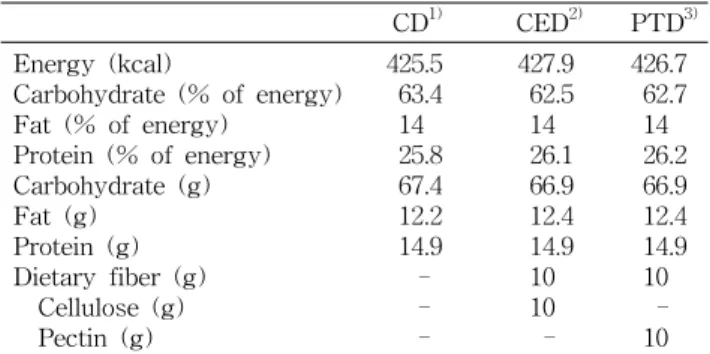
CD)을 대조군으로 하여 셀룰로오스를 함유하는 셀룰로오스 식(cellulose diet: CED), 펙틴을 함유하는 펙틴식(pectin di- et: PTD) 등 3가지를 사용하였으며, 실험식의 구성은 Table 1과 같았다. 이들 섭취량은 식품성분표에 의하여 계산하였 다. 실험에 사용한 셀룰로오스는 (주)화경물산에서 구입하 였고, 펙틴은 (주)삼익유가공에서 제공받아 사용하였다.
CD는 가급적 식이섬유소 함량이 낮은 흰 밀가루만으로 만든 롤 브레드와 크림스프를 섭취하도록 하였으며, CED는 흰 밀가루에 셀룰로오스를 첨가한 롤 브레드와 크림스프, PTD는 흰 밀가루에 펙틴을 첨가한 롤 브레드와 크림 스프 를 아침 한 끼에 각각 1인당 10 g이 되도록 조리하였다.
본 연구는 모든 대상자들이 각각 다른 날에 실험식을 모두 섭취하도록 하였고, 실험식의 선정은 무작위로 하였으며, 실 험식에 대한 정보는 제공하지 않았다. 또한 실험식은 실험일 당일 아침식사로서 1회 급식하였다. 실험식의 조리 및 급식
Table 1. Energy and macronutrient composition of the test diets
CD1) CED2) PTD3) Energy (kcal)
Carbohydrate (% of energy) Fat (% of energy)
Protein (% of energy) Carbohydrate (g) Fat (g)
Protein (g) Dietary fiber (g) Cellulose (g) Pectin (g)
425.5 63.4 14 25.8 67.4 12.2 14.9 - - -
427.9 62.5 14 26.1 66.9 12.4 14.9 10 10 -
426.7 62.7 14 26.2 66.9 12.4 14.9 10 - 10
1)CD: Control diet. 2)CED: Cellulose diet. 3)PTD: Pectin diet.
은 영양사 및 연구원의 엄격한 관리 하에 실시하였으며 일정 한 장소에서 일정한 시간(아침 08:30)에 섭취하도록 하였다.
실험대상자들은 실험식 급여 전날 오후 8시 이후부터 금 식토록 하였으며, 실험식 급식일 오전 7시 30분에 가급적 신체활동을 억제하기 위하여 숙소에서 승용차를 이용하여 실험실에 도착하도록 하였고, 즉시 신장, 체중 및 체지방량 을 측정한 다음 반듯하게 누운 상태에서 잠들지 않은 상태로 30분 동안 안정을 취하게 하였다.
30분간 안정을 취한 후 주어진 식단표에 의하여 만들어진 실험식을 주어진 장소에서 비교적 일정한 시간(아침 08:30) 에 섭취하도록 하였으며, 15분 동안 섭취하도록 시간을 일정 하게 조절하였고 약 300 mL의 물을 제공하였다.
신체 계측
신장은 실험실 도착 후 맨발의 상태로 자연스럽게 직립자 세를 취하게 하고, 발뒤꿈치와 엉덩이, 어깨, 머리 뒷부분이 수직으로 일직선이 되도록 하고, 시선은 정면을 바라보고 수평이 되도록 하여 0.1 cm 단위까지 측정하였다. 체중은 매일 측정하였으며, 맨발로 측정기기 위에 표시된 지점에 정확히 올라서도록 하여 0.1 kg 단위까지 측정하였다.
체지방량은 체성분 측정기기(BCA-1000, Medigate, Korea)로 측정하였으며, 측정 전 대상자의 연령과 신장, 성 별을 입력한 뒤 금속제품을 제거하고 가벼운 옷차림 상태에 서 맨발로 표시된 지점에 정확히 올라서도록 하여 측정하였 다. 체지방량은 생체전기저항법(Bioelectrical impedance analysis)을 이용하였고 0.1 kg 단위까지 측정하였다.
신장과 체중 모두 소수 첫째 자리까지 측정하고 다음의 공식에 대입하여 체질량 지수(body mass index, BMI)를 구 하였다. BMI=body weight (kg)/height (m)2
대사량 측정
대상자들의 휴식대사량(resting energy expenditure, REE) 및 DIT는 간접 열량계(AeroSport VO2000, Medigraphics, USA)를 사용하여 측정하였다. 대상자들은 각 실험식사 급 식 직전 완전 공복 상태와 급식 후 30분, 60분, 90분, 120분, 150분 및 180분에 각각 정확히 10분간 침대에 누워 수면을 취하지 않으며 충분한 안정을 취하고 있는 상태에서 심박동 센서가 장착된 장치를 착용시키고, 마스크를 착용하여 가스 호흡분석기로 호흡하는 공기 내의 산소소비량과 이산화탄 소 배출량을 10분 동안 측정한 후 측정 시작 1분 동안의 값을 제외하고, 나머지 값들의 평균을 휴식대사량으로 계산하였 다. 휴식대사량보다 증가된 에너지를 DIT로 계산하였다.
DIT=(postprandial energy expenditure-preprandial energy expenditure)×time (min)
식후 시간별 각각의 실험 성적은 공복 시의 기준치를 감한 증감량이며 실험식사 급식 후 각 시간별 실험 성적의 막대그 림 면적과 공복 시 성적의 막대그림 면적의 차이를 모두 합 한 값(integrated area under the curves: Δ-AUC)으로 각 실험식사에 대한 성적을 비교 검토하였다.
통계처리
본 연구의 실험 결과는 SPSS(Statistical Package for the Social Science) 12.0 프로그램을 이용하여 각 실험군 별로 평균과 표준오차(mean±SE)를 구하였고, 실험군 간의 비교 는 one-way ANOVA로 유의성을 확인한 후 Duncan's multiple range test를 이용하여 유의수준 α=0.05에서 사후 검정을 시행하였다.
결과 및 고찰
대상자들의 일반사항
모든 대상자들은 실험하는 동안 환경 및 주어진 식단에 잘 적응하였으며, 대상자들의 신체 상황은 Table 2와 같았다.
대상자들의 연령은 평균 22.3±1.9세이었으며 신장은 평 균 159.7±4.7 cm이었고, 체중은 평균 52.5±8.6 kg이었다.
신장과 체중에 의한 체질량 지수는 20.6±2.7 kg/m2으로 정 상 범위(Dietary Refenence Intakes for Koreans, 2005)에 속하였다(35). 대상자들의 제지방량은 41.8±5.0 kg이었고, 체중에 대한 체지방율은 19.6±8.3%이었다.
휴식대사량
각 실험식을 급식하기 직전 휴식대사량은 평균 0.79±0.02 kcal/min(1,132.2±63.4 kcal/day)이었다(Table 3). 최근 Ro 등(36)이 보고한 한국인 성인 여성 휴식대사량인 0.82 kcal/
min(1,185 kcal/day)와 유사하였다. 그러나 Chang과 Lee (37)가 보고한 여대생의 휴식대사량인 0.87 kcal/min 또는 Park 등(38)이 발표한 0.91 kcal/min나 Choi 등(39)의 1.09 kcal/min보다 낮은 경향이었다. 이는 간접열량계를 이용하 는 경우 RQ(respiratory quotient) 값 산정을 위한 시점(time point)을 찾는 방법 및 대기(흡기) 중의 이산화탄소와 산소, 그리고 피험자 호기 중의 이산화탄소와 산소 농도를 측정 또는 계산하는 방법 등에 차이, 호기의 불완전 수집, 호흡 속도에 따른 RQ의 심한 변동, 측정 도중 기계조작 등에 의한 차이로 생각되어 직접적인 비교는 어렵다고 본다.
Table 2. Physical characteristics of the subjects
Age (yr) Height (cm) Weight (kg) Body fat (%) BMI1) (kg/m2)
Mean±SE2) 22.3±1.9 159.7±4.7 52.5±8.6 19.6±8.3 20.6±2.7
1)Body Mass Index=weight (kg)/height (m)2.
2)Values are means±standard errors.
Table 3. Resting energy expenditure before consuming each test diet
kcal/day kcal/min kcal/kg/day
REE1) 1,132.2±63.42) 0.79±0.0 21.6±0.0
1)REE: Resting energy expenditure.
2)Values are means±standard errors.
본 실험에서 성별에 따라 신장, 체중과 나이를 적용한 Harris-Benedict 공식으로 구한 휴식대사량은 0.92±0.03 kcal/min(1,330 kcal/day)으로 실측 휴식대사량보다 높게 나 타났는데 이는 Chang과 Lee(37)의 결과와 유사하다. 또한 Owen(40)의 연구에서도 Harris-Benedict 공식으로 구한 예 측 기초대사량이 실측 휴식대사량보다 높게 나왔고 Dalderup 등(41)의 연구, Daly 등(42)의 연구와 기타 몇몇 연구(43,44)들에서도 유사한 결과였다. 이와 같이 Harris- Benedict 공식으로 산출한 기초대사량이 실측 휴식대사량보 다 높게 나온 이유는 첫째, Harris와 Benedict의 연구가 이루 어진 시점의 생활상과 지금과는 많이 다르다. 즉 식생활 향 상은 체위향상뿐 아니라 수명이 길어짐에 따라 활동의 정도 도 다르게 나타나며, 특히 나이가 주요 변수로 작용하는 Harris-Benedict 공식은 젊은 사람들에게서 높게 나오고, 나 이든 사람에게서는 낮게 평가되는 기초대사량 산출의 문제 점(40) 때문이라 생각된다. 그리고 Harris-Benedict 공식이 정상 체중인 사람들의 측정 결과(45)를 바탕으로 만들어졌 기 때문에, 모든 사람들에게 적용하면 실측 휴식대사량에 가까운 결과를 얻기 어렵다는 제한점 이외에도 한국인의 체 위와는 다른 대상자를 기준으로 만들어진 것이므로 한국인 에 적합한 휴식대사량 산출 공식에 대한 연구가 필요할 것으 로 사료된다.
식이성 발열효과
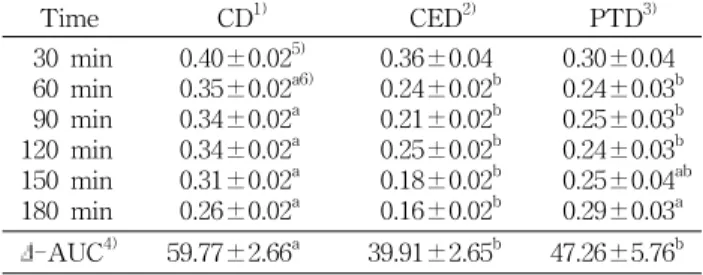
각 실험식사 급식 후 시간별 DIT의 변동량은 Table 4와 같았다. DIT는 식후 30분에 모든 군에서 현저하게 상승하였 고, 이후 감소하는 양상이었다. 60분 이후부터 120분까지의 DIT는 식이섬유 첨가군인 CED와 PTD가 식이섬유 무첨가
Table 4. Incremental diet induced thermogenesis (DIT) after consuming each test diet (kcal/min)
Time CD1) CED2) PTD3)
30 min 60 min 90 min 120 min 150 min 180 min
0.40 0.35 0.34 0.34 0.31 0.26
±0.025)
±0.02a6)
±0.02a
±0.02a
±0.02a
±0.02a
0.36 0.24 0.21 0.25 0.18 0.16
±0.04
±0.02b
±0.02b
±0.02b
±0.02b
±0.02b
0.30 0.24 0.25 0.24 0.25 0.29
±0.04
±0.03b
±0.03b
±0.03b
±0.04ab
±0.03a Δ-AUC4) 59.77±2.66a 39.91±2.65b 47.26±5.76b
1)CD: Control diet. 2)CED: Cellulose diet. 3)PTD: Pectin diet.
4)Δ-AUC: Integrated area under the curve.
5)Values are means±standard errors.
6)Values with the different superscript letter in the same row are significantly different among the test diets (p<0.05).
군인 CD에 비하여 유의적으로 낮은 수준을 유지하였고, 이 후 측정시간 종료 시까지 CED가 가장 낮은 DIT를 보였다.
휴식대사량에 비하여 증가된 DIT의 Δ-AUC는 CD, CED 및 PTD가 각각 59.77±2.66 kcal/min, 39.91±2.65 kcal/min 및 47.26±5.7 kcal/min을 기록하여, 식이섬유를 첨가하지 않은 CD에 비하여 셀룰로오스와 펙틴을 첨가한 CED 및 PTD가 유의적으로 낮은 성적을 보였다. 이는 각 실험식사 로 섭취한 열량의 14.05±0.62%(CD), 9.33±0.62%(CED), 11.07±1.35%(PTD)에 해당한다.
DIT는 음식물을 섭취한 후 공복 시보다 증가한 에너지 소비로 정의되며 식품의 섭취, 소화, 흡수, 운반, 저장, 식품 의 이용 등에 이용되는데, Westerterp(28)는 건강한 성인이 혼합식을 섭취하였을 때의 DIT가 10%에 해당한다고 하였 다. 또한 Westerterp-Plantenga 등(46)과 Mikkelsen 등(11) 은 당질의 수준을 65%로 급식시킨 후 24시간에 측정한 DIT 값이 10.7%를 나타내었다고 보고하였으나 Raben 등(47)은 65%의 당질을 급식 후 5시간에 측정한 DIT가 7.1%를, Ro 등(36)은 65%의 당질을 함유한 일반식사 섭취 후 식후 3시 간 동안의 DIT가 8.9%를 기록하여 본 실험에서 식이섬유를 첨가하지 않은 65%의 당질을 함유한 CD에서 DIT가 14.05±0.62%로 위의 결과들에 비해 다소 높은 결과를 나타 내었는데 이는 식이적 차이 즉, 혼합식과 정제된 식이로 인 한 결과로 생각된다.
본 연구에서 셀룰로오스와 펙틴을 급여한 식이섬유 첨가 식이 식이섬유 제한식에 비해 DIT가 유의적으로 낮았다. 식 이섬유가 DIT를 낮추는 기전으로는 전분 소화율의 저하, 소 화된 음식물의 십이지장으로의 이동 속도 감소, 소장으로 확산되는 당류의 속도 감소 등(48)을 들 수 있다. 또한 혈당 대사의 식후 조절에 관련되는 장 호르몬의 분비조절, 말초조 직의 인슐린 수용체의 증가, 인슐린 민감성의 증가, 위 배출 시간의 지연 등(49,50)도 관여하리라 생각된다.
Raben 등(16)이 고식이섬유와 저식이섬유를 급식시킨 10 명의 건강한 대상자에게서 고식이섬유를 급식한 군이 유의 적으로 DIT가 낮아졌다고 하였으며, Ryttig 등(27) 역시 펙 틴을 7 g/d 제공한 군과 플라스보를 제공한 군으로 나누어 DIT를 측정한 결과, 플라스보군에 비해 펙틴을 급식시킨 군 에서 DIT가 1.3±1.7% 감소하였다고 하여 식이섬유의 첨가 에 의해 DIT가 감소한 본 연구와 유사한 결과를 보고하였다.
또한 Sparti와 Milon(51)도 불용성 식이섬유인 셀룰로오스 와 수용성 식이섬유인 펙틴을 혼합 첨가하여 급식시켰을 때 DIT가 감소하였다고 하였는데, 이는 식이섬유가 보수력이 커서 겔 형성으로 점도를 높이며, 그로 인해 음식물이 위에 머무르는 시간이 길어져 포만감을 주고, 영양소의 소화 흡수 를 지연시키기 때문이라고 설명하였다(52).
본 연구에서는 각 식이섬유 첨가식 간의 식이섬유 함량을 동일하게 조절하여, 동일한 실험대상자를 대상으로 실험한 연구로 각 실험군 간의 DIT 결과로 보아 식이섬유의 첨가로
Table 5. Incremental heart rate after consuming each test
diet (beats/min)
Time CD1) CED2) PTD3)
30 min 60 min 90 min 120 min 150 min 180 min
11.25 11.02 9.84 10.98 9.84 7.30
±0.885)a6)
±1.21
±1.25
±1.15
±1.10a
±1.60a
8.31 7.81 7.75 9.27 5.22 4.59
±0.69b
±2.18
±1.42
±1.74
±0.62b
±0.87ab
8.34 7.25 7.22 7.19 3.72 2.50
±0.84b
±0.94
±0.65
±0.78
±0.90b
±0.65b Δ-AUC4) 1,686.6±152.83a 1,130.63±81.11b 1,109.06±95.15b
1)CD: Control diet. 2)CED: Cellulose diet. 3)PTD: Pectin diet.
4)Δ-AUC: Area under the curve.
5)Values are means±standard errors.
6)Values with the different superscript letter in the same row are significantly different among the test diets (p<0.05).
DIT가 유의적으로 낮아졌으나 불용성 식이섬유인 셀룰로오 스식과 수용성 식이섬유인 펙틴식에 있어서는 유의적인 차 이는 없었다. 그러나 불용성 식이섬유인 셀룰로오스 첨가군 에 비해 수용성 식이섬유인 펙틴 첨가군에서 3시간 동안의 DIT 면적의 합이 20% 정도 높은 것으로 보아 추후 더 많은 대상자를 한 연구가 필요할 것으로 생각한다
심박수와 체온
각 실험식을 급식하기 직전의 체온은 CD, CED 및 PTD가 각각 평균 36.24±0.08oC, 36.28±0.06oC, 36.23±0.06oC이었 고, 공복 시의 심박수는 각각 59.25±2.65 beat/min, 63.50
±3.36 beat/min, 60.13±3.60 beat/min이었으며, 각 실험식 간 유의적인 차이는 없었다. 각 실험식사 급식 후 시간별 심박수 변화값과 체온의 변화값은 Table 5 및 Table 6과 같았다. 실험식사 섭취에 따른 심박수의 공복 시에 대한 변 화정도는 CD, CED 및 PTD 모두 30분에 최고치를 보였다가 비교적 감소하는 경향을 보였는데, 그 정도가 DIT의 변화 정도와 유사하였으나 유의적인 상관성은 없었다.
Schwartz 등(53)은 식후 교감신경계가 증가하게 되는데, 특히 당질의 섭취에 의해 증가하였다가 공복시에 교감신경 계의 작용이 급격히 감소하였다고 하여 DIT와 교감신경계 와의 상관성을 보고한 바 있다. 그러나 Marques-Lopes 등 (29)은 고당질식을 섭취한 경우에 공복시에 비하여 교감신 경계의 지속적인 상승이 있었으나 DIT와의 상관성이 없었
Table 6. Incremental body temperature after consuming
each test diet (oC)
Time CD1) CED2) PTD3) 30 min
60 min 90 min 120 min 150 min 180 min
0.22 0.13 0.11 0.30 0.29 0.28
±0.045)
±0.05
±0.06
±0.04
±0.07
±0.06
0.21 0.17 0.12 0.20 0.20 0.26
±0.03
±0.03
±0.02
±0.03
±0.05
±0.04
0.21 0.07 0.00 0.19 0.15 0.17
±0.03
±0.05
±0.03
±0.03
±0.03
±0.04 Δ-AUC4) 36.19±8.99 31.03±4.78 19.03±3.94
1)CD: Control diet. 2)CED: Cellulose diet. 3)PTD: Pectin diet.
4)Δ-AUC: Area under the curve.
5)Values are means±standard errors.
Values are not significantly different among experimental diets (p<0.05).
다고 하였고, Nagai 등(30)은 일본인을 대상으로 평가한 고 당질식에서 심박수로 측정한 교감신경계에 미치는 영향이 없었다고 하여 DIT 결과가 심박수로 측정한 교감신경계의 변화와 유의적 상관성을 보이지 않은 본 연구결과와 같았다.
또한 본 연구에서는 실험식사 섭취에 따른 체온의 공복 시에 대한 변화정도가 CD, CED 및 PTD 모두 30분에 증가 하였다가 이후 감소하여 DIT의 경향과 유사하였으나, 세 군 모두 90분 이후 뚜렷한 증가를 보여 DIT와의 상관성이 유의 적이지 않았다. 그러므로 이의 결과를 보완할 추후 연구가 필요할 것으로 생각한다.
식이성 발열효과와 심박수, 체온 및 체조성과의 상관성 Table 7과 같이 실험식의 섭취에 따른 DIT의 생성과 심박 수, 체온, 체중, 체지방량, 체지방률, 제지방량 및 BMI와의 상관성을 살펴본 결과는 다음과 같았다. DIT는 신체조성 및 심박수, 체온과는 상관성을 보이지 않았다.
Marques-Lopes 등(29)은 DIT가 체지방률과 음의 상관 성을 보인 반면, 제지방조직과 양의 상관성을 보였다고 하였 는데 본 연구에서 DIT는 체지방률, 제지방 등에 있어 상관성 을 보이지 않았다. 이는 대상자들의 체중, 체지방량, 체지방 률, 제지방량, BMI 등의 구성 비율이 다소 차이가 있고, 8명 으로 제한된 실험 환경에 의한 결과로 생각된다. 따라서 DIT 에 영향을 미치는 여러 요인과의 상관성을 밝힐 수 있는 다 양한 조건에서의 추후 연구가 필요할 것으로 사료된다.
Table 7. Pearson's coefficients among diet induced thermogenesis, heart rate, body temperature and body composition DIT1) Heart rate Body temperature Body weight Body fat % Body fat LBM Heart rate (beats/min)
Body temperature (oC) Body weight (kg) Body fat (kg)
% Body fat LBM2) BMI3)
0.104 -0.280 -0.367 -0.235 -0.145 -0.361 -0.337
0.190 0.043 0.070 0.035 -0.004 0.067
0.096 0.182 0.204 -0.047 0.177
0.843**
0.697**
0.783**
0.922**
0.971**
0.326 0.956**
0.108
0.870** 0.509*
1)DIT: diet induced thermogenesis (cal/min). 2)LBM: Lean body mass (kg). 3)BMI: Body mass index {weight (kg)/height (m)2}.
*p<0.05, **p<0.01.
요 약
본 연구에서는 불용성 식이섬유인 셀룰로오스와 수용성 식이섬유인 펙틴이 식사성 열생성에 미치는 영향을 관찰하 기 위하여 건강한 여자 대학생을 대상으로 식이섬유 제한식 인 CD를 대조군으로 셀룰로오스식인 CED, 펙틴식인 PTD 를 급식시켜 식후 3시간 동안의 DIT와 체온, 심박수를 측정 하여 다음과 같은 결과를 얻었다. 대상자들의 나이는 평균 22.3±1.9세이었고, 신장과 체중은 각각 평균 159.7±4.7 cm 및 52.5±8.6 kg이었다. 대상자들의 휴식대사량은 평균 0.79±0.02 kcal/min이었다. 시간에 따른 DIT는 모든 실험식 에서 식후 30분에 최고치를 나타내었다가 이후 감소하는 경 향이었다. 실험식사 섭취 후 3시간 동안 측정한 DIT의 반응 면적(Δ-AUC)은 CD, CED 및 PTD가 각각 59.77±2.66 kcal, 39.91±2.65 kcal 및 47.26±5.76 kcal를 기록하여 섭취한 열 량의 14.05±0.62%, 9.33±0.62% 및 11.07±1.35%이었다. 식 이섬유를 첨가한 실험군인 CED와 PTD가 CD에 비해 식후 3시간 동안의 DIT가 유의적으로 낮았으나, 식이섬유간 DIT 는 유의적인 차이가 없었다. 실험식사 섭취 후 3시간 동안 측정한 체온의 반응면적(Δ-AUC)은 실험식 간에 유의한 차 이가 없었으나, 심박수로 측정한 교감신경계는 CD가 CED 및 PTD에 비하여 유의적으로 높았고, 식이섬유 간의 차이는 없었다. 이상에서와 같이 동량의 종류를 달리하여 제공한 셀룰로오스식과 펙틴식이 식후 열생성을 유의적으로 낮추 었다. 그러나 대상자의 심박수, 체온, 체조성과 같은 제요인 과의 상관성을 밝히지 못하여, 이의 기전을 밝히기 위한 추 후 연구가 필요하다.
문 헌
1. Blackburn GL, Kanders BS. 1994. Obesity pathophysiology, psychology and treatment. Chapman & Hall, New York.
p 39-79.
2. Ravussin E, Bogardus C. 1989. Relationship of genetics, age, and physical fitness to daily energy exenditure and fuel utilization. Am J Clin Nutr 49: 968-975.
3. Kiorsis DN, Durak I, Turpin G. 1999. Effects of a loe calorie diet on resting metabolic rate and serum tri-iodothyronine levels in obese children. Eur J Pediatr 158: 446-450.
4. Astrup A, Buemann B, Toubro S, Ranneries C, Raben A.
1996. Low resting metabolic rate in subjects predisposed to obesity: a role for thyroid status. Am J Clin Nutr 63:
879-883.
5. LeBlanc J, Cabanac M, Samson P. 1984. Reduce post- prandial heat production with gavage as compared with meal feeding in human subjects. Am J Physiol 246: 95-101.
6. Acheson KJ, Ravussin E, Wahren J, Jequier E. 1984.
Thermic effect of glucose in man: obligatory and facultative thermogenesis. J Clin Invest 74: 1572-1580.
7. Astrup A, Bulow J, Christensen NJ, Madsen J, Quaade F.
1986. Facultative thermogenesis induced by carbohydrates:
a skeletal muscle component mediated by epinephrine. Am J Physiol 250: 226-229.
8. Schwarz RS, Jaeger LF, Veith RC. 1988. Effect of clonidine on the thermic effect of feeding in humans. Am J Physiol 254: 90-94.
9. Westerterp KR, Wilson SAJ, Rolland V. 1999. Diet induced thermogenesis measured over 24 h in a respiration cham- ber: effect of diet composition. Int J Obes 23: 287-292.
10. Luscombe ND, Clifton PM, Noakes M, Parker B, Wittert G. 2002. Effects of energy-restricted diets containing in- creased protein on weight loss, resting energy expenditure, and the thermic effect of feeding in type 2 diabetes. Diabets Care 25: 652-657.
11. Mikkelsen PB, Toubro S, Astrup A. 2000. Effect of fat-re- duced diets on 24-h energy expenditure: comparisons be- tween animal protein, vegetable protein, and carbohydrate.
Am J Clin Nutr 72: 1135-1141.
12. Crovetti R, Porrini M, Santangelo A, Testolin G. 1998. The influence of thermic effect of food on satiety. Eur J Clin Nutr 52: 482-488.
13. Naim M, Ohara I, Kare MR, Levinson M. 1991. Interaction of MSG taste with nutrition: perspectives in consummatory behavior and digestion. Physiol Behav 49: 1019-1024.
14. Ohnuki K, Niwa S, Maeda S, Inoue N, Yazawa S, Fushiki T. 2001. CH-19 sweet, a non-pungent cultivar of red pep- per, increased body temperature and oxygen consumption in humans. Biosci Biotechnol Biochem 65: 2033-2036.
15. Peracchi M, Santangelo A, Conte D, Fraquelli M, Tagliabue R, Gebbia C, Porrini M. 2000. The physical state of a meal affects hormone release and postprandial thermogenesis.
Br J Nutr 83: 623-628.
16. Raben A, Christensen NJ, Madsen J, Holst JJ, Astrup A.
1994. Decreased postprandial thermogenesis and fat oxida- tion but increased fullness after a high-fiber meal compared with a low-fiber meal. Am J Clin Nutr 59: 1386-1394.
17. Le Goff G, Le Groumellec L, van Milgen J, Dubois S, Noblet J. 2002. Digestibility and metabolic utilization of dietary en- ergy in adult sow: influence of addition and origin of dietary fibre. Br J Nutr 87: 325-335.
18. Vollenweider P, Tappy L, Randin D, Schneiter P, Jequier E, Nicod P, Scherrer U. 1993. Differential effects of hyper- insulinemia and carbohydrate metabolism on sympathetic nerve activity and blood flow in humans. J Clin Invest 92:
147-154.
19. Salmeron J, Manson JE, Stampfer MJ, Colditz G, Wing AL, Willett WC. 1997. Dietary fiber, glycemic load, and risk of non-insulin-dependent diabetes mellitus in women. JAMA 277: 472-476.
20. Trowell H. 1974. Definitions of fiber. Lancet 303: 503.
21. Marlett JA. 1990. Dietary fiber, definition and determination.
Center for Academic Publication, Tokyo, Japan. p 4-14.
22. Helena GML, Anna KEF, Inger MEB. 1999. Effects of the glycemic index and content of indigestible carbohydrate of cereal-based breakfast meals on glucose tolerance at lunch in healthy subjects. Am J Clin Nutr 69: 647-655.
23. Torsdottir J, Alpsten M, Holm G, Sandberg AS, Tolli J.
1991. A small dose of soluble alginate fiber affects post- prandial glycemia and gastric emptying in humans with diabetes. J Nutr 121: 795-799.
24. Dabai FD, Walker AF, Sambrook IE, Welch VA, Owen RW, Abeyasekera S. 1996. Comparative effects on blood lipids and faecal steroids of five legume species incorporated into a semi-purified hypercholesterolaemic rat diet. Br J Nutr 75: 557-571.
25. Xu H, Tan SM, Li SQ. 2001. Effects of soybean fibers on blood sugar, lipid levels and hepatic-nephritic histomor- phology in mice with diabetes mellitus. Biomed Environ
Sci 14: 256-261.
26. Scalfl L, Coltorti A, D'Arrigo E. 1987. Effect of dietary fibre on postprandial thermogenesis. Int J Obes 11(suppl 1):
95-99.
27. Ryttig KR, Lammert O, Nielsen E, Poulsen K. 1990. The effect of a soluble dietary fibre supplement on 24-hour en- ergy expenditure during a standardized physical activity programme. Int J Obes 14: 451-455.
28. Westerterp KR. 2004. Diet induced thermogenesis.
Nutrition and Metabolism 1: 1-5.
29. Marques-Lopes I, Forga L, Martinez JA. 2003. Thermogenesis induced by a high-carbohydrate meal in fasted lean and overweight young men: insulin, body fat, and sympathetic nervous system involvement. Nutrition 19: 25-29.
30. Nagai N, Sakane N, Hamada T. 2005. The effect of a high-carbohydrate meal on postprandial thermogenesis and sympathetic nervous system activity in boys with a recent onset of obesity. Metab Clin Exp 54: 430-438.
31. Luscombe ND, Parker B, Clifton PM, Witter G, Noakes M.
2002. Effects of energy-restricted diets containing in- creased protein on weight loss, resting energy expenditure, and the thermic effect of feeding in type 2 diabetes.
Diabetes Care 25: 652-657.
32. Soucy J, Leblanc J. 1999. Protein meals and postprandial thermogenesis. Physiol Behav 65: 705-709.
33. Goff GL, Dubois S, Noblet J. 2002. Digestibility and meta- bolic utilisation of dietary energy in adult sows: influence of addition and origin of dietary fibre. Br J Nutr 87:
325-335.
34. Roben A, Tagliabue A, Madsen J. 1994. Resistant starch:
the effect on postprandial glycemia, hormonal response, and satiety. Am J Clin Nutr 60: 544-551.
35. The Korean Nutrition Society. 2005. Dietary Refenence Intakes for Koreans. The Korean Nutrition Society, Seoul.
36. Ro H-K, Choi I-S, Oh S-H. 2005. Effects of high carbohy- drate, high fat and protein meal on postprandial thermo- genesis in young women. J Korean Soc Food Sci Nutr 34:
1202-1209.
37. Chang U-J, Lee K-R. 2005. Correlation between measured resting energy expenditure and predicted basal energy ex- penditure in female college students. J Korean Soc Food Sci Nutr 34: 196-201.
38. Park JA, Kim KJ, Kim JH, Park YS, Koo JO, Yoon JS. 2003.
A comparison of resting energy expenditure of Korean adults using indirect calorimetry. Korean J Community Nutrition 8: 993-1000.
39. Choi HJ, Song JM, Kim EK. 2005. Assessment of daily steps, activity coefficient, body composition, resting energy expenditure and daily energy expenditure in female uni- versity students. J Kor Diet Assoc 11: 159-169.
40. Owen OE. 1988. Resting metabolic requirements of men and
women. Mayo Clin Proc 63: 503-510.
41. Dalderup LM, Opdam-Stockman VA, Rechsteiner-de Vos H. 1996. Basal metabolic rate, anthropometric, electro- cardiographic, and dietary date relating to elderly persons.
J Gerontol 21: 22-26.
42. Daly JM, Heymsfield SB, Head CA, Harvey LP, Nixon DW.
1995. Human energy requirements: overestimation by widely used prediction equation. Am J Clin Nutr 42:
1170-1174.
43. Pavlou KN, Hoefer MA, Blackburn GL. 1986. Resting en- ergy expenditure in moderate obesity: predicting velocity of weight loss. Ann Surg 203: 136-141.
44. Mifflin MD, Hill LA, Scott BJ, Daugherty SA, Koh YO.
1990. A new predictive equation for resting energy ex- penditure in healthy individuals. Am J Clin Nutr 51:
241-247.
45. Cunningham JJ. 1991. Body composition as a determinant of energy expenditure: a synthetic review and a proposed general prediction equation. Am J Clin Nutr 54: 963-969.
46. Westerterp-Plantenga MS, Rolland V, Wilson SAJ, Westerterp KR. 1999. Satiety related to 24 h diet-induced thermogenesis during high protein/carbohydrate vs high fat diets measured in a respiration chamber. Eur J Clin Nutr 53: 495-502.
49. Raben A, Agerholm-Larsen L, Flint A, Holst JJ, Astrup A. 2003. Meals with similar energy densities but rich in protein, fat, carbohydrate, or alcohol have diifferent effects on energy expenditure and substrate metabolism but not on appetite and energy intake. Am J Clin Nutr 77: 91-100.
48. Rosado JL, Diaz M. 1995. Physicochemical properties re- lated to gastrointestinal function of 6 sources of dietary fiber. Rev Invest Clin 47: 283-289.
49. Spiller RC. 1994. Pharmacology of dietary fiber. Pharmacol Ther 62: 407-427.
50. Braaten JT, Scott FW, Wood PJ, Riedel KD, Wolynetz MS, Brule D, Collins MW. 1994. High beta-glucan oat bran and oat gum reduce postprandial blood glucose and insulin in subjects with and without type 2 diabetes. Diabet Med 11:
312-318.
51. Sparti A, Milon H. 2000. Effect of diets high or low in un- available and slowly digestible carbohydrates on the pat- tern of 24-h substrate oxidation and feelings of hunger in human. Am J Clin Nutr 72: 1461-1468.
52. Torsdottir J, Alpsten M, Holm G, Sandberg AS, Tolli J.
1991. A small dose of soluble alginate fiber affects post- prandial glycemia and gastric emptying in humans with diabetes. J Nutr 121: 795-799.
53. Schwartz MW, Baskin DG, Kaiyala KJ, Woods SC. 1999.
Model for the regulation of energy balance and adiposity by the central nervous sastem. Am J Clin Nutr 69: 584-596.
(2006년 11월 8일 접수; 2007년 1월 6일 채택)