Effect of Gocho(苦椒) Extract Mesotherapy on Regional Fat Loss in Obese Korean Women.
Eun-Joo Kim, OMD1, Marc Brodsky, MD, MBA, MPH2, Jae-Heung Cho, OMD1, Yu-Jeong Cho, OMD1, Mi-Yeon Song, OMD, PhD1
1Department of Oriental Rehabilitation Medicine, College of Oriental Medicine, Kyung Hee University
2StamfordHospital,Stamford,Connecticut,USA
Original Article
⋅Received:23 July 2011 ⋅Revised:27 September 2011 ⋅Accepted:11 October 2011
⋅Correspondence to:Mi-Yeon Song
Department of Oriental Rehabilitation Medicine, College of Oriental Medicine, Kyung Hee University, 1 Hoegi-dong, Dongdaemun-gu, Seoul 130-701, Republic of Korea
Tel:+82-2-440-7580, Fax:+82-2-440-6238, Email:[email protected]
Objectives: The purpose of this study was to determine whether gocho (苦椒) extract mesotherapy can effectively reduce weight and abdominal fat in obese patients.
Methods: Forty obese participants were recruited and randomly assigned to two groups. Five participants dropped out voluntarily during the course of the study and four men were excluded from the analysis to avoid gender bias. Results are presented on a total of thirty-one women. Over an eight-week period, the treatment group (n=13) received gocho (苦椒) extract injections (100mcg/3cc) in the abdominal skin, twice per week; the control group (n=18) received normal saline injections (3cc). A mixed lidocaine and prilocaine cream (2.5%/2.5% EMLA cream) was applied before the injection.
At baseline and 8 weeks, body weight, body-mass index (BMI), waist circumference (WC), waist-hip ratio (WHR), abdominal fat, energy expenditure, and questionnaires (eating attitudes and physical activity) were evaluated in both groups.
Results: Reductions in body weight (p<0.005), BMI, and WC (p<0.05) were greater in the treatment group. WHR, total fat area, and visceral fat area decreased only in the treatment group (p<0.05). Resting metabolic rate (RMR) change was correlated with weight loss only in the control group (r=-0.498, p<0.05). Before and after the treatment, there were no significant differences between the two groups in questionnaire variables (p>0.05).
Conclusion: his study suggests that abdominal gocho (苦椒) extract mesotherapy might be an effective way to promote weight and abdominal fat loss in obese Korean women.
Key Words : Gocho (苦椒) extract mesotherapy, capsaicin, weight loss, abdominal fat, obesity
Introduction
Obesity is defined as an accumulation of excessive body fat1). Obesity has become a major public health problem with high costs that affect both individuals and society at large2). Well-organized weight-loss programs are continuously in demand.
In Korea, the intra-dermal injection of herbal medication using a mesogun is called herbal
mesotherapy. It includes injections of distilled herbal formulas with a syringe subcutaneously or intradermally at acupoints or areas of fat accumulation. Intradermal injection can compensate for defects of oral admini- stration that are dependent on the dosage forms of medicine, gastric pH, difficulty of localization, and possibility of unsuspected systemic response from medication. Clinically, herbal mesotherapy is widely used to treat obesity in Korea, but only a few case-
controlled clinical studies have been reported3,4). Natural substances derived from gocho (苦椒), have been shown to increase metabolism and reduce body fat in animal and human studies5-7). Injectable delivery using a mesogun might enhance gocho (苦椒)’s effects by bypassing the rapid metabolism of ingested gocho (苦椒).
The purpose of this study was to determine whether gocho (苦椒) extract mesotherapy can reduce weight and abdominal fat in obese patients.
Materials and Methods
1. Participants
Obese (BMI≥25kg/m2) Korean participants between 18 and 65 years of age were enrolled in this randomized controlled, double-blinded study from 10th April to 20th October, 2009 after providing written informed consent. Forty participants were recruited; five dropped out voluntarily during the study, leaving 35 participants who completed the study. We excluded 4 men from the current analyses to avoid gender bias. Results from a total of 31 (13 in treatment group and 18 in control group) women are presented. Inclusion criteria required ambulatory participants from 18 to 65 years with a body-mass index (BMI)≥25g/m2. Participants who either previously or currently had heart disease, diabetes mellitus, kidney disease, or malignant tumors were excluded from our study.
Participants who had experienced weight changes over 3 kilograms within two months and who were or might be pregnant or who had given birth during the last six months were also excluded. Any participant with a compliance of less than 70% was removed from our analysis. This study was approved by the Institutional Review Board of Kyung Hee University Hospital at Gangdong. Recruitment was done through newspapers, advertisements and hospital websites.
2. Procedures
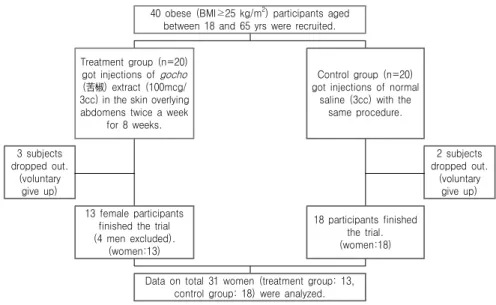
Before the treatment all participants had an intra- dermal allergy skin test to check for hypersensitivity reaction to the herbal solution. Volunteers were randomized into two groups. Each treated point was injected with 0.05cc, a total of 3cc per session. Injection of the solution was performed using a mesogun (MESO-PRI, Hyun-dae Meditech, Korea) in the skin overlying the abdomen, twice per week for eight weeks. The treatment group received a solution with 100mcg/3cc of gocho (苦椒) extract while the control group got 3cc of normal saline (Fig. 1.).
To minimize discomfort and maintain blinding, a mixed lidocaine and prilocaine cream (2.5%/2.5%
EMLA cream) was applied before the injection.
Participants were advised to follow a hypocaloric diet (<1200 Kcal per day) and to walk for at least 30 minutes three times a week.
Before and after the procedure, body weight, BMI, waist circumference (WC), waist-hip ratio (WHR), abdominal fat, energy expenditure, and questionnaires (eating attitudes and physical activity) were evaluated in both groups.
3. Materials
Herbal solution of gocho (苦椒) extract was supplied by Sigma Pharmaceuticals. To meet requirements of safety, sterility and endotoxin testing of herbal solution was performed by a microbiologist in ARL (ANALY- TICAL RESEARCH LABORATORIES, Oklahoma, US). The sterility testing was regulated by test method USP (United States Pharmacopeia) 71, and the result was sterile. The endotoxin testing was regulated by test method USP 85 and the result was <1.0 EU/ml (limits based on a dose of 6 ml in 24 hours as specified by client: 1389 EU/ml). Gocho (苦椒) extract is derived from the dried fruit of Capsicum frutescens L., and it conforms to all applicable provisions of the Federal Food, Drug, and Cosmetic Act. The amount of specific major capsaicinoids in the product
40 obese (BMI≥25 kg/m2) participants aged between 18 and 65 yrs were recruited.
Treatment group (n=20) got injections of gocho (苦椒) extract (100mcg/
3cc) in the skin overlying abdomens twice a week
for 8 weeks.
Control group (n=20) got injections of normal
saline (3cc) with the same procedure.
3 subjects dropped out.
(voluntary give up)
2 subjects dropped out.
(voluntary give up) 13 female participants
finished the trial (4 men excluded).
(women:13)
18 participants finished the trial.
(women:18)
Data on total 31 women (treatment group: 13, control group: 18) were analyzed.
Fig. 1. Schematic diagram of study design. 40 participants were randomized into two groups.
During the study, 5 participants (3 in treatment group and 2 in control group) dropped out voluntarily and 4 men were subsequently excluded from the analysis to avoid gender bias. Results on a total of 31 (13 in treatment group and 18 in control group) women are presented.
Major Capsaicinoids 60% to 80% (Official Monographs of the USP 25) Color intensity Not applicable
Appearance A light brown viscous oil to a crystalline solid Aroma and Flavor Not applicable
Dispersibility Dispersible in vegetable oil and other nonpolar carriers when warmed to 50℃ and agitated.
Dispersible in cetyl alcohol and ethyl alcohol when warmed to 50℃ and agitated.
Storage conditions Dry warehousing in full, tightly sealed containers at temperatures not to exceed 75℉. Shelf life under these conditions is one year.
GMO status Does not contain ingredients from genetically modified source materials; where appropriate, ingredients are traceable back to their origin with an Identity Preserved system.
Table 1. Technical Information of Herbal Solution of Gocho (苦椒) Extract reflects the natural balance found in gocho (苦椒). This
balance will vary somewhat from lot to lot; it is approximately 36% capsaicin (CAS no. 404-86-4), 24% dihydrocapsaicin (CAS no.19408-84-5) and 10%
nordihydrocapsaicin (CAS no. 28789-35-7). The balance of the product, approximately 30%, is the fatty acid fraction of the gocho (苦椒). The technical information is shown below (Table 1.).
4. Evaluations 1) Anthropometry
Body weight (BSM330, BIOSPACE, Korea) and height (BSM330, BIOSPACE, Korea) were measured
to the nearest 0.1kg and 0.5cm, respectively, while participants wore a hospital gown. Waist circumference (WC) and hip circumference (HC) were measured using flexible measuring tape by the same observer three times according to the World Health Organi- zation (WHO) method, mid-point between the lower end of the rib cage and top of the iliac crest in a standing position, which is usually 3cm above the anterior superior iliac spine.
2) Abdominal Fat Computed Tomography (CT) Scanning Abdominal fat area was measured by CT scanning (GEMINI 16 Power CT, Philips Medical systems,
Variables Treatment group (n=13) Control group (n=18) p-value
Age 44.46±10.39 39.39±10.35 0.189
Weight (kg) 66.83±6.93 71.92±9.03 0.100
BMI (kg/m2) 27.55±2.24 28.01±2.35 0.186
WC (cm) 91.14±6.10 92.71±7.33 0.532
WHR 0.910±0.036 0.896±0.045 0.392
TFA (cm2) 288.86±65.07 316.69±68.82 0.265
Values represent the mean ± SD
BMI: Body-mass index WC: Waist circumference WHR: Waist-hip ratio TFA: Total fat area
Table 2. Characteristics of the Participants (n=31) Cleveland, US) at the level between the L4 and L5 vertebrae. Cross-sectional total fat area (TFA) and visceral fat area (VFA) were estimated by delineating the regions and calculating at an attenuation range of-190 to-30 Hounsfield units (HUs)4).
3) Energy expenditure
Oxygen consumption (VO2, ml/min) was measured by indirect calorimetry (MedGem, Health Tech, US).
At baseline and 8 weeks, each individual participant was evaluated at a pre-scheduled time. Participants were told not to engage in physical activity for 24h before testing. Measurements were performed after participants rested for 30minutes in a supine position. In our laboratory, the daily variability in RMR is 4~5%. Participants were told to breath through the mouth with a mouthpiece inserted for about 20~30minutes8,9). Resting metabolic rate (RMR, kcal/day) was calculated using the Weir’s equation:
Resting metabolic rate =[(3.941)(VO2)+(1.106)(VCO2)(RQ)]10)
4) Questionnaires
At baseline and 8weeks, all subjects completed questionnaires on eating attitudes and physical activities.
The three-factor eating questionnaire R18 (TFEQ)11) to estimate eating attitudes and international physical activity questionnaire (IPAQ)12) to estimate physical activities were used. The TFEQ-R18 consists of 18 items and item scores are summated into scale scores for cognitive restraint, uncontrolled eating, and emotional
eating13,14). The IPAQ consists of 7 items; six questions are about the number of days and the number of minutes per day of their participation in all kinds of vigorous, moderate and walking physical activities during the last seven days. The seventh question is about the time that participants spend sitting during an average weekday15).
5. Data analysis
All values are mean ± SD. Correlation between changes in body weight loss and changes in RMR were performed by Pearson’s correlation. Between both groups, weight reduction, BMI, WC, WHR, abdominal fat, energy expenditure and questionnaires were compared by independent t-test using the Statistical Package for the Social Sciences (SPSS) 12.0 program for Windows. A p-value less than 0.05 was considered statistically significant.
Results
1. Demographic Characteristics of Participants Data from 31 women from 22 to 61 years of age with a BMI from 25.0kg/m2 to 31.0kg/m2 were analyzed.
Participants’ demographic and anthropometric charac- teristics are summarized in Table 2. There were no significant differences between the two groups in baseline demographics.
Variables Before After Decrease p-value† p‐value‡ Weight
Treatment group 66.83±6.93 64.12±6.50 2.71±1.71 0.000**
0.003**
Control group 71.92±9.03 71.00±9.27 0.92±1.31 0.009**
BMI
Treatment group 27.55±2.24 25.87±2.01 1.04±0.69 0.000**
0.011*
Control group 28.01±2.35 27.58±2.46 0.42±0.58 0.007**
WC
Treatment group 91.14±6.10 84.78±6.14 6.35±2.51 0.000**
0.012*
Control group 92.71±7.33 89.97±7.13 2.74±4.37 0.016*
WHR
Treatment group 0.910±0.036 0.863±0.046 0.042±0.027 0.000**
0.005**
Control group 0.896±0.045 0.891±0.044 0.004±0.043 0.633
TFA
Treatment group 288.86±65.07 256.36±64.25 32.50±33.47 0.004**
0.005**
Control group 316.69±68.82 316.09±77.91 0.60±25.57 0.921
Values represent the mean ± SD BMI: Body-mass index WC: Waist circumference WHR: Waist-hip ratio TFA: Total fat area
†: Difference of values before and after treatment in each group
‡: Difference of values between the two groups
*: Decrease is significant at the 0.05 level
**: Decrease is significant at the 0.01 level
Table 3. Reduction of Weight, BMI, WC, WHR, and TFA
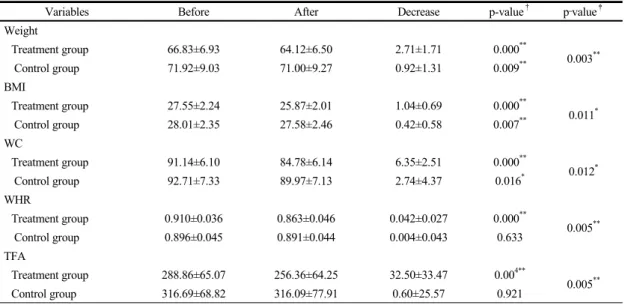
2. Reduction of weight, BMI, WC, WHR, and TFA Weight loss occurred in both treatment (-2.71kg;
p=0.001) and control (-0.92kg; p=0.009) groups with a greater reduction in the treatment group (p=0.003).
The changes in BMI, WC, WHR, and TFA were also greater in the treatment group (Table 3).
3. The Change of VFA
Baseline values for VFA (treatment group: 70.18±
28.86㎠ vs. control group: 75.76±24.10㎠; p=0.563) were not different. After eight weeks of treatment, VFA reduced significantly in the treatment group (10.42±
13.65㎠; p=0.017) but not in the control group (2.70±
9.24㎠; p=0.232) (Fig. 2.).
4. Energy expenditure
Due to a technical issue with the indirect calori-
meter (the display screen on the indirect calorimeter was cracked), the RMR of two participants (control group) could not be measured. Therefore, data for 29 participants (treatment group: 13, control group: 16) are presented. There were no significant between-group differences in baseline RMR (treatment group: 1470.77±
169.72kcal/day vs. control group: 1638.75±271.95kcal/
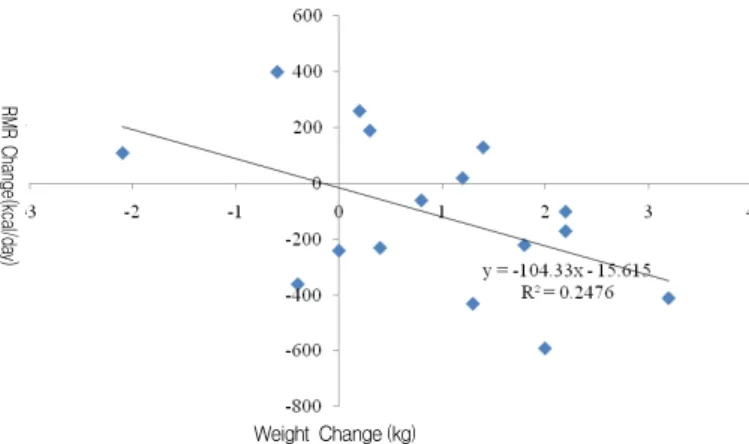
day; p=0.083). The change in RMR was significantly correlated with change in weight (r=0.498, p<0.05) (Fig. 3.) in the control group but not in the treatment group (r=0.313, p>0.05).
5. Questionnaires
There were no significant differences at baseline or 8weeks for eating attitudes and physical activity (p>0.05) questionnaires. The scale score for cognitive restraint of TFEQ-R18 questionnaire significantly increased in the control group (p=0.009) only.
110 100 90 80 70 60 50
Baseline 8 Weeks
VFA(cm 2)
Control group(n=18) Treatment group(n=13)
Fig. 2. Changes in VFA after eight weeks of treatment. Values represent the mean ± SD.
★:Significantly different from baseline. p<0.05.
RMR Change(kcal/day)
Weight Change (kg)
Fig. 3. The relationship between change in body weight and change in resting metabolic rate (RMR) in control group. RMR decrease in control group was significantly correlated with weight loss (r=-0.498, p<0.05).
6. Adverse events
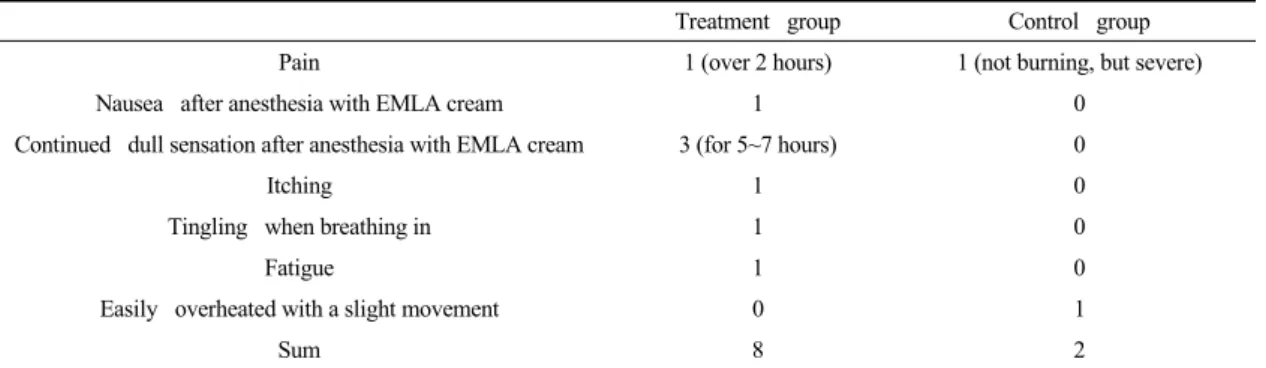
Ten moderate adverse events possibly related to treatment were reported by 6 participants, 4 in the treatment group and 2 in the control (Table 4.).
Multiple answers were chosen by each participant.
Almost all of them were symptoms related to anesthesia cream or injection of solutions, and disappeared in a day. No serious adverse events were reported.
In previous studies, capsaicin injections were associated with typical burning pain which diminished during the first few minutes and lasted for about 10 or 15 minutes16). Therefore, we did not calculate typical pain as an adverse event.
Discussion
Gocho (苦椒) is the fruit of plants from the genus Capsicum, members of the nightshade family Solanaceae17). Its traditional herbal name is ralcho (辣椒) or beoncho (番椒). Gocho (苦椒) is hot and spicy, so it warms the inside, keeps out the cold, unblocks the stomach, and increases body temperature18). Gocho (苦椒) spread from Japan to Korea about 400 years ago, and was widely cultivated in the 1700’s.
Now it is an important dietary seasoning in Korea19). Capsaicin is the active component from which a hot taste derives in gocho (苦椒). It was first isolated in pure form by Thresh, who gave it the name capsaicin.
Treatment group Control group
Pain 1 (over 2 hours) 1 (not burning, but severe)
Nausea after anesthesia with EMLA cream 1 0
Continued dull sensation after anesthesia with EMLA cream 3 (for 5~7 hours) 0
Itching 1 0
Tingling when breathing in 1 0
Fatigue 1 0
Easily overheated with a slight movement 0 1
Sum 8 2
Number of the report cases, the subjects could give multiple answers.
Table 4. Adverse Events
Micho revealed its molecular formula (C1818H27NO3), Nelson elucidated its structure by chemical synthesis19). The ingredients of gocho (苦椒) differ due to drying temperature, processing method, storage condition, kinds of gocho (苦椒), growing condition, ripening period, and parts of gocho (苦椒) used17,19-26).
Therefore, to maintain the reproducibility of expected effects, we made a herbal solution not with whole plants, but with major capsaicinoids including capsaicin, because they are the main ingredients which have anti-obesity effects of gocho (苦椒), and the injectable dosage into the human body without harmful side effects has been shown in previous studies16,27-8).
In this study, body weight, BMI, and WC of both groups significantly reduced after treatment.
The drop of body weight, BMI, and WC in the control group was slight but statistically significant, which may result from advised co-intervention to follow a hypocaloric diet and to walk for at least 30 minutes three times a week.
Gocho (苦椒) extract mesotherapy might be attributed regional fat loss. Although weight loss was observed in both groups, abdominal fat loss was significant only in the treatment group. This fat loss in the targeted region contributed to the drop of WHR and VFA.
Effects of capsaicin on fat loss have been already reported in previous studies. Snitker et al. reported that oral ingestion of capsaicinoids (6mg/d) for 12
weeks appeared to be safe and was associated with abdominal fat loss29). Kawada et al. reported that capsaicin stimulates lipid mobilization from adipose tissue and lowers serum triglyceride concentration in rats30).
Kang et al. studied roles of capsaicin in the adipose tissues of obese mice. Adipokines are associated with obesity-induced chronic inflammatory response which plays major roles in the development of obesity-related complications. The study demonstrated that capsaicin can suppress the expressions of IL-6 and MCP-1 genes and protein release from the adipose tissues and adipocytes of obese mice31).
According to these studies, using gocho (苦椒) extract mesotherapy for obesity treatment might be useful by regulating obesity-induced chronic inflam- matory molecules as well as reducing regional fat.
Clinical research on capsaicin showed that consump- tion of a breakfast with capsaicin caused an increase in diet-induced energy expenditure (23%) immediately after the meal ingestion in Japanese males32). In 13 female subjects addition of red pepper to the experi- mental meals increased postprandial energy expenditure and lipid oxidation as well33). These increases were assumed to be caused by enhanced catecholamine secretion from adrenal medulla, mainly through acti- vation of the central nervous system34-36) and by β- adrenergic stimulation37).
Our study suggests that gocho (苦椒) extract
mesotherapy might be effective to maintain energy expenditure without RMR decrease following weight loss and useful on weight loss. The most commonly reported metabolic consequence of weight loss is a reduction in energy requirement expected from the loss of body mass38). In our study, we could not find a reduction of RMR following weight loss in the treatment group, whereas the reduction of RMR in the control group was significantly correlated with weight loss. Although there were no significant differences in questionnaires on eating attitudes and physical activities between two groups before and after treatment, the weight loss of the treatment group was significantly larger than that of the control. This result might be derived from gocho (苦 椒) extract maintaining energy expenditure during weight loss.
There are conflicting studies about association between capsaicin and appetite. In previous study, oral exposure to capsaicin increased satiety and reduced energy and fat intake39). Yoshioka et al. also reported that the ingestion of red pepper decreases appetite and subsequent protein and fat intakes in Japanese females and energy intake in Caucasian males40).
However, Astrid et al. reported that capsaicin supplementation of one meal in a postprandial state has no effects on appetite feelings41). Before and after treatment in our study, we could not find a significant difference between the two groups in the questionnaire about eating attitudes except the scale score for cognitive restraint of the TFEQ-R18 ques- tionnaire, which significantly increased only in the control group.
According to these results, significant weight loss in the treatment group compared to the control might be derived not from appetite but from energy expenditure.
This study had several limitations. First, our sample size was too small to generalize the results. Second, our study did not have a broad racial/ethnic con-
sideration since we included only Korean participants.
Therefore, additional studies are necessary that include more diverse ethnic groups. Third, since the mechanism of weight and abdominal fat loss is not clear, further studies are required to identify the detailed mechanism of gocho (苦椒) extract mesotherapy on fat loss in human participants. Fourth, we had difficulty keeping our study double-blinded because of the typical burning pain participants experienced following gocho (苦椒) extract mesotherapy. To make clinical applications of gocho (苦椒) extract mesotherapy possible in prac- tice, development of a new form that could diminish discomfort is needed.
In conclusion, this study suggests that abdominal gocho (苦椒) extract mesotherapy might be an effective way to promote weight and abdominal fat loss.
Further evaluations using more participants to isolate the mechanism are necessary.
Acknowledgement
This study was supported by 2009 research funding from the Society of Korean Medicine for Obesity Research.
References
1. Haslam DW, James WP. Obesity. Lancet. 2005;
366:1197-209.
2. 2005 Korean national health and nutrition examination survey. MINISTRY OF HEALTH
& WELFARE. 2006.
3. Song MY, Park JH, Lee JH, Kim HJ, Lee MJ.
The Efficacy and Safety of Ephedra and Green Tea Mesotherapy on Localized Fat. J of of Society of Korean Med for Obes Research. 2007;
7:71-85.
4. Lee AR, Cho YJ, Chung WS, Yang YJ, Song MY. The effects of Sobi-eum (Xiaofei-yin) Meso- therapy on abdominal fat distribution. J Oriental
Rehab Med. 2009; 19:261-73.
5. Ahuja KD, Robertson IK, Geraghty DP, Ball MJ.
Effects of chili consumption on postprandial glucose, insulin, and energy metabolism. Am J Clin Nutr. 2006; 84:63-9.
6. Masuda Y, Haramizu S, Oki K, Ohnuki K, Watanabe T, Yazawa S, et al. Upregulation of uncoupling proteins by oral administration of capsiate, a nonpungent capsaicin analog. J Appl Physiol. 2003; 95:2408-15.
7. Sambaiah K, Satyanarayana MN. Influence of red pepper and capsaicin on body composition and lipogenesis in rats. J Biosci. 1982; 4:425-30.
8. Jacobson P, Rankinen T, Tremblay A, Perusse L, Chagnon YC, Bouchard C. Resting metabolic rate and respiratory quotient: results from a genome- wide scan in the Quebec Family Study. Am J Clin Nutr. 2006; 84:1527-33.
9. Lim KW, Suh HJ. Effect of red pepper ingestion on energy substrates utilization during in athletes.
Kor J Exer Nutr. 1997; 1:61-7.
10. Cecil JE, Tavendale R, Watt P, Hetherington MM, Palmer CN. An obesity-associated FTO gene variant and increased energy intake in children. N Engl J Med. 2008; 359:2558-66.
11. de Lauzon B, Romon M, Deschamps V, Lafay L, Borys JM, Karlsson J, et al. The Three-Factor Eating Questionnaire-R18 Is Able to Distinguish among Different Eating Patterns in a General Population. J Nutr. 2004; 134:2372-80.
12. Baecke JA, Burema J, Frijters JE. A short questionnaire for the measurement of habitual physical activity in epidemiological studies. Am J Clin Nutr. 1982; 36:936-42.
13. Stunkard AJ, Messick S. The three-factor eating questionnaire to measure dietary restraint, disin- hibition and hunger. J Psychosom Res. 1985;
29:71-83.
14. Karlsson J, Persson LO, Sjöström L, Sullivan M.
Psychometric properties and factor structure of the Three-Factor Eating Questionnaire (TFEQ) in obese men and women. Results from the Swedish Obese Subjects (SOS) study. Int J Obes Relat Metab Disord. 2000; 24:1715-25.
15. Papathanasiou G, Georgoudis G, Papandreou M, Spyropoulos P, Georgakopoulos D, Kalfakakou V, et al. Reliability measures of the short Interna- tional Physical Activity Questionnaire (IPAQ) in Greek young adults. Hellenic J Cardiol. 2009;
50:283-94.
16. Simone DA, Ngeow JY, Putterman GJ, LaMotte RH. Hyperalgesia to heat after intradermal injection of capsaicin. Brain Res. 1987; 418:
201-3.
17. Russo VM, Biles CL. Fertilizer rate and beta- galactosidase and peroxidase activity in pepper fruit at different stages and years of harvest. Plant Foods Hum Nutr. 2003; 58:231-9.
18. Jiangsu New Medical College (Ed). A Grand Dictionary of Chinese Medicinal Herbs. Shanghai, Chinese: Shanghai Science and Technology Publishing House. 1994: 2570-1.
19. Chung BS, Kang KO. The changes of capsaicin contents in fresh and processed red peppers. J Korean Soc Food Nutr. 1985; 14:409-18.
20. Hwang SY, Cho DH, Jo JS. Changes in lipid composition of Korean red pepper (Capsicum annuum) during processing and storage. Korean J Dietary Culture. 1998; 13:519-28.
21. Lee CY, Woo SK, Lee YS, Kwon IB. Analysis of pungent principle of capsicum fruit by HPLC.
Kor J Food Hygiene. 1989; 4:191-8.
22. Koeda S, Hosokawa M, Kang BC, Yazawa S.
Dramatic changes in leaf development of the native Capsicum chinense from the Seychelles at temperatures below 24 degrees C. J Plant Res.
2009; 122:623-31.
23. Barchi L, Lefebvre V, Sage-Palloix AM, Lanteri
S, Palloix A. QTL analysis of plant development and fruit traits in pepper and performance of selective phenotyping. Theor Appl Genet. 2009;
118:1157-71.
24. Alan O, Eser B. Pepper seed yield and quality in relation to fruit position on the mother plant.
Pak J Biol Sci. 2007; 10:4251-5.
25. Sudré CP, Gonçalves LS, Rodrigues R, do Amaral Júnior AT, Riva-Souza EM, Bento Cdos S. Genetic variability in domesticated Capsicum spp as assessed by morphological and agronomic data in mixed statistical analysis. Genet Mol Res.
2010; 9:283-94.
26. Govindarajan VS, Sathyanarayana MN. Capsicum- production, technology, chemistry, and quality.
Part V. Impact on physiology, pharmacology, nutrition, and metabolism; structure, pungency, pain, and desensitization sequences. Crit Rev Food Sci Nutr. 1991; 29:435- 74.
27. Simone DA, Nolano M, Johnson T, Wendelschafer- Crabb G, Kennedy WR. Intradermal injection of capsaicin in humans produces degeneration and subsequent reinnervation of epidermal nerve fibers:
correlation with sensory function. J Neurosci 1998; 18:8947-59.
28. Cantillon M, Vause E, Sykes D, Russel R, Moon A, Hughes S. Preliminary safety, tolerability and efficacy of ALGRX 4975 in osteoarthritis of the knee. J Pain. 2005; 6:S39.
29. Snitker S, Fujishima Y, Shen H, Ott S, Pi-Sunyer X, Furuhata Y, et al. Effects of novel capsinoid treatment on fatness and energy metabolism in humans: possible pharmacogenetic implications.
Am J Clin Nutr. 2009; 89:45-50.
30. Kawada T, Hagihara K, Iwai K. Effects of capsaicin on lipid metabolism in rats fed a high fat diet. J Nutr. 1986; 116:1272-8.
31. Kang JH, Kim CS, Han IS, Kawada T, Yu R.
Capsaicin, a spicy component of hot peppers,
modulates adipokine gene expression and protein release from obese-mouse adipose tissues and isolated adipocytes, and suppresses the inflamma- tory responses of adipose tissue macrophages.
FEBS Lett. 2007; 581:4389-96.
32. Kawada T, Sakabe S, Watanabe T, Yamamoto M, Iwai K. Some pungent principles of spices cause the adrenal medulla to secrete catecholamine in anesthetized rats. Proc Soc Exp Biol Med.
1988; 188:229-33.
33. Yoshioka M, St-Pierre S, Suzuki M, Tremblay A. Effects of red pepper added to high-fat and high-carbohydrate meals on energy metabolism and substrate utilization in Japanese women. Br J Nutr. 1998; 80:503-10.
34. Kawada T, Watanabe T, Takaishi T, Tanaka T, Iwai K. Capsaicin-induced beta-adrenergic action on energy metabolism in rats: influence of capsaicin on oxygen consumption, the respiratory quotient, and substrate utilization. Proc Soc Exp Biol Med. 1986; 183:250-6.
35. Watanabe T, Kawada T, Kurosawa M, Sato A, Iwai K. Adrenal sympathetic efferent nerve and catecholamine secretion excitation caused by capsaicin in rats. Am J Physiol. 1988; 255:E23-7.
36. Watanabe T, Kawada T, Yamamoto M, Iwai K.
Capsaicin, a pungent principle of hot red pepper, evokes catecholamine secretion from the adrenal medulla of anesthetized rats. Biochem Biophys Res Commun. 1987; 142:259-64.
37. Szallasi A. Piperine: researchers discover new flavor in an ancient spice. Trends Pharmacol Sci.
2005; 26:437-9.
38. Wyatt HR, Grunwald GK, Seagle HM, Klem ML, McGuire MT, et al. Resting energy expenditure in reduced-obese subjects in the National Weight Control Registry. Am J Clin Nutr. 1999; 69:
1189-93.
39. Westerterp-Plantenga MS, Smeets A, Lejeune
MP. Sensory and gastrointestinal satiety effects of capsaicin on food intake. Int J Obes (Lond).
2005; 29:682-8.
40. Yoshioka M, St-Pierre S, Drapeau V, Dionne I, Doucet E, Suzuki M, et al. Effects of red pepper on appetite and energy intake. Br J Nutr. 1999;
82:115-23.
41. Smeets AJ, Westerterp-Plantenga MS. The acute effects of a lunch containing capsaicin on energy and substrate utilization, hormones, and satiety.
Eur J Nutr. 2009; 48:229-34.