Clinical Evidence and Mechanisms of High-Protein Diet-Induced Weight Loss
Jaecheol Moon
1, Gwanpyo Koh
1,2,*
1
Department of Internal Medicine, Jeju National University Hospital, Jeju;
2Department of Internal Medicine, Jeju National University School of Medicine, Jeju, Korea
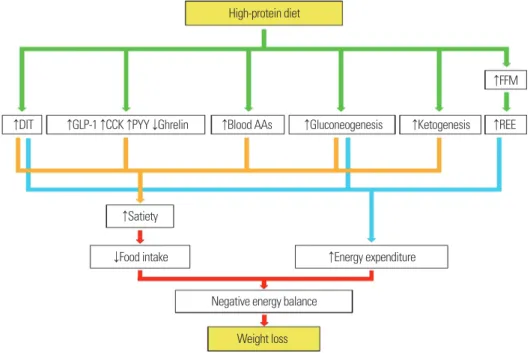
Several clinical trials have found that consuming more protein than the recommended dietary allowance not only reduces body weight (BW), but also enhances body composition by decreasing fat mass while preserving fat-free mass (FFM) in both low-calorie and standard-calorie diets. Fairly long-term clinical trials of 6–12 months reported that a high-protein diet (HPD) provides weight-loss effects and can prevent weight regain after weight loss. HPD has not been reported to have adverse effects on health in terms of bone density or renal function in healthy adults. Among gut-derived hormones, glucagon-like peptide-1, cholecystokinin, and peptide tyrosine- tyrosine reduce appetite, while ghrelin enhances appetite. HPD increases these anorexigenic hormone levels while decreasing orexigenic hormone levels, resulting in increased satiety signaling and, eventually, reduced food intake. Additionally, elevated diet-induced thermogenesis (DIT), increased blood amino acid concentra- tion, increased hepatic gluconeogenesis, and increased ketogenesis caused by higher dietary protein contribute to increased satiety. The mechanism by which HPD increases energy expenditure involves two aspects: first, pro- teins have a markedly higher DIT than carbohydrates and fats. Second, protein intake prevents a decrease in FFM, which helps maintain resting energy expenditure despite weight loss. In conclusion, HPD is an effective and safe tool for weight reduction that can prevent obesity and obesity-related diseases. However, long-term clinical trials spanning more than 12 months should be conducted to further substantiate HPD effects.
Key words: High protein diet, Weight loss, Obesity, Satiation
Received April 1, 2020 Reviewed April 25, 2020 Accepted May 19, 2020
* Corresponding author Gwanpyo Koh
https://orcid.org/0000-0002-6020-2777 Department of Internal Medicine, Jeju National University School of Medicine, 102 Jejudaehang-ro, Jeju 54987, Korea Tel: +82-64-754-8163
Fax: +82-64-717-1131 E-mail: [email protected]
INTRODUCTION
Prevalence of obesity around the world have increased rapidly in recent years. This phenomenon poses serious health risks because obesity can progressively cause a wide range of diseases such meta- bolic syndrome, non-alcoholic fatty liver disease, type 2 diabetes, and cardiovascular diseases.
1To resolve obesity, a negative energy balance, in which energy expenditure is greater than energy intake, must be encouraged. This can be achieved via an energy-restricted diet.
2However, an energy-restricted diet carries the risk of post-loss weight regain because it increases hunger and decreases fullness.
Furthermore, weight loss through an energy-restricted diet reduces fat mass and fat-free mass (FFM), which hinders a continuous neg-
ative energy balance. To overcome this, lowering energy intake while maintaining fullness and FFM is crucial, and a high-protein, energy-restricted diet is one important strategy.
3,4In this review ar- ticle, we examine the clinical evidence for the weight-loss effects and side effects of high-protein diet (HPD) and introduce various mechanisms through which HPD increases satiety and induces weight loss while preserving FFM.
CLINICAL OUTCOMES WITH HPD
Protein is a component of the human body, a source of energy, and an essential nutrient that facilitates growth and development.
The recommended dietary allowance of protein to avoid protein
Copyright © 2020 Korean Society for the Study of Obesity
This is an Open Access article distributed under the terms of the Creative Commons Attribution Non-Commercial License (https://creativecommons.org/licenses/by-nc/4.0/) which permits unrestricted non-commercial use, distribution, and reproduction in any medium, provided the original work is properly cited.
2017-03-16 https://crossmark-cdn.crossref.org/widget/v2.0/logos/CROSSMARK_Color_square.svg
Clinical Evidence and Mechanisms of High-Protein Diet-Induced Weight Loss
Jaecheol Moon
1, Gwanpyo Koh
1,2,*
1
Department of Internal Medicine, Jeju National University Hospital, Jeju;
2Department of Internal Medicine, Jeju National University School of Medicine, Jeju, Korea
Several clinical trials have found that consuming more protein than the recommended dietary allowance not only reduces body weight (BW), but also enhances body composition by decreasing fat mass while preserving fat-free mass (FFM) in both low-calorie and standard-calorie diets. Fairly long-term clinical trials of 6–12 months reported that a high-protein diet (HPD) provides weight-loss effects and can prevent weight regain after weight loss. HPD has not been reported to have adverse effects on health in terms of bone density or renal function in healthy adults. Among gut-derived hormones, glucagon-like peptide-1, cholecystokinin, and peptide tyrosine- tyrosine reduce appetite, while ghrelin enhances appetite. HPD increases these anorexigenic hormone levels while decreasing orexigenic hormone levels, resulting in increased satiety signaling and, eventually, reduced food intake. Additionally, elevated diet-induced thermogenesis (DIT), increased blood amino acid concentra- tion, increased hepatic gluconeogenesis, and increased ketogenesis caused by higher dietary protein contribute to increased satiety. The mechanism by which HPD increases energy expenditure involves two aspects: first, pro- teins have a markedly higher DIT than carbohydrates and fats. Second, protein intake prevents a decrease in FFM, which helps maintain resting energy expenditure despite weight loss. In conclusion, HPD is an effective and safe tool for weight reduction that can prevent obesity and obesity-related diseases. However, long-term clinical trials spanning more than 12 months should be conducted to further substantiate HPD effects.
Key words: High protein diet, Weight loss, Obesity, Satiation
Received April 1, 2020 Reviewed April 25, 2020 Accepted May 19, 2020
* Corresponding author Gwanpyo Koh
https://orcid.org/0000-0002-6020-2777 Department of Internal Medicine, Jeju National University School of Medicine, 102 Jejudaehang-ro, Jeju 54987, Korea Tel: +82-64-754-8163
Fax: +82-64-717-1131 E-mail: [email protected]
deficiency in adults is 0.80 g/kg body weight (BW)/day, which translates to about 48–56 g/day and about 10%–15% of the total daily energy expenditure.
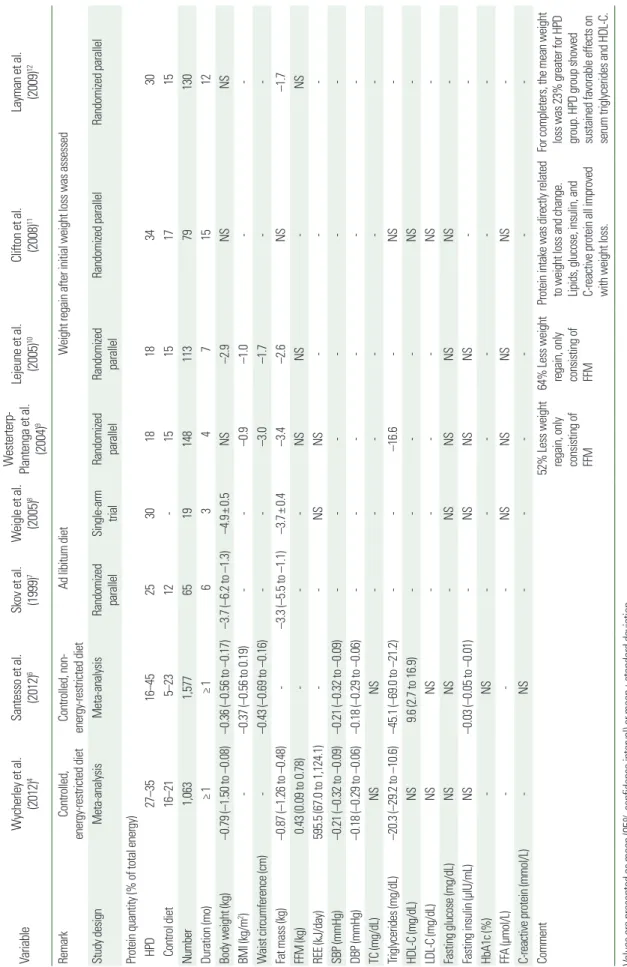
5To date, many clinical trials have at- tempted to regulate BW through high protein consumption more than the recommended dietary allowance (Table 1).
Wycherley et al.
4conducted a meta-analysis of 24 randomized controlled trials (RCTs) that compared HPD and standard-protein diet (SPD) with isocaloric, energy-restricted diets. Subjects in the HPD group consumed 1.07–1.60 g protein/kg BW/day (27%–35%
of total energy intake consumed as protein), and subjects in the SPD group consumed 0.55–0.88 g/kg BW/day (16%–21% of total energy intake consumed as protein), with the two groups having a difference less than 1,250 kJ/day in total energy intake. A total of 1,063 participants were enrolled, and the mean (± standard devia- tion) diet duration was 12.1± 9.3 weeks. Compared with subjects in the SPD group, those in the HPD group showed a significant re- duction in BW (–0.79 kg; 95% confidence interval [CI], –1.50 to –0.08 kg), fat mass (–0.87 kg; 95% CI, –1.26 to –0.48 kg), and blood triglycerides (–20.3 mg/dL; 95% CI, –29.2 to –10.6 mg/dL) and a significant increase in FFM (0.43 kg; 95% CI, 0.09–0.78 kg) and resting energy expenditure (REE; 595.5 kJ/day; 95% CI, 67.0–
1,124.1 kJ/day). Santesso et al.
6conducted a meta-analysis of 74 RCTs with less than 5% difference in calorie intake between the two study groups regardless of energy restriction. Compared with subjects in the SPD group who consumed protein as 5%–23% of their daily total energy, subjects in the HPD group who consumed protein as 16%–45% of their daily total energy showed a significant decrease in BW (–0.36 kg; 95% CI, –0.56 to –0.17 kg), body mass index (–0.37 kg/m
2; 95% CI, –0.56 to 0.19 kg/m
2), waist circum- ference (–0.43 cm; 95% CI, –0.69 to –0.16 cm), and blood pressure (systolic: –0.21 mmHg; 95% CI, –0.32 to –0.09 mmHg and dia- stolic: –0.18 mmHg; 95% CI, –0.29 to –0.06 mmHg), but the de- gree of improvement was small.
Most clinical trials examining the effects of HPD used controlled diets, which were provided by the investigators. However, Skov et al.
7and Weigle et al.
8conducted clinical trials involving ad libitum diets. Skov et al.
7conducted a six-month randomized dietary inter- vention trial, where participants were divided into an HPD (protein as 25% of total energy intake, n= 25), high-carbohydrate diet (pro- tein as 12% of total energy intake, n=25), or control group (n=15),
with fat intake set to 30% of total energy intake. Although the par- ticipants followed an ad libitum diet at designated restaurants, they were instructed to strictly adhere to the required diet composition.
In contrast to other controlled feeding trials, the withdrawal rate was very low (<10%). After 6 months, participants in the high-protein group significantly lost BW (–3.7 kg; 95% CI, –6.2 to –1.3 kg) and fat mass (–3.3 kg; 95% CI, –5.5 to –1.1 kg) compared with those in the high-carbohydrate diet group. Similar results were observed in the study by Weigle et al.
8That study was a single-arm trial in- volving a weight-maintaining diet (15% protein, 35% fat, and 50%
carbohydrate) for the first 2 weeks, an isocaloric HPD (30% pro- tein, 20% fat, and 50% carbohydrate) for the next 2 weeks, and an ad libitum HPD (30% protein, 20% fat, and 50% carbohydrate) for the next 12 weeks. After HPD, satiety increased, while BW (–4.9±
0.5 kg) and fat mass (–3.7± 0.4 kg) significantly decreased.
Some studies examined the effect of HPD on weight regain after weight loss. Westerterp-Plantenga et al.
9induced weight loss through a 4-week, very low-energy diet in 148 mildly obese participants, af- ter which protein was additionally administered at 48.2 g/day for 3 months. The participants in the group given additional protein consumed 18% of their daily total energy as protein, while the con- trol group consumed 15% of their daily total energy as protein. Par- ticipants in the protein group showed 50% less weight regain com- pared with control-group participants. Weight regain constituted FFM in the protein-group participants and fat mass in the control- group participants. Lejeune et al.
10also observed less weight regain in participants consuming 30 g/day of protein for 6 months (0.8 vs.
3.0 kg; P<0.05). Clifton et al.
11and Layman et al.
12compared HPD and high-carbohydrate diet for nine and 12 months, respectively, and they confirmed a correlation between protein intake and weight loss and between protein intake and fat-mass reduction, respectively.
In conclusion, many clinical trials have shown that consuming more protein than the recommended dietary allowance induces weight loss and improves body composition regardless of total en- ergy intake. HPD was also observed to have long-term weight-loss effects and to prevent weight regain following initial weight loss.
POSSIBLE HARMFUL EFFECTS OF HPD
The benefits of HPD are well known, but there have been con-
Table 1. Summary of studies on HPD Variable Wycherley et al. (2012)
4Santesso et al. (2012)
6Skov et al. (1999)
7
W
eigle et al. (2005)
8