Effects of Supplementation with Needles of Pinus densiflora on the Fermentation Characteristics of Honey Wine
Je-Hyuk Lee1, Woo-Cheul Han2, In-Chul Kim3, Chul Cheong4, Soon-Ah Kang4 and Ki-Hyo Jang2†
1Plant Resources Research Institute, Duksung Women’s University, Seoul 132-714, Korea
2Dept. of Food and Nutrition, Kangwon National University, Samcheok 245-907, Korea
3Dept. of Food and Nutrition, GangneungWonju National University, Gangneung 210-702, Korea
4Dept. of Fermented Food Science, Seoul University of Venture and Information, Seoul 137-070, Korea
솔잎 첨가 벌꿀주의 발효 특성
이제혁1․한우철2․김인철3․정철4․강순아4․장기효2†
1덕성여자대학교 식물자원연구소, 2강원대학교 식품영양학과, 3강릉원주대학교 식품영양학과,
4서울벤처정보대학원대학교 발효식품과학과
Abstract
The goal of this study was to evaluate the effects of supplementation with the needles of Pinus densiflora on the fermen- tation characteristics of honey wine (Pinus densiflora-honey wine). Honey without supplementation with needles of Pinus densiflora (honey wine) was included as a control. Physiochemical changes were investigated during 30 days of fermentation at 20℃, and following aging. At the beginning of fermentation, pH and viable cell counts of Pinus densiflora-honey wine changed rapidly, while °Bx decreased gradually. Viable yeast counts reached maximum levels at 5 to 10 days of ferment- ation. At day 0, the pH of Pinus densiflora-honey wine was 3.8, while the non-supplemented honey wine had a pH of 3.4.
Decease in °Bx was faster in Pinus densiflora-honey wine than in non-supplemented honey wine. Supplementation of honey with needles of Pinus densiflora prior to fermentation shifted the initial pH to a more neutral pH, and the presence of Pinus densiflora needles increased the fermentation speed. The final °Bx, pH, ethanol content, and total titratable acidity of Pinus densiflora-honey wine were 13.7°Bx, pH 3.05, 13.5%, and 0.37%, respectively. A sensory evaluation demonstrated that addition of 4% (w/v) fructose to honey wine supplemented with neddles of Pinus densiflora raised the level of product acceptability.
Key words : Fermentation, honey, mead, neddle of Pinus densiflora, wine.
†Corresponding author : Ki-Hyo Jang, Tel : +82-33-570-6882, Fax : +82-33-570-6889, E-mail : [email protected]
INTRODUCTION
Honey has been used as a natural seasoning and a healthy food material for thousands of years, and it has been recently received much attention from the cosmetics and pharmaceu- tical companies (Lee et al 1997). Honey contains sugars, vita- mins, minerals, and fatty acids, which provide some physio- logical functions, such as the release of fatigues and alcohol detoxication (Lee et al 1997, Jung et al 1999). The sugar com- position of honey was detected to have the monohydrate fruc- tose and glucose as the major carbohydrates, and some sucrose and oligosaccharides. The ratio of fructose/glucose was ranged between 2 and 28, and the excellent sweet tastes of honey
might be due to high fructose contents (Kim & Rhee 1995).
In honey wine, the carbohydrates (monosaccharides and di- saccharides) are converted to ethanol by the single-fermenta- tion of yeasts (Jung et al 1999). So far, the honey wine has not been popular, because materials of honey wine were ex- pensive, and the taste is too sweet, and easily contaminated by some spoilage microorganisms for a long fermentation period.
However, the short fermentation process by adding substrates for yeasts and the filtration system diminished the problems of the honey-wine fermentation (Kim et al 1999).
Korean red pine (Pinus densiflora Siebold et Zuccarini) with needle-like leaves is distributed over the Korean Penin- sula, and grows to 35 m. Pine leaves have been used as tra- ditional medicines for neurodiseases, cardiovascular and liver diseases (Kang et al 1995). And the extract of pine leaves was investigated to have chlorophylls, vitamin A, C, proteins,
lipids, enzymes, and essential oils (plant volatile terpenes) (Jung et al 1999). The physiological functions of pine leaves were performed for lipid metabolisms in serum (Kim et al 1991, Kim et al 2005) and for enzymes in serum and liver of high fat diet induced mouse (Kang et al 1996a, Kang et al 1996b).
In addition, the pine leaves have the anti-aging activity of free radical scavenging (Choi et al 2001) and antibacterial activity (Choi et al 1997). Recently the life style seeking well-being increases the interest of wines containing medicinal plant ex- tracts, which are expected to have several physiological func- tions and the preventive activity for illness (Kim & Park 2007, Lee et al 2008).
Several researchers have been tried to use the pine leaves and honey as a novel food material for the health improve- ment. However, little is known of the original copy for the fermentation of pine leaves-honey wine. In this study, we will report the fermentation characteristics of honey wine contai- ning pine leaves extracts.
METHODOLOGY
1. Materials
Honey was collected from Robinia pseudo-acaci trees at Wonju (Kangwon, Korea) in 2006. The pine leaves were ob- tained from Pinus densiflora Siebold et Zuccarini at Sam- chuck (Kangwon, Korea) in May 2006, washed with tap water, and dried. Yeast (Saccharomyces bayanus, EC-1118) for wine- fermentation was purchased from Lallemand Co. (Mountreal, ON, Canada). Sucrose and potassium metabisulfite (K2S2O5) were obtained from Cheiljedang Co. (Gangwon-do, Korea) and Sigma Co. (St. Louis, MO., USA), respectively.
2. Preparation of Pine Leaves-Honey Extracts Pine leaves (2 kg) were mixed with honey (4 L), and were stored for 30 days at room temperature. For the adjustment of sugar contents to 24.0 °Bx, the honey (2,600 mL) filtrated with a sterile cotton-cloth was mixed with water (6,940 mL).
3. Fermentation of Honey Wine
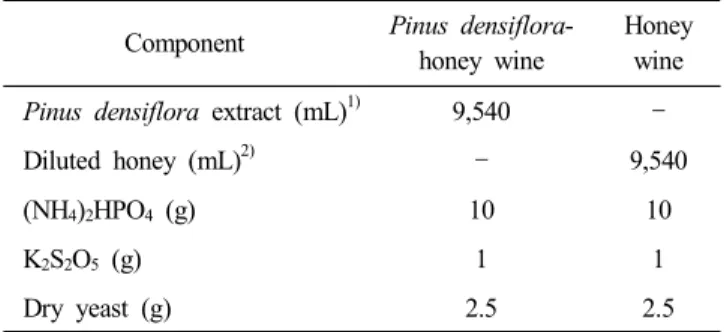
Pine leaves-honey extracts (9,540 mL), diammonium hydro- gen phosphate (10 g), which is a stimulator for yeast growth, and potassium metabisulfite (1 g) were mixed in 20 L of fer- mentor with air-lock for 16 hr (Table 1). For Honey wine fermentation, pine leaves-honey extracts was replaced by di- luted honey (9,540 mL). Dry yeast (2.5 g) were transferred
Table 1. Proportion of Pinus densiflora-honey wine and honey wine
Component Pinus densiflora- honey wine
Honey wine Pinus densiflora extract (mL)1) 9,540 -
Diluted honey (mL)2) - 9,540
(NH4)2HPO4 (g) 10 10
K2S2O5 (g) 1 1
Dry yeast (g) 2.5 2.5
1) Honey extracts of Pinus densiflora were prepared by mixing of honey(4,000 mL) and needle of Pinus densiflora (2 kg) at room temperature for 30 days.
2) Honey was diluted with distilled water to give diluted honey (24.0°Bx).
onto fermentor and then allowed to grow at 20~21℃ for 30 days. Samples (50 mL) were taken during fermentation pe- riod, and stored at -20℃ for the analysis.
4. Analysis of Carbohydrates
The sugar contents of fermented mixture were determined by the hand-held refractometer (model N-1α, ATAGO, Japan).
Quantitative determination for glucose, fructose, sucrose, and oligosaccharides was conducted by HPLC with a refractive index detector and gel filtration column (300×8 mm, Shodex Ionpack KS-802, Japan) using deionized water as a mobile phase (0.4 mL/min).
5. Determination of pH and Acidity
The change of pH in fermented mixture was measured by pH meter (model 725p, Istek Co., Seoul, Korea). For determi- nation of total titratable acidity (TTA), the fermented mixture (10 mL) with 1~2 drops of phenolphthalein was titrated with 0.1N NaOH. TTA was calculated by the following equation using consumed amounts (mL) of 0.1N NaOH at the end-point (pink color).
Total titratable acidity % (TTA, %) =
[(mL of 0.1 N NaOH) × (N NaOH) × 0.075 (DL-tartaric acid coefficient) 100] / mL sample
6. Determination of Alcohols and Fusel Oils Contents The alcohols and fusel oils of fermented mixture was mea- sured by a gas chromatograph (6890, Agilent Technologies
Inc., Santa Clara, CA, USA) equipped with HP-INNOWax co- lumn (0.25 μm, 30 m × 0.25 mm, Agilent Technologies Inc.).
The column temperature was programmed to hold constant at 35℃ for 5 min, to increase to 150℃ with 5℃/min, and to 250℃
with 20℃/min, and to hold at 250℃ for 2 min. Injection volume was 10 μL, and the temperature of injection port was 225℃. The temperature of the detector port with FID detector (split ratio was 10:1) was 260℃.
7. Assessment of Viable Yeast Number
The diluted fermented-mixture was spread on YPD agar plate (DIFCO, St. Louis, MO, USA) and incubated at 30℃ for 48 hr under aerobic conditions, and the viable yeasts were counted. Result was expressed as the average of triplicate.
8. Color Measurement
The color of honey-wine was determined by spectrophoto- meter (UV-visible spectrophotometer UV-1650 PC, Shimadzu, Japan) using 10 mm quartz cuvette, and the distilled water was used as the blank. Total phenol content, the brightness, the anthocyanin content, colority and shade were expressed as A280, A420, A520, A420+A520, and A420/A520, respectively.
9. Statistical Analysis
Results were analyzed using 1-way analysis of variance (ANOVA) at 95% level of significance (Albright et al 1999).
Experiments were carried out in triplicates. The results were presented as mean standard deviations (SD). Thestatistical ana- lysis of sensory evaluation was performed using SPSS 12.0 software. The preferences for color, flavors, and the taste of honey-wines were evaluated by Friedman test, which is the nonparametric method (the number of samples <30). Statis- tical significance was considered at p<0.05.
RESULTS AND DISCUSSIONS
1. Characteristics of Honey Wines
The pine leaves were extracted by honey with a high os- molarity and subsequently used for wine fermentation after supplemented with nitrogen source. Potassium metabisulfite (K2S2O5, 105 ppm) was added to fermented mixture for the prevention of oxidation, the color stability and the spoilage pre- vention. Honey without supplementation of neddle of Pinus densiflora (Honey wine) was also included as control. The
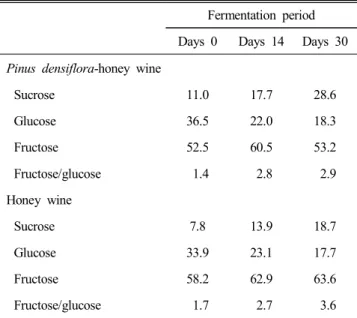
supplement of sugars is necessary for the fermentation of fruit wines, such as grape wine and Korean Black Raspberry wine (Bokbunjaju, Rubus coreanus Miquel). However, the honey wine had the high sugar contents so that a dilution process was necessary for the success fermentation. The carbohydrate contents of Pinus densiflora-honey wine were fructose > glucose
> sucrose, with 1.4 of the fructose/glucose-ratio (Table 2).
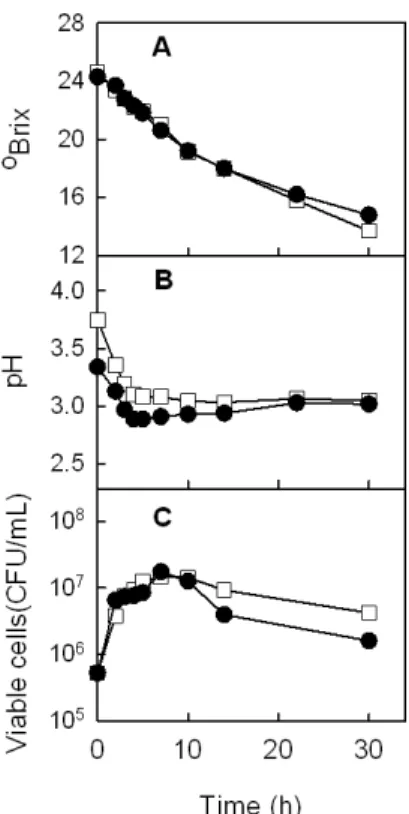
Similar results were found in honey wine. These results were consistent to other reports regarding sugar composition of honey (Lee et al 1997, Kim & Rhee 1995). The ratio of fruc- tose / glucose was further increased, as the fermentation pro- ceeded. The fructose/glucose of 0 day, 14 day and 30 day fer- mentation of Pinus densiflora-honey wine were 1.4, 2.8 and 2.9, respectively. Based on this, it is expected that the sweetness of honey wine is due to the presence of fructose in the honey wine (Lee et al 1997, Kim & Rhee 1995). Several researchers recommend that initial sugar content should be between 22 to 24°Bx because it affects ethanol concentration and fermen- tation progress (Kim SK 1996, Kim et al 2008). Kim et al (2008) found that the mulberry wine fermented at 24°Bx showed excellent characteristics in terms of ethanol produc- tion. In the present study, the initial sugar content of both Pinus densiflora-honey wine and honey wine was equally 24°Bx. It is interesting to note that decrease in °Bx was faster in Pinus densiflora-honey wine than Honey wine (Fig. 1A).
Not only carbon sources, but also nitrogen sources are im-
Table 2. Changes in the relative sugar compositions (%) in Pinus densiflora- honey wine and honey wine during al- cohol fermentation at 20℃ for 30 days
Fermentation period Days 0 Days 14 Days 30 Pinus densiflora-honey wine
Sucrose Glucose Fructose Fructose/glucose Honey wine
Sucrose Glucose Fructose Fructose/glucose
11.0 36.5 52.5 1.4
7.8 33.9 58.2 1.7
17.7 22.0 60.5 2.8
13.9 23.1 62.9 2.7
28.6 18.3 53.2 2.9
18.7 17.7 63.6 3.6
Fig. 1. Changes of sugar concentration (°Bx) (A), pH (B), and viable yeast cells(colony forming unit/mL) (C) of Pinus densiflora-honey wine and honey wine from alcohol ferenta- tion at 20℃ for 30 days. Open symbol; Pinus densiflora- honey wine, closed symbol; Honey wine.
portant for honey wine fermentation (Jung et al 1999, Hwang et al 2004). In the optimization of the water melon wine fer- mentation using 17 Saccharomyces sp., Hwang et al (2004) reported that 0.2% (w/v) of (NH4)2HPO4 among several nitro- gen sources provided the highest ethanol contents (12.4%).
Otherwise, Jung et al (1999) reported that ethanol level was 13.7% (v/v) of the fermented mixture containing 0.1% (NH4)2SO4, 0.05% K3PO4, 0.005% NaHSO4, 0.002% peptone, 0.144%
tartaric acid, 0.233% malic acid, 0.0005% thiamine, 0.00025%
Ca-pantothenate, 0.0002% inositol, 0.000025% pyridoxine, and 0.000002% biotin. In the present study, (NH4)2HPO4 (0.1%) was used as sole nitrogen source for fermentation.
2. Change of pH and Viable Yeast Number
At day 0, the initial pH of Pinus densiflora-honey wine and honey wine were 3.8 and 3.4, respectively. In both honey wines, decrease in pHs were only seen within 5 days in fermentation.
For instance, the pH of fermented mixture in Pinus densiflora- honey wine was decreased from pH 3.8 (0 day) to pH 3.1 (4 day) and pH 3.0 was maintained throughout extended fermen-
tation period (Fig. 1B). For the fermentation of Citrus-honey wine, the change of pH was from pH 4.4 (0 days) to pH 2.9 (13 days), and for Maesil (Prunus mume)-honey wine was from pH 3.1 (0 days) to pH 3.0 (13 days). Citrus-honey wine and Maesil-honey wine fermented successfully, but low con- centration of hydrogen ion (pH 2.8) made the honey wine fer- mentation difficult. Based on these results, authors suggested that adjustment of initial pH in fermentation medium is needed for the successful ethanol fermentation (Jung et al 1999). Taken together with the data from our work and others, it can be concluded that supplementation of needle of Pinus densiflora to honey prior to fermentation shifted the initial pH to more neutral pH, so that the presence of needle of Pinus densiflora in honey wine increased the fermentation speed.
Fermentation rate in honey wine is dependant on the con- centration of minerals. Potassium contents (< 300 ppm) provide the decrease of pH to below 2.7, so that the honey wine fer- mentation was terminated (Schramm K 2005). Leaves of Ko- rean domestic Pinus densiflora contain 514 mg% of potassium, 294 mg% of calcium, 84 mg% of magnesium, 18 mg% of man- ganese, 16 mg% of sodium, 5 mg% of iron, and 19 mg% of phosphorous and, among minerals, the potassium content showed the highest value (Chung et al 1996). Honey-extraction of minerals from pine leaves for a long time may supplement the potassium for successful honey wine fermentation.
Among S. bayanus, S. cerevisiae, S. uvarum, S. formosensis and S. sake, S. bayanus is reported to be the best yeast strain for honey wine fermentation, showing ethanol production (13.8%) in low temperature and low pH for 17 days fermen- tation (Jung et al 1999). The number of viable yeast in Pinus densiflora-honey wine was 6.4×10⁵ colony forming unit (CFU)/
mL at day 0, and reached to 1.5×10⁷ CFU/mL at day 7 of fer- mentation, then decreased to 4.2×10⁶ CFU/mL (Fig. 1C, Table 3). In case of honey wine, viable yeast cells were 5.3×10⁵ CFU/
mL at day 0, 1.7×10⁷ CFU/mL at day 7, and 1.6×10⁶ CFU/mL at day 30, respectively.
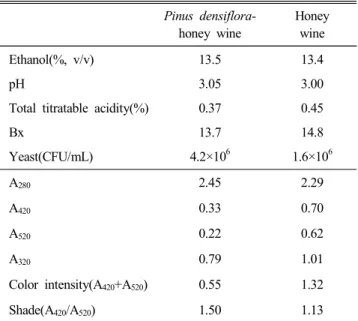
3. Fermentation Characteristics of Honey Wines Fermentation characteristics of Pinus densiflora-honey wine and honey wine were summarized in Table 3. Kahoun et al (2008) reported that 19 phenolic compounds were detected from 46 kinds of honey wines by HPLC, and its composition was dependant on the kind of honey, fermentation process, heating process and storage conditions. The phenolic compounds in wines were determined by absorbance at specific wave-
Table 3. Ethanol concentration, pH, titratable acidity (TA), Bx, viable yeast cell, and color properties of Pinus densi- flora-honey wine and honey wine from alcohol fermentation at 20℃ for 30 days
Pinus densiflora- honey wine
Honey wine Ethanol(%, v/v)
pH
Total titratable acidity(%) Bx
Yeast(CFU/mL)
13.5 3.05 0.37 13.7 4.2×10⁶
13.4 3.00 0.45 14.8 1.6×10⁶
A280 2.45 2.29
A420 0.33 0.70
A520 0.22 0.62
A320 0.79 1.01
Color intensity(A420+A520) 0.55 1.32
Shade(A420/A520) 1.50 1.13
length using UV-spectrophotometry (Sarneckis et al 2006). Total phenolic compounds (Sarneckis et al 2006) were evaluated by A280, and the colority of wines by a combined value of A520
and A420 (Kim & Kim 1997). Pinus densiflora-honey wine had 2.45 (A280) of total phenolic compounds and 0.55 of colority (A420+A520). Honey wine had 2.29 (A280) and 1.32 of colority (A420+A520) (Table 3). Five kinds of rice wines (Yakju) showed 11.2~25.5 of total phenolic contents at 280 nm of wavelength (Lee et al 2007).
According to the patent (Kwon et al 2005), the fermentation and maturity of red ginseng-honey wine with supplementation of nutrients provided 12.0% of ethanol content and 233 mg/L of fusel oil. Otherwise without supplementation of nutrients, ethanol and fusel oil contents was investigated to be 6.2% and 162 mg/L, respectively. It is reasonable to suppose that the supplementation of nutrients helps success the fermentation of wines. In this report, the contents of fusel oils, such as 1-pro- panol, iso-butyl alcohol, iso-amyl alcohol and 1-butanol, was 376 mg/L, and might provide rich pine flavor, providing the high preference for pine leaves-honey wine (Table 4).
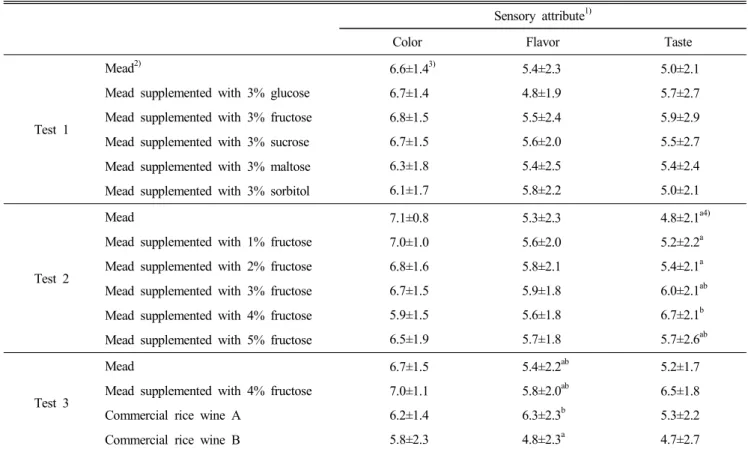
4. Sensory Evaluation for Pine Leaves-Honey Wines By the panel of 19 members (9 males and 10 females), the sensory evaluation for Pinus densiflora-honey wine was shown in Table 5. Pinus densiflora-honey wine containing fructose
Table 4. Volatile compounds of Pinus densiflora-honey wine from alcohol fermentation at 20℃ for 30 days
Pinus densiflora-honey wine
Ethyl acetate(mg/L) 104.7±25.8
Methanol(mg/L) 324.3±169.5
1-propanol(mg/L) 26.7±12.3
iso-Butyl alcohol(mg/L) 68.7±34.3
iso-Amyl alcohol(mg/L) 274.7±149.7
1-butanol(mg/L) 6.3±6.3
Phenethyl alcohol(mg/L) 202.0±140.0 Values are means±S.D. of 3 observations.
gained the highest score, 5.9, when 3% (w/v) of sugars and sugar alcohol were added, however it did not seem in signi- ficantly differences (p<0.05). Preference for Pinus densiflora- honey wine containing 1~5% of fructose was further eva- luated by sensory analysis. Color and favor for each honey wine with different fructose content did not show the diffe- rence of preference with significant difference. However, the taste’s score for 4% fructose group was 6.7, and its preference was much better than the control group (without supplemen- tation of fructose) with significant difference.
In addition, the preference of Pinus densiflora-honey wine supplemented with and without 4% fructose and two kinds of commercial rice wine (Yakju) were evaluated by sensory ana- lysis. Yakju-A and Yakju-B had 16.5% and 13.0% of ethanol content, pH 3.9 and pH 3.7, and 10.0°Bxand 11.0°Bx of su- gar contents, respectively. For color preference, Pinus densi- flora-honey wine supplemented with 4% fructose received the highest appearance values, but the significant difference was not shown.
Pinus densiflora-honey wine supplemented with 4% fruc- tose showed better appearance scores for flavor than Yakju-B, but pore appearance than Yakju-A. According to the report of sensory evaluation(Lee et al 2003), the major factor for pre- ference of Korean red wines was the taste and then color and flavor. The further study will be focused on maintaining pine leaves-flavor in Pinus densiflora-honey wine supplemented with 4% fructose for extended storage.
In this report, we investigated the fermentation characteris- tics and the sensory preference of Pinus densiflora-honey wine.
The change of viable yeast number and decrease of pH showed
Table 5. Sensory quality Pinus densiflora-honey wine supplemented with various sugars and sugar alcohol Sensory attribute1)
Color Flavor Taste
Test 1
Mead2)
Mead supplemented with 3% glucose Mead supplemented with 3% fructose Mead supplemented with 3% sucrose Mead supplemented with 3% maltose Mead supplemented with 3% sorbitol
6.6±1.43) 6.7±1.4 6.8±1.5 6.7±1.5 6.3±1.8 6.1±1.7
5.4±2.3 4.8±1.9 5.5±2.4 5.6±2.0 5.4±2.5 5.8±2.2
5.0±2.1 5.7±2.7 5.9±2.9 5.5±2.7 5.4±2.4 5.0±2.1
Test 2
Mead
Mead supplemented with 1% fructose Mead supplemented with 2% fructose Mead supplemented with 3% fructose Mead supplemented with 4% fructose Mead supplemented with 5% fructose
7.1±0.8 7.0±1.0 6.8±1.6 6.7±1.5 5.9±1.5 6.5±1.9
5.3±2.3 5.6±2.0 5.8±2.1 5.9±1.8 5.6±1.8 5.7±1.8
4.8±2.1a4) 5.2±2.2a 5.4±2.1a 6.0±2.1ab 6.7±2.1b 5.7±2.6ab
Test 3
Mead
Mead supplemented with 4% fructose Commercial rice wine A
Commercial rice wine B
6.7±1.5 7.0±1.1 6.2±1.4 5.8±2.3
5.4±2.2ab 5.8±2.0ab 6.3±2.3b 4.8±2.3a
5.2±1.7 6.5±1.8 5.3±2.2 4.7±2.7
1) 1 : dislike very much, 9 : like very much.
2) Abbreviation: mead, Pinus densiflora-honey wine obtained from alcohol fermentation at 20℃ for 30 days.
3) Values are mean±S.D. (standard deviation).
4) Values with different superscript letters are statistically significant among different type drinks by Friedman test.
the successful honey wine fermentation for 7 days fermen- tation. However the sugar content was decreased slightly for 30 days of whole fermentation period and fermentation was ter- minated with pH 3.05, 0.37% of acidity, and 13.5% of ethanol content. Additionally, the level of fusel oil and phenethyl al- cohol in honey wine were 376 and 202 ppm, respectively. The sensory analysis showed the better preference for tastes of Pinus densiflora-honey wine supplemented with 4% fructose.
The further studies for maintaining the pine leaves-flavor and shortening fermentation period by supplementation of nutrient might be necessary for the commercial products.
국문초록
이 연구의 목적은 솔잎을 꿀로 추출한 추출물을 이용한 발효주를 개발하는 것이다. 솔잎이 첨가되지 않은 꿀을 사용 한 그룹을 대조군으로 비교 평가하였다. 솔잎-벌꿀주와 벌꿀 주 등 2개의 그룹을 20℃에서 30일간 발효한 후 숙성하였다.
솔잎-벌꿀주에서는 발효 초기에 pH와 효모 생균수 변화는 빠 른 속도로 변화하였으나, 당도(°Bx)는 점진적으로 감소하였 다. 효모는 발효 시작 후 5~10일에서 가장 높은 생균수를 보였 다. 발효 전에는 솔잎-벌꿀주에서 발효액의 pH는 3.8으로 벌 꿀주의 pH 3.4보다 높았다. 벌꿀주와 비교시 솔잎-벌꿀주에 서 발효중 당도 감소 속도가 높게 나타났으며, pH는 초기의 산성 pH에서 중성쪽으로 변화하였고, 발효 속도는 증가하였 다. 발효와 숙성을 거친 솔잎-벌꿀주는 13.7°Bx, pH 3.05, 에 탄올 함량 13.5%, 산가 0.37%를 보였다. 솔잎-벌꿀주의 관능 적인 선호도를 높이기 위한 시도에서는 과당을 4% (w/v) 수 준으로 첨가시 가장 결과가 좋았다.
REFERENCES
Albright SC, Winston WL, Zappe C (1999) Data analysis and decision making with Microsoft Excel. Pacific Grove, Calif.
Brooks/Cole Publishing Co. California, USA.
Choi EJ, Lee E, Rhin TJ, Cha BC, Park HJ (1997) Antimicro-
bial activities of pine needle (Pinus densiflora) extract.
Korean J Appl Microbial Biotechnol 25: 293-297.
Choi JH, Kim DI, Park SH, Kim DW, Lee JH, Kim HS (2001) Investigation of anti-aging effect and determination of chemical structure of pine needle (Pinus densiflora) through animal experiment Ⅲ Effects of butanol fraction on oxygen radicals and their scavenger enzymes in brain of SD rats. Kor J Gerontol 11: 7-13.
Chung HJ, Hwang GH, Yoo MJ, Rhee SJ (1996) Chemical composition of pine sprouts and pine needles for the pro- duction of pine sprout tea. Korean J Dietary Culture 11:
635-641.
Hwang Y, Lee KK, Jung GT, Ko BR, Choi DC, Choi YG, Eun JB (2004) Manufacturing of wine with watermelon.
Korean J Food Sci Technol 36: 50-57.
Jung ST, Rhim JW, Kim DH (1999) Fermenetation charac- teristics of honey wine by Saccharomyces bayanus. Korean J Food Sci Technol 31: 1044-1049.
Kahoun D, Rezkova S, Veskrnova K, Kralovsky J, Hokapek M (2008) Determination of phenolic compounds and hyd- roxymethyl furfural in meads using high performance li- quid chromatography with coulometric-array and UV detec- tion. J Chromatog A 1202: 19-33.
Kang YH, Park YK, Ha TY, Moon KD (1996a) Effects of pine needdle extracts on serum and liver lipid contents in rats fed high fat diet. J Korean Soc Food Sci Nutr 25:
367-373.
Kang YH, Park YK, Ha TY, Moon KD (1996b) Effects of pine needdle extracts on enzyme activity of serum and li- ver, liver morphology in rats fed high fat diet. J Korean Soc Food Nutr 25: 374-378.
Kang YH, Park YK, Oh SR, Moon KD (1995) Studies on the physiological functionality of pine needle and mugwort extract. Korean J Food Sci Technol 27: 978-984.
Kim DH, Rhim JW, Jung ST (1999) Clarification and aging of fermented honey wine. Korean J Food Sci Technol 31:
1330-1336.
Kim ES, Rhee CO (1995) Analysis and quantitation of di- and trisaccharides in native-bee honeys using capillary gas chro- matography. Korean J Food Sci Technol 27: 605-611.
Kim JD, Yoon TH, Choi N, Im KJ, Ju JS, Lee SY (1991) Effect of dietary supplementation with pine leaf on lipid para-
meters in rat. Kor J Gerontol 1: 47-50.
Kim SH, Hwang SY, Park OS, Kim MK, Chung YJ (2005) Effect of Pinus densiflora extract on blood glucose level, OGTT and biochemical parameters in streptozotocin in- duced diabetic rats. J Korean Soc Food Sci Nutr 34: 973- 979.
Kim SK (1996) Deacidification of new wild grape wine.
Korean J Food Nutr 9: 265-270.
Kim SY, Kim SK (1997) Winemaking from new wild grape.
Korean J Food Nutr 10: 254-262.
Kim YS, Jeong DY, Shin DH (2008) Optimum fermentation conditions and fermentation characteristics of mulberry (Mo- rus alba) wine. Korean J Food Sci Technol 40: 63-69.
Kim YS, Park YS (2007) The production of traditional alco- holic beverage in cotaining medicinal herb. Food Science Industry 40: 83-89.
Kwon SI, Cho SO, Song SH, Kim YJ (2005) Method for preparing fermented wine using the powder of red ginseng and honey. Korean patent 0470463.
Lee DC, Lee SY, Cha SH, Choi YS, Rhee HI (1997) Charac- teristics of native-bee honey harvested in Kangwon-area.
Korean J Food Sci Technol 29: 1082-1088.
Lee JE, Hong HD, Shin YS, Won YD, Kim SS, Koh KH (2003) A study on the sensory chracteristics of Korean red wine part (III). Korean J Food Sci Technol 35: 841-848.
Lee SJ, Kim EH, Lee HG (2008) Development of rice wines using Cornus officinalis and Scutellaria baicalensis, res- pectively by antioxidant activity tests. Korean J Food Sci Technol 40: 21-30.
Lee SJ, Kwon YH, Kim HR, Ahn BH (2007) Chemical and sensory characterization of Korean commercial rice wines (Yakju). Food Sci Biotechnol 16: 374-380.
Sarneckis C, Dambergs RG, Jones P, Mercurio M, Herderich MJ, Smith P (2006) Quantification of condensed tannins by precipitationwith methyl cellulose: Development and vali- dation of an optimized tool for grape and wine analysis.
Aust J Grape and Wine Res 12: 39-49.
Schramm K (2005) Zymurgy. Available from: http://www.beer- town.org. Accessed Nov/Dec. 21-25.
접 수:
최종수정:
채 택:
2011년 2월 19일 2011년 3월 30일 2011년 4월 21일