J. Fish Pathol., 33(1) : 063~069 http://dx.doi.org/10.7847/jfp.2020.33.1.063
어류 양식장의 사육수는 수산생물 감염성 질병 의 전파 경로 중 가장 큰 비중을 차지한다. 따라서 사육수를 소독하는 일은 어류 질병의 예방을 위한 필수 요소이다(OIE, 2009). 양식 시설 및 양식용 장비의 소독은 다양한 물리적 및 화학적 방법을 이용하여 일상적으로 이루어지고 있다. 하지만 생 물이 생활하고 있는 사육수에 대한 화학적 소독은
양식 중인 생물에게 피해를 줄 수 있어서 조심스럽 게 접근해야 한다. 적은 양의 물을 사용하며 고밀 도로 사육하는 순환여과사육시스템에서 사육수의 소독은 더욱 중요하다(Sharrer and Summerfelt, 2007; Schroeder et al., 2011). 이러한 이유로 병원체 로 인한 질병 발생을 예방하고 수질 향상에 도움을 주기 위하여 다양한 소독 기술의 개발이 진행되고 있으며, 그 중 일부는 이미 양식장에서 이용되고 있다(OIE, 2009). 잔류 소독제를 최소화할 수 있는 소독 방법으로 대표적인 것은 UV light 또는 오존
코로나 방전 플라즈마 처리수에 의한 어류 병원체 소독 효과
유진호 ・ 이지현 ・ 문성희 ・ 권세련 ・ 박태섭
*
・ 권준영†
선문대학교 수산생명의학과, *㈜진진이앤티
Disinfection effect of corona discharged plasma water on fish pathogens
Jin Ho You, Ji Hyun Lee, Seong Hee Mun, Se Ryun Kwon, Tae Sup Park
*and Joon Yeong Kwon
†Department of Aquatic Life Medical Sciences, Sunmoon University, Asan 31460, Korea
*
JIN JIN E&T Co., Ltd., Asan 31450, Korea
Fish culture is constantly threatened by various infectious diseases which are largely transmitted by water. Plasma technology is being used to sterilize polluted water in many industries. In this study, two bacterial pathogens Aeromonas salmonicida and Streptococcus iniae, and a virus (viral hemorrhagic septicemia virus, VHSV) were subjected to plasma water that was produced by a corona discharge system. Growth of A. salmonicida was greatly inhibited from 105.61 CFU/ml in positive control to 103.51 CFU/ml in treated group by only 60 sec contact with plasma water. Similarly, S.
iniae was inhibited from 10
5.85 CFU/ml to 103.40 CFU/ml. VHSV titer also decreased from 104.1 TCID50/ ml to 101.45 TCID50/ml by the same treatment. Activation of water by the plasma was confirmed by the existence of ozone in the plasma water. These results suggest that plasma water could efficiently disinfect fish pathogens, possibly by the action of reactive oxygen species contained in the plasma water.Key words: Plasma, Corona discharge, Ozone, Aeromonas salmonicida, Streptococcus iniae, Viral
hemorrhagic septicemia virus (VHSV)†
Corresponding author: Joon Yeong Kwon
Tel: +82-41-530-2284, Fax: +82-41-530-2917
E-mail: [email protected]
처리 등이 있으며, 최근 플라즈마 처리수(plasma water)를 이용한 사육수 소독도 제안되고 있다.
플라즈마는 고체, 액체, 기체 어디에도 속하지 않는 제 4의 물질 상태로 불리며, 전자, 중성입자, 이온 등의 입자들로 나누어진 상태를 말한다. 수중 플라즈마 생성 공정은 저온 플라즈마(non-thermal plasma)에 속하는 코로나방전(corona discharge)이 나 유전체장벽방전(dielectric barrier discharge, DBD) 등의 플라즈마 발생 장치에 의해 이루어진다. 이중 코로나방전 방식은 처리 공정이 비교적 간단하며, 강한 전기장을 이용하여 플라즈마를 생산한다. 이 때 산소(O2)를 주입하면 수중에 오존(O3), OH 라디 칼, 과산화수소(H2O2) 등 각종 활성산소종(reactive oxygen species, ROS)이 생성된다(Deng et al., 2006).
이러한 ROS들은 강력한 산화력으로 수중의 세균 및 바이러스의 외막과 DNA를 파괴하기 때문에 병 원체 제거에 효과적일 것으로 예상되며, 반응 후 빠르게 분해되어 2차 오염이 없는 장점을 가지고 있다(Lee et al., 2013a,b; Park et al., 2013). 게다가 유기물, 난분해성 물질 제거 및 질소성 물질 감소 등 수질 향상에도 긍정적인 영향을 미친다고 알려 져 있다(Schroeder et al., 2011; Spiliotopoulou et al., 2018). 플라즈마 처리 기술은 수영장 및 선박의 평 형수 소독, 녹조 제거 등 다양한 수처리 분야에서 활발하게 이용되고 있다(Lee et al., 2013a). 수산 양식에 적용하기 위한 노력이 진행 중이지만 플라 즈마 처리수의 어류 병원체 소독에 대한 연구는 아직 충분하지 않다.
Aeromonas salmonicida는 어류에 감염성 질병을
일으키는 병원체의 하나로 무지개송어 를 포함한 연어과 어류에 절창병(furunculosis)을 일으켜 내수 면 양식에 큰 피해를 준다(Janda and Abbott 2010).Streptococcus iniae는 연쇄구균증의 원인 병원체이
며, 담수어 및 해수어 모두 감염되며, 특히 국내에 서는 넙치 양식에 큰 피해를 주는 병원체이다(Shinet al., 2006). 바이러스성출혈성패혈증(viral hemor-
rhagic septicemia, VHS)의 원인 바이러스(VHSV)는 Family Rhabdoviridae, Genus Novirhabdovirus에 속 하며, 외막이 있는 RNA 바이러스이다. VHSV는 성 어보다 치어를 더 잘 감염시키며, 유럽에서는 무지 개송어(Oncorhynchus mykiss)양식에 매우 치명적인 질병으로 알려져 있지만, 국내에서는 넙치와 같 은 해산어류에 치명적 질병을 일으키는 것으로 더 잘 알려져 있다(Kim et al., 2009). 본 연구에서는 어류 병원성 세균 2종(A. salmonicida, S. iniae) 및 바이러스 1종(VHSV)에 대한 플라즈마 처리수의 소독 효과를 평가하였다.
재료 및 방법
플라즈마 발생장치
코로나 방전식 플라즈마 발생장치(corona dis- charge system, 하이브리드형 전자식 플라즈마 발 생장치, model FKC-10TH, 진진이앤티)를 사용하 여 생산한 플라즈마 처리수의 어류 병원성 세균 및 바이러스에 대한 증식억제 능력을 평가하였다.
이 장치에 의한 플라즈마 처리수 생성과정은 Fig.
1과 같다. 산소농축기로부터 플라즈마 발생장치에 산소를 공급하고, 방전관의 전극 사이에 높은 전압 을 걸어 플라즈마를 생성시킨다. 생성된 플라즈마 는 벤츄리, 가압펌프 및 마이크로 믹싱 펌프에 의 해 물과 혼합되어 플라즈마 처리수가 된다. 이 처 리수 안에는 오존, OH 라디칼, 과산화수소 등 다양 한 ROS가 포함되어 있어 살균 및 소독효과를 가질 수 있다. 본 연구에서 사용한 플라즈마 발생장치의 산소주입량은 2~3 LPM이었으며, 플라즈마 발생 량은 7.8~10.4 g/h이었다. 플라즈마 처리수 내의 화 학적 활성종 모두를 정량적으로 측정할 수 없어서, 본 연구에서는 오존 측정기(DOZ5500, Clean In, China)를 사용하여 오존 농도를 측정한 후 이 농도 를 실험 시 기준으로 활용하였다.
세균 소독효과 평가
A. salmonicida와 S. iniae는 각각 1% NaCl이 포함
된 TSB (tryptic soy broth)와 1% NaCl이 포함된 BHIB (brain heart infusion broth)에서 48시간 동안 배양한 후(27℃) 108 CFU/ml이 되도록 준비하였다.소형실험수조(10 L)에 A. salmonicida (108 CFU/ml) 10 ml를 넣은 수돗물 1 L를 투입한 다음 플라즈마 처리수 9 L를 이 수조에 직접 주입하였다. 실험 시 주입할 세균의 농도 및 배양조건 등은 일련의 최적 화 실험을 통해 결정하였다. 양성대조군에는 플라
즈마 처리수 대신 수돗물을 주입하였으며, 음성대 조군에는 세균을 넣지 않았다. 각 그룹을 60초 동 안 실험수조 내 용액과 접촉시키고, 1 ml씩 채수하 였다. 플라즈마 발생장치 작동 시부터 세균과의 접 촉 완료 시까지 플라즈마 처리수 내 오존 농도는 대략 0.1~1 mg/l 사이였다. 채수한 샘플은 PBS로 단계 희석한 다음 TSA (tryptic soy agar) 배지에 100 μl씩 접종하고 도말하였다. 이후 27℃에서 24시간 배양하고, 콜로니를 계수하여 CFU (colony forming unit)로 계산하였다. S. iniae (108 CFU/ml)도 동일한 방법으로 실험을 진행하였으며, 배지의 종류만 BHIA (brain heart infusion agar)배지로 바꾸어 접종 하였다.
병원성 바이러스 소독효과 평가
5% (v/v) fetal bovine serum (FBS)과 1% (v/v) an- tibiotic-antimycotic agent가 첨가된 minimum essen- tial medium (MEM)을 이용하여 epithelioma pap- ulosum cyprini (EPC) 세포를 20℃에 배양하였다.
VHSV (KJ2008 분리주, Kim et al., 2016)를 EPC에 접종하여 15℃에서 3~5일 배양 후 세포변성효과 (cytopathic effect, CPE)를 확인하였다. 배양액을
3,000 ×g에서 15분 동안 원심 분리 후 상층액을 수 거하고 -80℃에 보관하였다. 실험에 사용할 바이 러스의 농도 및 배양 온도조건 등은 일련의 최적화 실험을 통해 결정하였다. 50% tissue culture infec- tious dose (TCID50) 방법으로 VHSV의 역가를 확인 하였고, 최종적으로 얻어진 VHSV의 역가는 108 TCID50/ml였다. 소형실험수조(10 L)에 VHSV를 5 ml를 넣은 수돗물 1 L를 투입한 다음 플라즈마 처 리수 4 L를 이 수조에 직접 주입하였다. 양성대조 군에는 플라즈마 처리수 대신 수돗물을 주입하였 으며, 음성대조군에는 바이러스를 넣지 않았다. 실 험수조 내 온도는 15℃로 유지 시켰으며, 플라즈마 처리수에 60초 동안 접촉 시키고 E-tube에 샘플 1 ml를 채수하였다. 오존 농도는 플라즈마 발생장치 작동 시부터 1분 반응 시간까지 대략 0.17 ~ 1.89 mg/l 사이를 나타냈다. 채수한 샘플은 10단계 희석 한 다음 96 well plate에 미리 배양해 둔 EPC 세포에 50 μl 씩 접종한 후 TCID50을 측정하였다.
통계처리
본 실험 결과는 mean±SD로 나타내었고, 통계처 리는 SPSS program ver.23을 이용하여 진행하였으
Fig. 1. Schematic diagram for the production of plasma water by a corona discharge system. ROS (reactive oxygen
species).
며, one-way ANOVA와 Duncan's multiple range test 를 이용하여 p<0.05 수준에서 유의성을 검증하였다.
결과 및 고찰
플라즈마 처리수는 어류 병원성 세균 2종(A. sal-
monicida, S. iniae) 및 바이러스 1종(VHSV)을 효과
적으로 소독하였다. 플라즈마 처리수 내의 어떤 인 자가 이러한 효과를 유도하였는지는 명확하지 않 으나, 플라즈마 처리수에 포함되어 있는 ROS로부 터 비롯되었을 가능성이 높다.세균(Aeromonas salmonicida, Streptococcus iniae) 소독효과
코로나 방전식 플라즈마 처리수를 A. salmonici-
da와 S. iniae에 처리하여 증식억제 능력을 평가하
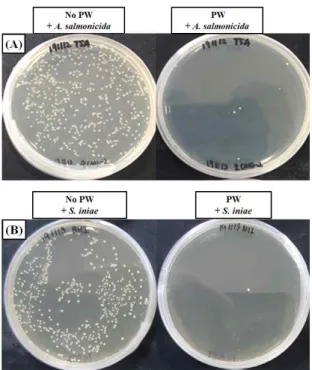
였다. 그 결과 A. salmonicida 양성대조군은 105.61 CFU/ml이었던 반면 플라즈마 처리수를 주입한 실 험군은 103.51CFU/ml으로서 A. salmonicida에 대해 99.21%의 증식억제율을 보였다. 이와 비슷하게 S.iniae 양성대조군은 10
5.85CFU/ml이었으며, 실험군 은 103.40CFU/ml으로서 S. iniae 실험군은 양성대조 군에 비해 99.64%의 증식억제율을 보였다. 따라서A. salmonicida와 S. iniae 모두에서 플라즈마 처리
수에 의한 세균 소독 효과가 뚜렷이 확인되었다 (Fig. 2, Fig. 3). 음성대조군에서는 세균이 검출되 지 않았다.얻어진 효과의 원인물질은 플라즈마 처리수 내 의 ROS일 가능성이 높다(Guo et al., 2015). 본 연구 에서는 대표적 ROS의 하나인 오존의 농도를 모니 터링하였고, 플라즈마 처리수가 세균과 접촉하는 시간 동안(60초), 처리수 내 오존 농도는 0.1 ~ 1 mg/l 사이였다. 오존의 살균 효과는 이미 오래전 보고된 바 있는데, 오존 농도 0.1 ~ 1.0 mg/l의 물을 60초 동안 세균 A. salmonicida, Aeromonas liquefa-
ciens, Pseudomonas fluorescens, Yersinia ruckeri 등
에 처리 하였을 때 99% 이상의 세균 감소 효과가 있었다(Colberg and Lingg, 1978). 또한 오존은 다양 한 해산어류 병원체 Enterococcus seriolicida, Vibrioanguillarum, Pasteurella piscicida 등에 대해서도 살
균 효능을 갖는 것으로 보고되었다(Sugita et al.,1992). 플라즈마 수중방전 장치를 사용한 실험에 서는 솔방울병 원인 병원체(Aeromonas hydrophila) 를 관상어 사육수조에 투입하였을 때, 플라즈마 장
Fig. 2. Disinfection of pathogenic bacteria by treatment with plasma water. Aeromonas salmonicida (A) and Streptococcus iniae (B) were incubated in TSA plate and BHI plate, respectively. No PW: Not treated with plasma water, PW: Treated with plasma water.
Fig. 3. Difference of bacterial growth (Aeromonas sal-
monicida and Streptococcus iniae) in log number of col-
ony forming unit (CFU) between No PW (■, not treated
with plasma water) and PW (□, treated with plama wa-
ter). (1 = 1 log
10CFU/ml). * indicates significant differ-
ence between No PW and PW (P<0.05).
치가 설치된 수조에서는 세균 투입 2일 만에 세균 98%가 제거되었고 대조구에 비해 관상어의 생존 율도 유의하게 높았다(Lee et al., 2013a). 한편, 전기 분해장치에서 발생한 mixed oxidant (MO)에 노출 된 Streptococcus parauberis에 대한 살균효과도 확 인되었다(Park et al., 2018). 이상의 모든 실험에서 소독 효과는 여러 종류의 ROS와 관련되어 있었다.
바이러스(VHSV) 소독효과
플라즈마 처리수를 VHSV에 처리하여 소독효과 를 평가한 결과 VHSV 대조군은 104.1TCID50/ml 역 가를 보였으며, 실험군은 101.45TCID50/ml 역가를 보였다. 따라서 실험군은 대조군과 비교하여 102.65 TCID50/ml의 역가 차이가 나타났으며, 명백한 바이 러스 불활성화 효과를 확인하였다(Fig. 4). 음성대 조군에서는 세포변성효과(CPE)가 나타나지 않았 다. 세균 실험에서와 마찬가지로 플라즈마 처리수 의 바이러스 소독효과도 ROS에 의해 비롯되었을 것으로 추측된다(Filipic et al., in press). 바이러스 실험 시 오존의 농도는 접촉 시간 동안(60초) 0.17
~ 1.89 mg/l 사이였다. 오존은 VHSV와 같은 rhab-
doviridae에 속하는 탄환형 바이러스인 vesicular
stomatitis Indian virus (VSIV)를 효과적으로 불활성 화 시켰다(Murray et al., 2008). Ultraviolet C (UVC) radiation에 노출된 infectious hematopoietic necrosis virus (IHNV)와 VHSV도 모두 불활성화되었는데 (Afonso et al., 2012), UV 처리가 ROS를 생성하는것은 잘 알려진 사실이다. ROS는 바이러스의 외막 (Envelope) 또는 단백질외각(Capsid)에 처음으로 접촉하며, 외막과 캡시드가 파괴되면 보호되지 않 은 핵산(nucleic acid)과 반응하여 바이러스를 불활 성화 시킨다.
플라즈마 처리수는 오존뿐만 아니라 OH 라디 칼, 과산화수소 등 다양한 화학적 활성종들을 포함 하고 있으며 이들이 복합적으로 작용하여 난분해 성 물질 및 병원체를 제거할 수 있기 때문에 다양 한 산업분야에서 활용하고 있다. 하지만 수산양식 분야에서 플라즈마 처리수의 적절한 활용 방법은 아직 개발되지 않았다. 플라즈마 처리수의 살균 효 능에 영향을 주는 인자들은 여러 가지가 있지만 가장 중요한 인자는 농도와 접촉시간이다. 오존 농 도는 물속 유기물이 많을수록 빨리 낮아지며 물과 접촉 후 시간이 경과함에 따라 급격히 낮아진다 (Lee et al., 2012; Sharrer and Summerfelt, 2007). 본 연구에서 플라즈마 처리수에 60초 동안 접촉시켰 을 때 살균력이 99.9% 보다 낮았던 것은 투입된 세균량이 많았고, 오존의 빠른 반감기로 인해 살균 력이 감소된 것으로 추정된다. 또한 이 때문에 플 라즈마 처리수와의 접촉시간을 60초 이상 3분, 5 분, 15분으로 늘려주어도 살균력이나 소독효과가 더 증가하지 않았다(data shown). 플라즈마 처리수 가 ROS를 통해 살균력을 갖는 시간은 매우 짧다.
따라서 수산양식 분야에서 플라즈마 처리수를 “살 균력이 있는 물”로 사용하기 보다는 ROS 제거 후
“살균이 완료된 물”로 활용하는 것이 더 적절할 수 있다.
결론적으로 본 연구에서는 플라즈마 처리수의 어류 병원체 A. salmonicida, S. iniae, VHSV에 대한 소독효과를 확인하였다. 양식장 사육수의 병원체 제거에 활용할 수 있을 것으로 예상되나, 플라즈마 처리수의 효과가 ROS를 통해 발휘되므로 ROS의 독성(Ritola et al. 2002)과 물질적 불안정성을 고려 하여 안전하고 효율적인 이용을 위한 추가 연구가 이루어져야 할 것이다.
감사의 글
본 결과물은 농림축산식품부의 재원으로 농림
Fig. 4. Difference of infectivity titers of viral hemor-
rhagic septicemia virus (VHSV) between No PW (■,
not treated with plasma water) and PW (□, treated with
plama water). (1 = 1 log
10TCID
50/ml). * indicates sig-
nificant difference between No PW and PW (P<0.05).
식품기술기획평가원의 농식품연구성과후속지원 사업의 지원을 받아 연구되었음(818006-02).
References