ORIGINAL ARTICLE
영가철 및 개질 영가철을 이용한 triclosan의 환원분해 특성
최정학 김영훈1)*
부산가톨릭대학교 환경공학과, 1)안동대학교 환경공학과
Reduction Characteristics of Triclosan using Zero-valent Iron and Modified Zero-valent Iron
Jeong-Hak Choi, Young-Hun Kim1)*
Department of Environmental Engineering, Catholic University of Pusan, Busan 46252, Korea
1)Department of Environmental Engineering, Andong National University, Andong 36729, Korea
Abstract
In this study, the reductive dechlorination of triclosan using zero-valent iron (ZVI, Fe0) and modified zero-valent iron (i.e., acid-washed iron (Aw/Fe) and palladium-coated iron (Pd/Fe)) was experimentally investigated, and the reduction characteristics were evaluated by analyzing the reaction kinetics. Triclosan could be reductively decomposed using zero-valent iron. The degradation rates of triclosan were about 50% and 67% when Fe0 and Aw/Fe were used as reductants, respectively, after 8 h of reaction. For the Pd/Fe system, the degradation rate was about 57% after 1 h of reaction. Thus, Pd/Fe exhibited remarkable performance in the reductive degradation of triclosan. Several dechlorinated intermediates were predicted by GC-MS spectrum, and 2-phenoxyphenol was detected as the by-product of the decomposition reaction of triclosan, indicating that reductive dechlorination occurred continuously. As the reaction proceeded, the pH of the solution increased steadily; the pH increase for the Pd/Fe system was smaller than that for the Fe0 and Aw/Fe system. Further, zero-order, first-order, and second-order kinetic models were used to analyze the reaction kinetics. The first-order kinetic model was found to be the best with good correlation for the Fe0 and Aw/Fe system. However, for the Pd/Fe system, the experimental data were evaluated to be well fitted to the second-order kinetic model. The reaction rate constants (k) were in the order of Pd/Fe > Aw/Fe > Fe0, with the rate constant of Pd/Fe being much higher than that of the other two reductants.
Key words : Triclosan, Zero-valent iron (ZVI), Modified ZVI, Reductive dechlorination, Reaction rate constant 1)1. 서 론
최근 우리의 일상생활에 밀접하게 연관되어 널리 사 용되고 있는 의약품 및 개인관리용품(Pharmaceuticals and Personal Care Products, PPCPs)이 환경으로의 유
출 시 생태계 및 인간의 건강과 안전성을 위협하는 신 생오염물질(emerging pollutants)로 관심의 대상이 되 고 있다(Zuccato et al., 2000). PPCPs 물질 중 triclosan (5-chloro-2-(2,4-dichlorophenoxy)phenol)은 광범위 한 항균성을 지니는 합성 항균제로 소독제, 비누,
Received 20 June, 2017; Revised 17 July, 2017;
Accepted 20 July, 2017
*Corresponding author: Young-Hun Kim, Department of Environ -mental Engineering, Andong National University, Andong 36729, Korea
Phone : +82-54-820-5818 E-mail : [email protected]
ⓒ The Korean Environmental Sciences Society. All rights reserved.
This is an Open-Access article distributed under the terms of the Creative Commons Attribution Non-Commercial License (http://
creativecommons.org/licenses/by-nc/3.0) which permits unrestricted non-commercial use, distribution, and reproduction in any medium, provided the original work is properly cited.
세제, 치약 등 다양한 개인생활용품 및 주방용품에 첨 가되어 사용되고 있으며, 그 사용량이 매년 증가함에 따라 환경으로의 유출량도 증가하는 추세에 있다 (Dann and Hontela, 2011; Kim et al., 2014). 수환경 으로의 triclosan 유출은 주로 하·폐수처리시설의 방류 수나 슬러지 처분 과정에서 주로 나타나며, 재래식 하·
폐수처리공정에서의 triclosan 제거율은 매우 낮은 것 으로 알려져 있다(Federle et al., 2002; McAvoy et al., 2002; Ying et al., 2009; Yang et al., 2011).
선행 연구결과에 따르면, 처리수 방류 후 지표수에 서 검출된 triclosan의 평균농도 범위는 호주의 경우 75 ng/L(Ying and Kookana, 2007), 미국의 경우 140 ng/L(Kolpin et al., 2002)로 보고된 바 있다. 비록 실 제 환경 중 triclosan의 농도가 미량으로 존재하고 있 기는 하지만, triclosan은 물에서 안정한 친유성 화합 물이며 상대적으로 높은 옥탄올-물 분배계수(pH 7에 서 log Kow = 4.8)를 가지고 있어 수중생물에 장기간 노출될 경우 생체축적 및 독성을 야기할 수 있다. 또한 구조적으로 내분비계 교란물질과 유사하여 어류나 양 서류 등의 성비 교란 및 갑상선 항상성에 영향을 미칠 수 있음이 보고된 바 있으며, 수환경에 존재하여 태양 광에 노출될 경우 광화학반응을 통해 다이옥신 (2,8-dichlorodibenzo-p-dioxin (2,8-DCDD))을 생성 한다고도 알려져 있다(Ishibashi et al., 2004; Mezcua et al., 2004; Crofton et al., 2007; Kim et al., 2014).
일반적으로 염소에 의해 산화된 유기염소계 화합 물의 경우, 환원처리가 분해 또는 독성 저감에 유리할 수 있으며, 영가금속(Zero-Valent Metals, ZVMs)이 가지는 높은 환원력을 이용하여 비교적 쉽게 산화-환 원 반응을 유도할 수 있다. 영가금속을 이용한 환원처 리는 독성이 높은 염소계 유기화합물과 Cr(VI), nitrate 등의 무기오염물질을 환원하여 독성을 저감시 키는 결과를 보이고 있으며, 지하수 및 토양오염 복원 을 위한 반응벽체(Permeable Reactive Barriers, PRBs) 공법에도 적용되고 있다(Johnson et al., 1998; Blowes et al., 2000; Choi et al., 2007; Choi et al., 2008; Choi and Kim, 2009; Choi et al., 2009). 또한, 염색폐수에 포함된 염료의 경우에도 영가금속에 의한 환원처리로 색도 제거가 가능한 것으로 알려져 있다(Cao et al., 1999; Deng et al., 2000; Nam and Tratnyek, 2000;
Ma et al., 2004).
Triclosan은 염소 원자(Cl) 3개가 치환되어 산화된 상태의 염소계 유기화합물로서(Fig. 1), 환원에 의한 분해 및 처리가 유리하게 적용될 수 있을 것으로 판단 되며, 앞선 많은 연구에서 영가철 또는 이중금속을 이 용한 염소계 유기화합물의 분해반응은 염소를 제거하 는 탈염소반응으로 보고하였다(Kim and Carraway, 2000; Li and Farrell, 2000; Morales et al., 2002; Choi et al., 2008; Choi and Kim, 2009). 따라서 영가금속 을 이용한 triclosan의 환원반응 역시 탈염소반응일 것 으로 예상된다. 이에 본 연구에서는 영가철(Zero -Valent Iron, ZVI) 및 개질 영가철(Modified ZVI)을 이용하여 triclosan의 탈염소화 및 환원분해 반응을 유 도하고, 다양한 반응 조건에서의 환원분해 양상을 살 펴보고자 하였다. 또한 triclosan의 분해과정 중 나타 나는 중간생성물의 생성과 분해를 규명하고, kinetic 분석을 통해 각 조건별 반응속도상수를 도출하고자 하였다.
2. 재료 및 방법
2.1. 실험 재료
환원제로 사용된 영가철(zero-valent iron, Fe0)은 Aldrich사에서 구입한 영가철 분말(iron powder (fine), 99%)을 전처리 없이 사용하였으며, 이와 함 께 표면의 산화피막을 제거하기 위해 산세척 과정을 거친 acid-washed Fe (Aw/Fe)와 palladium (Pd) 촉매 를 코팅한 Pd/Fe를 제조하여 triclosan의 환원처리에 적용하였다. Aw/Fe는 100 g의 영가철 분말에 0.05 N 염산(HCl) 용액 100 mL을 주입하고 180 rpm에서 10 분간 교반 후 증류수로 2회, 아세톤으로 2회 헹구어 drying oven (60 65 )에서 6 7시간 동안 완전히 건조시켜 제조하였다. Pd/Fe는 PdCl2 용액(5 wt.%
solution in 10 wt.% HCl, Sigma-Aldrich, Inc.) 2 mL 을 증류수 100 mL에 주입하여 희석시킨 후, 이 용액 에 미리 제조해 둔 Aw/Fe 100 g을 넣고 180 rpm에서 20분간 교반 후 증류수로 2회, 아세톤으로 2회 헹구어 drying oven (60 65 )에서 6 7시간 동안 완전히 건조시켜 제조하였다. 제조한 Aw/Fe와 Pd/Fe는 암소 에 보관하여 사용하였다. 환원처리의 대상물질로
사용된 triclosan은 Sigma-Aldrich사에서 구입한 시약 을 별도의 전처리 없이 그대로 사용하였다.
Fig. 1. Chemical structure of triclosan.
2.2. 실험 방법
실험에 사용된 triclosan 용액은 먼저 methanol을 용매로 한 1000 mg/L의 stock solution을 제조한 후, 이를 30 50 μM 농도로 희석하여 초기 농도로 하였 다. 60 mL 용량의 vial에 triclosan 용액 40 mL과 환원 제(Fe0, Aw/Fe, Pd/Fe) 1.0 g을 주입한 후, shaking incubator (25 , 180 rpm)에서 반응을 진행시켰다.
반응 시작 및 반응 중에 별도의 pH 조절은 하지 않았 다.
반응 시작 후 일정 시간 간격으로 vial을 꺼내 반응 후 용액의 pH를 측정(model 250, Thermo Orion)하 고, Gas Chromatography (GC) 분석을 위해 반응물을 추출하였다. 추출 용매로는 n-Hexane (95%, HPLC grade, Tedia Company, Inc., USA)을 사용하였으며, 각각의 반응물에 10 mL의 n-Hexane을 주입한 후 shaking incubator (25 , 180 rpm)에서 10분간 추출 을 진행하였다. 추출된 반응물의 정량 및 정성 분석에 는 GC-ECD (GC-2010 Plus, SHIMADZU)와 GC-MS (5977A Series GC/MSD System, Agilent)를 이용하 였으며, 모든 실험은 회분식으로 3회 반복실험을 통해 결과를 도출하였다.
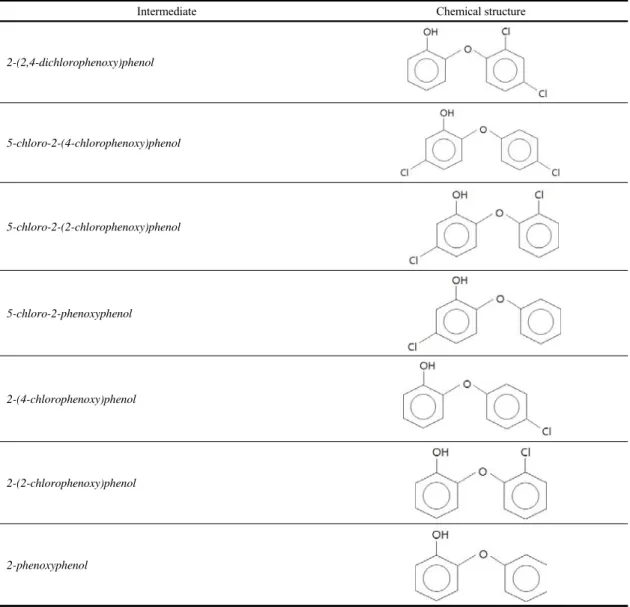
일반적으로 염소가 제거될수록 오염물질의 독성이 낮아지지만, 오히려 독성이 높아지는 경우도 있어 분 해생성물의 분석은 환원적 분해 연구에서 중요한 부 분이다. 이에 본 연구에서는 GC-MS를 이용하여 반응 물과 생성물의 구조를 파악하고자 하였는데, triclosan 의 탈염소 생성물은 1개의 염소가 제거된 생성물로 3 개의 이성질체가 가능하며(2-(2,4-dichlorophenoxy) phenol, 5-chloro-2-(4-chlorophenoxy)phenol, 5-chloro -2-(2-chlorophenoxy)phenol), 2개의 염소가 제거된
생성물로 3개의 이성질체(5-chloro-2-phenoxyphenol, 2-(4-chlorophenoxy)phenol, 2-(2-chlorophenoxy)phenol) 가 가능하다. 또한 3개의 염소가 모두 제거된 경우의 생성물은 2-phenoxyphenol이다. Triclosan의 탈염소 화 반응으로 생성 가능한 물질들의 구조를 Table 1에 나타내었다. 국내외에서 상업적으로 구입가능한 생성 물은 없으며, GC-MS 제조사가 제공하는 mass spectrum library에는 triclosan과 3개의 염소가 모두 제거된 2-phenoxyphenol만이 포함되어 있다.
3. 결과 및 고찰
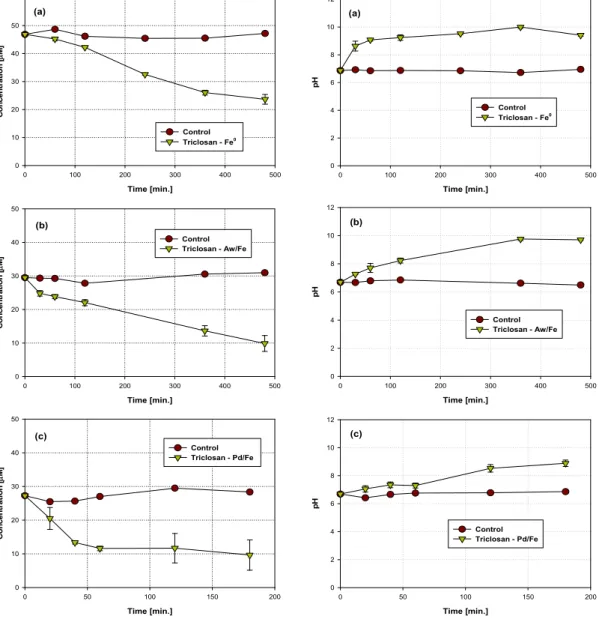
3.1. Fe0, Aw/Fe 및 Pd/Fe를 이용한 triclosan의 제거 Fe0, Aw/Fe 및 Pd/Fe를 환원제로 사용한 triclosan 의 제거 결과를 Fig. 2에 나타내었다. Fig. 2에 나타난 바와 같이 (a) Fe0의 경우 반응 시간이 경과함에 따라 triclosan의 농도가 감소하였으며, 480분 반응 후 49.9%의 제거율을 보였다. 영가철의 표면을 개질한 (b) Aw/Fe 및 (c) Pd/Fe의 경우는 (a) Fe0의 경우보다 제거율이 우수한 것으로 나타났으며, (b) Aw/Fe의 경 우 480분 반응 후 68.1%, (c) Pd/Fe의 경우는 180분 반응 후 66.0%의 제거율을 보였다. 영가철에 의한 염 소계 유기화합물의 분해 제거는 이미 염소(Cl)기로 치환되어 산화상태에 있는 염소계 유기화합물이 영 가철의 높은 환원력(표준환원전위 E0(vs. SHE) =
0.44 V)에 의해 탈염소화가 진행되어 나타나는 것 으로 보고되고 있으며, 환원에 의한 탈염소화 반응은 아래의 반응식으로 요약할 수 있다(Matheson and Tratnyek, 1994). 본 실험 결과에서 나타난 영가철에 의한 triclosan의 제거 역시 탈염소화에 따른 분해에 기 인한 것으로 판단되며, 이를 확인하기 위해 triclosan의 분해반응 진행에 따른 중간생성물을 GC-MS를 이용 하여 분석하고, 그 결과를 3.3에 나타내었다.
Fe2+ + 2e- Fe0 (E0 (vs. SHE) = -0.44 V) (1) RX + H+ + 2e- RH + X- (2) Fe0 + RX + H+ Fe2+ + RH + X- (3)
영가금속을 이용한 염소계 유기화합물과 nitrate 등 의 환원처리에 있어서 영가금속 표면을 산세척 하거나
Intermediate Chemical structure
2-(2,4-dichlorophenoxy)phenol
5-chloro-2-(4-chlorophenoxy)phenol
5-chloro-2-(2-chlorophenoxy)phenol
5-chloro-2-phenoxyphenol
2-(4-chlorophenoxy)phenol
2-(2-chlorophenoxy)phenol
2-phenoxyphenol
Table 1. Possible intermediates of the dechlorination of triclosan
촉매 금속을 코팅한 이중금속(bimetal)을 제조하여 반 응성을 향상시킨 선행 연구결과들이 다수 보고된 바 있으며(Choi et al., 2007; Choi et al., 2008; Choi and Kim, 2009; Choi et al., 2009), Choi et al.(2008)은 2,4,6-trichlorophenol의 환원분해 연구에서 Fe0 사용 시에 40일 반응시간 동안 전혀 분해가 진행되지 않은 반면, Pd/Fe(Pd 농도 = 636 ppm) 사용 시에는 5일 이 내에 탈염소화가 완전히 진행되어 phenol이 주된 반 응 생성물로 나타남을 보고하였다. 이는 촉매를 입힌
이중금속을 사용할 경우 환원 반응에 관여하는 수소 이온(H+)이 촉매 금속의 격자 내에 삽입되어 H2 기체 로 환원되기보다 대상물질을 환원시키는데 유리하게 작용하는 효과가 있어 반응성이 향상되는 것으로 알 려져 있다(Cheng et al., 1997; Scherer et al., 2000).
따라서, 본 연구에서도 Pd를 촉매로 한 이중금속 (Pd/Fe)을 제조하여 적용한 결과, 반응성 및 triclosan 의 제거율이 반응 초기에 다른 환원제에 비해 높게 나 타남을 확인할 수 있었다.
Time [min.]
0 100 200 300 400 500
Concentration [M]
0 10 20 30 40 50 60
Control Triclosan - Fe0 (a)
Time [min.]
0 100 200 300 400 500
Concentration [M]
0 10 20 30 40 50
Control Triclosan - Aw/Fe (b)
Time [min.]
0 50 100 150 200
Concentration [M]
0 10 20 30 40 50
Control Triclosan - Pd/Fe (c)
Time [min.]
0 100 200 300 400 500
pH
0 2 4 6 8 10 12
Control Triclosan - Fe0 (a)
Time [min.]
0 100 200 300 400 500
pH
0 2 4 6 8 10 12
Control Triclosan - Aw/Fe (b)
Time [min.]
0 50 100 150 200
pH
0 2 4 6 8 10 12
Control Triclosan - Pd/Fe (c)
Fig. 2. Degradation of triclosan using zero-valent iron and modified zero-valent iron.
Fig. 3. pH variations during the degradation reaction of triclosan using zero-valent iron and modified zero-valent iron.
3.2. Triclosan 제거반응에 따른 pH 변화
Triclosan 제거반응에 따른 pH 변화 양상을 Fig. 3 에 나타내었다. 제조한 triclosan 용액의 초기 pH는 6.5 7.0 사이의 영역으로 측정되었으며, 영가철과의 반응이 진행됨에 따라 pH가 지속적으로 상승하는 경 향을 보였다. Fig. 3에서 나타난 바와 같이 (a) Fe0에서
는 반응 초기 60분 후에 pH가 9.1로 상승하였고, 이후 반응시간이 경과함에 따라 pH가 9.5 10.0까지 높아 지는 결과를 보였다. (b) Aw/Fe의 경우는 반응 초기 60분 후에 pH가 7.7로 상승하였으며, 480분의 반응 경과 후에는 9.7 수준까지 상승하였다. 반면, (c) Pd/Fe 의 경우에서는 초기 60분 반응 후에 pH 7.3, 180분
반응 후에 pH 8.9로 나타나 pH 상승폭이 상대적으로 작게 나타남을 확인할 수 있었다. 또한 반응 초기 triclosan의 환원 분해반응이 Pd/Fe > Aw/Fe > Fe0 순 으로 나타났음에도 초기 pH의 증가속도는 Fe0 >
Aw/Fe > Pd/Fe 순으로 나타났다. 이는 Fe0에서 수소 이온(H+)이 triclosan의 환원 분해반응에 충분히 이용 되지 못하고 H2 기체 형태로 환원됨에 따른 결과로 보 이며, 반면 Pd/Fe에서는 환원 반응에 관여하는 H+ 이 온이 촉매로 사용된 Pd 격자 내에 삽입되어 H2 기체로 환원되기보다 triclosan을 환원시키는데 충분히 사용 됨에 따른 결과라고 판단된다(Cheng et al., 1997;
Scherer et al., 2000).
3.3. Triclosan 분해반응 중간생성물
Triclosan 분해반응의 중간생성물을 확인하기 위해 triclosan (control)과 Pd/Fe를 사용하여 120분 반응 후 추출한 샘플을 대상으로 GC-MS 분석을 진행하였다.
Fig. 4는 triclosan 및 triclosan의 분해생성물 중 GC-MS로 분석된 질량 스펙트럼(mass spectrum)을 나타내었다. Triclosan 및 1개, 2개, 3개의 염소가 제거 될 경우 생성물의 분자량(g/mol)은 각각 289.5, 254.0, 218.5, 183.0이다. Triclosan은 19.639 min에 peak가 나타났으며, 질량 스펙트럼은 Fig. 4(a)이다. 이는 GC-MS library의 표준 스펙트럼과 비교되어 확인이 되었다. 1개 염소가 제거된 분해생성물로 판단되는 물 질은 15.998 min과 16.498 min에 검출되었으며, 질량 스펙트럼은 각각 Fig. 4(b)와 Fig. 4(c)이다. 15.998 min의 스펙트럼의 경우 146.0의 m/z가 검출되었으며, 이는 benzene 고리에 2개의 염소가 결합되어 있는 경 우로 phenol 고리의 염소가 먼저 제거된 후 생성된 분 해생성물로 판단된다. 반면 16.498 min의 스펙트럼에 서는 146.0의 m/z가 발견되지 않아 triclosan의 phenol 고리와 benzene 고리 가운데 benzene 고리에서 염소 가 제거된 형태의 분해생성물일 가능성이 높은 것으 로 판단된다. 2개의 염소가 제거된 분해생성물은 13.020 min에 peak가 나타났으며, 스펙트럼은 Fig.
4(d)이다. 128.1의 m/z가 검출된 것으로 보아 phenol 고리에 염소가 결합된 형태의 분해생성물로 판단된 다. 3개의 염소가 모두 제거된 분해생성물인 2-phenoxyphenol은 10.168 min에 peak가 나타났으
며, 질량 스펙트럼은 Fig. 4(e)이다. 이는 GC-MS library의 표준 스펙트럼과 비교되어 확인되었으며, 상기 분해생성물의 예측과 확인을 통해 연속적인 탈 염소화 반응이 일어났음을 알 수 있다.
3.4. Triclosan 제거반응의 반응속도 모델 및 속도상수 Fe0, Aw/Fe 및 Pd/Fe를 이용한 triclosan 분해의 반 응속도 해석을 위하여 식(4)를 이용하여 0차, 1차 및 2 차 분해반응속도식으로 속도상수를 도출하고, 결과를 비교하였다(Fogler, 2001).
(4)
0차, 1차 및 2차 분해반응속도식은 조건 t=0에서 C=C0, t=t에서 C=Ct로 하여 적분하면 식(5) (7)로 나 타낼 수 있다.
(5) ln
(6)
(7)
여기서, k0는 0차 반응속도상수(μM/min)이고, k1은 1차 반응속도상수(1/min), k2는 2차 반응속도상수 (1/min/μM)이다. C0와 Ct는 각각 초기농도와 평형시 간 t에서의 농도(μM)를 나타낸다.
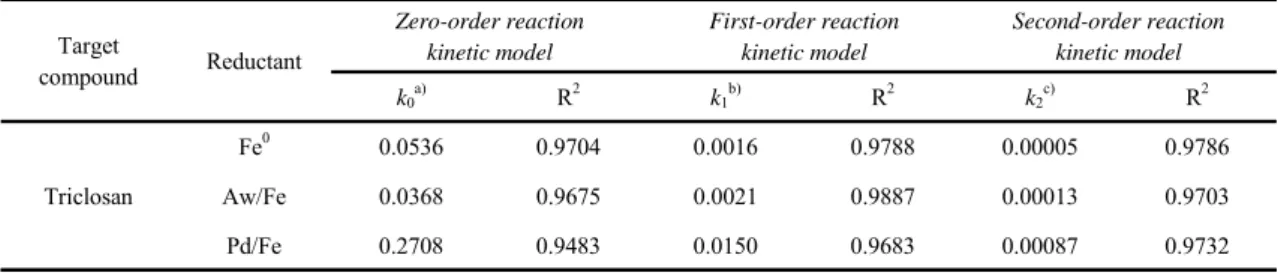
Fe0, Aw/Fe 및 Pd/Fe을 이용한 triclosan 분해실험 을 통해 얻은 결과를 식(5) (7)에 각각 적용하여 반응 차수에 따른 속도상수를 도출하여 Table 2에 나타내 었다. Fe0와 Aw/Fe에 의한 triclosan의 분해 반응은 와 t, ln와 t, 그리고 와 t의 상관계수(R2)가 0 2차 반응속도식에서 0.9675 0.9887로서 크게 변 화하지 않았다. 하지만, Pd/Fe에 의한 triclosan의 분해 반응에서 상관계수(R2)는 0차 반응에서 0.9483, 1차 반응에서 0.9683 및 2차 반응에서 0.9732로 점차 증가 하는 경향을 보였다. 이 결과는 Fe0와 Aw/Fe에 비해 Pd/Fe의 경우, 첨가된 Pd가 촉매작용을 하여 triclosan 의 분해가 반응초기에 빠르게 진행되기 때문에 높은
Fig. 4. Mass spectrum of triclosan((a)) and intermediates((b) (e)) of the decomposition reaction of triclosan.
Target
compound Reductant
Zero-order reaction kinetic model
First-order reaction kinetic model
Second-order reaction kinetic model
k0a) R2 k1b) R2 k2c) R2
Triclosan
Fe0 0.0536 0.9704 0.0016 0.9788 0.00005 0.9786
Aw/Fe 0.0368 0.9675 0.0021 0.9887 0.00013 0.9703
Pd/Fe 0.2708 0.9483 0.0150 0.9683 0.00087 0.9732
a)Zero-order reaction rate constant [μM/min]
b)First-order reaction rate constant [1/min]
c)Second-order reaction rate constant [1/μM/min]
Table 2. Kinetic analysis of the degradation reaction of triclosan using zero-valent iron and modified zero-valent iron
반응차수에서 상관계수(R2)가 높게 나타난 것으로 사 료된다. 반응속도상수는 Pd/Fe > Aw/Fe > Fe0 순이었 으며, Pd/Fe의 속도상수가 월등히 높게 나타나 Pd 촉 매에 의한 반응성 향상을 확인할 수 있었다.
Fig. 5는 Fe0, Aw/Fe 및 Pd/Fe의 triclosan 분해 결 과를 0차, 1차 및 2차 반응속도 모델에 적용한 모델링 결과이다. Triclosan의 분해에 있어 실험치와 예측치 가 정확하게 일치하지는 않았다. 하지만, Fe0 < Aw/Fe
< Pd/Fe의 순으로 반응차수가 높은 반응속도식에 의 해 더 잘 예측되었으며, Pd/Fe의 경우 촉매반응에 의 해 초기 분해 속도가 증가한다는 것을 확인할 수 있었 다. 선행 연구에서도 TiO2를 이용한 광촉매 분해 반응 에서 ZnO를 첨가하게 되면 triclosan의 분해반응속도 가 2배 정도 증가한다고 보고하였다(Kosera et al., 2017). 또한, Fe(IV)에 의한 산화반응에서 triclosan의
t (min)
0 100 200 300 400 500 600
Concentration (M)
0 10 20 30 40 50
Triclosan + Fe0 Triclosan + Aw/Fe Triclosan + Pd/Fe Zero order reaction 1st order reaction 2nd order reaction
Fig. 5. Comparison of reaction order rate by using zero- valent iron and modified zero-valent iron.
분해반응속도는 Fe(IV)와 triclosan의 농도에 의존하 는 2차 분해반응속도(
) 로 나타낼 수 있으며, R2=0.986으로서 이 식에 의해 잘 모사된다고 하였다(Yang et al., 2011). 본 연구결 과는 Kosera et al.(2017)와 Yang et al.(2011)가 제시 한 결과와 유사하게 영가철에 의한 triclosan의 분해와 Pd의 촉매반응이 동시에 일어나 Fe0 < Aw/Fe < Pd/Fe 의 순서와 반응속도식의 반응차수가 정비례하는 결과 를 보인 것으로 판단된다.
4. 결 론
1) 영가금속을 사용하여 triclosan의 환원 분해반응 을 유도할 수 있었다. Triclosan의 환원 분해에 있어서 Fe0과 Aw/Fe를 환원제로 사용한 경우 8시간 반응 후 에 약 50%와 67%의 분해율을 보였고, Pd/Fe를 사용 한 경우 1시간 반응 후에 약 57%의 분해율을 보여 Pd/Fe의 분해능이 월등히 우수한 것으로 나타났다.
2) Triclosan 분해반응의 중간생성물로 1개의 염 소가 제거된 생성물 2개와 2개의 염소가 제거된 생성 물 1개가 질량 스펙트럼으로 확인되었으며, 3개의 염 소가 모두 제거된 분해생성물(2-phenoxyphenol)은 GC-MS의 표준 스펙트럼과 비교되어 확인되었다. 이 를 통해 연속적 탈염소반응이 일어났음을 알 수 있다.
3) 반응이 진행됨에 따라 pH가 지속적으로 상승하 는 경향을 보였으며, pH의 상승폭은 Pd/Fe가 Fe0 및 Aw/Fe 보다 작게 나타났다. 이는 용액 내 H+가 환원 되어 triclosan의 Cl을 치환하는데 유리하도록 유도하는
Pd 촉매의 역할(intercalation)에 기인한 것으로 사료 된다.
4) Triclosan의 분해반응을 0차, 1차, 2차 반응속도 모델에 각각 적용한 결과, Fe0과 Aw/Fe의 경우는 1차 반응속도 모델에, Pd/Fe의 경우는 2차 반응속도 모델 에 잘 맞는 것으로 평가되었다.
5) 반응속도상수(k)는 Pd/Fe > Aw/Fe > Fe0 순이었 으며, Pd/Fe의 반응속도상수가 월등히 높게 나타났다.
감사의 글
본 연구는 2015년도 부산가톨릭대학교 교내학술연 구비 지원에 의하여 수행되었습니다.
REFERENCES
Blowes, D. W., Ptacek, C. J., Benner, S. G., McRae, C. W.
T., Bennett, T. A., Puls, R. W., 2000, Treatment of inorganic contaminants using permeable reactive barriers, J. Contam. Hydrol., 45, 123-137.
Cao, J., Wei, L., Huang, Q., Wang, L., Han, S., 1999, Reducing degradation of azo dye by zero-valent iron in aqueous solution, Chemosphere, 38, 565-571.
Cheng, I. F., Fernando, Q., Korte, N., 1997, Electrochemical dechlorination of 4-chlorophenol to phenol, Environ. Sci. Technol., 31, 1074-1078.
Choi, J. H., Choi, S. J., Kim, Y. H., 2008, Hydrodechlorination of 2,4,6-trichlorophenol for a permeable reactive barrier using zero-valent iron and catalyzed iron, Korean J. Chem. Eng., 25, 493-500.
Choi, J. H., Kim, Y. H., 2009, Reduction of 2,4,6-trichlorophenol with zero-valent zinc and catalyzed zinc, J. Hazard. Mater., 166, 984-991.
Choi, J. H., Kim, Y. H., Choi, S. J., 2007, Reductive dechlorination and biodegradation of 2,4,6-trichlorophenol using sequential permeable reactive barriers:
Laboratory studies, Chemosphere, 67, 1551-1557.
Choi, J. H., Shin, W. S., Choi, S. J., Kim, Y. H., 2009, Reductive denitrification using zero-valent iron and bimetallic iron, Environ. Technol., 30, 939-946.
Crofton, K. M., Paul, K. B., De Vito, M. J., Hedge, J. M., 2007, Short term in vivo exposure to the water contaminant triclosan: Evidence for disruption of thyroxine, Environ. Toxicol. Pharmacol., 24, 194-197.
Dann, A. B., Hontela, A., 2011, Triclosan: Environmental exposure, toxicity and mechanisms of action, J. Appl.
Toxicol., 31, 285-311.
Deng, N., Luo, F., Wu, F., Xiao, M., Wu, X., 2000, Discoloration of aqueous reactive dye solution in the UV/Fe0 system, Water Res., 34, 2408-2411.
Federle, T. W., Kaiser, S. K., Nuck, B. A., 2002, Fate and effects of triclosan in activated sludge, Environ.
Toxicol. Chem., 21, 1330-1337.
Fogler, H. S., 2001, Elements of chemical reaction engineering, 3rd ed., Prentice Hall Inc., New Jersey, 75-147.
Ishibashi, H., Matsumura, N., Hirano, M., Matsuoka, M., Shiratsuchi, H., Ishibashi, Y., Takao, Y., Arizono, K., 2004, Effects of triclosan on the early life stages and reproduction of medaka Oryzias latipes and induction of hepatic vitellogenin, Aquat. Toxicol., 67, 167-179.
Johnson, T. L., Fish, W., Gorby, Y. A., Tratnyek, P. G., 1998, Degradation of carbon tetrachloride by iron metal: Complexation effects on the oxide surface, J.
Contam. Hydrol., 29, 379-398.
Kim, J. S., Kim, I. H., Lee, W. M., Lee, H. I., Kim, S. G., 2014, A Effect of heavy metal to toxicity of triclosan focused on Vibrio fischeri assay, J. Kor. Soc. Environ.
Eng., 36, 153-161.
Kim, Y. H., Carraway, E. R., 2000, Dechlorination of pentachlorophenol by zero valent iron and modified zero valent irons, Environ. Sci. Technol., 34, 2014-2017.
Kolpin, D. W., Furlong, E. T., Meyer, M. T., Thurman, E.
M., Zaugg, S. D., Barber, L. B., Buxton, H. T., 2002, Pharmaceuticals, hormones, and other organic wastewater contaminants in US streams, 1999-2000:
A National reconnaissance, Environ. Sci. Technol., 36, 1202-1211.
Kosera, V. S., Cruz, T. N., Chaves, E. S., Tiburtius, E. R.
L., 2017, Triclosan degradation by heterogeneous photocatalysis using ZnO immobilized in biopolymer as catalyst, J. Photochem. Photobio. A, 344, 184-191.
Li, T., Farrell, J., 2000, Reductive dechlorination of trichloroethene and carbon tetrachloride using iron and palladized-iron cathodes, Environ. Sci. Technol., 34, 173-179.
Ma, L. M., Ding, Z. G., Gao, T. Y., Zhou, R. F., Xu, W. Y., Liu, J., 2004, Discoloration of methylene blue and
wastewater from a plant by a Fe/Cu bimetallic system, Chemosphere, 55, 1207-1212.
Matheson, L. J., Tratnyek, P. G., 1994, Reductive dehalogenation of chlorinated methanes by iron metal, Environ. Sci. Technol., 28, 2045-2053.
McAvoy, D. C., Schatowitz, B., Jacob, M., Hauk, A., Eckhoff, W. S., 2002, Measurement of triclosan in wastewater treatment systems, Environ. Toxicol.
Chem., 21, 1323-1329.
Mezcua, M., Gomez, M. J., Ferrer, I., Aguera, A., Hernando, M. D., Fernandez-Alba, A. R., 2004, Evidence of 2,7/2,8-dibenzodichloro-p-dioxin as a photodegradation product of triclosan in water and wastewater samples, Anal. Chim. Acta., 524, 241-247.
Morales, J., Hutcheson, R., Cheng, I. F., 2002, Dechlorination of chlorinated phenols by catalyzed and uncatalyzed Fe(0) and Mg(0) particles, J. Hazard.
Mater., 90, 97-108.
Nam, S., Tratnyek, P. G., 2000, Reduction of azo dyes
with zero-valent iron, Water Res., 34, 1837-1845.
Scherer, M. M., Richter, S., Valentine, R. L., Alvarez, P. J.
J., 2000, Chemistry and microbiology of permeable reactive barriers for in situ groundwater clean up, Crit.
Rev. Environ. Sci. Technol., 30, 363-411.
Yang, B., Ying, G. G., Zhao, J. L., Zhang, L. J., Fang, Y.
X., Nghiem, L. C., 2011, Oxidation of triclosan by ferrate: Reaction kinetics, products identification and toxicity evaluation, J. Hazard. Mater., 186, 227-235.
Ying, G. G., Kookana, R. S., 2007, Triclosan in wastewaters and biosolids from Australian wastewater treatment plants, Environ. Int., 33, 199-205.
Ying, G. G., Kookana, R. S., Kolpin, D. W., 2009, Occurrence and removal of pharmaceutically active compounds in sewage treatment plants with different technologies, J. Environ. Monit., 11, 1498-1505.
Zuccato, E., Calamari, D., Natangelo, M., Fanelli, R., 2000, Presence of therapeutic drugs in the environment, Lancet., 355, 1789-1790.