• 검색 결과가 없습니다.

The Integration of Social Media to the Theory of Planned Behavior: A Case Study in Indonesia

N/A
N/A
Protected

Academic year: 2021

Share "The Integration of Social Media to the Theory of Planned Behavior: A Case Study in Indonesia"

Copied!
10
0
0

로드 중.... (전체 텍스트 보기)

전체 글

(1)

Print ISSN: 2288-4637 / Online ISSN 2288-4645 doi:10.13106/jafeb.2021.vol8.no5.0445

The Integration of Social Media to the Theory of Planned Behavior:

A Case Study in Indonesia

Sabrina O. SIHOMBING

1

, Rudy PRAMONO

2

Received: January 15, 2021 Revised: March 21, 2021 Accepted: April 01, 2021

Abstract

Leader and leadership are one of the important aspects in the life of a country. This study aims to predict the intention of young voters to vote for state leader elections by expanding the theory of planned behavior to the Indonesian context. Apart from the importance of the presidential election, research rarely uses the theory of planned behavior, and to the best of researchers’ knowledge, there are no studies that have applied the theory of planned behavior to predict the intention to vote for the president. Therefore, this study is an attempt to fill that gap. Two hundred questionnaires were distributed using non-probability purposive sampling. Data analysis was carried out using the structural equation modeling (SEM) approach. The results showed that attitude and behavior control were positively related to voters’

intention to elect presidential candidates. Furthermore, information from social media also has a positive relationship with the attitude of choosing presidential candidates. However, the results also show that subjective norms do not have a significant relationship with voters’

intention. This study contributes knowledge to researchers, practitioners, and policymakers about the factors that influence youth intention to vote in Indonesia, namely, attitudes, perceived behavior control, and information from social media.

Keywords: Theory of Planned Behavior, Social Media, Election, Indonesia JEL Classification Code: A14, H42, O15, M37

is often seen as a beacon of democracy and pluralism in Southeast Asia (Arifianto et al., 2019; Takahashi, 2019).

The presidential elections are important in many ways.

Many say that the presidential election is a party of democracy in Indonesia (e.g., Dedi, 2019; Khodijah & Yusuf, 2019;

Setyawan, 2019; Natsir & Ridha, 2018; Soebagio, 2008), but there are impacts of the presidential election. First, studies show that many presidential elections create polarization in society (Smidt, 2017; Jones, 2015; Abramowitz & Saunders, 2008). In the context of Indonesia, the year of the presidential election is always a “hot” year for the people in Indonesia.

Especially since 2014, the presidential election resulted in heavy voter polarization until the presidential election in 2019. Tensions between family, friends and the community are examples of how the polarization of certain presidential voters arises in daily life. This polarization is believed to continue until the upcoming presidential election (De Jong, 2019; Warburton, 2019; Fata, 2018). Second, presidential elections affect many aspects such as economic and business performance (Harymawan et al., 2020; Evelyn & Basana, 2018; Obradovi & Tomic, 2017; Sagita, 2017; Shen et al., 2017; Chieo et al., 2014; Imelda et al., 2014), public health issues (DeJonckheere et al., 2018; Mette & Bertolini, 2018;

1

First Author. Faculty of Economics and Business, Universitas Pelita Harapan, Indonesia. Email: [email protected]

2

Corresponding Author. Pelita Harapan University, Indonesia [Postal Address: MH Thamrin Boulevard 1100, Klp. Dua, Kec. Klp. Dua, Tangerang, Banten 15811, Indonesia]

Email: [email protected]

© Copyright: The Author(s)

This is an Open Access article distributed under the terms of the Creative Commons Attribution Non-Commercial License (https://creativecommons.org/licenses/by-nc/4.0/) which permits unrestricted non-commercial use, distribution, and reproduction in any medium, provided the original work is properly cited.
1. Introduction

Leaders and leadership are important in many aspects of social life. The stability of a country is closely related to the stability of business, politics, society, and others. The president is the highest leader of a country. In this regard, the presidential election is important because the position of the president is the head of state and head of government.

Therefore, many things depend on the leadership of the

president. The success or failure of the president has an impact

on many social aspects such as economy, politics, culture,

democracy, and others. Regarding democracy, Indonesia

(2)

Sabrina O. SIHOMBING, Rudy PRAMONO / Journal of Asian Finance, Economics and Business Vol 8 No 5 (2021) 0445–0454

446

William & Medlock, 2017), public security (Masters, 2018;

Nwolise, 2007), work engagement and job performance (Beck & Shen, 2018; Petrillo, 2016), and others.

One of the main targets for political parties is young people or millennial (Wanasida et al, 2021), considering the significant number of young people. Specifically, the youth population (15–35 years old) in Indonesia accounts for 34.5 to 50 percent of the total population, which shows a significant size. Youth voters are usually perceived as being half way from enthusiasm and political apathy. Indonesian youth is often portrayed as pragmatic and less interested in politics (Irawanto, 2019; Hasyim, 2018; Morissan, 2016). It can be said that they seemed eager and curious about the election.

However, this enthusiasm is not necessarily in line with the reality of political behavior. Young people are identified as voters who change their minds easily (swing voters). They are easy to find and receive information from the Internet.

2. Literature Review

This research applied one theory of consumer behavior, namely, the theory of planned behavior (TPB), in the context of the intention to elect a presidential candidate. This is because researchers in marketing and consumer behavior show that voters can be analyzed as consumers in political markets (Peng & Hackley, 2009; O’Cass & Pecotich, 2005; Newman, 1985). Not only that, but researchers have also used theories in consumer behavior to predict voting behavior since the 1970s (Newman, 1985; Luc, 2020;

Wu et al., 2020). Specifically, planned behavior theory is one of the most parsimonious and widely used theories in predicting behavior (Hasbullah et al., 2014; Connee &

Armitage, 1998). Furthermore, this theory is also open for the addition of other variables. Ajzen (1991, 1988) states that the expansion of the theory of planned behavior can be done in an effort to understand more deeply people’s behavior.

Researchers have broadened the theory of planned behavior by adding variables that fit their research context such as habits (Xin et al., 2019; Soh et al., 2018; Foltz et al., 2016;

Moons & De Pelsmacker, 2015), future behavior (Parkinson et al., 2018; Raut et al., 2018; Wang & Zhang, 2016; Patiro

& Sihombing, 2014; Sommer, 2011), knowledge (Chiu et al., 2019; Setyawan et al., 2018; Maichum et al., 2017; Park et al., 2017), trust (Ha et al., 2019; Rameez & Kulathunga, 2019), emotions (Parkinson et al., 2018; Londono-Roldan et al., 2017; Moon & De Pelsmacker, 2015), perceived benefits (Ha et al., 2019; Gangwal & Bansal, 2016) environmental care (Chen & Tung, 2014), moral norms (Botetzagias et al., 2015), among others.

Despite the importance of presidential elections, research rarely applies TPB and there is no research in applying extended theories to predict intention to choose a president.

Furthermore, understanding young voters is important. They

are future leaders. They are at the forefront in changing the country. Their role is important in politics where they are not just voters, but active actors in politics themselves (Lestari

& Arumsari, 2018; Skelton, 2010; McFarland & Thomas, 2006). Therefore, this study aims to predict the intentions of young voters in electing presidential candidates by expanding the TPB. This study applied the TPB by adding a research variable, namely, information from social media. In this study, TPB was added with information from social media as an antecedent variable of attitude. The addition of this variable is because social media is the main element in the daily lives of young people. And social media is also becoming the dominant channel in political marketing (Kardashian, 2019; Harris &

Harrigan, 2015). Specifically, social media is also used as an important tool in political campaigns where they can be used for sending political campaign advertisements (Bright et al., 2019; Dasli, 2019; Weeks et al., 2017; Vonderschmitt, 2012). Further, social media is believed to shape individual choices especially in election context (Biswas et al., 2014).

Several studies have shown the influence of social media in presidential and legislative elections (Sekarwulan et al., 2020; Adinugroho et al., 2019; Munzir & Zetra, 2019;

Ratnamulyani & Maksudi, 2018).

3. Research Methods and Materials

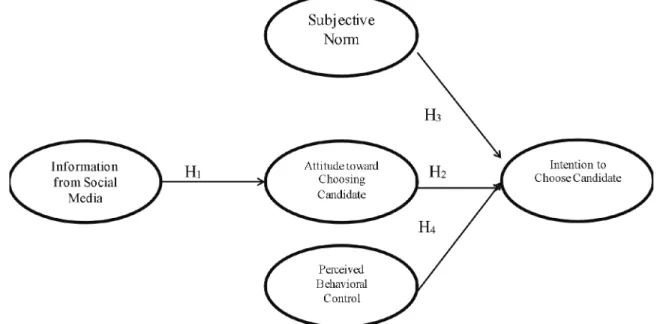
This study applied a quantitative paradigm (see Figure 1). Specifically, descriptive research with the aim of testing hypotheses is the type of research carried out.

Furthermore, the sampling method in this study is a non- probability sampling method, that is, purposive sampling which aims to select respondents with certain criteria that are consistent with the study (Sekaran & Bougie, 2019). In this study, the sample used was students from private universities who had the right to vote in the 2019 Presidential Election.

Young people were selected in this study given the important role of young people in nation building. Young people live with social media and are quickly influenced by information from social media. The sample size was 200 respondents.

One guidelines of sample size is samples less than 100 are

“small” samples, 100 to 200 are “medium,” and more than 200 are “large” (Kline, 2005). Other researchers stated that a range of sample size from 30 to 460 is appropriate (Wolf et al., 2013). Thus, the samples in this study have met the requirements of the number of samples.

This study applied items from previous research to measure the research variables (Hsu et al., 2015; Ajze, 2006).

To measure the answers of respondents, the questionnaire

used the interval scale because this scale shows a clear

distance between each scale point (scale point) that is in the

respondent’s answer (Hair et al., 2007). The type of interval

scale used in this study is a Likert scale. Likert scale is a

method of measurement that will indicate the response of

(3)

Figure 1: Research Model

the respondents to their attitude towards an object. The measurement method using the Likert scale consists of a range of answers from “strongly agree” to “strongly disagree,”

which will be answered by respondents (Hair et al., 2007).

Likert scale is used because it is a method of measuring attitudes that is simple and convenient (Chyung et al., 2017).

Before testing hypotheses, reliability and validity tests are performed first to ensure the research indicators are reliable and valid (Sekaran & Bougie, 2019). The reliability test conducted in this study used the Cronbach’s alpha method. Furthermore, validity tests were conducted by using Composite Reliability and AVE to test convergent validity and Fornell-Larcker Criterion to test discriminant validity (Hair et al., 2010). Then, data were analyzed using structural equation modeling (SEM).

This is because many important variables in social science cannot be observed directly (latent variables), for example, the variables of attitude, intention, motivation, and so others.

These variables will then be measured by various indicators that may contain measurement errors. Structural equation modeling (SEM) has become the main tool for testing and understanding the relationship between latent variables (Deng et al., 2018; Byrne, 2010; Guo & Lee, 2007).

4. Results and Discussion 4.1. Results

A total of 200 questionnaires were distributed; 165 questionnaires were returned, resulting in a response rate

of 82.5%. However, two questionnaires could not be used because they were not filled out. Thus, 163 questionnaires could be used or a response rate of 81.5%. Two thirds of respondents are women and one third are men. All respondents are students from a private university.

The research instrument test was conducted by testing the reliability and validity of the indicators used in measuring each variable. Table 1 shows that the indicators used for the variables are reliable and valid. Specifically, the table shows that each construct demonstrated internal consistency with a Cronbach’s alpha value of α in the range of 0.671 to 0.855. These alpha values were described as reasonable (Taber, 2018).

Table 1 also shows that all composite reliability values

were above 0.8 and AVE values above 0.6. Thus, it can be

stated that convergent validity had been achieved in this

study (Hair et al., 2010). Discriminant validity was assessed

using the Fornell and Larcker criteria by comparing the

square root of each AVE in the diagonal with the correlation

coefficient (off-diagonal) for each construct in the relevant

row and column. Table 2 shows the estimated correlations

between constructs, and the square root of the extracted

mean variance (AVE) on diagonal values. AVE is between

0.699 and 0.856 (Table 1), which is above the required value

of 0.50 (Fornell & Larcker, 1981). The square root AVE,

which is from 0.836 to 0.925, is higher than the value of the

correlation, which is from -0.020 to 0.582. Thus, it can be

stated that the discriminant validity of the research construct

has been achieved.

(4)

Sabrina O. SIHOMBING, Rudy PRAMONO / Journal of Asian Finance, Economics and Business Vol 8 No 5 (2021) 0445–0454

448

Table 1: Reliability and Validity Results

Construct Indicator Loadings Cronbach’s α Composite

Average Variance Reliability Extracted

Information ISM1 0.853 0.855 0.902 0.699

from Social ISM2 0.760

Media ISM3 0.854

ISM4 0.871

Subjective SN1 0.908 0.834 0.922 0.856

Norm SN2 0.942

Intention INT1 0.930 0.671 0.851 0.742

INT2 0.786

Perceived PBC1 0.873 0.816 0.889 0.728

Behavioral PBC2 0.796

Control PBC3 0.889

Attitude ATT1 0.791 0.800 0.883 0.715

ATT2 0.885

ATT3 0.859

Table 2: Discriminant Validity (Fornell-Larcker Criterion & Heterotrait-Monotrait Criterion) Fornell and Larcker

criterion Inf. from

Social Media Perceived

Behavioral Control Intention Subj. Norm Attitude Inf.from Social Media 0.836

Perceived Beh. Control 0.572 0.853

Intention 0.309 0.563 0.861

Subj. Norm 0.043 -0.020 0.021 0.925

Attitude 0.533 0.637 0.582 0.008 0.846

Heterotrait-Monotrait

criterion Inf. from

Social Media Perceived

Behavioral Control Intention Subj. Norm Attitude Inf.from Social Media

Perceived Beh. Control 0.668

Intention 0.376 0.703

Subj. Norm 0.089 0.080 0.031

Attitude 0.633 0.765 0.756 0.0807

Square Roots of AVE (Diagonally in Bold).

Hypothesis testing is conducted after the goodness of the data is examined by using the reliability and validity tests.

Structural equation modeling is applied to test the structural relationships between variables. This research applied T-statistics and p-value to test significance coefficient hypothesis. The results of the structural equation modeling analysis are presented in Table 3.

4.2. Discussion

The research aims to examine the extended Theory of

Planned Behavior by adding variables information from

social media to predict the intention to choose a presidential

candidate. This research confirms the first hypothesis that

shows the relationship between information from social

(5)

media and attitude toward choosing a president candidate.

This result is consistent with attitude theory that information is the basis for attitude formation. Specifically, a person processes information about an object before he arrives at the object’s evaluation and forms his attitude towards the object (Jacoby et al., 2002; Lutz, 1978). This result of the relationship between information and attitude is consistent with previous findings (e.g., Utami & Rahyuda, 2019;

Sihombing, 2017; Elliot & Speck, 2005).

The results of this study confirm the second hypothesis that shows a positive relationship between attitude and intention to behave. Attitude theories such as Theory of Reasoned Action, Theory of Planned Behavior, and Theory of Acceptance Model show that attitude is a predictor of intention to behave (Ijzen & Fisbein, 2005; Davis, 1989).

The results of this study are also consistent with previous studies that show a positive relationship between attitude and intention to behave (e.g., Cho & Son, 2019; Nguyen et al., 2019; Natalia & Sihombing, 2018; Hussein, 2017; Patiro &

Sihombing, 2016; Gunadi & Sihombing, 2015; Sihombing, 2011; Hansen & Jensen, 2007).

The results show that the third hypothesis is not supported. The unsupported hypothesis is related to the relationship between subjective norms and the intention to choose a presidential candidate. Subjective norms refer to the influence of people who are considered important (e.g., family, siblings, and friends) that will affect one’s behavior.

The results of this study indicate that subjective norms do not have a significant relationship with the intention to choose a presidential candidate. This result can be explained through the current political situation in Indonesia. It can be said that everyone who has the right to vote already has made their “choice”. In other words, families of fathers and mothers and their children can have different choices. Each choice is often considered a result of political polarization.

Political polarization between supporters of two presidential candidates Jokowi and Prabowo was sharper in the 2019 presidential election. This was because the battle between the two was a continuation of the previous period in 2014.

The battle continued in the 2019 presidential election.

The battle between the two camps (i.e., Jokowi vs. Prabowo) created acute fanaticism, which divided the community into

two camps in the 2019 presidential election. Jokowi won the presidential election in 2014 ago with a narrow margin. The difference in votes between Jokowi and Prabowo in 2014 was the thinnest among presidential elections since 1998, marking intense competition between the two camps. Prabowo’s reluctance to admit his defeat in the 2014 presidential election was considered a trigger for the continuation of political segregation during the Jokowi administration in 2014–2019 and created polarization in society (Triwibowo, 2019). It has been reported in many newspapers or other forms of media that the president’s choice is different between husband and wife or parents with children or with close friends has made family relations or friendships can heat up during the election.

The results of this study indicate that there is a positive relationship between perceived behavioral control and intention to behave. It is related to the context of the general election (president, regional head, and others) in Indonesia, which adheres to the “LUBER” principle, which stands for

“Direct (L), General (U), Free (B) and Confidential (R)”

(Fatayati, 2017). Specifically, “Free” means that voters are required to vote without coercion from any party. Free also reflects control from within the individual. The results of this study are also consistent with past studies that show a positive relationship between perceived behavioral control and behavioral intention (e.g., Saputra & Sihombing, 2018;

Patiro & Sihombing, 2016; Sihombing, 2011; Liao et al., 2010; Wang, 2010).

5. Conclusion

This study aims to predict the voting intention in a presidential election using an extended planned behavior theory. The results show that only one hypothesis is not supported, namely, the relationship between subjective norms and the intention to choose a presidential candidate.

Supported hypotheses show that attitude and behavioral control have a positive relationship with the intention to choose a presidential candidate. Information from social media also has a positive relationship with attitudes to choose presidential candidates.

There are two main limitations of the study. First, this study uses non-probability sampling by selecting student Table 3: Result of Hypotheses Testing

Path Standardized

Regression Weight T-statistics P-value Conclusion

Attitude ← Inf. from Social Media 0.533 8.451 0.000 Supported

Intention ← Attitude 0.325 3.048 0.002 Supported

Intention ← Subjective Norm 0.025 0.343 0.731 Not Supported

Intention ← Perceived Behavioral Control 0.375 4.330 0.000 Supported

(6)

Sabrina O. SIHOMBING, Rudy PRAMONO / Journal of Asian Finance, Economics and Business Vol 8 No 5 (2021) 0445–0454

450

respondents at a private university. Therefore, the results do not reflect the general voting student population in Indonesia. Thus, future studies can replicate research by using young voter respondents with different characteristics, for example, young voters who are already working. Thus, the results of research using different respondents can give the same or different results, and are useful to provide an understanding of the intention to vote. Second, data for this study were collected in only one period (cross-sectional study). Therefore, this study only describes the phenomenon at one time. Future research can try to develop causality.

References

Abramowitz, A., & Saunders, K. (2008). Is Polarization a Myth? The Journal of Politics, 70(2), 542–555. https://doi.org/10.1017/

S0022381608080493

Adinugroho, B., Prisanto, G. F., Irwansyah, & Ernungtyas, N. F.

(2019). Social Media and the Internet in Political and Election Information Involvement. Jurnal Representamen, 5(2), 80–95.

Ajzen, I. (2006). Constructing a TpB Questionnaire: Conceptual and Methodological Considerations. Retrieved June 27, 2011 from the World Wide Web: http://www.people.umass.edu/

aizen/pdf/tpb.measurement.pdf

Ajzen, I., & Fishbein, M. (2005). The Influence of Attitudes on Behavior. In: the Handbook of Attitudes. Mahwah, NJ:

Lawrence Erlbaum.

Azjen, I. (1991). The Theory of Planned Behavior. Organizational Behavior and Human Decision Processes, 50(2), 179–211.

https://doi.org/10.1016/0749-5978(91)90020-T

Ajzen, I. (1988). From Intentions to Actions: Attitudes, Personality,

& Behavior. Chicago: Dorsey Press.

Arifianto, A. R., Pepinsky, T., Laksmana, E. A., Anwar, D. F., &

Murphy, A. M. (2019). Indonesia after the 2019 Election. Asia Policy, 14(4), 43–87.

Beck, J. W. and Shen, W. (2018). The Effects of Presidential Elections on Work Engagement and Job Performance.

Applied Psychology, 68(3), 547–576. https://doi.org/10.1111/

apps.12167

Biswas, A., Ingle, N. & Roy, M. (2014). Influence of Social Media on Voting Behavior. Journal of Power, Politics & Governance, 2(2), 127–155.

Botetzagias, I., Dima, A. & Malesios, C. (2015). Extending the Theory of Planned Behavior in the Context of Recycling:

The role of Moral Norms and of Demographic Predictors.

Resources, Conservation and Recycling, 95, 58–67. https://doi.

org/10.1016/j.resconrec.2014.12.004

Bright, J., Hale, S., Ganesh, B., Bulovsky, A., Margetts, H., &

Howard, P. (2019). Does Campaigning on Social Media Make a Difference? Evidence from Candidate Use of Twitter During the 2015 and 2017 U.K. Elections. Communication Research.

https://doi.org/10.1177/0093650219872394

Byrne, B. (2010). Structural Equation Modeling with Amos (2

nd

ed.). London: Routledge.

Chen, M., & Tung, P. (2014). Developing an Extended Theory of Planned Behavior Model to Predict Consumers’ Intention to Visit Green Hotels. International Journal of Hospitality Management, 36, 221–230. https://doi.org/10.1016/j.ijhm.2013.

09.006

Chieo, W., Mayer, R.W., & Wang, Z. (2014). Stock Market, Economic Performance, and Presidential Elections. Journal of Business & Economics Research, 12(2), 159–170.

https://dx.doi.org/10.19030/jber.v12i2.8530

Chiu, Y., Chou, Y., Chang, Y., Chu, C., Lin, F., Lai, C., Hwang, S., Fang, W., & Kao, S. (2019). Using an Extended Theory of Planned Behavior to Predict Smoking Cessation Counsellors’

Intentions to Offer Smoking Cessation Support in the Taiwanese Military, BMJ Open. Retrieved from: https://bmjopen.bmj.

com/content/bmjopen/9/5/e026203.full.pdf

Cho, E., & Son, J. (2019). The effect of social connectedness on consumer adoption of social commerce in apparel shopping.

Fashion and Textiles, 6(14). https://dx.doi.org/10.1186/s40691- 019-0171-7

Chyung, S. Y., Roberts, K., Swanson, I., & Hankinson, A. (2017).

Evidence-Based Survey Design: The Use of a Midpoint on the Likert Scale. Performance Improvement, 56(10), 15–23.

https://doi.org/10.1002/pfi.21727

Connee, M., & Armitage, C. J. (1998). Extending the Theory of Planned Behavior: A Review and Avenues for Further Research.

Journal of Applied Social Psychology, 28(15), 1429–1464.

https://doi.org/10.1111/j.1559-1816.1998.tb01685.x

Dasli, Y. (2019). Use of Social Media as a Tool for Political Communication in the Field of Politics. Ordu University Journal of Social Science Research, 9(1), 243–251.

Davis, F. D. (1989). Perceived Usefulness, Perceived Ease of Use, and End User Acceptance of Information Technology. MIS Quarterly, 13, 318–339. https://doi.org/10.2307/249008 De Jong, A. (2019). Indonesia’s Election and Polarization.

International Viewpoint – Online Socialist Magazine. Available at http://www.internationalviewpoint.org/spip.php?article6137 Dedi, A. (2019). Analysis of the 2019 Concurrent General

Election System. Jurnal Moderat, 5(3), 213–226. http://dx.doi.

org/10.25147/moderat.v5i3.2676

Deng, L., Yang, M., & Marcoulides, K.M. (2018). Structural Equation Modeling with Many Variables; a Sstematic Review of Issues and Developments. Frontiers in Psychology, 9, 580.

https://doi.org/10.3389/fpsy.2018.00580

DeJonckheere, M., Fisher, A., & Chang, T. How has the presidential election affected young Americans? Child and Adolescent Psychiatry and Mental Health, 12(8). https://doi.org/10.1186/

s13034-018-0214-7

Elliott, M., & Speck, P. (2005). Factors That Affect Attitude toward

a Retail Web Site. Journal of Marketing Theory and Practice,

13(1), 40–51. Retrieved July 27, 2020, from www.jstor.org/

(7)

stable/40470185 https://doi.org/10.1080/10696679.2005.1165 8537

Evelyn, E., & Basana, S. R. (2018). Effect of 2008 and 2016 U. S.

Presidential Election in the Indonesian Stock Market. Jurnal Manajemen dan Kewirausahaan, 20(1), 16–22. https://dx.doi.

org/10.9744/jmk.20.1.16-22

Fatayati, S. (2017). The Relevance of Election Principles as Efforts to Create Democratic Elections with Integrity. Tribakti:

Jurnal Pemikiran KeIslaman, 28(1), 147–165. https://doi.org/

10.33367/tribakti.v28i1.472

Fata, M. K. (2018). Reading the Polarization of Santri in the Presidential Election Contest 2019. Jurnal Dinamika Penelitian: Media Komunikasi Sosial Keagamaan, 18(02), 325–346.

Foltz, B., Newkirk, H. E. & Schwager, P. H. (2016). An Empirical Investigation of Factors that Influence Individual Behavior toward Changing Social Networking Security Settings. Journal of Theoretical and Applied Electronic Commerce Research, 11(2), 1–15.

https://dx.doi.org/10.4067/S0718-18762016000200002 Fornell, C., & Larcker, D. F. (1981). Evaluating Structural Equation

Models with Unobservable Variables and Measurement Error.

Journal of Marketing Research, 18(1), 39–50. https://doi.

org/10.2307/3151312

Gangwal, N., & Bansal, V. (2016). Application of Decomposed Theory of Planned Behavior for M-commerce Adoption in India. In: Proceedings of the 18th International Conference on Enterprise Information Systems (ICEIS 2016), 2, 357–367.

https://dx.doi.org/10.5220/0005627503570367

Gunadi, A. P., & Sihombing, S. O. (2015). Prediction of Actual E-Toll Card Use with Structural Model Equation Approach.

Jurnal Manajemen Teknologi, 14(2), 151–172. https://doi.

org/10.12695/jmt.2015.14.2.3

Guo, S., & Lee, C. K. (2007). Statistical power of SEM in social work research: Challenges and strategies. Paper presented at the Eleventh Annual Conference of the Society of Social Work Research. San Francisco.

Ha, N. T., Nguyen, T. L. H., Nguyen, T. P. L., & Nguyen, T. D.

(2019). The Effect of Trust on Consumers’ Online Purchase Intention: An Integration of TAM and TPB. Management Science Letters, 9, 1451–1460. https://doi.org/10.5267/

j.msl.2019.5.006

Hagger, M. S. (2019). The reasoned action approach and the theories of reasoned action and planned behavior. In:

Dunn, D. S. (Ed.), Oxford Bibliographies in Psychology. New York, NY: Oxford University Press. https://dx.doi/10.1093/

OBO/9780199828340-0240

Hair, J. F., Black, W. C., Babin, B. J., Anderson, R. E., & Tatham, R. L. (2010). Multivariate Data Analysis (7

th

ed.). Upper Saddle River, NJ: Prentice Hall.

Hair, J. F, Money, A. H., Samouel, P., & Page, M. (2007). Research Methods for Business. Chichester, UK: John Wiley and Sons.

Hansen, E. R., & Tyner, A. (2018). Educational Attainment and Social Norms of Voting. Presented in the Annual Meeting of The American Political Science, August 20-September 2, Available at https://static1.squarespace.com/

static/5b953c5f9d5abb8c51d6d8c6/t/5b957f1203ce64eefd1f ba92/1536524051067/Hansen_Tyner_Norms_Voting.pdf Harris, L., & Harrigan, P. (2015). Social Media in Politics: The

Ultimate Voter Engagement Tool or Simply an Echo Chamber?

Journal of Political Marketing, 14(3), 251–283. https://doi.

org/10.1080/15377857.2012.693059

Harymawan, I., Nasih, M., Suhardianto, N., & Shauki, E. (2020).

How does the presidential election period affect the performance of the state-owned enterprise in Indonesia? Cogent Business &

Management, 7(1), 1750330. https://doi.org/10.1080/2331197 5.2020.1750330

Hasbullah, N., Mahajar, A. J., & Salleh, M. I. (2014). A conceptual framework of extending the theory of planned behavior: the role of service quality and trust in the consumer cooperatives.

International Journal of Business and Social Science, 5(12), 142–148.

Hansen, T., & Jensen, J. M. (2007). Understanding Voters’

Decisions: A Theory of Planned Behaviour Approach.

Innovative Marketing, 3(4), 87–93.

Hasyim, S. (2018). The Role of Millennial Generation in Determining Victory in the Presidential Election 2019.

Available at https://www.matamatapolitik.com/peran-generasi- milenial-dalam-menentukan-kemenangan-di-pilpres-2019/

Hsu, M., Chang, C., Lin, H., & Lin, Y. (2015). Determinants of Continued Use of Social Media: The Uses and Gratifications Theory and Perceived Interactivity. Information Research, 20(2). Available at http://informationr.net/ir/20-2/paper671.

html#.XlXju0pS_IU

Hussein, Z. (2017). Leading to Intention: The Role of Attitude in Relation to Technology Acceptance Model in E-Learning.

Procedia Computer Science, 105, 159–164. https://doi.org/10.

1016/j.procs.2017.01.196

Imelda, I., Siregar, H., & Anggraeni, L. (2014). Abnormal Returns and Trading Volume in the Indonesian Stock Market in Relation to the Presidential Elections in 2004, 2009, and 2014. Bisnis &

Birokrasi Journal, 21(2), 64–76. https://doi.org/10.20476/jbb.

v21i2.4319

Irawanto, B. (2019). Young and Faithless: Wooing Millenials in Indonesia’s 2019 Presidential Election. ISEAS Perspective, 1, 1–10.

Jacoby, J., Morrin, M., Jaccard, J., Gurhan, Z., Kuss, A., &

Maheswaran, D. (2002). Mapping Attitude Formation as a Function of Information Input: Online Processing Models of Attitude Formation. Journal of Consumer Psychology, 12(1), 21–34. https://doi.org/10.1207/S15327663JCP1201_03

Jones, D. (2015). Partisan Polarization and the Effect of

Congressional Performance Evaluations on Party Brands and

American Elections. Political Research Quarterly, 68(4),

(8)

Sabrina O. SIHOMBING, Rudy PRAMONO / Journal of Asian Finance, Economics and Business Vol 8 No 5 (2021) 0445–0454

452

785–801. Retrieved July 14, 2020, from www.jstor.org/

stable/24637816

Kaplan, A. M., & Haenlein, M. (2010). Users of the World, Unite!

The Challenges and Opportunities of social media. Business Horizons, 53(1), 59–68.

Kardashian, K. (2019). Three Social Media Themes to Watch in 2020. Retrieved from: https://www.tuck.dartmouth.edu/news/

articles/three-social-media-themes-to-watch

Khodijah, S. N., & Yusuf, A. (2019). Comparative Study of Implicit Attitude Evaluation with Intention to Choose 2019 Presidential Election Candidates (Jokowi-Amin, Prabowo-Sandi, and Golput) in University of Indonesia Students. Jurnal KSM Eka Prasetya UI, 1(3).

Kline, R. B. (2005). Principles and practice of structural equation modeling (2

nd

ed.). New York: Guilford.

Lestari, E. Y., & Arumsari, N. (2018). Political Participation of Beginner Voters in Semarang Mayor Election in Semarang City. Integralistik, 1(XXIX), 63–72.

Liao, C., Lin, H., & Liu, Y. (2010). Predicting the Use of Pirated Software: A Contingency Model Integrating Perceived Risk with the Theory of Planned Behavior.

Journal of Business Ethics, 91(2), 237–252. Retrieved July 27, 2020, from www.jstor.org/stable/27749793 https://doi.org/10.1007/s10551-009-0081-5

Liew, A. (2007). Understanding Data, Information, Knowledge and Their Inter-Relationships. Journal of Knowledge Management Practice, 8(2). http://www.tlainc.com/articl134.htm

Londoño-Roldan, J. C, Davies, K., & Elms, J. (2017).

Extending the Theory of Planned Behavior to examine the role of anticipated negative emotions on channel intention: The case of an embarrassing product.

Journal of Retailing and Consumer Services, 36, 8–20.

https://doi.org/10.1016/j.jretconser.2016.12.002

Luc, P. T. (2020). Outcome Expectations and Social Entrepreneurial Intention: Integration of Planned Behavior and Social Cognitive Career Theory. Journal of Asian Finance, Economics and Business, 7(6), 399–407. https://doi.org/10.13106/

jafeb.2020.vol7.no6.399

Lutz, R. (1978). Attitude Change or Attitude Formation? An Unanswered Question: Rejoinder. Journal of Consumer Research, 4(4), 276–278. https://doi.org/10.1086/208708 Maichum, K., Parichatnon, S., & Peng, K. (2017). Developing an

Extended Theory of Planned Behavior Model to Investigate Consumers; Consumption Behavior toward Organic Food:

A Case Study in Thailand. International Journal of Scientific of Technology Research, 6(1), 72–80.

Masters, J. (2018). Russia, Trump, and the 2016 U.S. Election.

Available at https://www.cfr.org/backgrounder/russia-trump- and-2016-us-election

McFarland, D., & Thomas, R. (2006). Bowling Young: How Youth Voluntary Associations Influence Adult Political Participation.

American Sociological Review, 71(3), 401–425. https://doi.

org/10.1177/000312240607100303

Mette, K., & Bertolini, K. (2018). Fear, Anxiety, and the 2016 Presidential Election: What are the Effects on Student Achievement? Empowering Research for Educators, 2(1), 28–36. Available at: https://openprairie.sdstate.edu/ere/vol2/

iss1/5, 28-36

Moons, I., & De Pelsmacker, P. (2015). An Extended Decomposed Theory of Planned Behaviour to Predict the Usage Intention of the Electric Car: A Multi-Group Comparison. Sustainability, 7, 6212–6245. https://doi.org/10.3390/su7056212

Morissan. (2016). Level of Political and Social Participation of the Young Generation. Jurnal Visi Komunikasi, 15(01), 96–113.

Munzir, A., Asmawi, A., & Zetra, A. (2019) Various Roles of Social Media in Political World in Indonesia. JPPUMA: Jurnal Ilmu Pemerintahan dan Sosial Politik UMA (Journal of Governance and Political Social UMA), 7(2), 173–182.

Natalia, E., & Sihombing, S. O. (2018). The Relationship between Entrepreneurship Education and Mentoring toward Entrepreneurship Intention. Jurnal Manajemen, XXII (03), 340–359. https://doi.org/10.24912/jm.v22i3.426

Natsir, M., & Ridha, M. (2018). Stuck in Electoralism: Notes on Indonesian Democracy in the Last Two Decades. Jurnal Politik Profetik, 6(2), 234–248.

Newman, B. I. (1985). An Historical Review of the Voter as a Consumer.

In: Sheth, J. N. and Tan, C. T. (Eds.), SV - Historical Perspective in Consumer Research: National and International Perspectives.

Singapore: Association for Consumer Research, 257–261 Nwolise, O. B. C. (2007). Electoral Violence and Nigeria’s 2007

Elections. Journal of African Elections, 6(2), 155–179. https://

doi.org/10.20940/JAE/2007/v6i2a9

Obradovic, S., & Tomic, N. (2017). The Effect of Presidential Election in the USA on Stock Return Flow - A Study of a Political Event. Journal Economic Research, 30(1), 112–124.

https://doi.org/10.1080/1331677X.2017.1305802

O’Cass, A., & Pecotich, A. (2005). The Dynamics of Voter Behavior and Influence Processes in Electoral Markets: A Consumer Behavior Perspective. Journal of Business Research, 58, 406–413. https://doi.org/10.1016/j.jbusres.2003.08.003 Park, J. Y., Chiu, W., & Won, D. (2017). Sustainability of Exercise

Behavior in Seniors: An Application of the Extended Theory of Planned Behavior. Journal of Physical Education and Sport, 17(1), 342–347.

Parkinson, J., Russell-Bennett, R., & Previte, J. (2018). Challenging the Planned Behavior Approach in Social Marketing: Emotion and Experience Matter. European Journal of Marketing, 52(3/4), 837–865. https://doi.org/10.1108/EJM-05-2016-0309 Patiro, S., & Sihombing, S. (2016). Predicting Intention to Purchase

Counterfeit Products: Extending the Theory of Planned Behavior. International Research Journal of Business Studies, 7(2). https://doi.org/10.21632/irjbs.7.2.109-120

Peng, N., & Hackley, C. (2009). Are Voters, Consumers? A Qualitative Exploration of the Voter-Consumer. Qualitative Market Research: An International Journal, 12(2), 171–186.

https://doi.org/10.1108/13522750910948770

(9)

Petrillo, L. (2016). Presidential Election Is Stressing Out Workers, Hurting Productivity. https://www.shrm.org/resourcesandtools/

hr-topics/employee-relations/pages/politics-at-work-.aspx Rameez, M., & Kulthunga, D. (2019). Customers’ Online Purchase

Intention: Applying Extended Theory of Planned Behavior Model. Information and Knowledge Management, 9(10), 23–36.

Ratnamulyani, I. A., & Maksudi, B. I. (2018). The Role of Social Media in Increasing Participation of Beginner Voters Among Students in Bogor Regency. Sosiohumaniora, 20(2), 154–161.

Raut, R. K., Das, N., & Kumar, R. (2018). Extending the Theory of Planned Behavior: Impact of Past Behavioral Biases on the Investment Decision of Indian Investor. Asian Journal of Business and Accounting, 11(1), 265–291. https://doi.

org/10.22452/ajba.vol11no1.9

Sagita, V. D. (2017). Trump’s Elected Shock Effect in Indonesian Stock Market. Journal of Indonesian Applied Economics, 7(1), 71–83. https://dx.doi.org/10.21776/ub.jiae.2017.007.01.5 Saputra, T., & Sihombing, S. (2018). Application of the Theory of

Planned Behavior for Predicting the Intention of International Entrepreneurship: Global Mindset and Cultural Intelligence as Moderation Variables. Asia Pacific Management and Business Application, 7(2), 59–80. https://doi.org/10.21776/

ub.apmba.2018.007.02.1

Sekaran, U., & Bougie, R. (2019). Research Methods for Business.

Hoboken, NJ: Wiley.

Shen, C., Bui, D. G., & Lin, C. (2017). Do political factors affect stock returns during presidential elections? Journal of International Money and Finance, 77(C), 180–198. https://

dx.doi.org/10.1016/j.jimonfin.2017.07.019

Sekarwulan, A., Azzahra, A. A., Syifafasya, N., & Safitri, D.

(2020). The Use of Social Media for the Participation of UNJ Communication Science Students in Determining the 2019 Presidential Candidates and Cawapres. Kanal: Jurnal Ilmu Komunikasi, 8(2), 50–57.

Setyawan, A., Noermijati, N. Sunaryo, S., & Aisjah, S. (2018).

Green Product Buying Intentions Among Young Consumers:

Extending the Application of Theory of Planned Behavior.

Problems and Perspectives in Management, 16(2), 145–154.

https://dx.doi.org/10.21511/ppm.16(2).2018.13

Setyawan, A. (2019). Let’s Succeed in the 2019 Democracy Party. Available at https://setkab.go.id/mari-sukseskan-pesta- demokrasi-2019/

Sihombing, S. O. (2017). Predicting intention to share news through social media: An empirical analysis in Indonesian youth context. Business and Economic Horizons, 13(4), 468–477. http://dx.doi.org/10.15208/beh.2017.32

Sihombing, S. O. (2011). Understanding Knowledge Sharing Behavior: an Examintai8on of the Extended Theory of Planned Behavior. Journal the Winners, 12(1), 24–39. https://doi.

org/10.21512/tw.v12i1.681

Skelton, T. (2010). Taking young people as political actors seriously: Opening the borders of political geography. Area,

42(2), 145–151. Retrieved July 20, 2020, from www.jstor.org/

stable/27801455. https://doi.org/10.1111/j.1475-4762.2009.

00891.x

Smidt, C. (2017). Polarization and the Decline of the American Floating Voter. American Journal of Political Science, 61(2), 365–381. Retrieved July 17, 2020, from www.jstor.org/

stable/26384737. https://doi.org/10.1111/ajps.12218

Soebagio, H. (2008). Implications of the White Group in the Perspective of Democratic Development in Indonesia. Makara, Sosial Humaniora, 12(2), 82–86.

Soh, P., Koay, K. Y., & Lim, V. K. G. (2018). Understanding Cyberloafing by Students through the Lens of an Extended Theory of Planned Behavior. First Monday, https://doi.

org/10.5210/fm.v23i6.7837

Sommer, L. (2011). The Theory of Planned Behavior and the Impact of Past Behavior. International Business & Economics Research Journal, 19(1), 98–110. https://dx.doi.org/10.19030/

iber.v10i1.930

Taber, K. S. (2018). The Use of Cronbach’s Alpha When Developing and Reporting Research Instruments in Science Education.

Research in Science Education, 48, 1273–1296. https://dx.doi.

org/10.1007/s11165-016-9602-2

Takahashi, T. (2019). Indonesia’s presidential election puts SE Asia’s democracy to the test, Retrieved from https://asia.nikkei.

com/Spotlight/Comment/Indonesia-s-presidential-election- puts-SE-Asia-s-democracy-to-the-test2

Triwibowo, W. (2019). Preventing Political Polarization after the 2019 Presidential Election is Sharpening. https://nasional.

kompas.com/read/2019/04/23/13291151/mencegah-polarisasi- politik-pasca-pilpres-2019-semakin-tajam?page=all

Utami, P. D. P., & Rahyuda, K. (2019). International Research Journal of Management, IT & Social Sciences, 6(4), 107–117.

https://dx.doi.org/10.21744/irjmis.v6n4.663

Vonderschmitt, K. (2012). The Growing Use of Social Media in Political Campaigns: How to use Facebook, Twitter, and YouTube to Create an Effective Social Media Campaign.

Honors College Capstone Experience/ Thesis Projects. Paper 360. http://digitalcommons.wku.edu/stu_hon_theses/360 Wanasida, A. S., Bernarto, I., Sudibjo, N., & Pramono, R. (2021).

Millennial Transformational Leadership on Organizational Performance in Indonesia Fishery Startup. Journal of Asian Finance, Economics and Business, 8(2), 555–562. https://doi.

org/10.13106/jafeb.2021.vol8.no2.0555

Wang, L., & Zhang, Y. (2016). An extended version of the theory of planned behaviour: the role of self-efficacy and past behaviour in predicting the physical activity of Chinese adolescents.

Journal of Sports Sciences, 34(7), 587–597. https://doi.org/10.

1080/02640414.2015.1064149

Wang, E. (2010). The Effects of Browsing Frequency and Gender

on the Relationship between Perceived Control and Patronage

Intentions in E-tail. International Journal of Electronic

Commerce, 14(3), 129–144. Retrieved July 27, 2020, from

www.jstor.org/stable/20749974

(10)

Sabrina O. SIHOMBING, Rudy PRAMONO / Journal of Asian Finance, Economics and Business Vol 8 No 5 (2021) 0445–0454

454

Warburton, E. (2019). Polarisation in Indonesia: What if Perception is Reality. Available at https://www,newmandala.org/how- polarised-is-indonesia/

Weeks, B. E., Ardèvol-Abreu, A., & de Zúñiga, H. G. (2017).

Online Influence? Social Media Use, Opinion Leadership, and Political Persuasion, International Journal of Public Opinion Research, 29(2), 214–239. https://doi.org/10.1093/ijpor/edv050 William, D. R., & Medlock, M. M. (2017). Health Effect of

Dramatic Societal Events - Ramifications of the Recent Presidential Election. The New England Journal of Medicine, 376, 2295–2299. https://doi.org/10.1056/NEJMms1702111 Wolf, E. J., Harrington, K. M., Clark, S. L., & Miller, M. W. (2013).

Sample Size Requirements for Structural Equation Models: An

Evaluation of Power, Bias, and Solution Propriety. Educational and Psychological Measurement, 76(6), 913–934. https://doi.

org/10.1177/0013164413495237

Wu, W. Y., Do, T. Y., Nguyen, P. T., Anridoh, N., & Vu, M. Q. (2020) An Integrated Framework of Customer-based Brand Equity and Theory of Planned Behavior: A Meta-analysis Approach.

Journal of Asian Finance, Economics and Business, 7(8), 371–381. https://doi.org/10.13106/jafeb.2020.vol7.no8.371 Xin,Z., Liang,M., Zhanyou,W., & Hua,X. (2019). Psychosocial

factors influencing shared bicycle travel choices among Chinese: An application of theory planned behavior. PLOS ONE, 14(1), e0210964. https://doi.org/10.1371/journal.

pone.0210964

수치

Figure 1:  Research Model
Table 2:  Discriminant Validity (Fornell-Larcker Criterion & Heterotrait-Monotrait Criterion) Fornell and Larcker

참조

관련 문서

The purpose of this study is to verify whether The mediating effects of planned happenstance skills on the relationship between perceived social support

The purpose of this study is to examine the effects of flow experience through the dance sports media, a dance sports image, and identification on

In order to extract the factors of brand personality, prior literature review in the fields of consumer behavior theory and psychology was performed. The

 The transport theory which permits one to calculate the neutron densities or fluxes is an essentially statistical theory because the behavior of individual neutrons is3.

□ The least-upper-bound property (sometimes called completeness or supremum property) is a fundamental property of the real number system. The least-upper-bound

The “Asset Allocation” portfolio assumes the following weights: 25% in the S&P 500, 10% in the Russell 2000, 15% in the MSCI EAFE, 5% in the MSCI EME, 25% in the

1 John Owen, Justification by Faith Alone, in The Works of John Owen, ed. John Bolt, trans. Scott Clark, "Do This and Live: Christ's Active Obedience as the

This study was conducted to develop and evaluate the effects of a posture management program based on the theory of planned behavior (TPB) which was