1 접수 2010년 12월 30일, 수정(1차: 2011년 8월 31일), 게재확정 2011년 8월 31일 Received 30 December 2010; Revised(1st: 31 August 2011); Accepted 8 August 2011
2 건국대학교 자연과학대학 College of Natural Science, Kunkuk Unvi., Chungju(380-701), Korea([email protected]) 3 부산대학교 조경학과 Dept. of Landscape Architecture, Pusan National Univ., Miryang(627-706), Korea
4 삼성에버랜드 Samsung Everland, Seoul(100-102), Korea([email protected])
5 부산대학교 대학원 조경학과 Dept. of Landscape Architecture, Graduate School, Pusan National Univ., Miryang(627-706), Korea([email protected])
6 부산대학교 대학원 조경학과 Dept. of Landscape Architecture, Graduate School, Pusan National Univ., Miryang(627-706), Korea([email protected])
a 이 논문은 2010년 본 학회 학술대회 제20권 2호 발표(Kim et al., 2010) 후 심사를 거쳐 발전시킨 것임.
* 교신저자 Corresponding author([email protected])
Vegetation Structure of Deciduous Broad-leaved Forest at the Beomeosa(Temple) Valley in Kumjungsan, Busan 1a
Jeong-Ho Kim 2 , Song-Hyun Choi 3* , In-Tae Choi 4 , Soon-Ja Yang 5 , Sang-Cheol Lee 6
부산 금정산 범어사계곡 낙엽활엽수림의 식생구조
1a김정호2․최송현3*․최인태4․양순자5․이상철6
ABSTRACT
The purpose of this study is to investigate the structure of vegetation dominated by deciduous broad-leaved trees at the Beomeosa(Temple) Valley of Mt. Kumjungsan in Busan. To this end, 28 plots were set up and surveyed. The result analyzed by TWINSPAN, one of the classification technique, showed that the communities were divided into six groups which are Carpinus tschonoskii-Deciduous broad-leaved forest community(Ⅰ), Quercus serrata-C. tschonoskii community(Ⅱ), C. tschonoskii-Q.s serrata-Pinus densiflora community(Ⅲ), C. tschonoskii-Quercus serrata-Q. mongolica communtiy(Ⅳ), Q. serrata-Deciduous broad- leaved forest community(Ⅴ) and Chamaecyparis obtusa-C. tschonoskii community (Ⅵ). Species diversity ranged from 0.3832 to .0450. The lowest diversity was Chamaecyparis obtusa community(Ⅵ) but the highest was Carpinus tschonoskii-Deciduous broad-leaved forest community(Ⅰ) and Q. serrata-Deciduous broad- leaved forest community(Ⅴ). The average number of species was 6.8±3.2 in the unit area(100㎡). Carpinus
tschonoskii community at the Beomeosa Valley of Mt. Geumjeongsan was a climatic climax forest having a
value to preserve, so a continuous management will be needed.KEY WORDS: TWINSPAN, SPECIES DIVESITY, Carpinus tschonoskii COMMUNITY, CLIMATIC CLIMAX
요 약
부산 금정산 범어사계곡의 낙엽활엽수가 우점하는 군락의 식생구조를 분석하기 위해 단위면적 100㎡의 조사구 28개 를 설정하고 조사를 실시하였다. Classification기법중의 하나인 TWINSPAN을 이용하여 군락을 분류한 결과, 개서어나 무-낙엽활엽수군락(군락 Ⅰ), 졸참나무-개서어나무군락(군락 Ⅱ), 개서어나무-졸참나무-소나무군락(군락 Ⅲ), 개서어나
무-졸참나무-신갈나무군락(군락 Ⅳ), 졸참나무-낙엽활엽수군락(군락 Ⅴ), 편백-개서어나무군락(군락 Ⅵ)의 6개 군락으 로 최종 분리되었다. 군락별 종다양도는 0.3832~1.0450의 범위이었으며 인공식재한 편백나무가 우점하는 군락 Ⅵ의 종다양도가 가장 낮았고 개서어나무와 기타 낙엽활엽수가 우점하는 군락 Ⅰ과 군락 Ⅴ의 종다양도가 가장 높았다.
단위면적당(100㎡) 종수는 6.8±3.2종이었다. 금정산 범어사계곡의 개서어나무군락은 기후극상림으로써 보전가치 높으 므로 지속적인 보전관리대책이 요구된다.
주요어: TWINSPAN, 종다양도, 개서어나무군락, 기후극상
INTRODUCTION
Kumjungsan is located on the southern tip of Nakdong- Jeongmaek(a range of mountains), which is coming down along the eastern coast of Korea. It spans Dongrae-gu, Kumjung-gu, Buk-gu of Busan City and Yangsan-gun in South Gyeongsang Province. Total area is 51.7㎢.
Geographically, it is located between 129° 02′~ 129° 07′
east longitude and 35° 12′~ 35° 17′north latitude. Study site is deciduous broad-leaved forest including Carpinus
tschonoskii which is widely grown over Beomeosa Valley
in Kumjung-gu, Busan. Topographically, stony slopes of valley type is widely distributed in the Beomeosa Valley, and this area is well worth preserving when it comes to natural degree of vegetation.Study on plant community in Kumjungsan area was firstly conducted by Lee(1954), who provided result of studies about flora in around Kumjungsan. Following studies mainly on flora were done by Kim et al.(1997).
Many studies to evaluate ecological value of plant community were conducted. Kim et al.(1993) conducted ecological study of plant community on eastern slope of Kumjungsan. Nam(1994) studied flora of Kumjungsan and structure of main vegetation. Also, Jang(2005) studied plant community and changes in Kumjungsan. However, they were mainly about characteristics and changes in the community dominated by Pinus densiflora and Quercus spp. In addition to these studies, based on the plant sociology of forest in Busan, Lee(2003) studied plant distribution and current issues on Kumjungsan and suggested, for main vegetation distribution, Quercus dentata community on the ridge, communities dominated by Pinus
densiflora, Quercus mongolica and other Quercus spp. on
the main slope, Carpinus tschonoskii on the valley andQuercus variabilis in low-lying ground with severe human
interference.Areas which are dominated by Carpinus tschonoskii and deciduous broad-leaved trees in some areas of Beomeosa Valley of Kumjungsan are climate climax forest, having a high ecological value to preserve. However, since these areas are highly likely to be artificially damaged, detailed ecological studies and management plans are required(Lee, 2003).
Carpinus tschonoskii belongs to climatic climax forest
of southern cool temperate zone(Kil et al., 2000) and also grown in Mt. Hallasan and Seonunsan(Kim and Yim, 1986), Daedunsan(Kim et al., 1988) and Jirisan. Carpinustschonoskii community is also seen in some areas of
Kumjungsan. However, there was no study on the ecological structure of Carpinus tschonoskii community and deciduous broad-leaved tree community on Beomeosan Valley in Kumjungsan.In this study, we analyzed plant community of deciduous broad-leaved forest, which is widely located in Beomeosa Valley of Kumjungsan and intended the study result to be used for basic data for preservation and recovery of deciduous broad-leaved forest community in Beomeosa Valley in the future.
MATERIALS AND METHODS
1. Study Site
In order to study plant community dominated by deciduous broad-leaved trees in the Beomeosa Valley of Kumjungsan, we conducted preliminary and main studies in June~
November of 2009. Study plots on the areas dominated by Carpinus tschonoskii and Quercus serrata were set up considering areas where damages from mountain climbers, and nature was well preserved. Total number of study plots was 28 and size of each plot was 10m×10m(100㎡).
Figure 1. The location map of the survey plots in the Beomeosa Valley
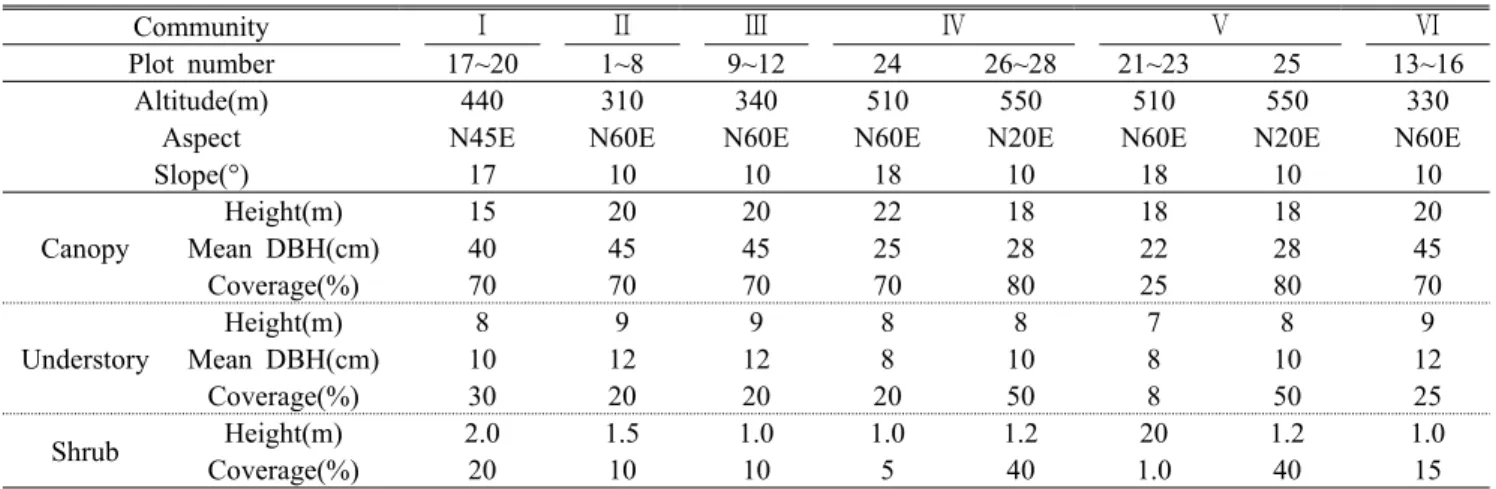
Community Ⅰ Ⅱ Ⅲ Ⅳ Ⅴ Ⅵ
Plot number 17~20 1~8 9~12 24 26~28 21~23 25 13~16
Altitude(m) 440 310 340 510 550 510 550 330
Aspect N45E N60E N60E N60E N20E N60E N20E N60E
Slope(°) 17 10 10 18 10 18 10 10
Canopy
Height(m) 15 20 20 22 18 18 18 20
Mean DBH(cm) 40 45 45 25 28 22 28 45
Coverage(%) 70 70 70 70 80 25 80 70
Understory
Height(m) 8 9 9 8 8 7 8 9
Mean DBH(cm) 10 12 12 8 10 8 10 12
Coverage(%) 30 20 20 20 50 8 50 25
Shrub Height(m) 2.0 1.5 1.0 1.0 1.2 20 1.2 1.0
Coverage(%) 20 10 10 5 40 1.0 40 15
Table 1. General description of the physical features and vegetation of the study plots 2. Study and Analysis Method
1) Vegetation and Environmental Factors
To study forest community in Beomeosa Valley of Kumjungsan, Busan, we set up study plots in areas which were changed in the plant community and environment.
Study was done by layers which are the canopy, understory and shrub layer. Trees have top crown were categorized as the canopy layer, trees with diameter of breast height (DBH) of less than 2㎝ as the understory layer, and other trees as shrub layer. In the canopy and understory layer, DBH of trees in a square sized 10m×10m was measured.
In the shrub layer, width of trees was measured in a small overlapped square of 5m×5m in size. Location, degree of slope, degree of tree canopy closure and tree height were
measured for each study plot to get general information.
2) Analysis of Vegetation Structure
To compare relative dominance of trees based on the result of plant community study, Importance Percentage (I.P.)(Brower and Zar, 1977) which was converted into percentage by combining I.V.(Importance Value) of Curtis and McIntosh(1951), was calculated by each layer. I.P.
was calculated by the formular of (relative density+relative coverage)/2. M.I.P.(Mean Importance Percentage), which provides weights to each layer considering the size of a tree, was obtained by the formular of ((canopy layer I.P.×3) + (understory layer I.P.×2) + (shrub layer I.P.×1))/6.
Based on I.P. analysis result, classification analysis(Hill, 1979b) and DCA ordination analysis(Hill, 1979a) by TWINSPAN was conducted. Three kinds of species diversities, Shannon's, Simpson's and Hurlbert's index, have applied for analyzing(Pielou, 1977; Cox, 1976). Similarity index was compared and analyzed based on result of plant communities and Whittaker(1956)'s formular (2C/A+B) was used to analyze similarity index.
RESULTS AND DISCUSSION
1. Overview of Study Area
Weather data for the last 17 years about Busan city shows annual average temperature of 14.7℃, annual average precipitation of 1,574.6㎜, annual average precipitation days of 995 days, and annual average humidity of 64.9%
(KMA, 2010).
Figure 3. DCA ordination of twenty eight plots in the Beomeosa Valley
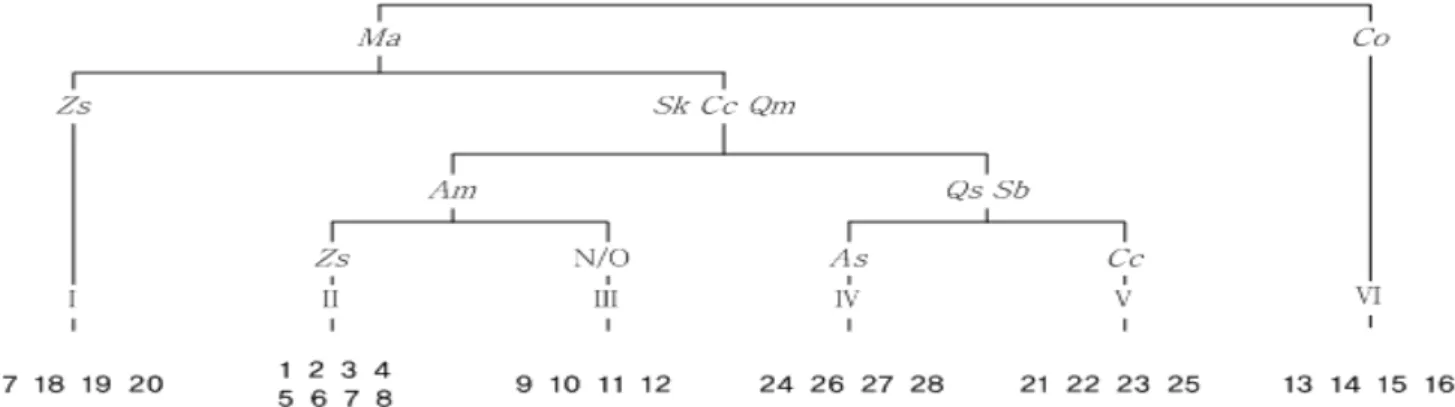
(◆: Community Ⅰ, ●: Community Ⅱ, ×: Community Ⅲ, ∗: Community Ⅳ, ▲: Community Ⅴ, ■: Community Ⅵ) Figure 2. The dendrogram of classification by TWINSPAN using twenty-eight plots in the Beomeosa Valley (Ma: Maackia amurensis, Co: Chamaecyparis obtusa, Zs: Zelkova serrata, Sk: Stewartia koreana, Cc: Carpinus
cordata, Am: Acer mono, As: Acer pseudo-sieboldianum, Qm: Quercus mongolica, Qs: Quercus serrata, Sb: Sasa borealis)
Following shows general information on study plots in Beomeosa Valley in Kumjungsan, Busan. Study plots were located at an altitude of 310~550m and mainly face northeast. Degree of slope ranges 10°~18°. Height of the canopy layer was 15~22m and the understory layer 7~9m.
DBH of the canopy layer ranged from 22 to 45cm and that of the understory layer ranged from 8 to 12cm.
2. Classification and Ordination Analysis
Classification and ordination analysis were conducted to classify communities of the study plots. For classification,
we used TWINSPAN(Figure 2) and DCA(Figure 3) for ordination. Purpose of ordination is to summarize data(Orloci, 1978) and indicate similarity or difference of samples depending on the distance on the coordinates. This is a method to find out inherent factors(Luwig and Reynolds, 1988).
Classfication analysis categorized study plots into 6 communities. Indicator species in the first level was
Maackia amurensis(Ma) to the left and Chamaecyparis
obtusa(Co) to the right side. Indicator species in the
second level was Zelkova serrata(Zs) to the left andStewartia koreana(Sk), Carpinus cordata(Cc), and Quercus
mongolica(Qm) to the right. In the third level, the group
divided by Stewartia koreana, Carpinus cordata andQuercus mongolica in the second level was divided into
left group by Acer mono(Am) and right group by Quercusserrata(Qs) and Sasa borealis(Sb).
All six communities which were finally categorized were as follows; CommunityⅠ Carpinus tschonoskii- Deciduous broad-leaved forest community, CommunityⅡ
Quercus serrata-C. tschonoskii community, Community
Ⅲ
Carpinus tschonoskii-Q. serrata-Pinus densiflora
community, Community Ⅳ Carpinus tschonoskii-Quercusserrata-Q. mongolica communtiy, Community Ⅴ Q. serrata-
Deciduous broad-leaved forest community, and CommunityⅥ
Chamaecyparis obtusa-C. tschonoskii community.
When this is compared with ordination analysis result, deciduous broad-leaved forest community of Beomeosa Valley shows similar environmental gradient except for the communities dominated by Pinus densiflora and Chamaecyparis
obtusa, and species composition difference caused by local
environmental discrepancy was shown in the undersotry and shrub layer.3. Vegetation Analysis by Community
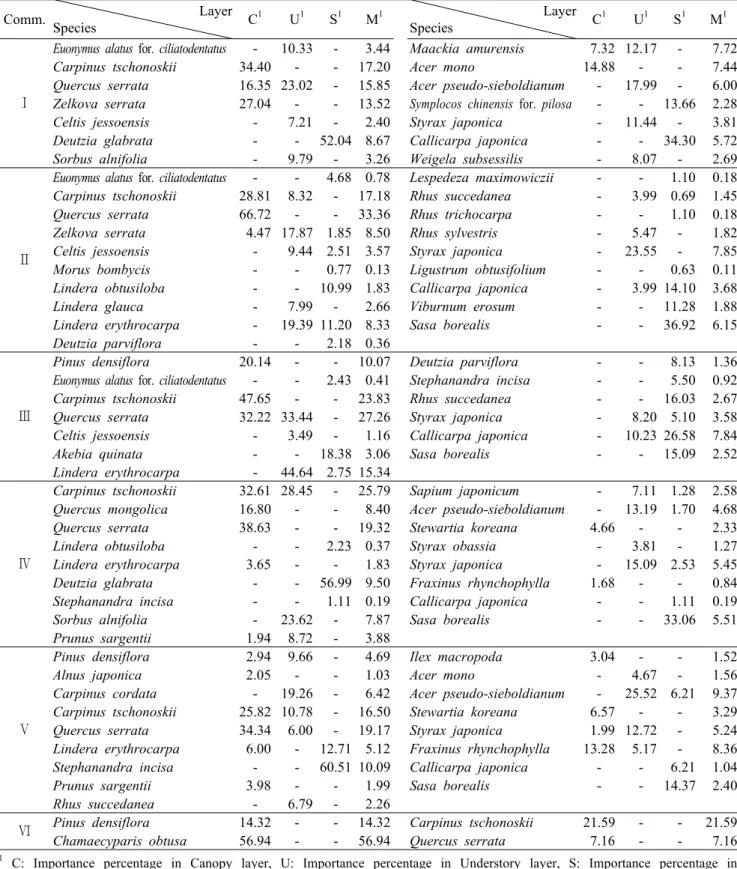
Table 2 shows I.P. and M.I.P. of six communities by layer classified by TWINSPAN method of classification.
Study plot No. 17, 18, 19, and 20 fall under Community
Ⅰ
Carpinus tschonoskii-Deciduous broad-leaved forest
community. For the details of each layer, in the canopy layer Carpinus tschonoskii(I.P. 34.4%), Zelkova serrata (I.P. 27.0%), Q. serrata(I.P. 16.4%), and Acer mono(I.P.14.9%) were main species and Q. serrata(I.P. 23.0%), Acer
pseudosieboldianum(I.P. 18.0%), and Maackia amurensis
(I.P. 12.2%) were main species in the understory layer.In the shrub layer, Deutzia glabrata(I.P. 52.0%), Callicarpa
japonica(I.P. 34.3%), and Symplocos chinensis for. pilosa
(I.P. 13.7%) were dominant species.Study plot No. 1~8 fall under Community Ⅱ Quercus
serrata-Carpinus tschonoskii community. In the canopy
layer, Quercus serrata(I.P. 66.7%)and C. tschonoskii(I.P.28.8%) were main species. In the understory layer, Styrax
japonicus(I.P. 23.6%), Lindera erythrocarpa(I.P. 19.4%),
and Zelkova serrata(I.P. 17.9%) were main species andC. tschonoskii were also seen. In the shrub layer, Sasa borealis(I.P. 36.9%) was dominant.
Study plot No. 9~12 come under Community Ⅲ, where
Carpinus tschonoskii-Quercus serrata-Pinus densiflora
community were dominant species. In the canopy layer,C. tschonoskii(I.P. 47.7%), Q. serrata(I.P. 32.2%), and P.
densiflora(20.1%) appeared. In the understory layer, Lindera erythrocarpa(I.P. 44.6%)and Q. serrata(I.P. 33.4%) were
main species. Nine species were seen in the shrub layer, with Callicarpa japonica(I..P. 26.6%)and Akebia quinata (I.P. 18.4%) as dominant species.Four study plots No. 24, 26, 27 and 28 fall under Community Ⅳ, which was Carpinus tschonoskii-Quercus
serrata-Q. mongolica community. In the canopy layer, Q.
serrata(I.P. 38.6%) showed highest dominance index but
was not seen in the understory and shrub layer. I.P. ofC. tschonoskii was 32.6% in the canopy and 28.5% in the
understory layer. Lindera erythrocarpa, Stewartia koreana,Fraxinus rhynchophylla, and Prunus sargentii also appeared
in the canopy layer. In the understory layer, C. tschonoskii had the highest dominance index and Sorbus alnifolia(I.P.23.6%) was another main species. In the shrub layer,
Deutzia glabrata(I.P. 57.0%) and Sasa borealis (I.P. 33.1%)
were dominant.Four study plots No. 21, 22, 23 and 25 come under Community Ⅴ,Q. serrata-Deciduous broad-leaved forest community. There were ten species in the canopy layer, showing biggest number of species among study plots.
Quercus serrata(I.P. 34.3%) and Carpinus tschonoskii(I.P.
25.8%) were main species and Prunus sargentii, Ilex
macropoda, Stewartia koreana, and Fraxinus rhynchophylla
also appeared. In the understory layer, Acer pseudosieboldianum (I.P. 25.5%) and Carpinus cordata(I.P. 19.3%) were main species. In the shrub layer, Stephanandra incisa(I.P. 60.5%) showed high dominance index. Compared to other communities, Community Ⅴ showed the biggest number of species and were the best in terms of preservation of nature. Especially, Carpinus cordata, which is climax species in succession, was seen in the canopy layer.Community Ⅵ, Chamaecyparis obtusa-C. tschonoskii community includes study plots No. 13~16. Planted
Chamaecyparis obtusa(I.P. 56.9%) were dominant in some
areas and Carpinus tschonoskii(I.P. 21.6%), Pinus densiflora (I.P. 14.3%), and Quercus serrata(I.P. 7.2%) were shown in the canopy layer, however, there were neither understory nor shrub layer. After deciduous broad-leaved forest in the southern coast of Korea had been damaged, ChamaecyparisComm. Layer
Species C1 U1 S1 M1 Layer
Species C1 U1 S1 M1
Ⅰ
Euonymus alatus for. ciliatodentatus
- 10.33 - 3.44Maackia amurensis
7.32 12.17 - 7.72Carpinus tschonoskii
34.40 - - 17.20Acer mono
14.88 - - 7.44Quercus serrata
16.35 23.02 - 15.85Acer pseudo-sieboldianum
- 17.99 - 6.00Zelkova serrata
27.04 - - 13.52Symplocos chinensis for. pilosa
- - 13.66 2.28Celtis jessoensis
- 7.21 - 2.40Styrax japonica
- 11.44 - 3.81Deutzia glabrata
- - 52.04 8.67Callicarpa japonica
- - 34.30 5.72Sorbus alnifolia
- 9.79 - 3.26Weigela subsessilis
- 8.07 - 2.69Ⅱ
Euonymus alatus for. ciliatodentatus
- - 4.68 0.78Lespedeza maximowiczii
- - 1.10 0.18Carpinus tschonoskii
28.81 8.32 - 17.18Rhus succedanea
- 3.99 0.69 1.45Quercus serrata
66.72 - - 33.36Rhus trichocarpa
- - 1.10 0.18Zelkova serrata
4.47 17.87 1.85 8.50Rhus sylvestris
- 5.47 - 1.82Celtis jessoensis
- 9.44 2.51 3.57Styrax japonica
- 23.55 - 7.85Morus bombycis
- - 0.77 0.13Ligustrum obtusifolium
- - 0.63 0.11Lindera obtusiloba
- - 10.99 1.83Callicarpa japonica
- 3.99 14.10 3.68Lindera glauca
- 7.99 - 2.66Viburnum erosum
- - 11.28 1.88Lindera erythrocarpa
- 19.39 11.20 8.33Sasa borealis
- - 36.92 6.15Deutzia parviflora
- - 2.18 0.36Ⅲ
Pinus densiflora
20.14 - - 10.07Deutzia parviflora
- - 8.13 1.36Euonymus alatus for. ciliatodentatus
- - 2.43 0.41Stephanandra incisa
- - 5.50 0.92Carpinus tschonoskii
47.65 - - 23.83Rhus succedanea
- - 16.03 2.67Quercus serrata
32.22 33.44 - 27.26Styrax japonica
- 8.20 5.10 3.58Celtis jessoensis
- 3.49 - 1.16Callicarpa japonica
- 10.23 26.58 7.84Akebia quinata
- - 18.38 3.06Sasa borealis
- - 15.09 2.52Lindera erythrocarpa
- 44.64 2.75 15.34Ⅳ
Carpinus tschonoskii
32.61 28.45 - 25.79Sapium japonicum
- 7.11 1.28 2.58Quercus mongolica
16.80 - - 8.40Acer pseudo-sieboldianum
- 13.19 1.70 4.68Quercus serrata
38.63 - - 19.32Stewartia koreana
4.66 - - 2.33Lindera obtusiloba
- - 2.23 0.37Styrax obassia
- 3.81 - 1.27Lindera erythrocarpa
3.65 - - 1.83Styrax japonica
- 15.09 2.53 5.45Deutzia glabrata
- - 56.99 9.50Fraxinus rhynchophylla
1.68 - - 0.84Stephanandra incisa
- - 1.11 0.19Callicarpa japonica
- - 1.11 0.19Sorbus alnifolia
- 23.62 - 7.87Sasa borealis
- - 33.06 5.51Prunus sargentii
1.94 8.72 - 3.88Ⅴ
Pinus densiflora
2.94 9.66 - 4.69Ilex macropoda
3.04 - - 1.52Alnus japonica
2.05 - - 1.03Acer mono
- 4.67 - 1.56Carpinus cordata
- 19.26 - 6.42Acer pseudo-sieboldianum
- 25.52 6.21 9.37Carpinus tschonoskii
25.82 10.78 - 16.50Stewartia koreana
6.57 - - 3.29Quercus serrata
34.34 6.00 - 19.17Styrax japonica
1.99 12.72 - 5.24Lindera erythrocarpa
6.00 - 12.71 5.12Fraxinus rhynchophylla
13.28 5.17 - 8.36Stephanandra incisa
- - 60.51 10.09Callicarpa japonica
- - 6.21 1.04Prunus sargentii
3.98 - - 1.99Sasa borealis
- - 14.37 2.40Rhus succedanea
- 6.79 - 2.26Ⅵ
Pinus densiflora
14.32 - - 14.32Carpinus tschonoskii
21.59 - - 21.59Chamaecyparis obtusa
56.94 - - 56.94Quercus serrata
7.16 - - 7.161 C: Importance percentage in Canopy layer, U: Importance percentage in Understory layer, S: Importance percentage in Shurb layer, M: Mean importance percentage
Table 2. Importance percentage of woody species by the layer in each community
Community H'(Shannon) Simpson' P.I.E.1 J'(evenness) D'(dominance) H'max
Ⅰ 1.0450 11.9153 0.9161 0.9117 0.0883 1.1461
Ⅱ 0.8672 3.9525 0.7470 0.6782 0.3218 1.2788
Ⅲ 0.9070 6.1152 0.8365 0.8142 0.1858 1.1139
Ⅳ 0.7441 3.4804 0.7127 0.6048 0.3952 1.2304
Ⅴ 1.0404 8.4839 0.8821 0.8289 0.1711 1.2553
Ⅵ 0.3832 1.9301 0.4819 0.6365 0.3635 0.6021
1 P.I.E.: the Probability of Interspecific Encounter
Table 3. Various diversity indices analysis in six communities
obtusa, Pinus rigida, and Cryptomeria japonica have been
forested(Oh et al., 2004). Likewise, in Beomeosa Valley of Kumjungsan, after forests had been damaged, Chamaecyparisobtusa was planted and Carpinus tschonoskii, Quercus serrata and other deciduous broad-leaved trees were
introduced. Therefore, succession to these species was expected. However, since next generation species have not appeared yet in the understory and shrub layer, recovery and management plants for these species should be also considered.Studies on six plant communities of Beomeosa Valley of Kumjungsan, Busan, which was stony slopes deciduous broad-leaved forest community, found out that Carpinus
tschonoskii and Qercus serrata were dominant in the
canopy layer, and Zelkova serrata, Acer mono, Ilexmacropoda, Stewartia koreana, Fraxinus rhynchophylla,
and Pinus densiflora were seen. In the understory layer,Acer pseudosieboldianum, Carpinus cordata, Carpinus tschonoskii, Styrax japonicus, and Lindera erythrocarpa
appeared. Deciduous broad-leaved tree community which was in good condition in terms of nature, had Carpinustschonoskii, a climate climax species, and deciduous
broad-leaved trees as dominant species. In the understory layer, Carpinus tschonoskii, a climatic climax species, andCarpinus cordata appeared and they were expected to
keep growing. However, the understory and shrub layer in an area with planted Chamaecyparis obtusa were not grown well, requiring ecological management for these communities.Deciduous broad-leaved forest community in Beomeosa Valley of Kumjungsan in Busan is highly worth preserving as climatic climax forest(Lee, 2003). Huge rocks with size of 2.5~4m in diameter were located in the ground layer of the forest. Soil exposure was very limited with less than 10%. Result of this study corresponded to the preceding
study showing that deciduous broad-leaved tree community dominated by Carpinus tschonoskii had Quercus serrata,
Carpinus cordata, Zelkova serrata, and Stewartia koreana
together(Um et al., 2009). Beomeosa Valley is well worth preserving with nature degree of vegetation of grade Ⅳ and degree of green naturality of grade 7~8.4. Species Diversity Analysis
Analysis on species diversity of six communities showed that Community Ⅰand Community Ⅴ showed high Shannon and Simpson index. In the canopy layer, Carpinus
tschonoskii-Q. serrata were dominant and various species
were grown in the understory and shrub layer. In the Community Ⅱ, Ⅲ, and Ⅳ, Carpinus tschonoskii andQuercus serrata were dominant species in the canopy
layer. However, in the understury and shrub layer a single species had high dominance index and especially dominance index of Sasa borealis in the shrub layer was high, showing low species diversity. Community Ⅵ hadChamaecyparis obtusa and Pinus densiflora as dominant
species and no species in the understory and shrub layer, having low diversity index of 0.3832. This study result is very similar to that of a preceding study conducted by Kim and Choi(2007) about plant community of coastal forest of Haeundae in Busan. It was also similar to the result of study done by Lee et al.(1999) about deciduous broad-leaved forest in Mt. Nojasan of Geoje-do, showing species diversity index of 0.9075~1.1951.5. Number of Species and Individuals Analysis Average number of individuals and species per unit area(100㎡) of 28 plots in Beomeosa Valley were analyzed by layer(Table 4). Regarding average number of individuals,
Descriptive analysis
No. of individuals No. of species
Tree Understory Shrub Total Tree Understory Shrub Total
Mean 5.0±4.0 3.1±2.7 29.7±25.7 37.8±30.5 2.8±1.7 2.1±1.6 2.6±2.3 6.8±3.2
Median 4 3 16 22 2 2 2 6.5
Mode 1 1 0 20 2 1 0 6
Maximum 14 9 224 243 8 6 6 13
Minimum 1 0 0 4 1 0 0 2
Table 4. Descriptive analysis of the number of species and population of twenty eight plots in the Beomeosa valley(Unit: 100㎡)
Community Ⅰ Ⅱ Ⅲ Ⅳ Ⅴ
Ⅱ 51.42
Ⅲ 43.51 65.93
Ⅳ 53.66 49.85 51.46
Ⅴ 40.14 50.92 55.68 52.06
Ⅵ 14.38 14.38 21.54 14.38 19.07
Table 5. Similarity index(%) between communities
the canopy layer had number of individuals of 5.0±4.0, the understory layer 3.1±2.7. For number of species per layer, the canopy, understory and shrub layer showed 2.8±1.7, 2.1±1.6, and 2.6±2.3 species respectively.
6. Similarity Index
Similarity index indicates difference or similarity between study plots or communities. If the similarity index is 20%
or below, communities are different from each other, and if it's 80% or above, communities are alike. The result of similarity index analysis on six communities (Table5) shows that Community Ⅵ, which was dominant by
Chamaecyparis obtusa and Pinus densiflora, had low
index of 14.38~19.07% with other communities, showing difference. Remaining five communities had Carpinustschonoskii and Quercus serrata as dominant species in
the canopy layer, showing similarity, however, the index was low in the undersotry and shrub layer due to species composition. Community Ⅱ and Community Ⅲ showed the highest similarity index with 65.93%.LITERATURE CITED
Cox, G.W. (1976) Laboratory manual of general ecology. Wn. C.
Brown Co., 232pp.
Brower, J.E. and J.H. Zar(1977) Field and Laboratory Methods for
General Ecology. Wm. C. Brown Company, 194pp.
Curtis, J.T. and R.P. McIntosh (1951) An upland forest continuum in the prairie-forest border region of Wisconsin. Ecology 32:
476-496.
Hill, M.O.(1979a) DECORANA- a FORTRAN program for de- trended correspondence analysis and reciprocal averaging.
Ecology and Systematics, Cornell University. Ithaca, N.Y.
Hill, M.O.(1979b) TWINSPAN - a FORTRAN program for arrang- ing multivariate data in an ordered two way table by classi- fication of the individuals and attribute. Ecology and Systematics, Cornell University. Ithaca, N.Y.
Jang, W.I.(2005) Study on Changes in Vegetation and Floras of the Mt. Kumjung. Univ. of Donga, Pusan, Korea, 250pp. (in Korean)
Kil, B.S., J.U. Kim and Y.S. Kim(2000) Forest Vegetation of Southern Area of Mt. Naejang National Park, Korea. Korean Journal of Ecology 23(3): 231-240. (in Korean with English ab- stract)
Kim, J.H., S.H. Choi, I.T. Choi, S.J. Yang and S.C. Lee(2010) Vegetation Structure of Deciduous Broad-leaved Forest at the Beomeosa(Temple) Valley in Geumjeongsan, Busan. Pro. Kor.
Env. Eco. Con. 20(2): 37-40. (in Korean)
Kim, J.U. and Y.J. Yim(1986) Classification of forest vegetation of Seonunsan area, southwestern Korea. Korean J. Ecol. 9:
209-223. (in Korean with English abstract)
Kim, J.U., Y.J. Yim and B.S. Kil(1988) Classification and pattern analysis of the forest.
Kim, M.K., C.H. Bae and J.W. Kim(1997) Character Analysis of the Flora of Mt. KumJung. J. of the Korean Environmental
Sciences Society 6(1):89-94. (in Korean with English abstract) Kim, M.K., H.Y. Lee and J.W. Kim(1993) Ecological studies of
eastern valley vegetation in Mt. Kumjung(Pusan). J. of the Korean Environmental Sciences Society 2(1):1-8. (in Korean with English abstract)
Kim, S.H. and S.H. Choi(2007) The Structure and Ecological Characteristics of Coastal Forest in Busan Metropolitan City.
Korean Journal of Environment and Ecology 21(1): 67-73. (in Korean with English abstract)
Korea Meteorological Administration(KMA)(2010) http://www.
kma.go.kr/
Lee, D.B.(1954) Vegetation of Mt. Gumjungsan. 381pp. (in Korean)
Lee, K.J., W. C and S.D. Lee(1999) Plant Community Structure of Nojasan in Koje Island. Korean Journal of Environment and Ecology 13(1): 78-88. (in Korean with English abstract) Lee, M.D.(2003) A Phytosocilogical Study of Forest Vegetation in
Busan Region. Dept. of Biology Graduate University, 78pp.
Vegetation in Daedunsan Provincial Korea. Korean J. Ecol. 11:
109-122. (in Korean with English abstract)
Ludwig, J.A. and J.F. Reynolds(1988) Statistical Ecology. John Wiley & Sons, 337pp.
Nam, J.C.(1994) Vegetation and Flora in Mt. Gumjungsan. Reseach Institute of Construction Technology and Planning 3(1):
119-141. (in Korean with English abstract)
Oh, K.K., S.H. Choi, K.T. Na and S.H. Kim(2004) Monitoring for the Restoration of Evergreen Broadleaved Forest in Warm Temperate Region(Ⅱ). Korean Journal of Environment and Ecology 17(4): 316-323. (in Korean with English abstract) Orloci, L.(1978) Multivariate Analysis in Vegetation research. 2nd
ed. W. Junk, The Hague, 468pp.
Pielou, E.C.(1977) Mathematical ecology. John Wiley & Sons, N.Y.
Um, T.W., G.T. Kim and G.C. Choo(2009) Vegetation Structure of Sinseonbong in the Byeonsanbando National Park, Korea.
Korean Journal of Environment and Ecology 23(2): 143-150.
(in Korean with English abstract)
Whittaker, R.H.(1956) Vegetation of the Great Smoky Mountains.
Ecol. Monogr. 26: 1-80.