─ 91 ─
오대산 국립공원 비로봉 일대 산지 삼림식생의 군락분포에 관한 연구
최영은・김창환*・오장근
1
・이남숙2
전북대학교 생태조경디자인학과,
1
국립공원관리공단,2
전북대학교 대학원 생태조경디자인학과Community Distribution on Mountain Forest Vegetation of the Birobong Area in the Odaesan Natio- nal Park, Korea. Choi, Young-Eun, Chang-Hwan Kim *, Jang-Geun Oh
1and Nam-Sook Lee
2(Depart- ment of Ecology Landscape Architecture-Design, Chonbuk National University;
1Korea National Park Service, Gondeok-dong, Mapo-gu, Seoul 121-717, Korea;
2Department of Ecology Landscape Archi- tecture-design, Graduate School of Chonbuk National University)
Abstract
Forest vegetation of Birobong (1,563 m) in Odaesan National Park is classified into mountain forest vegetation and flatland forest vegetation. Mountain forest vegetation is subdivided into deciduous broad- leaved forest, valley forest, coniferous forest, subalpine coniferous forest, subalpine broad-leaved forest, afforestation and etc., while riparian forest was found under the category of flatland forest vegetation. Including 196 communities of mountain forest vegetation, 1 community of flatland forest vegetation and 4 communities of other vegetation, the total of 201 communities were researched; the distributed colonies classified by physiognomy classification are 62 communities deciduous broad-leaved forest, 84 communities of valley forest, 15 communities of coniferous forests, 16 communities of subalpine coniferous forest, 3 communities of subalpine broad-leaved forest, 16 afforestation, 1 community of flatland forest and 4 other communities. As for the distribution rate for surveyed main communities, Quercus mongolica, Quercus variabilis, Tilia amurensis communities account for 37.08 percent of deciduous broad-leaved forest, Juglans mandshurica, Fraxinusmandshurica, Cornus controversa, Populus koreana community takes up 1.59 percent of mountain valley
forest, Pinus densiflora community holds 6.65 percent of mountain coniferous forest holds. In conclusion, minority species consisting of Quercus mongolica, Quercus variabilis, Tilia amurensis, Juglans mandshurica,Fraxinus mandshurica, Cornus controversa, Populus koreana, Pinus densiflora are distributed as dominant
species of the uppermost part in a forest vegetation of Birobong in Odaesan National Park. In addition, because of vegetation succession and climate factors, numerous colonies formed by the two species are expected to be replaced by Quercus mongolica, Tilia amurensis and Juglans mandshurica which are climax species in the area. However, the distribution rate of deciduous broad-leaved forest seems to increase gradually due to global warming and artificial disturbance.Key words: forest vegetation, Juglans mandshurica, Birobong, physiognomy classification, Quercus mongolica
ISSN: 2288-1115 (Print), 2288-1123 (Online)
Manuscript received 26 May 2014, revised 4 June 2014, revision accepted 5 June 2014
* Corresponding author: Tel: +82-63-850-0736, Fax: +82-63-850-0735, E-mail: [email protected]
ⓒ The Korean Society of Limnology. All rights reserved.
This is an open-access article distributed under the terms of the Creative Commons Attribution Non-Commercial License (http://creativecommons.org/licenses/by-nc/3.0/),
which permits unrestricted non-commercial use, distribution, and reproduction in any medium, provide the original work is properly cited.
서 론
오대산 국립공원은 강원도 평창군, 홍천군, 강릉시에 걸쳐 있는 산으로 백두대간과 차령산맥이 갈라져 나오는 지점에 자리하고 있는 산이다. 오대산은 비로봉(1,563 m) 을 주봉으로 하여 남서쪽으로 소대산 (1,270 m), 호령봉 (1,560 m), 소계방산(1,490 m)으로 뻗어내리고, 동쪽으로 는 상왕봉(1,493 m), 두로봉(1,422 m), 동대산(1,434 m), 노인봉(1,338 m) 등의 산봉우리로 이루어져 있다. 이 산 들이 마치 분지를 에워싼 것 같은 지형을 이루고, 그 사 이의 분지를 북한강 지류인 오대천이 비교적 깊은 협곡 을 이루면서 남류한다. 다만 동대산과 노인봉 사이의 진 고개는 오대천의 한 지류와 연곡천과의 분수령이 되는 곳으로 해발고도가 높은 지역이 많아 인간 간섭이 덜하 여 현재까지 자연자원의 보존이 양호한 편이다. 우리나 라의 대표적인 산악형 국립공원인 오대산국립공원은 1975년 2월에 국립공원으로 지정되었으며, 그 중 소금강 지역은 1970년 명승지 1호로 지정되었다.
오대산 국립공원은 전형적인 내륙성 기후를 띠고 있 으며 연평균 기온은 6.4�C이고, 월평균 최저기온과 최고 기온은 각각 1월에 -12.5�C, 8월에 22.9�C이다. 연평균 강수량은 1,717.2 mm로 하계에 강수량 집중도가 높은 편이다(Korea Meteorological Administration, 2008).
이 지역은 온대중부의 고산지대에 속하는 관계로 온 대중부의 식물상에 고산지대의 식물상이 어우러져 비교 적 식물상이 풍부한 것으로 알려졌다 (Kim, 1996). Kim
et al. (1996)은 환경부에서 희귀 및 멸종위기식물로 분
류된 식물이 39종이나 서식하고 있으며, 특히 약용 및 식용식물로 이용되는 것들이 많아 채취로 인한 피해가 우려된다고 보고하였다. 군락으로는 월정사 부근의 전나 무림, 두로봉 주변의 철쭉나무군락과 마가목군락, 노인 봉 주변의 분비나무군락, 상왕봉-비로봉-호령봉의 주목 군락 등이 있으며, 오대산 지역은 환경부의 생태계 모니 터링 대상 지역으로 지정되어 주기적으로 조사가 진행 되고 있다(Kim, 1996).오대산과 관련된 조사 및 연구는 최근까지 오대산 국 립공원의 주연부 식생 구조 (Oh et al., 1996), 오대산 국 립공원 상원사, 비로봉, 호령봉 지역의 삼림군집구조에 관한 연구 (Kim et al., 1996), 오대산 국립공원 동대산, 두노봉, 상왕봉 지역의 삼림군집구조에 관한 연구 (Kim
et al., 1996), 오대산 국립공원 소나무림의 식물군집구조
(Lee et al., 1996), 오대산 국립고원지역의 관속식물상 (Kim et al., 1996), 오대산 국립공원의 주요 삼림군집에 서 고사목의 양과 양분동태(Lee et al., 2009), 오대산 국립공원 월정사 전나무숲 식생구조 분석(Lee et al., 2008) 등 많은 연구가 수행되어졌다. 그러나 본 연구 지역인 비로봉 지역에 범위를 한정하여 조사된 연구는 거의 이 뤄지지 않아 오대산 국립공원의 식물상 및 식생과 관련 된 지역적 특징뿐만 아니라 지질∙지형적 특징 등이 반 영된 관리가 어려운 실정이다.
따라서 본 연구는 국립공원관리공단에서 진행하고 있 는 1 : 5,000 축척의 생태자연도 정밀화 사업의 일환으로 국립공원 자원모니터링 기본조사 자료의 활용성을 높이 고 국립공원 의사결정 도구로써 신뢰성을 높이기 위한 고축척 식생 전자지도의 필요성에 의하여 추진된 결과 의 일부이다. 정밀식생도 제작은 국립공원 경계 1 : 5,000 정밀임상도, 특별보호구역지도, 수치지도, 항공영상의 원 시자료를 연구 목적에 맞게 가공 변환하여 사용하였다.
따라서 기존 식생연구 및 식생도 제작에서 주로 사용한 1 : 25,000의 지형도를 이용한 조사에 비해 보다 정밀한 조사가 수행된 결과 중 상관대분류로 세분한 식물군락 에 대한 현존식생도 및 식물군락 분포 현황에 따른 식 생의 특징을 분석한 것이다.
또한 오대산국립공원을 3개 지역으로 구분하여 비교
∙분석함으로써 향후 오대산 국립공원의 보전∙복원∙
관리∙이용방안에 대한 기초 자료를 제공하는데 있다.
재료 및 방법
1.
조사범위본 연구의 조사범위는 오대산 국립공원의 현존식생을 보다 정밀하게 분석하기 위하여 비로봉 일대, 계방산 일
Fig. 1. Location of Birobong area in the Odaesan National Park.
Durobong
Birobong
Noinbong Hwangbyeongsan Sogyebangsan
Gyebangsan
Woljeongsa
0 4 8 km
N
대, 황병산 일대의 3개 주봉을 중심으로 하여 세분하였 다. 본 연구에서는 세분된 3개 지역 중 두번째로 오대산 국립공원의 주봉인 비로봉 일대를 연구지역으로 설정한 후 현존식생도와 군락의 분포현황을 분석하였다(Fig. 1).
2.
식생조사도면 제작1)
식생조사도면영상자료 및 수치지형도 등 참조자료를 활용하여 삼 림과 비삼림지역, 삼림 내 활엽수림, 침엽수림, 혼효림 등 대분류 수준의 식생 상관분류를 실시하였다. 이를 정 밀식생조사 시 참고할 수 있도록 식생조사도면을 작성
∙출력하였으며, 국립공원 경계 1 : 5,000 정밀임상도, 특 별보호구역, 수치지도, 항공영상의 원시자료를 목적에 맞게 가공∙변환하여 중첩하여 제작하였다. 좌표계는 GRS80 중부원점으로 통일하여 작성하였다.
2)
작성기준 및 분류체계본 연구에서 식생조사도면 작성기준은 환경부∙국립 환경과학원 정밀현존식생도 제작사업 수행 시 적용한 작성기준에 따라 식생조사도면을 작성하였으며(Ministry of Environment∙National Institute of Environmental Research, 2006) 식생조사도면 작성 시에는 영상 및 수 치지도를 활용하여 분류 가능한 범위 내에서 활엽수림, 침엽수림, 혼효림, 암벽식생, 기타식생의 5가지 내용으로 분류하였다.
3.
현존식생도 제작1)
위치보정 및 자료변환입수한 참조자료 중 Bessel 타원체 기준 좌표체계로 되어 있는 데이터는 세계측지계로 좌표변환을 실시하여 활용하였고, 영상자료는 국토지리정보원에서 제공받은 정사편위 완료 영상으로 위치보정 없이 사용하였다. 또 한 참조자료를 활용한 식생 외곽경계 및 내부경계를 분 류한 후 기 작성된 내장산과 덕유산 국립공원 정밀식생 도 GIS-DB 속성을 참고로 하여 식생속성을 입력하였다.
2)
현장식생조사용 도면식생대분류 결과와 항공사진, 수치지형도 및 참조자료 를 이용하여 식생조사도면 출력용 이미지 파일작성을 실시하였다. 도면은 식생조사도면, 참고도면, GPS 도면 등으로 구분하여 작성하였다.
4.
식생조사2013년 4월부터 2014년 1월까지 1 : 5,000의 지형도
및 항공영상자료를 참고하여 덕유산 국립공원 지역을 Braun-Blauquet (1964)의 식물사회학적 조사방법과 환 경부의 제3차 전국자연환경조사의 식생조사 지침을 참 고하여 조사하였다 (Ministry of Environment, 2009). 식 물의 분류와 동정은 Lee (1996)을 참조하였다.
결과 및 고찰
1.
상관대분류에 따른 군락 분포오대산 국립공원내 비로봉(해발고도 1,563 m)은 서쪽 으로 계방산 (해발고도 1,577 m), 소계방산 (해발고도 1,456 m), 동쪽으로 노인봉 (해발고도 1,338 m), 황병산 (해발고도 1,407 m)이 자리잡고 있다.
비로봉 일대의 삼림식생은 입지의 지형적 특성에 따 라 산지삼림식생과 평지삼림식생으로 대별되었다.
산지삼림식생은 산지낙엽활엽수림, 산지습성림, 산지침 엽수림, 아고산침엽수림, 아고산활엽수림, 식재림으로 세 분되었으며, 평지삼림식생으로는 버드나무군락인 하반림 과 기타식생으로 농경지, 2차초지 등이 있다. 이들 중 산 지 삼림식생을 구성하고 있는 각각의 분포군락수는 산 지낙엽활엽수림 62개 군락, 산지습성림 84개 군락, 산지 침엽수림 15개 군락, 아고산침엽수림 16개 군락, 아고산 활엽수림 3개 군락, 식재림 16개 군락이 분포하여 총 193개의 군락이 조사되었으며, 하반림에는 1개 군락, 기 타식생 4개 군락이 조사되어 전체 198개 군락이 분포한 다(Fig. 2).
비로봉 일대 산지 삼림식생 193개 군락 중 분포면적 1% 이상은 14개 군락으로 전체 군락의 약 76.47%를 차 지하고 있으며, 군락분포 면적 1% 이하 군락은 전체 면 적 23.53%, 179개 군락으로 조사되었다 (Tables 2~8).
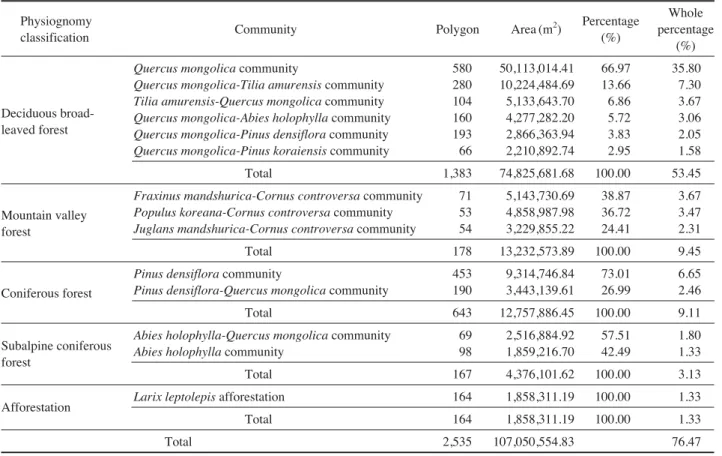
Table 1의 상관대분류별로 볼 때 산지낙엽활엽수림은 분 포면적 1% 이상 군락이 6개로 조사되었으며, 신갈나무 군락, 신갈나무-피나무군락, 피나무-신갈나무군락, 신갈나 무-전나무군락 순으로 분포 비율이 높았다(Table 1).
산지습성림은 들메나무-층층나무군락, 물황철나무-층 층나무군락, 가래나무-층층나무군락 등의 3개 군락이 1% 이상 분포 면적을 차지하고 있어 비로봉 일대 산지 계곡은 대부분이 들메나무와 층층나무, 물황철나무, 가 래나무에 의하여 강하게 우점되어 있음을 알 수 있다 (Table 1). 산지침엽수림은 소나무군락이 6.65%, 소나무- 신갈나무군락 2.46%로 비로봉 일대 침엽수림은 대부분 이 소나무군락이 분포하고 있음을 알 수 있다(Table 1).
그러나 소나무군락을 제외한 소나무-신갈나무군락의 침
Fig. 2. Actual vegetation map in the Birobong of Odaesan National Park.
엽수림대 혼효림은 천이가 진행되면 신갈나무군락으로 군락 대체가 예상되어 비로봉 일대 침엽수림의 분포 면 적은 감소할 것으로 보인다.
한편 비로봉 일대의 식재림은 비로봉 사면 저지대의 마을, 경작지, 도로와 연접된 부분에 일본잎갈나무가 비 교적 넓은 면적으로 식재림이 조성되어 있어 천이의 진 행과 함께 참나무속 수종으로 매우 빠르게 군락이 대체 될 것으로 보인다.
결론적으로 비로봉 일대의 산림식생은 신갈나무, 피나 무, 소나무, 들메나무, 층층나무, 물황철나무 등 이들 종 들과 혼생군락을 이루고 있는 군락들은 천이 및 기후적 요인들에 의하여 산지낙엽활엽수림은 신갈나무, 산지습 성림은 들메나무와 층층나무 군락으로 대체가 빠르게 일어날 것으로 보인다.
2.
산지삼림식생1)
산지낙엽활엽수림비로봉 일대 산지낙엽활엽수림은 능선부, 산지사면 상 부와 중부에 집중적으로 분포하고 있으며, 정상 부근 경 사가 완만하고 비교적 토양습도가 높은 지역에는 들메
나무, 가래나무 혼생림이 군락을 이루고 있다. 조사된 산 지낙엽활엽수림 62개 군락(Table 2)의 대부분은 신갈나 무, 굴참나무, 피나무, 졸참나무와 혼생림을 이루고 있다.
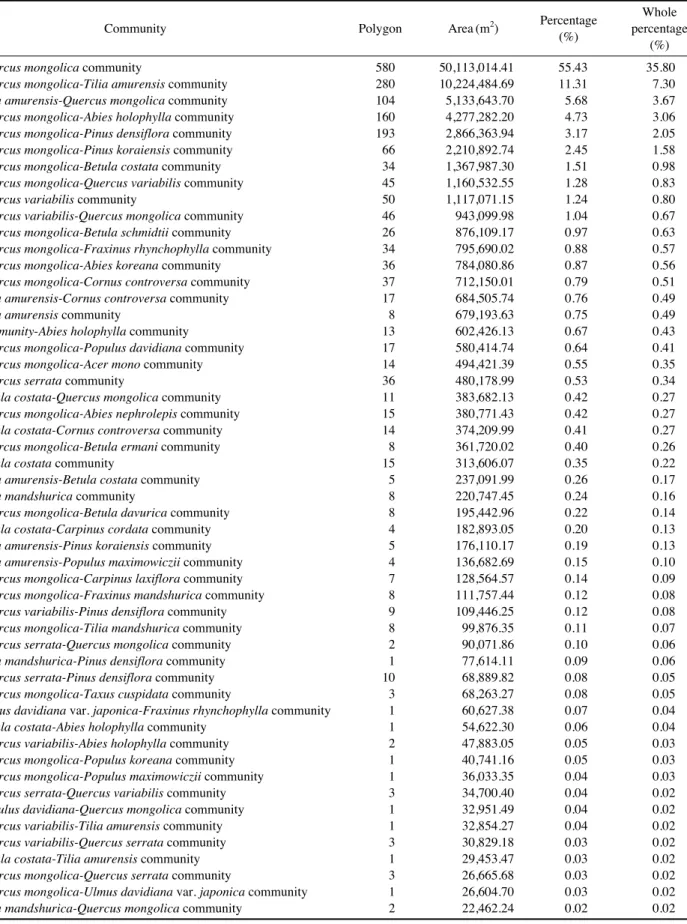
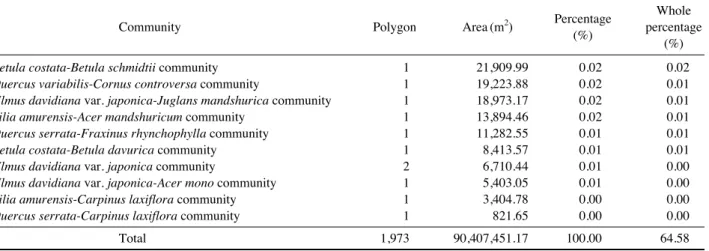
62개 군락 중 1개 종이 최상층에 우점하는 군락은 신갈 나무가 580개 polygon, 35.80%로 가장 분포역 및 분포 비율이 높았으며, 굴참나무군락이 50개 polygon, 0.80%, 피나무군락 8개 polygon, 0.49%, 졸참나무군락이 36개 polygon, 0.34%이며, 거제수나무군락과 찰피나무군락이 0.22%와 0.16% 비율로 분포하고 있다(Table 2).
2종이 최상층에서 혼생하고 있어 혼생군락을 형성하 고 있는 군락 중 1% 이상의 분포 비율을 나타내고 있는 군락은 신갈나무-피나무군락이 10,224,484,69 m
2
, 7.30%, 피나무-신갈나무군락이 5,133,643.70 m2
, 3.67%, 신갈나 무-전나무군락이 4,277,282.20 m2
, 3.06%, 신갈나무-소나 무군락이 2,866,363.94 m2
, 2.05%, 신갈나무-잣나무군락 이 2,210,892.74 m2
, 1.58% 등으로 조사되었다. 또한 전 체 62개 군락 중 신갈나무와 혼생하는 군락은 28개 군 락 24.60%이며, 굴참나무와 혼생하는 군락은 8개 군락, 1.70%, 피나무와 혼생하는 군락은 11개 군락 12.34%, 졸 참나무군락과 혼생하는 군락은 7개 군락, 0.19%로 나타 났다.Table 1. Communities of ¤1% distribution area in the 94 communities of Birobong area in the Odaesan National Park.
Physiognomy Percentage Whole
classification Community Polygon Area (m
2)
(%) percentage (%)
Quercus mongolica community 580 50,113,014.41 66.97 35.80
Quercus mongolica-Tilia amurensis community 280 10,224,484.69 13.66 7.30 Tilia amurensis-Quercus mongolica community 104 5,133,643.70 6.86 3.67 Deciduous broad- Quercus mongolica-Abies holophylla community 160 4,277,282.20 5.72 3.06 leaved forest Quercus mongolica-Pinus densiflora community 193 2,866,363.94 3.83 2.05 Quercus mongolica-Pinus koraiensis community 66 2,210,892.74 2.95 1.58
Total 1,383 74,825,681.68 100.00 53.45
Fraxinus mandshurica-Cornus controversa community 71 5,143,730.69 38.87 3.67 Mountain valley Populus koreana-Cornus controversa community 53 4,858,987.98 36.72 3.47 forest Juglans mandshurica-Cornus controversa community 54 3,229,855.22 24.41 2.31
Total 178 13,232,573.89 100.00 9.45
Pinus densiflora community 453 9,314,746.84 73.01 6.65
Coniferous forest Pinus densiflora-Quercus mongolica community 190 3,443,139.61 26.99 2.46
Total 643 12,757,886.45 100.00 9.11
Subalpine coniferous Abies holophylla-Quercus mongolica community 69 2,516,884.92 57.51 1.80
forest Abies holophylla community 98 1,859,216.70 42.49 1.33
Total 167 4,376,101.62 100.00 3.13
Afforestation Larix leptolepis afforestation 164 1,858,311.19 100.00 1.33
Total 164 1,858,311.19 100.00 1.33
Total 2,535 107,050,554.83 76.47
Table 2. Plant communities of deciduous broad-leaved forest by physiognomy classification of Birobong area in the Odaesan National
Park.Percentage Whole
Community Polygon Area (m2)
(%) percentage (%)
Quercus mongolica community
580 50,113,014.41 55.43 35.80Quercus mongolica-Tilia amurensis community
280 10,224,484.69 11.31 7.30Tilia amurensis-Quercus mongolica community
104 5,133,643.70 5.68 3.67Quercus mongolica-Abies holophylla community 160
4,277,282.20 4.73 3.06Quercus mongolica-Pinus densiflora community
193 2,866,363.94 3.17 2.05Quercus mongolica-Pinus koraiensis community
66 2,210,892.74 2.45 1.58Quercus mongolica-Betula costata community
34 1,367,987.30 1.51 0.98Quercus mongolica-Quercus variabilis community
45 1,160,532.55 1.28 0.83Quercus variabilis community
50 1,117,071.15 1.24 0.80Quercus variabilis-Quercus mongolica community
46 943,099.98 1.04 0.67Quercus mongolica-Betula schmidtii community
26 876,109.17 0.97 0.63Quercus mongolica-Fraxinus rhynchophylla community
34 795,690.02 0.88 0.57Quercus mongolica-Abies koreana community
36 784,080.86 0.87 0.56Quercus mongolica-Cornus controversa community
37 712,150.01 0.79 0.51Tilia amurensis-Cornus controversa community
17 684,505.74 0.76 0.49Tilia amurensis community
8 679,193.63 0.75 0.49community-Abies holophylla community
13 602,426.13 0.67 0.43Quercus mongolica-Populus davidiana community
17 580,414.74 0.64 0.41Quercus mongolica-Acer mono community
14 494,421.39 0.55 0.35Quercus serrata community
36 480,178.99 0.53 0.34Betula costata-Quercus mongolica community
11 383,682.13 0.42 0.27Quercus mongolica-Abies nephrolepis community
15 380,771.43 0.42 0.27Betula costata-Cornus controversa community
14 374,209.99 0.41 0.27Quercus mongolica-Betula ermani community
8 361,720.02 0.40 0.26Betula costata community
15 313,606.07 0.35 0.22Tilia amurensis-Betula costata community
5 237,091.99 0.26 0.17Tilia mandshurica community
8 220,747.45 0.24 0.16Quercus mongolica-Betula davurica community
8 195,442.96 0.22 0.14Betula costata-Carpinus cordata community
4 182,893.05 0.20 0.13Tilia amurensis-Pinus koraiensis community
5 176,110.17 0.19 0.13Tilia amurensis-Populus maximowiczii community
4 136,682.69 0.15 0.10Quercus mongolica-Carpinus laxiflora community
7 128,564.57 0.14 0.09Quercus mongolica-Fraxinus mandshurica community
8 111,757.44 0.12 0.08Quercus variabilis-Pinus densiflora community
9 109,446.25 0.12 0.08Quercus mongolica-Tilia mandshurica community
8 99,876.35 0.11 0.07Quercus serrata-Quercus mongolica community
2 90,071.86 0.10 0.06Tilia mandshurica-Pinus densiflora community
1 77,614.11 0.09 0.06Quercus serrata-Pinus densiflora community
10 68,889.82 0.08 0.05Quercus mongolica-Taxus cuspidata community
3 68,263.27 0.08 0.05Ulmus davidiana var. japonica-Fraxinus rhynchophylla community
1 60,627.38 0.07 0.04Betula costata-Abies holophylla community
1 54,622.30 0.06 0.04Quercus variabilis-Abies holophylla community
2 47,883.05 0.05 0.03Quercus mongolica-Populus koreana community
1 40,741.16 0.05 0.03Quercus mongolica-Populus maximowiczii community
1 36,033.35 0.04 0.03Quercus serrata-Quercus variabilis community
3 34,700.40 0.04 0.02Populus davidiana-Quercus mongolica community
1 32,951.49 0.04 0.02Quercus variabilis-Tilia amurensis community
1 32,854.27 0.04 0.02Quercus variabilis-Quercus serrata community
3 30,829.18 0.03 0.02Betula costata-Tilia amurensis community
1 29,453.47 0.03 0.02Quercus mongolica-Quercus serrata community
3 26,665.68 0.03 0.02Quercus mongolica-Ulmus davidiana var. japonica community
1 26,604.70 0.03 0.02Tilia mandshurica-Quercus mongolica community
2 22,462.24 0.02 0.02Betula costata-Betula schmidtii community
1 21,909.99 0.02 0.02Quercus variabilis-Cornus controversa community
1 19,223.88 0.02 0.01Ulmus davidiana var. japonica-Juglans mandshurica community
1 18,973.17 0.02 0.01Tilia amurensis-Acer mandshuricum community
1 13,894.46 0.02 0.01Quercus serrata-Fraxinus rhynchophylla community
1 11,282.55 0.01 0.01Betula costata-Betula davurica community
1 8,413.57 0.01 0.01Ulmus davidiana var. japonica community
2 6,710.44 0.01 0.00Ulmus davidiana var. japonica-Acer mono community
1 5,403.05 0.01 0.00Tilia amurensis-Carpinus laxiflora community
1 3,404.78 0.00 0.00Quercus serrata-Carpinus laxiflora community
1 821.65 0.00 0.00Total 1,973 90,407,451.17 100.00 64.58
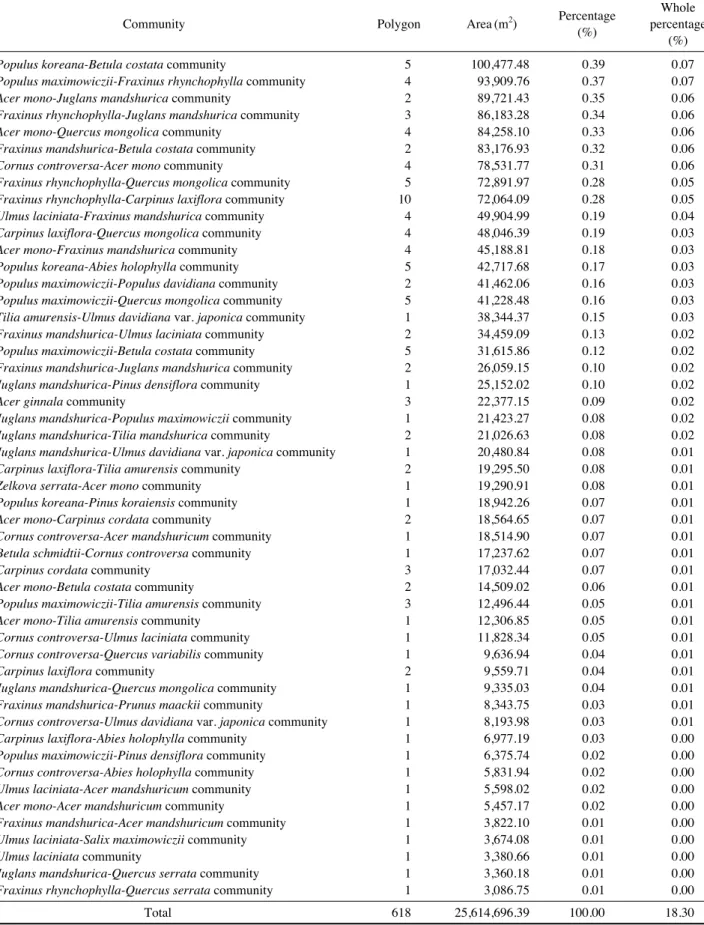
Table 3. Plant communities of mountain valley forest by physiognomy classification of Birobong area in the Odaesan.
Percentage Whole
Community Polygon Area (m2)
(%) percentage (%)
Fraxinus mandshurica-Cornus controversa community
71 5,143,730.69 20.08 3.67Populus koreana-Cornus controversa community
53 4,858,987.98 18.97 3.47Juglans mandshurica-Cornus controversa community
54 3,229,855.22 12.61 2.31Juglans mandshurica community
38 1,389,801.19 5.43 0.99Fraxinus mandshurica-Quercus mongolica community
10 777,598.40 3.04 0.56Populus koreana-Fraxinus mandshurica community
14 744,803.92 2.91 0.53Fraxinus rhynchophylla-Acer mono community
19 704,771.40 2.75 0.50Cornus controversa-Fraxinus mandshurica community
6 620,126.99 2.42 0.44Cornus controversa-Tilia amurensis community
16 536,394.55 2.09 0.38Juglans mandshurica-Tilia amurensis community
14 513,457.25 2.00 0.37Fraxinus rhynchophylla-Tilia mandshurica community
8 475,919.33 1.86 0.34Acer mono-Cornus controversa community
18 448,621.09 1.75 0.32Fraxinus rhynchophylla-Tilia amurensis community
13 392,197.17 1.53 0.28Fraxinus mandshurica community
7 379,260.32 1.48 0.27Fraxinus mandshurica-Tilia mandshurica community
7 361,230.75 1.41 0.26Juglans mandshurica-Fraxinus rhynchophylla community
8 350,216.17 1.37 0.25Fraxinus rhynchophylla-Fraxinus mandshurica community
14 319,750.33 1.25 0.23Cornus controversa community
28 291,607.70 1.14 0.21Fraxinus rhynchophylla-Cornus controversa community
14 288,723.09 1.13 0.21Populus maximowiczii-Cornus controversa community
8 257,824.75 1.01 0.18Cornus controversa-Fraxinus rhynchophylla community
6 234,969.92 0.92 0.17Fraxinus mandshurica-Acer mono community
7 177,934.14 0.69 0.13Populus koreana community
4 163,231.32 0.64 0.12Populus maximowiczii community
9 158,228.55 0.62 0.11Fraxinus rhynchophylla community
19 156,889.52 0.61 0.11Cornus controversa-Juglans mandshurica community
2 156,535.29 0.61 0.11Fraxinus mandshurica-Populus koreana community
2 137,783.68 0.54 0.10Betula schmidtii-Quercus mongolica community
2 129,475.48 0.51 0.09Juglans mandshurica-Acer mono community
3 125,802.00 0.49 0.09Fraxinus mandshurica-Fraxinus rhynchophylla community
3 114,085.16 0.45 0.08Acer mono community
15 112,730.59 0.44 0.08Acer mono-Fraxinus rhynchophylla community
6 107,316.69 0.42 0.08Fraxinus rhynchophylla-Ulmus davidiana var. japonica community
4 107,266.53 0.42 0.08Fraxinus rhynchophylla-Morus bombycis community
1 104,215.46 0.41 0.07Table 2. Continued.
Percentage Whole
Community Polygon Area (m2)
(%) percentage (%)
Populus koreana-Betula costata community
5 100,477.48 0.39 0.07Populus maximowiczii-Fraxinus rhynchophylla community
4 93,909.76 0.37 0.07Acer mono-Juglans mandshurica community
2 89,721.43 0.35 0.06Fraxinus rhynchophylla-Juglans mandshurica community
3 86,183.28 0.34 0.06Acer mono-Quercus mongolica community
4 84,258.10 0.33 0.06Fraxinus mandshurica-Betula costata community
2 83,176.93 0.32 0.06Cornus controversa-Acer mono community
4 78,531.77 0.31 0.06Fraxinus rhynchophylla-Quercus mongolica community
5 72,891.97 0.28 0.05Fraxinus rhynchophylla-Carpinus laxiflora community
10 72,064.09 0.28 0.05Ulmus laciniata-Fraxinus mandshurica community
4 49,904.99 0.19 0.04Carpinus laxiflora-Quercus mongolica community
4 48,046.39 0.19 0.03Acer mono-Fraxinus mandshurica community
4 45,188.81 0.18 0.03Populus koreana-Abies holophylla community
5 42,717.68 0.17 0.03Populus maximowiczii-Populus davidiana community
2 41,462.06 0.16 0.03Populus maximowiczii-Quercus mongolica community
5 41,228.48 0.16 0.03Tilia amurensis-Ulmus davidiana var. japonica community
1 38,344.37 0.15 0.03Fraxinus mandshurica-Ulmus laciniata community
2 34,459.09 0.13 0.02Populus maximowiczii-Betula costata community
5 31,615.86 0.12 0.02Fraxinus mandshurica-Juglans mandshurica community
2 26,059.15 0.10 0.02Juglans mandshurica-Pinus densiflora community
1 25,152.02 0.10 0.02Acer ginnala community
3 22,377.15 0.09 0.02Juglans mandshurica-Populus maximowiczii community
1 21,423.27 0.08 0.02Juglans mandshurica-Tilia mandshurica community
2 21,026.63 0.08 0.02Juglans mandshurica-Ulmus davidiana var. japonica community
1 20,480.84 0.08 0.01Carpinus laxiflora-Tilia amurensis community
2 19,295.50 0.08 0.01Zelkova serrata-Acer mono community
1 19,290.91 0.08 0.01Populus koreana-Pinus koraiensis community
1 18,942.26 0.07 0.01Acer mono-Carpinus cordata community
2 18,564.65 0.07 0.01Cornus controversa-Acer mandshuricum community
1 18,514.90 0.07 0.01Betula schmidtii-Cornus controversa community
1 17,237.62 0.07 0.01Carpinus cordata community
3 17,032.44 0.07 0.01Acer mono-Betula costata community
2 14,509.02 0.06 0.01Populus maximowiczii-Tilia amurensis community
3 12,496.44 0.05 0.01Acer mono-Tilia amurensis community
1 12,306.85 0.05 0.01Cornus controversa-Ulmus laciniata community
1 11,828.34 0.05 0.01Cornus controversa-Quercus variabilis community
1 9,636.94 0.04 0.01Carpinus laxiflora community
2 9,559.71 0.04 0.01Juglans mandshurica-Quercus mongolica community
1 9,335.03 0.04 0.01Fraxinus mandshurica-Prunus maackii community
1 8,343.75 0.03 0.01Cornus controversa-Ulmus davidiana var. japonica community
1 8,193.98 0.03 0.01Carpinus laxiflora-Abies holophylla community
1 6,977.19 0.03 0.00Populus maximowiczii-Pinus densiflora community
1 6,375.74 0.02 0.00Cornus controversa-Abies holophylla community
1 5,831.94 0.02 0.00Ulmus laciniata-Acer mandshuricum community
1 5,598.02 0.02 0.00Acer mono-Acer mandshuricum community
1 5,457.17 0.02 0.00Fraxinus mandshurica-Acer mandshuricum community
1 3,822.10 0.01 0.00Ulmus laciniata-Salix maximowiczii community
1 3,674.08 0.01 0.00Ulmus laciniata community
1 3,380.66 0.01 0.00Juglans mandshurica-Quercus serrata community
1 3,360.18 0.01 0.00Fraxinus rhynchophylla-Quercus serrata community
1 3,086.75 0.01 0.00Total 618 25,614,696.39 100.00 18.30
Table 3. Continued.
Percentage Whole
Community Polygon Area (m2)
(%) percentage (%)
2)
산지습성림비로봉 일대 산지습성림은 정상 부근 계곡부의 산지습 성림과 고도가 낮은 지역의 계곡부의 산지습성림으로 구 분된다. 비로봉 위쪽 계곡부에 주로 분포하고 있는 군락 은 들메나무와 물황철나무, 가래나무, 층층나무를 우점종 으로 하는 군락이 형성되어 있고 아래쪽에는 물푸레나무, 고로쇠나무가 주로 나타난다. 산지습성림의 분포 면적은 전체 조사면적 139,984,851.75 m
2
중 25,614,696.39로약 18.30%를 차지하고 있다.
조사된 군락은 가래나무, 들메나무, 층층나무, 물황철나 무, 황철나무, 물푸레나무, 고로쇠나무, 신나무 등과 이들 군락과의 혼생군락 등 총 84개 군락이 분포한다 (Table 3).
산지습성림을 형성하고 있는 84개 군락의 분포 비율을 보면 가래나무군락과 들메나무군락, 물황철나무군락이 각각 5.43%, 1.48%, 0.64%로 산지습성림 전체의 7.55%
Table 4. Plant communities of coniferous forest by physiognomy classification of Birobong area in the Odaesan National Park.
Percentage Whole
Community Polygon Area (m2)
(%) percentage
(%)
Pinus densiflora community
453 9,314,746.84 67.11 6.65Pinus densiflora-Quercus mongolica community
190 3,443,139.61 24.81 2.46Pinus densiflora-Quercus variabilis community
18 341,852.57 2.46 0.24Pinus densiflora-Tilia mandshurica community
7 243,678.54 1.76 0.17Pinus densiflora-Quercus serrata community
18 213,913.74 1.54 0.15Pinus densiflora-Populus deltoides community
3 99,686.17 0.72 0.07Pinus densiflora-Populus maximowiczii community
6 98,592.78 0.71 0.07Pinus densiflora-Betula costata community
2 36,263.06 0.26 0.03Pinus densiflora-Betula schmidtii community
1 19,064.99 0.14 0.01Pinus densiflora-Juglans mandshurica community
3 15,099.13 0.11 0.01Pinus densiflora-Fraxinus mandshurica community
1 13,696.59 0.10 0.01Pinus densiflora-Pinus koraiensis community
1 12,813.03 0.09 0.01Pinus densiflora-Fraxinus rhynchophylla community
1 12,121.33 0.09 0.01Pinus densiflora-Abies holophylla community
1 10,894.15 0.08 0.01Pinus densiflora-Salix koreensis community
1 4,297.62 0.03 0.00Total 706 13,879,860.15 100.00 9.92
Table 5. Plant communities of subalpine coniferous by physiognomy classification of Birobong area in the Odaesan National Park.
Percentage Whole
Community Polygon Area (m2)
(%) percentage
(%)
Abies holophylla-Quercus mongolica community
69 2,516,884.92 39.78 1.80Abies holophylla community
98 1,859,216.70 29.39 1.33Pinus densiflora-Quercus mongolica community
12 408,850.51 6.46 0.29Abies holophylla-Betula ermani community
5 398,538.75 6.30 0.28Abies holophylla-Tilia amurensis community
10 312,511.47 4.94 0.22Abies holophylla-Pinus densiflora community
11 268,131.17 4.24 0.19Abies holophylla-Betula costata community
3 194,274.61 3.07 0.14Abies holophylla-Taxus cuspidata community
2 129,852.28 2.05 0.09Pinus densiflora-Betula ermani community
1 50,023.00 0.79 0.04Abies koreana community
6 45,957.63 0.73 0.03Pinus densiflora community
9 41,559.29 0.66 0.03Taxus cuspidata community
1 26,974.77 0.43 0.02Abies koreana-Pinus densiflora community
1 26,429.79 0.42 0.02Abies holophylla-Fraxinus mandshurica community
1 16,753.77 0.26 0.01Abies nephrolepis community
3 16,598.92 0.26 0.01Pinus densiflora-Abies holophylla community
1 14,251.94 0.23 0.01Total 233 6,326,809.52 100.00 4.52
를 차지하고 있으며, 들메나무-층층나무군락의 20.08%, 물황철나무-층층나무군락 18.97%, 가래나무-층층나무군 락의 12.61%를 포함한 들메나무와 층층나무, 물황철나 무가 우점종으로서 군락을 형성하고 있는 비율은 산지 습성림 전체의 51.66%로서 조사되었다.
3)
산지침엽수림비로봉 일대의 산지침엽수림은 조사지역 전체의 9.92
%를 차지하고 있다. 조사된 군락은 15개 군락으로 소나 무군락이 산지침엽수림 중 67.11%를 차지하고 있으며, 소나무-신갈나무군락, 소나무-굴참나무군락이 각각 24.81
%, 2.46%로 산지침엽수림의 94.38%로서 대부분이 이들 3개 군락으로 이뤄져 있다(Table 4).
4)
아고산침엽수림 및 아고산활엽수림비로봉 일대의 아고산침엽수림과 아고산활엽수림은 조 사지역 전체의 4.52%, 0.31%를 차지하고 있다. 조사된
군락은 아고산침엽수림이 16개 군락, 아고산활엽수림이 3 개 군락으로 전나무군락이 아고산활엽수림 중 29.39%를 차지하고 있으며, 전나무-신갈나무군락이 39.78%로 아고 산침엽수림의 69.17%로서 대부분이 이들 2개 군락으로 이뤄져 있다 (Table 5). 아고산활엽수림은 사스래나무와 사스래나무 혼생림 3군락으로 구성되어 있다(Table 6).
5)
식재림,
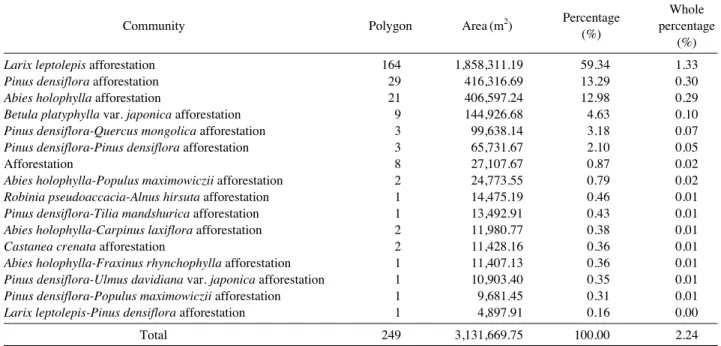
하반림 및 기타식생비로봉 지역의 식재림은 대부분이 마을, 경작지, 도로 와 연접된 지역 등 산의 저지대 및 국립공원 경계선에 대상으로 분포한다. 조사된 식재림 중 일본잎갈나무가 식재림 전체의 59.34%, 잣나무 13.29%, 전나무 12.98%, 자작나무 4.63%로 전체 식재림의 90.24%를 차지하고 있어 식재된 대부분의 수종은 이들 4종 및 4종과 혼생 림을 이루는 것으로 조사되었다 (Table 7). 16개 식재군 락 중 6개 식재군락은 오대산 국립공원 일대에서 자생
Table 6. Plant communities of subalpine broad-leaved forest by physiognomy classification of Birobong area in the Odaesan National
Park.Percentage Whole
Community Polygon Area (m2)
(%) percentage
(%)
Betula ermani-Cornus controversa community
2 204,029.37 46.36 0.15Betula ermani-Quercus mongolica community
2 119,911.19 27.24 0.09Betula ermani community
3 116,193.94 26.40 0.08Total 7 440,134.50 100.00 0.31
Table 7. Plant communities of afforestation by physiognomy classification of Birobong area in the Odaesan National Park.
Percentage Whole
Community Polygon Area (m2)
(%) percentage
(%)
Larix leptolepis afforestation
164 1,858,311.19 59.34 1.33Pinus densiflora afforestation
29 416,316.69 13.29 0.30Abies holophylla afforestation
21 406,597.24 12.98 0.29Betula platyphylla var. japonica afforestation
9 144,926.68 4.63 0.10Pinus densiflora-Quercus mongolica afforestation
3 99,638.14 3.18 0.07Pinus densiflora-Pinus densiflora afforestation
3 65,731.67 2.10 0.05Afforestation 8 27,107.67 0.87 0.02
Abies holophylla-Populus maximowiczii afforestation
2 24,773.55 0.79 0.02Robinia pseudoaccacia-Alnus hirsuta afforestation
1 14,475.19 0.46 0.01Pinus densiflora-Tilia mandshurica afforestation
1 13,492.91 0.43 0.01Abies holophylla-Carpinus laxiflora afforestation
2 11,980.77 0.38 0.01Castanea crenata afforestation
2 11,428.16 0.36 0.01Abies holophylla-Fraxinus rhynchophylla afforestation
1 11,407.13 0.36 0.01Pinus densiflora-Ulmus davidiana var. japonica afforestation
1 10,903.40 0.35 0.01Pinus densiflora-Populus maximowiczii afforestation
1 9,681.45 0.31 0.01Larix leptolepis-Pinus densiflora afforestation
1 4,897.91 0.16 0.00Total 249 3,131,669.75 100.00 2.24
군락을 형성하고 있는 신갈나무, 소나무, 황철나무, 찰피 나무, 서나무 등과 혼생하고 있어 향후 천이가 진행되면 자연군락으로 빠르게 군락 대체가 예상된다.
하반림으로는 버드나무군락이 전체 조사지역 중 0.01
%를 차지하고 있다(Table 8).
기타 식생으로는 농경지, 2차 초지, 관중군락, 속새-관 중군락 등으로 약 82,353.12 m
2
로서 전체의 약 0.06%를 차지하고 있다(Table 9).결론적으로 오대산 국립공원 비로봉 일대의 산림식생 은 신갈나무, 굴참나무, 피나무, 가래나무, 들메나무, 물황 철나무, 층층나무, 소나무 등 지형적, 고도, 습도 등의 주 요 요인들에 의하여 최상층부가 우점되어 있으며, 이들 종들과 혼생하는 수많은 군락들은 식생천이 및 다양한 환경요인에 의하여 극상림으로 군락 대체가 일어날 것 으로 보인다. 따라서 주요종들의 천이에 의한 군락대체 가 이뤄질 경우 비로봉 일대는 산지낙엽활엽수림 중 고 도가 높은 지역에서는 신갈나무군락, 피나무군락, 산의 저지대 및 사면 하부에서는 굴참나무, 졸참나무, 산지습 성림은 가래나무, 들메나무, 물황철나무가 우점하는 식생 유형을 나타낼 것이다.
적 요
오대산 국립공원 비로봉 (해발고도 1,563 m) 일대 삼 림식생은 산지삼림식생과 평지삼림식생으로 대별되어있 다. 산지삼림식생은 산지낙엽활엽수림, 산지습성림, 산지
침엽수림, 아고산침엽수림, 아고산활엽수림, 식재림 등으 로 세분되었으며, 평지삼림식생은 하반림, 기타식생으로 조사되었다.
상관대분류에 의하여 구분된 산지삼림식생의 분포군 락수는 산지낙엽활엽수림 62개 군락, 산지습성림 84개 군락, 산지침엽수림 15개 군락, 아고산침엽수림 16개 군 락, 아고산활엽수림 3개 군락, 식재림 16개 군락, 하반림 1개 군락, 기타식생 4개 군락의 총 201개 군락이 조사되 었다. 조사된 주요 군락의 분포 비율을 보면 산지낙엽활 엽수림은 신갈나무군락이 50,113,014.41 m
2
의 35.80%로 가장 높은 분포 비율로 조사되었고, 굴참나무군락이 1,117,071.15 m
2
의 0.80%, 피나무군락 679,193.63 m2
, 0.49%로 3개 군락이 전체의 37.08%를 차지하고 있었 으며, 산지습성림은 가래나무군락, 들메나무군락, 물황철 나무군락이 전체의 0.99%, 0.27%, 0.12%로 비로봉 일 대의 산지습성림은 가래나무군락, 들메나무군락, 물황철 나무군락이 전체의 1.38%로 대부분을 차지하고 있는 것 으로 조사되었다. 산지침엽수림은 소나무군락이 전체의 6.65%로서 대부분의 산지침염수림은 소나무 1종이 상 층부에서 우점종으로 나타나는 군락의 양상을 나타내고 있다. 아고산침엽수림은 전나무군락이 1.33%, 아고산활 엽수림은 사스래나무군락이 0.08%, 식재림은 일본잎갈 나무식재림은 전체의 1.33%로 가장 많이 식재되었으며, 잣나무 0.30%, 전나무가 0.29%로 3개 수종이 전체의 1.92%로 대부분이 이들 3종에 의하여 식재되어졌다.결론적으로 오대산 국립공원 비로봉 일대 삼림식생은 신갈나무, 굴참나무, 피나무, 가래나무, 들메나무, 물황철
Table 8. Plant communities of flatland forest vegetation by physiognomy classification of Birobong area in the Odaesan National Park.
Percentage Whole
Community Polygon Area (m2)
(%) percentage
(%)
Salix koreensis community
4 13,750.81 100.00 0.01Total 4 13,750.81 100.00 0.01
Table 9. Plant communities of other vegetation by physiognomy classification of Birobong area in the Odaesan National Park.
Percentage Whole
Community Polygon Area (m2)
(%) percentage
(%)
Agricultural 9 64,055.12 77.78 0.05
Secondary meadow 4 11,936.13 14.49 0.01
Dryopteris crassirhizoma community
1 3,270.54 3.97 0.00Equisetum hyemale-Dryopteris crassirhizoma community
1 3,091.33 3.75 0.00Total 15 82,353.12 100.00 0.06
나무, 소나무 등 소수의 수종이 최상층부의 우점종으로 분포하고있으며 2종에 의하여 형성된 수많은 군락들은 식생천이 및 기후적 요인에 의하여 이 지역 일대의 극 상수종인 신갈나무, 들메나무 등으로 군락 대체가 예상 된다. 그러나 아고산침엽수림은 기후온난화와 인위적 교 란에 의하여 점차적으로 낙엽활엽수의 분포비율이 증가 할 것으로 보인다.
사 사
본 연구 논문은 국립공원관리공단 국립공원 정밀식생 도 제작사업 (오대산 국립공원, 2013)의 일부 결과를 반 영하여 작성되었습니다.
REFERENCES
Braun-Blanquet, J. 1964. Pflanzensoziologie. Grundzuge der Vegetationstunde, Wien, 865 p.
Kim, G.T., G.C. Choo and T.W. Um. 1996. Studies on the Struc- ture of Forest Community at Dongdaesan, Turobong, Sang- wangbong Area in Odaesan National Park. Korean Journal
of Environment and Ecology 9(2): 147-155.
Kim, G.T., G.C. Choo and T.W. Um. 1996. Studies on the Struc- ture of Forest Community at Sangwonsa, Pirobong, Hor- yongbong area in Odaesan National Park. Korean Journal
of Environment and Ecology 10(1): 151-159.
Kim, Y.S., S.H. Chon and K.H. Kang. 1996. Floristic Study of Odaesan National Park. Korean Journal of Environment
and Ecology 9(2): 77-98.
Korea Meteorological Administration. 2008. http://www.kma.
go.kr.
Lee, K.E. 2009. Dynamics of Mass and Nutrients of Coarse Woody Debris at Several Forest Stands in Mt. Odae Natio- nal Park. Kangwon University, the Graduate School.
Lee, K.J., J.S. Kim., J.W. Choi and B.H. Han. 2008. Vegetation Structure of Abies holophylla Forest near Woljeong Tem- ple in Odaesan National Park. Korean Journal of Environ-
ment and Ecology 22(2): 173-183.
Lee, K.J., W. Cho and B.H. Han. 1996. Plant Community Struc- ture of Pinus densiflora Forests in Odaesan National Park.
Korean Journal of Environment and Ecology 9(2): 115-
125.Lee, W.T. 1996. Coloured standard illustrations of Korean plants.
Academy Book.
Ministry of Environment. 2009. Survey methods and classifica- tion criteria of National Environment. Ministry of Environ- ment∙National Institute of Environmental Research. 2006.
3rd National natural environment research guidelines. Mini- stry of Environment∙National Institute of Environmental Research.
Oh, K.K. and T.H. Kwon. 1996. Edge Vegetation Structure in Odaesan National Park.
Uyeki, H. 1926. Corean timber tress. Vol. I, Ginkgeals & Conifer Forest Experimental Station, Govermment General of Chosen, Seoul.