The Analysis and Management of Phytosociological Vegetation Structure about Evergreen Broad-leaved Temple Forest, Korea
Sung Je LEE1 ․Keiichi OHNO1 ․Young-hee Ahn2 ․Chang-yong Choe2
1Graduate School of Environment and Information Sciences, Yokohama National University, JAPAN, 2Dept. of Applied PlantScience, Chung-Ang University, KOREA
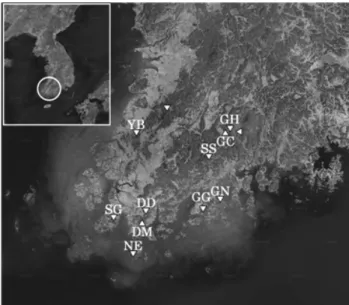
Figure 1. Research areas
Introduction
The vegetation studies about temple forest were insufficient. There were a fewpapers about Evergreen broad-leaved forest having meaning of temple forest until now. But most of the papers are composed with the types of local vegetation structures and communities (Oh etc, 1996; Chang etc, 1988). This result means it is so difficult to do the prediction about the succession of vegetation and potential natural vegetation in the future, and it is also difficult to manage Evergreen Broad-leaved Temple Forest (EBLTF). According to these matters , We make clear the vegetation structure of temple forest composed with evergreen broad-leaved forest(EBLF) and warm-temperate deciduous broad-leaved forest mixed with vegetation elements of evergreen broad-leaved forest(mixed SBLF). We also carried out this study with the purpose how we lead and maintain the vegetation for species diversity and stability under the point of view about the change of vegetation structure According to the global environmental change.
Materials and methods
1. Vegetation study
Vegetation research was carried outin total 101 stands, temple forests (EBLTF) of 10 places: Ssanggye-sa(SG), Mihwang-sa(DM), Daeheung-sa(DD), Nameun-sa(NE),
Geumtap-sa(GG), Seonahm-sa(SS), Hwaeom-sa(GH), Neungga-sa(GN), Choneun-sa(GC), Bulgap-sa(YB).
Especially, we confirmed the EBLF of 62 stands and mixed SBLF of 39 stands in total 101 stands (figure 1).
We did research the vegetation of EBLTF based on the phytosociological method (Braun-blanquet, 1964).
In case of the analysis of vegetation structure, we analyzed the EBLTF structure based on the new Korea evergreen broad-leaved forest vegetation classification system under the basison Japan Evergreen broad-leaved forest system already given papers and the analysis data of temple forest vegetation structure in the southern part of Korea (LEE etc, 2009; 2010). For the analysis of more specific vegetation structure, we carried out
Table1. phytosociological vegetation table the analysis of BC ordination with the quantification
results of vegetation researches through PC-ORD4.41.
For the analysis about relationship between EBLF vegetation structure and environmental conditions, we did the analysis of CCA ordination and classification with the degree and aspect of slope, elevation (m) and soil condition (T.N.(%),pH, Organic Matter(g/kg), P(mg/kg), Exchangeable Cations (cmol+/kg; K, Ca, Mg)).
2. Life form analysis
We analyzed Numata’s life form of total appearance species quantified (numata M, 1969; LEE, 1996). It is preferably more important to analyze the quantification data of appearance species in each layer than the number of appearance species for the occupying structure analysis of actual life form in present vegetation.
3. Species diversity analysis
We analyzed the species diversity with Shannon diversity index and evenness J.
We tried to make clear what kind of vegetation type is suitable for high stability, potential naturality and species diversity based on the diversity and evenness.
Results
We confirm 170 species in EBLF, 223 species in mixed SBLF and total 279 species in EBLTF.
1. Vegetation structure analysis
We confirmed three vegetation types of EBLTF:
Dendropanaco-Quercetum acutae Association (ass.), Ardisio-Castanopsietum sieboldii ass. under Camellietea japonicae Class as climatic climax forest (EBLF) and Quercus serrata-Quercus variabilis comm. as warm-
temperate deciduous broad-leaved forest type including the vegetation elements of evergreen broad-leaved forest (mixed SBLF).
Dendropanaco-Quercetum acutae ass. is composed with typical subassociation(subass.), Quercetum serratae
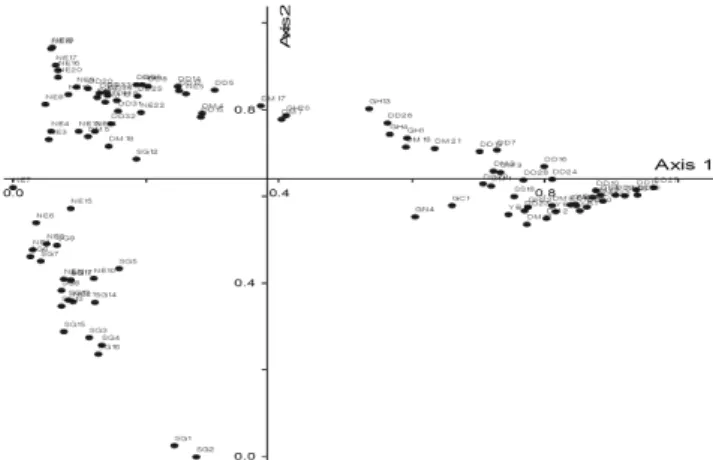
Figure 2. BC ordination of EBLTF
Figure 3. Classification of EBLF subass. and Torreyetum nuciferae variant, Q. serrata
typical subgroup and Aceretum palmatum variant etc.
as subunits.
In case of Ardisio-Castanopsietum sieboldii ass., it is divided into Quercus acuta subass. and typical subass..
Some stands of Camellia japonica were also confirmed.
In case of Q.serrata-Q.variabilis comm., C. japonica group as the elements of evergreen broad-leaved forest was confirmed and was separated to two subunits (Torreya nucifera subpgroup and Pinus densiflora subgroup) again (Table 1).
1) BC ordination analysis about EBLTF
We confirmed that EBLTF was divided into 3 wide areas, Castanopsis sieboldii forest, Quercus acuta forest and warm temperate deciduous broad-leaved forest.
Some mixed areas between C. sieboldii and Q. acuta forests were existed (Figure 2).
2) Typical evergreen broad-leaved forest (EBLF) analysis
(1) Classification
EBLF vegetation structure classification system is composed as two forest types(Q. acuta forest and C.sieboldii forest). In case of subunits in Q. acuta
forest, it is classified as two subunits: Q. acuta forest type influenced by only the vegetation elements of evergreen broad-leaved forest and Q. acuta forest type influenced relatively by the elementsof warm-temperate deciduous broad-leaved forest or the low influence of Q.acuta. In case of C.sieboldiiforest, it is divided into the first forest type influenced by the elements of Q.
acuta forest and second forest type without the influence of Q. acuta forest (figure 3).
As a result of BC ordination and Classification analysis, most of all is dominated by evergreen broad- leaved forest and the vegetation elements of warm- temperate deciduous broad-leaved forest is existed in some of areas. But in case of mixed SBLF, this forest hasthe capabilities of succession from deciduous forest to evergreen forest even if now is dominated by deciduous broad-leaved tree.
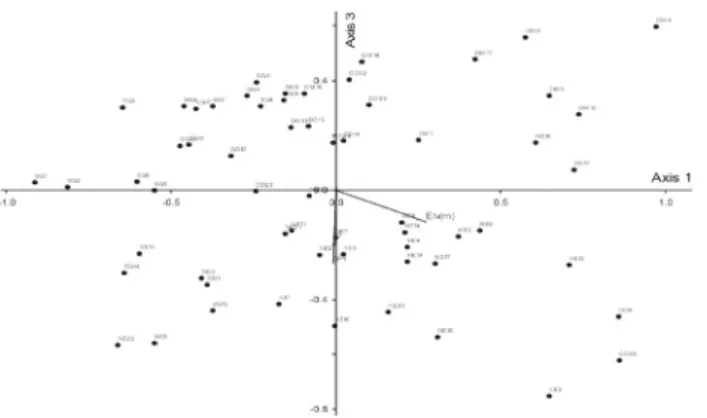
(2) CCA ordination
EBLTF is divided into two forest types (Q. acuta and C. sieboldiiforests) by Elevation. In case of correlation with soil condition (P and pH), it exists the influence of the vegetation elements of warm- temperate deciduous forest in EBLF vegetation structure(figure 4,5).
Figure 4. CCA ordination of EBLF (1) Figure 5. CCA ordination of EBLF (2)
Figure 6. The structure of total EBLTF
Figure 7. Numata’s radicoid form 2. Numata’s life form analysis
Tree layer (90.37) and shrub layer (60.7) occupied large area relatively (figure 6). R1-2 species such as Sasa borealis on herb layers dominated as low percentage (6%). But on only herb layer, R1-2 species occupied over 60%. Actually, shrub and subtree species (S. borealis and Pseudosasa japonica) were appeared on herb layer. This means the vegetation structure will be simply by the expansion of S. borealis and P.
japonicaareas if the management of forest is not conducted(figure 7).
3. Species diversity analysis
Mixed SBLF type represented higher species diversity than EBLF type. But, it is corollaries that mixed SBLF including the vegetation elements of evergreen broad-leaved forest presents higher species diversity relatively. The one thing important here is all of EBLF and mixed SBLF will be succession toward climatic climax forest (evergreen broad-leaved forest).
According to this anticipation, we need to lead the present forest types (EBLF & mixed SBLF) into evergreen broad-leaved forest. Especially, the forest types should be lead into high species diversity and evenness alike.
To lead present temple forest into the vegetation types (SG17, NE2, NE20, DD3, NE6, DM17, NE22 etc.) which EBLF and mixed SBLF each other intersect, is appropriate vegetation management direction in the longer term against the climatic change and vegetation change(climatic climax forest) (figure 8).
3. Species diversity analysis
Mixed SBLF type represented higher species diversity than EBLF type. But, it is corollaries that mixed SBLF including the vegetation elements of evergreen broad-leaved
Figure 8. Species diversity of EBLTF Figure 9. Species diversity by layers
forest presents higher species diversity relatively. The one thing important here is all of EBLF and mixed SBLF will be succession toward climatic climax forest (evergreen broad-leaved forest). According to this anticipation, we need to lead the present forest types (EBLF & mixed SBLF) into evergreen broad-leaved forest. Especially, the forest types should be lead into high species diversity and evenness alike.
To lead present temple forest into the vegetation types (SG17, NE2, NE20, DD3, NE6, DM17, NE22 etc.) which EBLF and mixed SBLF each other intersect, is appropriate vegetation management direction in the longer term against the climatic change and vegetation change(climatic climax forest) (figure 8).
References
Oh, K.K. & Cho W. (1996) Vegetation Structure of Warm Temperate Evergreen Forest at Ch’omch’alsan, Chindo, Korea. Korea. J. of environmental and ecology, 10(1):66-75.
Chang, S.M., Chang, H.S. & Kim, J.H. (1988) On Vegetation of Mt.
Cheomchal in Jindo Island. Korea J. Ecol. 11(3):153-173 Braun Blanquet J. (1964) Pflanzensoziologie Grundzuge der
Vegetation-skunde. Wien.New-York.
LEE, C.W. (1996) LINEAMENTA FLORAE KOREAE.
Academy.
李晟齊, 大野啓一, 宋種碩 (2009) 韓國(南西部島嶼、済州島)と日 本(九州北西部, 對馬)に分布するカシ林の植物社会学的研 究. 植生学会大14回大会.66.
李晟齊, 大野啓一、安永熙、金英花、Kyung-mee LEE, 宋種碩 (2010) 韓國南部における寺院林の植生学的構造解析. 日本 生態学会第57回全國大会. 271.