Print ISSN: 2288-4637 / Online ISSN 2288-4645 doi:10.13106/jafeb.2021.vol8.no1.001
Determinants and Prediction of the Stock Market during COVID-19:
Evidence from Indonesia*
Thomas Sumarsan GOH 1 , Henry HENRY 2 , Albert ALBERT 3
Received: September 30, 2020 Revised: November 22, 2020 Accepted: December 05, 2020
Abstract
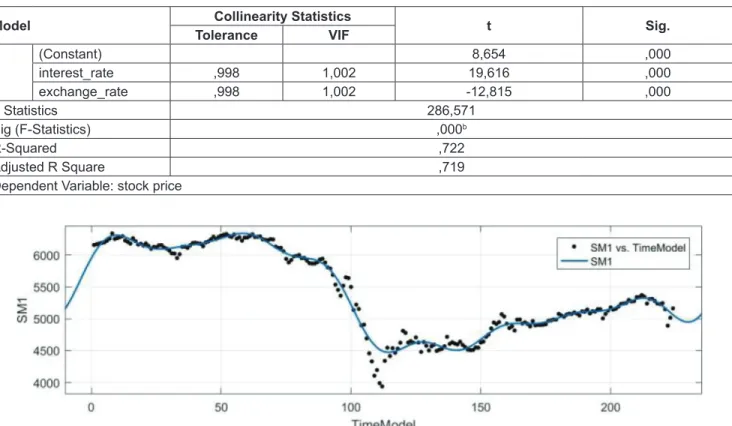
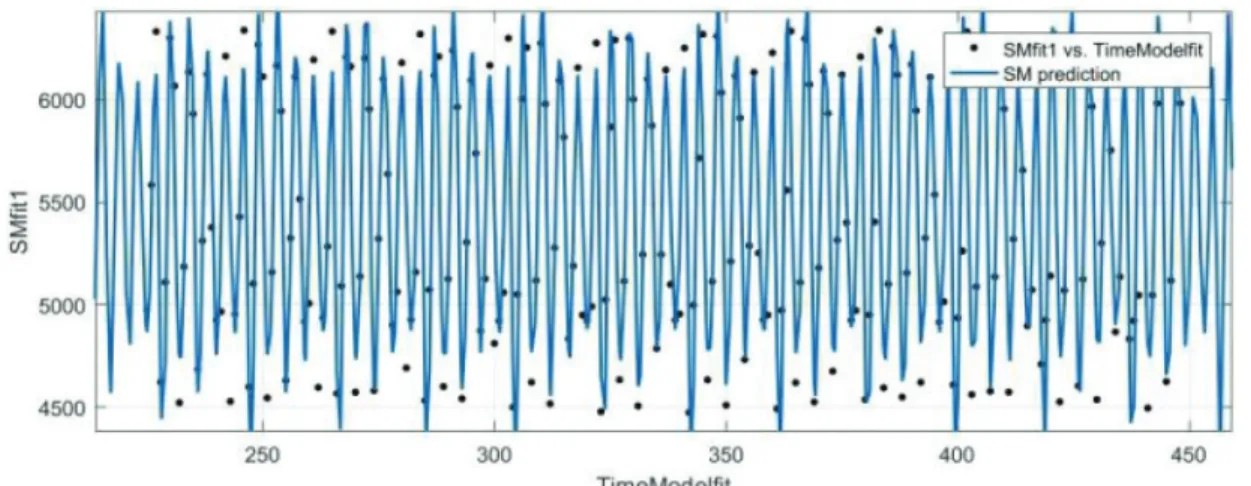
This research examines the stock market index determinants and the prediction using the FFT curve fitting of the Jakarta Stock Exchange (JKSE) Composite Index during the COVID-19 pandemic. This paper has used daily data of Jakarta Stock Exchange (JKSE) Composite Index, interest rate, and exchange rate from 15 October 2019 to 15 September 2020, and a total of 224 observations, retrieved from Indonesia Stock Exchange (IDX), Indonesia Statistics Central Bureau and Observation & Research of Taxation. The study covers descriptive statistics, multicollinearity test, hypothesis tests, determination test, and prediction using FFT curve fitting. The results unveil four fresh and robust evidence. Partially, the interest rate has affected positively and significantly the stock market index. Partially, the exchange rate has affected negatively and significantly the stock market index. The F-test result, interest rate, and exchange rate have significantly affected the stock market index (JKSE) simultaneously.
Furthermore, the FFT curve fitting has predicted that the stock market fluctuates and increases over time. The results have shown a strong influence of the independent variables and the dependent variable. The value of Adjusted R-Square is 0.719, which means that the independent variables have simultaneously impacted the dependent variable for 71.9%; other factors have influenced the remaining 28.1%.
Keywords: Stock Market, Interest Rate, Exchange Rate, FFT Curve Fitting, Prediction JEL Classification Code: E43, E44, F31, F37, G01
outbreaks of COVID-19 disease have had an enormous impact on various sectors in Indonesia. One of the affected sectors is the economic sector, including but not limited to the stock market index, interest rate, and exchange rate.
The COVID-19 pandemic has led to a tremendous slowdown in economies’ growth (Ding, Levine, Lin, & Xie, 2020; Park et al., 2020). Hence, a firm and the financial sector need to understand the determinants of Indonesia’s stock price during the pandemic. Before the epidemic, previous studies show that stock price positively impacts consumption expenditures and economic activities (Davis &
Zhu, 2009; Davis & Zhu, 2011; Ludvigson, 2004).
The result from the study by Assefa, Esqueda, and Mollick (2017) shows interest rates have significant effects on stock prices. With the interest rate under the severest scenario, some banks may face a significant capital shortage if market rates start to increase dramatically from current low levels and decrease the firm value (Cifter & Ozun, 2008;
Das, 2005; Dzmuranova & Teply, 2016). However, a low- interest rate is associated with decreased profitability for banks, particularly for small institutions, and simultaneously lower the firm value (Hamrita & Trifi, 2011; Reilly, Wright,
& Johnson, 2007). The policymakers can mitigate the
*Acknowledgements:
1
The authors are thankful to the Editor and the anonymous reviewers for their helpful comments.
1
First Author and Corresponding Author. Researcher and Lecturer, Faculty of Economics, University of Methodist Indonesia, Medan, Indonesia [Postal Address: Jl. Hang Tuah, No. 8, Madras Hulu, Kecamatan Medan Polonia, Sumatera Utara, 20151, Indonesia]
Email: [email protected]
2
Research Scholar, University of North Sumatra, Medan, Indonesia.
Email: [email protected]
3
Research Scholar, University of GadjahMada, Yogyakarta, Indonesia. Email: [email protected]
© Copyright: The Author(s)
This is an Open Access article distributed under the terms of the Creative Commons Attribution Non-Commercial License (https://creativecommons.org/licenses/by-nc/4.0/) which permits unrestricted non-commercial use, distribution, and reproduction in any medium, provided the original work is properly cited.
1. Introduction
Novel Coronavirus (2019-nCoV, hereinafter referred to as
COVID-19) is a new type of virus that has never been identified
before in humans. Coronavirus is a zoonosis (transmitted
between animals and humans), where clinical manifestations
usually appear within two to 14 days after exposure. Pandemic
global financial crisis’s effects by lowering the interest rate, providing fiscal stimulus, and protecting the poorest from economic deterioration (Purwono & Yasin, 2018).
The unpredictable exchange rate change can cause negativity on an economy, such as more significant uncertainty on future consumption (Devereux, 2004), increased change in business profitability (Aghion, Bacchetta, Rancière, &
Rogoff, 2006; Braun & Larrain, 2005), and an elevated risk for domestic and foreign direct investment (Byrne & Davis, 2005; Serven, 2003). Zhao (2010) indicates bidirectional volatility spillover between stock prices and exchange rates.
To the best of our knowledge, no other studies have examined the influence of interest rate and exchange rate on the stock price during the COVID-19 pandemic, especially in Indonesia. This paper also predicts the trend of stock prices.
This paper aims to understand how the interest rate affects the stock market index; how the exchange rate affects the stock market index; how interest rate and exchange rate impact the stock market index during the COVID-19 pandemic; and predict stock market price during COVID-19.
The reason for choosing Indonesia as an object of analysis is because Indonesia is one of the emerging economies, which contains great economic potential that put the country in an excellent position for newly-advanced economic development.
It is Southeast Asia’s largest economy; therefore, the state- owned enterprises (SOEs) and large private business groups (conglomerates) play a significant role. In 2025, Indonesia will count 287 million population, making Indonesia occupy the world’s 4th most populous country. This study’s contribution provides fresh and robust evidence for the investors to take precautionary steps before trading in stocks during this pandemic and to the extant literature by focusing on the determinants of stock market indices. The paper consists of five parts: Part 1 introduces research issues; Part 2 presents the review of literature; Part 3 presents research data and methods;
Part 4 shows the result of empirical research and discussion, and; the final section summarizes the findings.
2. Literature Review 2.1. Firm Value
The purpose of establishing a company is to create value and to increase the welfare of the shareholders (Block, Hirt,
& Danielsen, 2011; Brigham & Houston, 2015; Sumarsan, 2020). Many firm value concepts include face value, market value, intrinsic value, book value, and liquidation value.
A technique to value a company comprises of profitability approach, discounted cash flow method, dividend growth method, assets revaluation method, stock price method, and economic value-added method. Stock market indices reacted to the news (Alam, Alam, & Chavali, 2020; Khan et al., 2020).
2.2. Interest Rate
The interest rate can be an indicator in influencing the people’s decision to spend or deposit the money and the business world’s decisions to make loans for various purposes. When an interest rate is lower, more firms are willing to borrow money to expand their businesses, and the results are an increase in stock prices (Huang, Mollick, &
Nguyen, 2016). Saymeh and Orabi (2013) used the Granger causality statistic to determine inflation causes interest rates, although each variable is an independent variable. The interest rates in monetary policy influenced the stock prices (Apergis & Eleftheriou, 2002; Assefa, Esqueda, & Mollick, 2017). The study of Tursoy (2019) shows a significant relationship between stock prices and domestic interest rates; interest rates have negatively affected the stock prices.
However, Apergis and Eleftheriou (2002) show that interest rate correlates positively and insignificantly to stock prices.
2.3. Exchange Rate
According to Flota (2014), the concept of exchange risk comes from uncertain risk. The appreciation of the exchange rate decreased competitiveness (Rossi & Malavasi, 2016).
Doukas, Hall, and Lang (2003) thought that the exchange rate fluctuations on the firms’ market value depend on the firm’s exchange rate exposure. Domestic firms will be affected indirectly, through a mechanism whereby the exchange rate exposure affects aggregate demand and industrial competitiveness and concentration (Mok, 1993).
According to Hendry (1980), the exchange rate to prices generally defines through two channels, such as direct and indirect. Regression analysis is one of the most widely used techniques for analyzing multi-factor data. Successful use of regression requires an appreciation of both the theory and the practical problems that typically arise when the method employs real-world data (Novotny et al., 2019). In this study, the interest rates and exchange rates are the independent variables, and the stock market index is the dependent variable. The use of SPSS in this study varies from the other studies that use the Johansen cointegration test, generalized method of moments (GMM), and PLS-SEM.
There are various methods to do forecasting, such
as time-series forecasting, class of artificial intelligence
models, different neural network models, frequency-
domain models (Mallikarjuna & Rao, 2019), and logistic
regression models (Huet et al., 2004). The results showed
no single forecasting technique provided uniformly optimal
forecasting for all markets (Mallikarjuna & Rao, 2019). The
forecasting of market fluctuation helps investors make the
appropriate adjustment to the portfolios (Nguyen & Nguyen,
2019). Fourier transformations have been used in this study
to forecast the financial time series.
Therefore, based on the literature review, the hypotheses for this study are as follows:
H1: Interest rate has affected positively and significantly the stock market index.
H2: Exchange rate has affected negatively and significantly the stock market index.
H3: Interest rate and exchange rate have affected the stock market index significantly.
3. Data and Methodology 3.1. Data Set
This paper focuses on whether, during the pandemic, interest rate and exchange rate affect stock prices or not. It has used daily data of Jakarta Stock Exchange (JKSE) Composite Index, interest rate, and exchange rate from 15 October 2019 to 15 September 2020, a total of 224 observations, retrieved from Indonesia Stock Exchange (IDX), Indonesia Statistics Central Bureau, and Observation & Research of Taxation.
The data are collected and built-in Microsoft Excel, then SPSS is used to run the regression model.
3.2. Method
In this study, the relationship between the stock market index and the set of independent variables uses the coefficient determinants and an algorithm of Multiple Linear Regression. Other studies use the Johansen cointegration test. The independent variables are the exchange rate and interest rate, and the dependent variable is stock market prices – the general multiple linear least-square models.
0 0 1 1
...
= + + +
m m+
Y a z a z a z e (1)
Meanwhile, to predict the stock market index uses an algorithm of Fourier Transformation, the other studies have used logistic regression models, auto-regressive conditional heteroscedasticity (ARCH), and Generalized ARCH (GARCH).
Following the predictability literature and using Matlab tools, the available model Fourier usually can be written as:
f t ( ) A A
01
cos (
0t) + B sin
1(
0t ) (2) Where Ao is the mean value, A1 = C1cos θ, B1 = -C1sinθ, C1 is the amplitude, ωo is the angular frequency, t is period of time, and θ is the phase angle or phase shift.
The fast Fourier transformation (FFT) is a speedy way of calculating the discrete Fourier transformation (DFT). FFT works by splitting several data sets to be transformed into smaller groups of data to be changed. The larger the number of terms included in this series, the better the periodic
function approximates. It provides many sines and cosine waves and produces a higher spectral resolution.
Hence, in this study, the general model Fourier 8 terms are used, as follows:
0 1 0 1 0 2 0
2 0 3 0 1 0
4 0 4 0 5 0
5 0 6 0 6 0
7 0 7 0 8 0
8 0
( ) cos( ) sin( ) cos(2 ) sin(2 ) cos(3 ) sin( ) cos(4 ) sin(4 ) cos(5 ) sin(5 ) cos(6 ) sin(6 ) cos(7 ) sin(7 ) cos(8 ) sin(8 )
f t A A t B t A t
B t A t B t
A t B t A t
B t A t B t
A t B t A t
B t
ω ω ω
ω ω ω
ω ω ω
ω ω ω
ω ω ω
ω
= + + +
+ + +
+ + +
+ + +
+ + +
+ (3)
Simplify, the equation is:
8
0 0 0
1
( )
n(
n(
n
f t A A cos n t B sin n t ω ω
=