Print ISSN: 2288-4637 / Online ISSN 2288-4645 doi:10.13106/jafeb.2021.vol8.no5.0777
The Impact of COVID-19 Pandemic on Stock Market Performance in Indonesia
Christian Damara UTOMO
1, Dewi HANGGRAENI
2Received: January 30, 2021 Revised: April 05, 2021 Accepted: April 15, 2021
Abstract
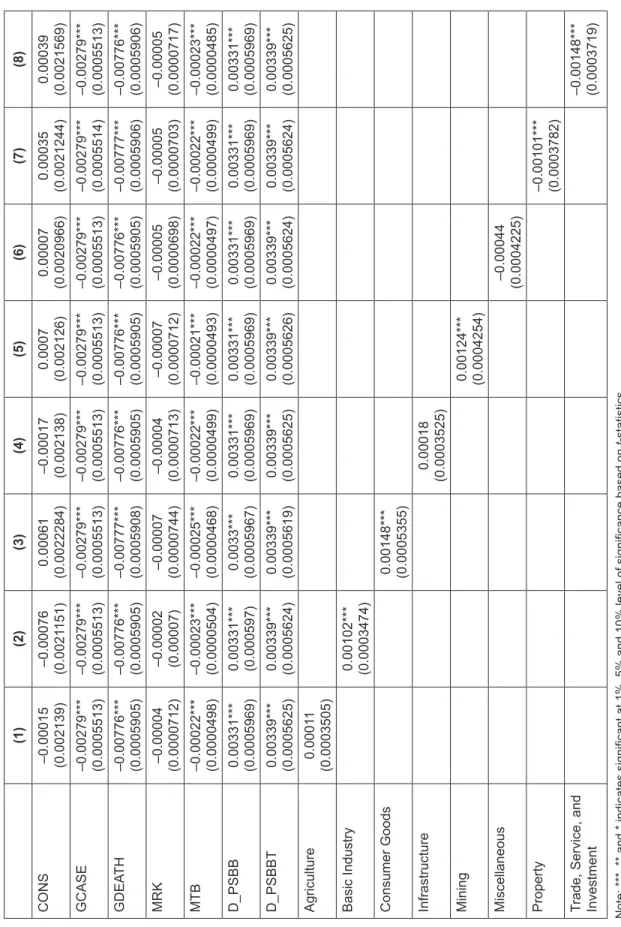
This study explores the impact of COVID-19 pandemic and the lockdown policies that are used to tackle the pandemic on stock market returns in Indonesia. This study uses fixed-effects panel-data regression method to evaluate the impact of the growth in COVID-19 total confirmed cases and death as well as the lockdown policies on daily stock returns of 272 firms that are listed on the Indonesia Stock Exchange’s main board and operate in the real sector from 2 March 2020 to 27 November 2020. The study confirms the significantly adverse impact of growth in the total of confirmed cases and death due to COVID-19 on Indonesia’s daily stock returns. Moreover, the lockdown policies regardless how strict they are, have a positive and significant impact on the Indonesia’s daily stock returns. This study further considers the different impact of COVID-19 pandemic on each of eight observed sectors; where the sector of property as well as trade, service and investment have a significantly negative performance; while the sector of basic industry, consumer goods and mining have a significantly better performance. This study suggests that COVID-19 pandemic and the lockdown policies have a mixed impact on the Indonesia’s stock market returns.
Keywords: COVID-19, Lockdown, Pandemic, Stock Returns, Indonesia JEL Classification Code: C23, G10, G15, I10
In 2017, Indonesian financial services authority (OJK) issued several regulations so that an increasing number of enterprises are projected to go public up until 2022 (Jakarta Post, 2020). IDX has also tried to promote the practice of investing in capital market to the individual investors, such as through marketing campaign towards the citizens. As a result, Indonesia’s market capitalization to GDP ratio has also increased to 45.15% in 2020 compared to 42.27% in 2015 (CEIC, 2020).
Since it first appears at the end of 2019, the coronavirus (COVID-19) has inflicted damage in several different aspects. On 11 March 2020, the World Health Organization (WHO) (2020) has declared this virus as a pandemic due to its spread around the globe and severity. Up until 22 February 2021, COVID-19 triggered 1,278,653 confirmed cases and 34,389 confirmed deaths in Indonesia (WHO, 2021). The country’s stock market has also experienced some downturn, with Jakarta Composite Index dropping at its lowest point on 23 March 2020, only 21 days after the first government officially confirmed COVID-19 cases.
Unlike Vietnam, the United Kingdom and Germany, the Indonesian government does not impose a full-scale nationwide lockdown. To reduce the snowballing case and death of COVID-19 figures, Indonesian regional
1
First Author. Department of Management, Faculty of Economics and Business, University of Indonesia, Indonesia.
Email: [email protected]
2
Corresponding Author. Lecturer, Department of Management, Faculty of Economics and Business, University of Indonesia, Indonesia [Postal Address: Jl. Prof. DR. Sumitro Djojohadikusumo, Kukusan, Kecamatan Beji, Kota Depok, Jawa Barat, 16424, Indonesia] Email: [email protected]
© Copyright: The Author(s)
This is an Open Access article distributed under the terms of the Creative Commons Attribution Non-Commercial License (https://creativecommons.org/licenses/by-nc/4.0/) which permits unrestricted non-commercial use, distribution, and reproduction in any medium, provided the original work is properly cited.
1. Introduction
Currently, Indonesia stock’s market has 728 listed
companies. This figure has increased compared to 502 listed
companies in 2014. Indonesian Stock Exchange (IDX)
authority classifies the companies into three different
segments, according to the size and track record of the
company. The segment for companies with the biggest size
in terms of asset and longest track record is called the main
board. IDX also classifies the companies further according to
their line of business, which consists of nine different sectors.
governments imposed a lockdown policy, better known as Social Restrictive Movement Policy (PSBB). Each region has different approaches in conducting the policy and not every region imposes such policy due to different levels of severity of COVID-19 between the regions. The policy itself aims to restrict citizen’s movement in order to achieve social distancing through developing a curfew and restricting non-vital activities.
The capital city, Jakarta, has also imposed the lockdown policy on 10 April 2020. From that day forward, the governor has decided to extend the policy for several weeks before switching to a less strict policy, which is known as Transition from Social Restrictive Movement Policy (PSBBT). The former and latter have been used interchangeably throughout 2020 by the Jakarta government in order to suppress the growing number of cases and deaths due to COVID-19 pandemic. The practical usefulness of such policies is still not certain since the figures of confirmed cases and death are still on the upward trend.
The government has also provided incentives in order to hinder the negative impact of COVID-19 pandemic.
While the Indonesian government has given incentives to companies operating in several sectors such as agriculture, mining, and financial services through tax reduction (Medina, 2020), the government has given more incentive to the financial sector. Through the Financial Services Authority, the government has conducted a debt restructuring in order to avoid an increase in non- performing loans (Aldin, 2020). According to Kacaribu, from the Indonesian Ministry of Finance (2020), the government has also provided a placement of funds in banks that have experienced debt restructuration. The Indonesian government believes that it is critical to keep the public’s positive sentiment on the financial services industry in order to be able to promote economic recovery.
This is a first study to examine the impact of lockdown policies as well as the growth in the number of cases and deaths due to COVID-19 pandemic on Indonesia’s stock market performance. This study contributes to the knowledge of stock market performance during pandemic in a country that has imposed two lockdown policies and still not be able to stop the pandemic from spreading and causing more deaths. This study will focus on the companies that operate outside the financial sector since those companies have not received the same amount of government incentives compared to the companies operating in the financial sector. Furthermore, this study will be concentrated on firms from the main board in order to determine the impact of COVID-19 pandemic even on the biggest listed firms in Indonesia.
2. Literature Review
2.1. Impact of Pandemics on Stock Market
Several studies have analyzed the impact of previous epidemics on stock market performance. Ichev and Marinč (2017) found that Ebola outbreak events are followed by negative returns in the financial market. The negative impact is more substantial on stocks of firms with small market capitalization and higher volatility. This study also found that such extreme event would enhance anxiety, bad mood and fear, which may induce pessimism among investors. Chen, Chen, Tang, and Huang (2009) confirm the negative impact of SARS outbreak on Taiwan’s stock price, specifically in tourism, wholesale, and retail sector. However, Chen, Chen, Tang, and Huang (2009) also confirm the positive impact of SARS outbreak on the biotech firms stock price.
For the case of COVID-19 pandemic, numerous studies have documented the impact of the pandemic on stock market performance. Orhun (2020) found that stock market in countries with more confirmed COVID-19 cases are more prone to getting negative impact from the global pandemic. The research by Camba and Camba Jr. (2021) also documented the negative impact of COVID-19 daily infection rate on Philippine stock market index. The negative impact of confirmed cases on stock market performance is supported by other studies, such as the research by Liu, Manzoor, Wang, Zhang, and Manzoor (2020) that founded a negative and significant impact of COVID-19 confirmed cases on 21 stock market indices around the world, such as Japan, Germany, France, and Korea. The research by Ryandono, Muafi, and Guritno (2021) also found a negative impact of COVID-19 pandemic on Indonesia’s sharia stock.
Bahrini and Filfilan (2020) also confirmed the negative impact of COVID-19 deaths on stock returns in Gulf Cooperation Council Countries. Ashraf (2020) found the negative impact of both confirmed cases and deaths because of COVID-19 on stock market returns in 64 countries. The increase in number of confirmed cases and deaths have a significant and positive impact toward market volatility (Baig, Butt, Haroon, & Rizvi, 2020).
According to research by Mishra and Mishra (2020), aside from COVID-19 confirmed case, the increase in volatility due to pessimistic and panic sentiments of investor has a negative impact on Asian stock market performance.
According to several studies (Baek, Mohanty, & Glambosky,
2020; Bora & Basistha, 2021; Chaudhary, Bakhshi, & Gupta,
2020; Khanthavit, 2020), the volatility in the stock market
increases during COVID-19 pandemic. Baek, Mohanty, and
Glamboksy (2020) further emphasizes that the negative news
is more impactful compared to the positive news, suggesting a negativity bias. The feeling of fear, thus, affected stock market performance in all region negatively (Al-Qudah &
Houcine, 2021).
2.2. Impact of COVID-19 Lockdown on Stock Market
The spread of COVID-19 has forced many governments to impose a movement restriction policy and physical distancing measures, often referred as lockdown (WHO, 2020) in order to slow down the spread of COVID-19.
Several studies have contributed to determine the impact of such policy on the stock market. Narayan, Phan, and Liu (2021) found the positive impact of lockdown on stock market returns in G7 countries. The research also found that lockdown is the most effective policy in cushioning the impact of COVID-19 compared to other policies such as economic stimulus packages. This is supported by Anh and Gan (2020) that find a positive impact of lockdown policy on Vietnam’s stock returns.
On the other hand, Liew (2020) found the negative impact of lockdown in Wuhan on stock prices of Booking Holdings Inc., Expedia Group, and Trip.com Group Ltd. since these companies derive their profits from tourism-related services that is now limited due to the lockdown policy. Alexakis, Eleftheriou, and Patsoulis (2020) also found that an increase in non-pharmaceutical interventions such as lockdown have a negative impact on stock market returns in 45 countries.
2.3. Hypotheses
COVID-19 pandemic brings an unprecedentedly impact on several aspects, such as to the stock market performance.
Several researches have elaborated the relevant proxy regarding the pandemic, such as the growth in the number of confirmed cases and deaths due to the COVID-19 (Ashraf, 2020). Aside from that, the proxy of COVID-19 can also be explained through the government intervention in order to impede the spread of the virus, such as through the imposition of a lockdown policy (Narayan, Phan, & Liu, 2021). Those proxies mentioned before, the growth in the number of confirmed cases and death as well as the lockdown policy, are believed to be the relevant domain to interpret the impact of COVID-19 pandemic (Anh & Gan, 2020; Al-Awadhi, Alsaifi, Al-Awadhi, & Alhammadi, 2020).
Hence, this study examines the impact of COVID-19 pandemic and the lockdown policies that were taken to inves- tigate whether those variables would be affecting the stock returns. The investigation is based on the following hypotheses:
H1: The growth of COVID-19 cases is significantly and negatively related to stock returns.
H2: The growth of COVID-19 confirmed deaths is significantly and negatively related to stock returns.
H3: The lockdown policies are significantly and positively related to stock returns.
3. Research Methods and Materials 3.1. Data
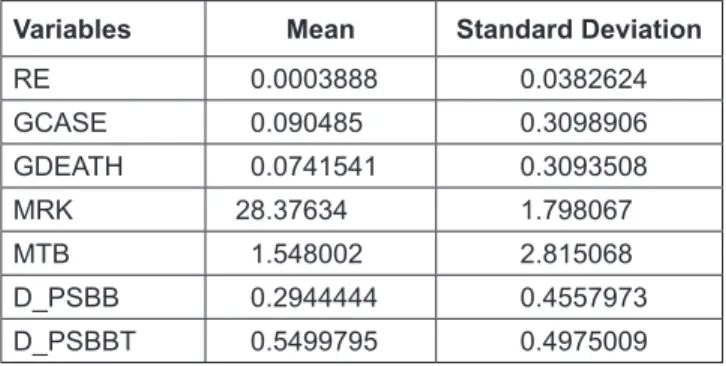
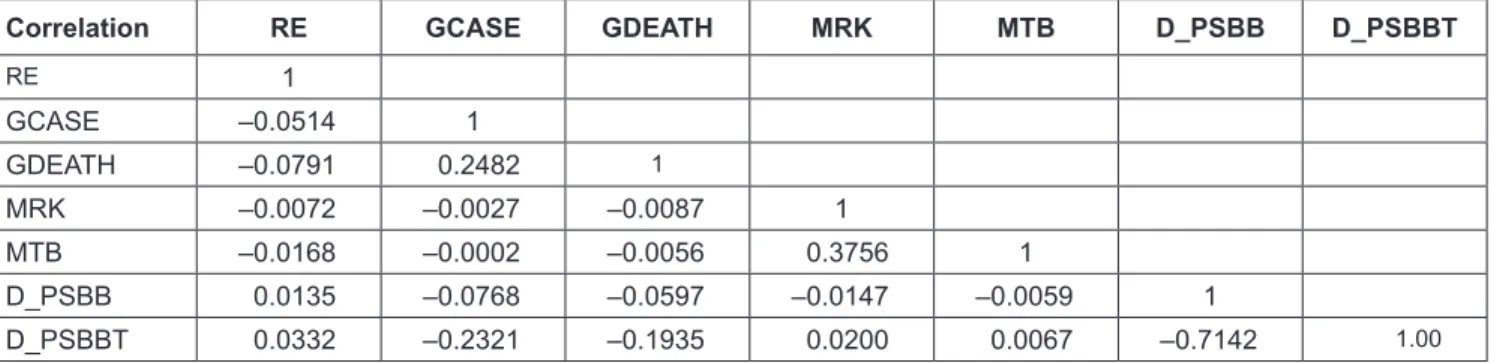
This study examines the impact of COVID-19 pandemic and lockdown policy on daily stock returns of 272 listed firms on Indonesia Stock Exchange. Those 272 are categorized as companies from main board that are operating in the real sector. The data starts from 2 March 2020, which was the first day of the government’s officially confirmed COVID-19 case in Indonesia. The end date of the daily stock data is 27 November 2020. The stock price data is obtained from Yahoo Finance while the firm-specific data is obtained from Thomson Reuters. The daily number of COVID-19 cases and deaths are from the official website of the Indonesian government for COVID-19 information (Covid19.go.id).
The information regarding the lockdown variables is taken from Jakarta’s official website for information and update on COVID-19 pandemic (Corona.Jakarta.go.id). In total, there are 48,960 observations in this study.
3.2. Methodology
Following Al-Awadhi, Alsaifi, Al-Awadhi, and Alhammidi (2020), Orhun (2020) and Sergi, Harjoto, Rossi, and Lee (2021), this study uses panel-data regression method rather than event-study method. Panel-data regression method has several advantages, such as the minimization of estimation bias and multicollinearity and controls of individual heterogeneity as well as the ability to identify time- varying relationship between dependent and independent variables (Wooldridge, 2011).
To test the impact of COVID-19 pandemic and lockdown policy on Indonesia Stock Exchange, this study follows the model of Anh and Gan (2020), Al-Awadhi, Alsaifi, Al-Awadhi, and Alhammidi (2020) and Ashraf (2020) to evaluate the impact of COVID-19 new confirmed cases and deaths as well as lockdown policy toward daily stock returns. In this study, the independent variables also consist of firm-specific data, following those variables in the Anh and Gan (2020) as well as Al-Awadhi, Alsaifi, Al-Awadhi, and Alhammidi (2020) such as the natural logarithm of firm’s daily market capitalization and market-to-book ratio. The model in this study is on Eq. (A.1):
RE GCASE GDEATH
MRK MTB
D_
j t t t
j t j t
,
, ,
= + +
+ +
+
− −
− −
α α α
α α
α
1 2 1 3 1
4 1 5 1
6