2021 The Korean Society of Veterinary Science.
This is an open-access article distributed under the terms of the Creative Commons Attribution Non-Commercial license (http://creativecommons.
org/licenses/by-nc/4.0/), which permits unrestrict- ed non-commercial use, distribution, and repro- duction in any medium, provided the original work is properly cited.
서론
Fenbendazole ( FBZ )은 수의에서 유용하게 쓰이는 구충제 중 하나이다[ 1 ]. FBZ 은 실 험용 설치류, 반려동물, 산업동물에서 회충, 십이지장충, 편충 등 내부 기생충 감염의 예방 및 치료제로 허가 받아 사용되고 있다[ 2 , 3 ]. 구충 작용기전으로는 기생충의 세포 분열 과정 중 미세소관의 형성을 방해하여 효과를 나타내는 것으로 알려져 있다[ 4 , 5 ].
최근 FBZ 이 항암효과가 있다는 보고[ 6 ]와 일부 임상사례를 시작으로 커뮤니티, 인터 넷을 통해 FBZ 을 임의로 복용하는 사례가 증가하였다. FBZ 은 인간 암세포의 미세소관 에 친화성을 나타내고 micromolar 농도에서 항암효과를 보였으며, 새로운 항암기전으 로 GLUT transporter 와 hexokinase 의 발현 억제로 glucose uptake 를 효과적으로 억제
Fenbendazole의 억제 효과
박서로1, 주홍구1,2*
1
제주대학교 수의과대학 수의약리학실
2
제주대학교 수의과학연구소
Inhibitory effects of fenbendazole, an anthelmintics, on lipopolysaccharide- activated mouse bone marrow cells
Seo-Ro Park 1 , Hong-Gu Joo 1,2*
1
Laboratory of Veterinary Pharmacology, College of Veterinary Medicine, Jeju National University, Jeju 63243, Korea
2
Veterinary Medical Research Institute, Jeju National University, Jeju 63243, Korea pISSN 2466-1384 · eISSN 2466-1392
Korean J Vet Res 2021;61(3):e22 https://doi.org/10.14405/kjvr.2021.61.e22
*Corresponding author:
Hong-Gu Joo
Laboratory of Veterinary Pharmacology, College of Veterinary Medicine, Jeju National University, 102 Jejudaehak-ro, Jeju 63243, Korea
Tel: +82-64-754-3379 Fax: +82-64-756-3354 E-mail:[email protected] ORCID:
https://orcid.org/0000-0002-1505-8761 Conflict of interest:
The authors declare no conflict of interest.
Received: June 7, 2021 Accepted: July 22, 2021
Original Article
Fenbendazole (FBZ) is a commonly used anthelmintics in veterinary medicine that has recently been found to have anticancer effects in humans. On the other hand, few studies have examined the anti-inflammatory effects of FBZ, and its mechanism is unknown. In this study, mouse bone marrow cells (BMs) were treated with lipopoly- saccharide (LPS), a representative inflammation-inducing substance, to generate a sit- uation similar to osteomyelitis in vitro. The effect of FBZ on inflammatory BMs was examined by measuring the metabolic activity, surface marker expression, cell nuclear morphology, and mitochondrial membrane potential (MMP) of BMs. FBZ decreased the metabolic activity and MMP of LPS-treated BMs. Annexin V-fluorescein isothiocy- anate/propidium iodide staining and Hoechst 33342 staining showed that FBZ re- duced the number of viable cells and induced the cell death of inflammatory BMs. In addition, FBZ reduced the proportion of granulocytes more than B lymphocytes in LPS-treated BMs. Overall, FBZ induces cell death by destabilizing the MMP of LPS-in- duced inflammatory BMs. In addition to anthelmintic and anticancer agent, FBZ can play a role as an anti-inflammatory agent.
Keywords: fenbendazole; bone marrow cells; inflammation; lipopolysaccharides; os-
teomyelitis
하는 사실이 알려졌다[ 6 ].
골수는 혈액세포와 면역세포가 유래하는 기관으로 면역체계에서 매우 중요한 역할을 한다. 우리는 FBZ 이 항암제로서의 가능성이 대 두되고 있는 가운데 골수세포에 대한 항염증 효과 또한 있는지 의문 이 들었다. 하지만 앞선 연구에서는 조류에서 선충 감염으로 인해 발생한 골수염에 FBZ 을 투여하여 치료한 사례만이 존재하였다[ 7 ].
이와 같이, FBZ 의 골수염에 대한 효과에 관한 연구는 많이 부족하 다. 따라서 본 연구에서는 in vitro 에서 골수염과 유사한 상황을 만들 기 위해 대표적인 염증 유발물질인 lipopolysaccharide ( LPS )를 골 수세포에 처리하여 FBZ 의 항염증 효과 유무와 작용기전을 알아보 았다. 이를 위해 FBZ 을 농도별로 처리한 후 골수세포의 대사활성 도, 표면 마커 발현, 세포의 핵 형태, 미토콘드리아 막전위( mito- chondrial membrane potential ) 등을 측정하여 골수세포에서 FBZ 의 항염증 효과에 대해 연구하였다.
재료 및 방법
실험동물과 시약
실험동물은 OrientBio ( Korea )에서 구입하여 제주대학교 실험동 물센터에서 유지하였다. 동물실험에서 8 - 12 주령 사이의 C57BL / 6 마우스가 사용되었고, 제주대학교 동물실험윤리위원회의 승인을 받 아 시행되었다(승인번호, 2018 - 0011 ). FBZ 과 LPS ( Escherichia coli O55 )는 Sigma 사( USA )에서 구입하였으며, FBZ 은 dimethyl sulf- oxide , LPS 는 인산완충액에 녹인 후 사용하였다.
골수세포의 분리와 물질 처리
본 실험실에서 확립된 방법으로 골수세포를 분리하였다[ 8 ]. CO
2gas 로 마우스를 안락사 시킨 뒤 대퇴골과 경골을 적출하여 골수조직 을 채취하였다. 이 조직을 ammonium chloride - potassium lysis buffer 로 처리하여 적혈구를 제거한 후 70 μm cell strainer 에 걸러 single cell 을 획득하였다. 이를 계수하여 96 - 또는 6 - well culture plates 에 배양하였다. FBZ 과 LPS 를 처리한 후 37°C , 5 % CO
2의 조 건에서 배양하였고 분석에 이용하였다.
골수세포의 대사활성도 측정
골수세포를 1 × 10
6cells / mL 의 농도로 96 - well culture plate 에 넣은 후 FBZ 과 LPS ( 1 μg / mL )를 농도별로 처리한 후 배양하였다.
배양이 끝난 후 골수세포에 3 -( 4 , 5 - dimethylthiazol - 2 - yl )- 2 , 5 - di- phenyltetrazoliumbromide ( MTT , Sigma ) 용액을 0 . 5 mg / mL 농 도로 넣고 4 시간 동안 처리하였다[ 9 ]. 살아있는 세포에 의해 생긴 crystal violet 을 녹이기 위해 10 % sodium dodecyl sulfate 용액을 well 당 100 μL 씩 넣어 2 시간 동안 반응시켰다. 그 후 microplate reader ( Molecular Devices 사, USA )를 이용하여 흡광도( 570 nm ) 를 측정하였다.
유세포 분석
마우스 골수세포를 6 - well culture plate 에 1 × 10
6cells / mL 의 농도로 배양하고 FBZ 과 LPS 를 농도별로 처리하였다. 3 일간 배양 후 미토콘드리아 막전위를 측정하기 위해 rhodamine 123 용액을 10 μg / mL 의 농도로 암실조건에서 30 분간 염색하였다. 골수세포의 세포사( cell death ) 측정을 위해 annexin Ⅴ- fluorescein isothiocya- nate ( FITC )와 propidium iodide ( PI ) 용액으로 염색하였다[ 10 ]. 또 한, 과립구와 B 림프구의 비율을 측정하기 위해 allophycocyanin - la- beled anti - Gr - 1 항체와 biotin - labeled anti - B220 항체, FITC - avi- din 을 사용하였다. 유세포 분석은 CytoFLEX 와 CytExpert soft- ware ( Beckman Coulter , USA )를 이용해 분석하였다.
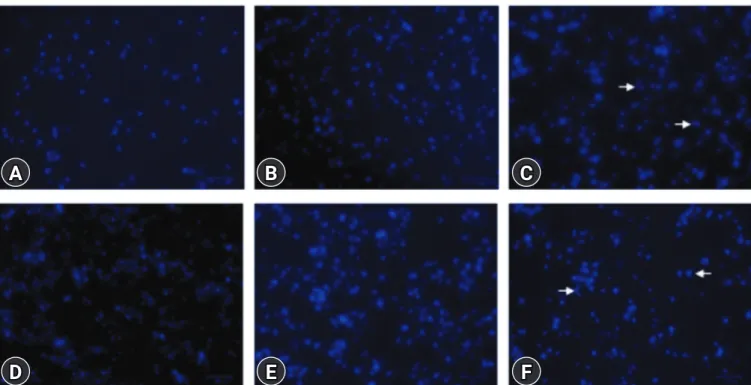
Hoechst 33342
염색을 이용한 골수세포 핵 관찰골수세포의 세포사를 확인하기 위해 핵 모양을 관찰하였다. 세포 의 핵을 염색하기 위해 Hoechst 33342 용액을 2 . 5 μg / mL 농도로 처리하여 37°C 에서 10 분간 염색하였다[ 11 ]. 염색된 세포는 형광현 미경( ZOE Fluorescent Cell Imager ; BIO - RAD , USA )을 이용해 관찰하였고 사진 촬영을 했다.
통계분석
각 실험은 2 - 3 회 반복하여 시행되었다. Fig . 1 은 평균 ± 표준편 차로 나타냈다. One way analysis of variance 분석 후에 Tur- key - Kramer multiple comparison test ( GraphPad Prism ; Graph- Pad Software , USA )로 유의성을 확인하였다. 통계처리 후 p - value
OD at 57 0 nm
0 0.125 0.25 FBZ (μM)
0.5
##
###
** *** ***
1 2
1.0 0.8 0.6 0.4 0.2 0
FBZ FBZ + LPS
Fig. 1. Fenbendazole (FBZ) decreases the metabolic activity of lipopolysaccharide (LPS)-treated and untreated bone marrow cells (BMs). BMs (1 × 10
6cells/mL) were incubated in 96-well culture plates and treated with FBZ in the absence or presence of 1 µg/
mL LPS. The concentration range of FBZ was 0 to 2 µM and treat-
ed by 2-fold dilution stepwise. MTT assay was performed at 3 days
after the drug treatment. The data are presented as the mean ±
standard deviation. ***, ### indicate p < 0.001 and **, ## indicate
p < 0.01, compared to the BMs treated without LPS or LPS alone
(FBZ 0 µM), respectively. OD, optical density.
가 0 . 05 미만인 경우 유의한 것으로 판단하였다.
결과
FBZ
이 골수세포의 대사활성도에 미치는 영향FBZ 단독과 FBZ + LPS ( 1 μg / mL ) 처리군에서 골수세포의 대사 활성도를 알아보기 위해 MTT assay 를 수행하였다( Fig . 1 ). MTT assay 결과 FBZ 단독에 비해 FBZ + LPS 처리군은 모든 농도( 0 - 1 µM )에서 보다 높은 대사활성도를 나타내었으며, FBZ 의 농도가 증 가함에 따라 대사활성도가 감소됨을 확인하였다. 특히, FBZ 단독의 0 . 5 - 2 µM 농도에서 유의하게 대사활성도가 감소하였고, FBZ + LPS 처리군에서는 1 - 2 µM 농도에서 유의한 감소를 보였다. 이러한 결과는 FBZ 이 LPS 와 같은 염증 물질에 의해 자극된 골수세포의 활
동을 억제할 수 있음을 나타낸다.
FBZ
에 의한 골수세포의 미토콘드리아 막전위 변화FBZ 이 골수세포에 미치는 영향을 조사하기 위해 FBZ 과 LPS 를 처리한 골수세포의 미토콘드리아 막전위를 측정하였다. 이를 위해 rhodamine 123 용액을 사용하여 골수세포를 염색한 후 유세포 분 석을 하였다( Fig . 2 ). LPS 는 골수세포의 미토콘드리아 막전위를 높 이는 반면, FBZ 은 LPS 로 증가된 미토콘드리아 막전위를 크게 감 소시켰다. 특히, FBZ 0 . 25 µM 농도와 FBZ 1 µM 농도의 fluores- cence intensity 평균값의 차이는 5 , 034 로, FBZ 0 µM 농도와 FBZ 0 . 25 µM 농도의 평균값의 차이인 1 , 083 보다 크다. 이 결과는 0 . 25 - 1 µM 사이 농도의 FBZ 은 LPS 에 의해 자극된 골수세포의 미토콘드 리아 이중막의 구조를 더욱 불안정하게 할 수 있음을 나타낸다.
Rhodamine 123 A
D
B
E
C
F
Fig. 2. Fenbendazole (FBZ) reduces the mitochondrial membrane potential of both lipopolysaccharide (LPS)-treated and untreated bone marrow cells (BMs). Mouse BMs in 6-well culture plates were treated with or without 1 µg/mL LPS for 2 days, followed by an FBZ treat- ment. The treated BMs were stained with Rhodamine 123 solution. The number in histograms indicates the mean fluorescence intensi- ties. (A) FBZ 0 µM, (B) FBZ 0.25 µM, (C) FBZ 1 µM, (D) FBZ 0 µM + LPS 1 µg/mL, (E) FBZ 0.25 µM + LPS 1 µg/mL, and (F) FBZ 1 µM + LPS 1 µg/mL.
Tube 1 all event
Count
200
100
0
150
100
50
0
100
50
0
150
100
50
0 200
100
0 150
100
50
0
Count Count Count Count Count
FITC-A 10555
25384
9574
24301
8547
19267 10
210
210
210
210
210
210
310
310
310
310
310
310
410
410
410
410
410
410
510
510
510
510
510
510
610
610
610
610
610
6FITC-A
Tube 4 all event
Tube 2 all event
FITC-A
FITC-A Tube 5 all event
Tube 3 all event
FITC-A
FITC-A
Tube 6 all event
FBZ
에 의한 골수세포의 세포사 증가유세포 분석은 골수세포의 세포사를 확인하기 위해 annexin V - FITC / PI 염색 후 수행되었다( Fig . 3 ). FBZ 단독 또는 FBZ + LPS 처리된 세포의 viable cells ( annexin V -/ PI -)의 비율이 유사하 게 감소하였다. 이 감소는 특히 Fig . 2 와 같이 FBZ 1 µM 농도에서 현저하게 감소함을 보였다. Viable cells 는 FBZ 단독일 때 FBZ 0 - 0 . 25 µM 은 2 . 3 %, FBZ 0 . 25 - 1 µM 은 13 . 8 % 감소하였다. FBZ + LPS 처리군에서도 FBZ 0 - 0 . 25 µM 은 3 . 4 %, FBZ 0 . 25 - 1 µM 은 9 . 3 % 감소하였다. 죽은 세포 중 necrotic cells ( annexin V -/ PI +)의 수는 FBZ 0 - 1 µM 농도에서 5 %에서 6 %로 증가한 FBZ 단독에 비 해 FBZ + LPS 처리군에서 더욱 현저한 변화를 보였다. 그러나 ear- ly apoptosis cells ( annexin V +/ PI -)에서는 FBZ 단독은 6 %에서 12 %로 증가한 반면, FBZ + LPS 처리군에서는 10 %로 일정하였다.
이러한 결과는 FBZ 이 LPS 처리 여부와 관계없이 골수세포에서 세 포사를 유도할 수 있음을 보여준다.
골수세포 내의 과립구와