• 검색 결과가 없습니다.

Analysis of The Management of Three Tertiary General Hospital(2011 to 2013)

N/A
N/A
Protected

Academic year: 2021

Share "Analysis of The Management of Three Tertiary General Hospital(2011 to 2013)"

Copied!
11
0
0

로드 중.... (전체 텍스트 보기)

전체 글

(1)

DOI: http://dx.doi.org/10.15205/kschs.2016.6.30.582

Analysis of The Management of Three Tertiary General Hospital (2011 to 2013)

Hyun-Suk Park

Department of Health Service Management, Daejeon University (Received April 15, 2016; Received April 22 2016; Accepted April 27, 2016)

5)

Abstract

Purpose. For more effective hospital management, it analyzes the trend through general characteristics, bal- ance sheet, income statement, and financial ratio analysis, grasps the causes of the problems, and analyzes management of the hospital in order to use the result as baseline data for development of the hospital in the future.

Methods. The collected data of 3 years from 2011 to 2013 about 3 tertiary hospitals in metropolitan cities from Alio (provider of public institution information; www.alio.go.kr), Health Insurance Review &

Assessment Service (www.hira.or.kr), and the website of the Ministry of Health and Welfare (www.mw.go.kr) were analyzed and general characteristics, balance sheet, income statement, and financial ra- tio, analysis are used as data.

Results & Conclusions. From the result of data analysis from 2011 to 2013, general characteristics, balance sheet, income statement, financial ratio analysis, and pie charts could lead to conclusions as follows. In the result of comprehensive analysis, the 3 tertiary hospitals showed increase of fixed expense due to extension of the buildings and so did the scale of fund and asset. Although medical revenue increased, the margin of increase for medical expense was greater than that of medical revenue, which consequently led to loss. In prediction for the 3 tertiary hospitals based on characteristics so far, it is expected to see improved revenue structure after building extension is completed, but it is necessary to exert management effort to maintain its optimal level by enhancement in stability of management and inventory turnover through management of inventories.

Key words: Balance Sheet, Efficiency, Financial ratio analysis, Hospital management analysis, Income Statement

*Corresponding author :[email protected]

(2)

1. Introduction

Hospitals are generally non-profit public utility institutions. Due to their several unique character- istics, different hospitals have different hospital management environment, medical policy, health insurance system, medical consumers and com- petitive advantages over competitors. It is difficult for hospital management to control the external en- vironment while the internal environment can be managed to a certain level. Therefore, there should be efforts to change the internal environment to a positive direction in order to survive, such as ra- tionalization of management

1-2)

.

Typically, an analysis of hospital management uses a balance sheet, a profit and loss statement, a result of patient treatments, medical profits, human resources by the type of works, a result of facility use and general status

3-8)

. During reviewing pre- vious studies to analyze the public nature and prof- itability of national and public university hospitals, there was a difficult in explaining the analysis re- sults due to difference and no standardization in measurement indicators다

9)

. The importance of this study includes all measures to analyze management results and financial performance, find underlying causes and provide the management and interested parties with useful information, based on manage- ment statistics such as financial data and patient treatment results covering the past, present and fu- ture planning

3-8)

.

There are growing demands on the necessity of analyzing efficiency of hospital management. As the external environment including controlling med- ical fees deteriorates, hospitals cannot sufficiently use or analyze hospital information necessary to identify the current status of management and find a way of management improvement

10)

. Therefore, the effects of management improvement are not likely to reach an expected level. The main reason is that a management system of hospital is not rea-

sonably implemented enough to deal with change of the external environment. Information that is re- quired for important decision making for reasonable hospital management and operation is not system- atically used. In addition, there is little opportunity of systematic training. Therefore, it is necessary for hospital management and administrators to system- atically collect and classify hospital information for more efficient management of a hospital. This study aims to analyze and evaluate such in- formation in order to utilize it for efficient hospital operation.

2. Methods

2.1. Research Subjects

Three tertiary general hospitals (A, B and C) were randomly selected among the national and public university hospitals that allows accessing to their data. As of 2014, A hospital has total 1,104 beds while B and C hospital have 970 beds and 1,324 beds, respectively. All three hospitals are a tertiary general hospital that is a representative hos- pital of a corresponding region. This study tries to systematically collect, analyze and compare in- formation of each hospital for three consecutive years (2011, 2012 and 2013) to use as basic data and analyze financial status of tertiary hospitals for 2011-2013, which are provided by Public Institution Management Information Disclosure System (www.alio.go.kr), Health Insurance Review and Assessment Service (www.hira.or.kr), the Ministry of Health and Welfare (www.mw.go.kr) and acces- sible by the public. All data can be used for im- provement of hospital management.

2.2. Purpose of Study

The purpose of this study is to provide hospital

management and administrators with basic data for

(3)

Category A tertiary hospital Category B tertiary hospital C tertiary hospital

Officer 11

Medical Doctors

Concurrent as

Professor 146 144

Concurrent as

Clinician 57 82

Employee 3720 Fellowship 45 46

Resident 268 252

Contract Worker 140 Total 516 524

Nurse 699 797

Temporary Worker 572 General Staff 338 399

Administration 242 216

Total 4443 Total 1769 1939

Ratio to # of Sickbed 4.024 Ratio to # of Sickbed 1.851 1.464

Source: (www.alio.go.kr),(www.hira.or.kr),(www.mw.go.kr).

Table 1. Actual States of Medical Facilities and Staffs (Unit: bed and person, %)

Account Type

Balance Sheet

A tertiary hospital B tertiary hospital C tertiary hospital

2011 2012 2013 2011 2012 2013 2011 2012 2013

Asset

. Liquid Asset 145,444 161,360 193,621 153,456 143,781 119,568 85,067 61,174 58,695 . Fixed Asset 444,566 453,882 455,434 259,333 259,333 299,467 134,844 185,827 177,527 Total Asset 590,010 615,242 649,054 403,115 403,115 419,035 219,911 247,001 236,222 Debt

. Liquid Debt 110,708 113,212 113,289 95,283 95,283 97,222 52,413 64,627 60,609 . Fixed Debt 300,838 327,453 354,714 182,727 182,727 190,160 27,774 29,359 39,393 Total Debt 411,546 440,665 468,003 278,010 278,010 287,382 80,188 93,987 100,003 Fund

. Endowment Fund 270,059 283,153 301,349 192,227 192,227 208,074 115,114 130,722 132,343 . Surplus Fund (110,908) (120823) 132019 (67,122) (67,122) (76,421) 24610 22292 51639 Total capital 178,464 174,577 181,052 125,104 125,104 131,653 139,723 153,014 136,219

Source: (www.alio.go.kr),(www.hira.or.kr),(www.mw.go.kr).

Table 2. Summarized Balance Sheet (Unit: million Won)

systematic collection, classification, analysis and evaluation of hospital information in order to help them manage a hospital more efficiently.

Specific purposes of this study are as followings.

1. To identify common characteristics of organ- izational structure of a tertiary general hospital.

2. To analyze a balance sheet of a tertiary gen- eral hospital.

3. To analyze a profit and loss statement of a tertiary general hospital.

4. To conduct financial ratio analysis for a ter- tiary general hospital.

3. Results

For the number of employees, A hospital has 4,443 while B and C hospital has 1,851 and 1,464, respectively. For the ratio of the number of em- ployees to a bed, A hospital has the highest ratio, with 4.024%, followed by B and C hospital, with 1.851% and 1.464%, respectively. For A hospital, there is limitations in analyzing profits and losses relating to its staffing structure because it does not disclose such information by a job position.

3.2. Summarized Balance Sheet

(4)

3.3. Diagram of Balance Sheet Analysis

Figure1. Analysis Chart for Balance Charts of 3 Tertiary Hospitals in 2011 (Unit: %)

Figure 2. Analysis Chart for Balance Charts of 3 Tertiary Hospitals in 2012 (Unit: %)

Figure 3. Analysis Chart for Balance Charts of 3 Tertiary Hospitals in 2013 (Unit: %)

(5)

Account Type

Income Statement

A tertiary hospital B tertiary hospital C tertiary hospital

2011 2012 2013 2011 2012 2013 2011 2012 2013

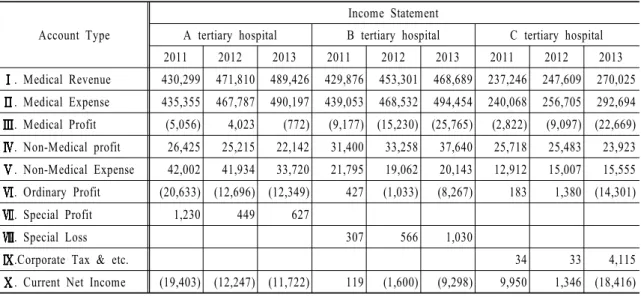
. Medical Revenue 430,299 471,810 489,426 429,876 453,301 468,689 237,246 247,609 270,025 . Medical Expense 435,355 467,787 490,197 439,053 468,532 494,454 240,068 256,705 292,694 . Medical Profit (5,056) 4,023 (772) (9,177) (15,230) (25,765) (2,822) (9,097) (22,669) . Non-Medical profit 26,425 25,215 22,142 31,400 33,258 37,640 25,718 25,483 23,923 . Non-Medical Expense 42,002 41,934 33,720 21,795 19,062 20,143 12,912 15,007 15,555 . Ordinary Profit (20,633) (12,696) (12,349) 427 (1,033) (8,267) 183 1,380 (14,301)

. Special Profit 1,230 449 627

. Special Loss 307 566 1,030

.Corporate Tax & etc. 34 33 4,115

. Current Net Income (19,403) (12,247) (11,722) 119 (1,600) (9,298) 9,950 1,346 (18,416)

Source: (www.alio.go.kr),(www.hira.or.kr),(www.mw.go.kr).

Table 3. Summarized Income Statement (Unit: million Won)

3.3.1. Analysis of Balance Sheets of A Tertiary Hospital

The total asset, liability and capital of A Tertiary Hospital keep increasing for the last three years.

The ratio of the fixed assets is much higher than the current assets. However, the ratio of the current assets is increasing every year while the ratio of the fixed assets keep decreasing.

There is a high ratio of the quick assets in the current assets because the ratio of ‘cash and cash equivalents’ and ‘medical account receivables are high. The fact that the medical account receivables kept decreasing in 2012 and 2013 shows that man- agement of the medical account receivables is stable. Most of the inventory is ’medicine’.

For the fixed assets, the ratio of intangible assets is high. The ratio of ‘Buildings’ in the intangible assets is average 60% and that of “Finance Lease”

is average 27%.

3.3.2. Analysis of Balance Sheets of B Tertiary Hospital

According to the analysis of last three year’s bal-

ance sheet of B tertiary hospital, the fixed assets has increased. In addition, it is found that there is a significant change of the liabilities. ‘Retirement Allowance’ has also increased. ‘Essential Business Reserve’ is used as a fund as it opened a new hos- pital building (216 beds) in 2013. As of 2013,

‘Work in Progress’ and ‘Essential Business Reserve’ have decreased while ‘Buildings’ has in- creased from KRW 40.3 Billion to KRW 42 Billion due to the completion of a new building.

3.3.3 Analysis of Balance Sheets of C Tertiary Hospital

There is no significant change of the current as- sets and the fixed assets on the balance sheet of C tertiary hospital. The current ratio has decreased as increasing the current liabilities was faster than in- creasing the fixed liabilities. It is analyzed that the percentage of labor cost on the profit and loss statement was 2% in 2012 but had significantly in- creased in 2013 because the capital and the net in- come kept decreasing from 2011 to 2013.

3.4. Analysis of Profit and Loss Statement

(6)

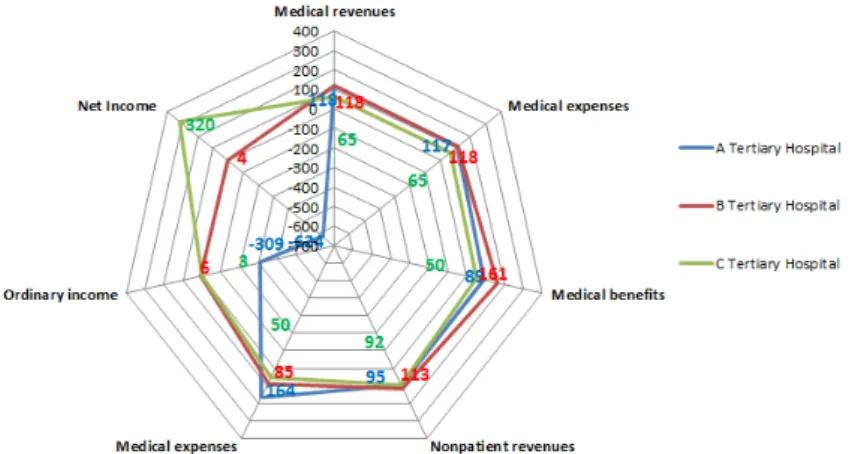
Figure 4. Analysis Chart for Management Performance of 3 Tertiary Hospitals in 2011 (Unit: %)

Figure 5. Analysis Chart for Management Performance of 3 Tertiary Hospitals in 2012 (Unit: %)

Figure 6. Analysis Chart for Management Performance of 3 Tertiary Hospitals in 2013 (Unit: %)

Source: (www.alio.go.kr), (www.hira.or.kr), (www.mw.go.kr).

(7)

Category 2010 2011 2012 2013

outpatient 739,649 738,619 771,307( 4.42%) 795,925

inpatient 361,246 364,997 377,185 368,923

Source: (www.alio.go.kr),(www.hira.or.kr),(www.mw.go.kr).

Table 4. outpatient, inpatient (Unit: p erson. %)

3.4.1. Analysis of Profit and Loss Statements of A Tertiary Hospital

The medical income of A Tertiary Hospital keeps increasing for the last three years (2011, 2012 and 2013). The increase rate of medical income in 2012 was 9.6% while the income was increased by 3.75 in 2013. The main reasons of the increase in 2012 were increased income from outpatients and inpatients. The number of outpatients in 2012 was increased by 4.42%, compared to 2011.

The medical expenses are also continuously increasing. The increase rate of medical expenses in 2012 was 6.8% while the medical expenses were increased by 2.8% in 2013. The main reason of the significant increase of medical expenses in 2012 was labor costs and material costs due to the in- creased number of outpatients and inpatients.

The trend of other incomes rather than medical incomes shows decrease for three consecutive years but the supplementary incomes increased. ‘Essential Business Reserve’, which has a significant portion in ‘Expenses other than Medical Expenses’, has significantly decreased in 2012 and 2013. For the ordinary incomes, the negative value decreases as

‘Expenses other than Medical Expenses’ decreases rather than increasing ‘Incomes other than Medical Incomes’.

3.4.2. B Analysis of Profit and Loss Statements of B Tertiary Hospital

The net income of B Tertiary Hospital keeps de- creasing for the three consecutive years (2011, 2012 and 2013). On the other hand, the medical in- comes are increasing. As the increasing rate of

medical incomes is lower than that of medical ex- penses, the profit structure worsens. For details of the expenses, labor costs, material costs and man- agement costs have increased. With such change, the medical loss increased from KRW 15.2 billion to KRW 25.7 billion and, as a result, the net loss was grown from KRW 1.6 billion to KRW 9.3 billion. Although the hospital recorded a positive figure in the net income in 2011, the net income had a negative figure from 2012 due to the con- struction cost.

3.4.3. Analysis of Profit and Loss Statements of C Tertiary Hospital

The analysis of the profit and loss statement of C Tertiary Hospital indicates that the medical ex- penses against the medical incomes have increased in 2011, 2012 and 2013. As the medical expenses against the medical incomes become higher, the net income worsens.

The reason why the medical expenses are in- creasing is that labor costs are increasing every year. The net income of C Tertiary Hospital is wor- sening due to its increased labor costs.

3.5. Analysis of Financial Ratios

A, B, C Comprehensive Analysis of Financial

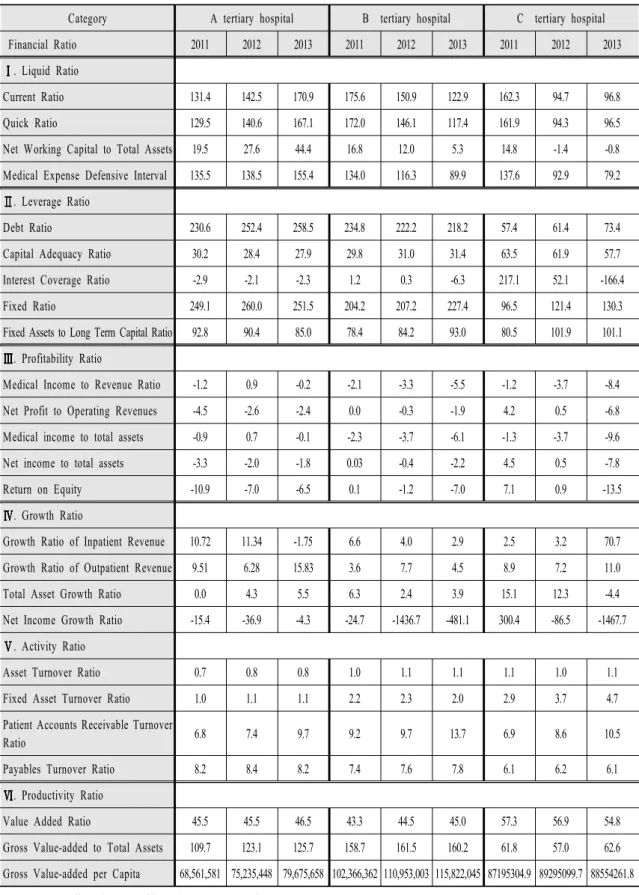
Ratios of Three Tertiary Hospitals Leverage Ratio –

The debt ratio of three tertiary hospitals is main-

tained at a similar level for three years. However,

it is analyzed that the fixed assets to stockholders'

equity and long-term liabilities of B and C tertiary

hospital reached almost 100%.

(8)

Category A tertiary hospital B tertiary hospital C tertiary hospital

Financial Ratio 2011 2012 2013 2011 2012 2013 2011 2012 2013

. Liquid Ratio

Current Ratio 131.4 142.5 170.9 175.6 150.9 122.9 162.3 94.7 96.8

Quick Ratio 129.5 140.6 167.1 172.0 146.1 117.4 161.9 94.3 96.5

Net Working Capital to Total Assets 19.5 27.6 44.4 16.8 12.0 5.3 14.8 -1.4 -0.8 Medical Expense Defensive Interval 135.5 138.5 155.4 134.0 116.3 89.9 137.6 92.9 79.2

. Leverage Ratio

Debt Ratio 230.6 252.4 258.5 234.8 222.2 218.2 57.4 61.4 73.4

Capital Adequacy Ratio 30.2 28.4 27.9 29.8 31.0 31.4 63.5 61.9 57.7

Interest Coverage Ratio -2.9 -2.1 -2.3 1.2 0.3 -6.3 217.1 52.1 -166.4

Fixed Ratio 249.1 260.0 251.5 204.2 207.2 227.4 96.5 121.4 130.3

Fixed Assets to Long Term Capital Ratio 92.8 90.4 85.0 78.4 84.2 93.0 80.5 101.9 101.1 . Profitability Ratio

Medical Income to Revenue Ratio -1.2 0.9 -0.2 -2.1 -3.3 -5.5 -1.2 -3.7 -8.4

Net Profit to Operating Revenues -4.5 -2.6 -2.4 0.0 -0.3 -1.9 4.2 0.5 -6.8

Medical income to total assets -0.9 0.7 -0.1 -2.3 -3.7 -6.1 -1.3 -3.7 -9.6

Net income to total assets -3.3 -2.0 -1.8 0.03 -0.4 -2.2 4.5 0.5 -7.8

Return on Equity -10.9 -7.0 -6.5 0.1 -1.2 -7.0 7.1 0.9 -13.5

. Growth Ratio

Growth Ratio of Inpatient Revenue 10.72 11.34 -1.75 6.6 4.0 2.9 2.5 3.2 70.7

Growth Ratio of Outpatient Revenue 9.51 6.28 15.83 3.6 7.7 4.5 8.9 7.2 11.0

Total Asset Growth Ratio 0.0 4.3 5.5 6.3 2.4 3.9 15.1 12.3 -4.4

Net Income Growth Ratio -15.4 -36.9 -4.3 -24.7 -1436.7 -481.1 300.4 -86.5 -1467.7 . Activity Ratio

Asset Turnover Ratio 0.7 0.8 0.8 1.0 1.1 1.1 1.1 1.0 1.1

Fixed Asset Turnover Ratio 1.0 1.1 1.1 2.2 2.3 2.0 2.9 3.7 4.7

Patient Accounts Receivable Turnover

Ratio 6.8 7.4 9.7 9.2 9.7 13.7 6.9 8.6 10.5

Payables Turnover Ratio 8.2 8.4 8.2 7.4 7.6 7.8 6.1 6.2 6.1

. Productivity Ratio

Value Added Ratio 45.5 45.5 46.5 43.3 44.5 45.0 57.3 56.9 54.8

Gross Value-added to Total Assets 109.7 123.1 125.7 158.7 161.5 160.2 61.8 57.0 62.6 Gross Value-added per Capita 68,561,581 75,235,448 79,675,658 102,366,362 110,953,003 115,822,045 87195304.9 89295099.7 88554261.8 Source: (www.alio.go.kr),(www.hira.or.kr),(www.mw.go.kr).
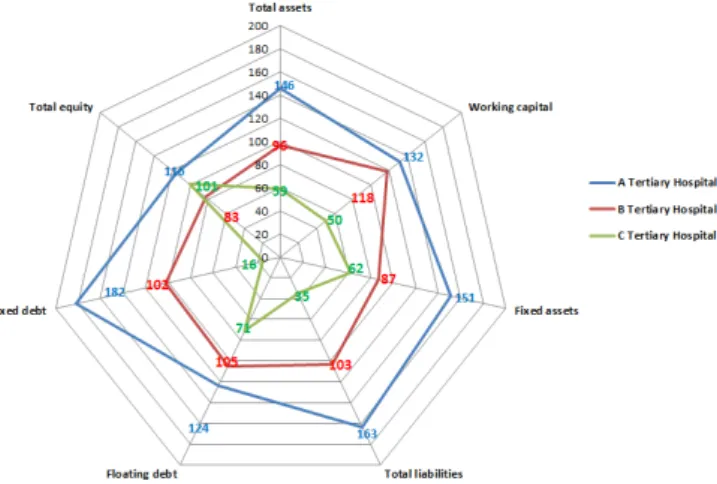
Table 5. Analysis Table for Financial Ratios of 3 Hospitals (Unit: %, Day, Times, #of Times, Thousand Won)

(9)

4. Discussion

This study analyzed general characteristics, bal- ance sheets, profit and loss statements and financial ratios of three tertiary general hospitals (A, B and C) for three consecutive years (2011, 2012 and 2013), using data disclosed by Public Institution Management Information Disclosure System (www.alio.go.kr), Health Insurance Review and Assessment Service (www.hira.or.kr), the Ministry of Health and Welfare (www.mw.go.kr). Analysis of hospital management was conducted using a re- sult of patient treatments, medical profits, human resources by a job position and a status of facility, equipment and other general elements on the basis of the results mentioned above

4-8)

.

First, with regard to the number of employees, A hospital has 4,443 while B and C hospital has 1,851 and 1,464, respectively. For the ratio of the number of employees to a bed, A hospital has the highest ratio, with 4.024%, followed by B and C hospital, with 1.851% and 1.464%, respectively.

There is limitations in analyzing profits and losses relating to its staffing structure because it does not disclose such information by a job position. During reviewing previous studies to analyze the public na- ture and profitability of national and public uni- versity hospitals, there was a difficult in explaining the analysis results due to difference and no stand- ardization in measurement indicators

9-11)

.

Second, the analysis of balance sheets of three tertiary hospitals shows that there is significant dif- ference in assets even among similar tertiary hospitals. As of 2015, A tertiary hospital has 1,263 beds while C tertiary hospital has 1,324 beds.

Although C tertiary hospital has more beds than A tertiary hospital, the total asset value of A tertiary hospital is approximately 2.7 times bigger than that of C tertiary hospital. The total amount of assets of C tertiary hospital increased, except for 2013. For B tertiary hospital, the total amount of fixed assets

was significantly increased apparently by con- struction of a new building. On the other hand, A and C tertiary hospital completed construction of a new building in 2010 and 2007, respectively. All three tertiary hospitals made investment in a new building. For A and B tertiary hospital, their debt ratio, which means the ratio of debt to the total as- set, was over 200%. As a result, it is important for them to reduce the debt ratio and increase stability of management.

Third, according to the analysis of profit and

loss statements of three tertiary hospitals, the medi-

cal incomes ranged between KRW 40 billion and

20 billion. Although the increase ranges are differ-

ent by a hospital, three tertiary hospitals commonly

show continual increase of medical income for the

three years, which indicates that national and public

large hospital still make a profit even though the

medical service market is in saturation. On the oth-

er hand, the medical expenses are also increasing

and three tertiary hospitals have the medical ex-

penses exceeding the medical incomes. Among the

three tertiary hospitals, A tertiary hospital made a

medical income only in 2012. For the incomes and

expenses other than medical incomes and expenses,

the ordinary income also decreases due to the in-

creased expenses. As a result, it is shown in the

analysis of the profit and loss statements for three

years that all three tertiary hospitals had decreased

profitability due to the excessive increased expenses

although their incomes also increased during the

same period of time. In addition, the analysis

shows the change of medical income, medical ex-

pense, income other than medical income, expense

other than medical expense, net income, ratio of in-

patient’s health insurance payment, ratio of out-

patient’s health insurance payment, medical profit

ratio, net medical profit ratio and ordinary medical

profit ratio by a year. It is demonstrated that the

net income found in the analysis is similar with

that of each national university hospital

11.12)

.

(10)

Fourth, according to the analysis of finance ra- tios of three tertiary hospitals, the ratio of fixed as- sets to stockholders' equity and long-term liabilities of three tertiary hospital reached almost 100%.

Therefore, it is thought that additional debt man- agement is necessary as debt may increase due to, for example, borrowing when the ratio exceeds 100%. Three tertiary hospitals shows decreased net income although the profits from both inpatients and outpatients are increasing because the expense such as labor costs, management costs and material costs have increased more quickly than the in- come

11.13.)

. The increased ratio of fixed assets to stockholders' equity and long-term liabilities in- dicates the need of appropriate management of the owner’s equity and the fixed debt

11-.15)

. Therefore, the hospital shall seek to an appropriate level of profits through management of their debt.

Overall, the analysis of three tertiary hospitals shows the fixed cost increased due to a con- struction project and the size of capital and assets expanded. Although the medical income increases, the medical expense is more quickly increasing than the medical income. The inventory turnover ratio also decreased due to the loss of income, par- ticularly the decreased net income. Considering such characteristics, it is expected that the income structure will be improved by utilizing a new building. In addition, it is also recommended that an appropriate level of inventory should be main- tained by increasing the inventory turnover ratio through appropriate inventory management.

This study analyzed general characteristics, bal- ance sheets, profit and loss statements and financial ratios, using data disclosed by Public Institution Management Information Disclosure System (www.alio.go.kr), Health Insurance Review and Assessment Service (www.hira.or.kr), the Ministry of Health and Welfare (www.mw.go.kr). However, it is necessary to supplement the data in the future as there are limitations in generalization when only

the official data is used.

5. Conclusion

First. with regard to the number of employees, A hospital has 4,443 while B and C hospital has 1,851 and 1,464, respectively. For the ratio of the number of employees to a bed, A hospital has the highest ratio, with 4.024%, followed by B and C hospital, with 1.851% and 1.464%, respectively.

For A hospital, there is limitations in analyzing profits and losses relating to its staffing structure because it does not disclose such information by a job position.

Second. the analysis of balance sheets of three tertiary hospitals shows that there is significant dif- ference in assets even among similar tertiary hospitals. As of 2015, A tertiary hospital has 1,263 beds while C tertiary hospital has 1,324 beds.

Although C tertiary hospital has more beds than A tertiary hospital, the total asset value of A tertiary hospital is approximately 2.7 times bigger than that of C tertiary hospital. The total amount of assets of C tertiary hospital increased, except for 2013. For B tertiary hospital, the total amount of fixed assets was significantly increased apparently by con- struction of a new building. On the other hand, A and C tertiary hospital completed construction of a new building in 2010 and 2007, respectively. All three tertiary hospitals made investment in a new building. For A and B tertiary hospital, their debt ratio, which means the ratio of debt to the total as- set, was over 200%.

Third. according to the analysis of profit and

loss statements of three tertiary hospitals, the medi-

cal incomes ranged between KRW 40 billion and

20 billion. Although the increase ranges are differ-

ent by a hospital, three tertiary hospitals commonly

show continual increase of medical income for the

three years, which indicates that national and public

large hospital still make a profit even though the

(11)

medical service market is in saturation. On the oth- er hand, the medical expenses are also increasing and three tertiary hospitals have the medical ex- penses exceeding the medical incomes. Among the three tertiary hospitals, A tertiary hospital made a medical income only in 2012. For the incomes and expenses other than medical incomes and expenses, the ordinary income also decreases due to the in- creased expenses. As a result, it is shown in the analysis of the profit and loss statements for three years that all three tertiary hospitals had decreased profitability due to the excessive increased expenses although their incomes also increased during the same period of time.

Fourth. according to the analysis of finance ra- tios of three tertiary hospitals, the ratio of fixed as- sets to stockholders' equity and long-term liabilities of three tertiary hospital reached almost 100%.

Therefore, it is thought that additional debt man- agement is necessary as debt may increase due to, for example, borrowing when the ratio exceeds 100%. Three tertiary hospitals shows decreased net income although the profits from both inpatients and outpatients are increasing because the expense such as labor costs, management costs and material costs have increased more quickly than the income As a result, The it is necessary to appropriate man- agement of the ratio of fixed assets to stockholders' equity and long-term liabilities

References

1. Yang DH, Kam HK, Jung DC. Hospital business analysis. chungram, 1st. 2011.

2. Jung KS, Hyundai of Hospital Business Analysis, jungusuhjeok, 1st. 2005.

3. Available from http://www.alio.go.kr

4. Available from http//www.hira.or.kr 5. Available from http://www.mw.go.kr 6. Available from http://www.khidi.or.kr

7. Park HS, Lee JM, Baek HS, et al. An Analytic Case Study on the Management of an Upper-lev- el General Hospital(2010-2012). The Journal of Korean clinical health science, 2014;2(1):1-16.

8. Gapenski LC, Vogel WB, Langland-Orban B.

The determinants of hospital profitability. Hosp Health Serv Adm. 1993 Spring;38(1):63-80.

9. Available from http://cafe.daum.net/terminology 10. Shin CG, An Analysis on the Efficiency and

Productivity Changes of the National University Hospitals in the Republic of Korea. Korean Social Security Studies, 2006; 22(4):49-78 11. Park HS. An Analysis of the Management of a

Tertiary General Hospital (2011 to 2013). The Journal of Korean clinical health science, 2015;3(1):276-289.

12. Baek SJ, Kim YH, Kim HS, et al. The Effects of Value Chain Activity on General Hospital Management Performance, Korean journal of hospital management, 2014;19(3):11-28.

13. Shin DW, Shin CG, Jung KT. A Study on Quality-incorporating Models in Evaluation of Hospital Efficiency with Data Envelopment Analysis-An Analysis on National University Hospitals in Korea, Korean journal of hospital management, 2008; 13(3):69-93

14. Park JY, Some Factors Affecting Profitability of Local Public Hospitals, Korean journal of hospital management, 2007;12(3):47-67.

15. Lee CE, Major Factors Influencing on the

Financial Performance of Local Government

Hospitals, The Korean Journal of Health

Service Management, 2010;4(1):99-110.

수치

Table 1. Actual States of Medical Facilities and Staffs (Unit: bed and person, %)
Figure 3. Analysis Chart for Balance Charts of 3 Tertiary Hospitals in 2013 (Unit: %)
Table 3. Summarized Income Statement (Unit: million Won)
Figure 4. Analysis Chart for Management Performance of 3 Tertiary Hospitals in 2011 (Unit: %)
+3

참조

관련 문서

It considers the energy use of the different components that are involved in the distribution and viewing of video content: data centres and content delivery networks

After first field tests, we expect electric passenger drones or eVTOL aircraft (short for electric vertical take-off and landing) to start providing commercial mobility

1 John Owen, Justification by Faith Alone, in The Works of John Owen, ed. John Bolt, trans. Scott Clark, "Do This and Live: Christ's Active Obedience as the

This was a descriptive study aimed to provide basic data on readaptation of hospital nurses after parental leave by exploring levels of parenting

IEA, Passive Solar Retrofitting of the University of Ioannina New School of Philosophy Building, Greece, IEA Energy Conservation in Building and Community Systems, Annex36

To analyze the demand and supply of Oriental Medicine Hospital status and population trends were analyzed inthe hospital service area.. As a result, the Service Area of the

A and E, In control group, a small amount of new bone was observed at the margin of bone defect (40×); B and F, In experimental group 1, a large amount of new bone was formed

Parents of the children completed a questionnaire, The questionnaire was consisted of the prevalence and types of alternative medicine used in the children,