KOREAN JOURNAL OF ENGLISH LANGUAGE AND LINGUISTICS
ISSN: 1598-1398 / e-ISSN 2586-7474 http://journal.kasell.or.kr
Teacher’s Perception on English Curriculum Completion Standards in Korea
*Byeoncheon Lee (Korea Institute for Curriculum and Evaluation)
This is an open-access article distributed under the terms of the Creative Commons License, which permits unrestricted non-commercial use, distribution, and reproduction in any medium, provided the original work is properly cited.
ABSTRACT
Lee, Byeong Cheon. 2021. Teacher’s perception on English curriculum completion standards in Korea. Korean Journal of English Language and Linguistics 21, 536-550.
This study explores teachers’ perceptions of curriculum completion standards (CCS) for English subject, including both of attendance rate and a criteria of English subject content completion. A total of 1,059 teachers (elementary school N=602, secondary school N=457) from 17 local provinces participated in this study. For the data collection, stratified random sampling was used as data collection process. For the data analysis, both descriptive statistics and inferential statistics were employed, of which t-tests and chi-square tests were conducted to check for statistical significant difference between the two teacher groups. The results of the current study showed that, though group differences were found in some sub-research questions, teachers in elementary and secondary schools had favorable perceptions on CCS introduction to English subject in Korean educational system.
Received: April 11, 2021 Revised: May 13, 2021 Accepted: June 25, 2021
Byeong Cheon Lee Researcher, Division of Curriculum & Textbooks, Korea Institute for Curriculum and Evaluation
8, Gyokak-ro, Deuksan-eup, Jincheon-gun, Chungcheongbuk-do, Korea
Tel: (043) 931-0522 Email: [email protected]
*This study is based on Lee, at al (2020)’s research project.
KEYWORDS
curriculum completion standards, a criteria of English course completion, elementary and secondary school, attendance rate
1. Introduction
Curriculum completion standards (CCS) broadly refers to a criteria for completion of a course of study (Kim and Lee 2012, p. 149), which is also well defined as ‘judgemental basis by which a student is accredited to have completed curriculum at a specific time period, or to have been ready to take subsequent curriculum’ (Lee, Lee, Jeoung, Lee, Kim, Cho and Oh 2020, p. 415). The CCS have been introduced and implemented in foreign countries for the purpose of providing students of low achievement or below the achievement standards with a variety of complementary supports which enable them to complete the corresponding curriculum and to be ready to take the following courses. The support includes a variety of learning opportunities such as taking summer school or weekend courses, alternative level subjects or taking relative exams. Students with unsatisfactory CCS and without taking complementary supporting programs are not allowed to take the following courses or not allowed to graduate corresponding school grade in some countries.
The CCS can be implemented either as a system for accrediting a certificate of graduation for a certain school grade year (i.e., retention system), or as a system for providing complementary supporting program to low achieving students in order for them to well prepare the following courses.
In any case, CCS enables for teachers to aware each student’s achievement level and weakness in each subject, in particular in core subjects, and to prevent accumulation of achievement deficit (Jin, Kim, Choi, Kang and Kim 2015).
Throughout the expansion of online instruction in the COVID-19 era, the educational achievement gap in core subjects has been widening, and the rate of under-achievers from elementary to high secondary school has been also intensifying (Yonhap News Agency 2021, 4. 26.) In line with this new report, a study emphasized that compulsory education period should be regarded as crucial and critical point to the students, because students’ under-achievement has been accumulated, in particular, from elementary to middle school which requires schools and teachers to provide them with in-time support (Jin et al. 2015). To do this, teachers should have supporting system of CCS without which teachers have no means to induce students with under-achievement to take complementary programs.
Even with the aforementioned rationale of introducing CCS in Korea, the system has not been fully institutionalized, and relevant regulations or articles in educational law have very unclear statement. The main reasons for the unclear statement and lack of active introduction of CCS are due to stigma effect that students and parents might have, and due to the fear of parents that may cause students’ morale or motive decline (Lee, et al. 2020). Ironically, the damage caused by not introducing the system has gone to low-achievers, because the achievement deficits are accumulating as time goes on and as the students go up upper grade. They should have taken instructional intervention or remedial education through which they were able to meet minimum essential achievement standards required for taking following courses, if CCS was implemented.
Generally, CCS consists of two main elements, attendance rate for each subject and a criteria of subject content completion (Lee et al 2021, Noh, Lee, Kim, Sin, Byun, Joo, Kim and Ji 2019, Woo and Kim 2019). Due to Korean educational environment where age-based automatic grade promotion or age-based automatic graduation system has long been naturally adopted (An and Kim 2021), rare
research on CCS has been conducted except a few on high school credit-based graduation system.
Therefore, this study focuses on the perceptions of teachers in elementary and secondary school on CCS introduction to Korean educational system. More specific two research questions are presented in the methodology section.
Based on the purpose of this study, two research questions are established as following:
(1) How do teachers with different school levels perceive attendance rate for English subject as CCS?
(2) How do teachers with different school levels perceive a criteria for English subject content completion as CCS?
2. CCS in Korea and Foreign Countries
2.1 CCS in Korea
As described in Introduction section in this paper, there has been several definition on CCS, such as a criteria for completion of a course of study (Kim and Lee 2012, p. 149) or judgemental basis or criteria for curriculum completion in a certain time period (Lee et al. 2020). Along with the definitions, researchers on high school credit system for course completion defines CCS as ‘standard of course completion as a criterion for determining whether or not students successfully complete the courses’
(Noh et al. 2019, p. 285). The aforementioned definitions can be summarized as a standard for deciding whether or not a student complete courses or curriculum in designated time period. In the case of high school curriculum where course credit system is implemented, credit system has two aspects including class or subject attendance rate and academic achievement on the corresponding subject. This combination of two aspects can be applied to other school level, elementary and secondary school (Jin et al. 2015).
Due to the fact that research on high school credit system is in just beginning stage and CCS has not been implemented in compulsory education, there has been rare research on CCS in elementary and middle school levels. In addition, presumptions that stakeholder in the field of education may have broad negative perceptions on the introduction of CCS to the compulsory education seem to be the reason that hinders such research from actively proceeding.
Attendance rate and a criteria of subject content completion needs to be clearly specified either in national curriculum or relevant educational laws in order for schools or teachers to have enough information on whether a student are ready to follow the subsequent courses or following school level, as stated by Woo and Kim (2019). In Korea, the relevant articles can be found in Enforcement Decree of the elementary and Secondary Education Act (2019), which stated rather unclear criteria of completion and graduation (Presidential Decree No. 30088, Sep. 24, 2019)
Article 50 (Completion and Graduation)
(1) The head of a school shall recognize the completion or graduation of a student's respective school year courses by evaluating student's achievement for the curricula which the student has completed.
(2) The number of student's days of attendance required for completing his/her respective school year courses shall be two-thirds or more of the number of school days referred to in Article 45.
(3) The head of a school shall give diplomas to persons who are deemed to have completed the curriculum of the school.
The Education Act states requirements of completion and graduation for persons who deem to be recognized as completing the designated curriculum of school level or school year course. This article can be reviewed in two aspects, a criteria for subject content completion and attendance rate for each subject. In terms of a criteria for subject content completion, this Article 50 has been applied to all elementary and secondary schools in Korea in a broad way. However most of schools do not have any customized criteria for authorizing learners’ curriculum completion regarding the range and level of subject content matter, even though the authority of the recognition in this Article 50 is given to head of school. Education system in Korea has both national curriculum and evaluation system in elementary and secondary school. National curriculum formulates subjects, time allotment for the subjects, mandatory and elective subjects, and extracurricular activities. Evaluation system includes diagnostic test of basic competence, national-level standardized achievement test, and school-made test. The curriculum and evaluation system can be used as basis for setting up standard for curriculum completion. However, CCS has not yet been established in Korea on the ground that elementary and secondary schooling is designated under compulsory education, signifying that no learners should be left behind in the process of moving to sequential grade or school level (Jin et al. 2015, Lee 2019).
In terms of attendance rate, the article in the Education Act stated only the number of student's days of attendance for completing general courses for a student’s respective school year which requires two-thirds or more of the number of school days, signifying that, regardless of class attendance rate for each subject, a student are deemed to satisfy required attendance rate. To take an extreme case, a student attends at just one class a day and leave early soon after the class in a whole year, then the student are recognized to meet the requirement for attendance rate. This is the reason why the attendance rate should be calculated based on subject-based completion (Noh et al. 2019).
2.2 CCS in Foreign Countries
In this sector, CCS in foreign countries is reviewed with intent to help understanding how it is applied to each educational system. Five countries which have national or state curriculum are selected from Asia, America, and Europe, and Australia. The countries selected include California State in U.S.A., Spain, Singapore, England, and New South Wales in Australia. CCS criteria will be analyzed in a brief way for each country such as curriculum, graduation standard, certificate, and evaluation relevant to CCS.
Each state of U.S.A. has each own educational system due to the concept of decentralization and local autonomy in which each state has its own CCS. California, for example, has its own curriculum framework and content standards in each subject which contains knowledge, skills, and concepts expected for learners to achieve in each grade. English, for example, has four strands such as speaking and listening, writing, reading, and language. Key skills and knowledge in the strands have marks with an asterisk, indicating that those are common core elements for learners to perform language learning as they go up to sequential grade or year (California Department of Education 2013). The key skills and knowledge constitute California Assessment of Student Performance and Progress (CAASPP) which requires all students in the state to be tested. The test covers English Language Arts and Literacy, and Mathematics which is taken annually from graders of 3 to 8. The test results are used by teachers to understand what areas each learner needs to pay particular attention to in order to follow next curriculum. CAASPP is different from NAEP (The National Assessment of Educational Progress) in which a certain percentage of schools and students in the state is sampled. Based on the information from the NAEP, state ministry of education collect and analyze the degree level to which students in each grade are able to achieve in each subject. These data are used for determining whether or not a student needs instructional intervention. In elementary and secondary school of the state, the two test results are not used as mandatory criteria for promotion or retention, but used as data for determining whether a student should take instructional intervention such as summer school or weekend complementary program. To take an example of employing requirement for promotion, students in 6,7, and 8 grade of Davis middle school in CA are required to take 42 out of 60 credit for grade promotion (Davis Middle school 2021). Credit consists of test results based on each subject content and school subject class attendance rate. Therefore, California State implements CCS based on the results of several data such as CAASPP, NAEP, school tests, and credit system.
Curriculum in elementary education in Spain consists of three subject groups such as core subjects, specific subjects, and freely structured subject. Core subjects include mathematics, science and first language, and others. Specific subjects include physical education, arts, and others. Freely structured subjects are selected by autonomous communities such as schools which are not selected by local ministry of education. Students are required to take courses in core subjects and specific subjects.
Curriculum in lower secondary education has the similar subject groups with elementary education. The curriculum provides evaluation criteria and assessable learning standards based on which formative and summative assessment are conducted. The results of tests in elementary and secondary schools are basic criteria on which school teachers and administrative bodies decide promotion or retention of students (Eurydice 2021). Retention can be applied exceptionally to students who are not able to complete supplementary supporting program after having failed completion of core and specific subjects. The supplementary supporting program has three measures such as ordinary measures, extraordinary measures, and care measures. Ordinary measures are provided for the purpose of detecting students’
difficulties or underachieving areas, and action is taken through adjusting learning progress, restructuring learning content and material, and methodology. Extraordinary measures can be taken through curriculum reconstruction so that special learners can sustain corresponding grade years. Care measures are given to learners who enter public education later than normal age, or those from foreign countries.
In particular, care measures includes supporting students having language difficulties with special program through varied languages. Thus, Spain also implements CCS based on tests of core subjects, and provides student-tailed instructional intervention.
Singapore educational system with regard to CCS is represented by two high stakes testing in elementary school and in secondary school. At the end of elementary school and middle school, students take primary school leaving examination (PSLE) and general certificate examination (Singapore Examination and Assessment Board 2021a). Based on the results of the exams the next school path is placed. Subjects for PSLE include English, mother language, mathematics, and science. Testing domain is based on the learning outcomes specified in national curriculum (e.g., English Language Syllabus 2010, Primary and Secondary (Express/ Normal [Academic]). Testing of English subject, for example, consists of oral examination, listening comprehension, and written examination (Singapore Examinations and Assessment Board 2021b). Students failing the test cannot be granted with certificate, and cannot be placed to secondary school. Students with the certificate can be placed to Express course or Normal course based on the test results. At the end of secondary school, students take general certificate examination (GCE). Following the result of the test, students are qualified or failed whether to take a path of university or college curriculum. While the certificate exam for each secondary course requires different essential subjects to be tested by students, in general, five to seven subjects are included in the exam, such as English, mother language, mathematics, science. Therefore, CCS in Singapore refers to PSLE and GCE, which is not for supporting underachieving students but for streaming-out students with differentiated abilities. Even though several supplementary or complementary learning programs are provided in elementary and secondary school in Singapore (e.g., Learning support, Enrichment program and activities for high-ability learners), those are not mainly used for supporting students with underachievement at each grade or school years. School class attendance rate is not specified in Singapore education.
England has distinctive features in terms of selection of testing subjects and testing types based on the key stages. England education has four key stages where year 1-2 is in key stage 1, year 3-6 in key stage 2, year 7-9 in stage 3, and year 10-11 is in key stage 4. Essential learning ability for students in grade 1 is regarded as reading ability which is tested through Phonics Screening Check.
Students in key stage 2 are required to take a test of Multiplication Tables Check, and those in key stage 4 should take a test for General Certificate of Secondary Education (GCSE). Both key stage 1 and 2 students have also teacher assessment and national curriculum test. The two tests do not cover all subject contents but only focus on specific subjects and core elements (Lee et al. 2020). For example, subjects for teacher assessment in key stage 1 include English reading and writing, Mathematics, and Science as core subjects. Foundation subjects such as Citizenship and History are excluded. Essential elements in core subjects for key stages are based on and extracted from national subject curriculum. Core elements in English subject, for example, presented in learning domains in the curriculum are extracted and adapted into a practicably testable way, signifying a clear data of CCS.
Subjects for GCSE test are also focused on core subjects such as English language and Math, and other subjects can be selected by students with at least five subjects in total (England Department of Education 2014). GCSE testing criteria is also specified for each subject. In particular, students failing
to get the score of minimum standard are required to take a supplementary course named post-16. This special course is applied to English language and mathematics. It should be pointed out that other learning support programs are provided to those who need supplementary or complementary courses.
Thus, England has CCS system focused on core subjects and tailed tests. Specific subjects to be studied in each key stage and subject class time allotment are not specified in national curriculum in England, but organized and implemented by each school. Each school manages students’ achievement through test results and credit system. Though attendance rate for each subject is not presented in England education, it is assumed that attendance rate is also one of main data for CCS because it has credit system for core subjects (Lee et al. 2018). In addition, England education presents Guided Learning Hour (GLH) by which minimum requirement for subject class attendance is guided (Lee et al. 2018).
National curriculum in New South Wales, Australia, has key learning areas (KLAs) which include main subjects such as English language and mathematics in elementary school and secondary school.
Each curriculum is organized with three main elements such as outcomes, content, and stage statements for each stage. Stages in Australia corresponding to elementary and lower secondary curriculum in Korean educational system are stage 1 to 5. Each stage consists of two years. Two main tests in NSW are Record of School Achievement (RoSA) and High School Certificate (HSC). RoSA refers to comprehensive record for students’ academic achievement for stages 5 and 6, including cumulative credentials with students’ complete and incomplete courses and test results of literacy and numeracy.
RoSA is submitted to NSW Education Standards Authority (NESA). In case students fail to complete mandatory courses, N determination is recorded (NSW Education Standards Authority 2021). If students fail to complete course requirements for RoSA, they are given some period for rectifying the problems.
School principals should contact Education Standards Authority (ESA) when a student can be eligible after being provided the time at the end of stage 5 (year 10). Though specific programs for rectifying the problems are not specified by ESA, complementary courses and a certain period is provided for the underachieving students. Complementary programs are provided for students who need additional learning support through curriculum adjustments, instructional adjustment, and environmental adjustment.
Thus, It can be said that NSW has CCS in that teachers use two main tests and school tests along with credit system (Lee, et al 2018), signifying that course completion can be accredited by test results and course attendance rate.
3. Method
3.1 Participants and Research Questions
In this research, a total of 1,059 teachers (elementary school N = 602, secondary school N = 457) from 17 local provinces participated in this study. The purpose of this study is to collect and analyze teachers’ perceptions and differences between the two school level teachers on introduction of CCS to Korean educational system. More specifically, this study focuses on the necessity of setting of both
attendance rate and subject content criteria for English class as shown in CCS of foreign countries.
3.2 Survey Instrument
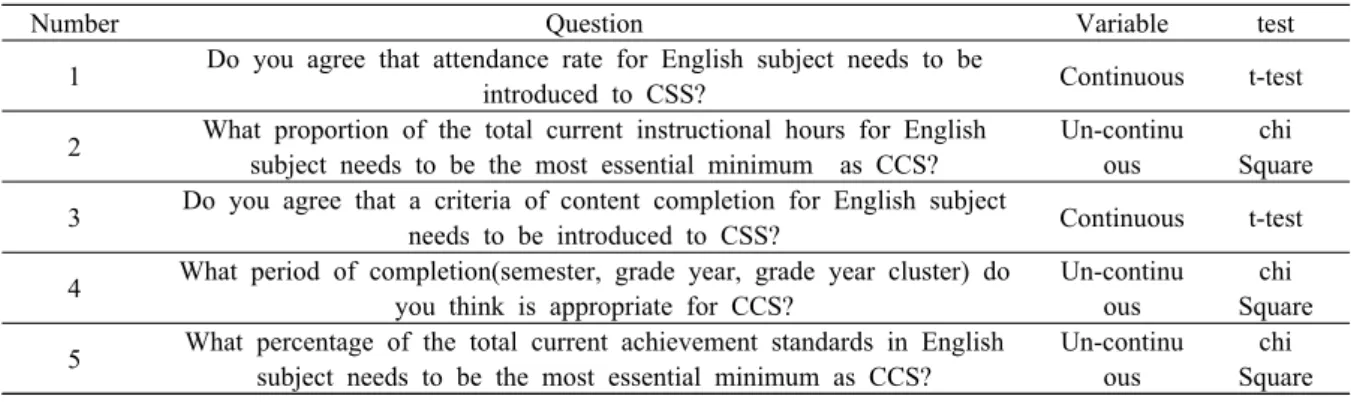
For the purpose of the current research, questionnaire with five items are used for investigating teachers’s perceptions. The questionnaire included (1) overall perceptions on attendance rate for English subject (Items 1-2), (2) perceptions about setting a criteria for subject content completion of English (Items 3-5).
The questionnaire (Items 1, 3) consists of a 5-point Likert scale in accordance with continuous variables, and others (Items 2, 4, 5) with un-continuous variables. The construct of questionnaire is shown in Tables 1.
TABLE 1. Construct of Questionnaire
Number Question Variable test
1 Do you agree that attendance rate for English subject needs to be
introduced to CSS? Continuous t-test
2 What proportion of the total current instructional hours for English subject needs to be the most essential minimum as CCS?
Un-continu ous
chi Square 3 Do you agree that a criteria of content completion for English subject
needs to be introduced to CSS? Continuous t-test
4 What period of completion(semester, grade year, grade year cluster) do you think is appropriate for CCS?
Un-continu ous
chi Square 5 What percentage of the total current achievement standards in English
subject needs to be the most essential minimum as CCS?
Un-continu ous
chi Square Note. Item number 1 and 2 are for attendance, and 3 to 5 for a criteria of English subject content completion.
3.3 Data Collection
For the data collection, stratified random sampling was used as data collection process. Three percentage of teachers in elementary and secondary schools from seventeen local provinces were sampled in accordance with the school size. Each teacher was informed the purpose of the research, the concept of CCS, and asked to complete the questionnaire through on-line survey platform. In the questionnaire, the participants were asked to indicate their item response on a five-point Likert scale ranging from “Strongly disagree” to “Strongly agree,” or, proportional or percentage response depending on types of the questions.
3.4 Data Analysis
For the data analysis, both descriptive statistics and inferential statistics were employed. The test results were counted in number, coded and analyzed using the statistical package of the SPSS 25.0 version and EXCELL 2010.
First of all, descriptive statistics were calculated. In order to answer the first and second research question regarding teachers' overall perception of attendance rate and a criteria for English subject
content completion, teacher responses to each questionnaire item were counted in number and converted into percentage.
Next, t-tests were conducted to check for any differences in order to check for statistical significant difference between the two teacher groups. Also, chi-square tests were carried out to check out their perceptions on how much attendance rate and what percentage of achievement standards are appropriate for English subject as CCS, through which responses from the two teacher groups were contrasted.
4. Results
4.1. Results of Research Question 1
This section examines teachers’ perceptions on setting attendance rate and proportion of the total current instructional hours as the most essential minimum for English subject as CCS.
First, the following descriptive statistics in Table 2 showed teachers’ perceptions on attendance rate for English subject as CCS.
TABLE 2. Perceptions on Attendance Rate for English Subject as CCS Group Strongly
Disagree Disagree Neutral Agree Strongly
Agree N M SD t(p)
E 75 (12.5) 61 (10.1) 139 (23.1) 205 (34.1) 122 (20.3) 602 (100.0) 3.40 1.26 -3.45**
(.001) S 31 (6.8) 38 (8.3) 88 (19.3) 202 (44.2) 98 (21.4) 457 (100.0) 3.65 1.11 S(A) 106 9.65 99 9.20 227 21.20 407 39.15 220 20.85 1,059 3.53 1.19 E: elementary, S: Secondary, S(A): Sum(Average) *p < .05 **p < .01 ***p < .001
In general, both groups of teachers similarly showed positive perceptions towards setting attendance rate for English subject as CCS, while secondary school teachers(hereafter SST) have more favorable opinions than elementary school teachers (hereafter EST).
More than 60% of the participants on average (EST 54.4%, SST 65.6%) rated their preferences to
“agree” or “strongly agree,” as shown in Table 2 . But there was statistical group difference between different school levels (t = -3.45, p = .001). SST reported more positive view (65.6% in total; Agree 44.2%, Strongly agree 21.4%)about their preferences than EST (54.3% in total; Agree 34.1%, Strongly agree 20.3%), revealing group differences. On the other hand, the ratio of disagreements (Strongly disagree and Disagree) was found to be less than 20% on average for both EST and SST (Strongly disagree 9.65%, Disagree 9.25%)
Second, the following descriptive statistics in Table 3 showed teachers’ perceptions on the proportion of the most essential minimum to the total current instructional hours for English subject as CCS.
TABLE 3. Perceptions on Proportion of Attendance Rate for English Subject as CCS
Group Less Than 1/3 Less Than 1/2 Less Than 2/3 More Than 2/3 N x² Elementary 114 (18.9) 80 (13.3) 202 (33.6) 206 (34.2) 602 (100.0) 19.68***
(.000) Secondary 59 (12.9) 34 (7.4) 170 (37.2) 194 (42.5) 457 (100.0)
Sum(Ave) 173 15.90 114 10.35 372 35.40 400 38.35 1,059
*p < .05 **p < .01 ***p < .001
In general, both groups of teachers similarly showed positive perceptions towards setting the ratio to the range of about 2/3 of the most essential minimum to current English instructional hours, while SST have more favorable opinions than EST.
About 73% of the participants on average (EST 67.8%, SST 79.7%) rated their preferences to the ration of around 2/3 or more as shown in Table 3. But there was statistical group difference between different school levels (x² = 19.68, p=.000). SST reported more positive view (79.7% in total; ‘Less than 2/3’ 37.2%, ‘More than 2/3’ 42.5%) about their preferences than EST (67.8% in total; ‘Less than 2/3’ 33.6%, ‘More than 2/3’ 34.2%), revealing group differences. On the other hand, the ratio of below half(1/2) was found to be around 13% on average for both EST and SST (‘Less than 1/3’ 15.9%,
‘Less than 1/2’ 10.35%)
4.2. Results of Research Question 2
This section examines teachers’ perceptions on setting a criteria of content completion for English subject including a period unit of completion(semester, grade year, grade year cluster) and a percentage of the most essential minimum to the total current achievement standards as CCS. As a reference on the meaning of grade year cluster in Korea, grades 1-2, 3-4, and 5-6 in elementary school are grouped into one grade year cluster respectively, while in secondary school, grades 1-3 are grouped into also one grade year cluster.
First, the following descriptive statistics in Table 4 showed teachers’ perceptions on setting a criteria of content completion for English subject.
TABLE 4. Perceptions on A Criteria of Content Completion for English Subject as CCS Group Strongly
Disagree Disagree Neutral Agree Strongly
Agree N M SD t(p)
E 46 (7.6) 41 (6.8) 127 (21.1) 238 (39.5) 150 (24.9) 602 (100.0)
3.67 1.15 5.93 (.431) S 22 (4.8) 29 (6.3) 83 (18.2) 217 (47.5) 106 (23.2) 457 (100.0)
S(A) 68 6.20 70 6.55 210 19.65 455 43.50 256 24.05 1,059 E: elementary, S: Secondary, S(A): Sum(Average) *p < .05 **p < .01 ***p < .001
In general, both groups of teachers similarly showed positive perceptions towards setting a criteria of content completion for English subject, while SST have more favorable opinions than EST.
About 67% of the participants on average (EST 64.4%, SST 70.7%) rated their preferences to ‘agree’
or ‘strongly agree’ as shown in Table 3. Though there was no statistical group difference between different school levels (t = 5.93, p = .431), SST reported more positive view (70.7% in total; Agree 47.5%, Strongly agree 23.2%) about their preferences than EST (64.4% in total; Agree 39.5%, Strongly agree 24.9%). On the other hand, the ratio of disagreements (Strongly disagree and Disagree) was found to be less than 13% on average for both EST and SST (Strongly disagree 6.20%, Disagree 6.55%)
Second, the following descriptive statistics in Table 5 showed teachers’ perceptions on setting a period unit of completion for English subject.
TABLE 5. Perceptions on Period Unit of Completion for English Subject as CCS
Group Unit of
Semester
Unit of school grade year
Unit of school grade
cluster N x²
Elementary 67 (11.1) 333 (55.3) 202 (33.6) 602 (100.0) 54.41***
(.000)
Secondary 125 (27.4) 239 (52.3) 93 (20.4) 457 (100.0)
Sum(Ave) 192 19.25 572 53.80 295 27.00 1,059
*p < .05 **p < .01 ***p < .001
In general, both groups of teachers similarly showed positive perceptions towards period unit of school grade year (1 year) for English subject. With regard to the preferences of a period unit of school grade cluster (elementary school 2 years, secondary school 3 years) and unit of semester, the both groups showed different perceptions.
About 53% of the participants on average (EST 55.3%, SST 52.3%) rated their preferences to a period unit of school grade year as shown in Table 5. Regarding the preferences to a period unit of school grade cluster, SST showed 20.4% comparing to 33.6% by EST. Also different perceptions are shown in the preferences of a period unit of semester (EST 11.1%, SST 27.4%). It can be said that these two different perceptions of both groups resulted in statistical differences (x² = 54.41, p = .000).
It is also assumed that SST who are concerned about accumulating deficits of learning for 3 years with intensive subject content matters and EST for two years cause the different perceptions.
Third, the following descriptive statistics in Table 6 showed teachers’ perceptions on setting the percentage of essential minimum to total number of achievement standards for English subject as CCS.
TABLE 6. Perceptions on Percentage of Essential Minimum to Total Number of Achievement Standards for English Subject as CCS
Group 0% 1-19% 20-39% 40-59% 60-79% 80-99% 100% N x²
E 24 (4.0) 19 (3.2) 49 (8.1) 178 (29.6) 228 (37.9) 83 (13.8) 21 (3.5) 602 (100.0) 5.93 (.431) S 14 (3.1) 14 (3.1) 39 (8.5) 154 (33.7) 175 (38.3) 53 (11.6) 8 (1.8) 457 (100.0) S(A) 38 3.55 33 3.15 88 8.30 332 31.65 403 38.10 136 12.70 29 2.65 1,059
E: elementary, S: Secondary, S(A): Sum(Average) *p < .05 **p < .01 ***p < .001
In general, both groups of teachers similarly showed positive perceptions towards setting 20% less or more, starting with 60% of achievement standards presented in national curriculum for English subject. With regard to the preferences of essential minimum percentage as CSS, while ‘60-79%’ of essential minimum has more favorable opinions than ‘40-59%’.
About 69% of the participants on average (EST 67.5%, SST 72.0%) rated their preferences to
‘40-59%’ or ‘60-79%’ as shown in Table 6. There was no statistical group difference between different school levels (t = 5.93, p = .431), and the both groups showed very similar opinions in the order of their preferences from 60-79%, 40-59%, and others. On the other hand, the ratio of others was found to be 3% to 12% for ‘0%’, ‘1-19%’, ‘20-39’, ‘80-89%’, and ‘100%’. This result shows that it is appropriate to set the essential minimum criteria based on achievement standards in English national curriculum, and that around 60% of the achievement standards are appropriate.
5. Discussion and Conclusion
The independent t-test and chi-square test in the current study showed that there were significant differences between EST and SST on their perceptions of setting attendance rate and proportion of the total current instructional hours as the most essential minimum for English subject as CCS. However, the descriptive statistics for the research question 1 indicates that both EST and SST similarly shows positive perceptions towards setting attendance rate for English subject, though SST shows more favorable perceptions towards setting attendance rate. Furthermore, SST has more positive perceptions than EST that proportion of attendance needs to be set around two thirds of total instructional hours presented in English national curriculum The results of research question 1 can be summarized that most of teachers in both elementary and secondary school have favorable perceptions towards setting attendance rate and that 2/3 proportion of total instructional hours for English subject are appropriate as CCS.
Research question 2 examines teachers’ perceptions on setting a criteria of content completion for English subject including a period unit of completion and a percentage of the most essential minimum to the total current achievement standards as CCS. The independent t-test and chi-square test in the current study shows that there are no significant differences between EST and SST on their perceptions on setting a criteria of content completion for English Subject and percentage of essential minimum to total number of achievement standards presented in English national curriculum. On the other hand, there were significant differences between EST and SST on their perceptions of a period unit of completion for English subject as CCS. However, the descriptive statistics for the research question 2 indicated that both EST and SST similarly showed positive perceptions towards the three sub-questions, while SST has more favorable perceptions towards a period unit of semester and school grade year.
The results of research question 2 can be summarized that most of teachers in both elementary and secondary school have favorable perceptions towards setting a criteria of English subject completion as CCS.
Based on the results of this current study, some discussions can be made for policy makers and
researchers in the field of English education in Korea. First, introduction and implementation of CCS need to be reviewed as educational policy as suggested in several previous studies (Jin et al. 2015, Lee et al. 2020). The most important factor in establishing educational policy is social consensus, in which teachers should be recognized as the crucial stakeholder in this decision. Their perceptions matter. We also need to consider why the necessity or rationale of CCS implementation is widely recognized by educational department in foreign countries in Asia, America, and Europe, and Australia as shown in this paper.
Second, research on the details of CCS needs to be continued. In other words, further research on which subject will be appropriate to be selected, and how the essential minimum content can be established in selected subjects. In addition, more specific issues such as what differences will be applied in detail in elementary and secondary school also should be researched. For example, the introduction and implementation of CCS should be determined in close connection with the evaluation system, in particular for secondary school (Seo 2020). Similarly, regarding the evaluation system for CCS, achievement standards-based criterion-referenced testing (Lee et al. 2018) and performance-based process-oriented assessment (Hwang, Kim and Kim 2019) are emphasized in secondary school.
In terms of differences between school levels, the selection of core subjects for CSS may also differ by school level. While five subjects including language arts, math, social studies, science, and English are recommended in secondary school for preventing accumulation of learning deficits (Hong 2011), the subjects preferred in elementary school may vary.
To sum up, this study draws out one significant point based on the teachers’ perceptions that the implementation of CSS is not to stigmatize underachievers, but to establish a preventive policy for those who are not ready to follow sequential courses or curriculum. It should be again noted that the accumulation of the learners’ academic deficits is in part due to the ambiguous and unclear statements or regulations in both general curriculum and education law. It can be strongly assumed based on the results of the current study and cases in foreign countries, we need the CSS system. Without this system, as learners moving up to upper grade or school without knowing their deficient parts of key skills or knowledge in a certain subject necessary for keeping up the sequential curriculum, the numbers of under-achievement learners and amounts of deficient ability are expected to be accumulated.
Therefore, once again it should be pointed out that the CSS needs to be mapped out in order to understand whether each student in compulsory education system is qualified or not to follow sequential grade curriculum.
References
An, H. and B. Kim. 2021. A Study on the grounded theory of the research school's operation process of high school credit system in vocational high schools. The Journal of Korean Teacher Education 38(1), 423-452.
California Department of Education. 2013. California common core state standards: English Language Arts & Literacy in History/Social Studies, Science, and Technical Subjects. Retrieved November
21, 2020, from https://www.cde.ca.gov/be/st/ss/documents/finalelaccssstandards.pdf
Davis middle school in CA. 2021. Student success. Retrived from April 21, 2021, from https://dms.
uinta1.com/apps/pages/index.jsp?uREC_ID=440045&type=d&pREC_ID=951270
England, Department of Education. 2014. England National Curriculum. https://www.gov.uk/national- curriculum/key-stage-3-and-4
Eurydice. 2021. Spain overview. Retrieved April 20, 2021, from https://eacea.ec.europa.eu/national -policies/eurydice/content/spain_en
Hwang, J. B. Kim, S. H. and H. D. Kim. 2019. A survey on the perceptions of teachers, students, and parents about the process-oriented English assessment in Korean secondary schools. Korean Journal of English Linguistics 19(4), 778-795.
Hong, H. J. 2011. From scattered course-taking to condensed course-taking in the Korean middle school curriculum. The Journal of Research in Education 40, 53-79.
Jin, K. Kim, S. K. Choi, Y. Kang, T. and D. Kim. 2015. Monitoring Elementary School Students’
Completion of Korean Language, Mathematics and English Curriculum and Enhancing Students’
Learning for Normalization of Public Education( ). Korea Institute for Curriculum and Evaluation. KICE Research Report PRE 2015-7.
Kim, J. and M. Lee. 2012. Inquiry of the focused course-taking based on the analysis of the meaning of 'completion' of a course of study. The Journal of Curriculum Studies 30(1), 125-149.
Lee, K. W., K. H. Lee, K. H. Kim, J. S. Min, Y. S. Lee, K. E. Kwon, J. R. Cho, B. K. Kim, H. M.
Kim, K. C. Kim, H. J. Kim, H. S. Lee, S. J. Lee, M. H. and Y. N. Lim. 2018. The Study on Establishment of Foundation for Implementing High School Credit System: Instructional Hours, Learning Experiences Outside of School, and Early Graduation or Re-completion System. KICE Research Report 2018-13.
Lee, S. 2019. A study on the compatibility of national level primary and secondary school systems for the properization of curriculum completion. Journal of Educational Innovation Research 29(3), 169-193.
Lee, S. Lee, B. C. Jeoung, Y. K. Lee, S. J. Kim, S. H. Cho, J. and S. J. Oh. 2020. Research on setting up standards of curriculum completion for elementary and secondary school. Korea Institute for Curriculum and Evaluation. KICE Research Report RRC 2020-8-1.
Noh, E. Lee, K. W. Kim, J. S. Sin, H. Byun, H. H. Joo, H. M. Kim, Y. E. and Y. Ji. 2019. A Study on Establishing the Standard of Course Completion for the High School Credit System. KICE Research Report RRC 2019-3.
NSW Education Standards Authority. 2021. Record of School Achievement. Retrieved April 26, 2021, from https://educationstandards.nsw.edu.au/wps/portal/nesa/k-10/leaving-school/record-of-school-achievement Presidential Decree. (No. 30088, Sep. 24, 2019). Enforcement decree of the elementary and secondary
education act. Retrieved April 20, 2021, from ttps://elaw.klri.re.kr/kor_service/lawView.do?hseq=
51993&lang=ENG
Seo, B. 2020 The introduction of high school credit system and change in high schools. Korean Journal of Sociology of Education 30(3), 55-79.
Singapore Examination and Assessment Board. 2021a. GCE O-level. Retrieved April 20, 2021 from
https://www.seab.gov.sg/home/examinations/gce-o-level
Singapore Examinations and Assessment Board. 2021b. PSLE English Language (https://www.seab.gov.sg/
content/syllabus/PSLE/2017_PSLE_Subject_info/0001_2017.pdf (2021.04.28.)
Woo, O. and D. Kim. 2019. Curriculum standards development for high school credit system. The Korean Journal of Educational Methodology Studies 31(1), 305-332.
Yonhap News Agency. (2021). COVID-19 deepens educational polarization at schools: civic group.
Retrieved April 26, 2021, from http://www.hani.co.kr/arti/society/society_general/992731.html
Examples in: English
Applicable Languages: English
Applicable Levels: Elementary and secondary