1237 www.eymj.org
INTRODUCTION
Left atrial appendage (LAA) occlusion is performed in patients with non-valvular atrial fibrillation (AF) to prevent embolic events as an alternative treatment to oral anticoagulation.
1,2Atrial septal defect (ASD) may cause right heart dysfunction and paradoxical embolism to occur. In patients with AF and ASD, occlusion both LAA and ASD in the same setting could be a possible strategy for an effective prevention of stroke and right heart failure. We report a case in which a LAA and ASD were sequentially occluded during the same procedure.
CASE REPORT
A 68-year-old male was referred for ASD closure, because the right ventricle (RV) was markedly enlarged. He had suffered
from a persistent AF without significant valvular disease, but refused to take a long-term anti-coagulation {CHA
2DS
2VASc:
3 [congestive heart failure, hypertension, age ≥75 years (2 points), diabetes mellitus, prior stroke or transient ischemic attack (2 points), vascular disease, age 65 to 74 years, and fe- male sex] and HAS-BLED: 2 [hypertension, abnormal renal/
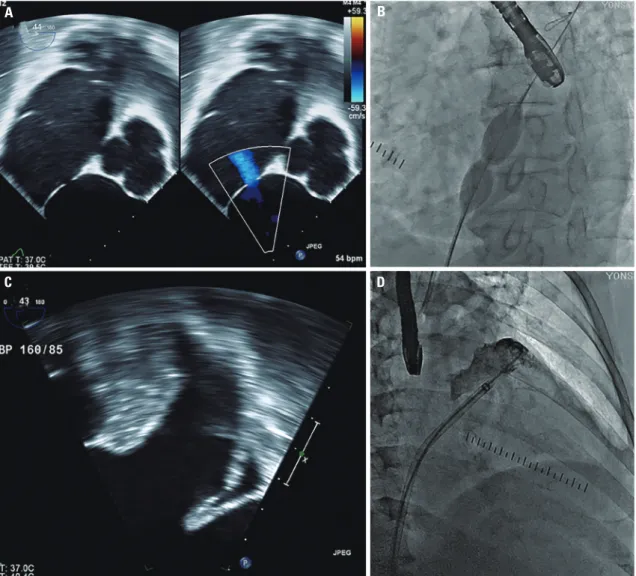
liver function, stroke, bleeding history or predisposition, labile international normalized ratio, elderly (>65 years), drugs/al- cohol concomitantly]}. Recently, he was diagnosed with gas- tric cancer and treated with endoscopic resection. Simultane- ous ASD and LAA occlusion were considered because LAA occlusion could be an alternative option of stroke prevention in AF and might be in trouble after ASD closure. Transthoracic echocardiography (TTE) showed a right atrium (RA) and RV with significant left to right shunt. Transesophageal echocar- diographic (TEE) indicated a single oval shaped secundum defect of 12×6 mm (Fig. 1A), and no thrombus was detected in left atrium (LA) and LAA (Fig. 1C). The landing zones of LAA were 24 mm in 45°, 28 mm in 90°, and 28 mm in 135°.
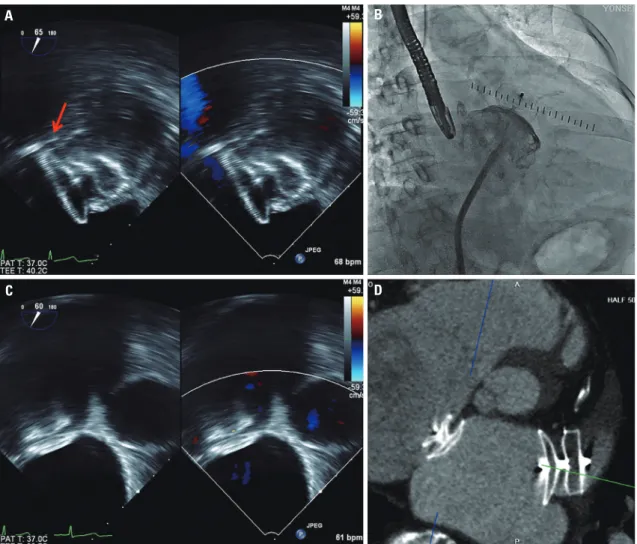
The procedure was performed under general anesthesia and TEE. A 6F multipurpose catheter (A&A M.D., Seoul, Ko- rea) with a 0.035-inch hydrophilic wire (Terumo, Tokyo, Ja- pan) was passed through the ASD under 3D TEE guidance, and a 0.035-inch Amplatz super stiff guidewire (Boston Scien- tific Corp., Natick, MA, USA) positioned pulmonary vein. Be- cause the anatomy of the LAA was toward the anterio-superi- or direction and not complex, ASD could be used as atrial septal access for LAA occlusion. To shorten the procedure Received: October 18, 2016 Revised: December 11, 2016
Accepted: January 10, 2017
Corresponding author: Dr. Jung-Sun Kim, Division of Cardiology, Severance Car- diovascular Hospital, Yonsei University College of Medicine, 50-1 Yonsei-ro, Seo- daemun-gu, Seoul 03722, Korea.
Tel: 82-2-2228-8458, Fax: 82-2-393-2041, E-mail: [email protected]
•The authors have no financial conflicts of interest.
© Copyright: Yonsei University College of Medicine 2017
This is an Open Access article distributed under the terms of the Creative Com- mons Attribution Non-Commercial License (http://creativecommons.org/licenses/
by-nc/4.0) which permits unrestricted non-commercial use, distribution, and repro- duction in any medium, provided the original work is properly cited.
Simultaneous Closure of a Left Atrial Appendage
through an Atrial Septal Defect and the Atrial Septal Defect
Shinjeong Song
1, Oh-Hyun Lee
1, Jung-Sun Kim
1,2, In-Jeong Cho
1, Chi-Young Shim
1, Geu-Ru Hong
1, Hui-Nam Pak
1, and Yangsoo Jang
1,21
Division of Cardiology, Severance Cardiovascular Hospital, Yonsei University Health System, Seoul;
2