• 검색 결과가 없습니다.

Percutaneous Left Atrial Appendage Closure in the Presence of Thrombus Using LAmbre Device and Cerebral Protection System

N/A
N/A
Protected

Academic year: 2022

Share "Percutaneous Left Atrial Appendage Closure in the Presence of Thrombus Using LAmbre Device and Cerebral Protection System"

Copied!
3
0
0

로드 중.... (전체 텍스트 보기)

전체 글

(1)

281 https://e-kcj.org

A 79-year-old woman in permanent atrial fibrillation with CHA

2

DS

2

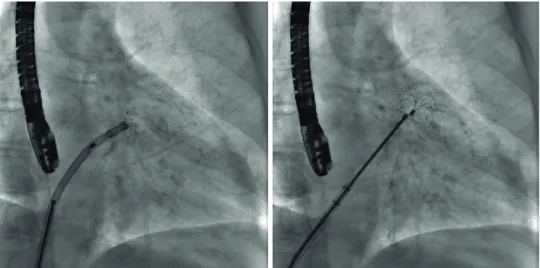
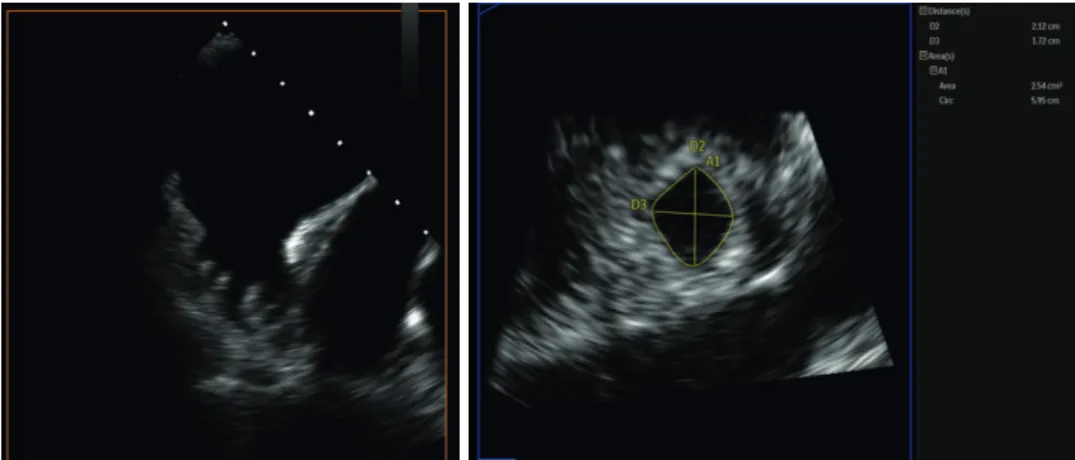
-VASc score 6 and under acenocumarol therapy was referred to our department for percutaneous left atrial appendage (LAA) closure after suffering a hemorrhagic cerebrovascular accident. Transesophageal echocardiography (TEE) revealed a thrombus in LAA (Figure 1). We planned to implant LAmbre™ (Lifetech Scientific Corp., Shenzhen, China) with simultaneous use of a cerebral protection device, Sentinel™ (Claret Medical, Santa Rosa, CA, USA) (Figure 2). The procedure was guided by TEE without any contrast injection. A partial umbrella delivery of a LAmbre 24/30 mm was done in front of LAA ostium and the whole system was advanced up to the point immediately before thrombus in LAA superior lobe. At this point, the umbrella delivery was completed and afterward the cover part was immediately unsheathed (Figure 3).

TEE revealed a proper position of LAmbre, so the device was eventually released (Figure 4).

Sentinel™ did not contain any debris. The patient's postoperative course was uneventful.

Korean Circ J. 2020 Mar;50(3):281-283 https://doi.org/10.4070/kcj.2019.0305 pISSN 1738-5520·eISSN 1738-5555

Images in

Cardiovascular Medicine

Received: Sep 20, 2019 Accepted: Oct 23, 2019 Correspondence to Mohsen Mohandes, MD

Interventional Cardiology Unit, Cardiology Division, Joan XXIII University Hospital, IISPV Universitat Rovira Virgili, Calle Dr Mallafré Guasch 4, Tarragona 43007, Spain.

E-mail: [email protected] Copyright © 2020. The Korean Society of Cardiology

This is an Open Access article distributed under the terms of the Creative Commons Attribution Non-Commercial License (https://

creativecommons.org/licenses/by-nc/4.0) which permits unrestricted noncommercial use, distribution, and reproduction in any medium, provided the original work is properly cited.

ORCID iDs Mohsen Mohandes

https://orcid.org/0000-0003-1045-3639 Conflict of Interest

The authors have no financial conflicts of interest.

Author Contributions

Conceptualization: Mohandes M, Pernigotti A; Data curation: Morr CI; Writing - original draft: Mohandes M; Writing - review & editing:

Bardají A.

Mohsen Mohandes , MD 1 , Alberto Pernigotti, MD 1 , Carlos Igor Morr, MD 2 , and Alfredo Bardají, MD, PhD, FESC 3

1

Interventional Cardiology Unit, Cardiology Division, Joan XXIII University Hospital, IISPV, Rovira i Virgili University, Tarragona, Spain

2

Echocardiography and Image Department, Cardiology Division, Joan XXIII University Hospital, IISPV, Rovira i Virgili University, Tarragona, Spain

3
Cardiology Division, Joan XXIII University Hospital, IISPV, Rovira i Virgili University, Tarragona, Spain

Percutaneous Left Atrial Appendage Closure in the Presence of Thrombus Using LAmbre Device and Cerebral Protection System

Figure 1. TEE at 135

o

shows a multilobed LAA with small thrombus in superior lobe (left). LAA ostium with maximum diameter of 21 mm (right).

TEE = transesophageal echocardiography; LAA = left atrial appendage.

(2)

The presence of thrombus in LAA has been considered a contraindication to percutaneous LAA closure since the manipulation of catheter and device may lead to systemic

embolisation. We used partial deployment technique of umbrella at the orifice of LAA as described in some reported cases.

1)

Thereafter, the system was advanced up to the landing zone where the device was completely delivered trying not to touch the thrombus.

In selected patients LAA closure in the presence of thrombus is safe and feasible and should not be considered an absolute contraindication.

2)

282 https://e-kcj.org https://doi.org/10.4070/kcj.2019.0305

Left Atrial Appendage Closure with Thrombus

Figure 2. Sentinel was introduced by right radial approach with its 2 baskets placed in right brachiocephalic trunk and left common carotid artery, respectively.

Figure 3. Partial delivery of umbrella component (left). Concave shape of the LAmbre's cover at the LAA entrance (right).

LAA = left atrial appendage.

(3)

REFERENCES

1. Bellmann B, Rillig A, Leistner DM, et al. Left atrial appendage closure in a patient with left atrial appendage thrombus using a novel fish ball technique. Int J Cardiol 2017;234:146-9.

PUBMED | CROSSREF

2. Tarantini G, D'Amico G, Latib A, et al. Percutaneous left atrial appendage occlusion in patients with atrial fibrillation and left appendage thrombus: feasibility, safety and clinical efficacy. EuroIntervention 2018;13:1595-602.

PUBMED | CROSSREF

283 https://e-kcj.org https://doi.org/10.4070/kcj.2019.0305

Left Atrial Appendage Closure with Thrombus

Figure 4. TEE shows proper placement of LAmbre 24/30 mm with its disk covering the LAA entrance (superior right and left). There is a no significant leak at the upper edge (superior left). Three-dimensional TEE depicts the LAmbre' cover (inferior left) at the entrance of LAA. Fluoroscopy image of LAmbre's release after confirmation of proper positioning and device stability (inferior right).

TEE = transesophageal echocardiography; LAA = left atrial appendage.

수치

Figure 1. TEE at 135 o  shows a multilobed LAA with small thrombus in superior lobe (left)
Figure 3. Partial delivery of umbrella component (left). Concave shape of the LAmbre's cover at the LAA  entrance (right)
Figure 4. TEE shows proper placement of LAmbre 24/30 mm with its disk covering the LAA entrance (superior  right and left)

참조

관련 문서

Novel 3D measurements of LAA geometry Geometric complexity, individual variation in LAA morphol- ogy, or mismatch between the device shape and LAA morphol- ogy may result in

We report here on a case of cardiac hemangioma that originated from the left atrial appendage; this was observed on the CT and coronary angiographic findings and the lesion

► See the article “Benefit of Four-Dimensional Computed Tomography Derived Ejection Fraction of the Left Atrial Appendage to Predict Thromboembolic Risk in the Patients with

Technical complications of percutaneous closure of an atrial septal defect (ASD) with device malposition, valve regurgitation, or infective endocarditis have been reported. 1)2)

Fistula of Ascending Aorta and Right Atrium Following Percutaneous Transcatheter Atrial Septal Defect Closure.. Hong Gook Lim, M.D.*, Chang-Ha Lee, M.D.*, Hong Joo Seo,

Totally Thoracoscopic Ablation for Treatment of Atrial Fibrillation after Atrial Septal Defect Device Closure.. Young Su Kim,

Patients with a left atrial (LA) thrombus are considered at risk of a serious thromboembolic event, and therefore endocardial radiofrequency catheter ablation (RFCA) of atrial

Congenital Absence of the Left Atrial Appendage: An Unexpected and Incidental Anomaly in a Patient with Multiple Cerebellar Infarctions.. Doohyuck Lee and