
C Carcinosarcoma of the Renal Pelvis andUrinary Bladder: A Case Report
5
0
0
전체 글
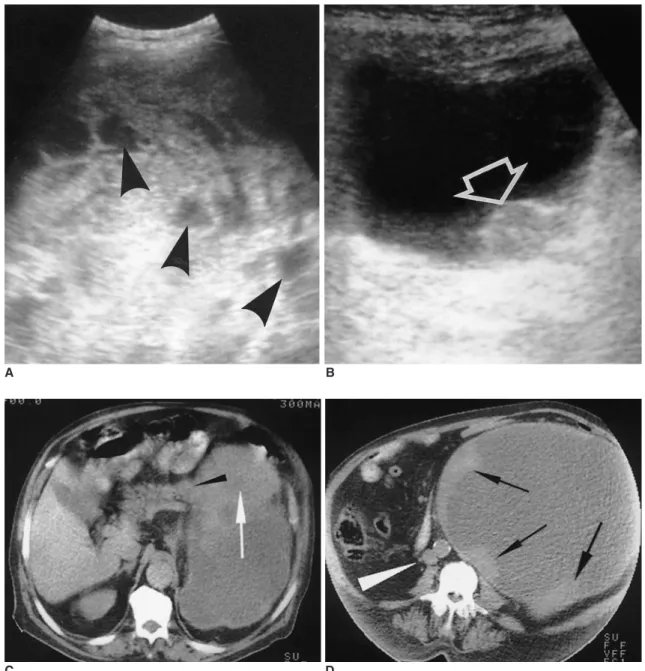
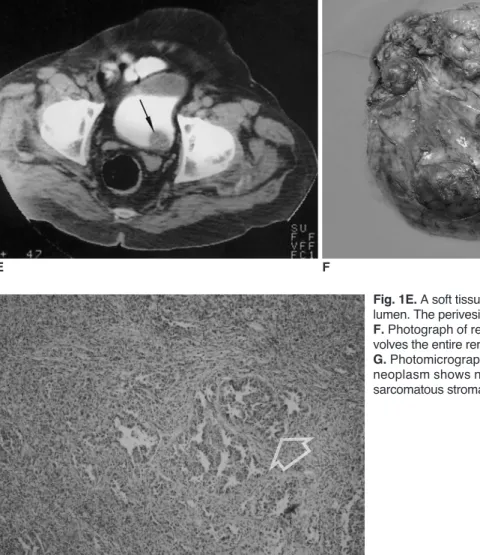
(2) Yilmaz et al.. showed a second separate mass in 1.0 cm-diameter arising from the left postero-lateral bladder wall. Based on the clinical and radiological findings, our diagnosis was initially a malignant tumor of the kidney such as a transitional carcinoma or renal cell carcinoma. A left radical nephrectomy with partial cystectomy was performed to remove the tumors. Pathological specimen showed that. A. the entire left kidney was completely replaced by the tumor. The tumor had occupied the renal collecting system and extended into the renal capsule without leaving any cortical tissue (Fig. 1F). Left ureter was not identified, a finding suggesting invasion of the tumor. Microscopic examination of the surgical specimens obtained from kidney and bladder showed malignant both epithelial and stromal. B. C D Fig. 1A. Sonogram of 12 cm-mass component located on top of the tumor shows variable echogenity with heterogeneous hyperechoic areas mixed with less echoic areas or small cysts presenting cystic necrosis (arrowheads). B. Transverse sonogram of urinary bladder reveals a small tumor (arrow) arising from the left postero-lateral bladder wall. C-E. Sequential enhanced CT scans through pancreas (C), at the level of the lower abdominal region (D) and the bladder (E). C. Relatively well-defined, heterogeneous tumor seems to originate from the left kidney without any normal tissue apparently preserved from invasion. Obliteration of the fat plane (arrowhead) is seen between the upper-medial portion of the tumor (arrow) and the pancreatic tail corresponding to invasion that was pathologically proven. D. Giant tumor extends caudally as a smoothly marginated mass with considerable displacement of the aorta and the inferior vena cava (arrowhead) at the midline. The tumor displays peripheral and nodular enhancement (arrows), which delineates large, hypodense zone of necrosis. The center has an attenuation value of between 20 25 HU.. 256. Korean J Radiol 4(4), December 2003.
(3) Carcinosarcoma of Renal Pelvis and Urinary Bladder. E. F Fig. 1E. A soft tissue sessile mass (arrow) extends into the bladder lumen. The perivesical fat planes are intact. F. Photograph of resected kidney demonstrates that the tumor involves the entire renal parenchyma and pelvocaliceal system. G. Photomicrograph of histological specimen obtained from renal neoplasm shows nest of transitional cell carcinoma (arrow) in a sarcomatous stroma (H and E, 100).. G. components. The predominant component mainly consisted of an undifferentiated spindle cell sarcoma with small areas of chondrosarcoma. The sarcomatous component comprised nests of invasive transitional cell carcinoma (Fig. 1G). The pathological findings were consistent with a true carcinosarcoma of the kidney and bladder concomitantly. Immunohistologic features supported this diagnosis. The areas of transitional cell carcinoma stained positive for both keratin and epithelial membrane antigen. By contrast, the sarcomatous component stained positive for vimentin. A small number of cells were S-100 protein and -smooth muscle actin positive. Following the surgery, the patient was treated by radiation therapy. Still, no recurrence was observed after 6 months.. DISCUSSION Carcinosarcomas are rare tumors containing both maligKorean J Radiol 4(4), December 2003. nant mesenchymal and epithelial elements (1). While the mesenchymal elements are usually chondrosarcoma or osteosarcoma, the epithelial component may be most frequently of transitional cell carcinoma, adenocarcinoma or an admixture of these. Meyer (4) classified the carcinosarcomas into three histogenetic groups. One of them is a collision tumor in which a carcinoma and sarcoma coincidentally arise in proximity and then invade each other. The two other groups include combination tumors in which both the carcinomatous and sarcomatous components arise from a pluripotential cell, and composition tumors in which both components derive from the same tissue concomitantly. Two main mechanisms of tumor involvement of both renal pelvis and urinary bladder are suggested for carcinosarcoma (2). Neoplastic transformation may occur in two distinct tissues or secondary sarcomatous change may develop in the stroma of a carcinoma. Willis (5) has limited the term carcinosarcoma more rigid by excluding the group 257.
(4) Yilmaz et al.. of collision tumors. Sarcomatoid carcinomas exhibit a prominent spindle cell component and are also aggressive tumors, but should not be confused with carcinosarcomas (6). Carcinosarcomas usually occur in the urinary bladder and only few of them originate from the renal pelvis (1, 2). To our knowledge, there are two articles regarding imaging findings of carcinosarcoma of the bladder (3, 7). But carcinosarcoma of the renal pelvis has not previously been reported in the radiology literature. The sonographic characteristics of a renal mass are not sufficiently specific to allow confident differentiation among the various malignant tumors. Moreover, if a renal mass is markedly large, it is sometimes difficult to note the adjacent structures at sonography, particularly when they are compressed or displaced. For this reason, assessment of such a mass can be difficult in terms of renal origin. In our case presented here, the mass sonographically was well-circumscribed with a clearly defined margin. The mass showed heterogeneous echo-pattern with central areas of low attenuation consistent with necrosis. It appeared to occupy nearly the entire left intraabdominal space and the origin of the mass was not clear. Conversely, the expansive type of growth arising from the left kidney, which reaches a very large size without sparing normal renal tissue, was well-delineated by CT images. Both CT and sonography excellently depicted the involvement of the urinary bladder. Enhanced CT images also documented the nature of the tumor by showing contrast enhanced components at the peripheral location, as large, central areas of necrosis have not exhibited any changing in density. Moreover, CT yielded more information related to adjacent organs and main blood vessels. Only one case of carcinosarcoma involving the urinary bladder, ureter and renal pelvis in an old man was presented by Orsatti et al (2) with clinical and histopathologic findings. In that case, when considering the temporal evolution, a secondary transformation in a preexisting carcinoma had been suggested. In fact, this change denoted an evolution into a highly aggressive tumor type spreading to other urothelial segments and replacing the whole kidney. We believed that our case had the same change because of the similar clinical appearance and pathological findings. In another case, Kakoi et al. recently reported an old man with carcinosarcoma arising from the renal pelvis and ureter (8). Obviously, when considering the bladder involvement, we initially thought that the tumor might be transitional cell carcinoma with an extension through urothelial system. However the typical transitional cell tumor is centrally located with centrifugal expansion that presumes the 258. uniform contour of the kidney and extrarenal spread at and through the renal hilum. The hydronephrotic form of transitional cell tumor is due to ureteropelvic junction obstruction and may present a diagnostic dilemma (9). Main differential radiologic diagnosis also includes other renal tumors arising within the renal parenchyma, such as sarcoma, sarcomatoid carcinoma or renal cell carcinoma. Histologically, carcinosarcomas and sarcomatoid carcinomas of the renal pelvis mimic each other. Carcinosarcomas contain both malignant mesenchymal and epithelial elements. Whereas, sarcomatoid renal or transtitional carcinomas have a histologic pattern consisting of a mixture of malignant elements, giving a sarcomatoid appearance. Therefore, they are by consensus excluded from the designation of carcinosarcom. Radiologically, Shirkhoda et al. reported that renal cell carcinomas and sarcomatoid carcinomas, which are indistinguishable from each other, generally involve the renal vein or the inferior vena cava, and associated with retroperitoneal adenopathy especially whenever the tumor reach such a large size (10). However, imaging findings of carcinosarcoma arising from renal pelvis are not well-known in the literature. Carcinosarcomas are usually highly aggressive, and the 5-year survival rate is approximately 20%. Although these tumors are resistant to radiation therapy, most investigators agree that the best outlook for cure includes a combination of surgery and irradiation (6). If a rapidly growing tumor is detected that seems to originate from the kidney with extension to ureter and bladder, though it is a rare tumor, carcinosarcoma should be included in the differential diagnosis. However, histopathologic confirmation is needed for the definitive diagnosis in that this tumor not only has imaging findings of renal sarcoma but also resembles radiologic features of variable types of epithelial malignancy arising from urothelial organs.. References 1. Baschinsky DY, Chen JH, Vadmal MS, et al. Carcinosarcoma of the urinary bladder- an aggressive tumor with diverse histogenesis. Arch Pathol Lab Med 2000;124:1172-1178 2. Orsatti G, Corgan FJ, Goldberg SA. Carcinosarcoma of urothelial organs: sequential involvement of urinary bladder, ureter, and renal pelvis. Urology 1993;41:289-291 3. Sumi Y, Shindoh N, Kimizuka T, Katayama H. Carcinosarcoma of the urinary bladder. AJR Am J Roentgenol 1999;172:767-769 4. Meyer R. Beitrag zur Vestandigung uber die Namengebung in der Geschwulstlehre. Zentralbl Allg Path 1920;30:291 5. Willis RA. Carcinoma. In: Pathology of tumors, 4th ed. New York: Appleton-Century-Crofts, 1967:138 6. Catalona WJ. Urothelial tumors of the urinary tract. In: Walsh PC, Retik AB, Stamey TA, Vaughan ED, ed. Campbell’s urology, 6thed. Philadelphia: WB Saunders, 1992:1134-1135 7. Tekes A, Kamel IR, Szarf G, et al. Carcinosarcoma of the uriKorean J Radiol 4(4), December 2003.
(5) Carcinosarcoma of Renal Pelvis and Urinary Bladder nary bladder: dynamic contrast-enhanced MR imaging with clinical and pathologic correlation. AJR Am J Roentgenol 2003;181: 139-142 8. Kakoi N, Miyajima A, Motizuku T. Carcinosarcoma of the renal pelvis and ureter: a case report. Hinyokika Kiyo 2002;48:29-32. Korean J Radiol 4(4), December 2003. 9. Leder RA, Dunnick NR. Transitional cell carcinoma of the pelvicalices and ureter. AJR Am J Roentgenol 1990;155:713-722 10. Shirkhoda A, Lewis E. Renal sarcoma and sarcomatoid renal cell carcinoma: CT and angiographic features. Radiology 1987;162: 353-357. 259.
(6)
수치
관련 문서
However, all greetings are usually used to welcome people and wish them
•Example Calculation: Points, Dipoles, lines, plates,.. What is the direction of the electric field at point C?. 1) Left 2) Right
Our main contribution consists in the elevation of the DTW power of alignment from the lowest level (Class A, non-periodic time series) to the highest level (Class
Since every classical or virtual knot is equivalent to the unknot via a sequence of the extended Reidmeister moves together with the forbidden moves, illustrated in Section 2,
웹 표준을 지원하는 플랫폼에서 큰 수정없이 실행 가능함 패키징을 통해 다양한 기기를 위한 앱을 작성할 수 있음 네이티브 앱과
_____ culture appears to be attractive (도시의) to the
After first field tests, we expect electric passenger drones or eVTOL aircraft (short for electric vertical take-off and landing) to start providing commercial mobility
1 John Owen, Justification by Faith Alone, in The Works of John Owen, ed. John Bolt, trans. Scott Clark, "Do This and Live: Christ's Active Obedience as the
